ECOSYSTEM
WHAT IS
ECOSYSTEM?
The simplest definition of an ecosystem is that it is a community
or group of living organisms that live in and interact with each
other in a specific environment.
For instance, tropical forests are ecosystems made up of living
beings such as trees, plants, animals, insects and micro-organisms
that are in constant interaction between themselves and that are
affected by other physical (sun, temperature) or chemical (oxygen
or nutrients) components.
Living Things
The living parts of an ecosystem
include animals (consumers),
plants (producers), and fungi and
micro-organisms (decomposers).
01
Non-Living things
The nonliving, or abiotic
components of an ecosystem
include the sun's energy, water,
air (atmospheric gases), and rock,
which makes up the landforms.
02
Living and Non-Living
Things
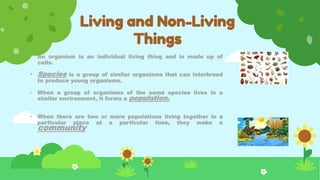
• An organism is an individual living thing and is made up of
cells.
• Species is a group of similar organisms that can interbreed
to produce young organisms.
• When a group of organisms of the same species lives in a
similar environment, it forms a population.
• When there are two or more populations living together in a
particular place at a particular time, they make a
community
Living and Non-Living
Things
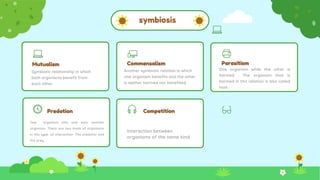
symbiosis
Mutualism
Symbiotic relationship in which
both organisms benefit from
each other.
Predation
One organism kills and eats another
organism. There are two kinds of organisms
in this type of interaction- The predator and
the prey.
Competition
Interaction between
organisms of the same kind.
Another symbiotic relation in which
one organism benefits and the other
is neither harmed nor benefited.
One organism while the other is
harmed . The organism that is
harmed in this relation is also called
host.
Commensalism Parasitism
Ecosystem:
Tropical Rainforest
The tropical rainforest biome is the area that covers only around 6% of the
area of the Earth but it covers around 50% of the species and has tall trees,
has a dense canopy and receives maximum rainfall.
Rainforests are often called the lungs of the planet for their role in
absorbing carbon dioxide, a greenhouse gas, and increasing local humidity.
Rainforests also stabilize climate, house incredible amounts of plants and
wildlife, and produce nourishing rainfall all around the planet.
Ecosystem: Tropical
Rainforest
Rainforest has different layers namely emergent, canopy, understory and
forest floor. Emergent refers to trees that are 130 to 180 feet tall. Canopy,
on the other hand, has tall slender trees from a dense platform of
vegetation with 60 to 129 feet of the ground.
Forests are full of living and nonliving things that depend on each other.
Trees, ferns, and shrubs grow in the forest. Deer, frogs, lizards, insects,
birds, and bears are some forest animals that need these plants. Water,
stones, and soil are nonliving things that animals need too.
Ecosystem: Tropical
Rainforest
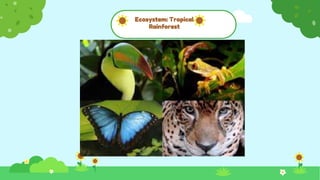
Living organisms in
tropical rain forest.
Plants
Animals
Small animals,
including monkeys,
birds, snakes, rodents,
frogs, and lizards are
common in the tropical
rainforest.
Orchids,
Philodendrons, Ferns,
Bromeliads, Kapok
Trees, Banana Trees,
Rubber Trees, Bam-
boo, Trees, Cassava
Trees, Avocado Trees.
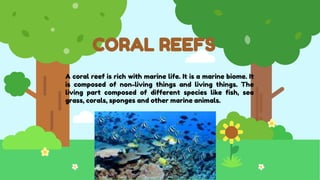
CORAL REEFS
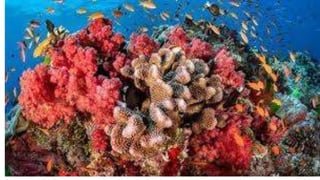
A coral reef is rich with marine life. It is a marine biome. It
is composed of non-living things and living things. The
living part composed of different species like fish, sea
grass, corals, sponges and other marine animals.
CORAL REEFS
Unfortunately, coral reef ecosystems are severely
threatened. Some threats are natural, such as diseases,
predators, and storms. Other threats are caused by
people, including pollution, sedimentation, unsustainable
fishing practices, and climate change, which is raising
ocean temperatures and causing ocean acidification.
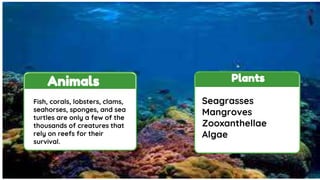
Plants
Animals
Seagrasses
Mangroves
Zooxanthellae
Algae
Fish, corals, lobsters, clams,
seahorses, sponges, and sea
turtles are only a few of the
thousands of creatures that
rely on reefs for their
survival.
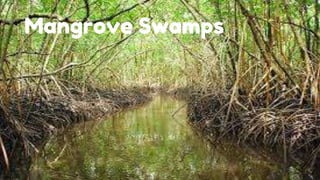
Mangrove Swamps
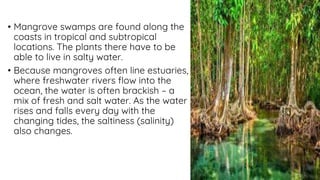
• Mangrove swamps are found along the
coasts in tropical and subtropical
locations. The plants there have to be
able to live in salty water.
• Because mangroves often line estuaries,
where freshwater rivers flow into the
ocean, the water is often brackish – a
mix of fresh and salt water. As the water
rises and falls every day with the
changing tides, the saltiness (salinity)
also changes.
Mangroves Their loss is markeFlorida to cut down a mangrove tree.
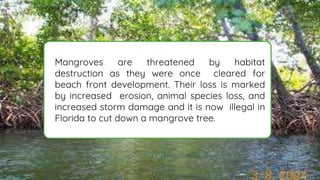
Mangroves are threatened by habitat
destruction as they were once cleared for
beach front development. Their loss is marked
by increased erosion, animal species loss, and
increased storm damage and it is now illegal in
Florida to cut down a mangrove tree.
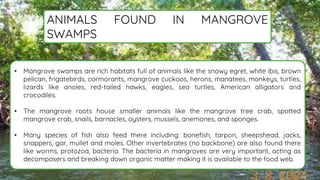
• Mangrove swamps are rich habitats full of animals like the snowy egret, white ibis, brown
pelican, frigatebirds, cormorants, mangrove cuckoos, herons, manatees, monkeys, turtles,
lizards like anoles, red-tailed hawks, eagles, sea turtles, American alligators and
crocodiles.
• The mangrove roots house smaller animals like the mangrove tree crab, spotted
mangrove crab, snails, barnacles, oysters, mussels, anemones, and sponges.
• Many species of fish also feed there including: bonefish, tarpon, sheepshead, jacks,
snappers, gar, mullet and moles. Other invertebrates (no backbone) are also found there
like worms, protozoa, bacteria. The bacteria in mangroves are very important, acting as
decomposers and breaking down organic matter making it is available to the food web.
ANIMALS FOUND IN MANGROVE
SWAMPS.
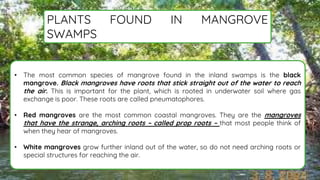
• The most common species of mangrove found in the inland swamps is the black
mangrove. Black mangroves have roots that stick straight out of the water to reach
the air. This is important for the plant, which is rooted in underwater soil where gas
exchange is poor. These roots are called pneumatophores.
• Red mangroves are the most common coastal mangroves. They are the mangroves
that have the strange, arching roots – called prop roots – that most people think of
when they hear of mangroves.
• White mangroves grow further inland out of the water, so do not need arching roots or
special structures for reaching the air.
PLANTS FOUND IN MANGROVE
SWAMPS.

ecosystem-3.pptx

  • 1.
  • 2.
    WHAT IS ECOSYSTEM? The simplestdefinition of an ecosystem is that it is a community or group of living organisms that live in and interact with each other in a specific environment. For instance, tropical forests are ecosystems made up of living beings such as trees, plants, animals, insects and micro-organisms that are in constant interaction between themselves and that are affected by other physical (sun, temperature) or chemical (oxygen or nutrients) components.
  • 3.
    Living Things The livingparts of an ecosystem include animals (consumers), plants (producers), and fungi and micro-organisms (decomposers). 01 Non-Living things The nonliving, or abiotic components of an ecosystem include the sun's energy, water, air (atmospheric gases), and rock, which makes up the landforms. 02 Living and Non-Living Things
  • 4.
    • An organismis an individual living thing and is made up of cells. • Species is a group of similar organisms that can interbreed to produce young organisms. • When a group of organisms of the same species lives in a similar environment, it forms a population. • When there are two or more populations living together in a particular place at a particular time, they make a community Living and Non-Living Things
  • 5.
    symbiosis Mutualism Symbiotic relationship inwhich both organisms benefit from each other. Predation One organism kills and eats another organism. There are two kinds of organisms in this type of interaction- The predator and the prey. Competition Interaction between organisms of the same kind. Another symbiotic relation in which one organism benefits and the other is neither harmed nor benefited. One organism while the other is harmed . The organism that is harmed in this relation is also called host. Commensalism Parasitism
  • 6.
    Ecosystem: Tropical Rainforest The tropicalrainforest biome is the area that covers only around 6% of the area of the Earth but it covers around 50% of the species and has tall trees, has a dense canopy and receives maximum rainfall. Rainforests are often called the lungs of the planet for their role in absorbing carbon dioxide, a greenhouse gas, and increasing local humidity. Rainforests also stabilize climate, house incredible amounts of plants and wildlife, and produce nourishing rainfall all around the planet.
  • 7.
    Ecosystem: Tropical Rainforest Rainforest hasdifferent layers namely emergent, canopy, understory and forest floor. Emergent refers to trees that are 130 to 180 feet tall. Canopy, on the other hand, has tall slender trees from a dense platform of vegetation with 60 to 129 feet of the ground. Forests are full of living and nonliving things that depend on each other. Trees, ferns, and shrubs grow in the forest. Deer, frogs, lizards, insects, birds, and bears are some forest animals that need these plants. Water, stones, and soil are nonliving things that animals need too.
  • 8.
  • 9.
    Living organisms in tropicalrain forest. Plants Animals Small animals, including monkeys, birds, snakes, rodents, frogs, and lizards are common in the tropical rainforest. Orchids, Philodendrons, Ferns, Bromeliads, Kapok Trees, Banana Trees, Rubber Trees, Bam- boo, Trees, Cassava Trees, Avocado Trees.
  • 10.
    CORAL REEFS A coralreef is rich with marine life. It is a marine biome. It is composed of non-living things and living things. The living part composed of different species like fish, sea grass, corals, sponges and other marine animals.
  • 12.
    CORAL REEFS Unfortunately, coralreef ecosystems are severely threatened. Some threats are natural, such as diseases, predators, and storms. Other threats are caused by people, including pollution, sedimentation, unsustainable fishing practices, and climate change, which is raising ocean temperatures and causing ocean acidification.
  • 13.
    Plants Animals Seagrasses Mangroves Zooxanthellae Algae Fish, corals, lobsters,clams, seahorses, sponges, and sea turtles are only a few of the thousands of creatures that rely on reefs for their survival.
  • 14.
  • 15.
    • Mangrove swampsare found along the coasts in tropical and subtropical locations. The plants there have to be able to live in salty water. • Because mangroves often line estuaries, where freshwater rivers flow into the ocean, the water is often brackish – a mix of fresh and salt water. As the water rises and falls every day with the changing tides, the saltiness (salinity) also changes.
  • 16.
    Mangroves Their lossis markeFlorida to cut down a mangrove tree. Mangroves are threatened by habitat destruction as they were once cleared for beach front development. Their loss is marked by increased erosion, animal species loss, and increased storm damage and it is now illegal in Florida to cut down a mangrove tree.
  • 17.
    • Mangrove swampsare rich habitats full of animals like the snowy egret, white ibis, brown pelican, frigatebirds, cormorants, mangrove cuckoos, herons, manatees, monkeys, turtles, lizards like anoles, red-tailed hawks, eagles, sea turtles, American alligators and crocodiles. • The mangrove roots house smaller animals like the mangrove tree crab, spotted mangrove crab, snails, barnacles, oysters, mussels, anemones, and sponges. • Many species of fish also feed there including: bonefish, tarpon, sheepshead, jacks, snappers, gar, mullet and moles. Other invertebrates (no backbone) are also found there like worms, protozoa, bacteria. The bacteria in mangroves are very important, acting as decomposers and breaking down organic matter making it is available to the food web. ANIMALS FOUND IN MANGROVE SWAMPS.
  • 18.
    • The mostcommon species of mangrove found in the inland swamps is the black mangrove. Black mangroves have roots that stick straight out of the water to reach the air. This is important for the plant, which is rooted in underwater soil where gas exchange is poor. These roots are called pneumatophores. • Red mangroves are the most common coastal mangroves. They are the mangroves that have the strange, arching roots – called prop roots – that most people think of when they hear of mangroves. • White mangroves grow further inland out of the water, so do not need arching roots or special structures for reaching the air. PLANTS FOUND IN MANGROVE SWAMPS.