THE LEAF
PRESENTED BY
AMAN SINGH CHAUHAN
B.SC (ZBC) 4SEM
INVERTIS UNIVERSITY BAREILLY
THE LEAF
A leaf is the green, flat lateral outgrowth in plants.They come
in different shapes, sizes, and colors, and are generally dorso-
ventrally flattened , thin and these are also called ‘the kitchen
of the plant’. This is because they are the
main organ responsible for photosynthesis, through which the
plant produces its energy a.k.a. it’s food.
They obtain their green color due to the presence of chlorophyll.
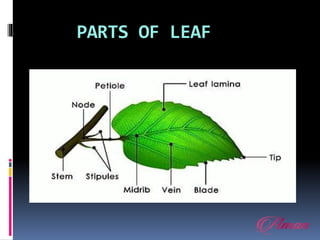
PARTS OF LEAF
.
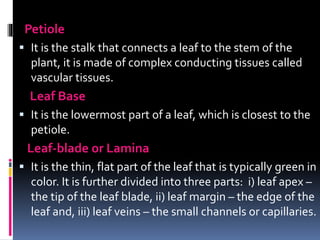
Petiole
 It is the stalk that connects a leaf to the stem of the
plant, it is made of complex conducting tissues called
vascular tissues.
Leaf Base
 It is the lowermost part of a leaf, which is closest to the
petiole.
Leaf-blade or Lamina
 It is the thin, flat part of the leaf that is typically green in
color. It is further divided into three parts: i) leaf apex –
the tip of the leaf blade, ii) leaf margin – the edge of the
leaf and, iii) leaf veins – the small channels or capillaries.
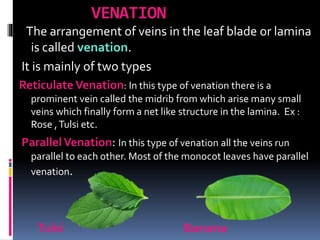
VENATION
The arrangement of veins in the leaf blade or lamina
is called venation.
It is mainly of two types
Reticulate Venation: In this type of venation there is a
prominent vein called the midrib from which arise many small
veins which finally form a net like structure in the lamina. Ex :
Rose ,Tulsi etc.
ParallelVenation: In this type of venation all the veins run
parallel to each other. Most of the monocot leaves have parallel
venation.
Tulsi Banana
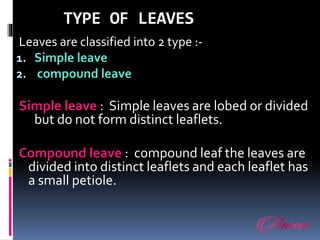
TYPE OF LEAVES
Leaves are classified into 2 type :-
1. Simple leave
2. compound leave
Simple leave : Simple leaves are lobed or divided
but do not form distinct leaflets.
Compound leave : compound leaf the leaves are
divided into distinct leaflets and each leaflet has
a small petiole.
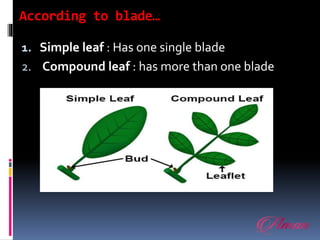
According to blade…
1. Simple leaf : Has one single blade
2. Compound leaf : has more than one blade
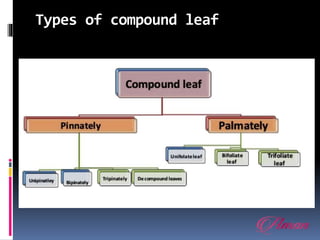
Types of compound leaf
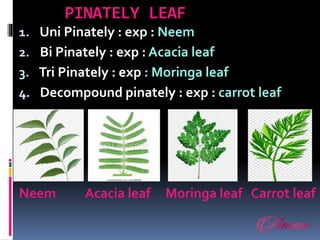
PINATELY LEAF
1. Uni Pinately : exp : Neem
2. Bi Pinately : exp : Acacia leaf
3. Tri Pinately : exp : Moringa leaf
4. Decompound pinately : exp : carrot leaf
Neem Acacia leaf Moringa leaf Carrot leaf
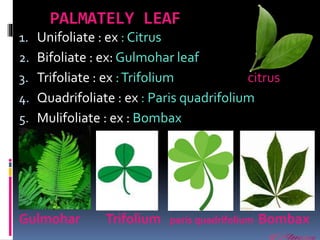
PALMATELY LEAF
1. Unifoliate : ex : Citrus
2. Bifoliate : ex: Gulmohar leaf
3. Trifoliate : ex :Trifolium citrus
4. Quadrifoliate : ex : Paris quadrifolium
5. Mulifoliate : ex : Bombax
Gulmohar Trifolium paris quadrifolium Bombax
THE FUNCTION OF LEAVES
 They…
 Produce oxygen for respiration of animals
 Remove carbon dioxide from the air
 Produce food for the plant
 Create hiding place for wildlife
 Are a source of food ( for animal and people)
 Reduce soil erosion by intercepting rains as it falls
 Lower the air temperature as a by product of
transpiration etc..
REFERENCES:-
 www.toppr.com
 www.Byju’s.com
 www.britannica.com
 www.pinterest.com
 And other…..
.
THANKYOU
ANY QUESTION PLEASE ASK ?

PLANT LEAF

  • 1.
    THE LEAF PRESENTED BY AMANSINGH CHAUHAN B.SC (ZBC) 4SEM INVERTIS UNIVERSITY BAREILLY
  • 2.
    THE LEAF A leafis the green, flat lateral outgrowth in plants.They come in different shapes, sizes, and colors, and are generally dorso- ventrally flattened , thin and these are also called ‘the kitchen of the plant’. This is because they are the main organ responsible for photosynthesis, through which the plant produces its energy a.k.a. it’s food. They obtain their green color due to the presence of chlorophyll.
  • 3.
  • 4.
    . Petiole  It isthe stalk that connects a leaf to the stem of the plant, it is made of complex conducting tissues called vascular tissues. Leaf Base  It is the lowermost part of a leaf, which is closest to the petiole. Leaf-blade or Lamina  It is the thin, flat part of the leaf that is typically green in color. It is further divided into three parts: i) leaf apex – the tip of the leaf blade, ii) leaf margin – the edge of the leaf and, iii) leaf veins – the small channels or capillaries.
  • 5.
    VENATION The arrangement ofveins in the leaf blade or lamina is called venation. It is mainly of two types Reticulate Venation: In this type of venation there is a prominent vein called the midrib from which arise many small veins which finally form a net like structure in the lamina. Ex : Rose ,Tulsi etc. ParallelVenation: In this type of venation all the veins run parallel to each other. Most of the monocot leaves have parallel venation. Tulsi Banana
  • 6.
    TYPE OF LEAVES Leavesare classified into 2 type :- 1. Simple leave 2. compound leave Simple leave : Simple leaves are lobed or divided but do not form distinct leaflets. Compound leave : compound leaf the leaves are divided into distinct leaflets and each leaflet has a small petiole.
  • 7.
    According to blade… 1.Simple leaf : Has one single blade 2. Compound leaf : has more than one blade
  • 8.
  • 9.
    PINATELY LEAF 1. UniPinately : exp : Neem 2. Bi Pinately : exp : Acacia leaf 3. Tri Pinately : exp : Moringa leaf 4. Decompound pinately : exp : carrot leaf Neem Acacia leaf Moringa leaf Carrot leaf
  • 10.
    PALMATELY LEAF 1. Unifoliate: ex : Citrus 2. Bifoliate : ex: Gulmohar leaf 3. Trifoliate : ex :Trifolium citrus 4. Quadrifoliate : ex : Paris quadrifolium 5. Mulifoliate : ex : Bombax Gulmohar Trifolium paris quadrifolium Bombax
  • 11.
    THE FUNCTION OFLEAVES  They…  Produce oxygen for respiration of animals  Remove carbon dioxide from the air  Produce food for the plant  Create hiding place for wildlife  Are a source of food ( for animal and people)  Reduce soil erosion by intercepting rains as it falls  Lower the air temperature as a by product of transpiration etc..
  • 12.
    REFERENCES:-  www.toppr.com  www.Byju’s.com www.britannica.com  www.pinterest.com  And other…..
  • 13.