Biology Holiday Homework
TOPIC-Anatomy of Leaf
Pranav Singh
XI-A
Introduction
In This PPT we will Understanding the Structure and Function of Leaves
Which will include:
 Leaf Structure
 The Part of leaves
 Leaf Anatomy
 The Adaptation of Leaves
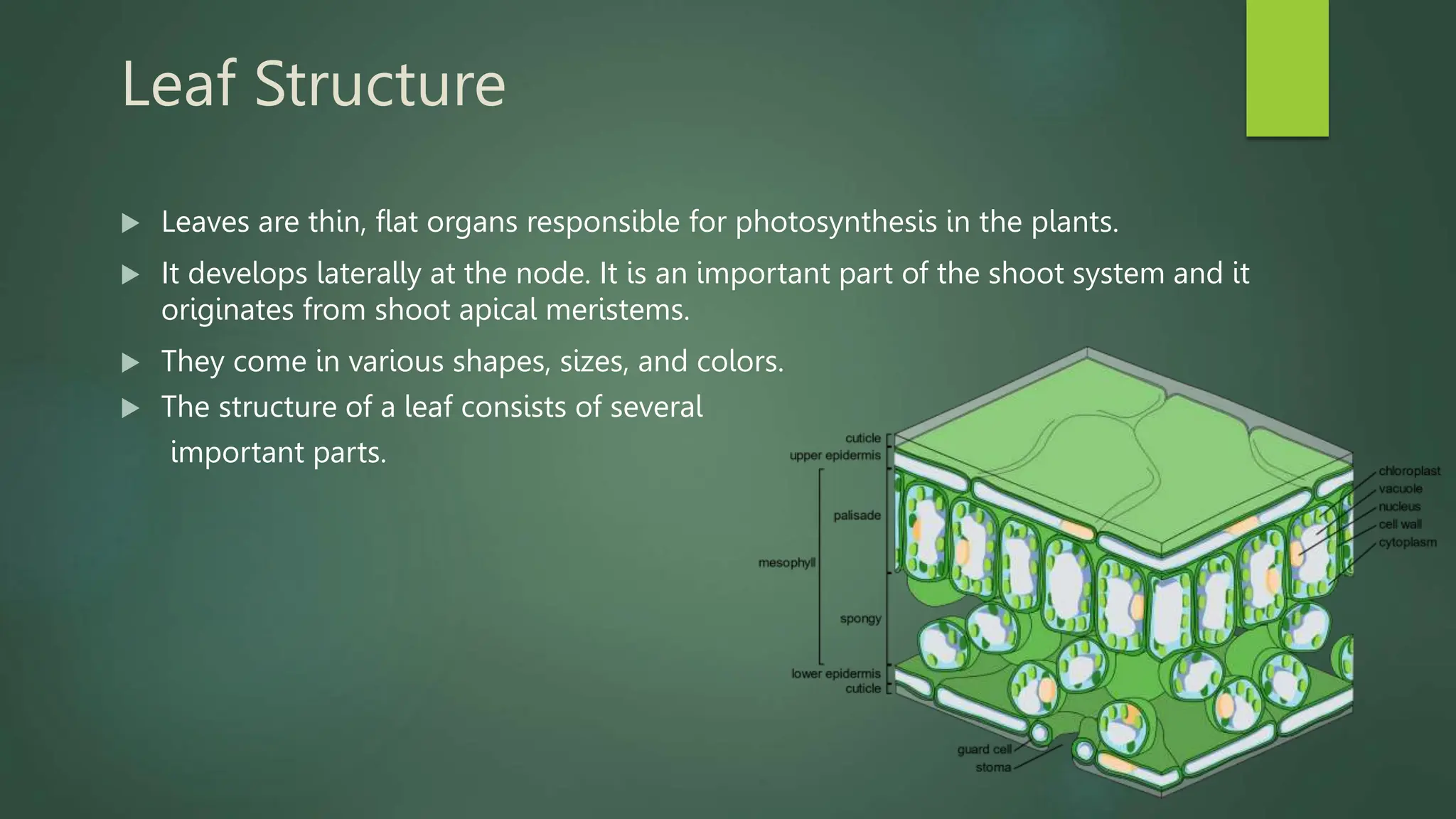
Leaf Structure
 Leaves are thin, flat organs responsible for photosynthesis in the plants.
 It develops laterally at the node. It is an important part of the shoot system and it
originates from shoot apical meristems.
 They come in various shapes, sizes, and colors.
 The structure of a leaf consists of several
important parts.
Parts of Leaves
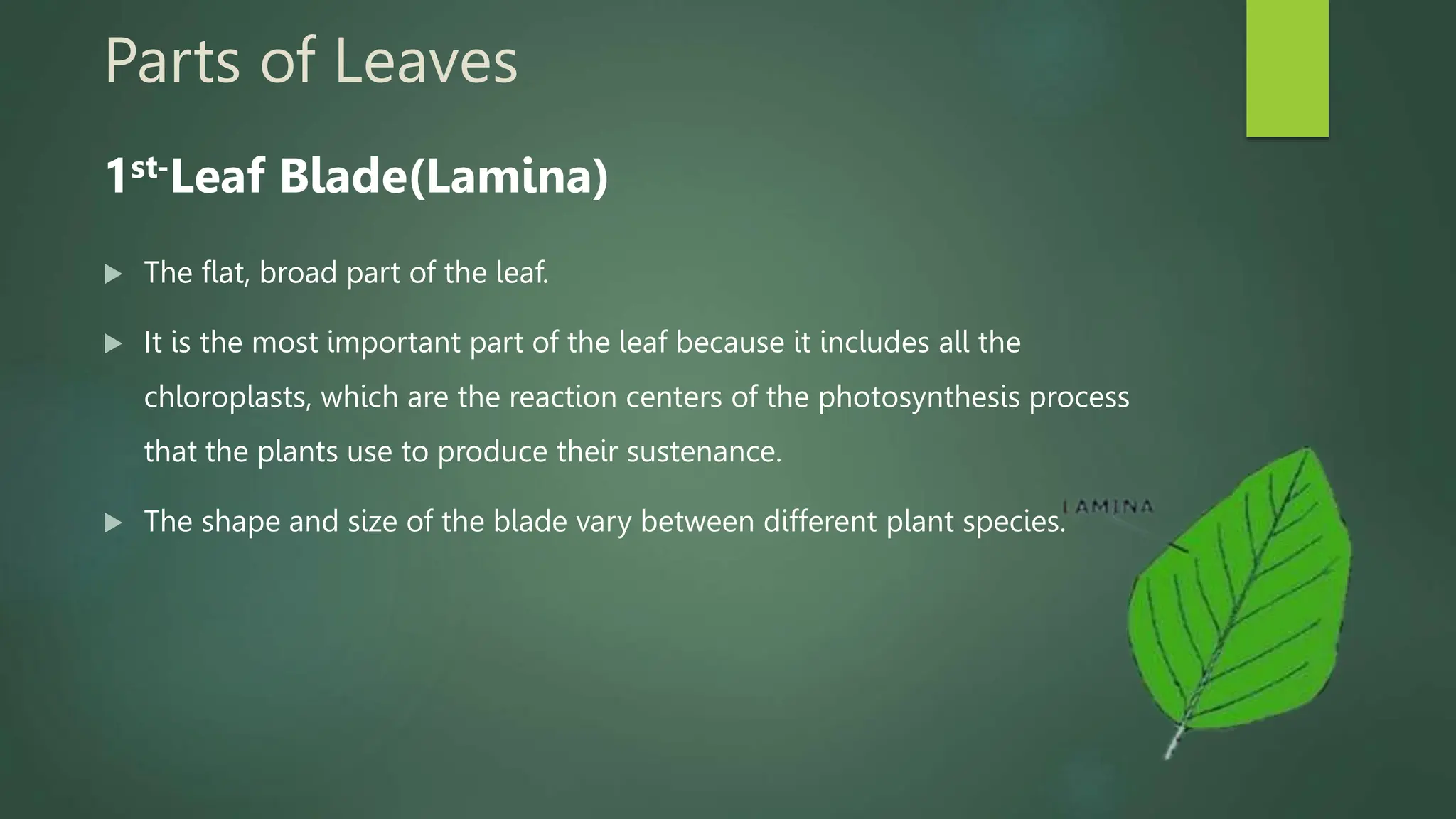
 The flat, broad part of the leaf.
 It is the most important part of the leaf because it includes all the
chloroplasts, which are the reaction centers of the photosynthesis process
that the plants use to produce their sustenance.
 The shape and size of the blade vary between different plant species.
1st-Leaf Blade(Lamina)
Parts of Leaves
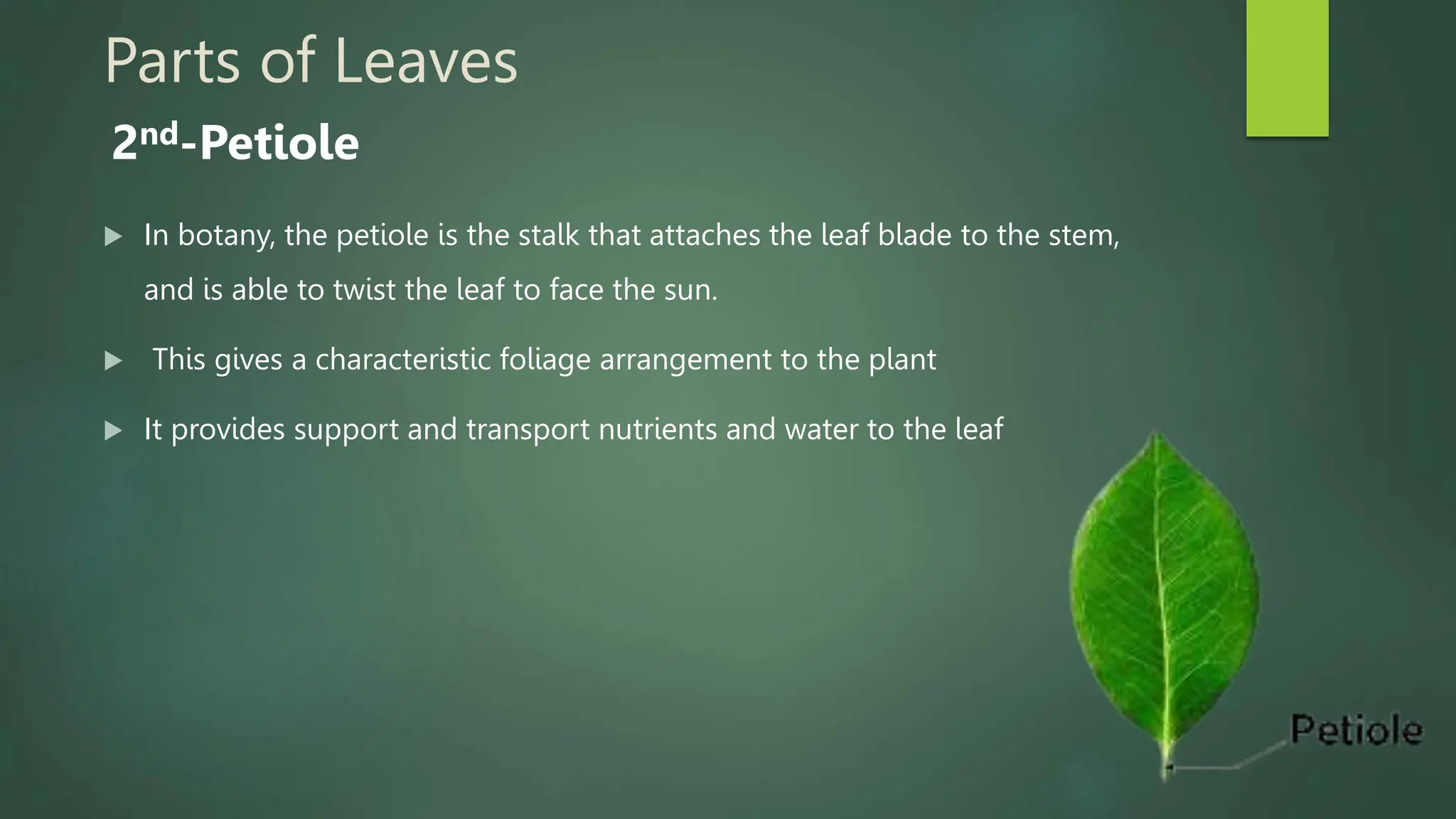
 In botany, the petiole is the stalk that attaches the leaf blade to the stem,
and is able to twist the leaf to face the sun.
 This gives a characteristic foliage arrangement to the plant
 It provides support and transport nutrients and water to the leaf
2nd-Petiole
Parts of Leaves
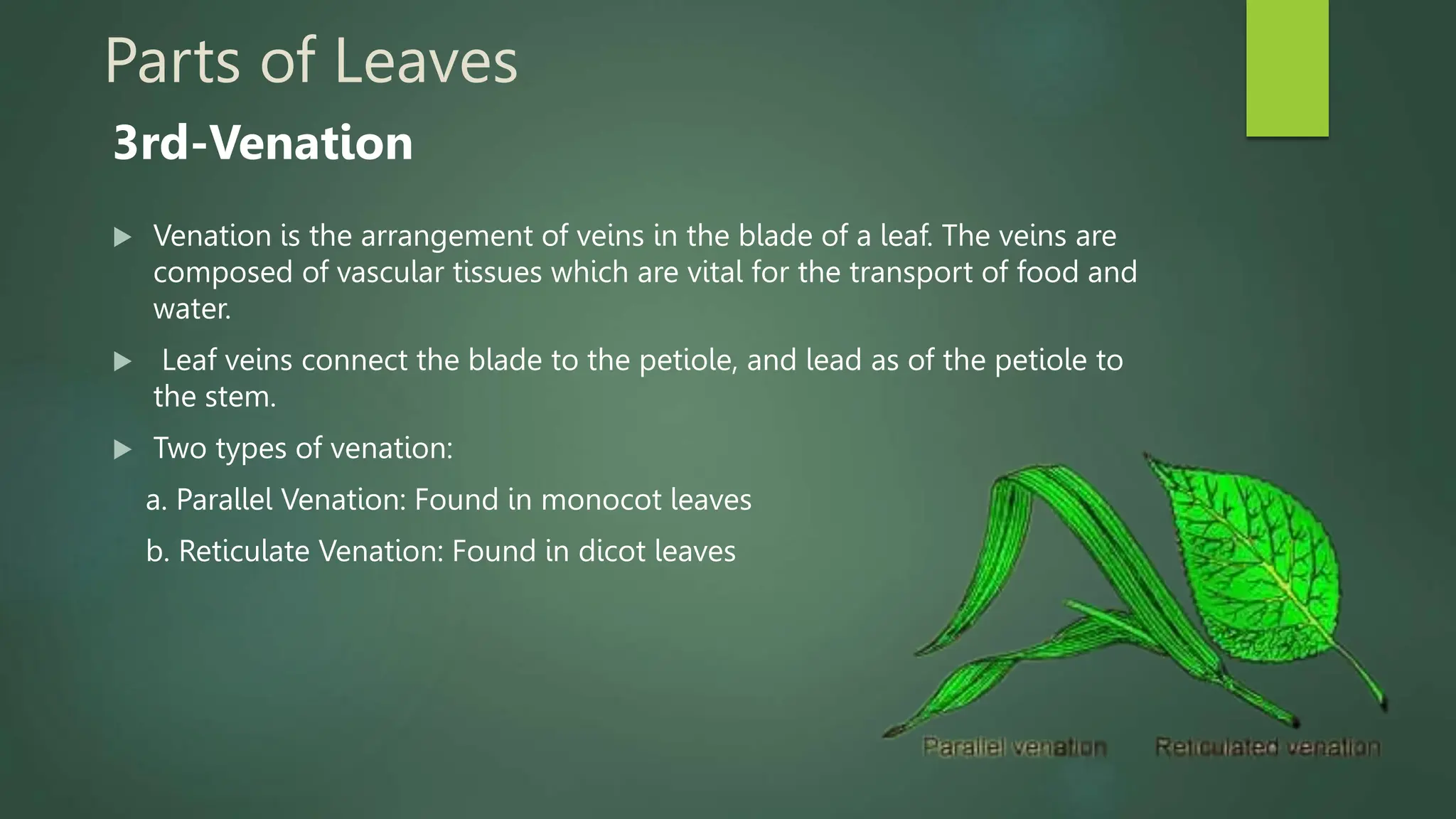
 Venation is the arrangement of veins in the blade of a leaf. The veins are
composed of vascular tissues which are vital for the transport of food and
water.
 Leaf veins connect the blade to the petiole, and lead as of the petiole to
the stem.
 Two types of venation:
a. Parallel Venation: Found in monocot leaves
b. Reticulate Venation: Found in dicot leaves
3rd-Venation
Leaf Anatomy - Cross-Section
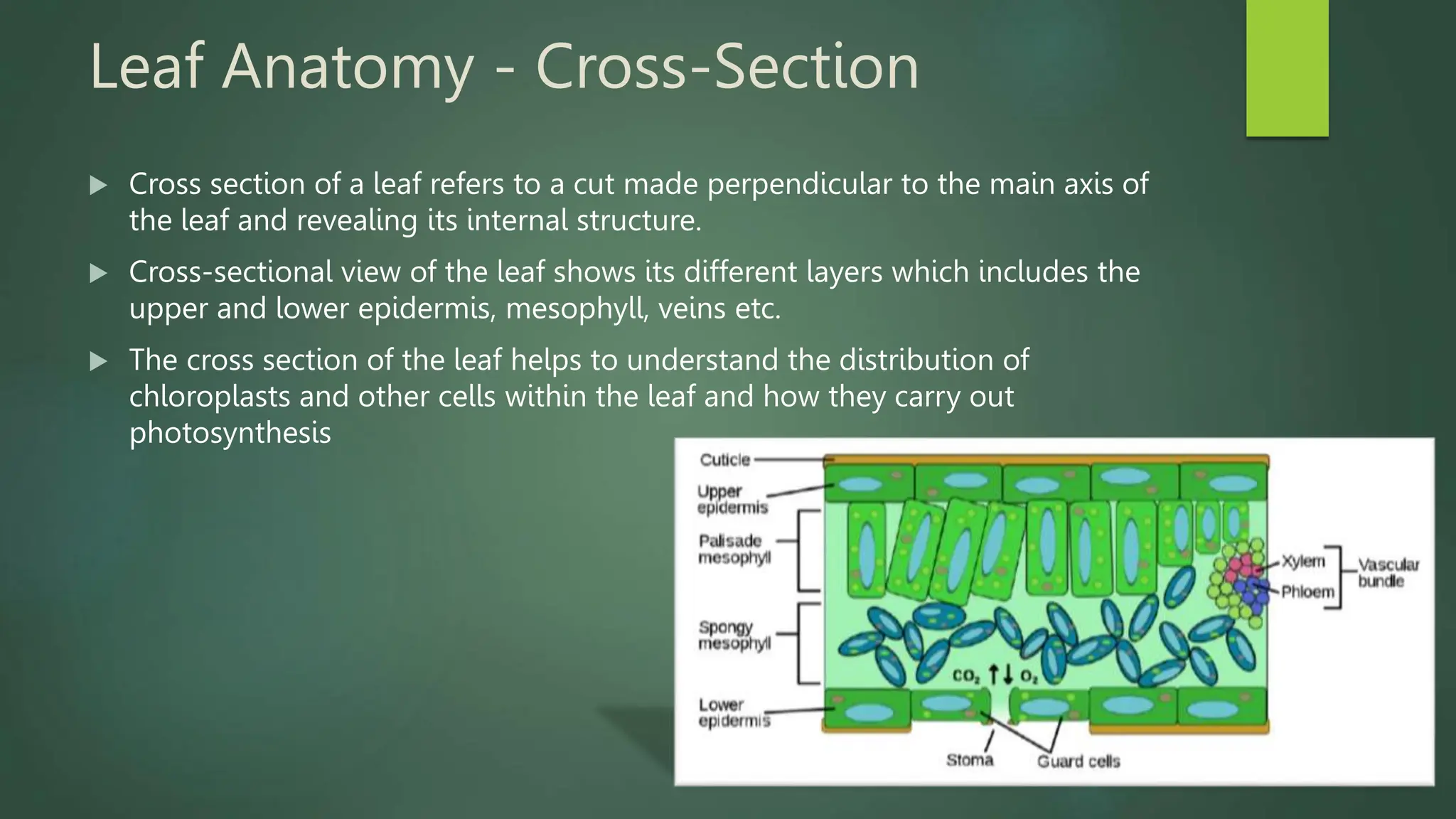
 Cross section of a leaf refers to a cut made perpendicular to the main axis of
the leaf and revealing its internal structure.
 Cross-sectional view of the leaf shows its different layers which includes the
upper and lower epidermis, mesophyll, veins etc.
 The cross section of the leaf helps to understand the distribution of
chloroplasts and other cells within the leaf and how they carry out
photosynthesis
Leaf Anatomy - Cross-Section
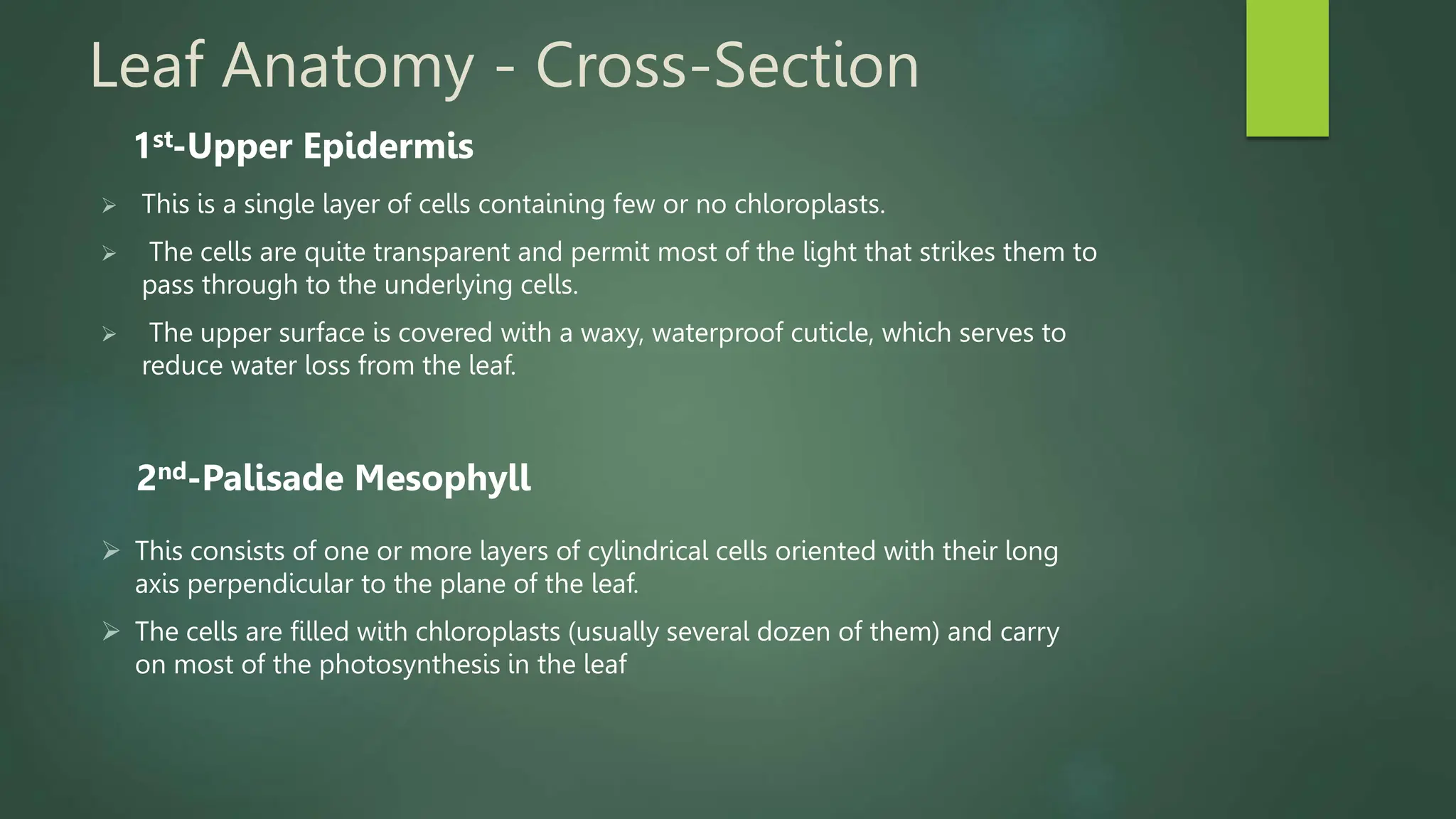
 This is a single layer of cells containing few or no chloroplasts.
 The cells are quite transparent and permit most of the light that strikes them to
pass through to the underlying cells.
 The upper surface is covered with a waxy, waterproof cuticle, which serves to
reduce water loss from the leaf.
1st-Upper Epidermis
2nd-Palisade Mesophyll
 This consists of one or more layers of cylindrical cells oriented with their long
axis perpendicular to the plane of the leaf.
 The cells are filled with chloroplasts (usually several dozen of them) and carry
on most of the photosynthesis in the leaf
Leaf Anatomy - Cross-Section
 Lying beneath the palisade layer, its cells are irregular in shape and loosely packed.
 Although they contain a few chloroplasts, their main function seems to be the
temporary storage of sugars and amino acids synthesized in the palisade layer.
 They also aid in the exchange of gases between the leaf and the environment.
3rd- Spongy Mesophyll
4th- Lower Epidermis
 Most of the stomata (thousands per square centimeter) are located in the
lower epidermis.
 Although most of the cells of the lower epidermis resemble those of the
upper epidermis, each stoma is flanked by two sausage-shaped cells
called guard cells.
Leaf Anatomy - Cross-Section
 Guard cells are pairs of epidermal cells that control gas diffusion by regulating the
opening and closure of stomatal pores.
 They help to regulate the rate of transpiration by opening and closing the stomata.
5th- Guard Cells
6th-Stomata
 Stomata are the tiny openings present on the epidermis of leaves.
 Stomata play an important role in gaseous exchange and photosynthesis.
 It maintains the moisture balance according to weather by opening and closing.
Adaptations of Leaves
 The plant produces larger leaves, which means a larger surface area for
maximum absorption of sunlight.
 The stomata are located on the backside of the leaves which helps regulate
water loss from the leaves.
 Leaves have a thin structure so that they can provide a short distance for
carbon dioxide to diffuse into leaf cells
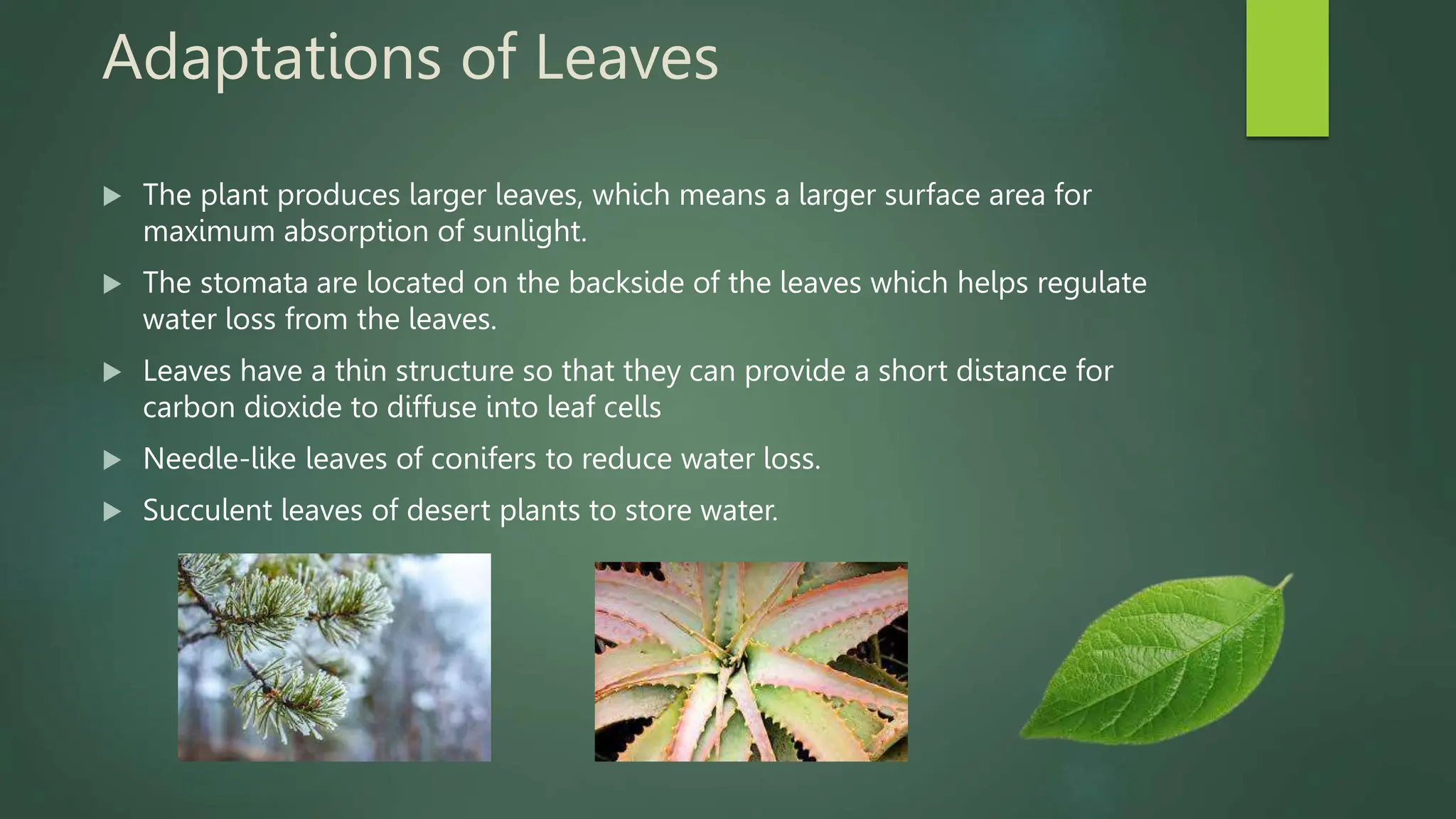
 Needle-like leaves of conifers to reduce water loss.
 Succulent leaves of desert plants to store water.
Conclusion
 Leaves are essential for the survival and growth of plants.
 A leaf works for plants throughout its life.then it benefits after it dead.
 Understanding their anatomy and adaptations helps us appreciate their
diversity and importance in the plant kingdom.

Anatomy Of Leaf Class 11th Biology Pranav Singh 11-A.pptx

  • 1.
    Biology Holiday Homework TOPIC-Anatomyof Leaf Pranav Singh XI-A
  • 2.
    Introduction In This PPTwe will Understanding the Structure and Function of Leaves Which will include:  Leaf Structure  The Part of leaves  Leaf Anatomy  The Adaptation of Leaves
  • 3.
    Leaf Structure  Leavesare thin, flat organs responsible for photosynthesis in the plants.  It develops laterally at the node. It is an important part of the shoot system and it originates from shoot apical meristems.  They come in various shapes, sizes, and colors.  The structure of a leaf consists of several important parts.
  • 4.
    Parts of Leaves The flat, broad part of the leaf.  It is the most important part of the leaf because it includes all the chloroplasts, which are the reaction centers of the photosynthesis process that the plants use to produce their sustenance.  The shape and size of the blade vary between different plant species. 1st-Leaf Blade(Lamina)
  • 5.
    Parts of Leaves In botany, the petiole is the stalk that attaches the leaf blade to the stem, and is able to twist the leaf to face the sun.  This gives a characteristic foliage arrangement to the plant  It provides support and transport nutrients and water to the leaf 2nd-Petiole
  • 6.
    Parts of Leaves Venation is the arrangement of veins in the blade of a leaf. The veins are composed of vascular tissues which are vital for the transport of food and water.  Leaf veins connect the blade to the petiole, and lead as of the petiole to the stem.  Two types of venation: a. Parallel Venation: Found in monocot leaves b. Reticulate Venation: Found in dicot leaves 3rd-Venation
  • 7.
    Leaf Anatomy -Cross-Section  Cross section of a leaf refers to a cut made perpendicular to the main axis of the leaf and revealing its internal structure.  Cross-sectional view of the leaf shows its different layers which includes the upper and lower epidermis, mesophyll, veins etc.  The cross section of the leaf helps to understand the distribution of chloroplasts and other cells within the leaf and how they carry out photosynthesis
  • 8.
    Leaf Anatomy -Cross-Section  This is a single layer of cells containing few or no chloroplasts.  The cells are quite transparent and permit most of the light that strikes them to pass through to the underlying cells.  The upper surface is covered with a waxy, waterproof cuticle, which serves to reduce water loss from the leaf. 1st-Upper Epidermis 2nd-Palisade Mesophyll  This consists of one or more layers of cylindrical cells oriented with their long axis perpendicular to the plane of the leaf.  The cells are filled with chloroplasts (usually several dozen of them) and carry on most of the photosynthesis in the leaf
  • 9.
    Leaf Anatomy -Cross-Section  Lying beneath the palisade layer, its cells are irregular in shape and loosely packed.  Although they contain a few chloroplasts, their main function seems to be the temporary storage of sugars and amino acids synthesized in the palisade layer.  They also aid in the exchange of gases between the leaf and the environment. 3rd- Spongy Mesophyll 4th- Lower Epidermis  Most of the stomata (thousands per square centimeter) are located in the lower epidermis.  Although most of the cells of the lower epidermis resemble those of the upper epidermis, each stoma is flanked by two sausage-shaped cells called guard cells.
  • 10.
    Leaf Anatomy -Cross-Section  Guard cells are pairs of epidermal cells that control gas diffusion by regulating the opening and closure of stomatal pores.  They help to regulate the rate of transpiration by opening and closing the stomata. 5th- Guard Cells 6th-Stomata  Stomata are the tiny openings present on the epidermis of leaves.  Stomata play an important role in gaseous exchange and photosynthesis.  It maintains the moisture balance according to weather by opening and closing.
  • 11.
    Adaptations of Leaves The plant produces larger leaves, which means a larger surface area for maximum absorption of sunlight.  The stomata are located on the backside of the leaves which helps regulate water loss from the leaves.  Leaves have a thin structure so that they can provide a short distance for carbon dioxide to diffuse into leaf cells  Needle-like leaves of conifers to reduce water loss.  Succulent leaves of desert plants to store water.
  • 12.
    Conclusion  Leaves areessential for the survival and growth of plants.  A leaf works for plants throughout its life.then it benefits after it dead.  Understanding their anatomy and adaptations helps us appreciate their diversity and importance in the plant kingdom.