ROKSANA AFTAB RUHI
DEPARTMENT OF AGRICULTURE
NOAKHALI SCIENCE & TECHNOLOGY UNIVERSITY
NOAKHALI, CHITTAGONG,BANGLADESH.
Leaf
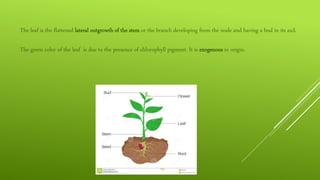
The leaf is the flattened lateral outgrowth of the stem or the branch developing from the node and having a bud in its axil.
The green color of the leaf is due to the presence of chlorophyll pigment. It is exogenous in origin.
PARTS OF LEAF
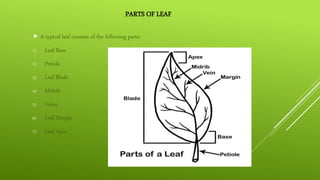
 A typical leaf consists of the following parts:
1) Leaf Base
2) Petiole
3) Leaf Blade
4) Midrib
5) Veins
6) Leaf Margin
7) Leaf Apex
LEAF BASE
 The part of leaves that attached to the stem or branch. In monocotyledons the base expands into a sheath which partially
or fully clasps the stem but in dicotyledons the leaf base bears two outgrowth known as stipules.
 The main functions of the leaf base is to give an arrangement of leaf blade and attached the leaf with stem.
PETIOLE
 The petiole is the stalk of the leaf which is generally cylindrical but may hollow or flattened. When the petiole is absent the
leaf is called sessile (rice, corn) and when absent is called stalked.
 There are two types of petiole present as following-
1. Bulbous Petiole; when petiole swells into a spongy bulb(pseudo bulb) containing innumerable air chamber for facility of
floating e.g. Water hyacinth.
2. Winged Petiole; the petiole is modified into wing like structure in citrus.
CONTINUED….
 The functions of the leaf petiole is to attached the leaf blade to the branch or stem.
 It also serves as the passage way between the stem and the blade for water and nutrients conduction.
LEAF BLADE/LAMINA
 Leaf blade or lamina is the body of the leaf. The lade is usually thin structure.
 Leaf blade has several functions such as-
1. This is the seat of the food manufacture for the entire plant.
2. It plays a vital role in gaseous exchange and transpiration.
LEAF MARGIN
AND
LEAF APEX
 The margin is the perimeter of the leaves between the apex and the leaf base. It gives a shape of the leaf.
 The apex is the farthest part of the lamina from the point of attachment of the leaf to the stem. It gives the protection of
the leaf such as date pulm.
MIDRIB
 The prominent vein which is run centrally through the leaf blade from its base to the apex is known as the midrib.
 Midrib cotains veins and veinlets.
VEINS
 Veins are the rigid ,linear structure which arise from the petiole. Veins and veinlet help the leaf blade to keep flat so that the whole structure can
secure more sunlight.
 The arrangement of veins and veinlet in the leaf blades is known as venation.
 There are two types of venation as following-
1. Reticulate Venation ; which are irregularly distributed forming a network
2. Parallel Venation ; when the veins and veinlet runs parallel to each other.
Plant leaf -an introduction

Plant leaf -an introduction

  • 1.
    ROKSANA AFTAB RUHI DEPARTMENTOF AGRICULTURE NOAKHALI SCIENCE & TECHNOLOGY UNIVERSITY NOAKHALI, CHITTAGONG,BANGLADESH. Leaf
  • 2.
    The leaf isthe flattened lateral outgrowth of the stem or the branch developing from the node and having a bud in its axil. The green color of the leaf is due to the presence of chlorophyll pigment. It is exogenous in origin.
  • 3.
    PARTS OF LEAF A typical leaf consists of the following parts: 1) Leaf Base 2) Petiole 3) Leaf Blade 4) Midrib 5) Veins 6) Leaf Margin 7) Leaf Apex
  • 4.
    LEAF BASE  Thepart of leaves that attached to the stem or branch. In monocotyledons the base expands into a sheath which partially or fully clasps the stem but in dicotyledons the leaf base bears two outgrowth known as stipules.  The main functions of the leaf base is to give an arrangement of leaf blade and attached the leaf with stem.
  • 5.
    PETIOLE  The petioleis the stalk of the leaf which is generally cylindrical but may hollow or flattened. When the petiole is absent the leaf is called sessile (rice, corn) and when absent is called stalked.  There are two types of petiole present as following- 1. Bulbous Petiole; when petiole swells into a spongy bulb(pseudo bulb) containing innumerable air chamber for facility of floating e.g. Water hyacinth. 2. Winged Petiole; the petiole is modified into wing like structure in citrus.
  • 6.
    CONTINUED….  The functionsof the leaf petiole is to attached the leaf blade to the branch or stem.  It also serves as the passage way between the stem and the blade for water and nutrients conduction.
  • 7.
    LEAF BLADE/LAMINA  Leafblade or lamina is the body of the leaf. The lade is usually thin structure.  Leaf blade has several functions such as- 1. This is the seat of the food manufacture for the entire plant. 2. It plays a vital role in gaseous exchange and transpiration.
  • 8.
    LEAF MARGIN AND LEAF APEX The margin is the perimeter of the leaves between the apex and the leaf base. It gives a shape of the leaf.  The apex is the farthest part of the lamina from the point of attachment of the leaf to the stem. It gives the protection of the leaf such as date pulm.
  • 9.
    MIDRIB  The prominentvein which is run centrally through the leaf blade from its base to the apex is known as the midrib.  Midrib cotains veins and veinlets.
  • 10.
    VEINS  Veins arethe rigid ,linear structure which arise from the petiole. Veins and veinlet help the leaf blade to keep flat so that the whole structure can secure more sunlight.  The arrangement of veins and veinlet in the leaf blades is known as venation.  There are two types of venation as following- 1. Reticulate Venation ; which are irregularly distributed forming a network 2. Parallel Venation ; when the veins and veinlet runs parallel to each other.