Plant Layout
Chapter 10
Production
Operations management
Plant Layout
Plant Layout
This Technical Measures Document refers to Plant Layout.
Other relevant Technical Measures Documents are:
•Design Codes - Plant
•Design Codes – Pipe work
•Plant Modification / Change procedures
•Maintenance procedures
When a new plant is erected The question of placement of
machinery at different places,the location of the
store,Plating shop,painting shop is very important.
A good deal of expertise is used by management to secure
a proper layout for new or existing plant.
Plant Layout
Meaning,Definition & scope
™A plant Layout refers to the arrangement of machinery &
other industrial facilities such as receiving & shipping
departments,Employer amenities for achieving quickest and
smoothest production at least cost
™The subject of plant layout not only covers the initial
layout,but encompasses improvement in ,or revision of
existing layout
™A more simple definition is given by Knowles & Thomson
they say the plant layout involves
™“Planning & arrangement of machinery & other industrial
facilities & services for the first time in completely new plant
™The improvement of layout already in use ,in order to
introduce new methods
Objectives of good
Plant Layout
™Provide enough Production Capacity
™Reduce material handling cost
™Reduce hazards to personnel
™Increase employee moral
™Reduce accidents
™Utilize available space
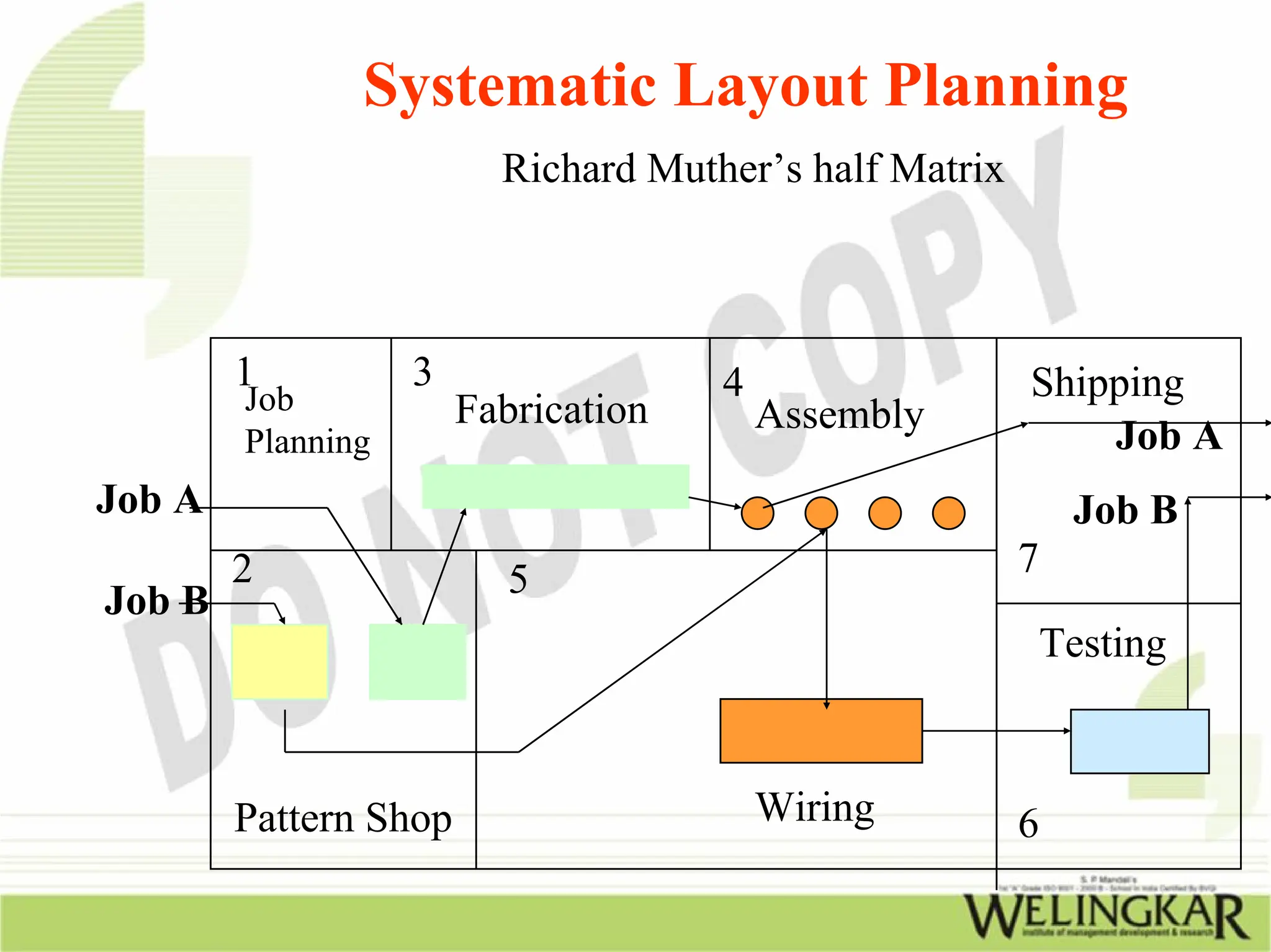
™Provide ease of production
™Provide ease of maintenance
™Provide ease of supervision
™Improve productivity
™Allow high machine utilization
Factors Influencing
Plant Layout
General principles
Plant layout is often a compromise between a number of
factors such as:
•The need to keep distances for transfer of materials between
plant/storage units to a minimum to reduce costs and risks;
•The geographical limitations of the site;
•Interaction with existing or planned facilities on site such as
existing roadways, drainage and utilities routings;
•Interaction with other plants on site;
•The need for plant operability and maintainability;
•The need to locate hazardous materials facilities as far as
possible from site boundaries and people living in the local
neighborhood;
Factors Influencing
Plant Layout
•The need to prevent confinement where release of
flammable substances may occur;
•The need to provide access for emergency services;
•The need to provide emergency escape routes for on-site
personnel;
•The need to provide acceptable working conditions for
operators.
The most important factors of plant layout as far as safety
aspects are concerned are those to:
•Prevent, limit and/or mitigate escalation of adjacent events
(domino);
•Ensure safety within on-site occupied buildings;
•Control access of unauthorized personnel;
Factors Influencing
Plant Layout
•Facilitate access for emergency services.
In determining plant layout designers should consider the
factors in outlined in the following sections.
Inherent safety
The major principle in Inherent Safety is to remove the
hazard altogether. The best method to achieve this is to
reduce the inventory of hazardous substances such that a
major hazard is no longer presented. However, this is not
often readily achievable and by definition no COMAH
facility will have done so. Other possible methods to achieve
an Inherently Safer design are:
Factors Influencing
Plant Layout
•Intensification to reduce inventories;
•Substitution of hazardous substances by less hazardous
alternatives;
•Attenuation to reduce hazardous process conditions i.e.
temperature, pressure;
•Simpler systems/processes to reduce potential loss of
containment or possibility of errors causing a hazardous
event;
•Fail-safe design e.g. valve position on failure.
Plant layout considerations to achieve Inherent Safety are
mainly those concerned with domino effects (see below).
Factors Influencing
Plant Layout
The Dow / Mond Indices
These hazard indices are useful for evaluating processes or
projects, ranking them against existing facilities, and
assigning incident classifications. They provides a
comparative measure of the overall risk of fire and explosion
of a process, and are useful tools in the plant layout
development stage since they enable objective spacing
distances to be taken into account at all stages.
The methodology for undertaking a rapid ranking method
that is based on the Dow / Mond index is detailed in ILO,
PIACT, Major Hazard Control: A practical manual, 1988.
Although these are useful rule-of thumb methodologies for
first consideration of plant layout, they do not replace risk
assessment.
Factors Influencing
Plant Layout
The distances derived between plant units using these
systems are based upon engineering judgment and some
degree of experience rather than any detailed analysis.
Domino effects
Hazard assessment of site layout is critical to ensure
consequences of loss of containment and chances of
escalation are minimized. Domino may be by fire, explosion
(pressure wave and missiles) or toxic gas cloud causing loss
of control of operations in another location.
Fire
A fire can spread in four ways:
•Direct burning (including running liquid fires);
•Convection;
•Radiation;
Factors Influencing
Plant Layout
•Conduction.
The spread of fire from its origin to other parts of the
premises can be prevented by vertical and horizontal
compartmentation using fire-resisting walls and floors.
Further information may be found in BS 5908 : 1990.
Consideration should also be given to the spread of
flammable material via drains, ducts and ventilation systems.
Delayed ignition following a release may result in spread of
flames through such systems via dispersed flammable gases
and vapors.
Protection against domino effects by convection, conduction
and radiation can be achieved by inherent safety principles
Principles of
Plant Layout
™The principle of Minimum travel
™The principle of sequence
™The principle of usage
™The principle of compactness
™The principle of safety
™The principle of satisfaction
™The principle of minimum investment
Types of
Plant Layout
™Process lay out,job lay out,functional lay out
™Product layout or line processing lay out
™Fixed position lay out
™Cellular Manufacturing lay out
™Combinational or hybrid layout
Types of
Plant Layout
Ch 7 - 6
© 1998 by Prentice-Hall Inc
Russell/Taylor Oper Mgt 2/e
Manufacturing Process Layout
L
L
L
L
L
L
L
L
L
L M
M
M
M
D
D
D
D
D
D
D
D
G
G
G
G
G
G
P
P
A A A
Receiving and
Shipping Assembly
Painting Department
Lathe Department
Milling
Department Drilling Department
Grinding
Department
Types of
Plant Layout
C h 7 - 7
© 1 9 9 8 b y P re n tice -H a ll In c
R u s se ll/T a ylo r O p e r M g t 2 /e
S ervice P rocess L ayout
W om e n ’s
lin g e rie
W om e n ’s
d re ss e s
W om e n ’s
sp o rts w e a r
S h o e s
C o sm e tics
& Je w e lry
E n try &
d is p la y a re a
H o u se w a re s
C h ild re n ’s
d e p a rtm e n t
M e n ’s
d e p a rtm e n t
Types of
Plant Layout
P R O C E S S L A Y O U T I N A
F U N C T I O N A L A P P R O A C H :
X X X
M a c h in e m a c h in e
g r o u p 1 g r o u p 2
M o v e m e n t o f
p r o d u c t
M a c h in e
g r o u p 3
M a c h in e
g r o u p ‘n ’
‘R a n d o m ’ m o v e m e n t ta k e s
p la c e a s p r o d u c ts a r e
m o v e d a c c o r d in g to p r o c e s s
r e q u ir e m e n ts .
T h e r e is n o ‘flo w ’ a s s u c h -
e a c h p r o d u c t w ill h a v e its
p a r tic u la r p r o c e s s
r e q u ir e m e n ts a n d w ill
m o v e to e a c h m a c h in e
g r o u p a s w h e n r e q u ir e d
Types of
Plant Layout
F IX E D P O SIT IO N L A Y O U T
P roduct
O perators perform processes
on the ‘fixed’ product. T here
m ay be m ore than one
operation perform ed on the
product at the sam e tim e.
E ach operation adds to the
product until it is com pleted
Types of Plant Layout
Fixed position layout
Air Craft Assembly
Raw material
Machine &
Equipment
Labor
Finished
product
Air craft
Types of
Plant Layout
P R O C E S S L A Y O U T IN A
P R O D U C T F A M IL Y C E L L
X X X X X X X
g r o u p 1 g r o u p 2 g r o u p 3 g r o u p 4
Types of
Plant Layout
C h 7 - 8
© 1 9 9 8 b y P r e n t i c e - H a l l I n c
R u s s e l l / T a y l o r O p e r M g t 2 / e
A P r o d u c t L a y o u t
I N
O U T
P R O D U C T L A Y O U T
X X X A s s e m b l y /
p a c k i n g
Cellular Layout Solution
12
1
2 3
4
5
6
7
8 9
10
11
A B
C
Raw materials
Cell1
Cell 2 Cell 3
Assembly
Types of
Plant Layout
Ch 7 - 9
© 1998 by Prentice-Hall Inc
Russell/Taylor Oper Mgt 2/e
Comparison Of Product And
Process Layouts
PRODUCT LAYOUT PROCESS LAYOUT
1. Description Sequential arrangement Functional grouping
of machines of machines
2. Type of Process Continuous, mass Intermittent, job shop
production, mainly batch production,
assembly mainly fabrication
3. Product Standardized Varied,
made to stock made to order
4. Demand Stable Fluctuating
5. Volume High Low
6. Equipment Special purpose General purpose
7. Workers Limited skills Varied skills
Types of
Plant Layout
Ch 7 - 10
© 1998 by Prentice-Hall Inc
Russell/Taylor Oper Mgt 2/e
Comparison Of Product And
Process Layouts
PRODUCT LAYOUT PROCESS LAYOUT
8. Inventory Low in-process, High in-process,
high finished goods low finished goods
9. Storage space Small Large
10. Material Fixed path Variable path
handling (conveyor) (forklift)
11. Aisles Narrow Wide
12. Scheduling Part of balancing Dynamic
13. Layout decision Line balancing Machine location
14. Goal Equalize work at Minimize material
each station handling cost
15. Advantage Efficiency Flexibility
Special arrangements for particular type
of plants (JOB PROCESSES )
1.Investment in automation is for general purpose
technology rather than product specific investment.
2.Many different products are run throughout the plant and
materials handling has to be modified and adjusted to suit
many different products and types
3.Detailed planning will evolve around sequencing
requirements for each product, capacities for each work
centre and order priorities: because of this scheduling is
relatively complicated, in comparison to repetitive ‘line’
manufacture.
Special arrangements for particular type
of plants (BATCH PROCESSES )
1. Automation, especially for lower volumes
of batch manufacturing, tends to be general
purpose, rather than dedicated to a particular
product whose volume does not demand product-
specific investment in automation.
2. Scheduling is complicated and has to be
completely reviewed on a regular, on-going basis -
this applies to new products, ‘one-off’s’ that may
be required, together with relatively high volume,
standard products: all of these types will need to
be scheduled.
Special arrangements for particular type
of plants (BATCH PROCESSES )
3.Operators have to be able to perform a number
of functions - this is obviously true of ‘job’ types
processes. In batch, though, this flexibility is
crucial in that it will allow operators to move to
various workstations as required.
4. Where automation is being used, set-up
time should be short: the ideal set up times is
quick enough to accommodate run lengths of just
one unit, switching over to other models and
volumes as, and when, required.
Special arrangements for particular type
of plants (Line PROCESSES )
1. Process times should be fast - which is critical
in order to satisfy delivery speed requirements
2. There should be simplification in
production planning and control and the tasks
themselves should also be simplified for each
workstation.
3. There should be small amounts of work in
process: in fact, work in process (which, in
accounting terms, can be viewed as an asset) is a
liability to the company which can ruin cash-flow
and stifle quick response to market requirements
Special arrangements for particular type
of plants (Line PROCESSES )
4. Materials handling between stations should be
placed as closely as possible to each other.
5.Materials flow and control are critical : Just-in
Time lends itself most noticeably to ‘line’ or very
high volume batch production. Stock-outs have to
be avoided although, at the same time, excess
stock is a waste and a liability, rather than an asset
(materials can be viewed as an asset on the
balance sheet which is misleading and alien to
world class manufacturing.
Special arrangements for particular type
of plants (Continuous PROCESSES )
1.The volume of a product is very high and the
process is dedicated to making, typically, only one
product.
2.Huge investment in dedicated plant is often
required.
3.Much automation tends to be evident and labour
input is one of ‘policing’ rather than being highly
skilled as an integral input to the overall process.
Importance of layout
1.Economics of handling
2. Effective use of available area
3. Minimization of product delay
4.Improved Quality control
5.Minimum Equipment investment
6.Avoidance of bottleneck
7.Better production control
8.Improve employee moral
Layout Planning
Steps in layout Planning and design
Product
Analyst Process
Equipment
Direct labor
Building design
Plant layout
Indirect
labor
Facilities
Expected Volume
Of Production
Phase1
Phase2
Layout Tools and techniques
™Various tools & techniques are available for
planning layouts
™The most common is to use two dimensional
template.
™Templates are patterns which consists of a thin
plate of wood or metal which serves as a gauge or
guide in mechanical work.A plant layout template
is a scaled representation of a physical object in a
layout
Criteria for selection &
Design layouts
Facility layouts must integrate work center
location ,office,computer facilities.Two of major
criteria for selecting and designing and layout are:
™Material handling cost: These costs are
minimized by using mechanized handling of
materials
™Worker effectiveness:Good layouts provide
workers with satisfying job & permit them to
work effectively at highest skill levels
Criteria for selection &
Design layouts
The various methods used for selecting the best
layout are
Travel Chart method
™The travel chart which is also known as from to chart is
helpful in analyzing overall flow of material
™It shows number of moves made between the
department& identifies most active department
™The solution is provided by trial & error method &
which attempts to minimize non adjacent flow by centrally
locating the Active department
Criteria for selection &
Design layouts
Travel Chart method(Procedure)
™Step1 Determine which departments have the most
frequent links with other department This can be done in
totaling entries in each row and column
™Step2 Try to locate Most active department in the central
position in the outline
™Step3 by trial & error method locate other departments
so that non adjacent flows are minimized
™Step4 If all the non adjacent moves are eliminated ,the
solution is complete.
Criteria for selection &
Design layouts
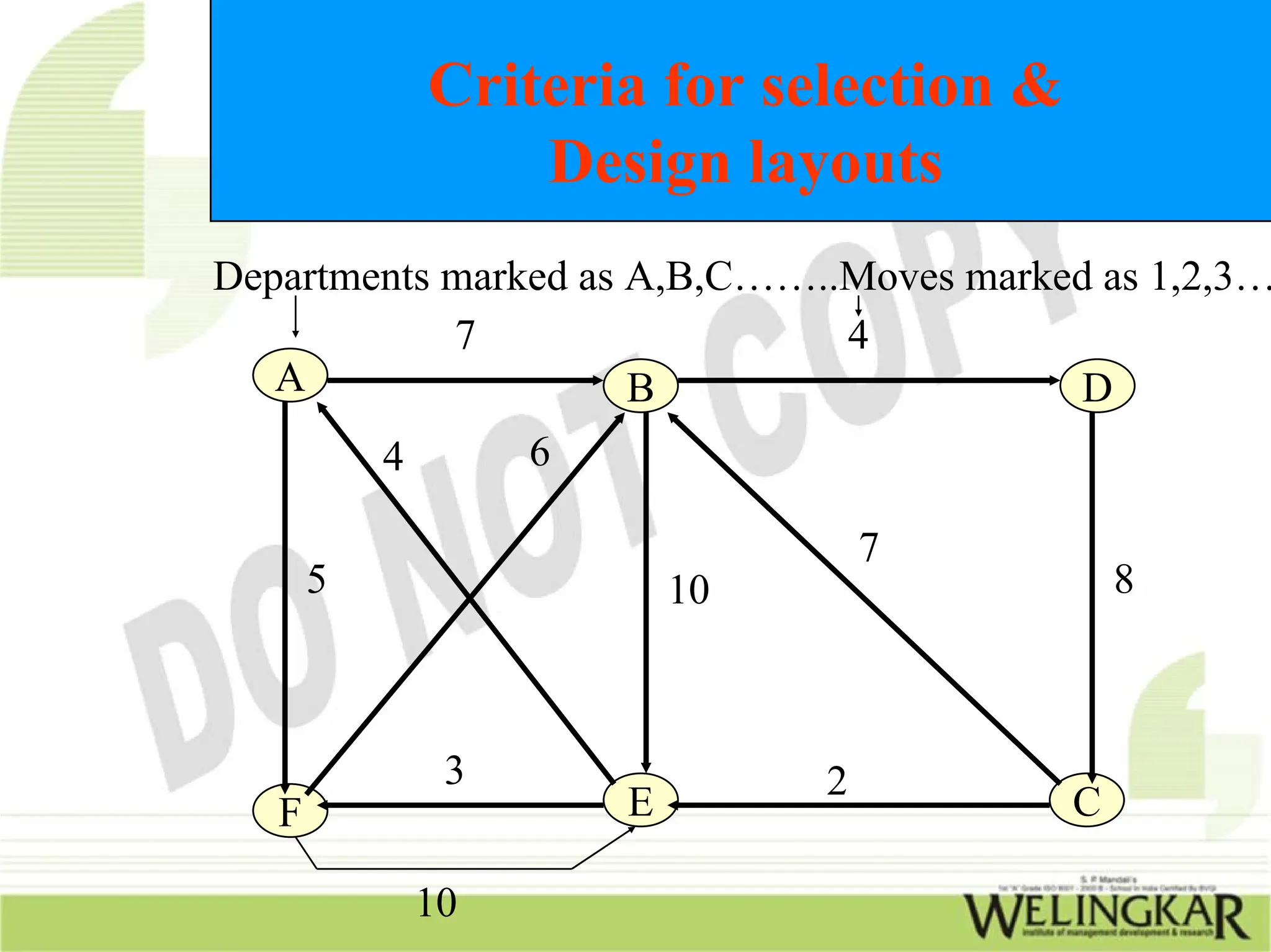
A
F
D
B
C
E
7
4 6
5
3
10
2
7
4
8
10
Departments marked as A,B,C……..Moves marked as 1,2,3…
Criteria for selection &
Design layouts
The various methods used for selecting the best layout are
Long Distance Analysis method
™When designing a new assembly plant or retrofitting an
existing plant, it is critical to determine where all the
materials will be received, stored and used.
™Variable width and color material flow diagrams created
by Factory FLOW are especially useful for presenting this
information.
™Factory FLOW automatically finds the shortest route
from origin to destination along an aisle network for all
materials/parts involved.
Criteria for selection &
Design layouts
™Once routes are determined. Factory FLOW draws the
routes, outputs travel distances, times, and costs to report
files and scales the thickness of flow lines according to the
flow intensity of each part.
™The input data required by Factory FLOW is the kind of
basic from-to information typically already available in a
database or spreadsheet.
™Among other output reports, Factory FLOW generates
detailed reports on manpower requirements by equipment
type. Factory FLOW's from-to chart shows the flow
intensities and distances between ail from-to locations
analyzed.
Criteria for selection &
Design layouts
™The distance intensity chart plots each part's move
intensity against its travel distance on an X-Y graph.
™With the help of powerful personal computer systems
and user friendly graphical environments, material flow
studies of over 10,000 parts within facilities of over 5
million square feet can be accomplished by a novice user
in under an hour.
Systematic Layout Planning
™ Systematic Layout Planning(SLP) method is used in
some production system such as service system,where the
amount of material that flows between department may not
be critical for developing a good facility layout.
™This method develops a chart known as “Relationship
chart”or “Richard Muther’s half Matrix.
™Important ratings are indicated by a,e,i,o,u,x known as
“nearness code”
™a- absolutely necessary,e-essential
™I-important,o-o.k
™U-unimportant
™X-undesirable
Systematic Layout Planning
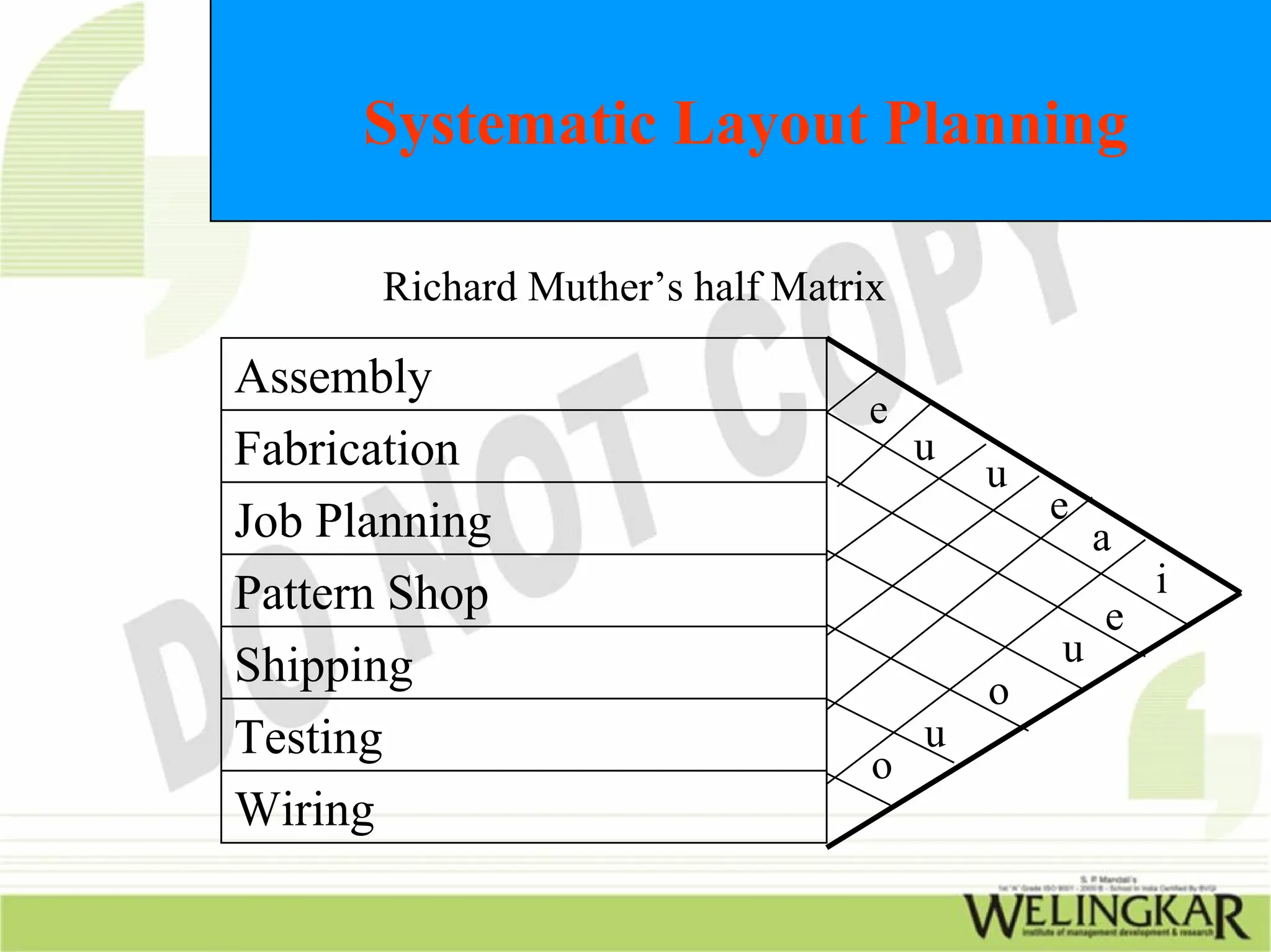
Assembly
Fabrication
Job Planning
Pattern Shop
Shipping
Testing
Wiring
o
u
o
u
e
i
e
u
u
e
a
Richard Muther’s half Matrix
Systematic Layout Planning
Richard Muther’s half Matrix
Job
Planning
Fabrication Assembly
Shipping
Pattern Shop Wiring
Testing
1
2
3 4
5
6
7
Job A
Job B
Job A
Job B
Plant Location
End Of
Chapter 10

Plant layout in production and Material Management

  • 1.
  • 2.
    Plant Layout Plant Layout ThisTechnical Measures Document refers to Plant Layout. Other relevant Technical Measures Documents are: •Design Codes - Plant •Design Codes – Pipe work •Plant Modification / Change procedures •Maintenance procedures When a new plant is erected The question of placement of machinery at different places,the location of the store,Plating shop,painting shop is very important. A good deal of expertise is used by management to secure a proper layout for new or existing plant.
  • 3.
    Plant Layout Meaning,Definition &scope ™A plant Layout refers to the arrangement of machinery & other industrial facilities such as receiving & shipping departments,Employer amenities for achieving quickest and smoothest production at least cost ™The subject of plant layout not only covers the initial layout,but encompasses improvement in ,or revision of existing layout ™A more simple definition is given by Knowles & Thomson they say the plant layout involves ™“Planning & arrangement of machinery & other industrial facilities & services for the first time in completely new plant ™The improvement of layout already in use ,in order to introduce new methods
  • 4.
    Objectives of good PlantLayout ™Provide enough Production Capacity ™Reduce material handling cost ™Reduce hazards to personnel ™Increase employee moral ™Reduce accidents ™Utilize available space ™Provide ease of production ™Provide ease of maintenance ™Provide ease of supervision ™Improve productivity ™Allow high machine utilization
  • 5.
    Factors Influencing Plant Layout Generalprinciples Plant layout is often a compromise between a number of factors such as: •The need to keep distances for transfer of materials between plant/storage units to a minimum to reduce costs and risks; •The geographical limitations of the site; •Interaction with existing or planned facilities on site such as existing roadways, drainage and utilities routings; •Interaction with other plants on site; •The need for plant operability and maintainability; •The need to locate hazardous materials facilities as far as possible from site boundaries and people living in the local neighborhood;
  • 6.
    Factors Influencing Plant Layout •Theneed to prevent confinement where release of flammable substances may occur; •The need to provide access for emergency services; •The need to provide emergency escape routes for on-site personnel; •The need to provide acceptable working conditions for operators. The most important factors of plant layout as far as safety aspects are concerned are those to: •Prevent, limit and/or mitigate escalation of adjacent events (domino); •Ensure safety within on-site occupied buildings; •Control access of unauthorized personnel;
  • 7.
    Factors Influencing Plant Layout •Facilitateaccess for emergency services. In determining plant layout designers should consider the factors in outlined in the following sections. Inherent safety The major principle in Inherent Safety is to remove the hazard altogether. The best method to achieve this is to reduce the inventory of hazardous substances such that a major hazard is no longer presented. However, this is not often readily achievable and by definition no COMAH facility will have done so. Other possible methods to achieve an Inherently Safer design are:
  • 8.
    Factors Influencing Plant Layout •Intensificationto reduce inventories; •Substitution of hazardous substances by less hazardous alternatives; •Attenuation to reduce hazardous process conditions i.e. temperature, pressure; •Simpler systems/processes to reduce potential loss of containment or possibility of errors causing a hazardous event; •Fail-safe design e.g. valve position on failure. Plant layout considerations to achieve Inherent Safety are mainly those concerned with domino effects (see below).
  • 9.
    Factors Influencing Plant Layout TheDow / Mond Indices These hazard indices are useful for evaluating processes or projects, ranking them against existing facilities, and assigning incident classifications. They provides a comparative measure of the overall risk of fire and explosion of a process, and are useful tools in the plant layout development stage since they enable objective spacing distances to be taken into account at all stages. The methodology for undertaking a rapid ranking method that is based on the Dow / Mond index is detailed in ILO, PIACT, Major Hazard Control: A practical manual, 1988. Although these are useful rule-of thumb methodologies for first consideration of plant layout, they do not replace risk assessment.
  • 10.
    Factors Influencing Plant Layout Thedistances derived between plant units using these systems are based upon engineering judgment and some degree of experience rather than any detailed analysis. Domino effects Hazard assessment of site layout is critical to ensure consequences of loss of containment and chances of escalation are minimized. Domino may be by fire, explosion (pressure wave and missiles) or toxic gas cloud causing loss of control of operations in another location. Fire A fire can spread in four ways: •Direct burning (including running liquid fires); •Convection; •Radiation;
  • 11.
    Factors Influencing Plant Layout •Conduction. Thespread of fire from its origin to other parts of the premises can be prevented by vertical and horizontal compartmentation using fire-resisting walls and floors. Further information may be found in BS 5908 : 1990. Consideration should also be given to the spread of flammable material via drains, ducts and ventilation systems. Delayed ignition following a release may result in spread of flames through such systems via dispersed flammable gases and vapors. Protection against domino effects by convection, conduction and radiation can be achieved by inherent safety principles
  • 12.
    Principles of Plant Layout ™Theprinciple of Minimum travel ™The principle of sequence ™The principle of usage ™The principle of compactness ™The principle of safety ™The principle of satisfaction ™The principle of minimum investment
  • 13.
    Types of Plant Layout ™Processlay out,job lay out,functional lay out ™Product layout or line processing lay out ™Fixed position lay out ™Cellular Manufacturing lay out ™Combinational or hybrid layout
  • 14.
    Types of Plant Layout Ch7 - 6 © 1998 by Prentice-Hall Inc Russell/Taylor Oper Mgt 2/e Manufacturing Process Layout L L L L L L L L L L M M M M D D D D D D D D G G G G G G P P A A A Receiving and Shipping Assembly Painting Department Lathe Department Milling Department Drilling Department Grinding Department
  • 15.
    Types of Plant Layout Ch 7 - 7 © 1 9 9 8 b y P re n tice -H a ll In c R u s se ll/T a ylo r O p e r M g t 2 /e S ervice P rocess L ayout W om e n ’s lin g e rie W om e n ’s d re ss e s W om e n ’s sp o rts w e a r S h o e s C o sm e tics & Je w e lry E n try & d is p la y a re a H o u se w a re s C h ild re n ’s d e p a rtm e n t M e n ’s d e p a rtm e n t
  • 16.
    Types of Plant Layout PR O C E S S L A Y O U T I N A F U N C T I O N A L A P P R O A C H : X X X M a c h in e m a c h in e g r o u p 1 g r o u p 2 M o v e m e n t o f p r o d u c t M a c h in e g r o u p 3 M a c h in e g r o u p ‘n ’ ‘R a n d o m ’ m o v e m e n t ta k e s p la c e a s p r o d u c ts a r e m o v e d a c c o r d in g to p r o c e s s r e q u ir e m e n ts . T h e r e is n o ‘flo w ’ a s s u c h - e a c h p r o d u c t w ill h a v e its p a r tic u la r p r o c e s s r e q u ir e m e n ts a n d w ill m o v e to e a c h m a c h in e g r o u p a s w h e n r e q u ir e d
  • 17.
    Types of Plant Layout FIX E D P O SIT IO N L A Y O U T P roduct O perators perform processes on the ‘fixed’ product. T here m ay be m ore than one operation perform ed on the product at the sam e tim e. E ach operation adds to the product until it is com pleted
  • 18.
    Types of PlantLayout Fixed position layout Air Craft Assembly Raw material Machine & Equipment Labor Finished product Air craft
  • 19.
    Types of Plant Layout PR O C E S S L A Y O U T IN A P R O D U C T F A M IL Y C E L L X X X X X X X g r o u p 1 g r o u p 2 g r o u p 3 g r o u p 4
  • 20.
    Types of Plant Layout Ch 7 - 8 © 1 9 9 8 b y P r e n t i c e - H a l l I n c R u s s e l l / T a y l o r O p e r M g t 2 / e A P r o d u c t L a y o u t I N O U T P R O D U C T L A Y O U T X X X A s s e m b l y / p a c k i n g
  • 21.
    Cellular Layout Solution 12 1 23 4 5 6 7 8 9 10 11 A B C Raw materials Cell1 Cell 2 Cell 3 Assembly
  • 22.
    Types of Plant Layout Ch7 - 9 © 1998 by Prentice-Hall Inc Russell/Taylor Oper Mgt 2/e Comparison Of Product And Process Layouts PRODUCT LAYOUT PROCESS LAYOUT 1. Description Sequential arrangement Functional grouping of machines of machines 2. Type of Process Continuous, mass Intermittent, job shop production, mainly batch production, assembly mainly fabrication 3. Product Standardized Varied, made to stock made to order 4. Demand Stable Fluctuating 5. Volume High Low 6. Equipment Special purpose General purpose 7. Workers Limited skills Varied skills
  • 23.
    Types of Plant Layout Ch7 - 10 © 1998 by Prentice-Hall Inc Russell/Taylor Oper Mgt 2/e Comparison Of Product And Process Layouts PRODUCT LAYOUT PROCESS LAYOUT 8. Inventory Low in-process, High in-process, high finished goods low finished goods 9. Storage space Small Large 10. Material Fixed path Variable path handling (conveyor) (forklift) 11. Aisles Narrow Wide 12. Scheduling Part of balancing Dynamic 13. Layout decision Line balancing Machine location 14. Goal Equalize work at Minimize material each station handling cost 15. Advantage Efficiency Flexibility
  • 24.
    Special arrangements forparticular type of plants (JOB PROCESSES ) 1.Investment in automation is for general purpose technology rather than product specific investment. 2.Many different products are run throughout the plant and materials handling has to be modified and adjusted to suit many different products and types 3.Detailed planning will evolve around sequencing requirements for each product, capacities for each work centre and order priorities: because of this scheduling is relatively complicated, in comparison to repetitive ‘line’ manufacture.
  • 25.
    Special arrangements forparticular type of plants (BATCH PROCESSES ) 1. Automation, especially for lower volumes of batch manufacturing, tends to be general purpose, rather than dedicated to a particular product whose volume does not demand product- specific investment in automation. 2. Scheduling is complicated and has to be completely reviewed on a regular, on-going basis - this applies to new products, ‘one-off’s’ that may be required, together with relatively high volume, standard products: all of these types will need to be scheduled.
  • 26.
    Special arrangements forparticular type of plants (BATCH PROCESSES ) 3.Operators have to be able to perform a number of functions - this is obviously true of ‘job’ types processes. In batch, though, this flexibility is crucial in that it will allow operators to move to various workstations as required. 4. Where automation is being used, set-up time should be short: the ideal set up times is quick enough to accommodate run lengths of just one unit, switching over to other models and volumes as, and when, required.
  • 27.
    Special arrangements forparticular type of plants (Line PROCESSES ) 1. Process times should be fast - which is critical in order to satisfy delivery speed requirements 2. There should be simplification in production planning and control and the tasks themselves should also be simplified for each workstation. 3. There should be small amounts of work in process: in fact, work in process (which, in accounting terms, can be viewed as an asset) is a liability to the company which can ruin cash-flow and stifle quick response to market requirements
  • 28.
    Special arrangements forparticular type of plants (Line PROCESSES ) 4. Materials handling between stations should be placed as closely as possible to each other. 5.Materials flow and control are critical : Just-in Time lends itself most noticeably to ‘line’ or very high volume batch production. Stock-outs have to be avoided although, at the same time, excess stock is a waste and a liability, rather than an asset (materials can be viewed as an asset on the balance sheet which is misleading and alien to world class manufacturing.
  • 29.
    Special arrangements forparticular type of plants (Continuous PROCESSES ) 1.The volume of a product is very high and the process is dedicated to making, typically, only one product. 2.Huge investment in dedicated plant is often required. 3.Much automation tends to be evident and labour input is one of ‘policing’ rather than being highly skilled as an integral input to the overall process.
  • 30.
    Importance of layout 1.Economicsof handling 2. Effective use of available area 3. Minimization of product delay 4.Improved Quality control 5.Minimum Equipment investment 6.Avoidance of bottleneck 7.Better production control 8.Improve employee moral
  • 31.
    Layout Planning Steps inlayout Planning and design Steps in layout Planning and design Product Analyst Process Equipment Direct labor Building design Plant layout Indirect labor Facilities Expected Volume Of Production Phase1 Phase2
  • 32.
    Layout Tools andtechniques ™Various tools & techniques are available for planning layouts ™The most common is to use two dimensional template. ™Templates are patterns which consists of a thin plate of wood or metal which serves as a gauge or guide in mechanical work.A plant layout template is a scaled representation of a physical object in a layout
  • 33.
    Criteria for selection& Design layouts Facility layouts must integrate work center location ,office,computer facilities.Two of major criteria for selecting and designing and layout are: ™Material handling cost: These costs are minimized by using mechanized handling of materials ™Worker effectiveness:Good layouts provide workers with satisfying job & permit them to work effectively at highest skill levels
  • 34.
    Criteria for selection& Design layouts The various methods used for selecting the best layout are Travel Chart method ™The travel chart which is also known as from to chart is helpful in analyzing overall flow of material ™It shows number of moves made between the department& identifies most active department ™The solution is provided by trial & error method & which attempts to minimize non adjacent flow by centrally locating the Active department
  • 35.
    Criteria for selection& Design layouts Travel Chart method(Procedure) ™Step1 Determine which departments have the most frequent links with other department This can be done in totaling entries in each row and column ™Step2 Try to locate Most active department in the central position in the outline ™Step3 by trial & error method locate other departments so that non adjacent flows are minimized ™Step4 If all the non adjacent moves are eliminated ,the solution is complete.
  • 36.
    Criteria for selection& Design layouts A F D B C E 7 4 6 5 3 10 2 7 4 8 10 Departments marked as A,B,C……..Moves marked as 1,2,3…
  • 37.
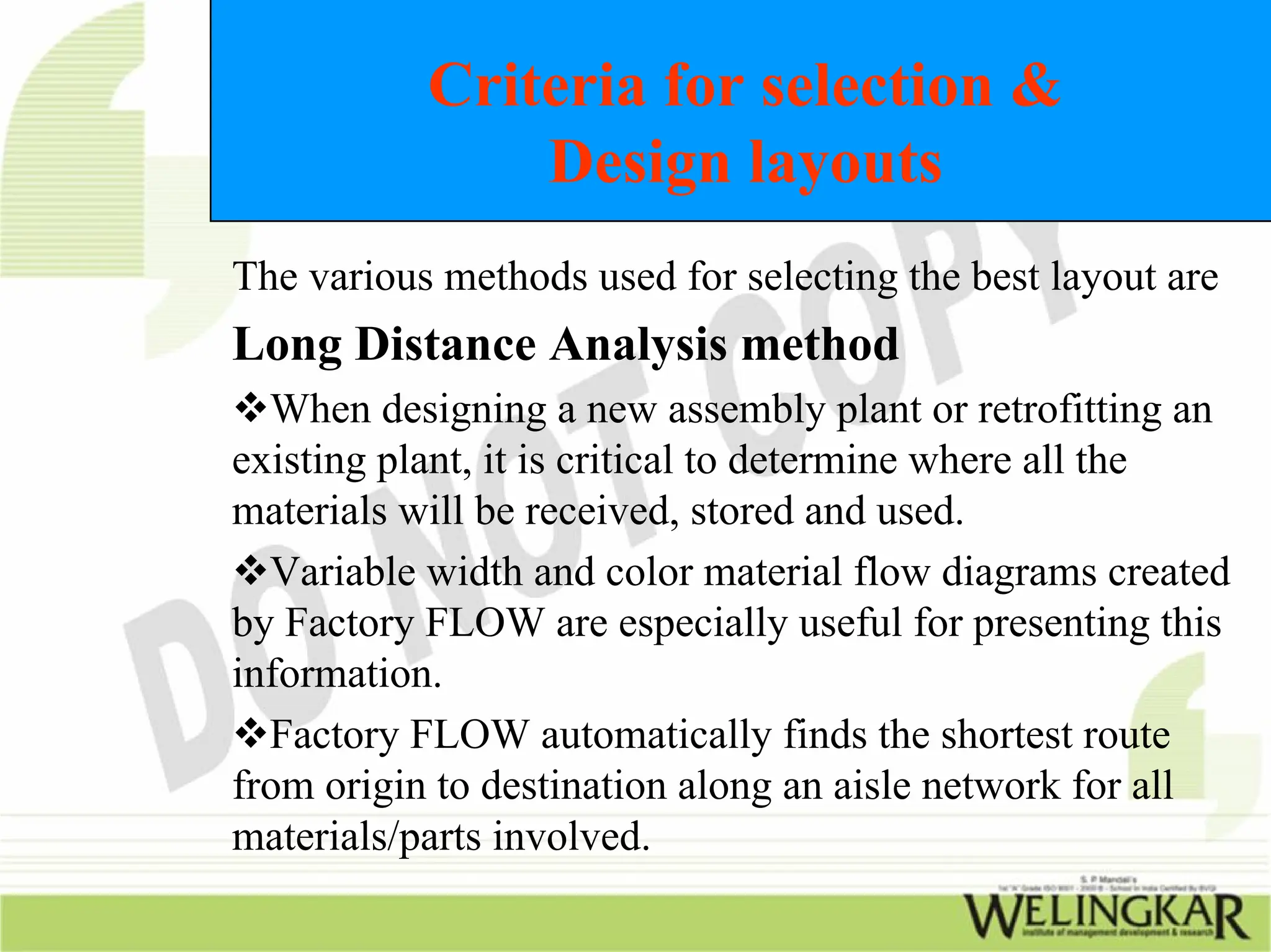
    Criteria for selection& Design layouts The various methods used for selecting the best layout are Long Distance Analysis method ™When designing a new assembly plant or retrofitting an existing plant, it is critical to determine where all the materials will be received, stored and used. ™Variable width and color material flow diagrams created by Factory FLOW are especially useful for presenting this information. ™Factory FLOW automatically finds the shortest route from origin to destination along an aisle network for all materials/parts involved.
  • 38.
    Criteria for selection& Design layouts ™Once routes are determined. Factory FLOW draws the routes, outputs travel distances, times, and costs to report files and scales the thickness of flow lines according to the flow intensity of each part. ™The input data required by Factory FLOW is the kind of basic from-to information typically already available in a database or spreadsheet. ™Among other output reports, Factory FLOW generates detailed reports on manpower requirements by equipment type. Factory FLOW's from-to chart shows the flow intensities and distances between ail from-to locations analyzed.
  • 39.
    Criteria for selection& Design layouts ™The distance intensity chart plots each part's move intensity against its travel distance on an X-Y graph. ™With the help of powerful personal computer systems and user friendly graphical environments, material flow studies of over 10,000 parts within facilities of over 5 million square feet can be accomplished by a novice user in under an hour.
  • 40.
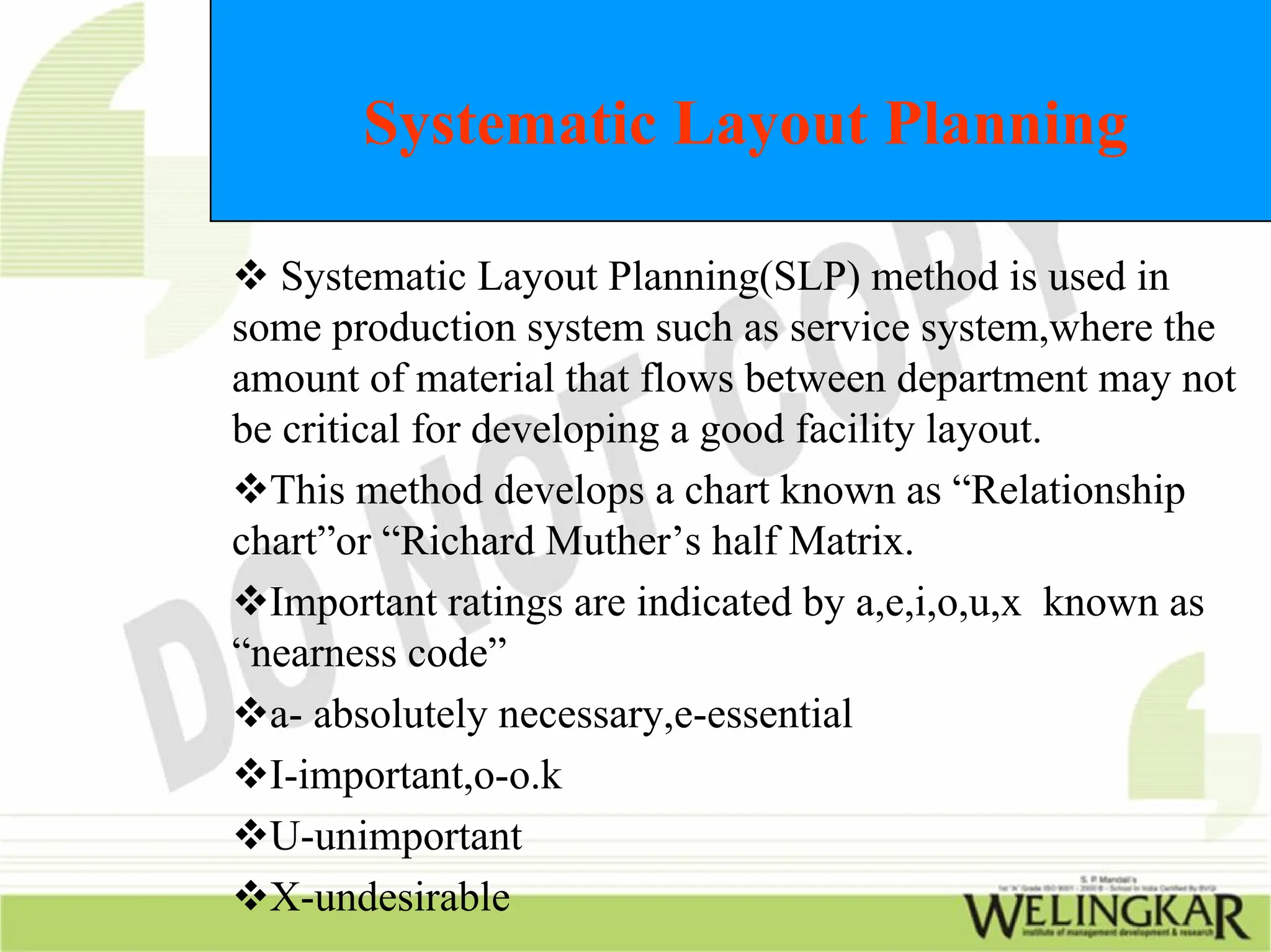
    Systematic Layout Planning ™Systematic Layout Planning(SLP) method is used in some production system such as service system,where the amount of material that flows between department may not be critical for developing a good facility layout. ™This method develops a chart known as “Relationship chart”or “Richard Muther’s half Matrix. ™Important ratings are indicated by a,e,i,o,u,x known as “nearness code” ™a- absolutely necessary,e-essential ™I-important,o-o.k ™U-unimportant ™X-undesirable
  • 41.
    Systematic Layout Planning Assembly Fabrication JobPlanning Pattern Shop Shipping Testing Wiring o u o u e i e u u e a Richard Muther’s half Matrix
  • 42.
    Systematic Layout Planning RichardMuther’s half Matrix Job Planning Fabrication Assembly Shipping Pattern Shop Wiring Testing 1 2 3 4 5 6 7 Job A Job B Job A Job B
  • 43.