MATERIALS HANDLING EQUIPMENT
LECTURE ONE
Introduction
Basics of Materials Handling Equipment
Outlines
 Definitions of MHE
 Benefits & Limitation of MHE
 Classification and Application of Material
handling
 Design considerations in MHE
By: Amanuel DIriba.
9/7/2019 By: Amanuel Diriba 1
9/7/2019 By: Amanuel Diriba 2
1.1 Material handling definition
 Material Handling is the movement, storage, control and
protection of materials, goods and products throughout the
process of manufacturing, distribution process including their
consumption and disposal.
 MH is the art and science of moving, storing, protecting, and
controlling material.
 Materials handling is the movement and storage of materials at
the lowest possible cost through the use of proper methods and
equipment.
 Materials handling is the art and science of conveying, elevating,
positioning, transporting, packaging and storing of materials.
9/7/2019 By: Amanuel Diriba 3
Cont..
 Material handling is the function of moving the right material to
the right place in the right time, in the right amount, in sequence,
and in the right condition to minimize production cost.
9/7/2019 By: Amanuel Diriba 4
Cont..
The essential requirements of a good materials handling
system may be summarized as:
(i) Efficient and safe movement of materials to the desired place.
(ii) Timely movement of the materials when needed.
(iii) Supply of materials at the desired rate.
(iv) Storing of materials utilizing minimum space.
(v) Lowest cost solution to the materials handling activities.
9/7/2019 By: Amanuel Diriba 5
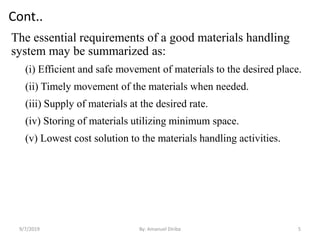
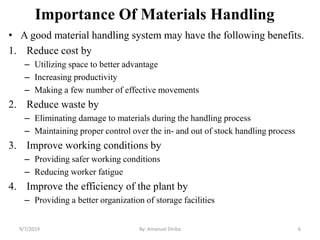
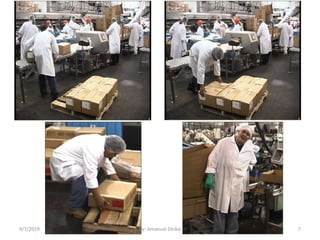
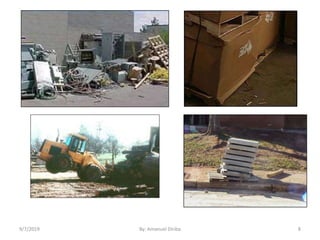
Importance Of Materials Handling
• A good material handling system may have the following benefits.
1. Reduce cost by
– Utilizing space to better advantage
– Increasing productivity
– Making a few number of effective movements
2. Reduce waste by
– Eliminating damage to materials during the handling process
– Maintaining proper control over the in- and out of stock handling process
3. Improve working conditions by
– Providing safer working conditions
– Reducing worker fatigue
4. Improve the efficiency of the plant by
– Providing a better organization of storage facilities
9/7/2019 By: Amanuel Diriba 6
9/7/2019 By: Amanuel Diriba 7
9/7/2019 By: Amanuel Diriba 8
Limitations Of Materials Handling
I. Additional capital cost involved in any materials handling
system.
II. Once a materials handling system get implemented, flexibility
for further changes gets greatly reduced.
III. With an integrated materials handling system installed,
failure/stoppage in any portion of it leads to increased
downtime of the production system.
IV. Materials handling system needs maintenance, hence any
addition to materials handling means additional maintenance
facilities and costs.
9/7/2019 By: Amanuel Diriba 9
Classification and Application of MHE
• The material handling technically divided into five distinct
functional divisions or spheres of activity are:-
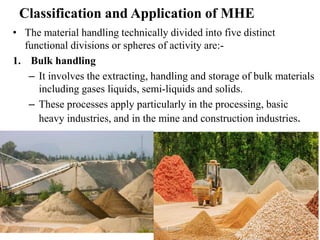
1. Bulk handling
– It involves the extracting, handling and storage of bulk materials
including gases liquids, semi-liquids and solids.
– These processes apply particularly in the processing, basic
heavy industries, and in the mine and construction industries.
9/7/2019 By: Amanuel Diriba 10
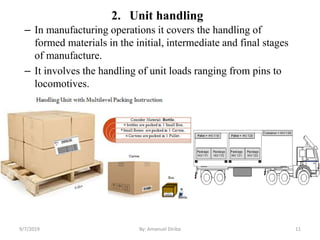
2. Unit handling
– In manufacturing operations it covers the handling of
formed materials in the initial, intermediate and final stages
of manufacture.
– It involves the handling of unit loads ranging from pins to
locomotives.
9/7/2019 By: Amanuel Diriba 11
3. Packaging
– Covers the design, selection and use of in process
containers, and included packing of semi-finished and
finished products
9/7/2019 By: Amanuel Diriba 12
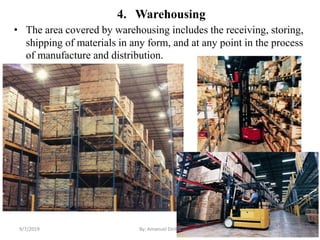
4. Warehousing
• The area covered by warehousing includes the receiving, storing,
shipping of materials in any form, and at any point in the process
of manufacture and distribution.
9/7/2019 By: Amanuel Diriba 13
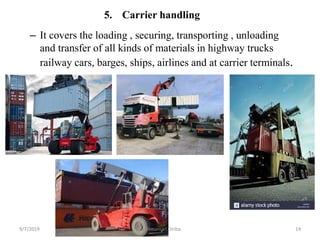
5. Carrier handling
– It covers the loading , securing, transporting , unloading
and transfer of all kinds of materials in highway trucks
railway cars, barges, ships, airlines and at carrier terminals.
9/7/2019 By: Amanuel Diriba 14
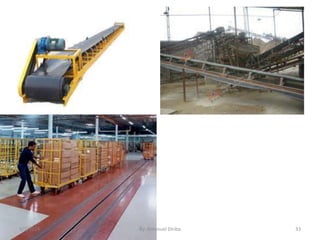
Material handling equipment can be classified into five major
categories:-
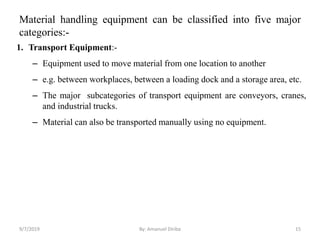
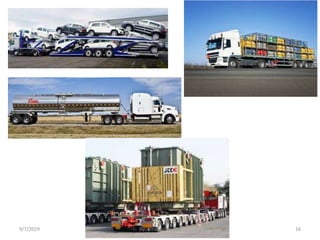
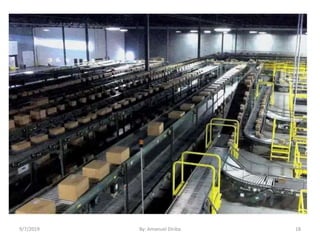
1. Transport Equipment:-
– Equipment used to move material from one location to another
– e.g. between workplaces, between a loading dock and a storage area, etc.
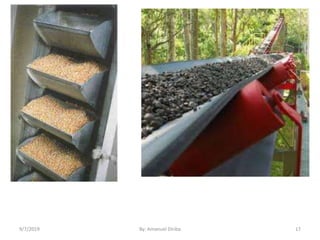
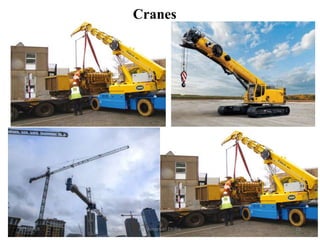
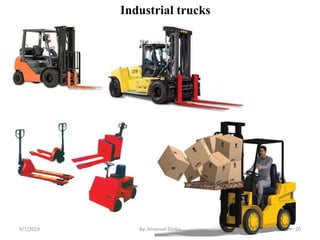
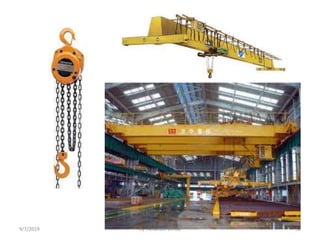
– The major subcategories of transport equipment are conveyors, cranes,
and industrial trucks.
– Material can also be transported manually using no equipment.
9/7/2019 By: Amanuel Diriba 15
9/7/2019 By: Amanuel Diriba 16
9/7/2019 By: Amanuel Diriba 17
9/7/2019 By: Amanuel Diriba 18
Cranes
9/7/2019 By: Amanuel Diriba 19
Industrial trucks
9/7/2019 By: Amanuel Diriba 20
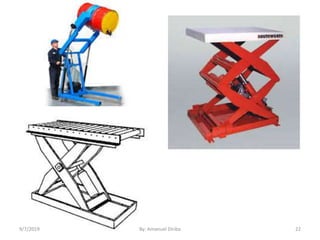
2. Positioning Equipment:-
– Equipment used to handle material at a single location
– e.g. to feed and/or manipulate materials so that are in the
correct position for subsequent handling, machining,
transport, or storage.
– Unlike transport equipment, positioning equipment is
usually used for handling at a single workplace.
– Material can also be positioned manually using no
equipment
9/7/2019 By: Amanuel Diriba 21
9/7/2019 By: Amanuel Diriba 22
Cont..
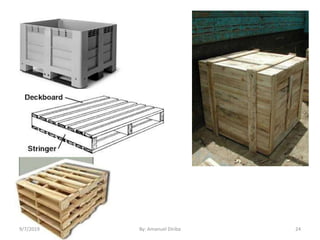
3. Unit Load Formation Equipment:-
– Equipment used to restrict materials so that they maintain
their integrity when handled a single load during transport
and for storage.
– If materials are self-restraining (e.g., a single part or
interlocking parts), then they can be formed into a unit
load with no equipment.
9/7/2019 By: Amanuel Diriba 23
9/7/2019 By: Amanuel Diriba 24
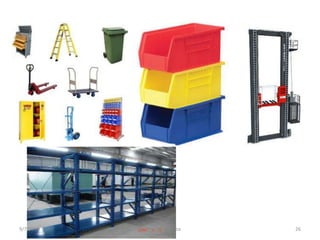
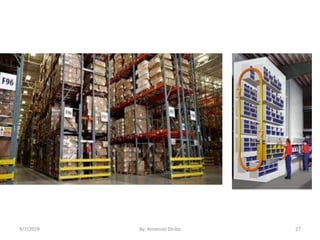
4. Storage Equipment
– Equipment used for holding or buffering materials over a
period of time.
– Some storage equipment may include the transport of
materials (e.g., the S/R machines of an AS/RS, or storage
carousels).
– If materials are block stacked directly on the floor, then no
storage equipment is required.
9/7/2019 By: Amanuel Diriba 25
9/7/2019 By: Amanuel Diriba 26
9/7/2019 By: Amanuel Diriba 27
Cont..
5. Identification and Control Equipment:-
– Equipment used to collect and communicate the
information that is used to coordinate the flow of
materials within a facility and between a facility and
its suppliers and customers.
– The identification of materials and associated control
can be performed manually with no specialized
equipment.
9/7/2019 By: Amanuel Diriba 28
9/7/2019 By: Amanuel Diriba 29
Cont..
• The three groups of materials handling equipment classified by
their design features
a. Hoisting equipment:
– A group of machines with lifting gear intended for moving
loads mainly in batches.
– This type of equipment is intended mainly for unit loads
– Hoisting machinery , cranes and elevators belong to this
group.
b. Conveying equipment:
– A group of machines, which may have no lifting gear and
which move load in a continuous flow.
– They are intended for bulk and unit loads one at a time
9/7/2019 By: Amanuel Diriba 30
Cont..
c. Surface and overhead equipment:
– A group of machines which may not be provided with
lifting gear and which usually handle loads in batches.
– Trackless trucks, narrow-gauge cars belong to this group.
Unit loads are formed solids of various sizes, shapes and
weights.
Bulk materials
– are those which are powdery, granular or lumpy in nature and are
stored in heaps.
– Example of bulk materials are: minerals (ores, coals etc.), earthly
materials (gravel, sand, clay etc.) processed materials (cement,
salt, chemicals etc.), agricultural products (grain, sugar, flour
etc.) and similar other materials.
9/7/2019 By: Amanuel Diriba 31
9/7/2019 By: Amanuel Diriba 32
9/7/2019 By: Amanuel Diriba 33
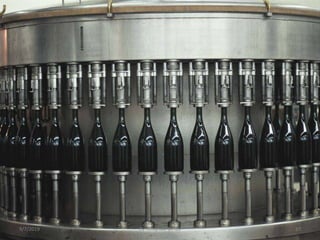
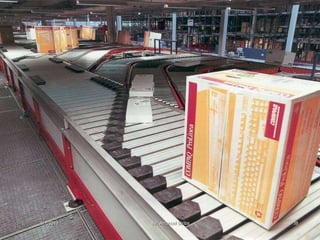
Some Application area of MHE
The application of materials handling is very wide. It is worthwhile
to list a few of them.
1. Manufacturing industry
2. Building construction industry
3. Heavy construction industry
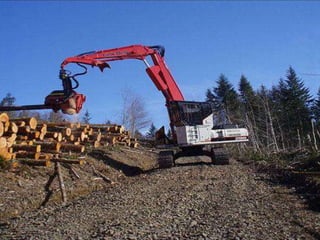
4. Mining industry
5. Food industry
6. Automotive and transportation industry
9/7/2019 By: Amanuel Diriba 34
9/7/2019 By: Amanuel Diriba 35
9/7/2019 By: Amanuel Diriba 36
9/7/2019 By: Amanuel Diriba 37
9/7/2019 By: Amanuel Diriba 38
9/7/2019 By: Amanuel Diriba 39
1.4 Design considerations in Material handling
I. Material characteristics
II. Flow rate
III. Plant layout
IV. Unit load principle
9/7/2019 By: Amanuel Diriba 40
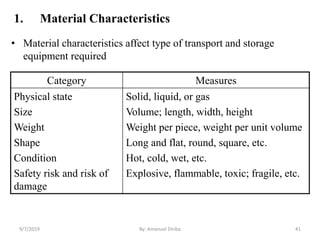
1. Material Characteristics
• Material characteristics affect type of transport and storage
equipment required
Category Measures
Physical state
Size
Weight
Shape
Condition
Safety risk and risk of
damage
Solid, liquid, or gas
Volume; length, width, height
Weight per piece, weight per unit volume
Long and flat, round, square, etc.
Hot, cold, wet, etc.
Explosive, flammable, toxic; fragile, etc.
9/7/2019 By: Amanuel Diriba 41
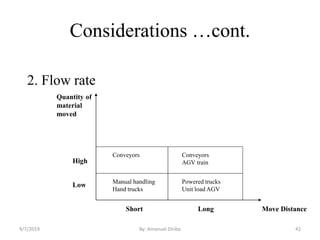
Considerations …cont.
2. Flow rate
Manual handling
Hand trucks
Powered trucks
Unit load AGV
Conveyors Conveyors
AGV trainHigh
Low
LongShort Move Distance
Quantity of
material
moved
9/7/2019 By: Amanuel Diriba 42
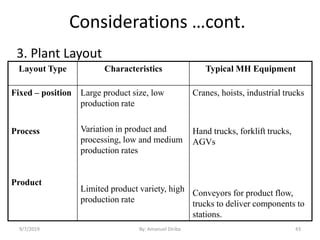
Considerations …cont.
3. Plant Layout
Layout Type Characteristics Typical MH Equipment
Fixed – position
Process
Product
Large product size, low
production rate
Variation in product and
processing, low and medium
production rates
Limited product variety, high
production rate
Cranes, hoists, industrial trucks
Hand trucks, forklift trucks,
AGVs
Conveyors for product flow,
trucks to deliver components to
stations.
9/7/2019 By: Amanuel Diriba 43
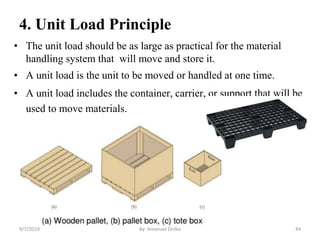
4. Unit Load Principle
• The unit load should be as large as practical for the material
handling system that will move and store it.
• A unit load is the unit to be moved or handled at one time.
• A unit load includes the container, carrier, or support that will be
used to move materials.
9/7/2019 By: Amanuel Diriba 44
Cont..
• Factors for determining unit load/ container:
– Size of carrier
– Size and weight of items
– Space for storing loaded/unloaded container
– Equipment used for moving
– Cost, supply and maintenance
– Aisle widths, door sizes, and clear stacking heights
– Environmental regulations
9/7/2019 By: Amanuel Diriba 45
Cont..
Reasons for using unit loads in material handling:
– Multiple items handled simultaneously
– Required number of trips is reduced
– Loading/unloading times are reduced
– Product damage is decreased
Unit Load Disadvantages
– Time spent forming and breaking down the unit load
– Empty containers/pallets may need to be returned to their
point of origin.
– Cost of containers/pallets and other load restraining materials
used in the unit load
9/7/2019 By: Amanuel Diriba 46
Cont..
The major advantages of unitization and handling of
unit loads are:
(i) It permits handling of larger loads at a time and
thereby reduces handling and transportation
costs.
(ii) Loading and unloading time of unit load is
substantially less than when handled as loose/
individual material.
(iii)Unitized loads are less susceptible to damage and
loss during movement from one place to another.
(iv) It offers safer handling and transportation
compared to those of loose materials
9/7/2019 By: Amanuel Diriba 47

Lecture 1 Material Handling Equipment (Introduction to Material handling equipment)

  • 1.
    MATERIALS HANDLING EQUIPMENT LECTUREONE Introduction Basics of Materials Handling Equipment Outlines  Definitions of MHE  Benefits & Limitation of MHE  Classification and Application of Material handling  Design considerations in MHE By: Amanuel DIriba. 9/7/2019 By: Amanuel Diriba 1
  • 2.
  • 3.
    1.1 Material handlingdefinition  Material Handling is the movement, storage, control and protection of materials, goods and products throughout the process of manufacturing, distribution process including their consumption and disposal.  MH is the art and science of moving, storing, protecting, and controlling material.  Materials handling is the movement and storage of materials at the lowest possible cost through the use of proper methods and equipment.  Materials handling is the art and science of conveying, elevating, positioning, transporting, packaging and storing of materials. 9/7/2019 By: Amanuel Diriba 3
  • 4.
    Cont..  Material handlingis the function of moving the right material to the right place in the right time, in the right amount, in sequence, and in the right condition to minimize production cost. 9/7/2019 By: Amanuel Diriba 4
  • 5.
    Cont.. The essential requirementsof a good materials handling system may be summarized as: (i) Efficient and safe movement of materials to the desired place. (ii) Timely movement of the materials when needed. (iii) Supply of materials at the desired rate. (iv) Storing of materials utilizing minimum space. (v) Lowest cost solution to the materials handling activities. 9/7/2019 By: Amanuel Diriba 5
  • 6.
    Importance Of MaterialsHandling • A good material handling system may have the following benefits. 1. Reduce cost by – Utilizing space to better advantage – Increasing productivity – Making a few number of effective movements 2. Reduce waste by – Eliminating damage to materials during the handling process – Maintaining proper control over the in- and out of stock handling process 3. Improve working conditions by – Providing safer working conditions – Reducing worker fatigue 4. Improve the efficiency of the plant by – Providing a better organization of storage facilities 9/7/2019 By: Amanuel Diriba 6
  • 7.
  • 8.
  • 9.
    Limitations Of MaterialsHandling I. Additional capital cost involved in any materials handling system. II. Once a materials handling system get implemented, flexibility for further changes gets greatly reduced. III. With an integrated materials handling system installed, failure/stoppage in any portion of it leads to increased downtime of the production system. IV. Materials handling system needs maintenance, hence any addition to materials handling means additional maintenance facilities and costs. 9/7/2019 By: Amanuel Diriba 9
  • 10.
    Classification and Applicationof MHE • The material handling technically divided into five distinct functional divisions or spheres of activity are:- 1. Bulk handling – It involves the extracting, handling and storage of bulk materials including gases liquids, semi-liquids and solids. – These processes apply particularly in the processing, basic heavy industries, and in the mine and construction industries. 9/7/2019 By: Amanuel Diriba 10
  • 11.
    2. Unit handling –In manufacturing operations it covers the handling of formed materials in the initial, intermediate and final stages of manufacture. – It involves the handling of unit loads ranging from pins to locomotives. 9/7/2019 By: Amanuel Diriba 11
  • 12.
    3. Packaging – Coversthe design, selection and use of in process containers, and included packing of semi-finished and finished products 9/7/2019 By: Amanuel Diriba 12
  • 13.
    4. Warehousing • Thearea covered by warehousing includes the receiving, storing, shipping of materials in any form, and at any point in the process of manufacture and distribution. 9/7/2019 By: Amanuel Diriba 13
  • 14.
    5. Carrier handling –It covers the loading , securing, transporting , unloading and transfer of all kinds of materials in highway trucks railway cars, barges, ships, airlines and at carrier terminals. 9/7/2019 By: Amanuel Diriba 14
  • 15.
    Material handling equipmentcan be classified into five major categories:- 1. Transport Equipment:- – Equipment used to move material from one location to another – e.g. between workplaces, between a loading dock and a storage area, etc. – The major subcategories of transport equipment are conveyors, cranes, and industrial trucks. – Material can also be transported manually using no equipment. 9/7/2019 By: Amanuel Diriba 15
  • 16.
  • 17.
  • 18.
  • 19.
  • 20.
  • 21.
    2. Positioning Equipment:- –Equipment used to handle material at a single location – e.g. to feed and/or manipulate materials so that are in the correct position for subsequent handling, machining, transport, or storage. – Unlike transport equipment, positioning equipment is usually used for handling at a single workplace. – Material can also be positioned manually using no equipment 9/7/2019 By: Amanuel Diriba 21
  • 22.
  • 23.
    Cont.. 3. Unit LoadFormation Equipment:- – Equipment used to restrict materials so that they maintain their integrity when handled a single load during transport and for storage. – If materials are self-restraining (e.g., a single part or interlocking parts), then they can be formed into a unit load with no equipment. 9/7/2019 By: Amanuel Diriba 23
  • 24.
  • 25.
    4. Storage Equipment –Equipment used for holding or buffering materials over a period of time. – Some storage equipment may include the transport of materials (e.g., the S/R machines of an AS/RS, or storage carousels). – If materials are block stacked directly on the floor, then no storage equipment is required. 9/7/2019 By: Amanuel Diriba 25
  • 26.
  • 27.
  • 28.
    Cont.. 5. Identification andControl Equipment:- – Equipment used to collect and communicate the information that is used to coordinate the flow of materials within a facility and between a facility and its suppliers and customers. – The identification of materials and associated control can be performed manually with no specialized equipment. 9/7/2019 By: Amanuel Diriba 28
  • 29.
  • 30.
    Cont.. • The threegroups of materials handling equipment classified by their design features a. Hoisting equipment: – A group of machines with lifting gear intended for moving loads mainly in batches. – This type of equipment is intended mainly for unit loads – Hoisting machinery , cranes and elevators belong to this group. b. Conveying equipment: – A group of machines, which may have no lifting gear and which move load in a continuous flow. – They are intended for bulk and unit loads one at a time 9/7/2019 By: Amanuel Diriba 30
  • 31.
    Cont.. c. Surface andoverhead equipment: – A group of machines which may not be provided with lifting gear and which usually handle loads in batches. – Trackless trucks, narrow-gauge cars belong to this group. Unit loads are formed solids of various sizes, shapes and weights. Bulk materials – are those which are powdery, granular or lumpy in nature and are stored in heaps. – Example of bulk materials are: minerals (ores, coals etc.), earthly materials (gravel, sand, clay etc.) processed materials (cement, salt, chemicals etc.), agricultural products (grain, sugar, flour etc.) and similar other materials. 9/7/2019 By: Amanuel Diriba 31
  • 32.
  • 33.
  • 34.
    Some Application areaof MHE The application of materials handling is very wide. It is worthwhile to list a few of them. 1. Manufacturing industry 2. Building construction industry 3. Heavy construction industry 4. Mining industry 5. Food industry 6. Automotive and transportation industry 9/7/2019 By: Amanuel Diriba 34
  • 35.
  • 36.
  • 37.
  • 38.
  • 39.
  • 40.
    1.4 Design considerationsin Material handling I. Material characteristics II. Flow rate III. Plant layout IV. Unit load principle 9/7/2019 By: Amanuel Diriba 40
  • 41.
    1. Material Characteristics •Material characteristics affect type of transport and storage equipment required Category Measures Physical state Size Weight Shape Condition Safety risk and risk of damage Solid, liquid, or gas Volume; length, width, height Weight per piece, weight per unit volume Long and flat, round, square, etc. Hot, cold, wet, etc. Explosive, flammable, toxic; fragile, etc. 9/7/2019 By: Amanuel Diriba 41
  • 42.
    Considerations …cont. 2. Flowrate Manual handling Hand trucks Powered trucks Unit load AGV Conveyors Conveyors AGV trainHigh Low LongShort Move Distance Quantity of material moved 9/7/2019 By: Amanuel Diriba 42
  • 43.
    Considerations …cont. 3. PlantLayout Layout Type Characteristics Typical MH Equipment Fixed – position Process Product Large product size, low production rate Variation in product and processing, low and medium production rates Limited product variety, high production rate Cranes, hoists, industrial trucks Hand trucks, forklift trucks, AGVs Conveyors for product flow, trucks to deliver components to stations. 9/7/2019 By: Amanuel Diriba 43
  • 44.
    4. Unit LoadPrinciple • The unit load should be as large as practical for the material handling system that will move and store it. • A unit load is the unit to be moved or handled at one time. • A unit load includes the container, carrier, or support that will be used to move materials. 9/7/2019 By: Amanuel Diriba 44
  • 45.
    Cont.. • Factors fordetermining unit load/ container: – Size of carrier – Size and weight of items – Space for storing loaded/unloaded container – Equipment used for moving – Cost, supply and maintenance – Aisle widths, door sizes, and clear stacking heights – Environmental regulations 9/7/2019 By: Amanuel Diriba 45
  • 46.
    Cont.. Reasons for usingunit loads in material handling: – Multiple items handled simultaneously – Required number of trips is reduced – Loading/unloading times are reduced – Product damage is decreased Unit Load Disadvantages – Time spent forming and breaking down the unit load – Empty containers/pallets may need to be returned to their point of origin. – Cost of containers/pallets and other load restraining materials used in the unit load 9/7/2019 By: Amanuel Diriba 46
  • 47.
    Cont.. The major advantagesof unitization and handling of unit loads are: (i) It permits handling of larger loads at a time and thereby reduces handling and transportation costs. (ii) Loading and unloading time of unit load is substantially less than when handled as loose/ individual material. (iii)Unitized loads are less susceptible to damage and loss during movement from one place to another. (iv) It offers safer handling and transportation compared to those of loose materials 9/7/2019 By: Amanuel Diriba 47