Planning and Executing
a Successful Industrial
Hygiene Program
Meet Your Moderator
During This Webinar
 All lines will be muted – please communicate via the
questions pane in your webinar panel.
 There will be a Q&A session at the end of the
presentation – submit your question(s) anytime
throughout the webinar.
 Unanswered questions will be responded to after the
webinar.
 The presentation will be emailed to you tomorrow.
Meet Your Presenter
Mark Liffers
Practice Director of EH&S Consulting
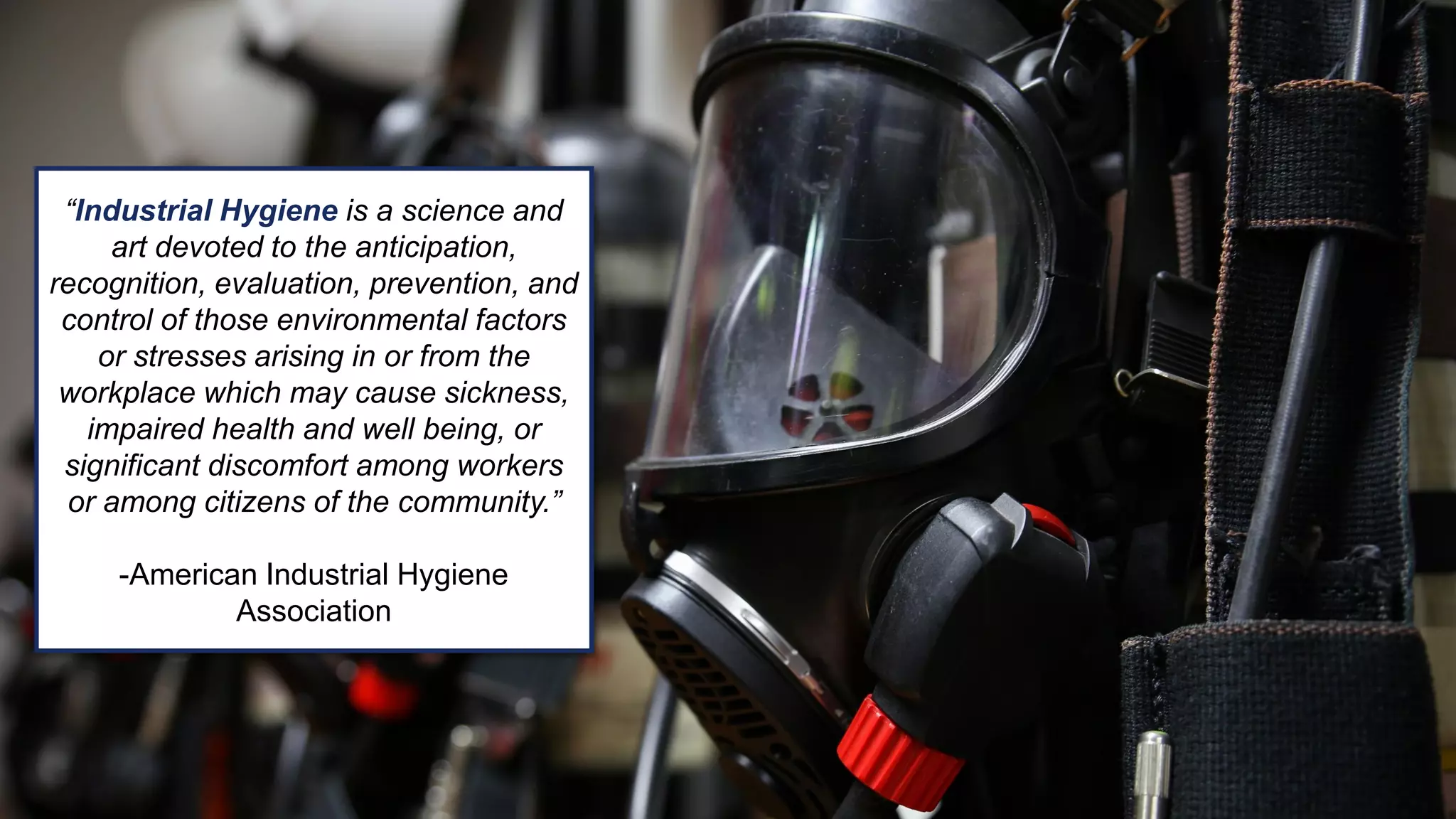
“Industrial Hygiene is a science and
art devoted to the anticipation,
recognition, evaluation, prevention, and
control of those environmental factors
or stresses arising in or from the
workplace which may cause sickness,
impaired health and well being, or
significant discomfort among workers
or among citizens of the community.”
-American Industrial Hygiene
Association
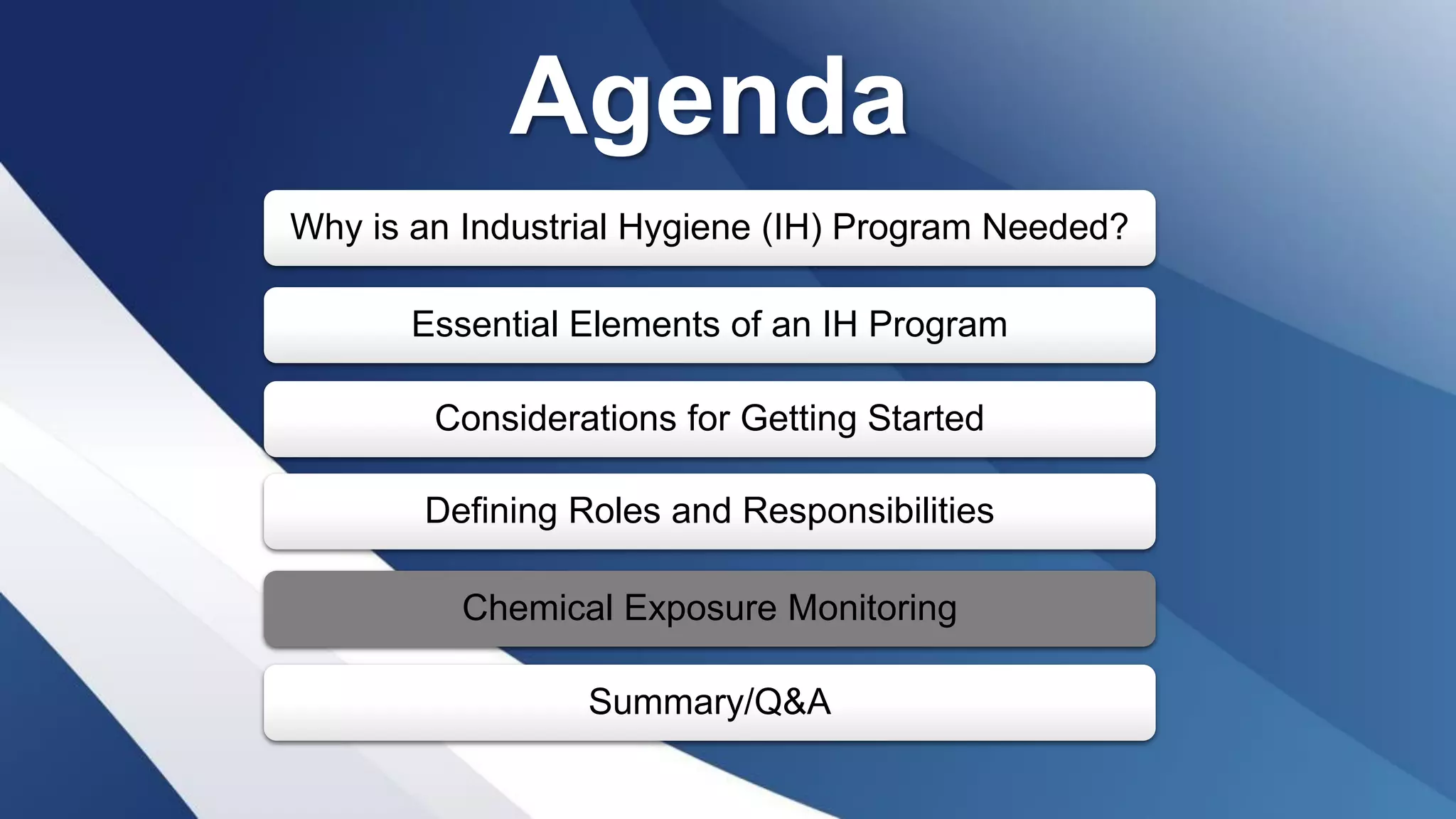
Agenda
Why is an Industrial Hygiene (IH) Program Needed?
Essential Elements of an IH Program
Considerations for Getting Started
Defining Roles and Responsibilities
Chemical Exposure Monitoring
Summary/Q&A
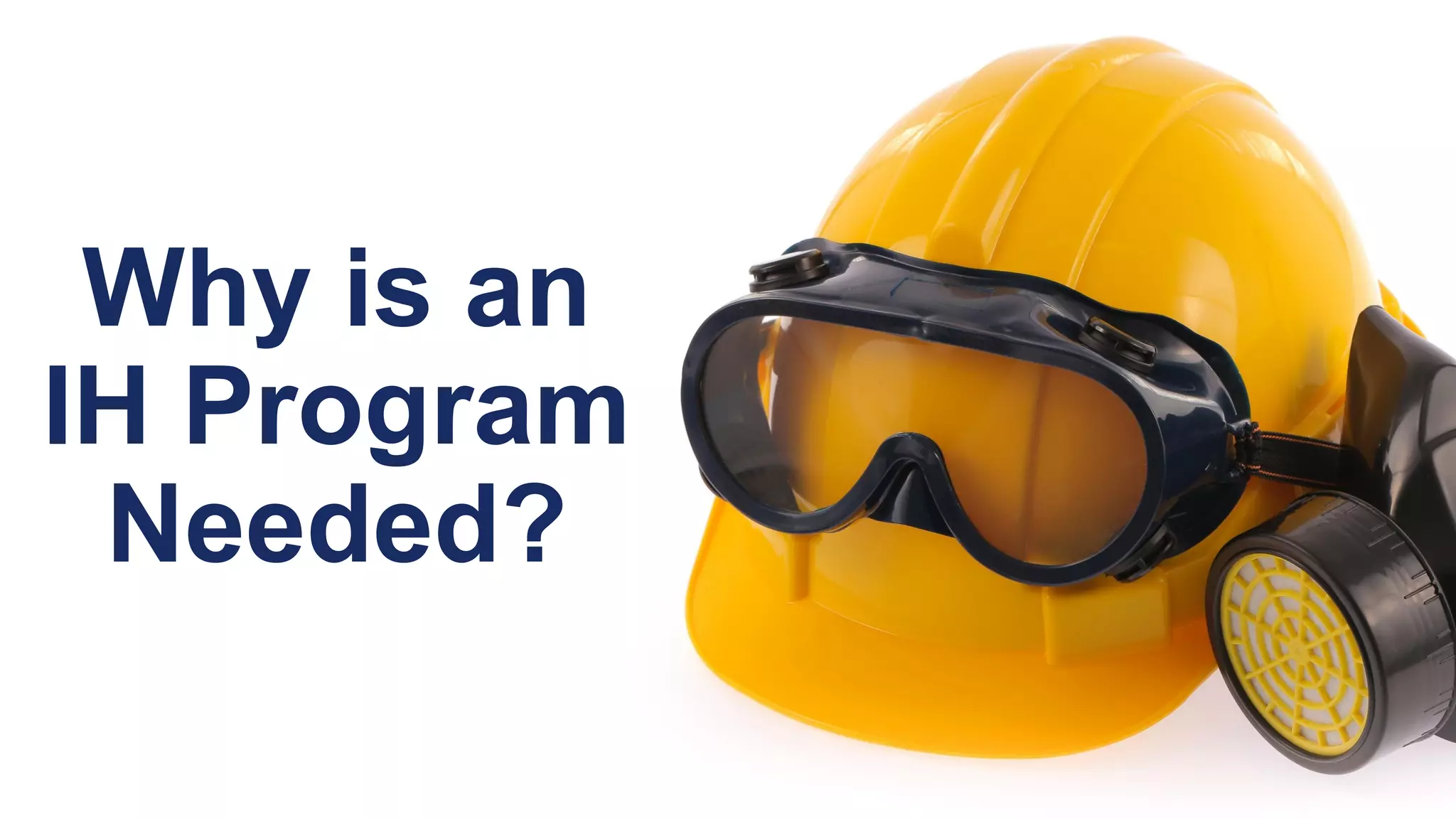
Why is an
IH Program
Needed?
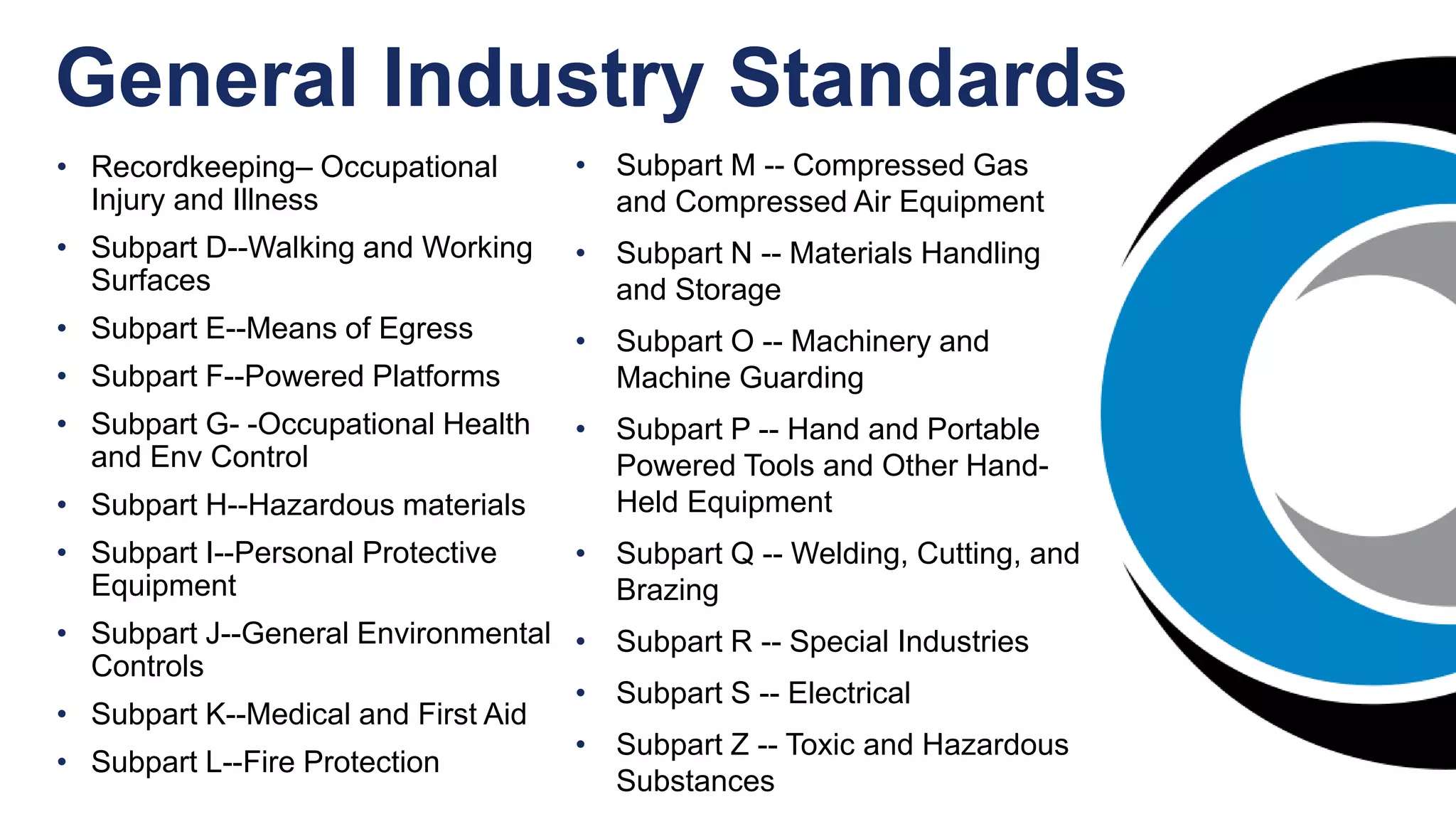
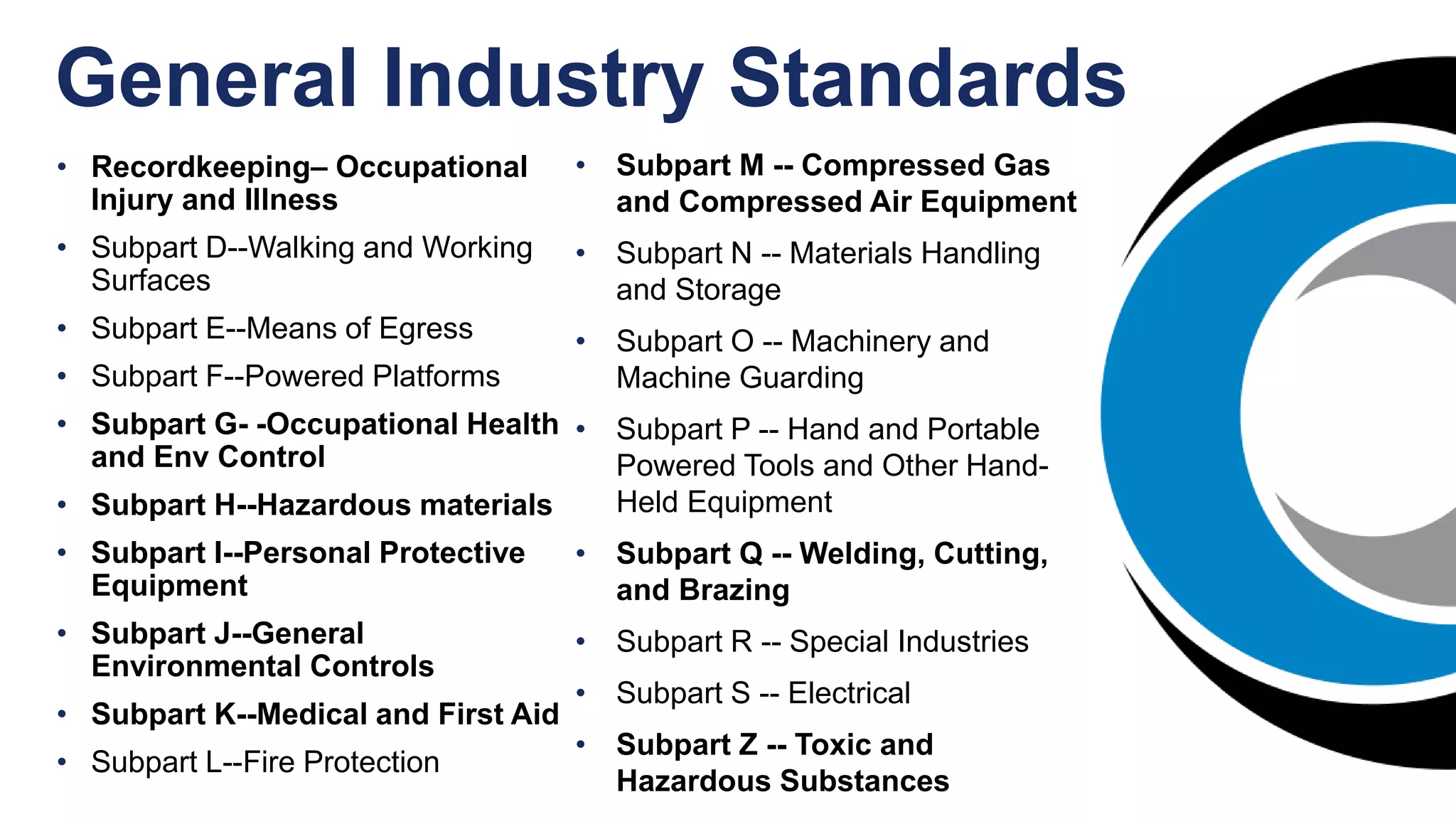
General Industry Standards
• Recordkeeping– Occupational
Injury and Illness
• Subpart D--Walking and Working
Surfaces
• Subpart E--Means of Egress
• Subpart F--Powered Platforms
• Subpart G- -Occupational Health
and Env Control
• Subpart H--Hazardous materials
• Subpart I--Personal Protective
Equipment
• Subpart J--General Environmental
Controls
• Subpart K--Medical and First Aid
• Subpart L--Fire Protection
• Subpart M -- Compressed Gas
and Compressed Air Equipment
• Subpart N -- Materials Handling
and Storage
• Subpart O -- Machinery and
Machine Guarding
• Subpart P -- Hand and Portable
Powered Tools and Other Hand-
Held Equipment
• Subpart Q -- Welding, Cutting, and
Brazing
• Subpart R -- Special Industries
• Subpart S -- Electrical
• Subpart Z -- Toxic and Hazardous
Substances
• Recordkeeping– Occupational
Injury and Illness
• Subpart D--Walking and Working
Surfaces
• Subpart E--Means of Egress
• Subpart F--Powered Platforms
• Subpart G- -Occupational Health
and Env Control
• Subpart H--Hazardous materials
• Subpart I--Personal Protective
Equipment
• Subpart J--General
Environmental Controls
• Subpart K--Medical and First Aid
• Subpart L--Fire Protection
• Subpart M -- Compressed Gas
and Compressed Air Equipment
• Subpart N -- Materials Handling
and Storage
• Subpart O -- Machinery and
Machine Guarding
• Subpart P -- Hand and Portable
Powered Tools and Other Hand-
Held Equipment
• Subpart Q -- Welding, Cutting,
and Brazing
• Subpart R -- Special Industries
• Subpart S -- Electrical
• Subpart Z -- Toxic and
Hazardous Substances
General Industry Standards
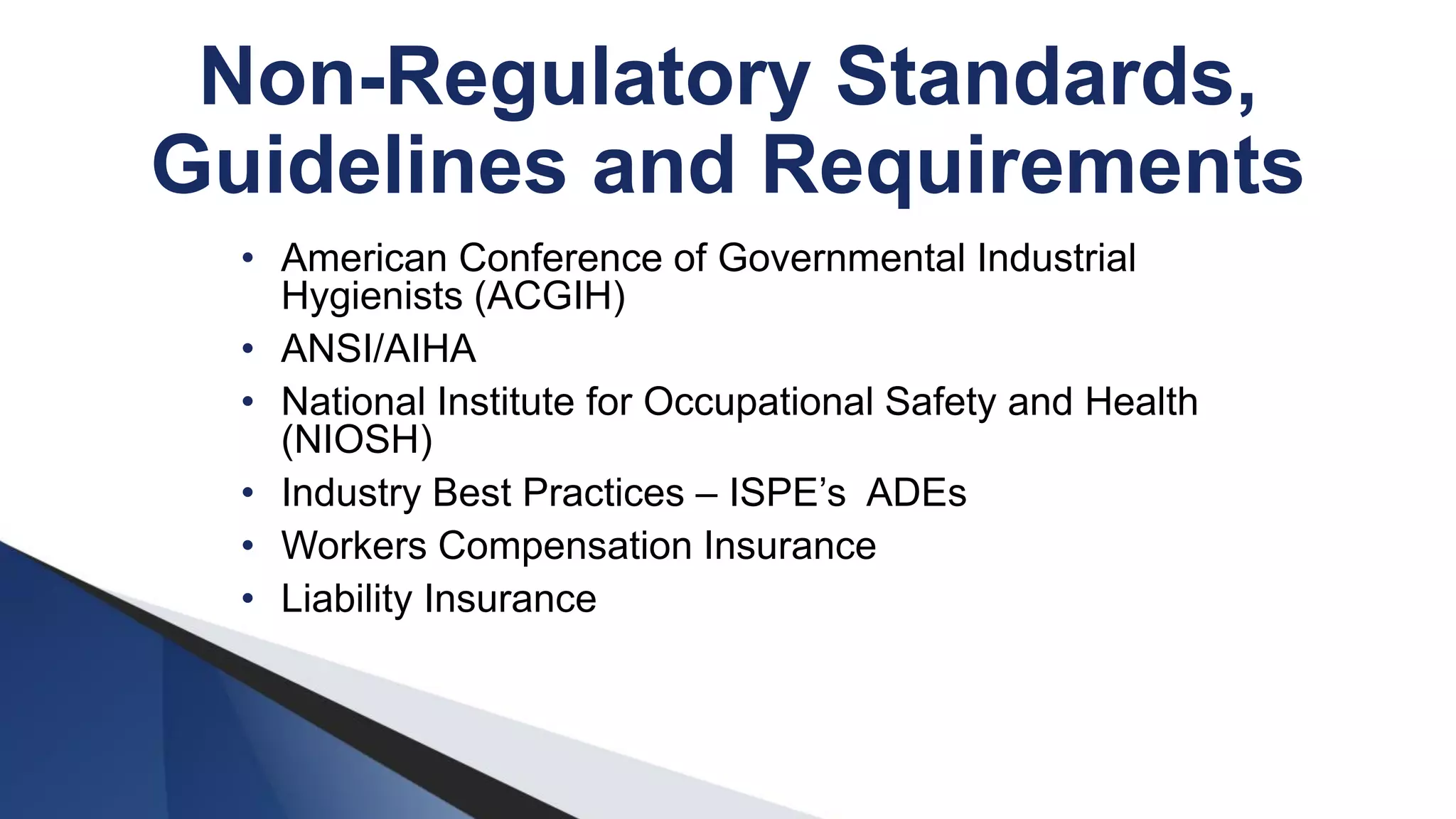
Non-Regulatory Standards,
Guidelines and Requirements
• American Conference of Governmental Industrial
Hygienists (ACGIH)
• ANSI/AIHA
• National Institute for Occupational Safety and Health
(NIOSH)
• Industry Best Practices – ISPE’s ADEs
• Workers Compensation Insurance
• Liability Insurance
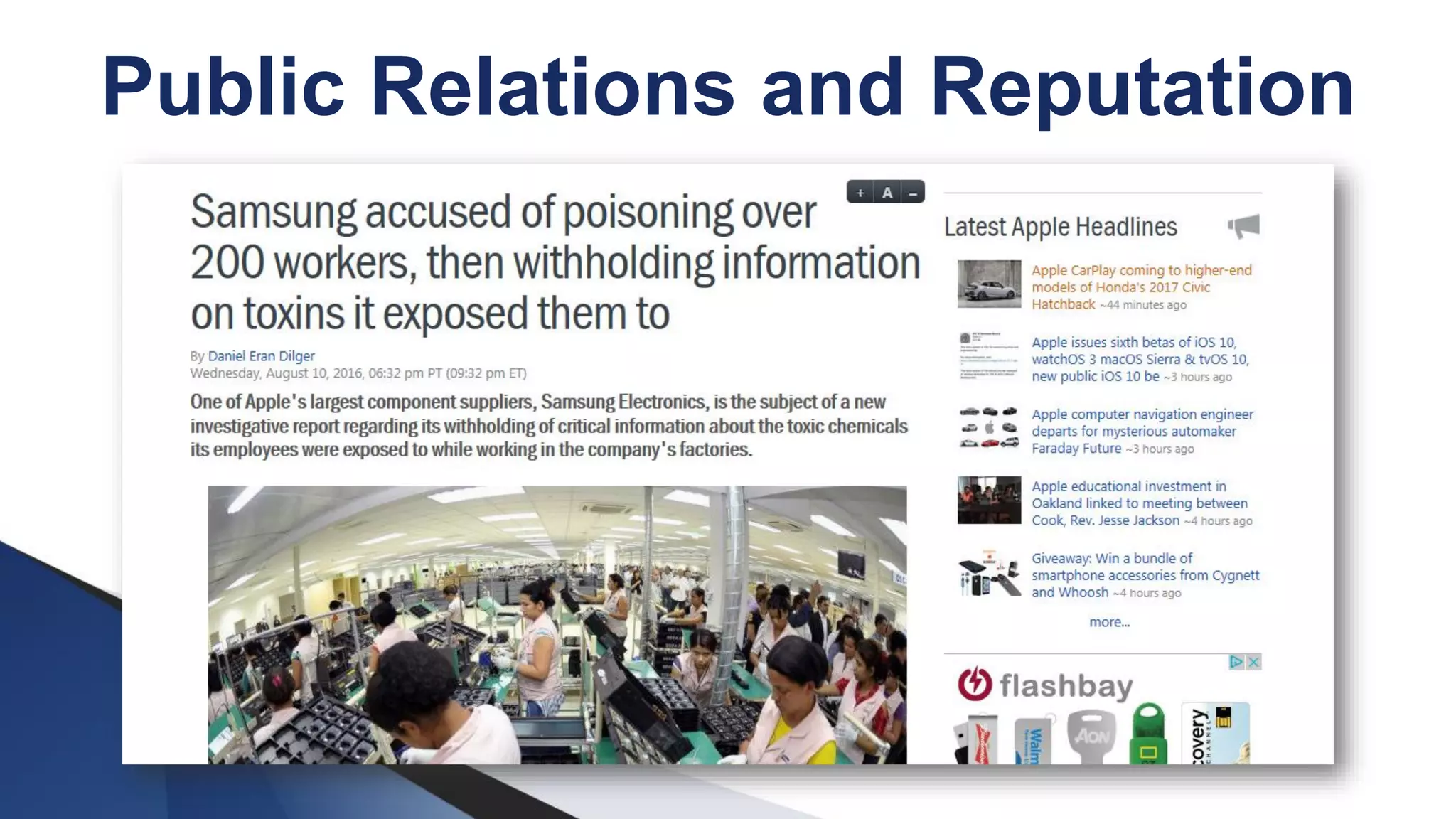
Public Relations and Reputation
Agenda
Why is an Industrial Hygiene (IH) Program Needed?
Essential Elements of an IH Program
Considerations for Getting Started
Defining Roles and Responsibilities
Chemical Exposure Monitoring
Summary/Q&A
Poll Question
1
3
How would you describe
your Industrial Hygiene
program?
Define the Purpose
“This program is intended to help
ensure the health and safety of our
employees, contractors others who
visit our site”
“To meet regulatory requirements”
“To meet our Global Corporate Health
and Safety goals”
Define the Scope
“This program applies to all of our
activities at our manufacturing and
service”
“This program applies to all North
American contractors and
subcontractors”
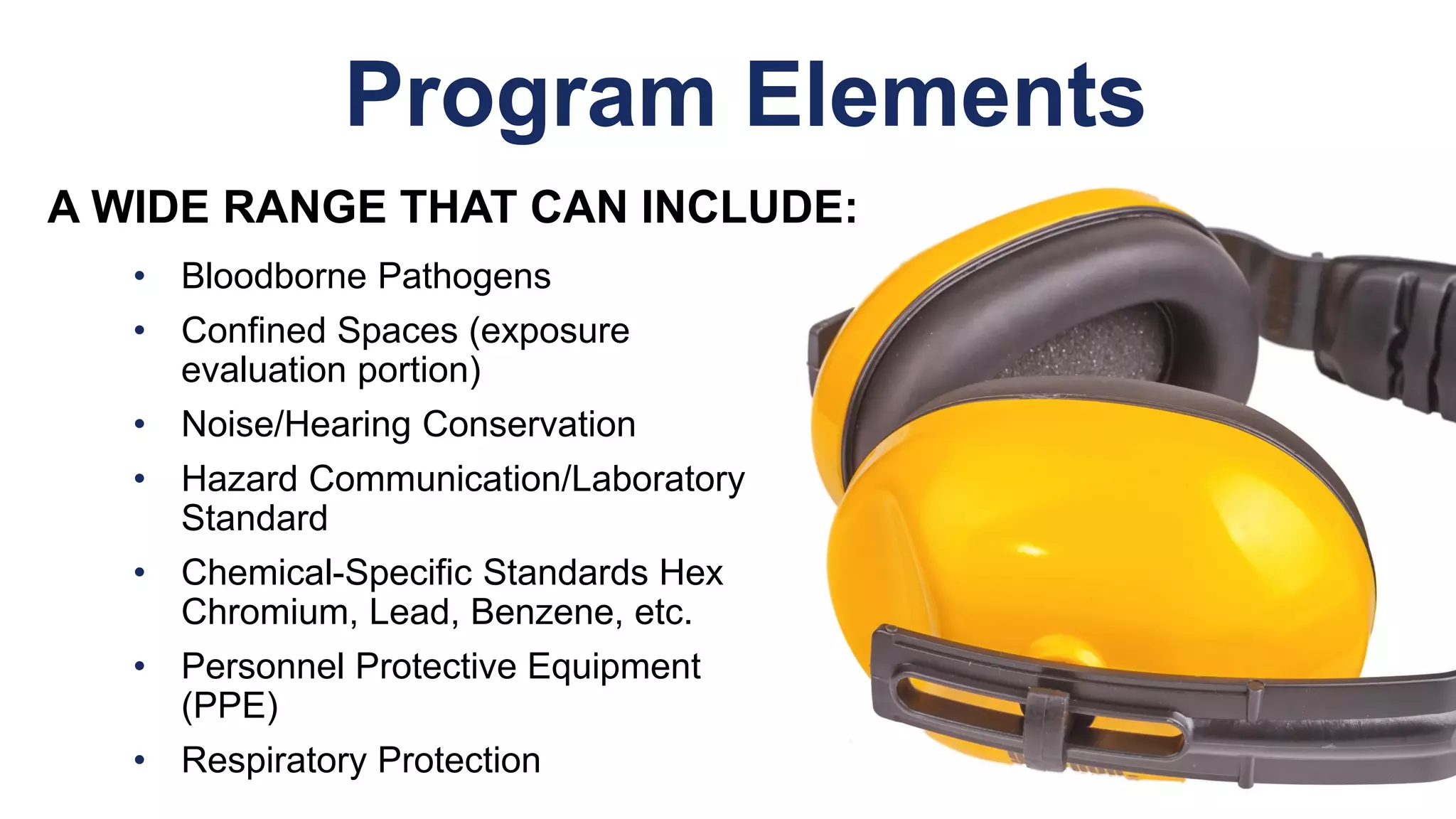
Program Elements
• Bloodborne Pathogens
• Confined Spaces (exposure
evaluation portion)
• Noise/Hearing Conservation
• Hazard Communication/Laboratory
Standard
• Chemical-Specific Standards Hex
Chromium, Lead, Benzene, etc.
• Personnel Protective Equipment
(PPE)
• Respiratory Protection
A WIDE RANGE THAT CAN INCLUDE:
• Ionizing Radiation
• Non-Ionizing Radiation
• Optical radiation
• Biological Safety
• Ergonomics
• Hot and Cold
environments
• Emergency Response
Program Elements
• Unusual work
schedules
• Electromagnetic fields
• Work in high or low
pressure environments
• And more!
Program Elements
Agenda
Why is an Industrial Hygiene (IH) Program Needed?
Essential Elements of an IH Program
Considerations for Getting Started
Defining Roles and Responsibilities
Chemical Exposure Monitoring
Summary/Q&A
Where to Start?
• What are your potential
and actual issues of
concern?
• What does management
want?
• What are the EHS/IH
norms for your industry?
Define the Priority Issues
• Baseline
Exposure
Assessment
• Risk-Based
(Typically
Qualitative)
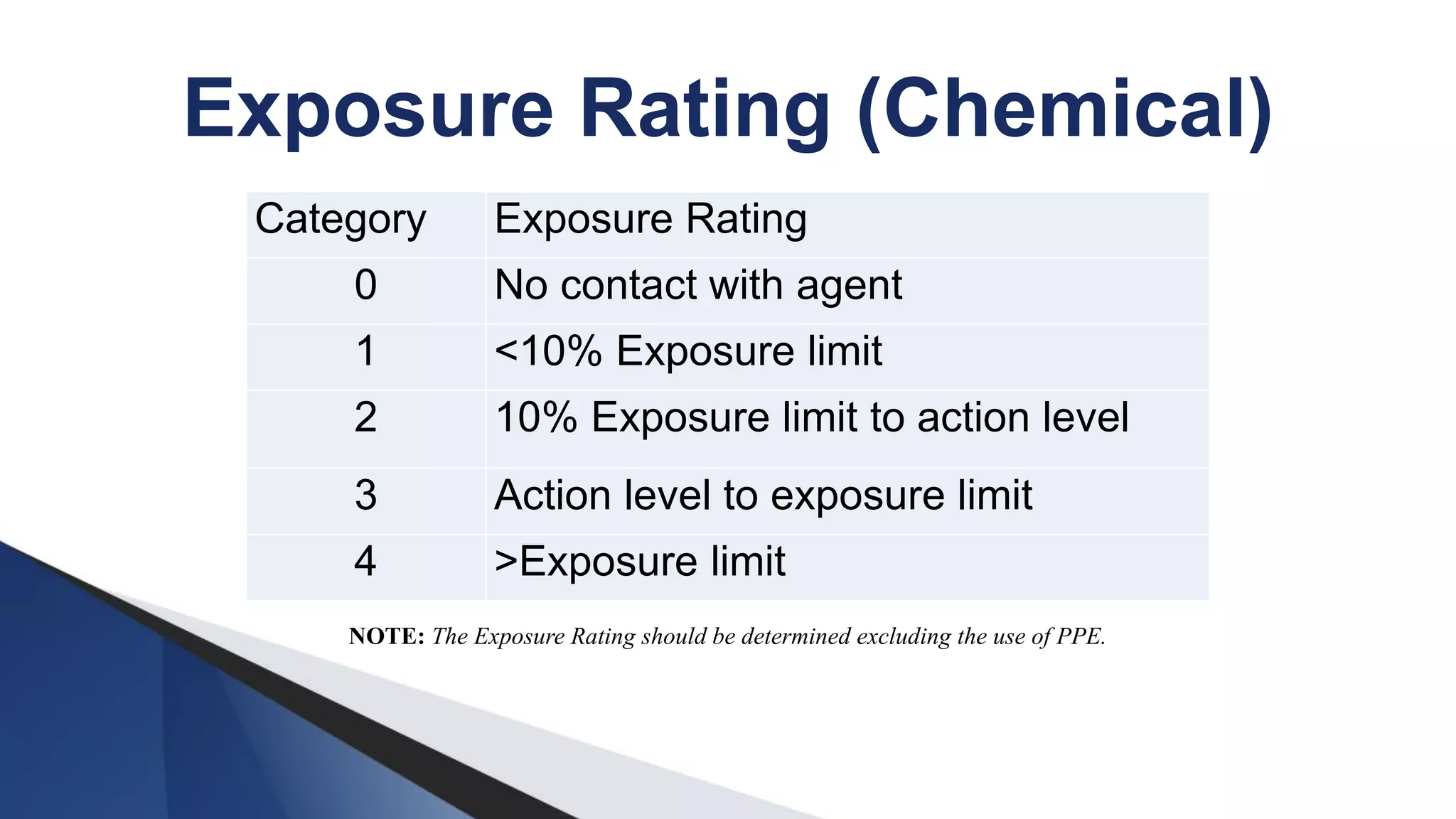
Category Exposure Rating
0 No contact with agent
1 <10% Exposure limit
2 10% Exposure limit to action level
3 Action level to exposure limit
4 >Exposure limit
Exposure Rating (Chemical)
NOTE: The Exposure Rating should be determined excluding the use of PPE.
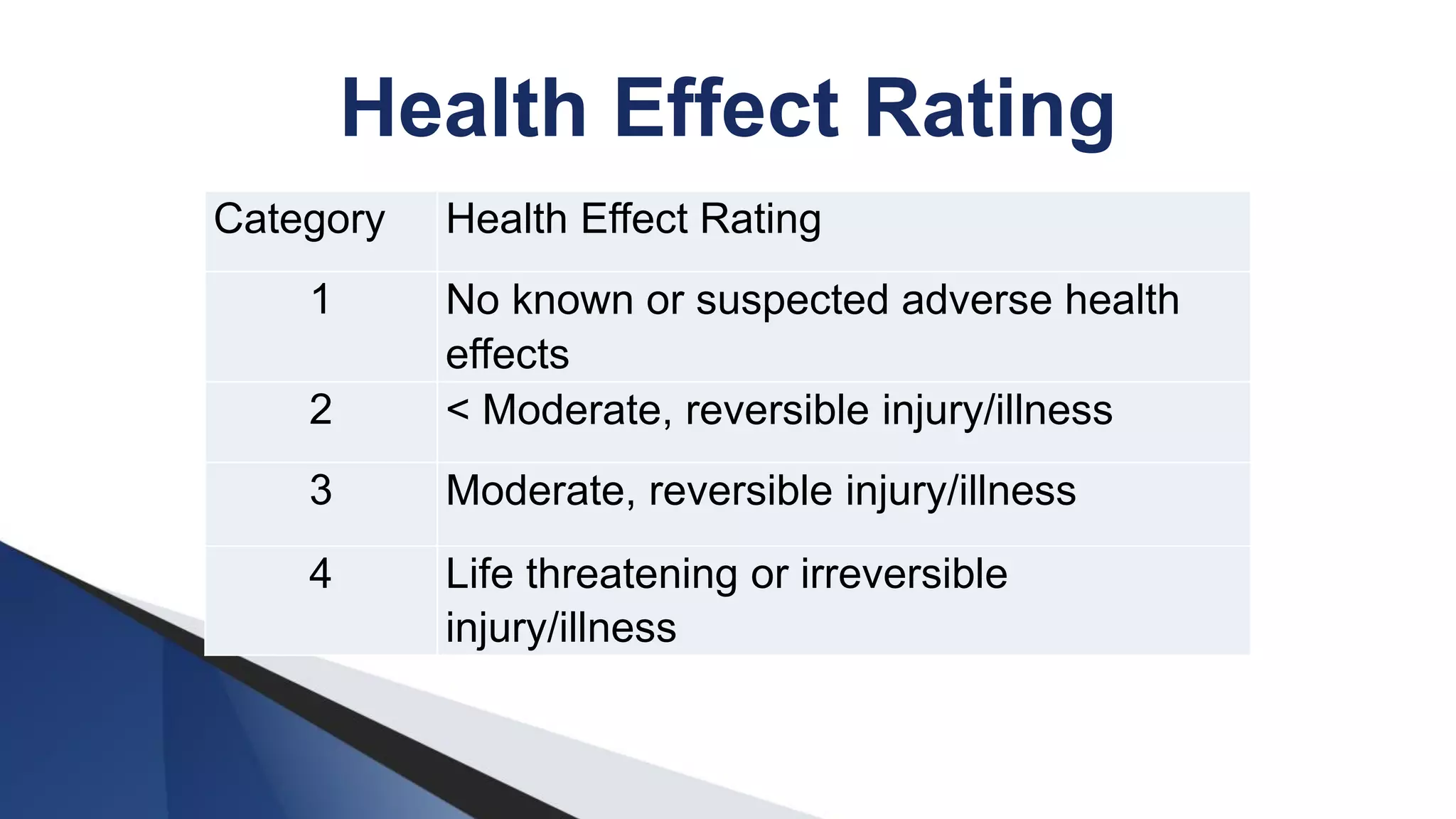
Health Effect Rating
Category Health Effect Rating
1 No known or suspected adverse health
effects
2 < Moderate, reversible injury/illness
3 Moderate, reversible injury/illness
4 Life threatening or irreversible
injury/illness
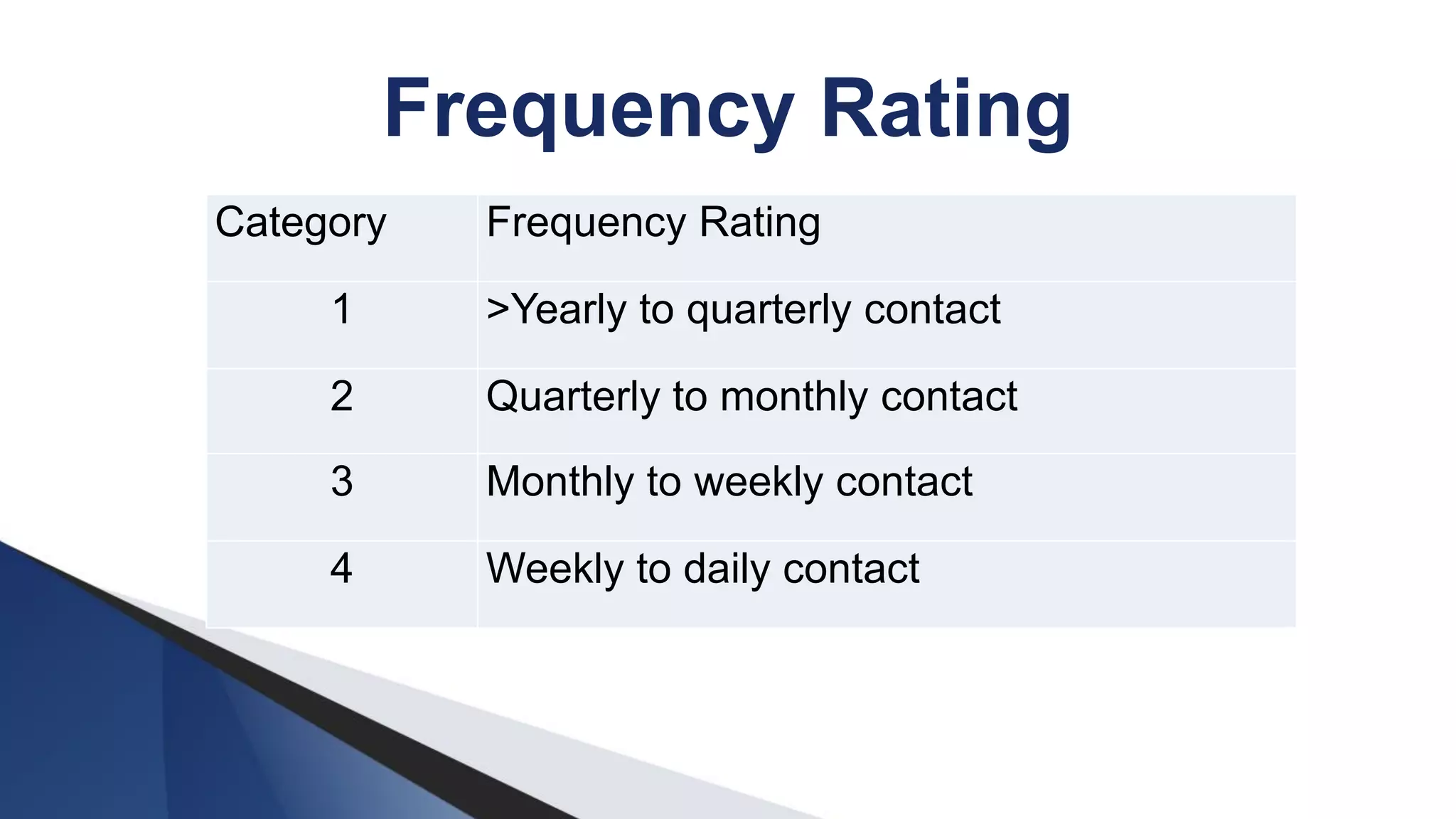
Frequency Rating
Category Frequency Rating
1 >Yearly to quarterly contact
2 Quarterly to monthly contact
3 Monthly to weekly contact
4 Weekly to daily contact
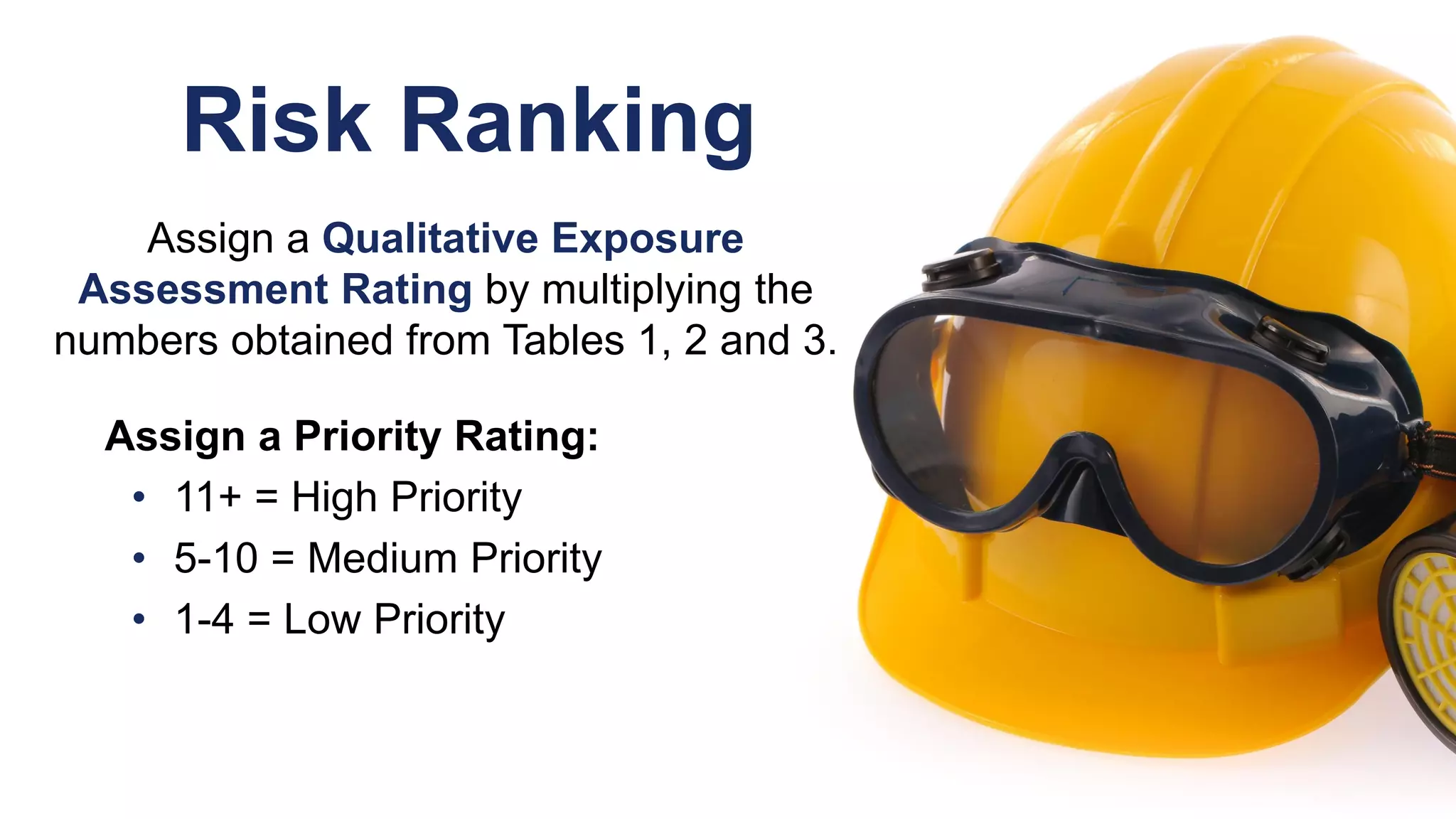
Risk Ranking
Assign a Qualitative Exposure
Assessment Rating by multiplying the
numbers obtained from Tables 1, 2 and 3.
Assign a Priority Rating:
• 11+ = High Priority
• 5-10 = Medium Priority
• 1-4 = Low Priority
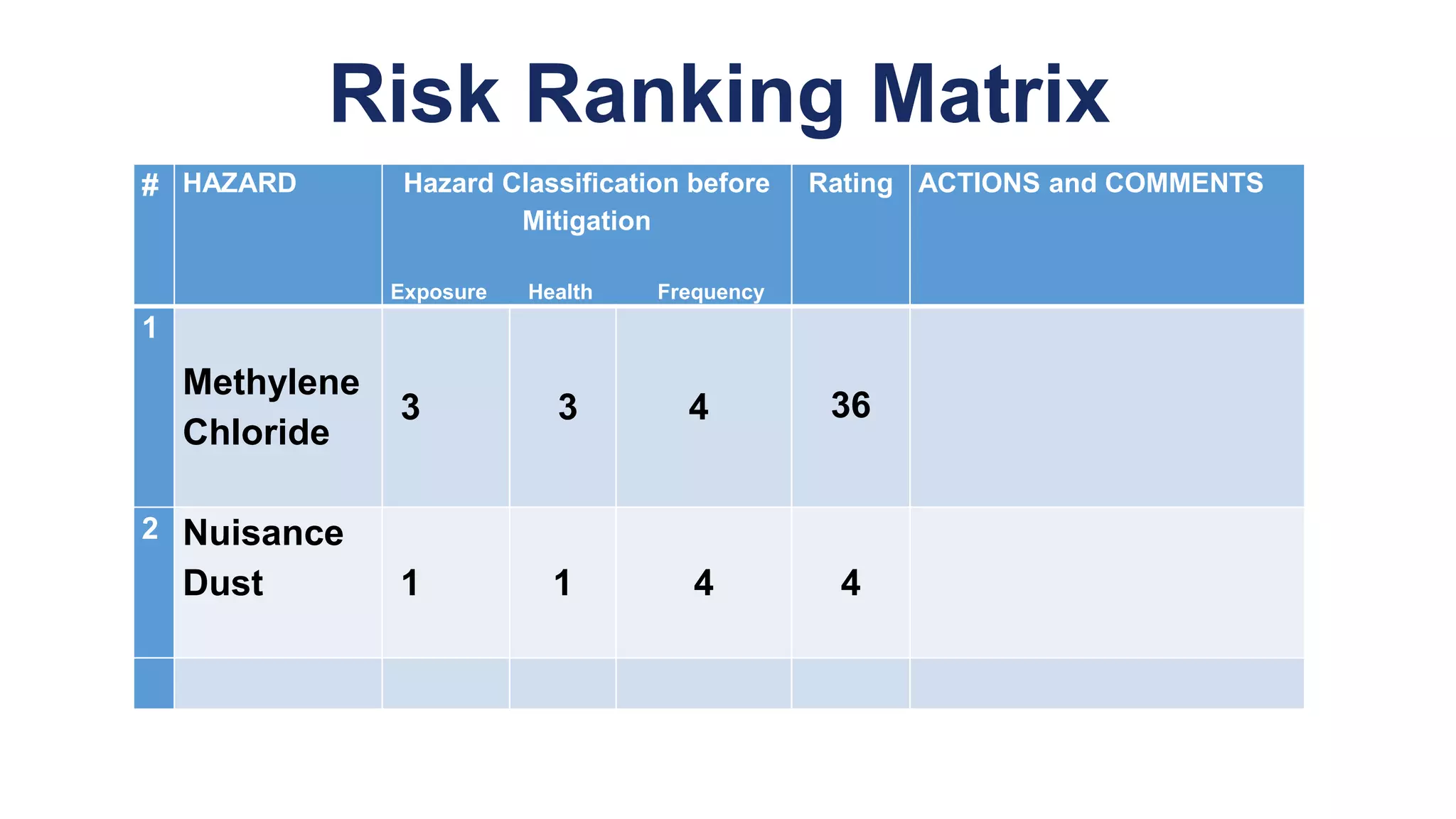
Risk Ranking Matrix
# HAZARD Hazard Classification before
Mitigation
Exposure Health Frequency
Rating ACTIONS and COMMENTS
1
Methylene
Chloride
3 3 4 36
2 Nuisance
Dust 1 1 4 4
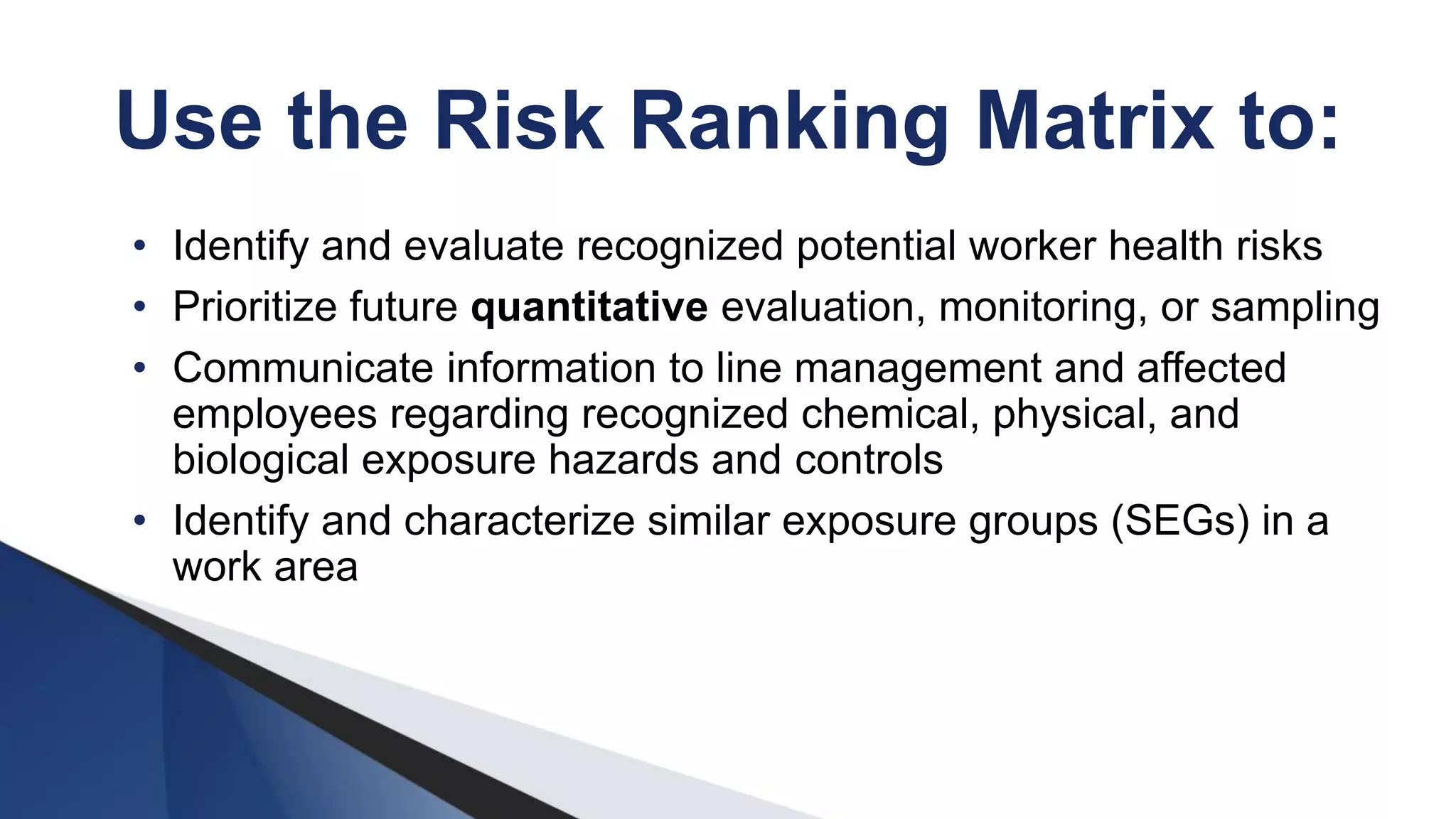
Use the Risk Ranking Matrix to:
• Identify and evaluate recognized potential worker health risks
• Prioritize future quantitative evaluation, monitoring, or sampling
• Communicate information to line management and affected
employees regarding recognized chemical, physical, and
biological exposure hazards and controls
• Identify and characterize similar exposure groups (SEGs) in a
work area
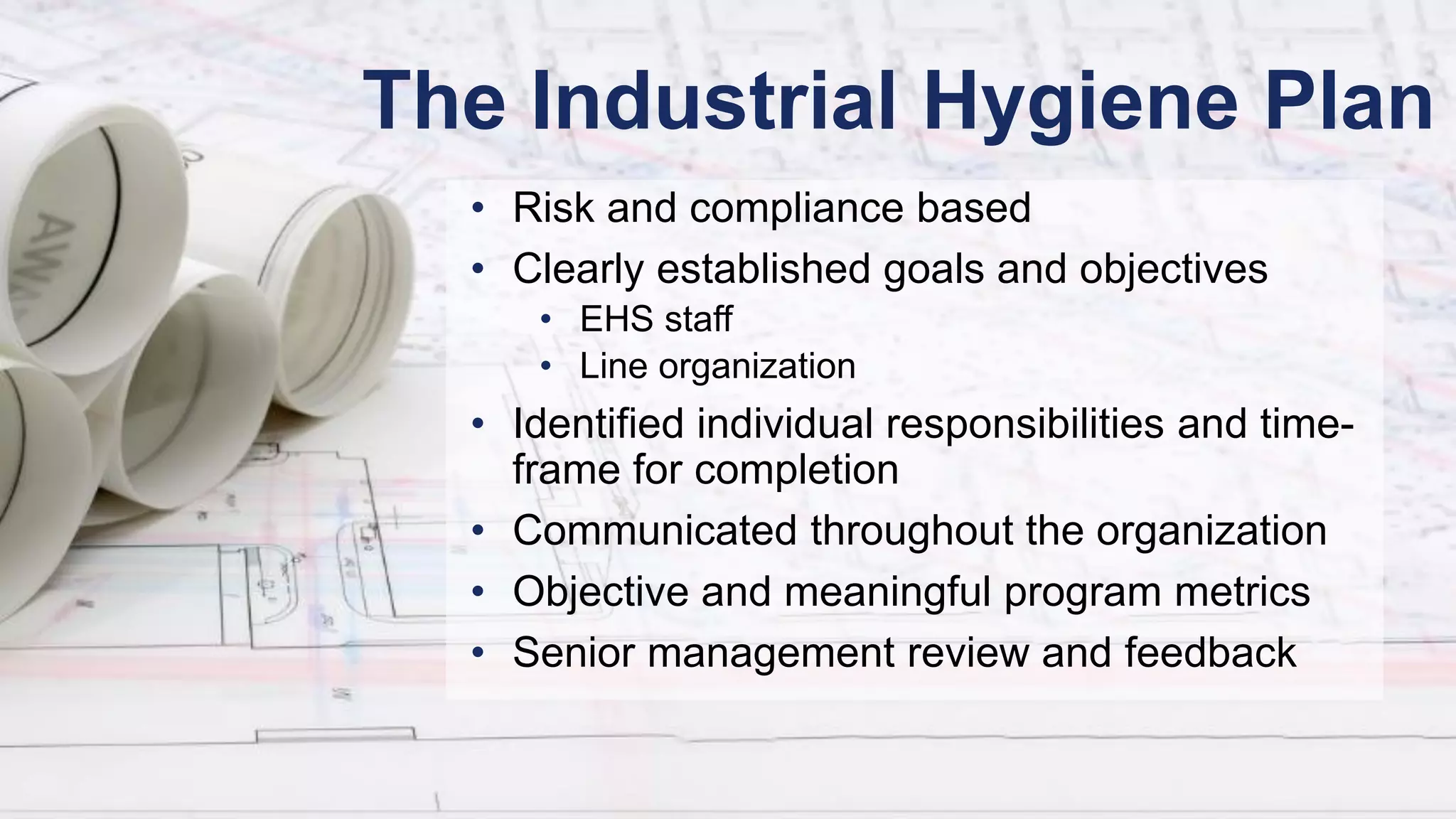
The Industrial Hygiene Plan
• Risk and compliance based
• Clearly established goals and objectives
• EHS staff
• Line organization
• Identified individual responsibilities and time-
frame for completion
• Communicated throughout the organization
• Objective and meaningful program metrics
• Senior management review and feedback
Agenda
Why is an Industrial Hygiene (IH) Program Needed?
Essential Elements of an IH Program
Considerations for Getting Started
Defining Roles and Responsibilities
Chemical Exposure Monitoring
Summary/Q&A
Poll Question
3
0
Are you responsible for
more than Industrial
Hygiene at your facility?
Roles and Responsibilities
Senior Management
• Ultimate responsibility and accountability for the
safety performance of the company
• Policy, guidance and oversight for the program
• Provide human and financial resources
Roles and Responsibilities
Industrial Hygienist (IH, CIH)
• Assist in the development of the IH program
• Approve the program as meeting generally
accepted IH standards of practice
• Conduct annual program reviews, ongoing oversight
of the program
• Verify personnel conducting monitoring are properly
qualified to perform the activities assigned
• Verify the quality of exposure evaluations and monitoring
is acceptable
• Provide recommendations based on assessments
• Develop annual exposure evaluation plans
Site Supervisors and Managers
• Understand the potential health
hazards of the work being done and in
the areas worked
• Evaluate potential health hazards as
part of a pre-job safety review
• Ensure workers are aware of the
potential hazards and the controls
• Request assistance from safety or IH
personnel as needed in evaluating
conditions
Roles and Responsibilities
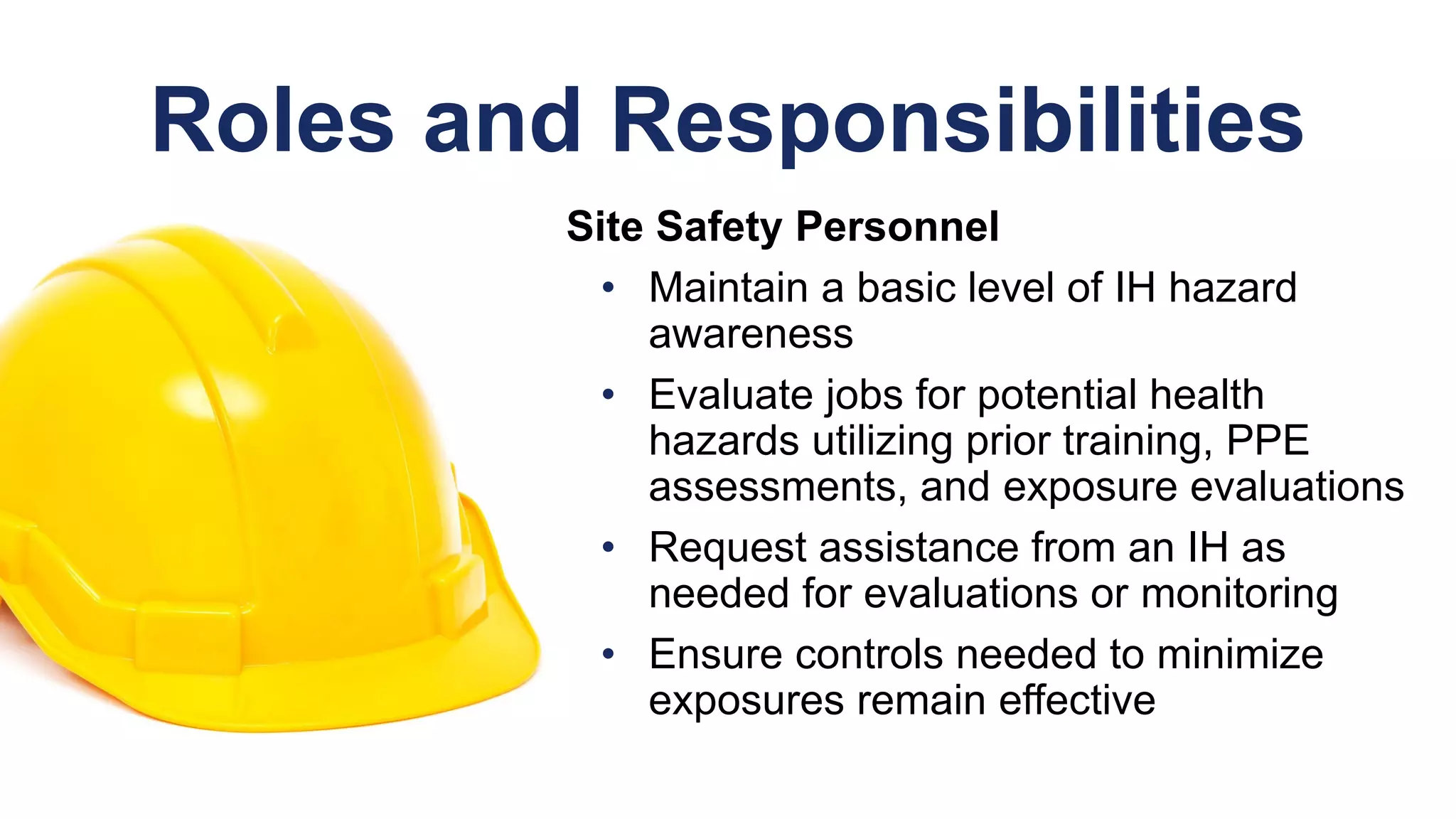
Site Safety Personnel
• Maintain a basic level of IH hazard
awareness
• Evaluate jobs for potential health
hazards utilizing prior training, PPE
assessments, and exposure evaluations
• Request assistance from an IH as
needed for evaluations or monitoring
• Ensure controls needed to minimize
exposures remain effective
Roles and Responsibilities
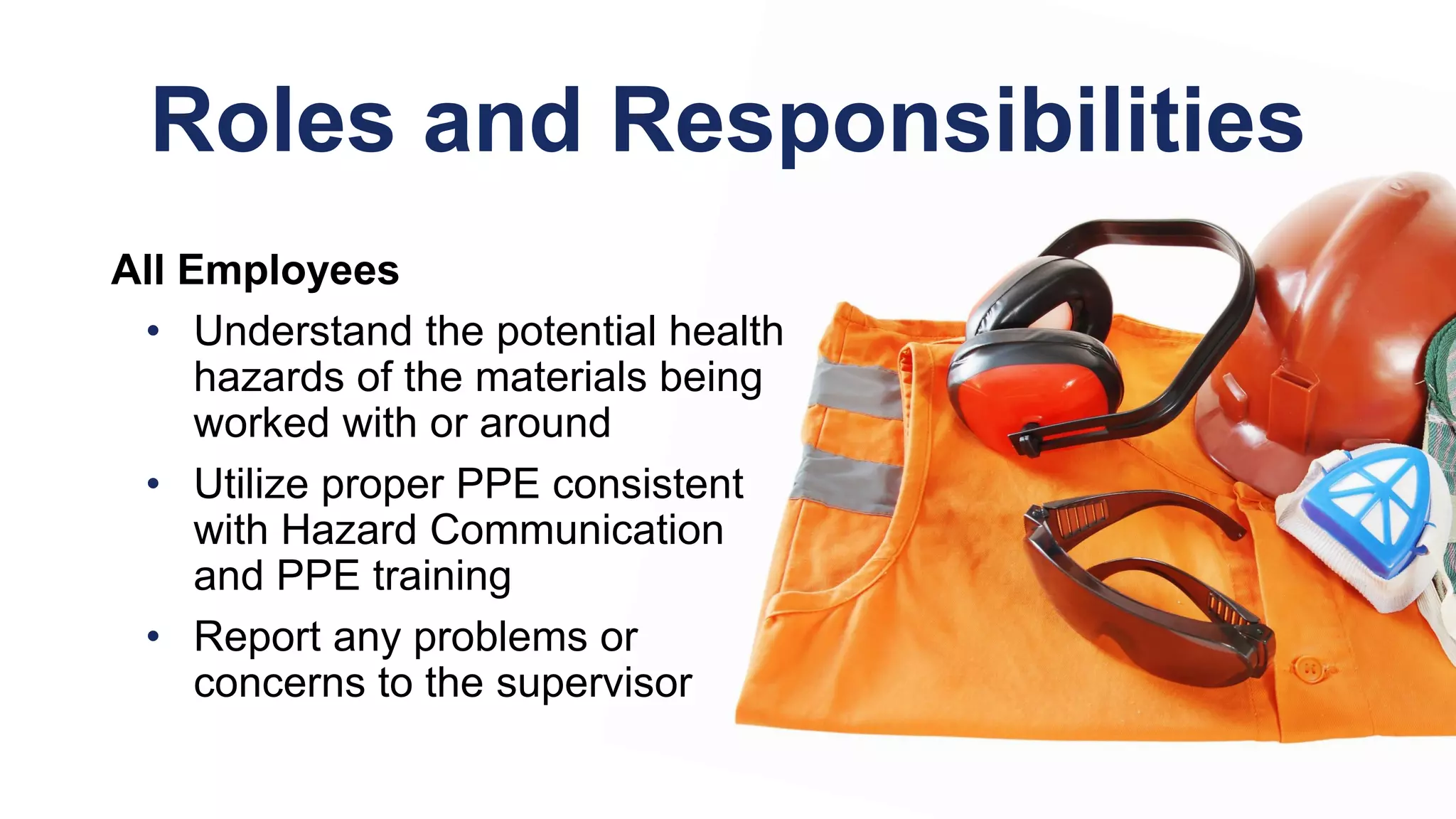
All Employees
• Understand the potential health
hazards of the materials being
worked with or around
• Utilize proper PPE consistent
with Hazard Communication
and PPE training
• Report any problems or
concerns to the supervisor
Agenda
Why is an Industrial Hygiene (IH) Program Needed?
Essential Elements of an IH Program
Considerations for Getting Started
Defining Roles and Responsibilities
Chemical Exposure Monitoring
Summary/Q&A
• Technology to evaluate exposure has evolved to a
high degree
 Passive dosimetry
 Direct reading instrumentation
• Exposure levels in the workplace vary considerably
with location and time
• Measurements integrated over a full work shift and
taken repeatedly for a similar work situation can often
show 10-fold variations from one day to another
Chemical Exposure Monitoring
39
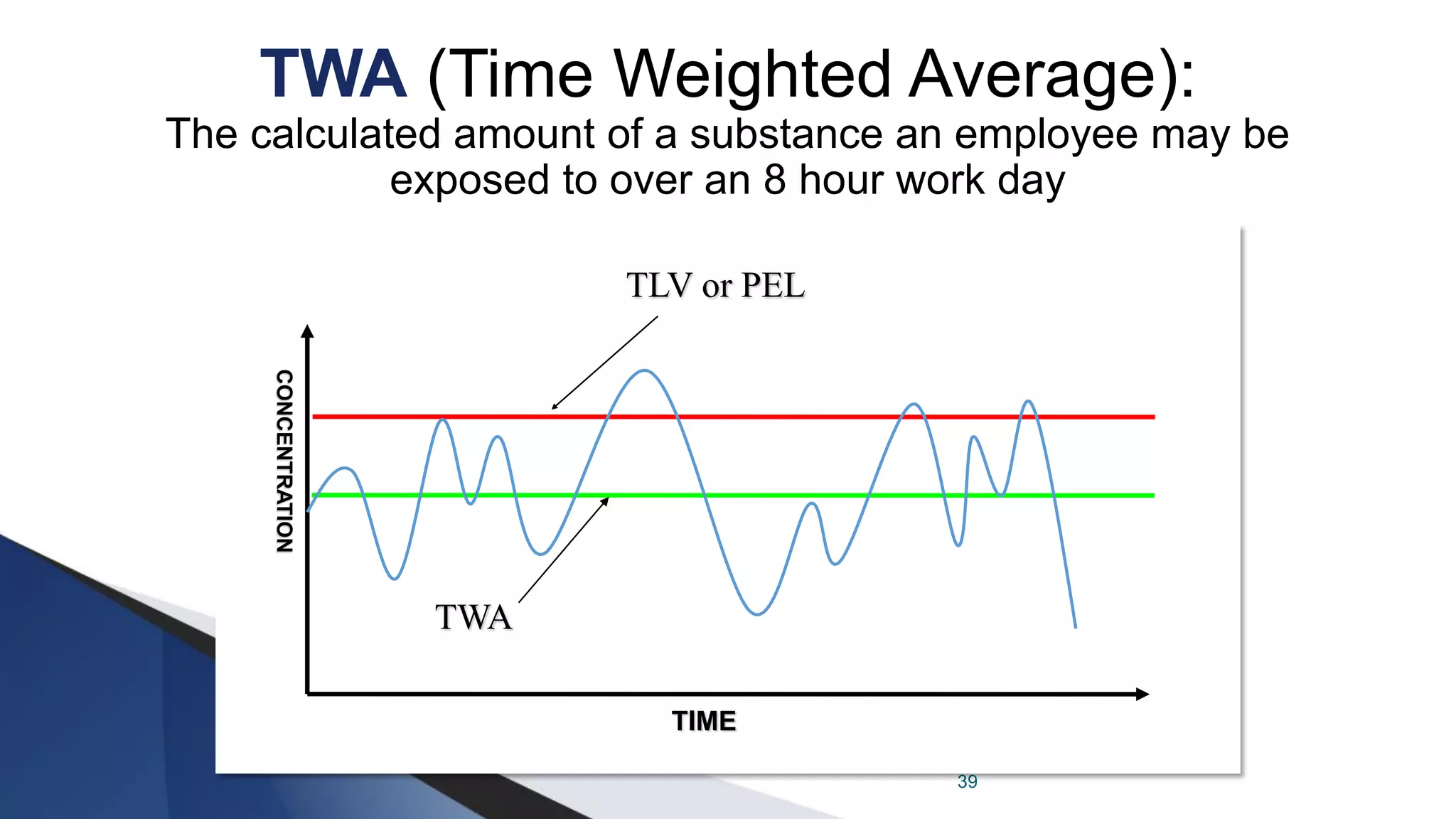
TWA
TLV or PEL
TIME
CONCENTRATION
TWA (Time Weighted Average):
The calculated amount of a substance an employee may be
exposed to over an 8 hour work day
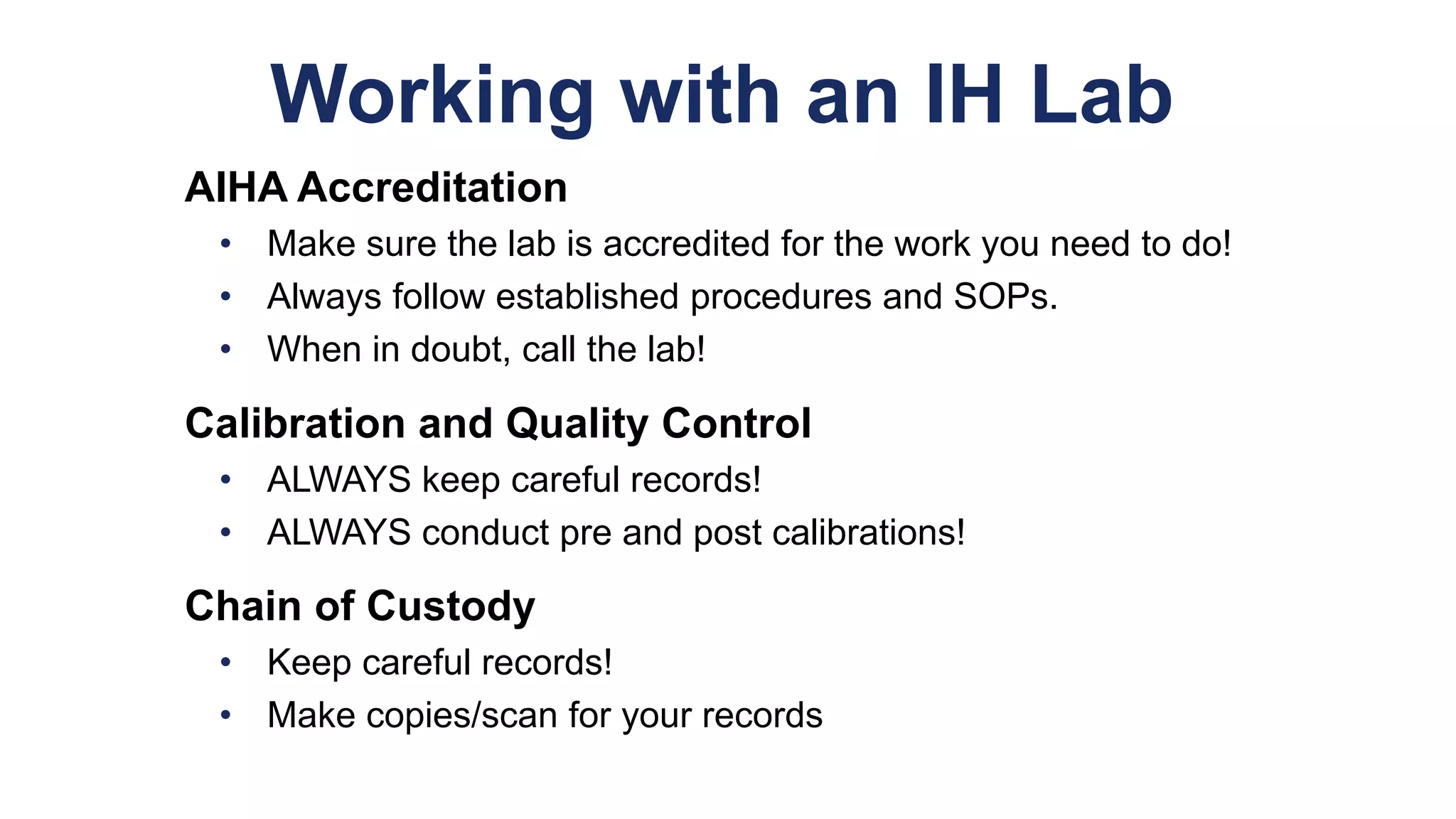
Working with an IH Lab
AIHA Accreditation
• Make sure the lab is accredited for the work you need to do!
• Always follow established procedures and SOPs.
• When in doubt, call the lab!
Calibration and Quality Control
• ALWAYS keep careful records!
• ALWAYS conduct pre and post calibrations!
Chain of Custody
• Keep careful records!
• Make copies/scan for your records
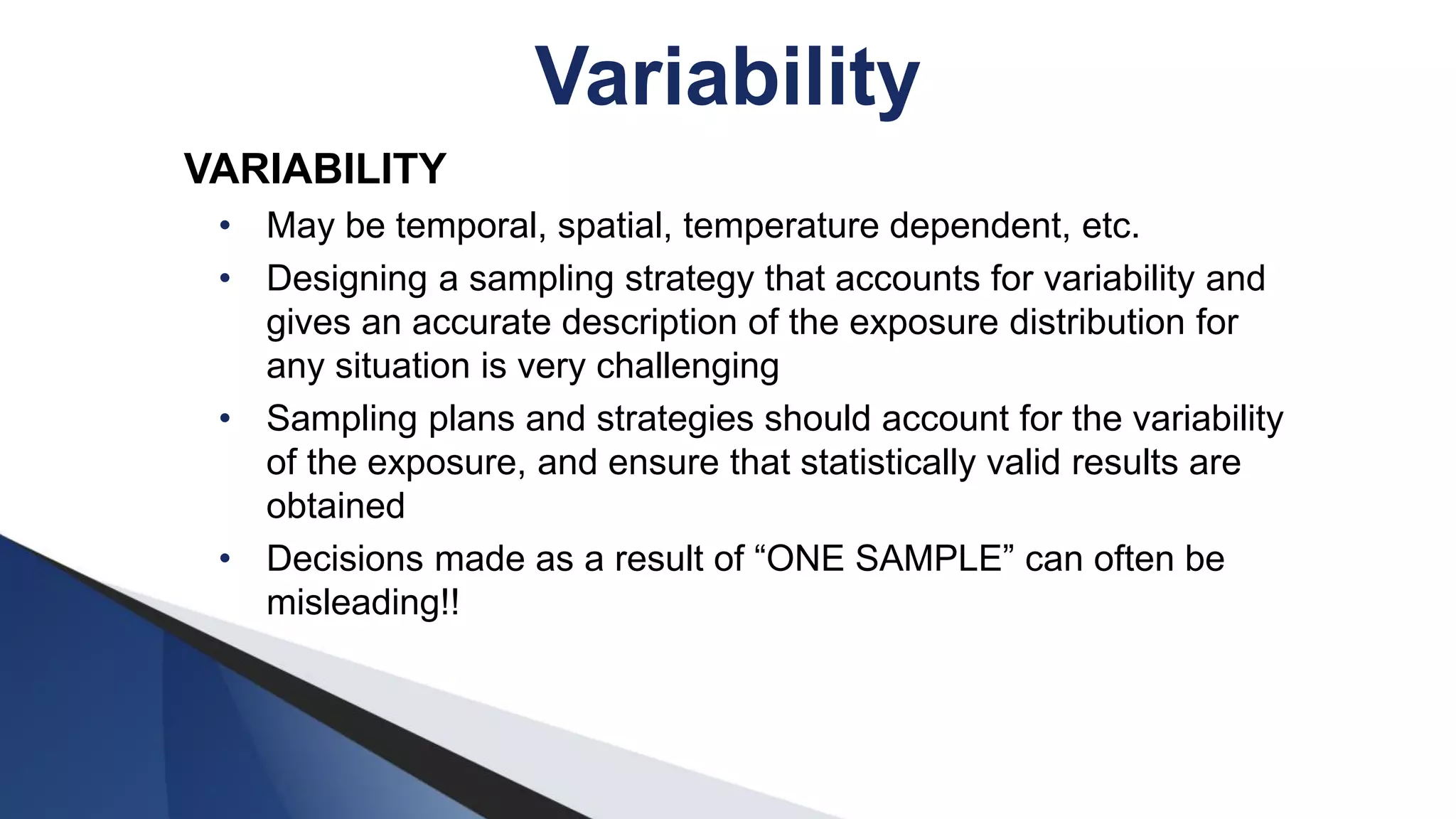
VARIABILITY
• May be temporal, spatial, temperature dependent, etc.
• Designing a sampling strategy that accounts for variability and
gives an accurate description of the exposure distribution for
any situation is very challenging
• Sampling plans and strategies should account for the variability
of the exposure, and ensure that statistically valid results are
obtained
• Decisions made as a result of “ONE SAMPLE” can often be
misleading!!
Variability
Agenda
Why is an Industrial Hygiene (IH) Program Needed?
Essential Elements of an IH Program
Considerations for Getting Started
Defining Roles and Responsibilities
Chemical Exposure Monitoring
Summary/Q&A
Summary/Conclusion
Industrial Hygiene is a multi-faceted discipline that
involves science, engineering, medicine, toxicology, and
solid management to achieve the goal of protecting
worker health.
A Risk Based approach is often the most efficient and
effective means to identify and prioritize actions.
Industry processes and IH technology are constantly
changing and evolving – so we need to keep up!
Thank You for
Attending!
Call Us!
1-888-834-9697
www.triumvirate.com
Mark Liffers:
mliffers@triumvirate.com
Contact:
Triumvirate can help meet your IH needs. For more
information on our Industrial Hygiene services, visit:
http://www.triumvirate.com/industrial-hygienist-services
References
• American Conference of Governmental Industrial Hygienists (ACGIH)
“Guide to Occupational Exposure Values” and “Threshold Limit Values for
Chemical Substances and Physical Agents & Biological Exposure Indices”
• American Industrial Hygiene Association (AIHA) Qualitative Exposure
Assessment Process
• International Society for Pharmaceutical Engineering (ISPE) Risk-
MaPP assessment process
• Occupational Safety and Health Administration (OSHA) Technical
Manual and Analytical Methods
• National Institute for Occupational Safety and Health (NIOSH)
Sampling Guide
• OSHA 29CFR 1910
• OSHA 29CFR 1926

Planning & Executing a Successful Industrial Hygiene Program

  • 1.
    Planning and Executing aSuccessful Industrial Hygiene Program
  • 2.
  • 3.
    During This Webinar All lines will be muted – please communicate via the questions pane in your webinar panel.  There will be a Q&A session at the end of the presentation – submit your question(s) anytime throughout the webinar.  Unanswered questions will be responded to after the webinar.  The presentation will be emailed to you tomorrow.
  • 4.
    Meet Your Presenter MarkLiffers Practice Director of EH&S Consulting
  • 5.
    “Industrial Hygiene isa science and art devoted to the anticipation, recognition, evaluation, prevention, and control of those environmental factors or stresses arising in or from the workplace which may cause sickness, impaired health and well being, or significant discomfort among workers or among citizens of the community.” -American Industrial Hygiene Association
  • 6.
    Agenda Why is anIndustrial Hygiene (IH) Program Needed? Essential Elements of an IH Program Considerations for Getting Started Defining Roles and Responsibilities Chemical Exposure Monitoring Summary/Q&A
  • 7.
    Why is an IHProgram Needed?
  • 8.
    General Industry Standards •Recordkeeping– Occupational Injury and Illness • Subpart D--Walking and Working Surfaces • Subpart E--Means of Egress • Subpart F--Powered Platforms • Subpart G- -Occupational Health and Env Control • Subpart H--Hazardous materials • Subpart I--Personal Protective Equipment • Subpart J--General Environmental Controls • Subpart K--Medical and First Aid • Subpart L--Fire Protection • Subpart M -- Compressed Gas and Compressed Air Equipment • Subpart N -- Materials Handling and Storage • Subpart O -- Machinery and Machine Guarding • Subpart P -- Hand and Portable Powered Tools and Other Hand- Held Equipment • Subpart Q -- Welding, Cutting, and Brazing • Subpart R -- Special Industries • Subpart S -- Electrical • Subpart Z -- Toxic and Hazardous Substances
  • 9.
    • Recordkeeping– Occupational Injuryand Illness • Subpart D--Walking and Working Surfaces • Subpart E--Means of Egress • Subpart F--Powered Platforms • Subpart G- -Occupational Health and Env Control • Subpart H--Hazardous materials • Subpart I--Personal Protective Equipment • Subpart J--General Environmental Controls • Subpart K--Medical and First Aid • Subpart L--Fire Protection • Subpart M -- Compressed Gas and Compressed Air Equipment • Subpart N -- Materials Handling and Storage • Subpart O -- Machinery and Machine Guarding • Subpart P -- Hand and Portable Powered Tools and Other Hand- Held Equipment • Subpart Q -- Welding, Cutting, and Brazing • Subpart R -- Special Industries • Subpart S -- Electrical • Subpart Z -- Toxic and Hazardous Substances General Industry Standards
  • 10.
    Non-Regulatory Standards, Guidelines andRequirements • American Conference of Governmental Industrial Hygienists (ACGIH) • ANSI/AIHA • National Institute for Occupational Safety and Health (NIOSH) • Industry Best Practices – ISPE’s ADEs • Workers Compensation Insurance • Liability Insurance
  • 11.
  • 12.
    Agenda Why is anIndustrial Hygiene (IH) Program Needed? Essential Elements of an IH Program Considerations for Getting Started Defining Roles and Responsibilities Chemical Exposure Monitoring Summary/Q&A
  • 13.
    Poll Question 1 3 How wouldyou describe your Industrial Hygiene program?
  • 14.
    Define the Purpose “Thisprogram is intended to help ensure the health and safety of our employees, contractors others who visit our site” “To meet regulatory requirements” “To meet our Global Corporate Health and Safety goals”
  • 15.
    Define the Scope “Thisprogram applies to all of our activities at our manufacturing and service” “This program applies to all North American contractors and subcontractors”
  • 16.
    Program Elements • BloodbornePathogens • Confined Spaces (exposure evaluation portion) • Noise/Hearing Conservation • Hazard Communication/Laboratory Standard • Chemical-Specific Standards Hex Chromium, Lead, Benzene, etc. • Personnel Protective Equipment (PPE) • Respiratory Protection A WIDE RANGE THAT CAN INCLUDE:
  • 17.
    • Ionizing Radiation •Non-Ionizing Radiation • Optical radiation • Biological Safety • Ergonomics • Hot and Cold environments • Emergency Response Program Elements
  • 18.
    • Unusual work schedules •Electromagnetic fields • Work in high or low pressure environments • And more! Program Elements
  • 19.
    Agenda Why is anIndustrial Hygiene (IH) Program Needed? Essential Elements of an IH Program Considerations for Getting Started Defining Roles and Responsibilities Chemical Exposure Monitoring Summary/Q&A
  • 20.
    Where to Start? •What are your potential and actual issues of concern? • What does management want? • What are the EHS/IH norms for your industry?
  • 21.
    Define the PriorityIssues • Baseline Exposure Assessment • Risk-Based (Typically Qualitative)
  • 22.
    Category Exposure Rating 0No contact with agent 1 <10% Exposure limit 2 10% Exposure limit to action level 3 Action level to exposure limit 4 >Exposure limit Exposure Rating (Chemical) NOTE: The Exposure Rating should be determined excluding the use of PPE.
  • 23.
    Health Effect Rating CategoryHealth Effect Rating 1 No known or suspected adverse health effects 2 < Moderate, reversible injury/illness 3 Moderate, reversible injury/illness 4 Life threatening or irreversible injury/illness
  • 24.
    Frequency Rating Category FrequencyRating 1 >Yearly to quarterly contact 2 Quarterly to monthly contact 3 Monthly to weekly contact 4 Weekly to daily contact
  • 25.
    Risk Ranking Assign aQualitative Exposure Assessment Rating by multiplying the numbers obtained from Tables 1, 2 and 3. Assign a Priority Rating: • 11+ = High Priority • 5-10 = Medium Priority • 1-4 = Low Priority
  • 26.
    Risk Ranking Matrix #HAZARD Hazard Classification before Mitigation Exposure Health Frequency Rating ACTIONS and COMMENTS 1 Methylene Chloride 3 3 4 36 2 Nuisance Dust 1 1 4 4
  • 27.
    Use the RiskRanking Matrix to: • Identify and evaluate recognized potential worker health risks • Prioritize future quantitative evaluation, monitoring, or sampling • Communicate information to line management and affected employees regarding recognized chemical, physical, and biological exposure hazards and controls • Identify and characterize similar exposure groups (SEGs) in a work area
  • 28.
    The Industrial HygienePlan • Risk and compliance based • Clearly established goals and objectives • EHS staff • Line organization • Identified individual responsibilities and time- frame for completion • Communicated throughout the organization • Objective and meaningful program metrics • Senior management review and feedback
  • 29.
    Agenda Why is anIndustrial Hygiene (IH) Program Needed? Essential Elements of an IH Program Considerations for Getting Started Defining Roles and Responsibilities Chemical Exposure Monitoring Summary/Q&A
  • 30.
    Poll Question 3 0 Are youresponsible for more than Industrial Hygiene at your facility?
  • 31.
    Roles and Responsibilities SeniorManagement • Ultimate responsibility and accountability for the safety performance of the company • Policy, guidance and oversight for the program • Provide human and financial resources
  • 32.
    Roles and Responsibilities IndustrialHygienist (IH, CIH) • Assist in the development of the IH program • Approve the program as meeting generally accepted IH standards of practice • Conduct annual program reviews, ongoing oversight of the program • Verify personnel conducting monitoring are properly qualified to perform the activities assigned • Verify the quality of exposure evaluations and monitoring is acceptable • Provide recommendations based on assessments • Develop annual exposure evaluation plans
  • 33.
    Site Supervisors andManagers • Understand the potential health hazards of the work being done and in the areas worked • Evaluate potential health hazards as part of a pre-job safety review • Ensure workers are aware of the potential hazards and the controls • Request assistance from safety or IH personnel as needed in evaluating conditions Roles and Responsibilities
  • 34.
    Roles and Responsibilities SiteSafety Personnel • Maintain a basic level of IH hazard awareness • Evaluate jobs for potential health hazards utilizing prior training, PPE assessments, and exposure evaluations • Request assistance from an IH as needed for evaluations or monitoring • Ensure controls needed to minimize exposures remain effective
  • 35.
    Roles and Responsibilities AllEmployees • Understand the potential health hazards of the materials being worked with or around • Utilize proper PPE consistent with Hazard Communication and PPE training • Report any problems or concerns to the supervisor
  • 37.
    Agenda Why is anIndustrial Hygiene (IH) Program Needed? Essential Elements of an IH Program Considerations for Getting Started Defining Roles and Responsibilities Chemical Exposure Monitoring Summary/Q&A
  • 38.
    • Technology toevaluate exposure has evolved to a high degree  Passive dosimetry  Direct reading instrumentation • Exposure levels in the workplace vary considerably with location and time • Measurements integrated over a full work shift and taken repeatedly for a similar work situation can often show 10-fold variations from one day to another Chemical Exposure Monitoring
  • 39.
    39 TWA TLV or PEL TIME CONCENTRATION TWA(Time Weighted Average): The calculated amount of a substance an employee may be exposed to over an 8 hour work day
  • 40.
    Working with anIH Lab AIHA Accreditation • Make sure the lab is accredited for the work you need to do! • Always follow established procedures and SOPs. • When in doubt, call the lab! Calibration and Quality Control • ALWAYS keep careful records! • ALWAYS conduct pre and post calibrations! Chain of Custody • Keep careful records! • Make copies/scan for your records
  • 41.
    VARIABILITY • May betemporal, spatial, temperature dependent, etc. • Designing a sampling strategy that accounts for variability and gives an accurate description of the exposure distribution for any situation is very challenging • Sampling plans and strategies should account for the variability of the exposure, and ensure that statistically valid results are obtained • Decisions made as a result of “ONE SAMPLE” can often be misleading!! Variability
  • 42.
    Agenda Why is anIndustrial Hygiene (IH) Program Needed? Essential Elements of an IH Program Considerations for Getting Started Defining Roles and Responsibilities Chemical Exposure Monitoring Summary/Q&A
  • 43.
    Summary/Conclusion Industrial Hygiene isa multi-faceted discipline that involves science, engineering, medicine, toxicology, and solid management to achieve the goal of protecting worker health. A Risk Based approach is often the most efficient and effective means to identify and prioritize actions. Industry processes and IH technology are constantly changing and evolving – so we need to keep up!
  • 44.
    Thank You for Attending! CallUs! 1-888-834-9697 www.triumvirate.com Mark Liffers: mliffers@triumvirate.com Contact: Triumvirate can help meet your IH needs. For more information on our Industrial Hygiene services, visit: http://www.triumvirate.com/industrial-hygienist-services
  • 45.
    References • American Conferenceof Governmental Industrial Hygienists (ACGIH) “Guide to Occupational Exposure Values” and “Threshold Limit Values for Chemical Substances and Physical Agents & Biological Exposure Indices” • American Industrial Hygiene Association (AIHA) Qualitative Exposure Assessment Process • International Society for Pharmaceutical Engineering (ISPE) Risk- MaPP assessment process • Occupational Safety and Health Administration (OSHA) Technical Manual and Analytical Methods • National Institute for Occupational Safety and Health (NIOSH) Sampling Guide • OSHA 29CFR 1910 • OSHA 29CFR 1926