The Key Elements to Creating an
OSHA-Compliant Workplace
from the Ground Up
Aimee Giovine, EHS Manager
Triumvirate Environmental
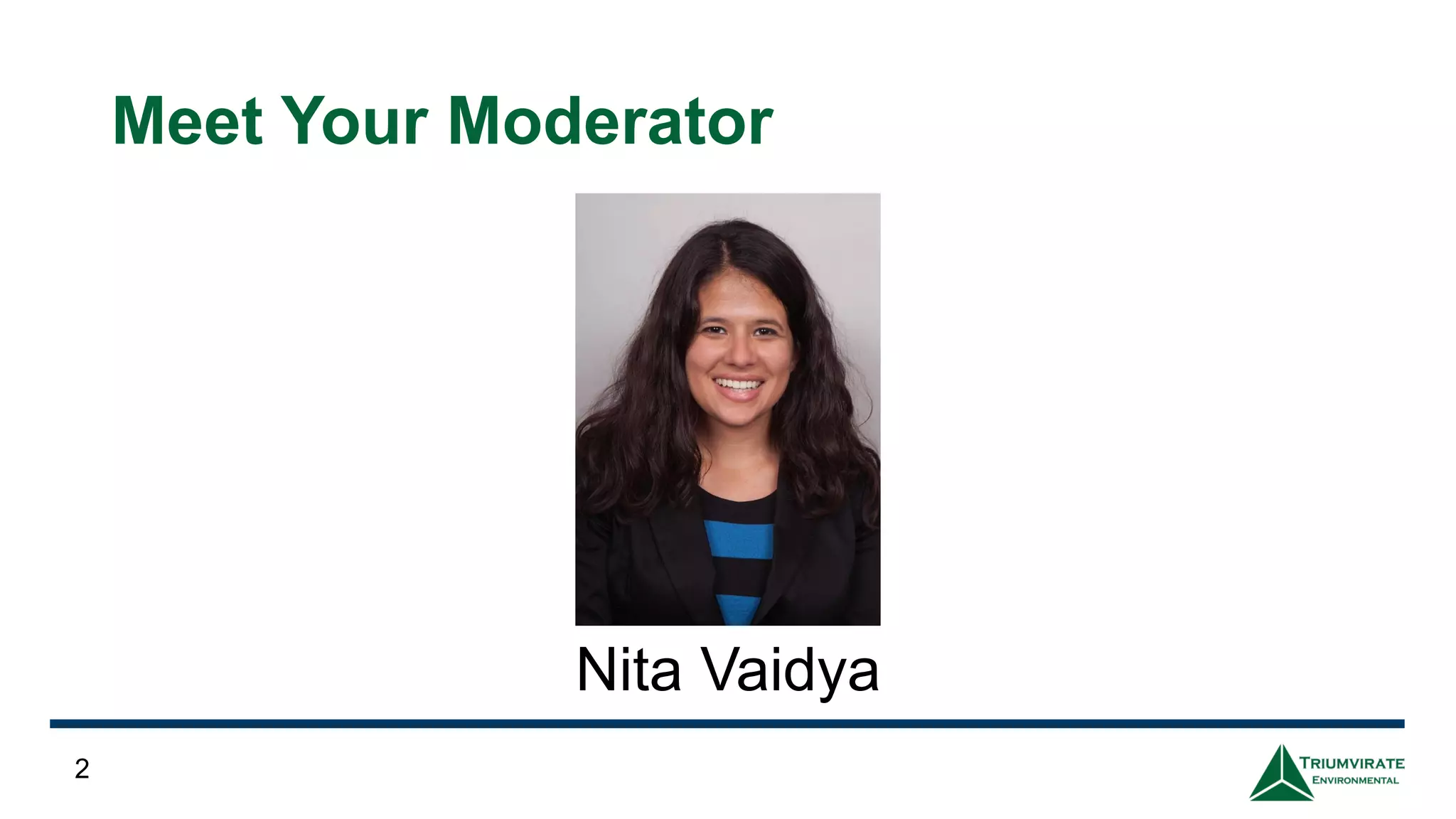
Meet Your Moderator
2
Nita Vaidya
3
During this Webinar
✓ All lines will be muted.
✓ Communicate via the questions tab in your webinar panel.
✓ Unanswered questions will be responded to personally after the
webinar.
✓ Webinar recording and slides will be emailed to you tomorrow.
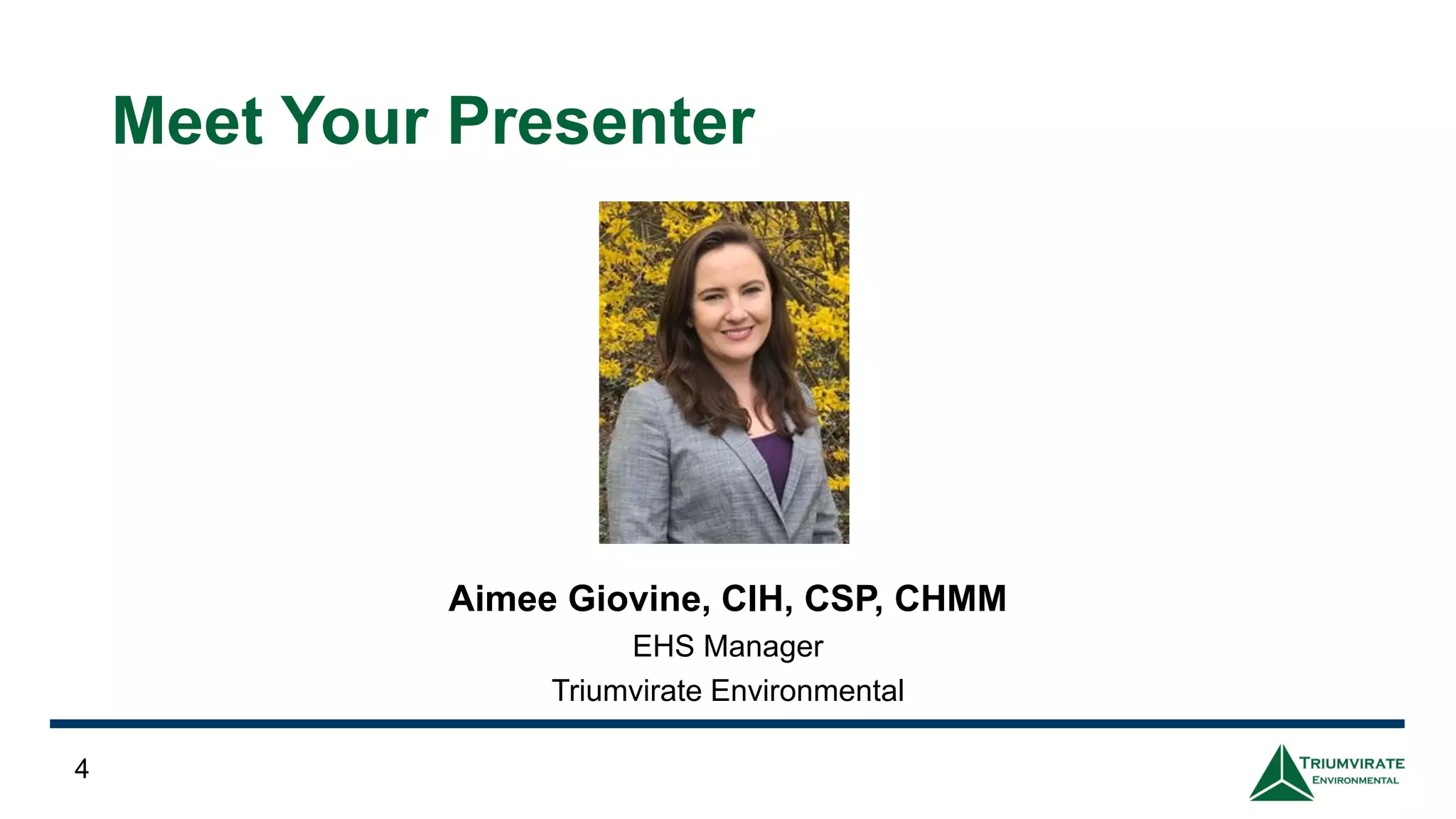
Aimee Giovine, CIH, CSP, CHMM
EHS Manager
Triumvirate Environmental
4
Meet Your Presenter
Agenda
5
OSHA Review
Assessing Your Workplace
Becoming Compliant
Program Maintenance
Q&A
Introduction
• An agency within the Department of Labor
• “Assure safe and healthy working conditions for working
men and women by setting and enforcing standards and
by providing training, outreach, education and assistance.”
• OSHA covers most private sector employers in all 50
states, the District of Columbia, and other US
jurisdictions—either directly through federal OSHA or
through an OSHA approved state plan
6
OSHA Review
• OSHA General Industry Standards are
covered under 29 CFR 1910
• The Standard has 20 subparts which
address different components of the work
environment
• Letters of Interpretation are searchable and
available for review
• Employers are responsible for determining
which components of the standard apply to
their operations
• Employers are responsible for recording and
reporting incidents as required by OSHA
7
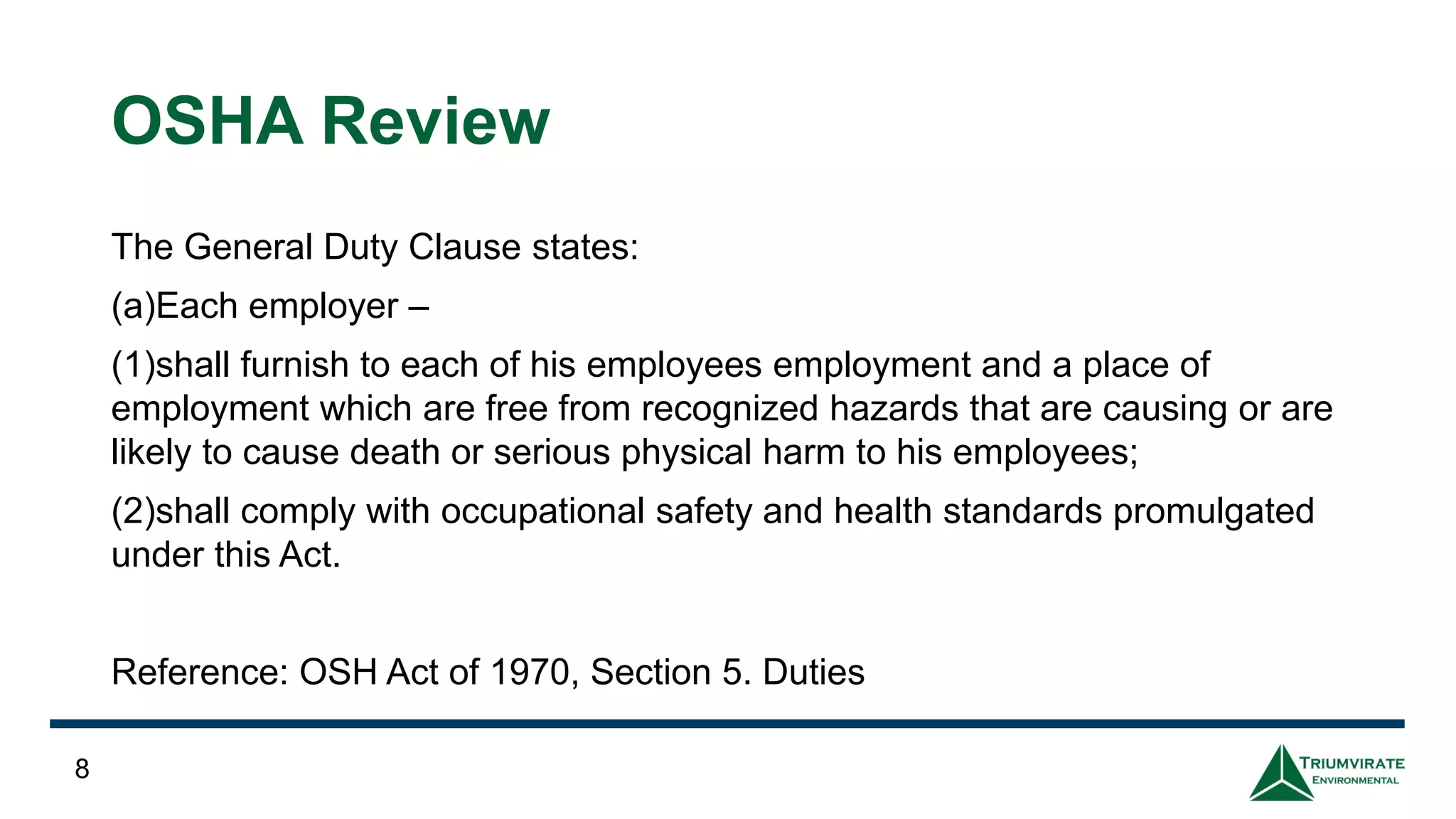
OSHA Review
The General Duty Clause states:
(a)Each employer –
(1)shall furnish to each of his employees employment and a place of
employment which are free from recognized hazards that are causing or are
likely to cause death or serious physical harm to his employees;
(2)shall comply with occupational safety and health standards promulgated
under this Act.
Reference: OSH Act of 1970, Section 5. Duties
8
OSHA Review
The General Duty Clause states:
(b) Each employee shall comply with occupational safety and
health standards and all rules, regulations, and orders issued
pursuant to this Act which are applicable to his own actions and
conduct.
Reference: OSH Act of 1970, Section 5. Duties
9
OSHA Review
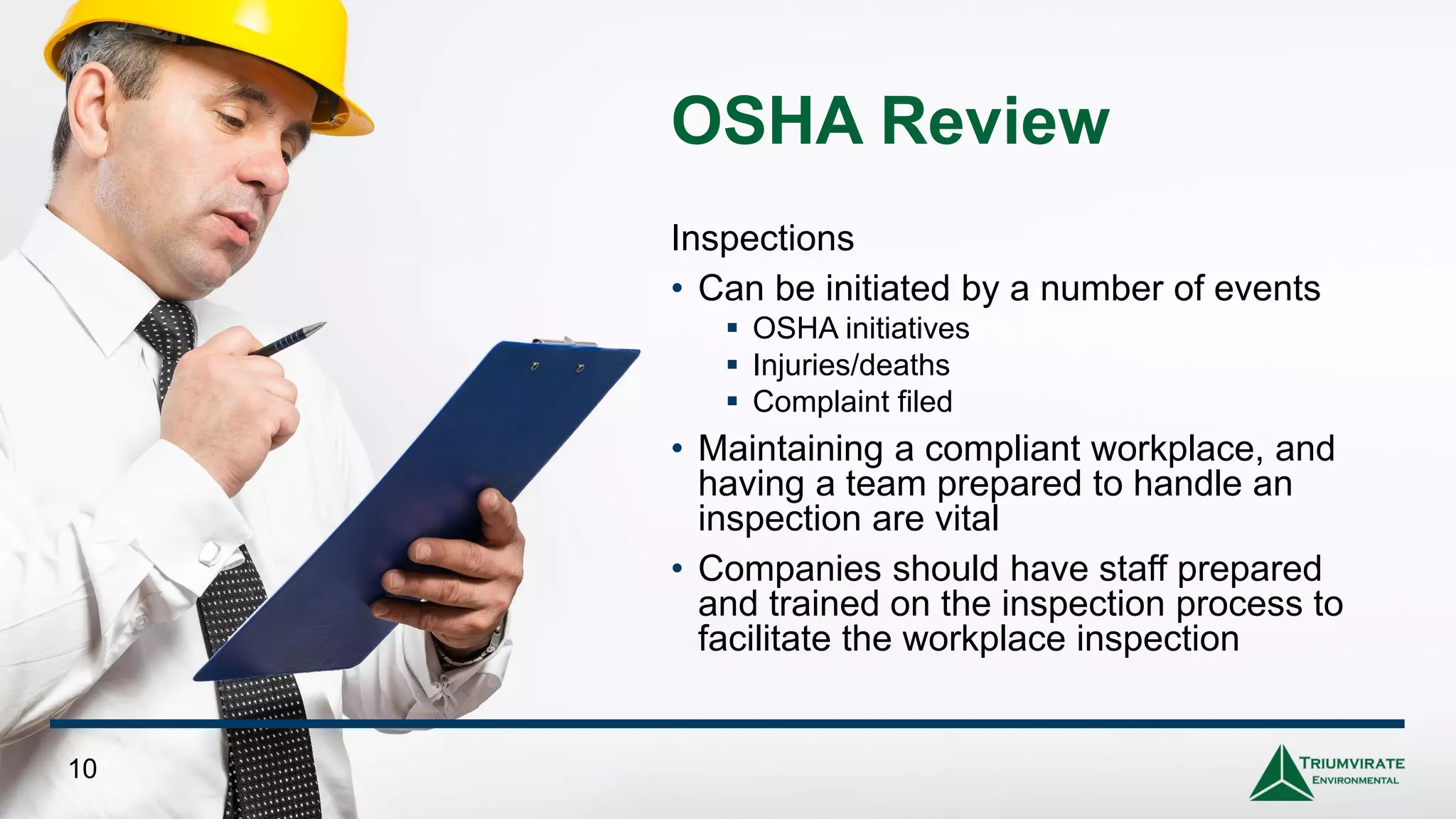
Inspections
• Can be initiated by a number of events
▪ OSHA initiatives
▪ Injuries/deaths
▪ Complaint filed
• Maintaining a compliant workplace, and
having a team prepared to handle an
inspection are vital
• Companies should have staff prepared
and trained on the inspection process to
facilitate the workplace inspection
10
OSHA Review
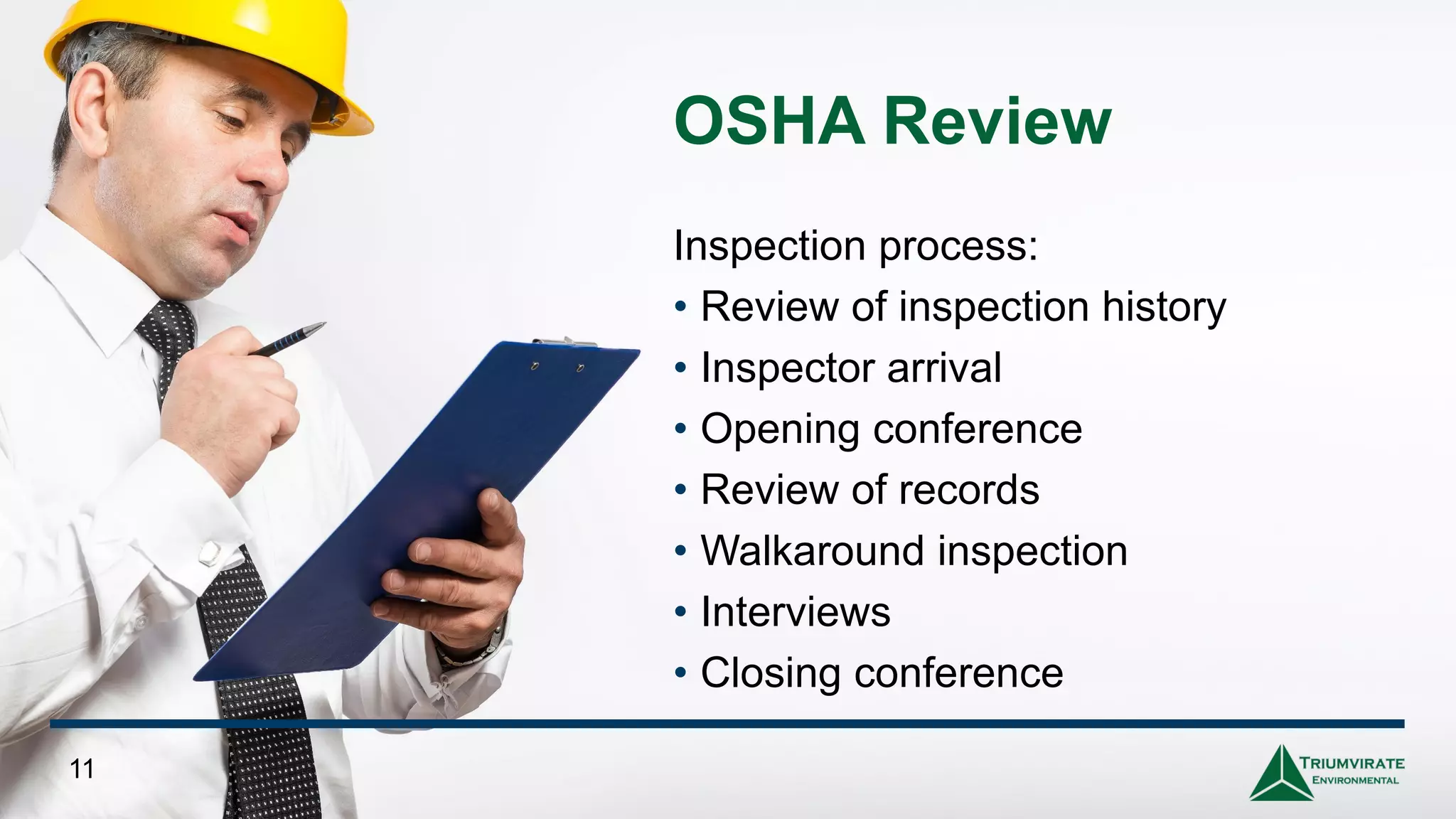
Inspection process:
• Review of inspection history
• Inspector arrival
• Opening conference
• Review of records
• Walkaround inspection
• Interviews
• Closing conference
11
OSHA Review
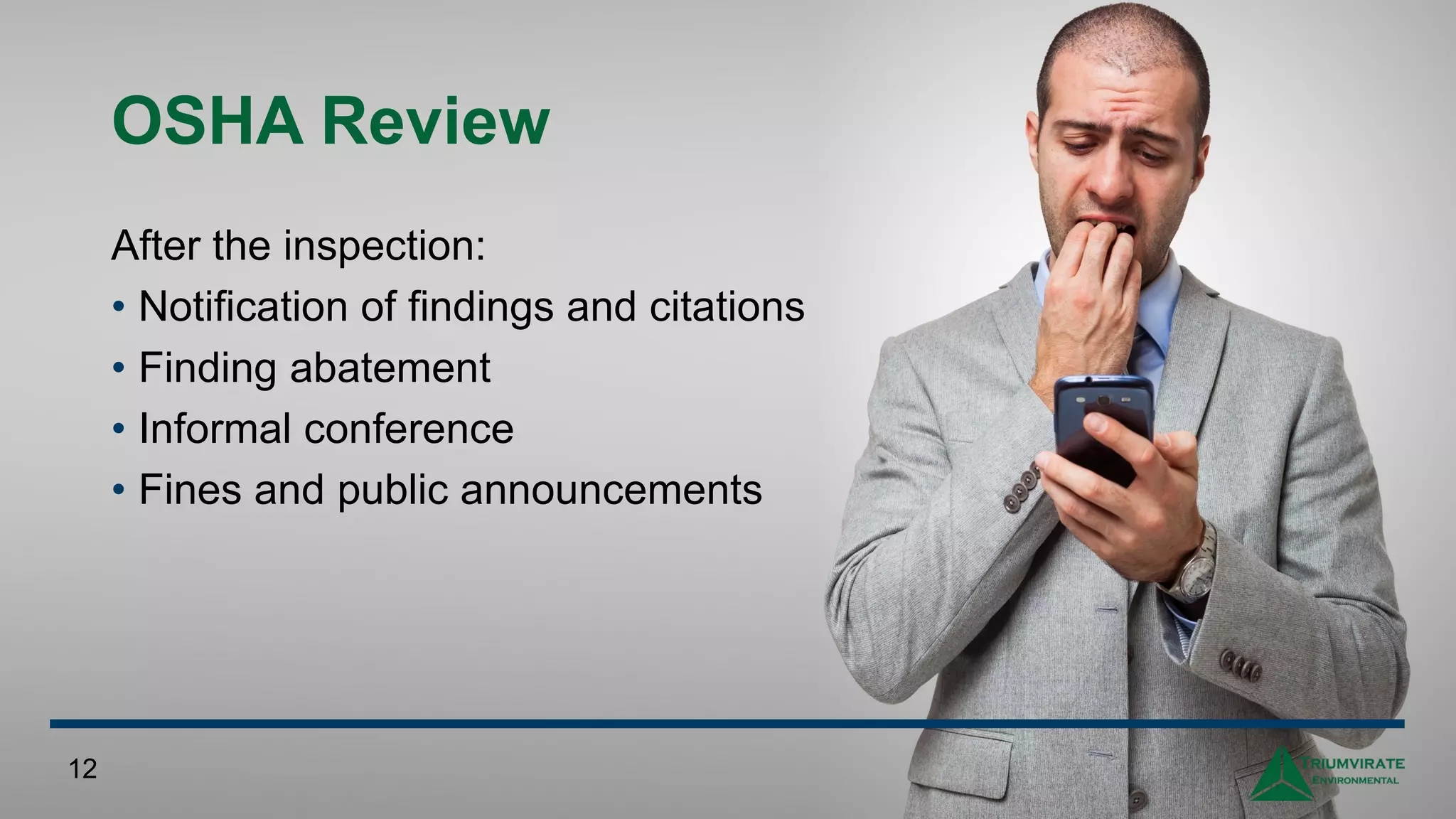
After the inspection:
• Notification of findings and citations
• Finding abatement
• Informal conference
• Fines and public announcements
12
OSHA Review
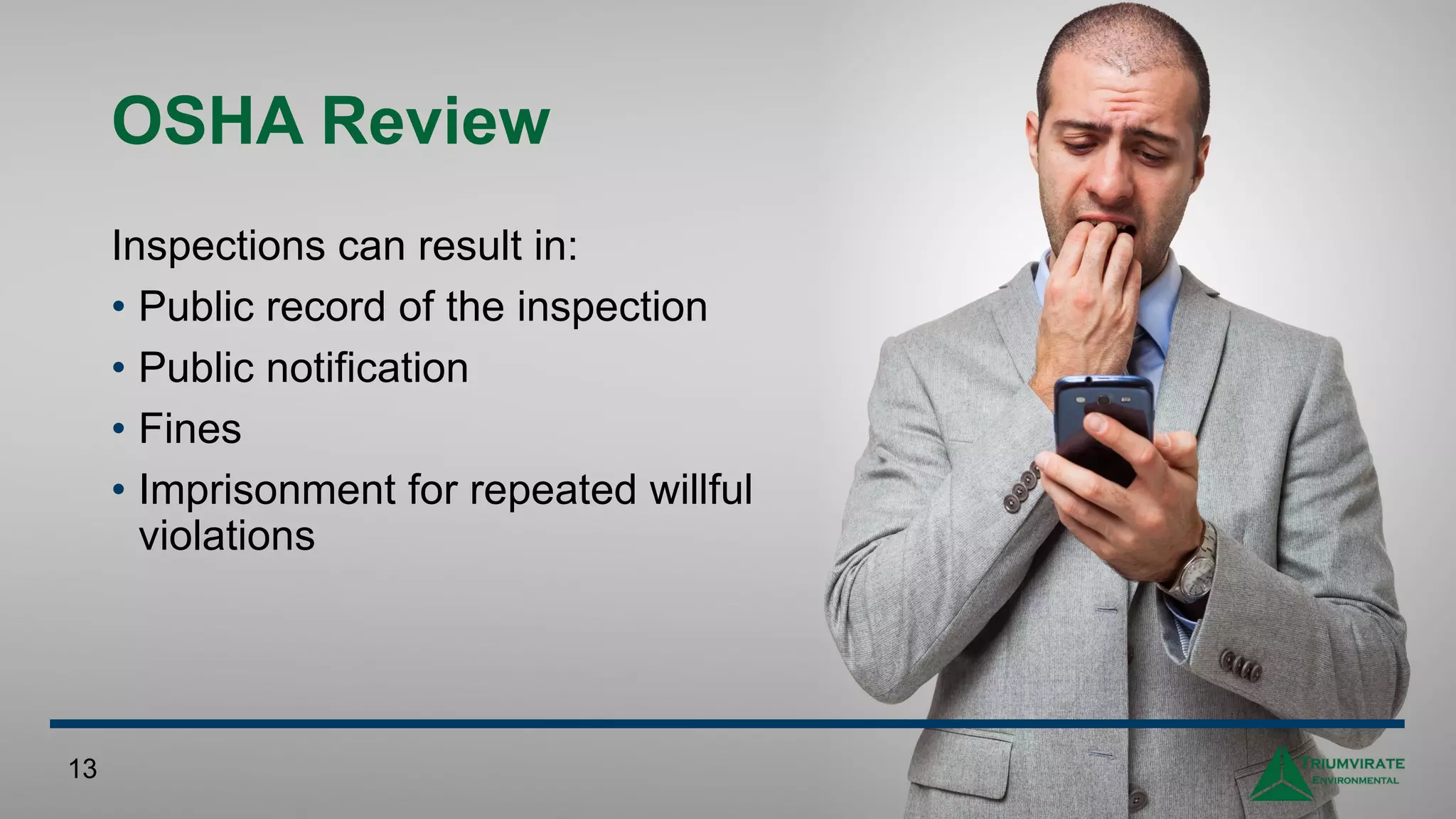
Inspections can result in:
• Public record of the inspection
• Public notification
• Fines
• Imprisonment for repeated willful
violations
13
Agenda
14
OSHA Review
Assessing Your Workplace
Becoming Compliant
Program Maintenance
Q&A
Poll Question
How well would your
workplace do if it was
inspected tomorrow?
15
Assessing Your Workplace
Know the regulations
• All OSHA standards are available on the OSHA website. It is the
employer’s responsibility to comply with all applicable
requirements.
• All programs must be specific to your workplace, and regularly
maintained, inspected, and documented to ensure compliance.
• As processes change, new regulations may apply.
16
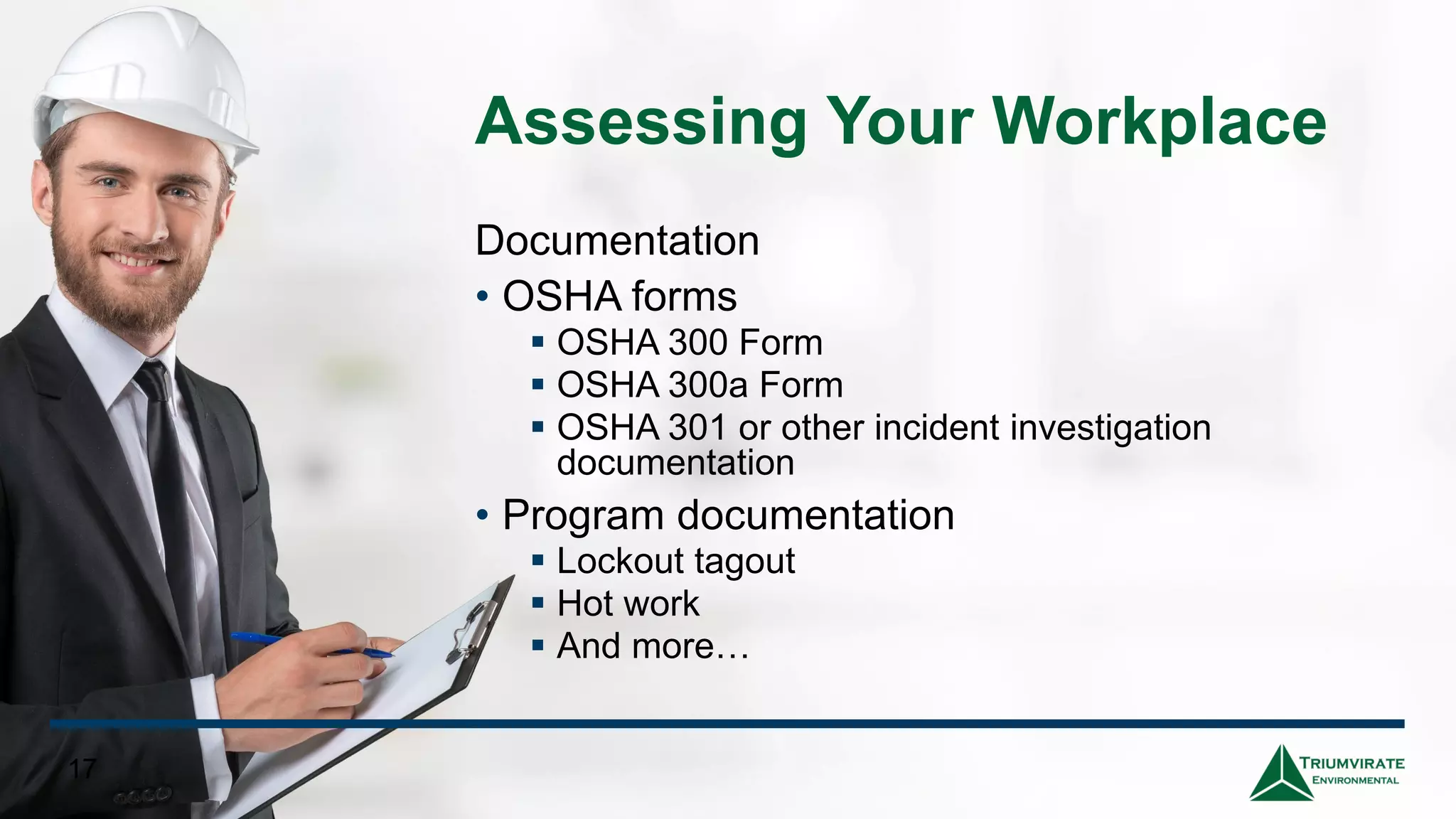
Assessing Your Workplace
Documentation
• OSHA forms
▪ OSHA 300 Form
▪ OSHA 300a Form
▪ OSHA 301 or other incident investigation
documentation
• Program documentation
▪ Lockout tagout
▪ Hot work
▪ And more…
1717
Assessing Your Workplace
Documentation
• Inspection documentation
▪ SOPs
▪ Eyewash, fire extinguisher
▪ Compliance inspections (laboratories,
machine guarding, PPE usage, Etc.)
• Sign-in sheets and minutes
▪ Trainings
▪ Safety committee meetings
▪ New hire onboarding and job-specific training
18
19
Assessing Your Workplace
Documentation
• Industrial Hygiene results
▪ Air sampling
▪ Formaldehyde
▪ Noise
• Voluntary programs
▪ Respirator
▪ Hearing protection
• Hazard Communication
▪ Safety data sheets
▪ Labels
▪ Program
19
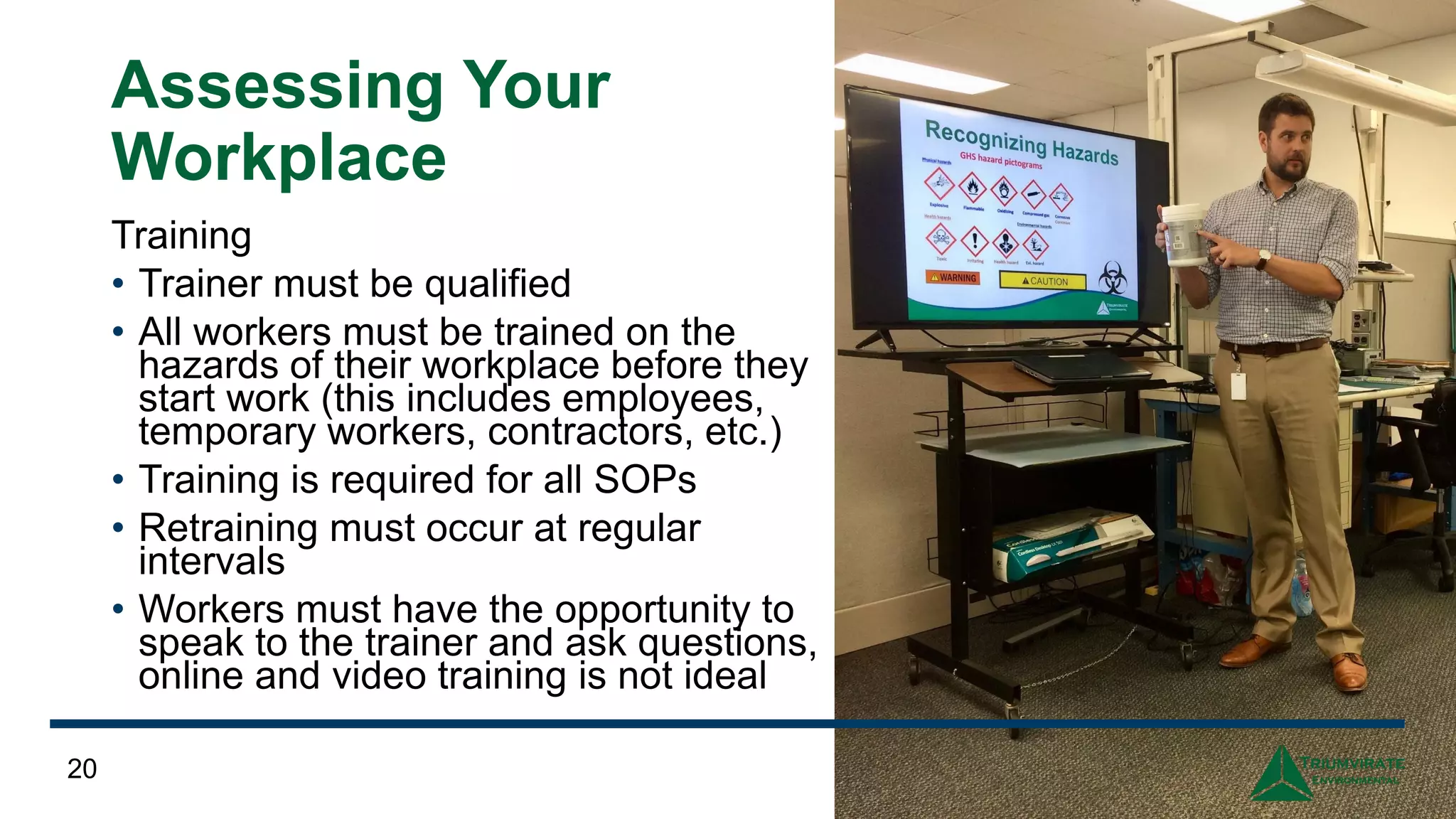
Assessing Your
Workplace
Training
• Trainer must be qualified
• All workers must be trained on the
hazards of their workplace before they
start work (this includes employees,
temporary workers, contractors, etc.)
• Training is required for all SOPs
• Retraining must occur at regular
intervals
• Workers must have the opportunity to
speak to the trainer and ask questions,
online and video training is not ideal
20
Assessing Your Workplace
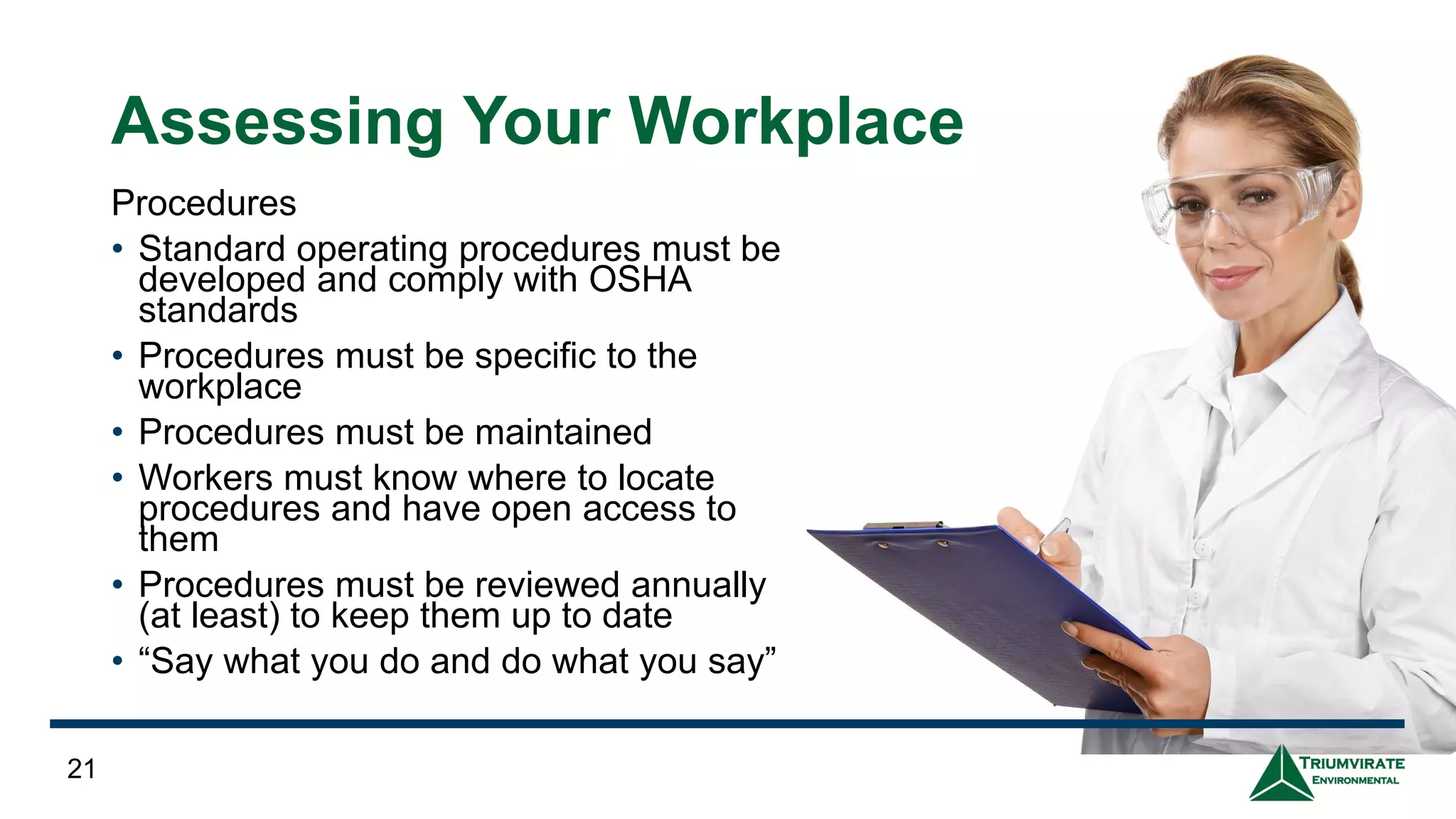
Procedures
• Standard operating procedures must be
developed and comply with OSHA
standards
• Procedures must be specific to the
workplace
• Procedures must be maintained
• Workers must know where to locate
procedures and have open access to
them
• Procedures must be reviewed annually
(at least) to keep them up to date
• “Say what you do and do what you say”
21
Assessing Your Workplace
Reporting - Know your reporting requirements!
• 300 Form
• Hospitalization
• Amputation
• Loss of eyesight
• Point of operation injury
• Loss of consciousness
• And more…
22
Assessing Your
Workplace
Inspection Preparedness
• The best way to prepare for an inspection
is to maintain a fully compliant EHS
program, and continuously work to prevent
reduce and prevent injuries
• Know what to expect
• Have a back up for the EHS manager
• Provide reception with instructions on what
to do when an OSHA inspector arrives
• Maintain documentation and comply with
record retention requirements
23
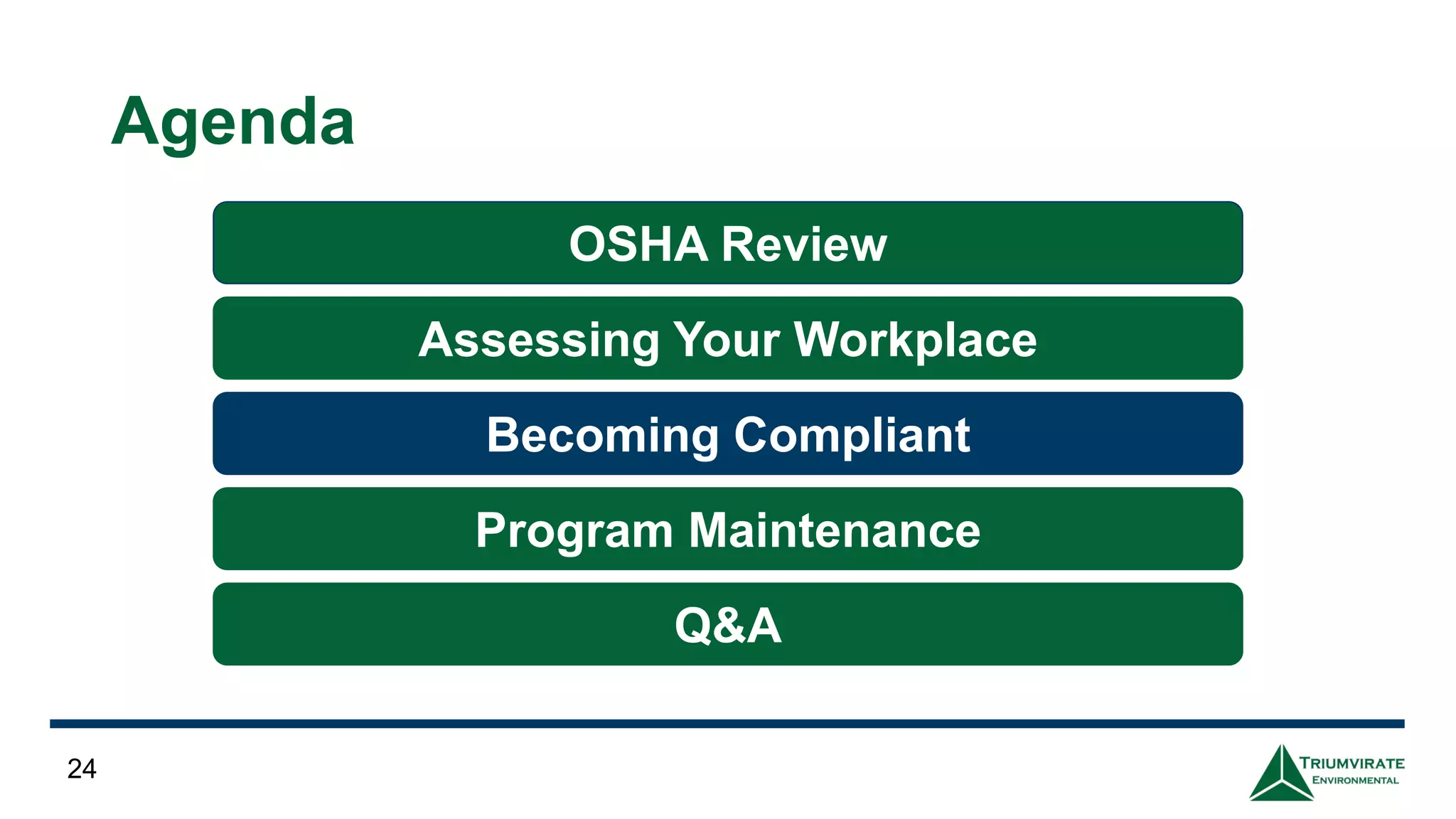
Agenda
24
OSHA Review
Assessing Your Workplace
Becoming Compliant
Program Maintenance
Q&A
Poll Question
How compliant is your
workplace with OSHA
requirements?
25
Becoming Compliant
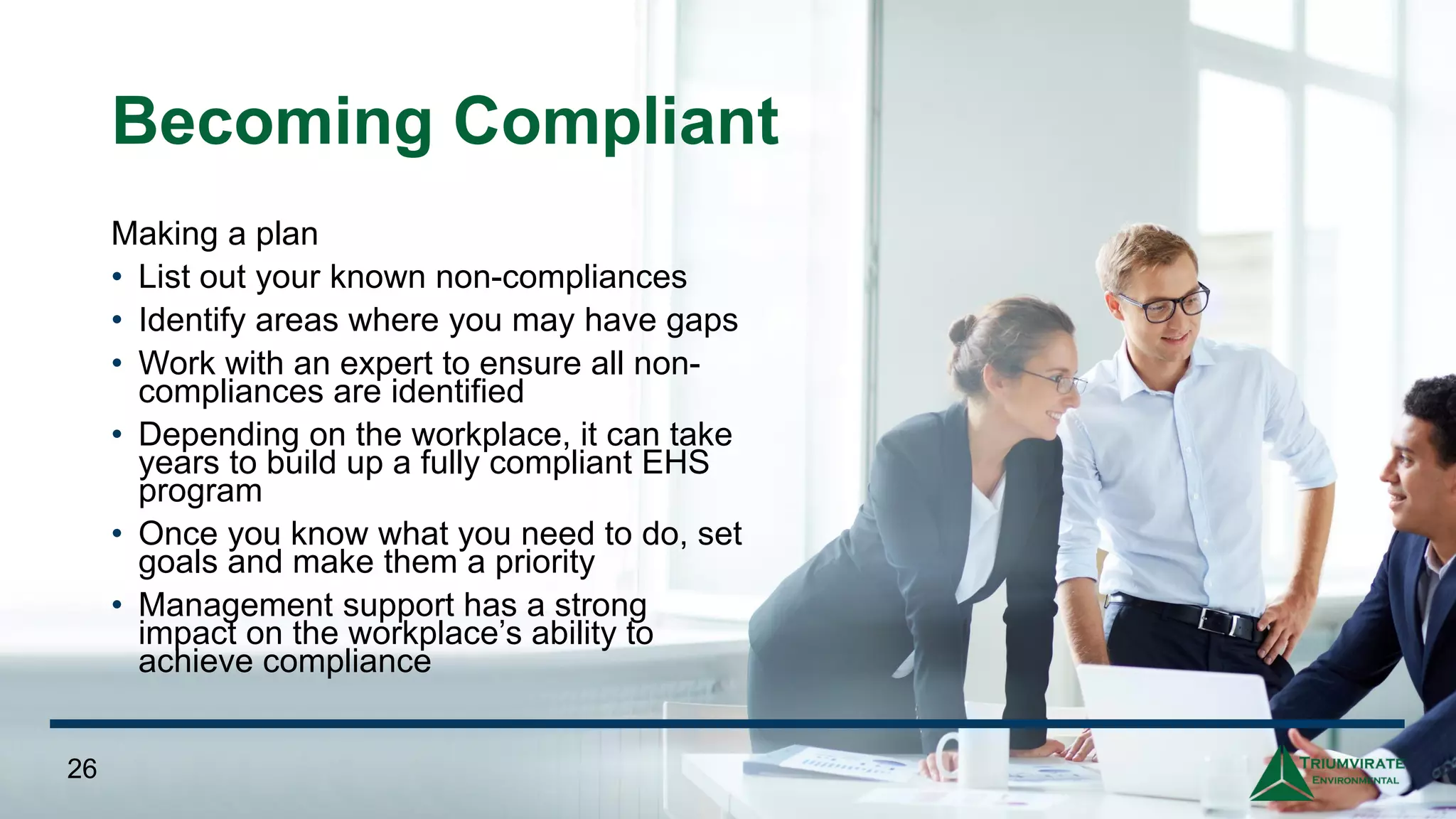
Making a plan
• List out your known non-compliances
• Identify areas where you may have gaps
• Work with an expert to ensure all non-
compliances are identified
• Depending on the workplace, it can take
years to build up a fully compliant EHS
program
• Once you know what you need to do, set
goals and make them a priority
• Management support has a strong
impact on the workplace’s ability to
achieve compliance
26
Becoming Compliant
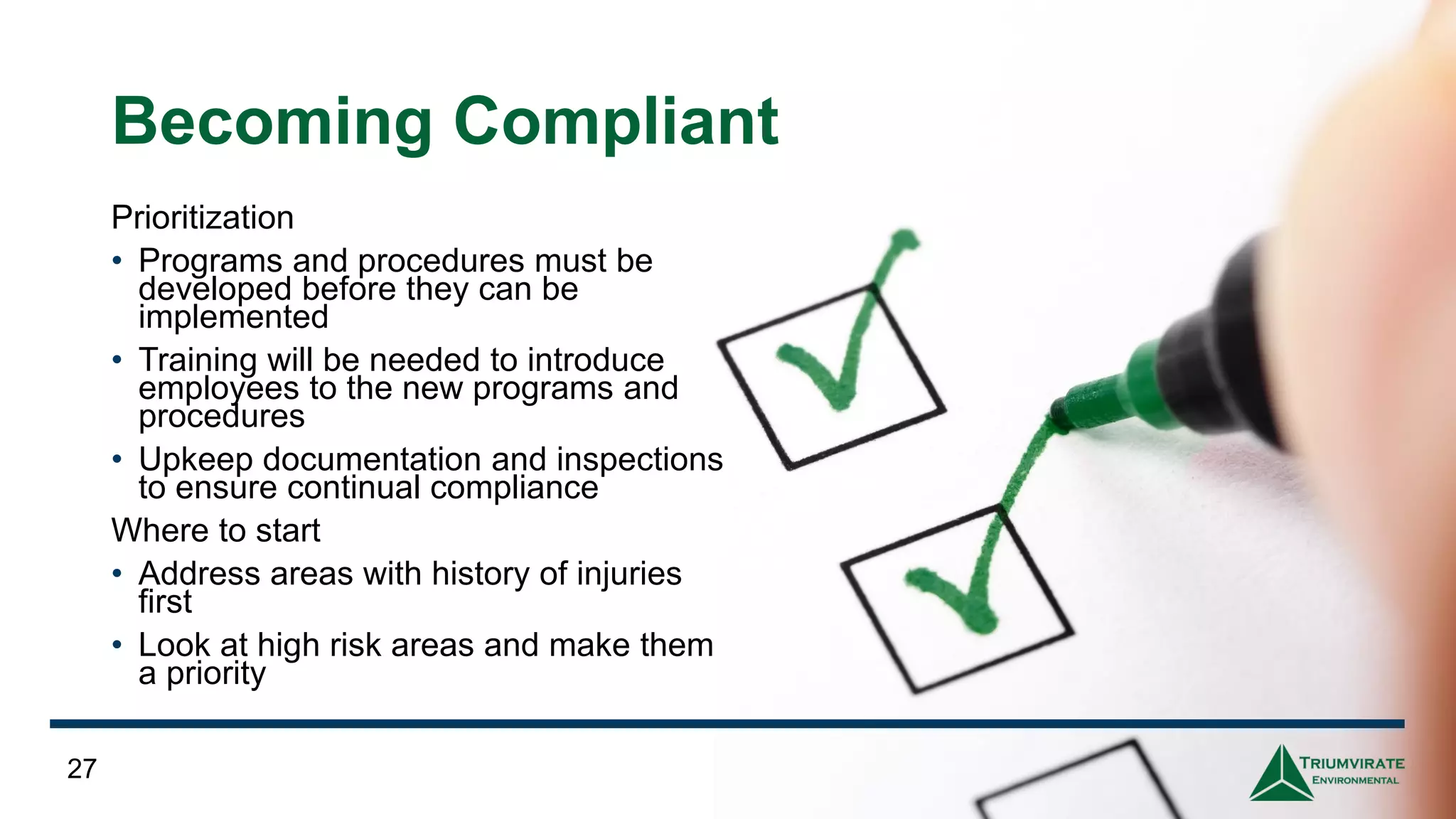
Prioritization
• Programs and procedures must be
developed before they can be
implemented
• Training will be needed to introduce
employees to the new programs and
procedures
• Upkeep documentation and inspections
to ensure continual compliance
Where to start
• Address areas with history of injuries
first
• Look at high risk areas and make them
a priority
27
Becoming Compliant
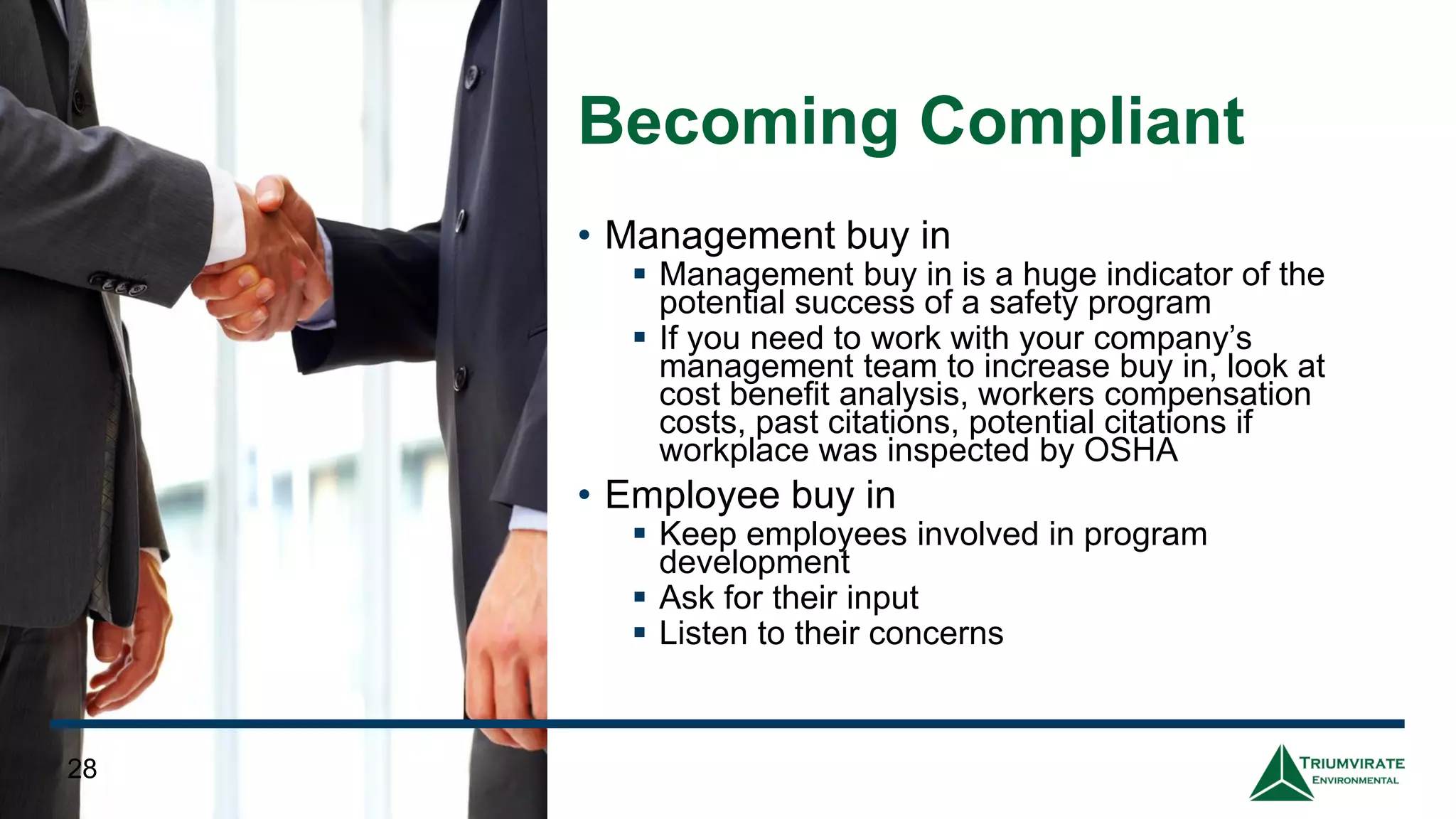
• Management buy in
▪ Management buy in is a huge indicator of the
potential success of a safety program
▪ If you need to work with your company’s
management team to increase buy in, look at
cost benefit analysis, workers compensation
costs, past citations, potential citations if
workplace was inspected by OSHA
• Employee buy in
▪ Keep employees involved in program
development
▪ Ask for their input
▪ Listen to their concerns
28
Becoming Compliant
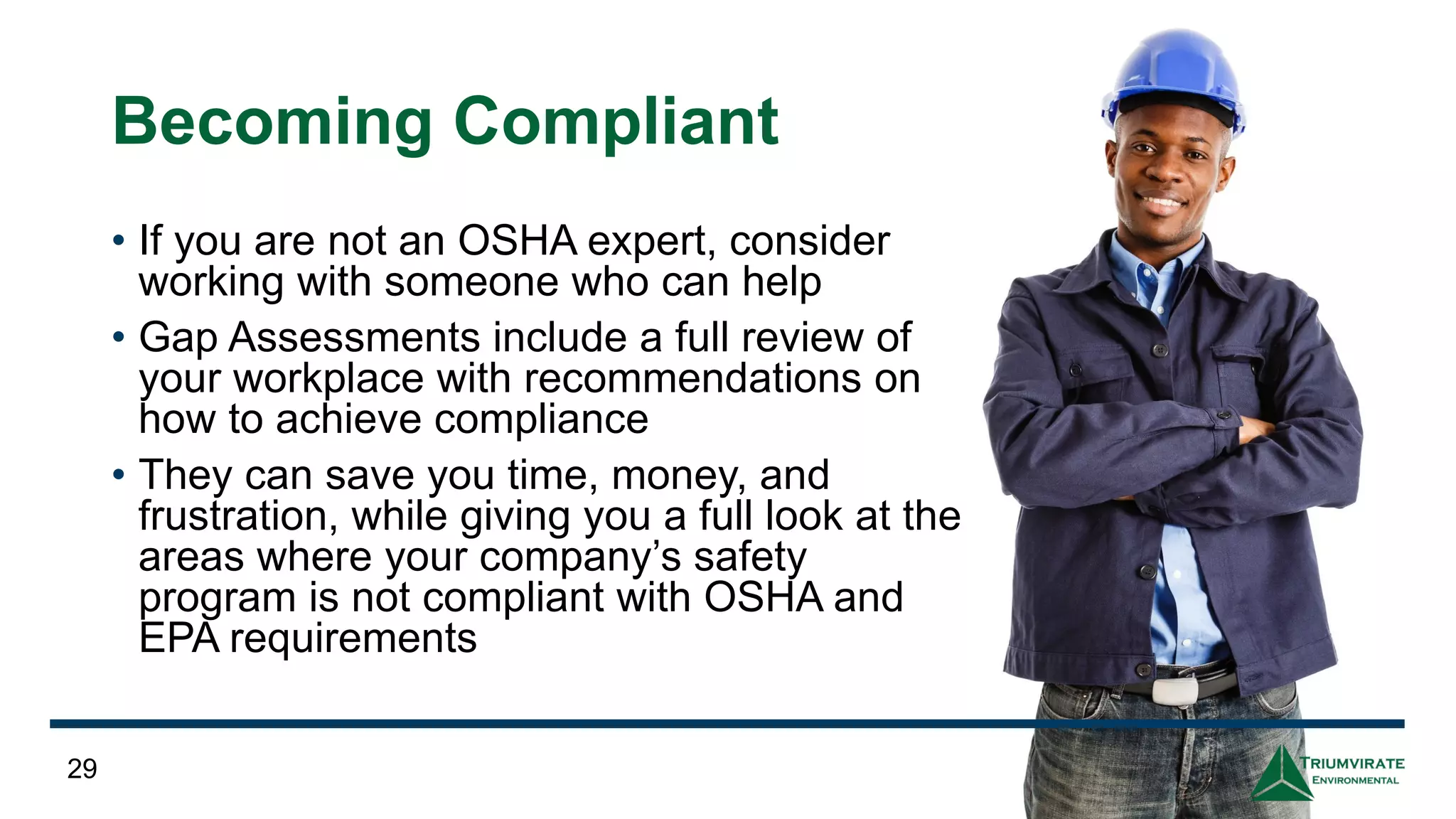
• If you are not an OSHA expert, consider
working with someone who can help
• Gap Assessments include a full review of
your workplace with recommendations on
how to achieve compliance
• They can save you time, money, and
frustration, while giving you a full look at the
areas where your company’s safety
program is not compliant with OSHA and
EPA requirements
29
Agenda
30
OSHA Review
Assessing Your Workplace
Becoming Compliant
Program Maintenance
Q&A
Program Maintenance
Once compliance is achieved, it must be maintained.
Program maintenance involves:
• Retraining
• Answering questions
• Evaluating new procedures and equipment
• Inspections
• Addressing inspection findings
• Incident investigation
• Onboarding
• Documentation upkeep
• Measurement of EHS key performance indicators
• Developing new programs
31
In Summary
• All workplaces need to be aware of the OSHA standards that
apply to them
• Compliance requires effort, expertise, and constant
maintenance. The benefit is:
▪ A reduction in employee injuries
▪ Avoiding OSHA visits
▪ Saving money in fines and workers compensation
▪ Protecting the company image
32
More Information
1. 29 CFR 1910
2. OSHA Field Operations Manual
3. www.OSHA.gov
33
Agenda
34
OSHA Review
Assessing Your Workplace
Becoming Compliant
Program Maintenance
Q&A
Questions?
THANK YOU!
Request a Free OSHA
Consultation:
https://www.triumvirate.com/webinar-offer-osha-compliance-review
Aimee Giovine: agiovine@triumvirate.com

The Key Elements of Building an OSHA-Compliant Workplace from the Ground Up

  • 1.
    The Key Elementsto Creating an OSHA-Compliant Workplace from the Ground Up Aimee Giovine, EHS Manager Triumvirate Environmental
  • 2.
  • 3.
    3 During this Webinar ✓All lines will be muted. ✓ Communicate via the questions tab in your webinar panel. ✓ Unanswered questions will be responded to personally after the webinar. ✓ Webinar recording and slides will be emailed to you tomorrow.
  • 4.
    Aimee Giovine, CIH,CSP, CHMM EHS Manager Triumvirate Environmental 4 Meet Your Presenter
  • 5.
    Agenda 5 OSHA Review Assessing YourWorkplace Becoming Compliant Program Maintenance Q&A
  • 6.
    Introduction • An agencywithin the Department of Labor • “Assure safe and healthy working conditions for working men and women by setting and enforcing standards and by providing training, outreach, education and assistance.” • OSHA covers most private sector employers in all 50 states, the District of Columbia, and other US jurisdictions—either directly through federal OSHA or through an OSHA approved state plan 6
  • 7.
    OSHA Review • OSHAGeneral Industry Standards are covered under 29 CFR 1910 • The Standard has 20 subparts which address different components of the work environment • Letters of Interpretation are searchable and available for review • Employers are responsible for determining which components of the standard apply to their operations • Employers are responsible for recording and reporting incidents as required by OSHA 7
  • 8.
    OSHA Review The GeneralDuty Clause states: (a)Each employer – (1)shall furnish to each of his employees employment and a place of employment which are free from recognized hazards that are causing or are likely to cause death or serious physical harm to his employees; (2)shall comply with occupational safety and health standards promulgated under this Act. Reference: OSH Act of 1970, Section 5. Duties 8
  • 9.
    OSHA Review The GeneralDuty Clause states: (b) Each employee shall comply with occupational safety and health standards and all rules, regulations, and orders issued pursuant to this Act which are applicable to his own actions and conduct. Reference: OSH Act of 1970, Section 5. Duties 9
  • 10.
    OSHA Review Inspections • Canbe initiated by a number of events ▪ OSHA initiatives ▪ Injuries/deaths ▪ Complaint filed • Maintaining a compliant workplace, and having a team prepared to handle an inspection are vital • Companies should have staff prepared and trained on the inspection process to facilitate the workplace inspection 10
  • 11.
    OSHA Review Inspection process: •Review of inspection history • Inspector arrival • Opening conference • Review of records • Walkaround inspection • Interviews • Closing conference 11
  • 12.
    OSHA Review After theinspection: • Notification of findings and citations • Finding abatement • Informal conference • Fines and public announcements 12
  • 13.
    OSHA Review Inspections canresult in: • Public record of the inspection • Public notification • Fines • Imprisonment for repeated willful violations 13
  • 14.
    Agenda 14 OSHA Review Assessing YourWorkplace Becoming Compliant Program Maintenance Q&A
  • 15.
    Poll Question How wellwould your workplace do if it was inspected tomorrow? 15
  • 16.
    Assessing Your Workplace Knowthe regulations • All OSHA standards are available on the OSHA website. It is the employer’s responsibility to comply with all applicable requirements. • All programs must be specific to your workplace, and regularly maintained, inspected, and documented to ensure compliance. • As processes change, new regulations may apply. 16
  • 17.
    Assessing Your Workplace Documentation •OSHA forms ▪ OSHA 300 Form ▪ OSHA 300a Form ▪ OSHA 301 or other incident investigation documentation • Program documentation ▪ Lockout tagout ▪ Hot work ▪ And more… 1717
  • 18.
    Assessing Your Workplace Documentation •Inspection documentation ▪ SOPs ▪ Eyewash, fire extinguisher ▪ Compliance inspections (laboratories, machine guarding, PPE usage, Etc.) • Sign-in sheets and minutes ▪ Trainings ▪ Safety committee meetings ▪ New hire onboarding and job-specific training 18
  • 19.
    19 Assessing Your Workplace Documentation •Industrial Hygiene results ▪ Air sampling ▪ Formaldehyde ▪ Noise • Voluntary programs ▪ Respirator ▪ Hearing protection • Hazard Communication ▪ Safety data sheets ▪ Labels ▪ Program 19
  • 20.
    Assessing Your Workplace Training • Trainermust be qualified • All workers must be trained on the hazards of their workplace before they start work (this includes employees, temporary workers, contractors, etc.) • Training is required for all SOPs • Retraining must occur at regular intervals • Workers must have the opportunity to speak to the trainer and ask questions, online and video training is not ideal 20
  • 21.
    Assessing Your Workplace Procedures •Standard operating procedures must be developed and comply with OSHA standards • Procedures must be specific to the workplace • Procedures must be maintained • Workers must know where to locate procedures and have open access to them • Procedures must be reviewed annually (at least) to keep them up to date • “Say what you do and do what you say” 21
  • 22.
    Assessing Your Workplace Reporting- Know your reporting requirements! • 300 Form • Hospitalization • Amputation • Loss of eyesight • Point of operation injury • Loss of consciousness • And more… 22
  • 23.
    Assessing Your Workplace Inspection Preparedness •The best way to prepare for an inspection is to maintain a fully compliant EHS program, and continuously work to prevent reduce and prevent injuries • Know what to expect • Have a back up for the EHS manager • Provide reception with instructions on what to do when an OSHA inspector arrives • Maintain documentation and comply with record retention requirements 23
  • 24.
    Agenda 24 OSHA Review Assessing YourWorkplace Becoming Compliant Program Maintenance Q&A
  • 25.
    Poll Question How compliantis your workplace with OSHA requirements? 25
  • 26.
    Becoming Compliant Making aplan • List out your known non-compliances • Identify areas where you may have gaps • Work with an expert to ensure all non- compliances are identified • Depending on the workplace, it can take years to build up a fully compliant EHS program • Once you know what you need to do, set goals and make them a priority • Management support has a strong impact on the workplace’s ability to achieve compliance 26
  • 27.
    Becoming Compliant Prioritization • Programsand procedures must be developed before they can be implemented • Training will be needed to introduce employees to the new programs and procedures • Upkeep documentation and inspections to ensure continual compliance Where to start • Address areas with history of injuries first • Look at high risk areas and make them a priority 27
  • 28.
    Becoming Compliant • Managementbuy in ▪ Management buy in is a huge indicator of the potential success of a safety program ▪ If you need to work with your company’s management team to increase buy in, look at cost benefit analysis, workers compensation costs, past citations, potential citations if workplace was inspected by OSHA • Employee buy in ▪ Keep employees involved in program development ▪ Ask for their input ▪ Listen to their concerns 28
  • 29.
    Becoming Compliant • Ifyou are not an OSHA expert, consider working with someone who can help • Gap Assessments include a full review of your workplace with recommendations on how to achieve compliance • They can save you time, money, and frustration, while giving you a full look at the areas where your company’s safety program is not compliant with OSHA and EPA requirements 29
  • 30.
    Agenda 30 OSHA Review Assessing YourWorkplace Becoming Compliant Program Maintenance Q&A
  • 31.
    Program Maintenance Once complianceis achieved, it must be maintained. Program maintenance involves: • Retraining • Answering questions • Evaluating new procedures and equipment • Inspections • Addressing inspection findings • Incident investigation • Onboarding • Documentation upkeep • Measurement of EHS key performance indicators • Developing new programs 31
  • 32.
    In Summary • Allworkplaces need to be aware of the OSHA standards that apply to them • Compliance requires effort, expertise, and constant maintenance. The benefit is: ▪ A reduction in employee injuries ▪ Avoiding OSHA visits ▪ Saving money in fines and workers compensation ▪ Protecting the company image 32
  • 33.
    More Information 1. 29CFR 1910 2. OSHA Field Operations Manual 3. www.OSHA.gov 33
  • 34.
    Agenda 34 OSHA Review Assessing YourWorkplace Becoming Compliant Program Maintenance Q&A
  • 35.
  • 36.
    THANK YOU! Request aFree OSHA Consultation: https://www.triumvirate.com/webinar-offer-osha-compliance-review Aimee Giovine: agiovine@triumvirate.com