
Conducting Internal Audits
and Preparing for
EPA/DEP/OSHA Inspections
Rick Foote
Triumvirate Environmental
Audit: Why Now?
2
• Increase in inspections and enforcement actions
• There has been an increased focus on pharmaceutical
waste collection
• Take advantage of the self-disclosure requirements
Audits: Your Options, Your
Risks
3
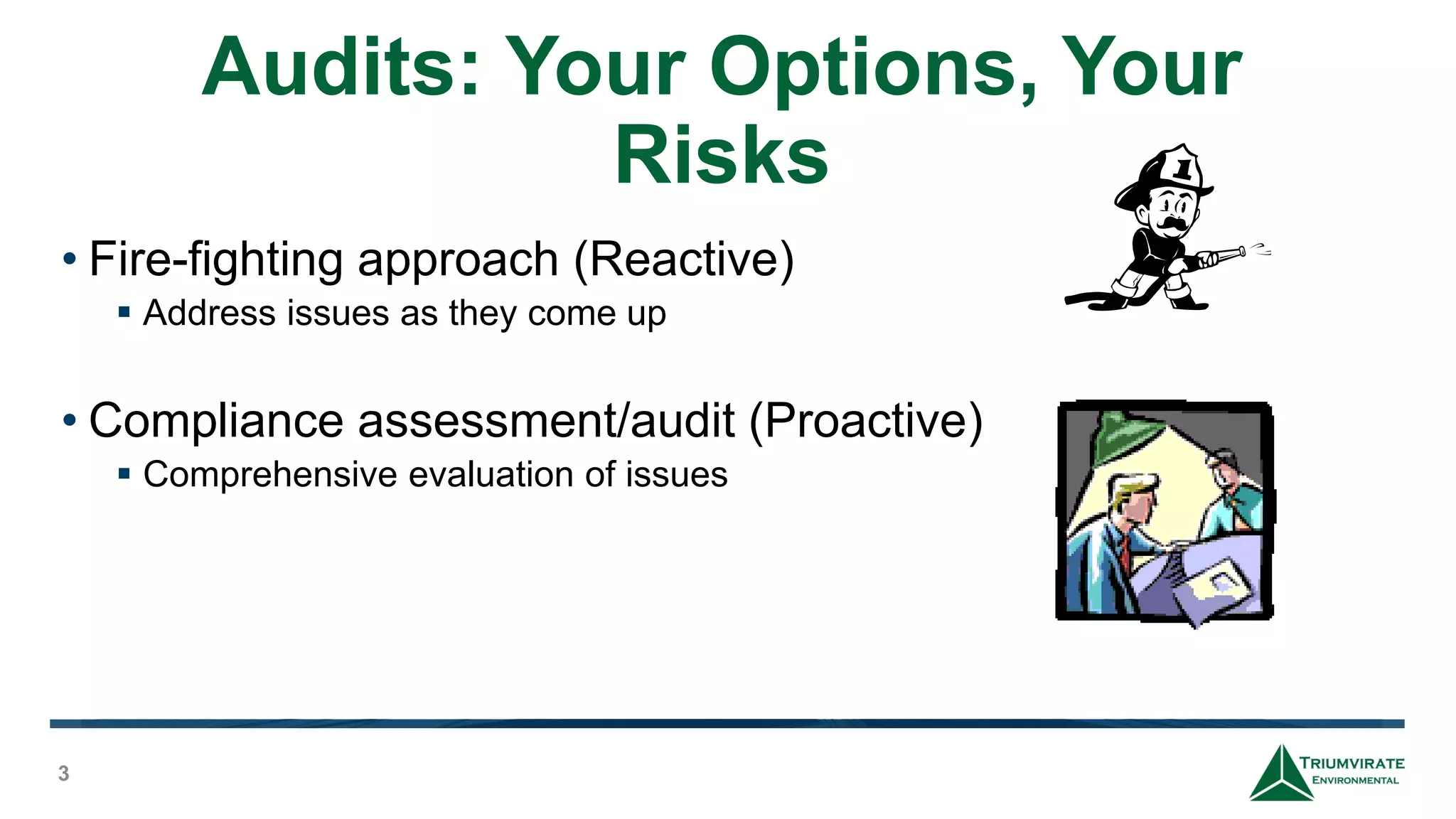
• Fire-fighting approach (Reactive)
 Address issues as they come up
• Compliance assessment/audit (Proactive)
 Comprehensive evaluation of issues
Benefits: Why Conduct an Audit?
4
• Efficiencies
 Time
 Resources
• Minimize potential for violations
• Prevent fines/penalties
• Stay out of the newspapers!
Multi-Media Audits
5
• Clean Water Act (CWA)
• Clean Air Act (CAA)
• Resource Conservation & Recovery Act (RCRA): Hazardous
Waste
• Department of Transportation (DOT)
• Emergency Planning & Community Right-to-Know (EPCRA)
• Fungicide Insecticide and Rodenticide Act (FIFRA)
• OSHA – General Industry and Construction
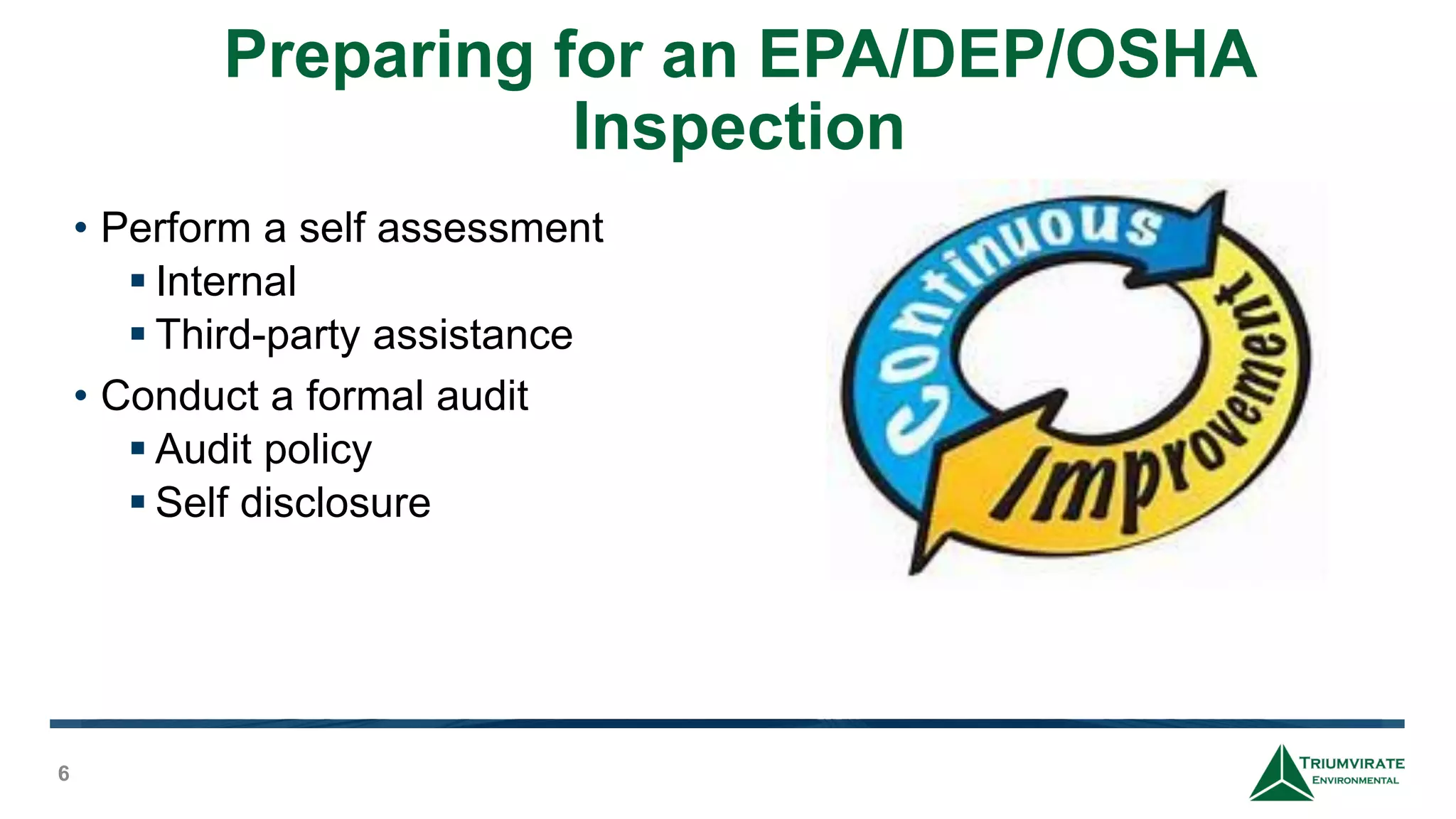
Preparing for an EPA/DEP/OSHA
Inspection
6
• Perform a self assessment
 Internal
 Third-party assistance
• Conduct a formal audit
 Audit policy
 Self disclosure
EPA/DEP/OSHA Inspections:
Preparation is Key!
7
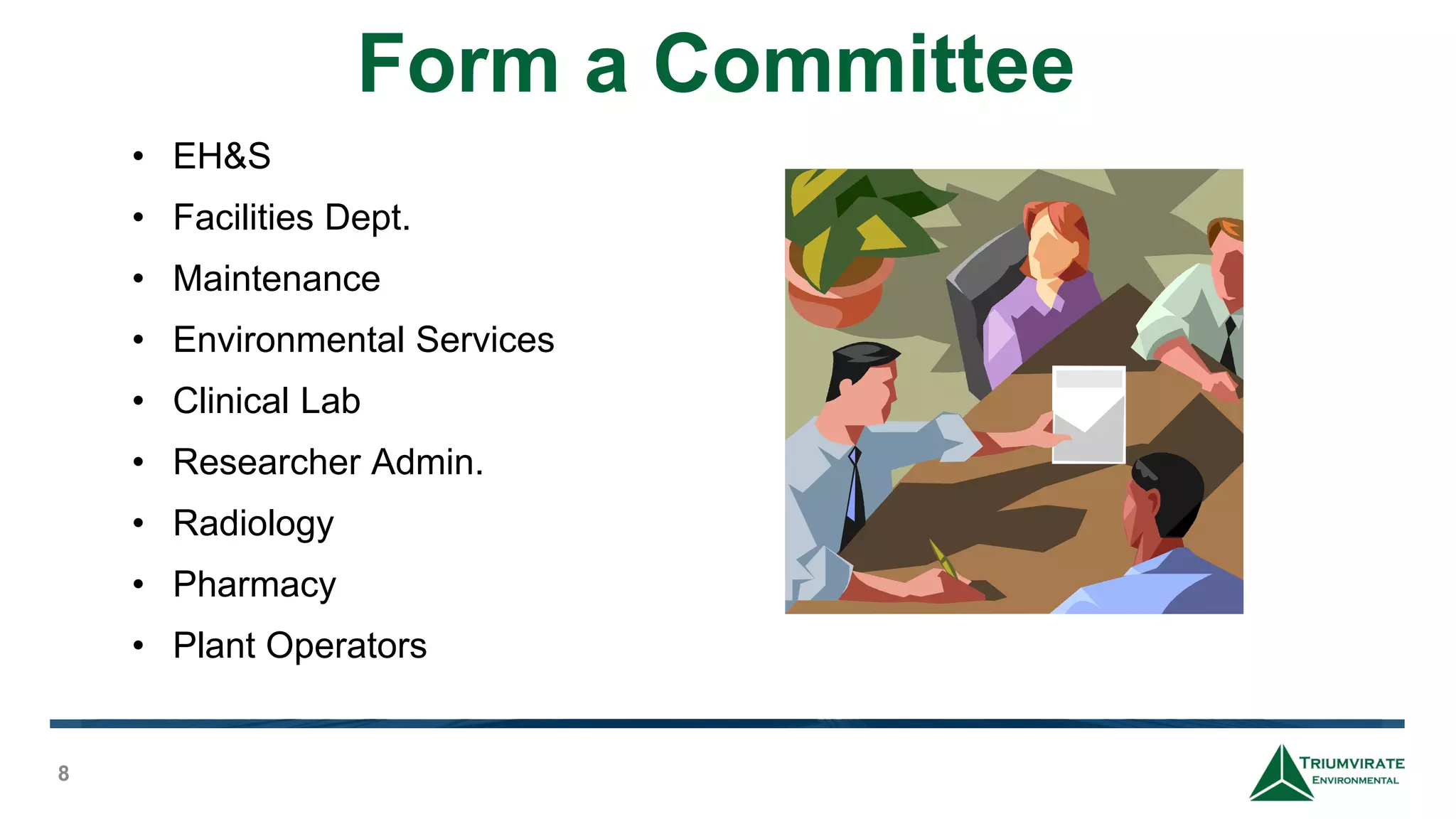
Form a Committee
8
• EH&S
• Facilities Dept.
• Maintenance
• Environmental Services
• Clinical Lab
• Researcher Admin.
• Radiology
• Pharmacy
• Plant Operators
EPA/DEP/OSHA Inspections - Tips
9
• Be Prepared!
 Maintain up-to-date plans and records
 Know where documents are; be able to produce
them in a timely manner
 Have a preparedness plan
• Records and Documentation Review
 Assemble materials requested by EPA/MDE/OSHA
 Identify conference room (do not use offices) for
records review
- Offer only requested documents for specific
locations
- Make duplicate copies of records that they copy
Be Ready!
1
0
• Wastewater discharge permits
(Local Authority permit)
• Stormwater permit (for
construction)
• Documentation of sampling/
lab reports (mercury analysis)
• Air emissions reports/permits
(Recordkeeping )
• Copies of waste manifests
(and profile forms)
• Biennial Hazardous Waste
Reports (LQGs)
• DOT HazMat Shipper
Registration
• Employee Training Records
(OSHA Lab Safety, HAZCOM,
RCRA/DOT)
• Oil SPCC Plan (tank
inspection records, spill
reports)
• Hazardous Waste
Contingency Plan
• DOT HazMat Security Plan
• Noise Exposure Monitoring
• Respirator Training
• Job Hazard Analysis
• Emergency Action Planning
• Etc………
Inspection Preparedness
Coordinating Committee
1
1
• Organizes and facilitates the opening conference
• Works out schedule with the inspectors
• Coordinates inspections with department/program managers
• Conducts daily debriefings
• Organizes and facilitates the closing conference
Facility Program Managers/
Experts
1
2
• Serve as primary contacts for specific compliance categories
(Air, Water, Haz Waste, Safety, etc.)
• Provide documents and records
• Accompany escorts and inspectors as necessary
• Accessible to answer questions regarding regulations and your
facility programs
Facility Inspector Escorts
1
3
• Introduce the inspector and convey seriousness of the interview
• Intercede when leading questions are asked during an interview
• Tactfully restate misunderstood questions to interviewee
• Don’t allow unqualified people to respond to questions
The Inspection
1
4
Inspections:
Logistics and Planning
1
5
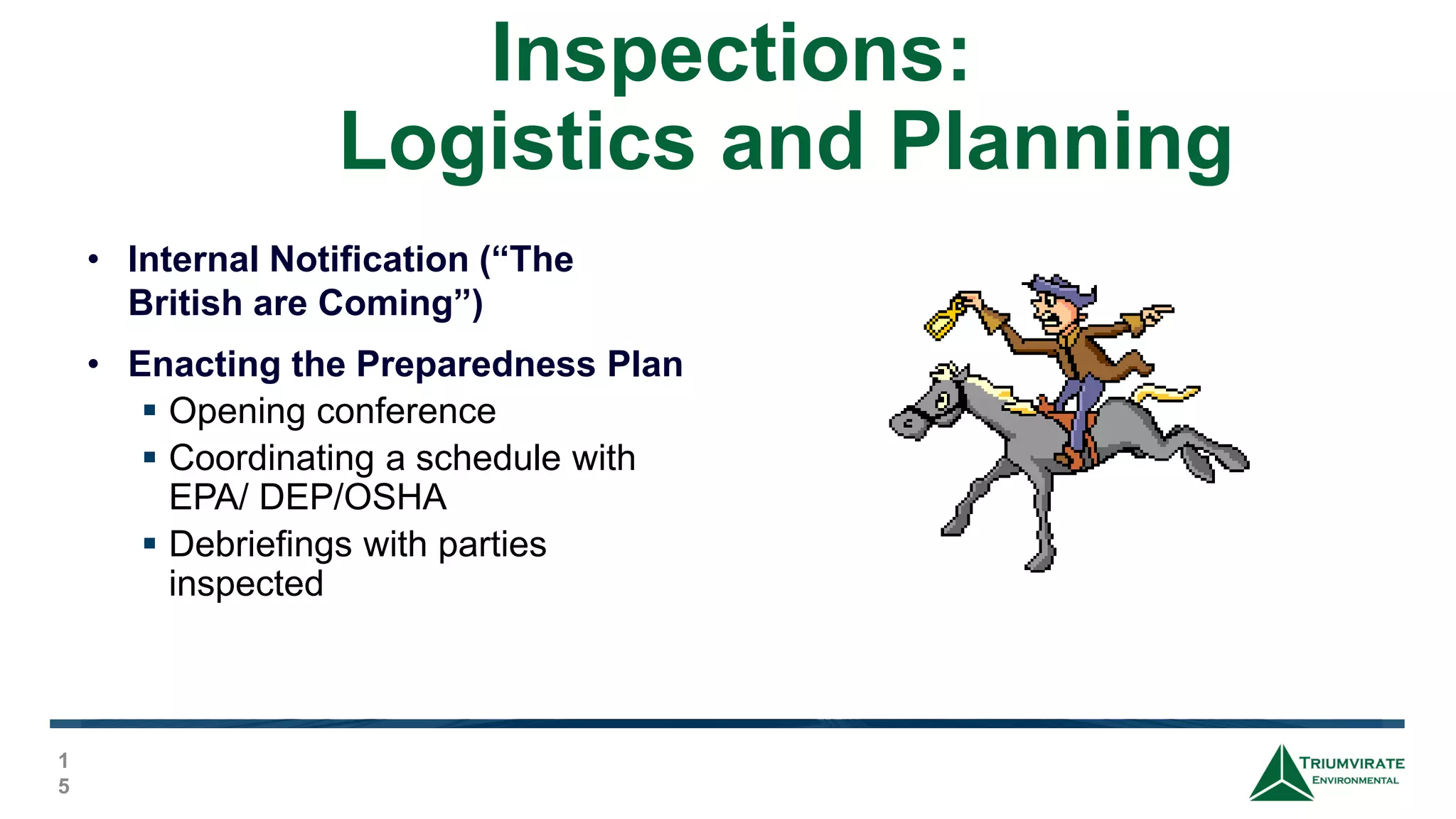
• Internal Notification (“The
British are Coming”)
• Enacting the Preparedness Plan
 Opening conference
 Coordinating a schedule with
EPA/ DEP/OSHA
 Debriefings with parties
inspected
Effective Communication
During the Inspection
1
6
• Internal communications
• Initial notification
• Opening conference
• During the audit
• Closing conference
• Debriefing
• Communications with inspectors
• Guidelines
Opening Conference
1
7
• State that the group has been assembled to help facilitate the
inspectors’ review & provide an open communication channel
with key facility officials
• Outline positive working relationship with EPA/DEP/OSHA
inspectors
• Discuss how important compliance is to your facility
• Who in upper management is involved and how often your
department meets with them
• Obtain an understanding of inspection scope
Guidelines: Site Inspection
1
8
• Identify nature and scope of inspection
• Accompany each inspector at all times
• Cooperate, but do not offer information not requested
• Duplicate all records copied
• Take good notes, photographs, split samples
• Monitor employee interviews
• Conduct an exit interview for each area to get an idea of what
they found
Facility Escort Guidelines
1
9
• Restate unclear answers from the interviewee to the
EPA/DEP/OSHA inspector
• Stay by the inspectors side
• Take notes:
 During and shortly after the interview
 Of issues that the inspector notes during the inspection
 Of questions that could not be answered
Taking Care of Business
2
0
• Fixing Potential Violations
 As issues are found
 Prior to EPA entry
 Before EPA finishes for the day
• Behind the Scenes During the Inspection
 EPA/DEP/OSHA location during the day
 Fielding questions
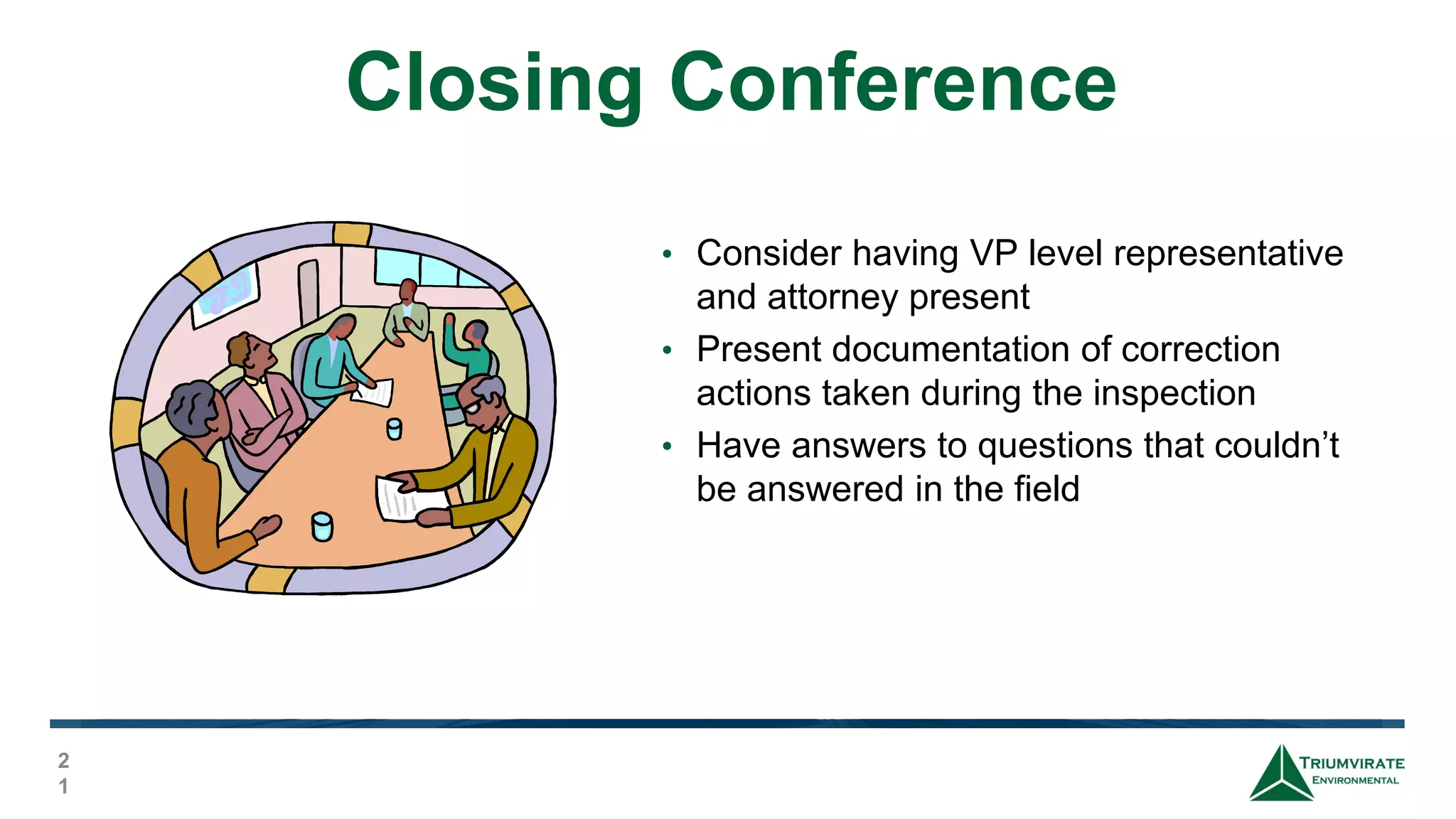
Closing Conference
2
1
• Consider having VP level representative
and attorney present
• Present documentation of correction
actions taken during the inspection
• Have answers to questions that couldn’t
be answered in the field
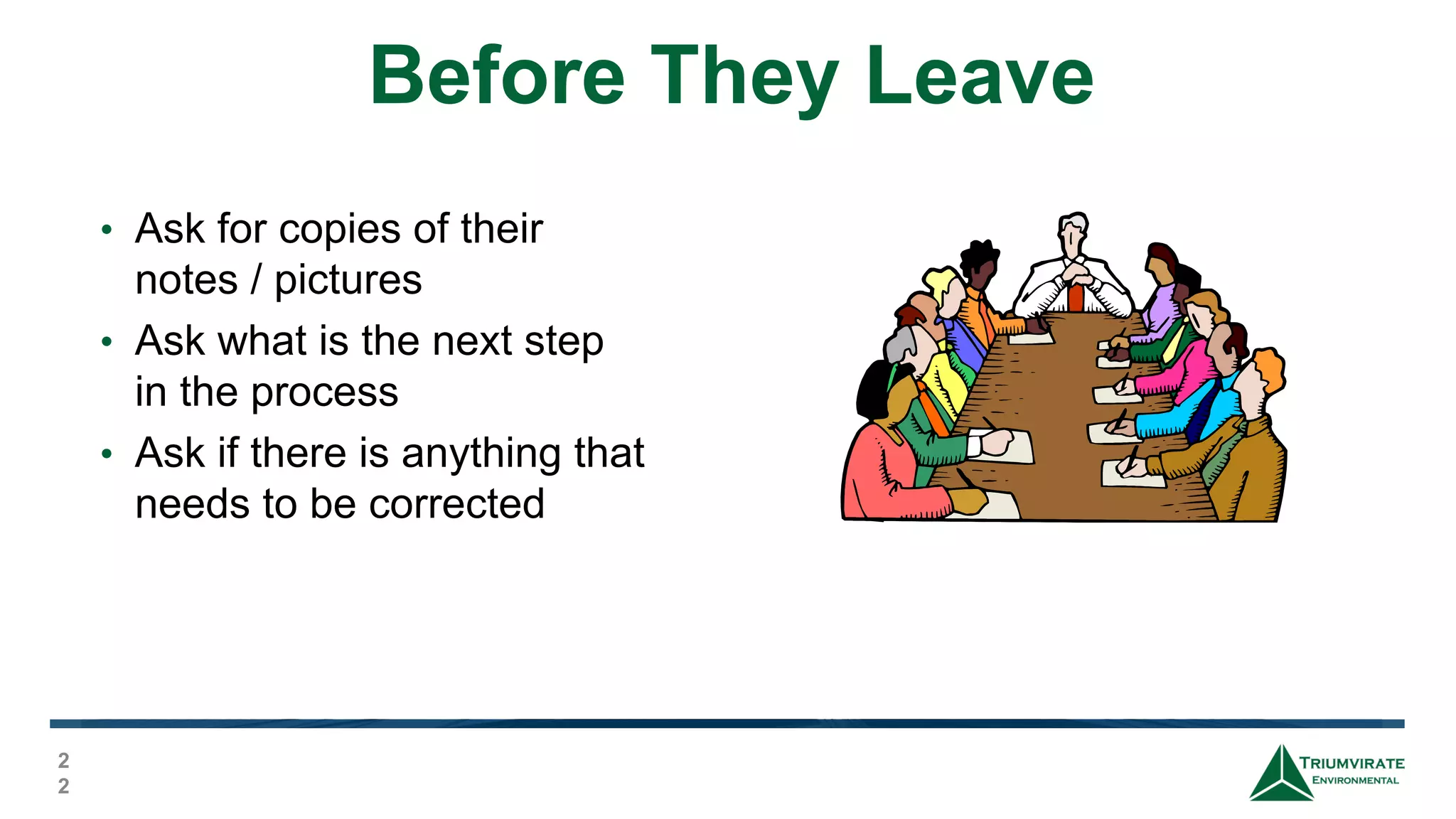
Before They Leave
2
2
• Ask for copies of their
notes / pictures
• Ask what is the next step
in the process
• Ask if there is anything that
needs to be corrected
Guidelines for Communications
During an Audit/Inspection
2
3
Attitudes & Behaviors
Goal: Stay in control
• Be courteous and respectful
• Be positive, professional and confident
• Be honest
Communications
During an Audit/Inspection
2
4
• Inspector questions
 Be an “Expert” on your programs
 Answer questions; ask for clarification as needed
• Understand the question - ask for clarification or repeat it
back to them
• Don’t volunteer additional, unnecessary information
• Keep answers simple and direct
• If you don’t know the answer, write it down and contact
someone who does
More Guidelines
2
5
• Take notes
• Don’t attempt to deal with hypothetical situations
• “Fix” simple deficiencies along the way
• Make a copy of anything given to the inspectors
• Seek approval for all photos requested by the inspectors; take
duplicate photos
• Likewise, take duplicate samples
Guidelines Continued…
2
6
• Don’t offer an opinion or agree/disagree with the inspectors
• Do talk about sports, music, general topics
• Don’t be their “buddy” or confidant
• Don’t sign anything
• Keep them from harm’s way (no confined space entry or near
high-hazard areas)
Guidelines Continued…
2
7
• Don’t offer information unless specifically asked
• Don’t argue with the inspectors
• Don’t complain about the regulations
• Don’t be pushed into giving an answer if you don’t know…say that
you don’t know
• Don’t be evasive; answer directly and succinctly
• Don’t lie to the inspectors or misrepresent what really happens in
your area
• Don’t engage in speculation
THANK YOU!
Rick Foote
Director of Industrial Practice
617-686-6184
rfoote@triumvirate.com

Conducting Internal Audits & Preparing for EPA/DEP/OSHA Inspections

  • 1.
    Conducting Internal Audits andPreparing for EPA/DEP/OSHA Inspections Rick Foote Triumvirate Environmental
  • 2.
    Audit: Why Now? 2 •Increase in inspections and enforcement actions • There has been an increased focus on pharmaceutical waste collection • Take advantage of the self-disclosure requirements
  • 3.
    Audits: Your Options,Your Risks 3 • Fire-fighting approach (Reactive)  Address issues as they come up • Compliance assessment/audit (Proactive)  Comprehensive evaluation of issues
  • 4.
    Benefits: Why Conductan Audit? 4 • Efficiencies  Time  Resources • Minimize potential for violations • Prevent fines/penalties • Stay out of the newspapers!
  • 5.
    Multi-Media Audits 5 • CleanWater Act (CWA) • Clean Air Act (CAA) • Resource Conservation & Recovery Act (RCRA): Hazardous Waste • Department of Transportation (DOT) • Emergency Planning & Community Right-to-Know (EPCRA) • Fungicide Insecticide and Rodenticide Act (FIFRA) • OSHA – General Industry and Construction
  • 6.
    Preparing for anEPA/DEP/OSHA Inspection 6 • Perform a self assessment  Internal  Third-party assistance • Conduct a formal audit  Audit policy  Self disclosure
  • 7.
  • 8.
    Form a Committee 8 •EH&S • Facilities Dept. • Maintenance • Environmental Services • Clinical Lab • Researcher Admin. • Radiology • Pharmacy • Plant Operators
  • 9.
    EPA/DEP/OSHA Inspections -Tips 9 • Be Prepared!  Maintain up-to-date plans and records  Know where documents are; be able to produce them in a timely manner  Have a preparedness plan • Records and Documentation Review  Assemble materials requested by EPA/MDE/OSHA  Identify conference room (do not use offices) for records review - Offer only requested documents for specific locations - Make duplicate copies of records that they copy
  • 10.
    Be Ready! 1 0 • Wastewaterdischarge permits (Local Authority permit) • Stormwater permit (for construction) • Documentation of sampling/ lab reports (mercury analysis) • Air emissions reports/permits (Recordkeeping ) • Copies of waste manifests (and profile forms) • Biennial Hazardous Waste Reports (LQGs) • DOT HazMat Shipper Registration • Employee Training Records (OSHA Lab Safety, HAZCOM, RCRA/DOT) • Oil SPCC Plan (tank inspection records, spill reports) • Hazardous Waste Contingency Plan • DOT HazMat Security Plan • Noise Exposure Monitoring • Respirator Training • Job Hazard Analysis • Emergency Action Planning • Etc………
  • 11.
    Inspection Preparedness Coordinating Committee 1 1 •Organizes and facilitates the opening conference • Works out schedule with the inspectors • Coordinates inspections with department/program managers • Conducts daily debriefings • Organizes and facilitates the closing conference
  • 12.
    Facility Program Managers/ Experts 1 2 •Serve as primary contacts for specific compliance categories (Air, Water, Haz Waste, Safety, etc.) • Provide documents and records • Accompany escorts and inspectors as necessary • Accessible to answer questions regarding regulations and your facility programs
  • 13.
    Facility Inspector Escorts 1 3 •Introduce the inspector and convey seriousness of the interview • Intercede when leading questions are asked during an interview • Tactfully restate misunderstood questions to interviewee • Don’t allow unqualified people to respond to questions
  • 14.
  • 15.
    Inspections: Logistics and Planning 1 5 •Internal Notification (“The British are Coming”) • Enacting the Preparedness Plan  Opening conference  Coordinating a schedule with EPA/ DEP/OSHA  Debriefings with parties inspected
  • 16.
    Effective Communication During theInspection 1 6 • Internal communications • Initial notification • Opening conference • During the audit • Closing conference • Debriefing • Communications with inspectors • Guidelines
  • 17.
    Opening Conference 1 7 • Statethat the group has been assembled to help facilitate the inspectors’ review & provide an open communication channel with key facility officials • Outline positive working relationship with EPA/DEP/OSHA inspectors • Discuss how important compliance is to your facility • Who in upper management is involved and how often your department meets with them • Obtain an understanding of inspection scope
  • 18.
    Guidelines: Site Inspection 1 8 •Identify nature and scope of inspection • Accompany each inspector at all times • Cooperate, but do not offer information not requested • Duplicate all records copied • Take good notes, photographs, split samples • Monitor employee interviews • Conduct an exit interview for each area to get an idea of what they found
  • 19.
    Facility Escort Guidelines 1 9 •Restate unclear answers from the interviewee to the EPA/DEP/OSHA inspector • Stay by the inspectors side • Take notes:  During and shortly after the interview  Of issues that the inspector notes during the inspection  Of questions that could not be answered
  • 20.
    Taking Care ofBusiness 2 0 • Fixing Potential Violations  As issues are found  Prior to EPA entry  Before EPA finishes for the day • Behind the Scenes During the Inspection  EPA/DEP/OSHA location during the day  Fielding questions
  • 21.
    Closing Conference 2 1 • Considerhaving VP level representative and attorney present • Present documentation of correction actions taken during the inspection • Have answers to questions that couldn’t be answered in the field
  • 22.
    Before They Leave 2 2 •Ask for copies of their notes / pictures • Ask what is the next step in the process • Ask if there is anything that needs to be corrected
  • 23.
    Guidelines for Communications Duringan Audit/Inspection 2 3 Attitudes & Behaviors Goal: Stay in control • Be courteous and respectful • Be positive, professional and confident • Be honest
  • 24.
    Communications During an Audit/Inspection 2 4 •Inspector questions  Be an “Expert” on your programs  Answer questions; ask for clarification as needed • Understand the question - ask for clarification or repeat it back to them • Don’t volunteer additional, unnecessary information • Keep answers simple and direct • If you don’t know the answer, write it down and contact someone who does
  • 25.
    More Guidelines 2 5 • Takenotes • Don’t attempt to deal with hypothetical situations • “Fix” simple deficiencies along the way • Make a copy of anything given to the inspectors • Seek approval for all photos requested by the inspectors; take duplicate photos • Likewise, take duplicate samples
  • 26.
    Guidelines Continued… 2 6 • Don’toffer an opinion or agree/disagree with the inspectors • Do talk about sports, music, general topics • Don’t be their “buddy” or confidant • Don’t sign anything • Keep them from harm’s way (no confined space entry or near high-hazard areas)
  • 27.
    Guidelines Continued… 2 7 • Don’toffer information unless specifically asked • Don’t argue with the inspectors • Don’t complain about the regulations • Don’t be pushed into giving an answer if you don’t know…say that you don’t know • Don’t be evasive; answer directly and succinctly • Don’t lie to the inspectors or misrepresent what really happens in your area • Don’t engage in speculation
  • 28.
    THANK YOU! Rick Foote Directorof Industrial Practice 617-686-6184 rfoote@triumvirate.com