


A
Seminar Presentation
On
Safety Action Guide for Foundry Industry
Under Guidance of-
Dr. Amitesh Kumar
Associate Professor and Head
Department of Foundry
Technology
Presented By-
Dibyendu Das
Roll No- 44121
2
CONTENTS:
1. Introduction
2. Literature Review
3. Various types of hazards in a foundry industry
And its preventions
3.1. Physical Hazards
3.2. Respiratory Hazards
3.3. Noise Problem
3.4. Fire and Explosions
3.5. Eye Problem
3.6. Some General Health Hazards Are Caused
As A Result Of Contact between the Pollutants
And The Body
4. Personal Protective Equipments (PPE) and their
uses
4.1. Head Protective Equipments
4.2. Respiratory Protective Equipment (RPE
4.3. Skin Protection
4.4. Eye protection
4.5. Hearing protection
4.6. Protective clothing and ensembles
4.7. Safety Shoes
5. Conclusion
3
Chapter: 1
Introduction
4
1.INTRODUCTION
Foundry safety refers to ‘The management of all
operations, and events within a Foundry Industry, for
protecting its employees and assets by minimizing
hazards, risks, accidents and near misses.’
The Foundry Industry is the most dangerous, Hazard
prone industry, because the workers working in the
foundry industry have to deal with very high
temperature molten metals. Also the dusty, noisy
atmosphere is very dangerous for health.
Dealing with foundry atmosphere is very difficult and
without following safety rules and regulation, it is
impossible. Hence those activities should be
performed with good judgement and caution.
 Every company should train their workers
how to deal with Hazards, and provide them
proper ‘Personal Protective Equipments
(PPE)’.
 The following occupational health and safety
issues may be encountered during Foundry
activities-
1. Physical Hazard
2. Respiratory Hazards
3. Noise
4 Fire and Explosions
5. Eye Problem
Chapter: 2
Literature Review
7
7
2. LITERATURE REVIEW:
Foundry is the process of Producing metal or alloy
Components by pouring molten metal or alloy into
prepared mould, and allow it to solidify. The solidified
pieces are called CASTING.
In the foundry industry first we have to melt the metal
into the Furnace. The furnace selection is depends on
types of metal is to be melt. In case of steel, we
generally use Electric Arc furnace, Induction Furnace. In
case of melting of Cast iron, Cupola furnace or
Induction furnace is used. For non ferrous metals and
alloys, we can use Induction furnace or EAF.
So dealing with those furnace and molten metal’s is
very dangerous and may cause vital injuries to the
workers and damages the industrial assets.
At the moulding shop, moulds are
prepared. This work is very dusty job.
Generally moulds are prepared with silica
sand. Inhaling of silica sand dust may
cause Lung decease, called ‘Silicosis’.
The Harmful rays produced during
melting or Welding may cause serious
effect on our eyes, and may cause
Blindness.
The noise produced at the EAF melting
shop, Fettling and Machining Shop is
very dangerous for our Ears, may cause
hard of Hearing.
9
10
Chapter: 3
Various types of hazards in
a foundry industry and its
preventions
3.1. Physical Hazards:
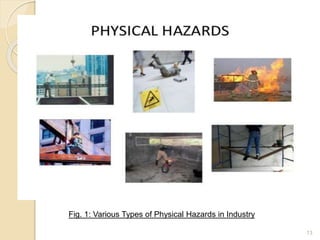
 Physical hazards in foundry operation
maybe related to handling of large,
heavy, hot raw materials, molten metal’s
and products. Accident related to heavy
mechanical transport (e.g. Trains, trucks,
EOT cranes and forklifts); Injuries from
grinding and cutting activities, maybe
due to falls from elevations.
 To avoid those-
1. Appropriate design and Layout of
facilities to avoid crossover of different
activities and flow of process.
11
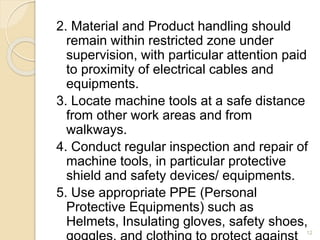
2. Material and Product handling should
remain within restricted zone under
supervision, with particular attention paid
to proximity of electrical cables and
equipments.
3. Locate machine tools at a safe distance
from other work areas and from
walkways.
4. Conduct regular inspection and repair of
machine tools, in particular protective
shield and safety devices/ equipments.
5. Use appropriate PPE (Personal
Protective Equipments) such as
Helmets, Insulating gloves, safety shoes,
12
13
Fig. 1: Various Types of Physical Hazards in Industry
3.2. Respiratory Hazards:
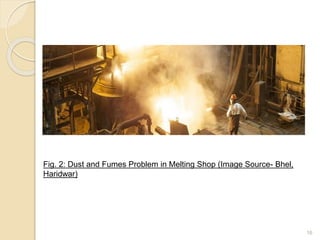
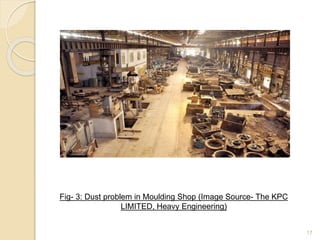
 Dust generated in foundries includes iron
and metallic dusts, which are present in
melting, casting and finishing shops; and
wooden and sand dusts, which are present in
the moulding shop, may cause respiratory
issue. In the former, workers are exposed to
iron oxide, and silica dust that may be
contaminated with heavy metals such as
chromium (Cr), nickel (Ni), lead (Pb), and
manganese (Mn). The fine particle size, and
potential metallurgical fumes, creates a
serious occupational inhalation risk.
14
 Recommendations to prevent exposure to gas
and dust include the following:
 Sources of dust and gases should be
separated and enclosed.
 Use automated equipment, especially in the
fettling process.
 Use of filter respirators when exposed to
heavy dust (e.g. fettling works).
 For carbon monoxide (CO) exposure,
detection equipment should be installed to
alert control rooms and local personnel. In
case of emergency intervention in areas with
high levels of CO, workers should be provided
with portable CO detectors, and fresh-air
15
16
Fig. 2: Dust and Fumes Problem in Melting Shop (Image Source- Bhel,
Haridwar)
17
Fig- 3: Dust problem in Moulding Shop (Image Source- The KPC
LIMITED, Heavy Engineering)
3.3. Noise Problem:
The foundry process generates noise from
various sources, including scrap handling,
furnace charging and EAF melting, fuel
burners, shakeout and mould /core
shooting, and transportation and ventilation
systems.
 Recommended noise management
techniques include the following:
 Cover and enclose scrap storage and
handling areas, as well as shake out and
fettling processes.
 Mandatory use of air plug at high noise
area. 18
3.4. Fire and Explosions:
Handling of liquid metal may generate a risk
of explosion, melt run out, and burns,
especially if humidity is trapped in enclosed
spaces and exposed to molten metal. Other
hazards include fires caused by molten
metal, and the presence of liquid fuel and
other flammable chemicals. In addition, iron
foundry slag may be highly reactive if
calcium carbide is used to desulfurize the
iron.
Recommended techniques to prevent and
control explosion and fire hazards include
the following:
19
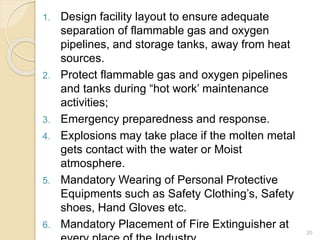
1. Design facility layout to ensure adequate
separation of flammable gas and oxygen
pipelines, and storage tanks, away from heat
sources.
2. Protect flammable gas and oxygen pipelines
and tanks during “hot work’ maintenance
activities;
3. Emergency preparedness and response.
4. Explosions may take place if the molten metal
gets contact with the water or Moist
atmosphere.
5. Mandatory Wearing of Personal Protective
Equipments such as Safety Clothing’s, Safety
shoes, Hand Gloves etc.
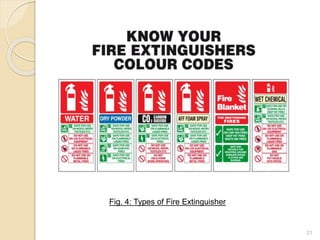
6. Mandatory Placement of Fire Extinguisher at
20
21
Fig. 4: Types of Fire Extinguisher
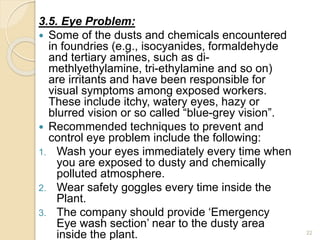
3.5. Eye Problem:
 Some of the dusts and chemicals encountered
in foundries (e.g., isocyanides, formaldehyde
and tertiary amines, such as di-
methlyethylamine, tri-ethylamine and so on)
are irritants and have been responsible for
visual symptoms among exposed workers.
These include itchy, watery eyes, hazy or
blurred vision or so called “blue-grey vision”.
 Recommended techniques to prevent and
control eye problem include the following:
1. Wash your eyes immediately every time when
you are exposed to dusty and chemically
polluted atmosphere.
2. Wear safety goggles every time inside the
Plant.
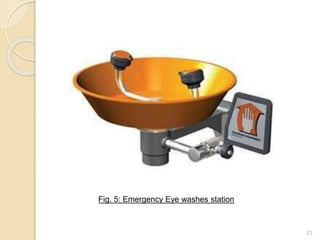
3. The company should provide ‘Emergency
Eye wash section’ near to the dusty area
inside the plant. 22
23
Fig. 5: Emergency Eye washes station
3.6. Some General Health Hazards Are
Caused As A Result Of Contact Between
The Pollutants And The Body. Those
Hazards Are Follows:
 Eye irritation
 Headache
 Nose and throat irritation
 Irritability of respiratory tract
 High temperature can cause fatigue
and dehydration.
 Chronic pulmonary diseases like
Bronchitis and asthma, are
aggravated by a high concentration of
SO 2 , NO 2 , particulate matter and
photochemical smog.
24
Chapter: 4
Personal protective
equipments (PPE) and their
uses
25
4. Personal protective equipments (PPE):
Personal protective equipment (PPE) refers to
protective clothing, helmets, goggles, or other
garments or equipment designed to protect the
workers body from injury or infection. The hazards
addressed by protective equipment include physical,
electrical, heat, chemicals, biohazards and airborne
particulate matter.
4.1: Head Protective Equipments:
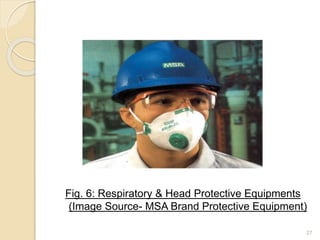
Our head is the Most Important organ of our body
and it should be protected from various types of
physical hazards. Protective Helmet should provided
by the company to their employees to deal with
physical hazards and to save life.
4.2: Respiratory Protective Equipment (RPE):
It is a particular type of Personal Protective
Equipment (PPE), used to protect the individual 26
Fig. 6: Respiratory & Head Protective Equipments
(Image Source- MSA Brand Protective Equipment)
27
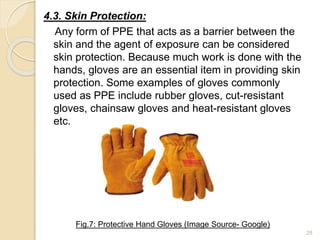
4.3. Skin Protection:
Any form of PPE that acts as a barrier between the
skin and the agent of exposure can be considered
skin protection. Because much work is done with the
hands, gloves are an essential item in providing skin
protection. Some examples of gloves commonly
used as PPE include rubber gloves, cut-resistant
gloves, chainsaw gloves and heat-resistant gloves
etc.
28
Fig.7: Protective Hand Gloves (Image Source- Google)
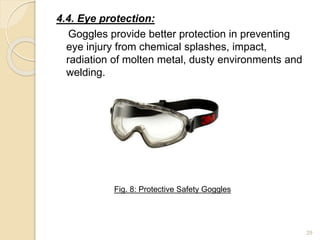
4.4. Eye protection:
Goggles provide better protection in preventing
eye injury from chemical splashes, impact,
radiation of molten metal, dusty environments and
welding.
29
Fig. 8: Protective Safety Goggles
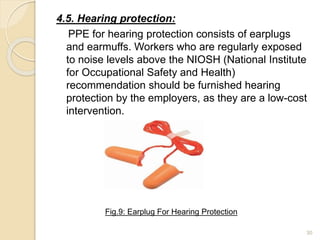
4.5. Hearing protection:
PPE for hearing protection consists of earplugs
and earmuffs. Workers who are regularly exposed
to noise levels above the NIOSH (National Institute
for Occupational Safety and Health)
recommendation should be furnished hearing
protection by the employers, as they are a low-cost
intervention.
30
Fig.9: Earplug For Hearing Protection
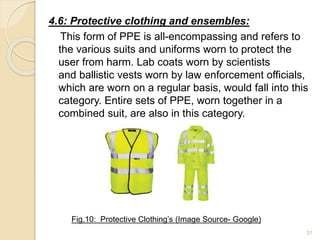
4.6: Protective clothing and ensembles:
This form of PPE is all-encompassing and refers to
the various suits and uniforms worn to protect the
user from harm. Lab coats worn by scientists
and ballistic vests worn by law enforcement officials,
which are worn on a regular basis, would fall into this
category. Entire sets of PPE, worn together in a
combined suit, are also in this category.
31
Fig.10: Protective Clothing’s (Image Source- Google)
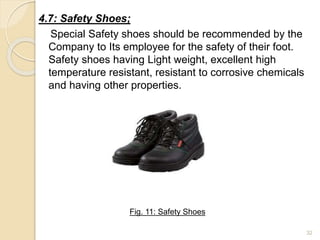
4.7: Safety Shoes;
Special Safety shoes should be recommended by the
Company to Its employee for the safety of their foot.
Safety shoes having Light weight, excellent high
temperature resistant, resistant to corrosive chemicals
and having other properties.
32
Fig. 11: Safety Shoes
5. CONCLUSION
As we know Foundry Industry is very dangerous
and Hazard prone area. So every company should
give it the first priority. Every company should
arrange a training about safety management every
day, and give everyone information about it.
Company should be strict about PPE, and without it
Company should not allow any workers to enter
into the working area. Company should place a
signboard at every hazard prone area of the
industry to aware the employees. Last of all I want
to say that, ‘At the working place, the goals are
simple- Safety and Security.
33
REFERENCES
1. Foundry Technology- O.P. Khanna (Dandapat Rai
Publication) - Page No- 760 to 768.
2. Principles of Safety Engineering- Akhil Kumar Das.
3. The Handbook of safety engineering: principles and
application- Frankare Smallman.
4. Slideshare Amtek India Safety Enginnering
Presentation.
5. Reliability and Safety Engineering Book.
34
35

Safety Action Guide for Foundry Industry

  • 1.
    A Seminar Presentation On Safety ActionGuide for Foundry Industry Under Guidance of- Dr. Amitesh Kumar Associate Professor and Head Department of Foundry Technology Presented By- Dibyendu Das Roll No- 44121
  • 2.
    2 CONTENTS: 1. Introduction 2. LiteratureReview 3. Various types of hazards in a foundry industry And its preventions 3.1. Physical Hazards 3.2. Respiratory Hazards 3.3. Noise Problem 3.4. Fire and Explosions 3.5. Eye Problem 3.6. Some General Health Hazards Are Caused As A Result Of Contact between the Pollutants And The Body
  • 3.
    4. Personal ProtectiveEquipments (PPE) and their uses 4.1. Head Protective Equipments 4.2. Respiratory Protective Equipment (RPE 4.3. Skin Protection 4.4. Eye protection 4.5. Hearing protection 4.6. Protective clothing and ensembles 4.7. Safety Shoes 5. Conclusion 3
  • 4.
  • 5.
    1.INTRODUCTION Foundry safety refersto ‘The management of all operations, and events within a Foundry Industry, for protecting its employees and assets by minimizing hazards, risks, accidents and near misses.’ The Foundry Industry is the most dangerous, Hazard prone industry, because the workers working in the foundry industry have to deal with very high temperature molten metals. Also the dusty, noisy atmosphere is very dangerous for health. Dealing with foundry atmosphere is very difficult and without following safety rules and regulation, it is impossible. Hence those activities should be performed with good judgement and caution.
  • 6.
     Every companyshould train their workers how to deal with Hazards, and provide them proper ‘Personal Protective Equipments (PPE)’.  The following occupational health and safety issues may be encountered during Foundry activities- 1. Physical Hazard 2. Respiratory Hazards 3. Noise 4 Fire and Explosions 5. Eye Problem
  • 7.
  • 8.
    7 2. LITERATURE REVIEW: Foundryis the process of Producing metal or alloy Components by pouring molten metal or alloy into prepared mould, and allow it to solidify. The solidified pieces are called CASTING. In the foundry industry first we have to melt the metal into the Furnace. The furnace selection is depends on types of metal is to be melt. In case of steel, we generally use Electric Arc furnace, Induction Furnace. In case of melting of Cast iron, Cupola furnace or Induction furnace is used. For non ferrous metals and alloys, we can use Induction furnace or EAF. So dealing with those furnace and molten metal’s is very dangerous and may cause vital injuries to the workers and damages the industrial assets.
  • 9.
    At the mouldingshop, moulds are prepared. This work is very dusty job. Generally moulds are prepared with silica sand. Inhaling of silica sand dust may cause Lung decease, called ‘Silicosis’. The Harmful rays produced during melting or Welding may cause serious effect on our eyes, and may cause Blindness. The noise produced at the EAF melting shop, Fettling and Machining Shop is very dangerous for our Ears, may cause hard of Hearing. 9
  • 10.
    10 Chapter: 3 Various typesof hazards in a foundry industry and its preventions
  • 11.
    3.1. Physical Hazards: Physical hazards in foundry operation maybe related to handling of large, heavy, hot raw materials, molten metal’s and products. Accident related to heavy mechanical transport (e.g. Trains, trucks, EOT cranes and forklifts); Injuries from grinding and cutting activities, maybe due to falls from elevations.  To avoid those- 1. Appropriate design and Layout of facilities to avoid crossover of different activities and flow of process. 11
  • 12.
    2. Material andProduct handling should remain within restricted zone under supervision, with particular attention paid to proximity of electrical cables and equipments. 3. Locate machine tools at a safe distance from other work areas and from walkways. 4. Conduct regular inspection and repair of machine tools, in particular protective shield and safety devices/ equipments. 5. Use appropriate PPE (Personal Protective Equipments) such as Helmets, Insulating gloves, safety shoes, 12
  • 13.
    13 Fig. 1: VariousTypes of Physical Hazards in Industry
  • 14.
    3.2. Respiratory Hazards: Dust generated in foundries includes iron and metallic dusts, which are present in melting, casting and finishing shops; and wooden and sand dusts, which are present in the moulding shop, may cause respiratory issue. In the former, workers are exposed to iron oxide, and silica dust that may be contaminated with heavy metals such as chromium (Cr), nickel (Ni), lead (Pb), and manganese (Mn). The fine particle size, and potential metallurgical fumes, creates a serious occupational inhalation risk. 14
  • 15.
     Recommendations toprevent exposure to gas and dust include the following:  Sources of dust and gases should be separated and enclosed.  Use automated equipment, especially in the fettling process.  Use of filter respirators when exposed to heavy dust (e.g. fettling works).  For carbon monoxide (CO) exposure, detection equipment should be installed to alert control rooms and local personnel. In case of emergency intervention in areas with high levels of CO, workers should be provided with portable CO detectors, and fresh-air 15
  • 16.
    16 Fig. 2: Dustand Fumes Problem in Melting Shop (Image Source- Bhel, Haridwar)
  • 17.
    17 Fig- 3: Dustproblem in Moulding Shop (Image Source- The KPC LIMITED, Heavy Engineering)
  • 18.
    3.3. Noise Problem: Thefoundry process generates noise from various sources, including scrap handling, furnace charging and EAF melting, fuel burners, shakeout and mould /core shooting, and transportation and ventilation systems.  Recommended noise management techniques include the following:  Cover and enclose scrap storage and handling areas, as well as shake out and fettling processes.  Mandatory use of air plug at high noise area. 18
  • 19.
    3.4. Fire andExplosions: Handling of liquid metal may generate a risk of explosion, melt run out, and burns, especially if humidity is trapped in enclosed spaces and exposed to molten metal. Other hazards include fires caused by molten metal, and the presence of liquid fuel and other flammable chemicals. In addition, iron foundry slag may be highly reactive if calcium carbide is used to desulfurize the iron. Recommended techniques to prevent and control explosion and fire hazards include the following: 19
  • 20.
    1. Design facilitylayout to ensure adequate separation of flammable gas and oxygen pipelines, and storage tanks, away from heat sources. 2. Protect flammable gas and oxygen pipelines and tanks during “hot work’ maintenance activities; 3. Emergency preparedness and response. 4. Explosions may take place if the molten metal gets contact with the water or Moist atmosphere. 5. Mandatory Wearing of Personal Protective Equipments such as Safety Clothing’s, Safety shoes, Hand Gloves etc. 6. Mandatory Placement of Fire Extinguisher at 20
  • 21.
    21 Fig. 4: Typesof Fire Extinguisher
  • 22.
    3.5. Eye Problem: Some of the dusts and chemicals encountered in foundries (e.g., isocyanides, formaldehyde and tertiary amines, such as di- methlyethylamine, tri-ethylamine and so on) are irritants and have been responsible for visual symptoms among exposed workers. These include itchy, watery eyes, hazy or blurred vision or so called “blue-grey vision”.  Recommended techniques to prevent and control eye problem include the following: 1. Wash your eyes immediately every time when you are exposed to dusty and chemically polluted atmosphere. 2. Wear safety goggles every time inside the Plant. 3. The company should provide ‘Emergency Eye wash section’ near to the dusty area inside the plant. 22
  • 23.
    23 Fig. 5: EmergencyEye washes station
  • 24.
    3.6. Some GeneralHealth Hazards Are Caused As A Result Of Contact Between The Pollutants And The Body. Those Hazards Are Follows:  Eye irritation  Headache  Nose and throat irritation  Irritability of respiratory tract  High temperature can cause fatigue and dehydration.  Chronic pulmonary diseases like Bronchitis and asthma, are aggravated by a high concentration of SO 2 , NO 2 , particulate matter and photochemical smog. 24
  • 25.
  • 26.
    4. Personal protectiveequipments (PPE): Personal protective equipment (PPE) refers to protective clothing, helmets, goggles, or other garments or equipment designed to protect the workers body from injury or infection. The hazards addressed by protective equipment include physical, electrical, heat, chemicals, biohazards and airborne particulate matter. 4.1: Head Protective Equipments: Our head is the Most Important organ of our body and it should be protected from various types of physical hazards. Protective Helmet should provided by the company to their employees to deal with physical hazards and to save life. 4.2: Respiratory Protective Equipment (RPE): It is a particular type of Personal Protective Equipment (PPE), used to protect the individual 26
  • 27.
    Fig. 6: Respiratory& Head Protective Equipments (Image Source- MSA Brand Protective Equipment) 27
  • 28.
    4.3. Skin Protection: Anyform of PPE that acts as a barrier between the skin and the agent of exposure can be considered skin protection. Because much work is done with the hands, gloves are an essential item in providing skin protection. Some examples of gloves commonly used as PPE include rubber gloves, cut-resistant gloves, chainsaw gloves and heat-resistant gloves etc. 28 Fig.7: Protective Hand Gloves (Image Source- Google)
  • 29.
    4.4. Eye protection: Gogglesprovide better protection in preventing eye injury from chemical splashes, impact, radiation of molten metal, dusty environments and welding. 29 Fig. 8: Protective Safety Goggles
  • 30.
    4.5. Hearing protection: PPEfor hearing protection consists of earplugs and earmuffs. Workers who are regularly exposed to noise levels above the NIOSH (National Institute for Occupational Safety and Health) recommendation should be furnished hearing protection by the employers, as they are a low-cost intervention. 30 Fig.9: Earplug For Hearing Protection
  • 31.
    4.6: Protective clothingand ensembles: This form of PPE is all-encompassing and refers to the various suits and uniforms worn to protect the user from harm. Lab coats worn by scientists and ballistic vests worn by law enforcement officials, which are worn on a regular basis, would fall into this category. Entire sets of PPE, worn together in a combined suit, are also in this category. 31 Fig.10: Protective Clothing’s (Image Source- Google)
  • 32.
    4.7: Safety Shoes; SpecialSafety shoes should be recommended by the Company to Its employee for the safety of their foot. Safety shoes having Light weight, excellent high temperature resistant, resistant to corrosive chemicals and having other properties. 32 Fig. 11: Safety Shoes
  • 33.
    5. CONCLUSION As weknow Foundry Industry is very dangerous and Hazard prone area. So every company should give it the first priority. Every company should arrange a training about safety management every day, and give everyone information about it. Company should be strict about PPE, and without it Company should not allow any workers to enter into the working area. Company should place a signboard at every hazard prone area of the industry to aware the employees. Last of all I want to say that, ‘At the working place, the goals are simple- Safety and Security. 33
  • 34.
    REFERENCES 1. Foundry Technology-O.P. Khanna (Dandapat Rai Publication) - Page No- 760 to 768. 2. Principles of Safety Engineering- Akhil Kumar Das. 3. The Handbook of safety engineering: principles and application- Frankare Smallman. 4. Slideshare Amtek India Safety Enginnering Presentation. 5. Reliability and Safety Engineering Book. 34
  • 35.