
The Hazardous Waste
Generator Improvements
Rule
Analysis of the provisions and what they mean for you.
Meet Your Moderator
James Ciccone
During this Webinar
 All lines will be muted.
 Communicate via the questions tab in your
webinar panel.
 Unanswered questions will be responded to after
the webinar.
 Webinar recording and slides will be emailed to
you tomorrow.
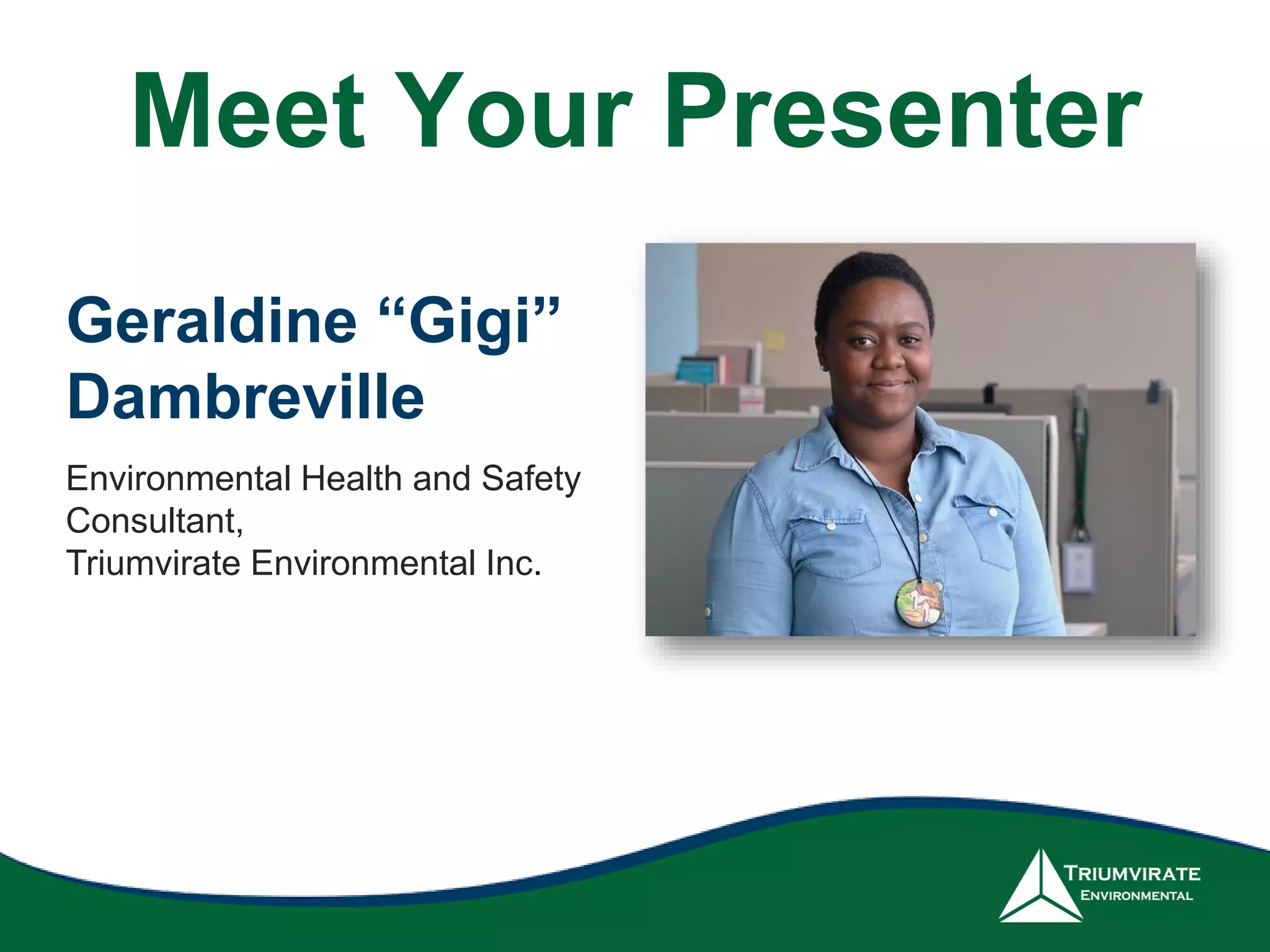
Meet Your Presenter
Geraldine “Gigi”
Dambreville
Environmental Health and Safety
Consultant,
Triumvirate Environmental Inc.
RCRA Overview
Current Issues
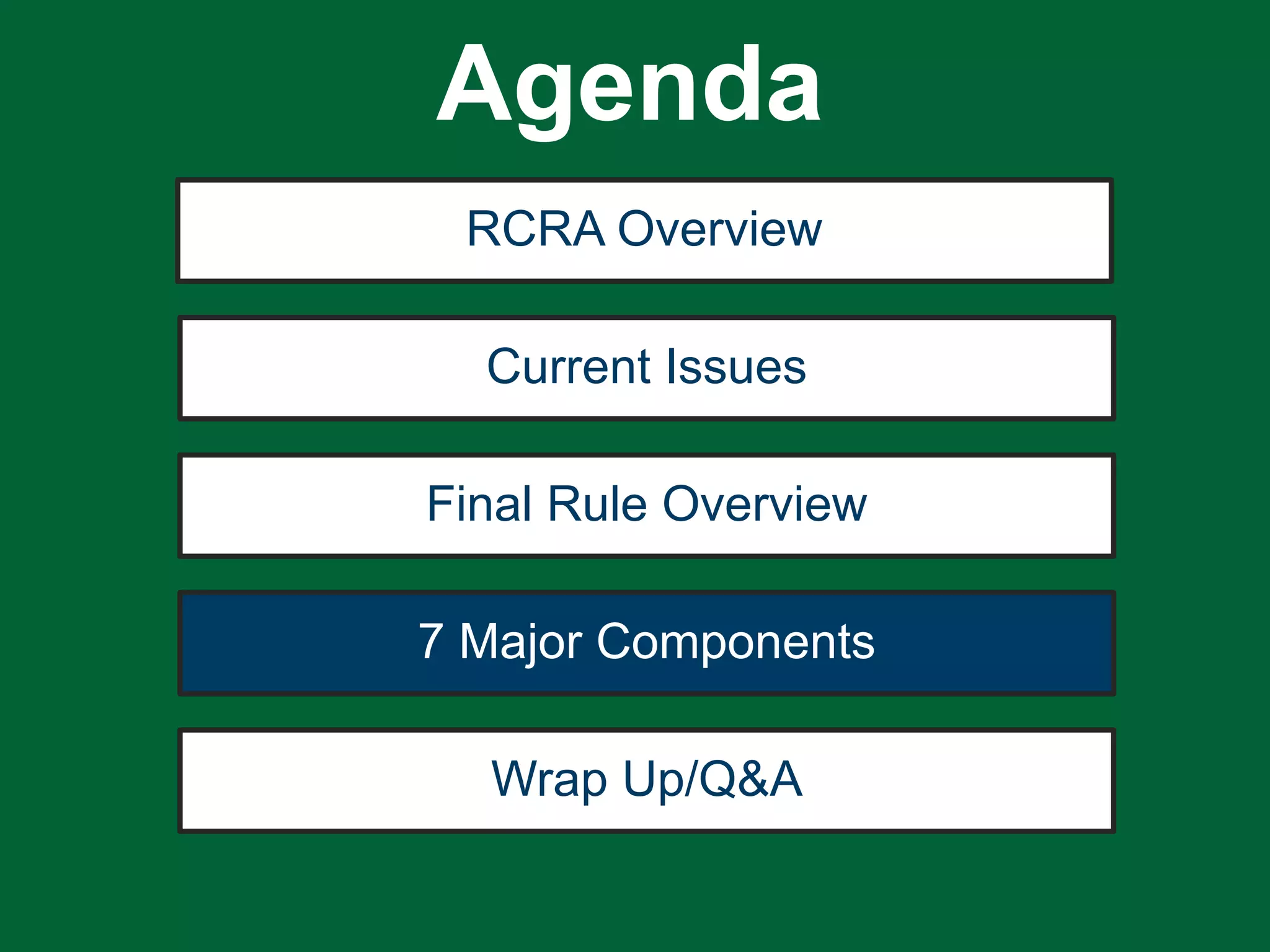
Final Rule Overview
7 Major Components
Wrap Up/Q&A
Agenda
How Concerned
Are You About
the New Rule?
Poll Question
The Resource Conservation and
Recovery Act of 1976:
Originally conceived as a law
addressing municipal trash
disposal, Subtitle C of RCRA
was included to give the U.S.
Environmental Protection
Agency (EPA) the authority to
regulate hazardous waste. This
includes the generation,
transportation, treatment,
storage, and disposal of
hazardous waste.
RCRA and Generators
HSWA continued where RCRA, Subtitle C left off,
including: adding mandates for the regulation of small
quantity generators, restrictions on land disposal of
hazardous waste, regulation of underground storage tanks
(USTs), and corrective action provisions to prevent RCRA
facilities from becoming Superfund sites.
The Hazardous and Solid Waste
Amendments of 1984:
HSWA and Generators
History of the Rule
• Hazardous Waste Generator Program
evaluation – April 2004
• Hazardous Waste Determination Program
evaluation – 2013
• Hazardous Waste Generator Proposed Rule
– 2015
40 CFR Parts 260 – 265
mainly
Federal register notice
September 25th, 2015
Comment period ended
December 24th,2015
Proposed
Regulations
Final Rule!
Signed by the EPA
Administrator on October
28, 2016
Will be published in the
Federal Register in the
coming weeks
Made effective May 30th
2017
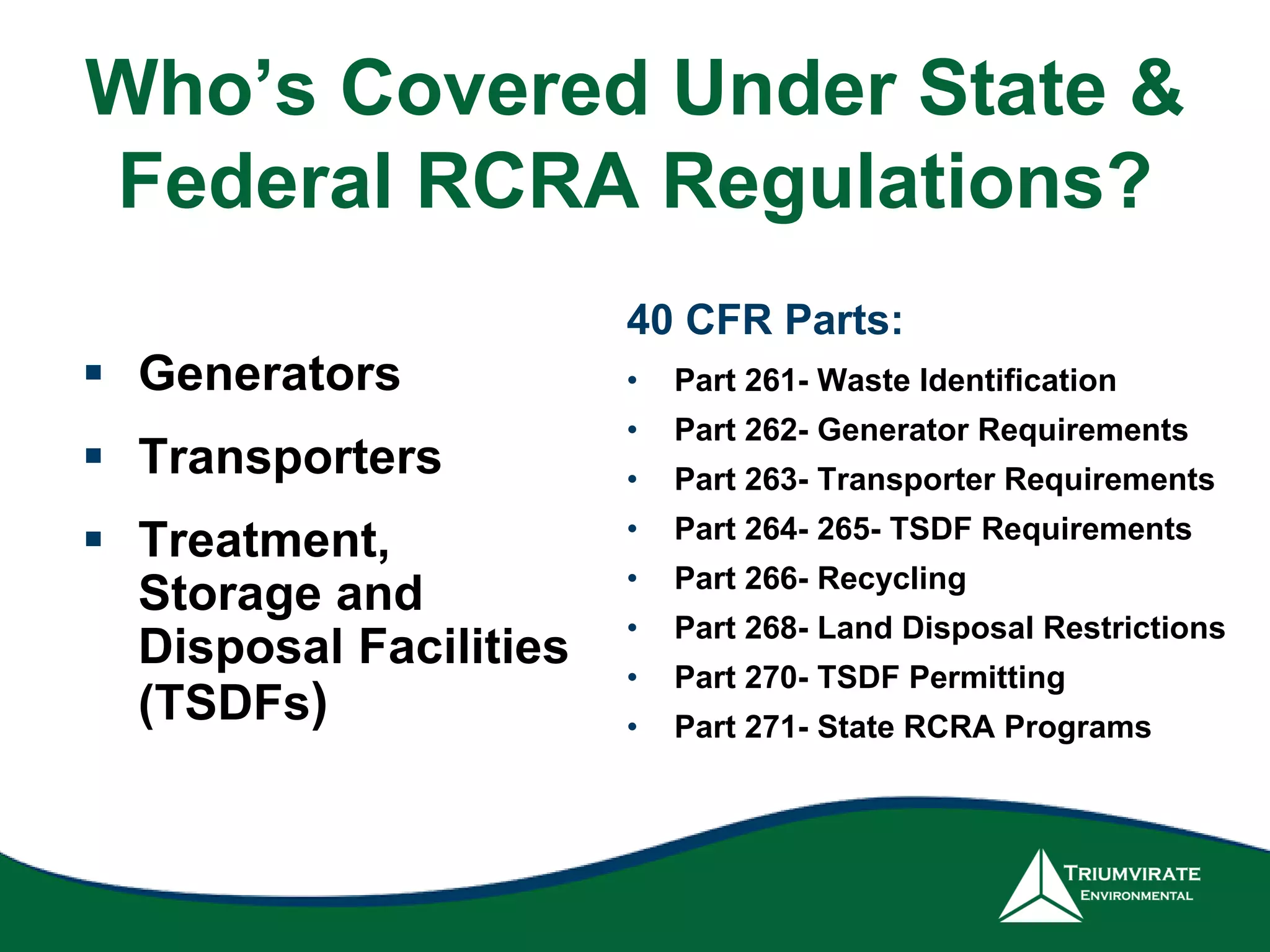
 Generators
 Transporters
 Treatment,
Storage and
Disposal Facilities
(TSDFs)
• Part 261- Waste Identification
• Part 262- Generator Requirements
• Part 263- Transporter Requirements
• Part 264- 265- TSDF Requirements
• Part 266- Recycling
• Part 268- Land Disposal Restrictions
• Part 270- TSDF Permitting
• Part 271- State RCRA Programs
40 CFR Parts: 260-281
Who’s Covered Under State &
Federal RCRA Regulations?
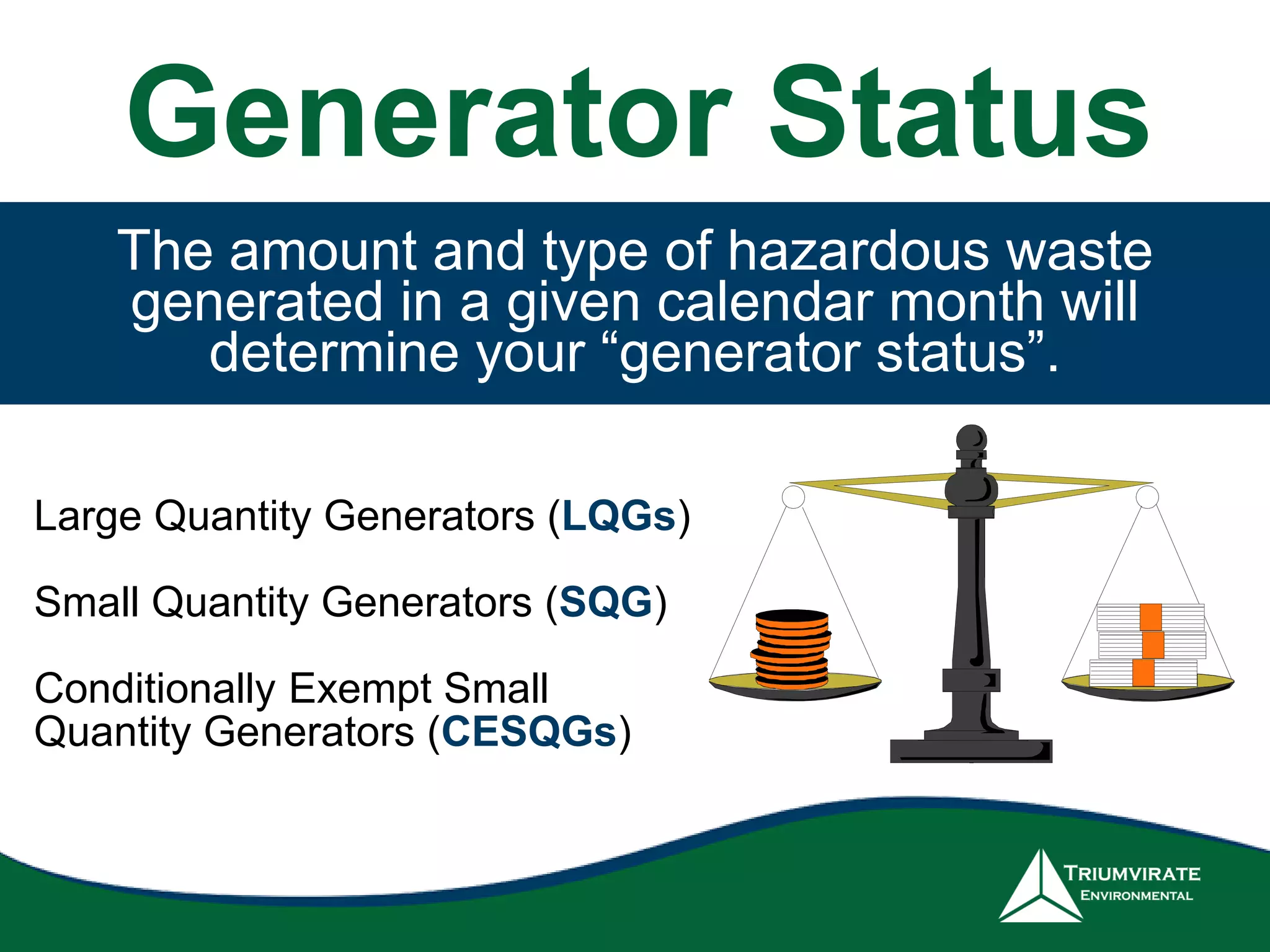
The amount and type of hazardous waste
generated in a given calendar month will
determine your “generator status”.
Large Quantity Generators (LQGs)
Small Quantity Generators (SQG)
Conditionally Exempt Small
Quantity Generators (CESQGs)
Generator Status
RCRA Overview
Current Issues
Final Rule Overview
7 Major Components
Wrap Up/Q&A
Agenda
Issue #1
Regulations
are Confusing
Issue #2
Lack of Flexibility for Operators of
Facility with Different Generator
Status
Issue #3
Lengthy Contingency Plan Requirements &
Lack of Recordkeeping Requirements
Issue #4
Mismanagement
of Waste from
Generators
RCRA Overview
Current Issues
Final Rule Overview
7 Major Components
Wrap Up/Q&A
Agenda
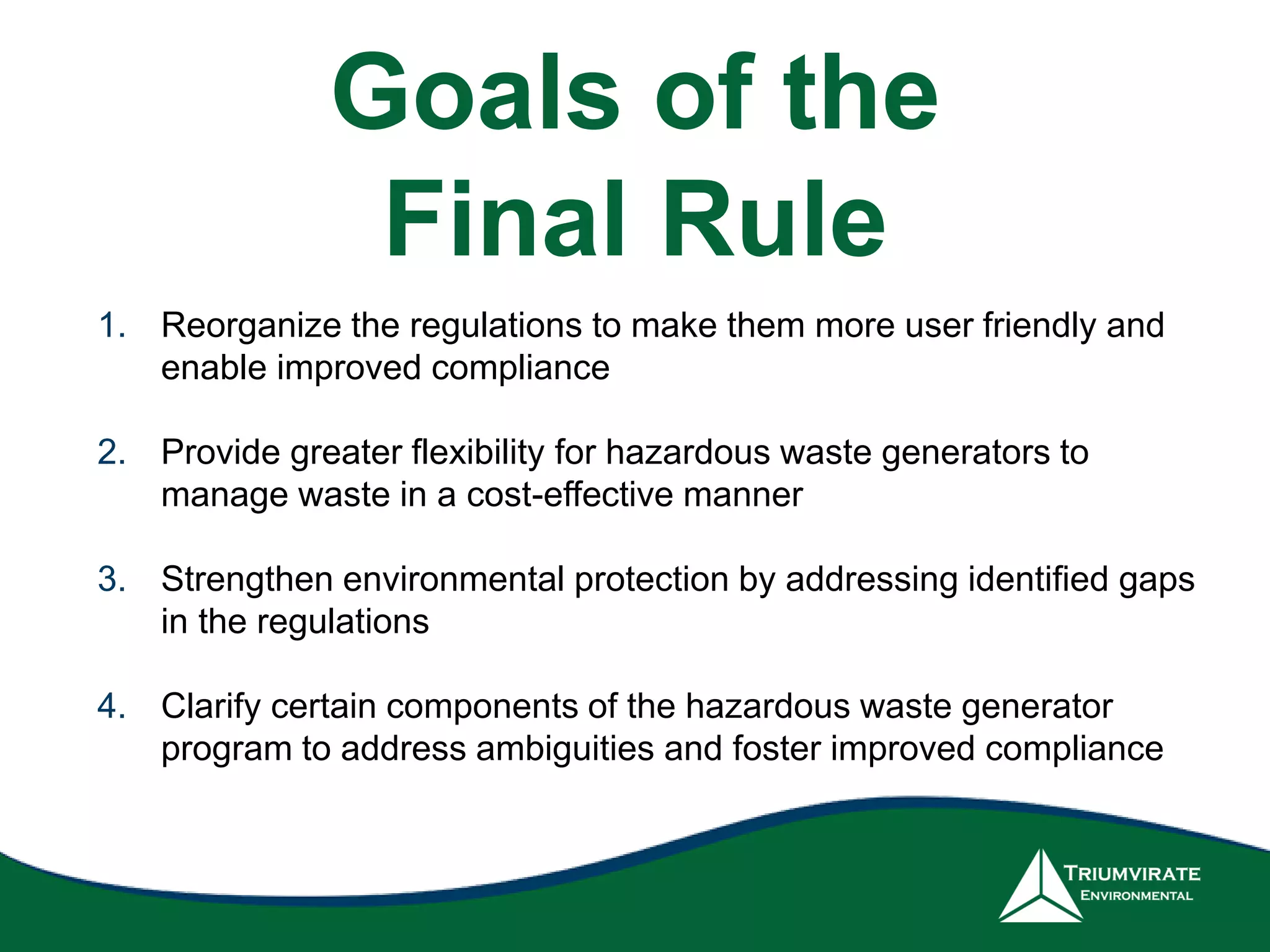
Goals of the
Final Rule
1. Reorganize the regulations to make them more user friendly and
enable improved compliance
2. Provide greater flexibility for hazardous waste generators to
manage waste in a cost-effective manner
3. Strengthen environmental protection by addressing identified gaps
in the regulations
4. Clarify certain components of the hazardous waste generator
program to address ambiguities and foster improved compliance
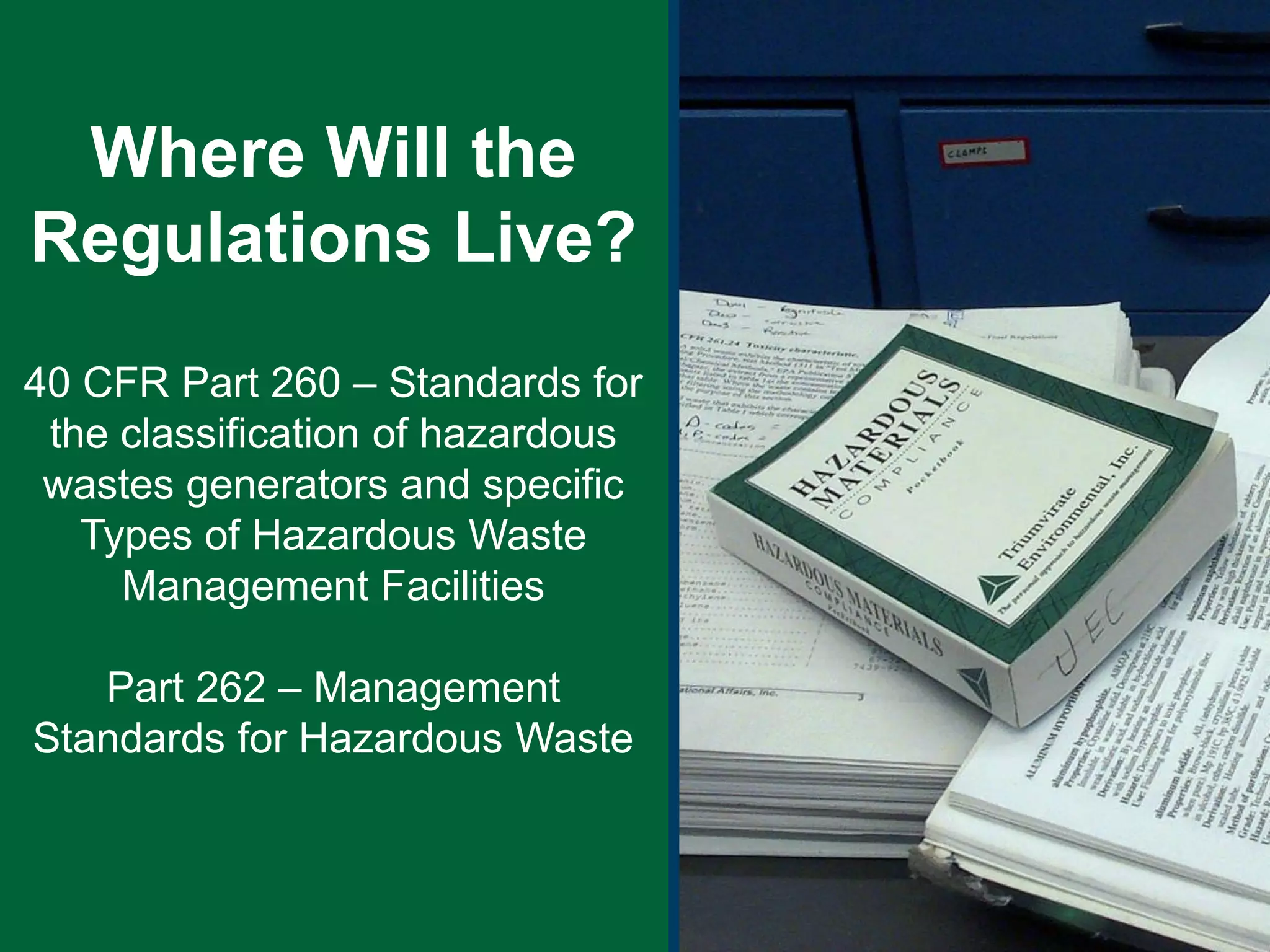
40 CFR Part 260 – Standards for
the classification of hazardous
wastes generators and specific
Types of Hazardous Waste
Management Facilities
Part 262 – Management
Standards for Hazardous Waste
Where Will the
Regulations Live?
RCRA Overview
Current Issues
Final Rule Overview
7 Major Components
Wrap Up/Q&A
Agenda
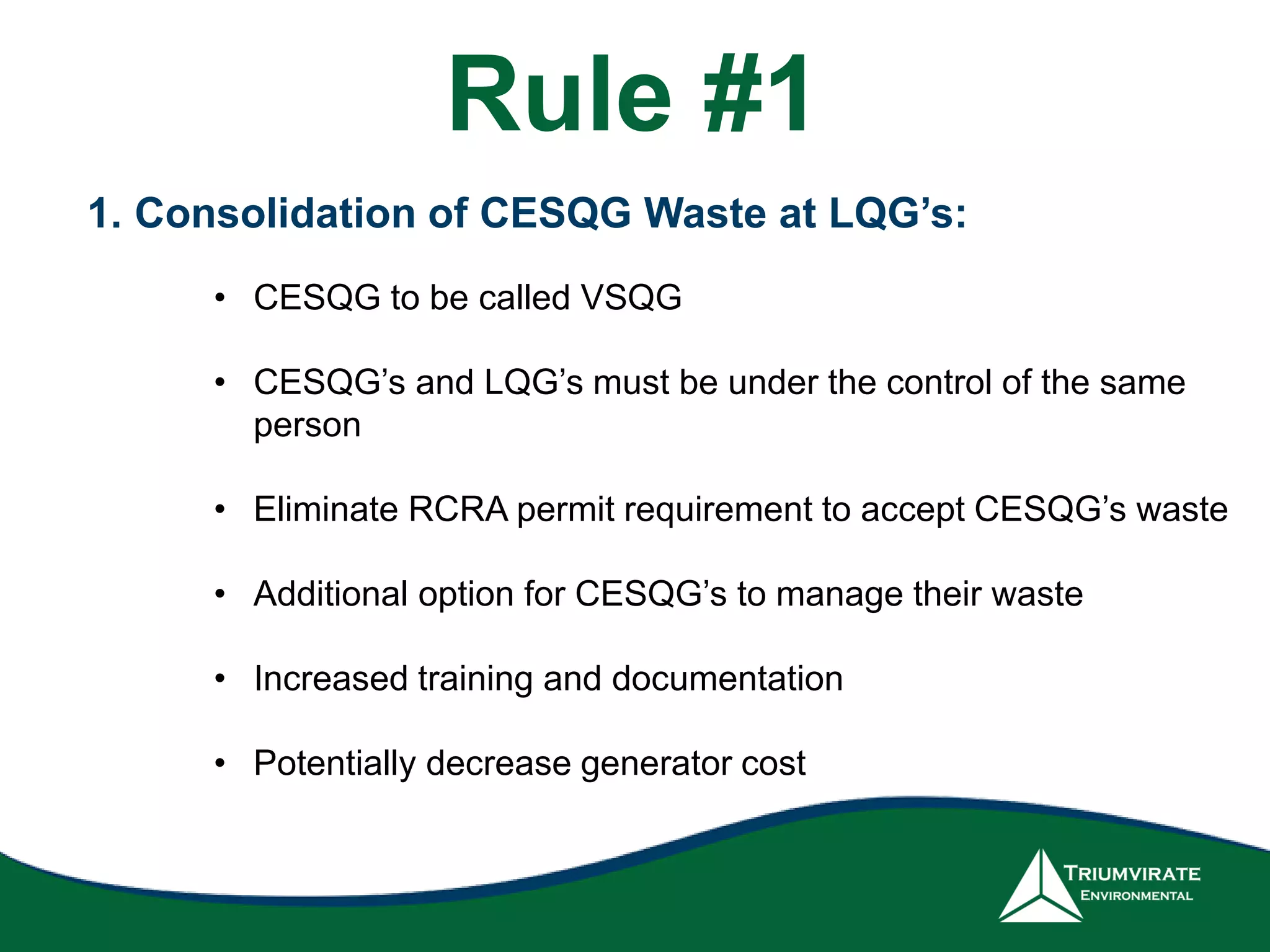
1. Consolidation of CESQG Waste at LQG’s:
• CESQG to be called VSQG
• CESQG’s and LQG’s must be under the control of the same
person
• Eliminate RCRA permit requirement to accept CESQG’s waste
• Additional option for CESQG’s to manage their waste
• Increased training and documentation
• Potentially decrease generator cost
Rule #1
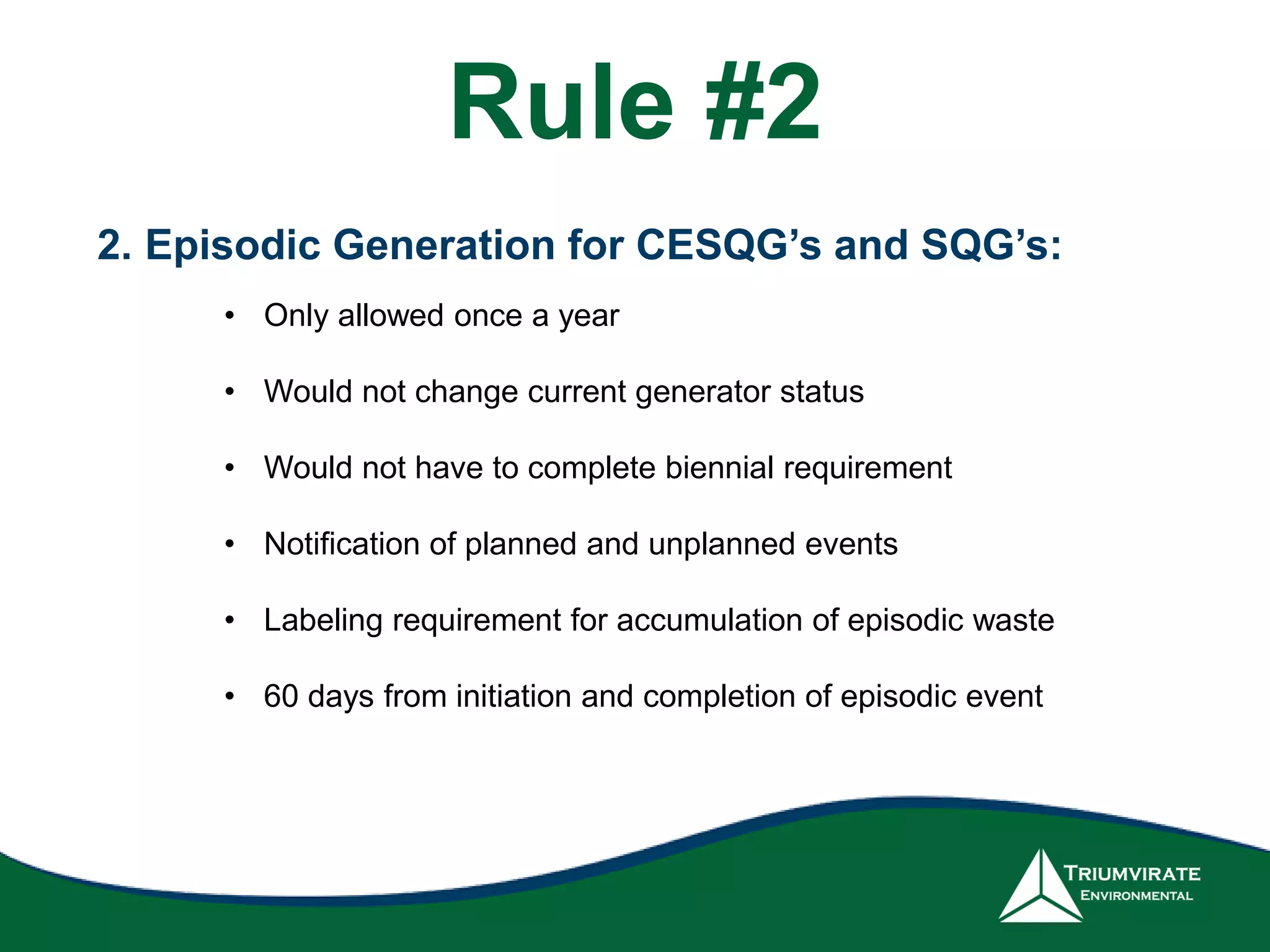
2. Episodic Generation for CESQG’s and SQG’s:
• Only allowed once a year
• Would not change current generator status
• Would not have to complete biennial requirement
• Notification of planned and unplanned events
• Labeling requirement for accumulation of episodic waste
• 60 days from initiation and completion of episodic event
Rule #2
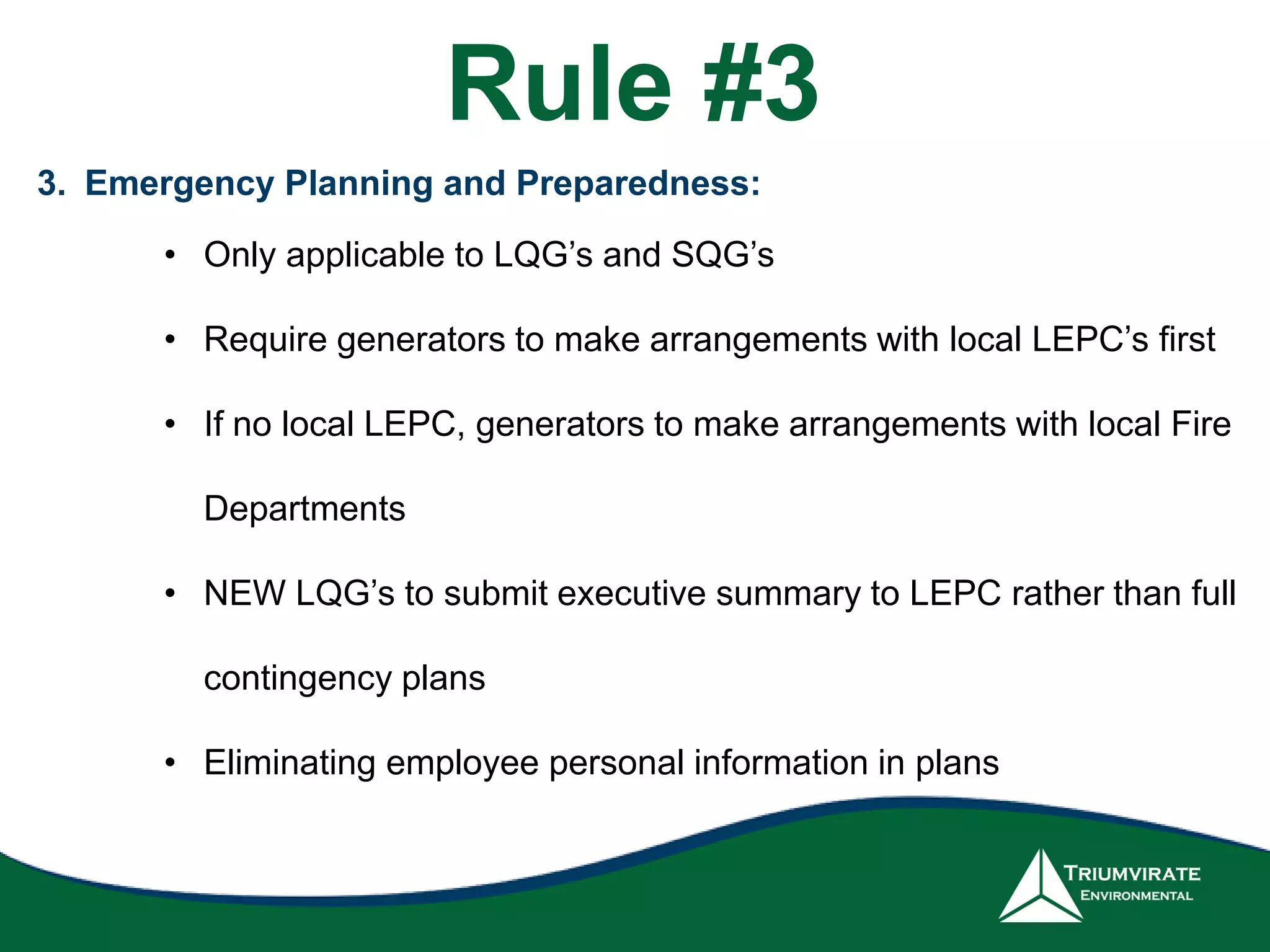
3. Emergency Planning and Preparedness:
• Only applicable to LQG’s and SQG’s
• Require generators to make arrangements with local LEPC’s first
• If no local LEPC, generators to make arrangements with local Fire
Departments
• NEW LQG’s to submit executive summary to LEPC rather than full
contingency plans
• Eliminating employee personal information in plans
Rule #3
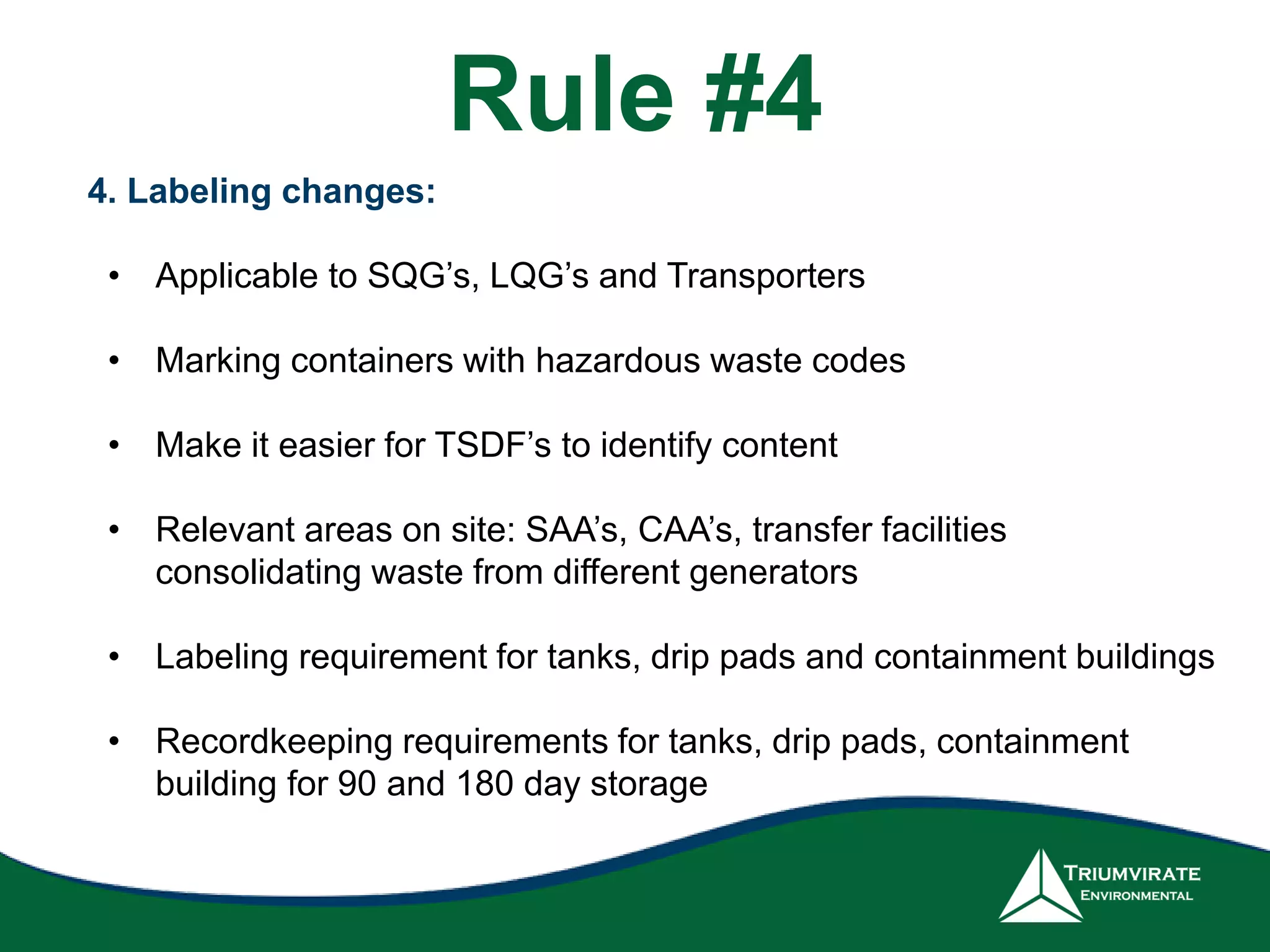
4. Labeling changes:
• Applicable to SQG’s, LQG’s and Transporters
• Marking containers with hazardous waste codes
• Make it easier for TSDF’s to identify content
• Relevant areas on site: SAA’s, CAA’s, transfer facilities
consolidating waste from different generators
• Labeling requirement for tanks, drip pads and containment buildings
• Recordkeeping requirements for tanks, drip pads, containment
building for 90 and 180 day storage
Rule #4
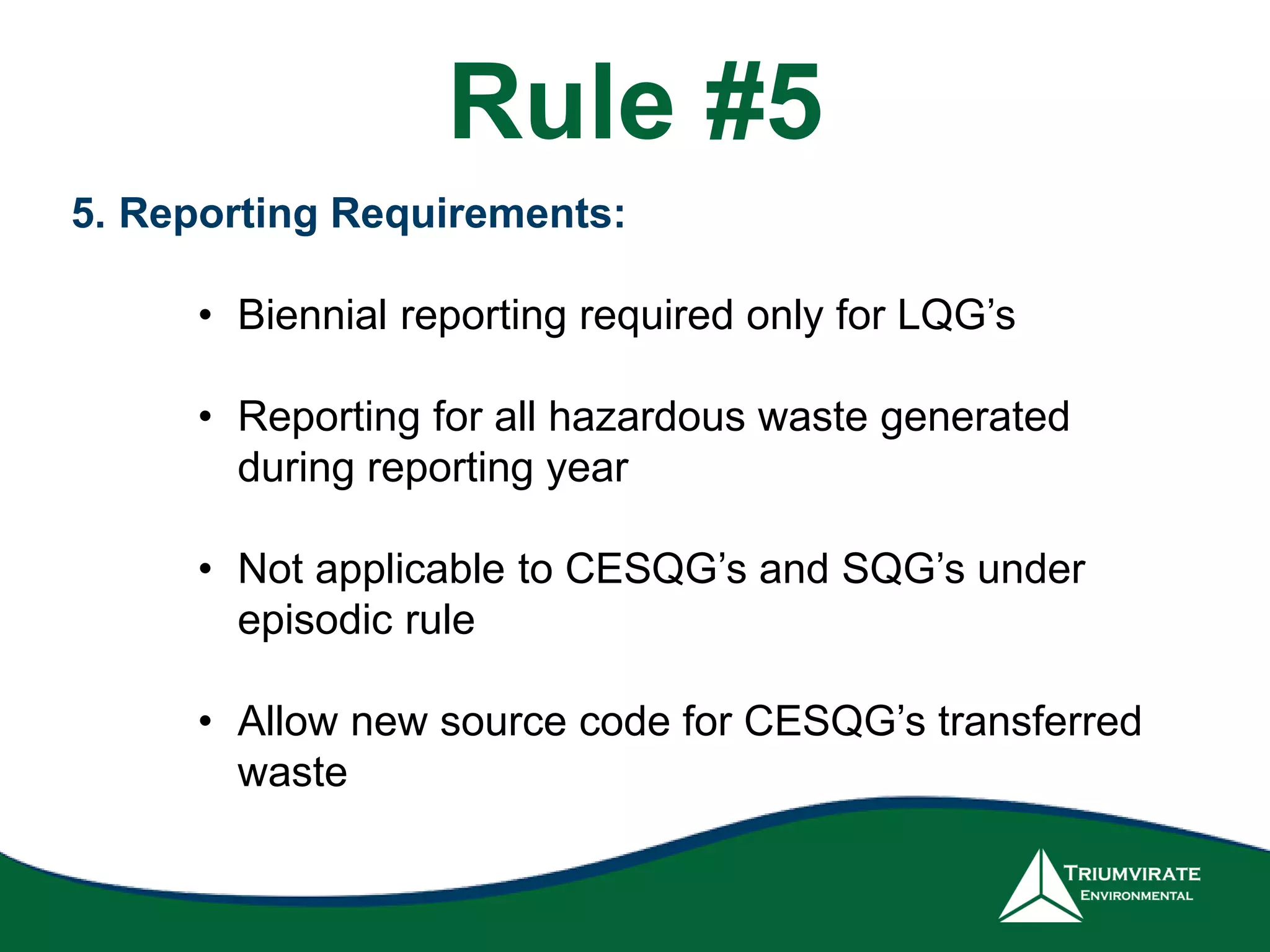
5. Reporting Requirements:
• Biennial reporting required only for LQG’s
• Reporting for all hazardous waste generated
during reporting year
• Not applicable to CESQG’s and SQG’s under
episodic rule
• Allow new source code for CESQG’s transferred
waste
Rule #5
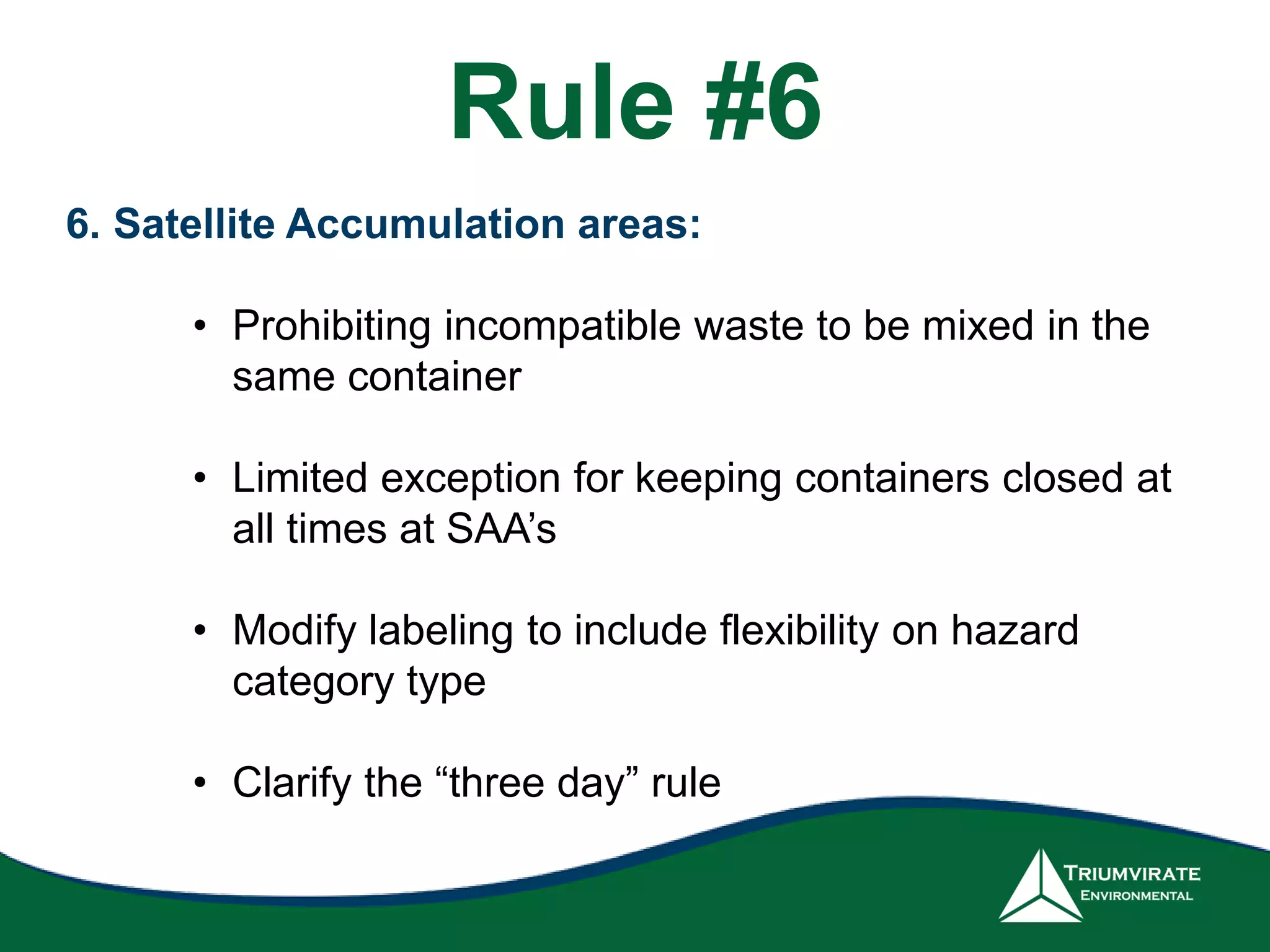
6. Satellite Accumulation areas:
• Prohibiting incompatible waste to be mixed in the
same container
• Limited exception for keeping containers closed at
all times at SAA’s
• Modify labeling to include flexibility on hazard
category type
• Clarify the “three day” rule
Rule #6
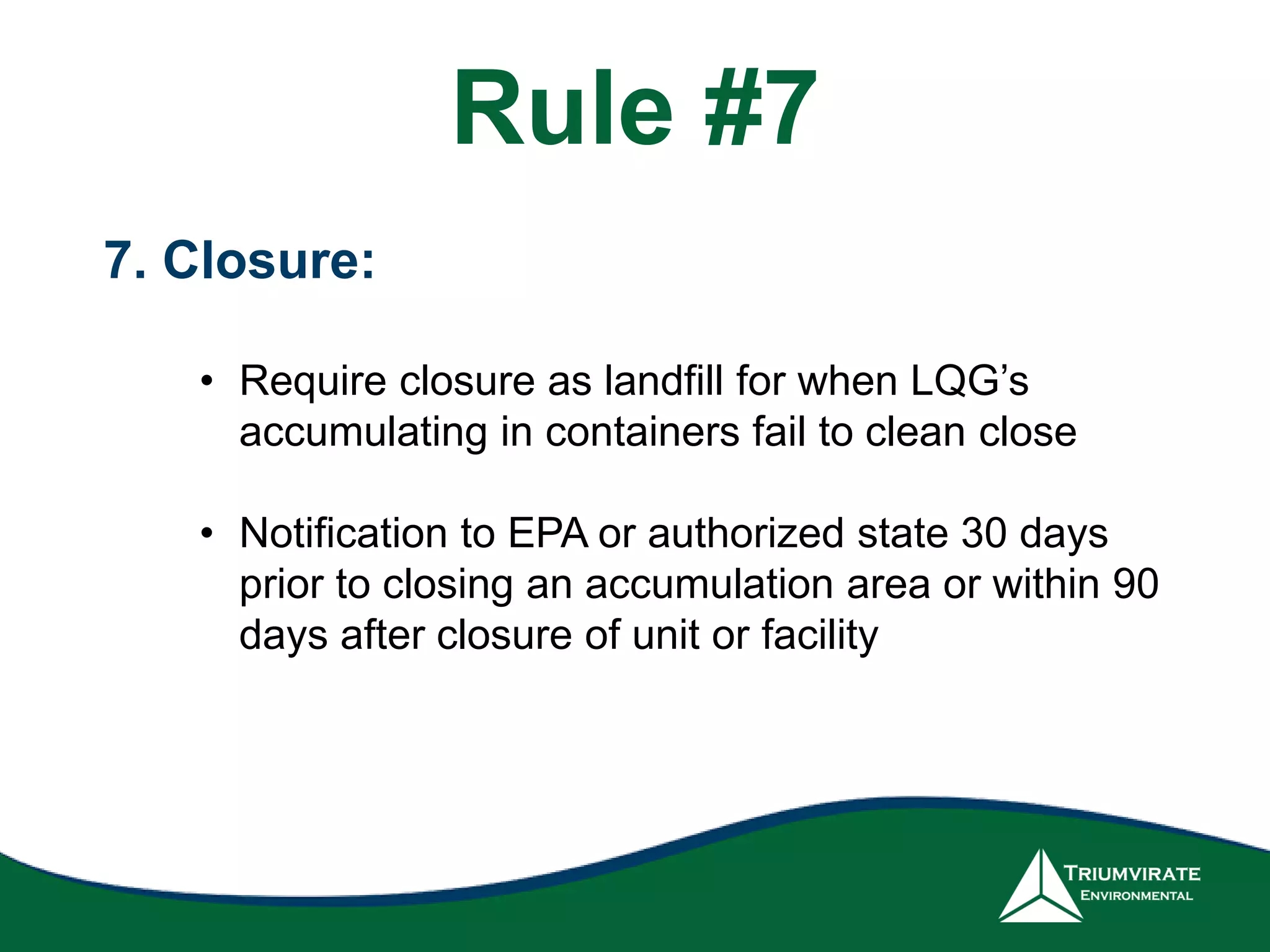
Rule #7
7. Closure:
• Require closure as landfill for when LQG’s
accumulating in containers fail to clean close
• Notification to EPA or authorized state 30 days
prior to closing an accumulation area or within 90
days after closure of unit or facility
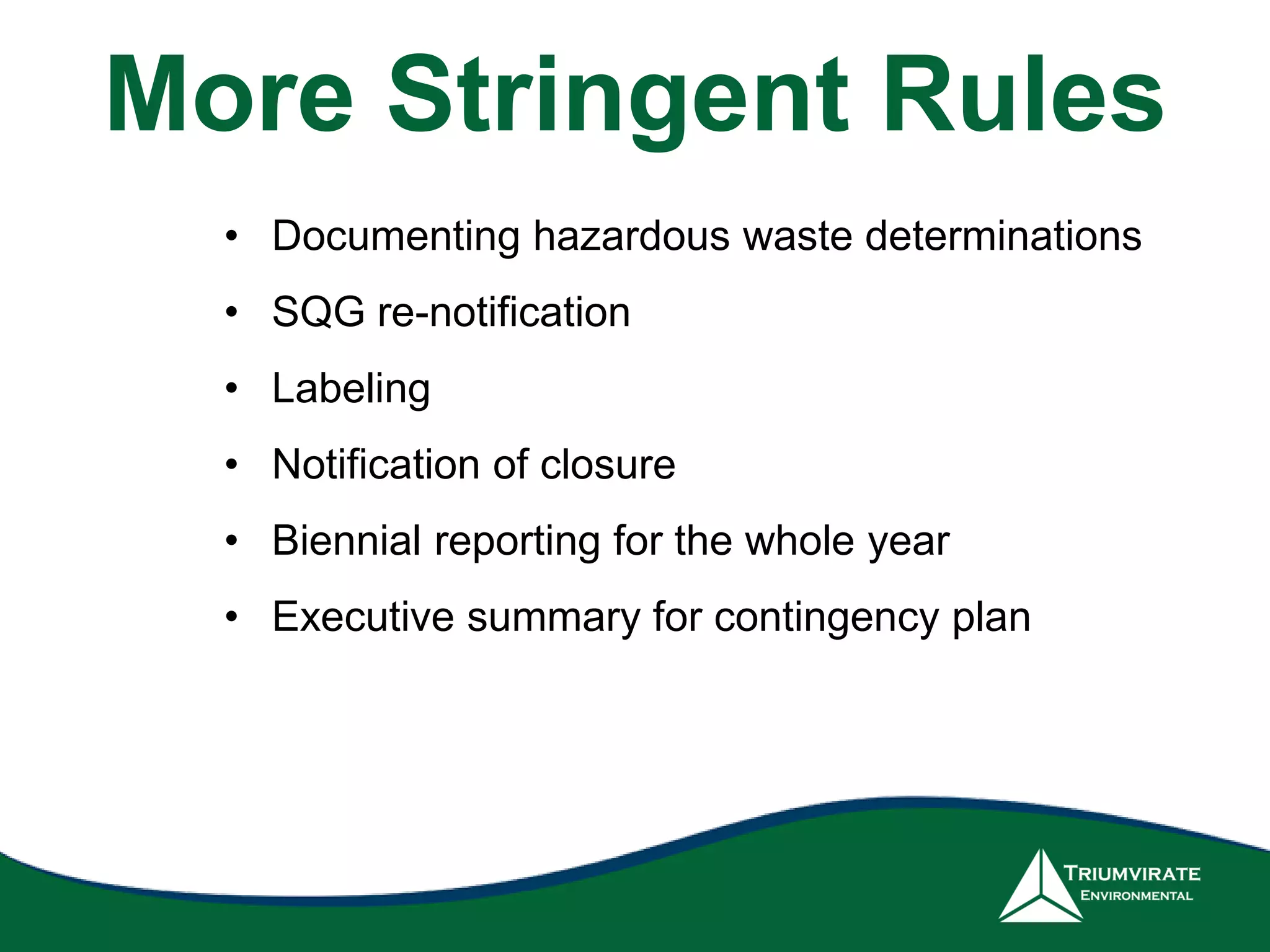
• Documenting hazardous waste determinations
• SQG re-notification
• Labeling
• Notification of closure
• Biennial reporting for the whole year
• Executive summary for contingency plan
More Stringent Rules
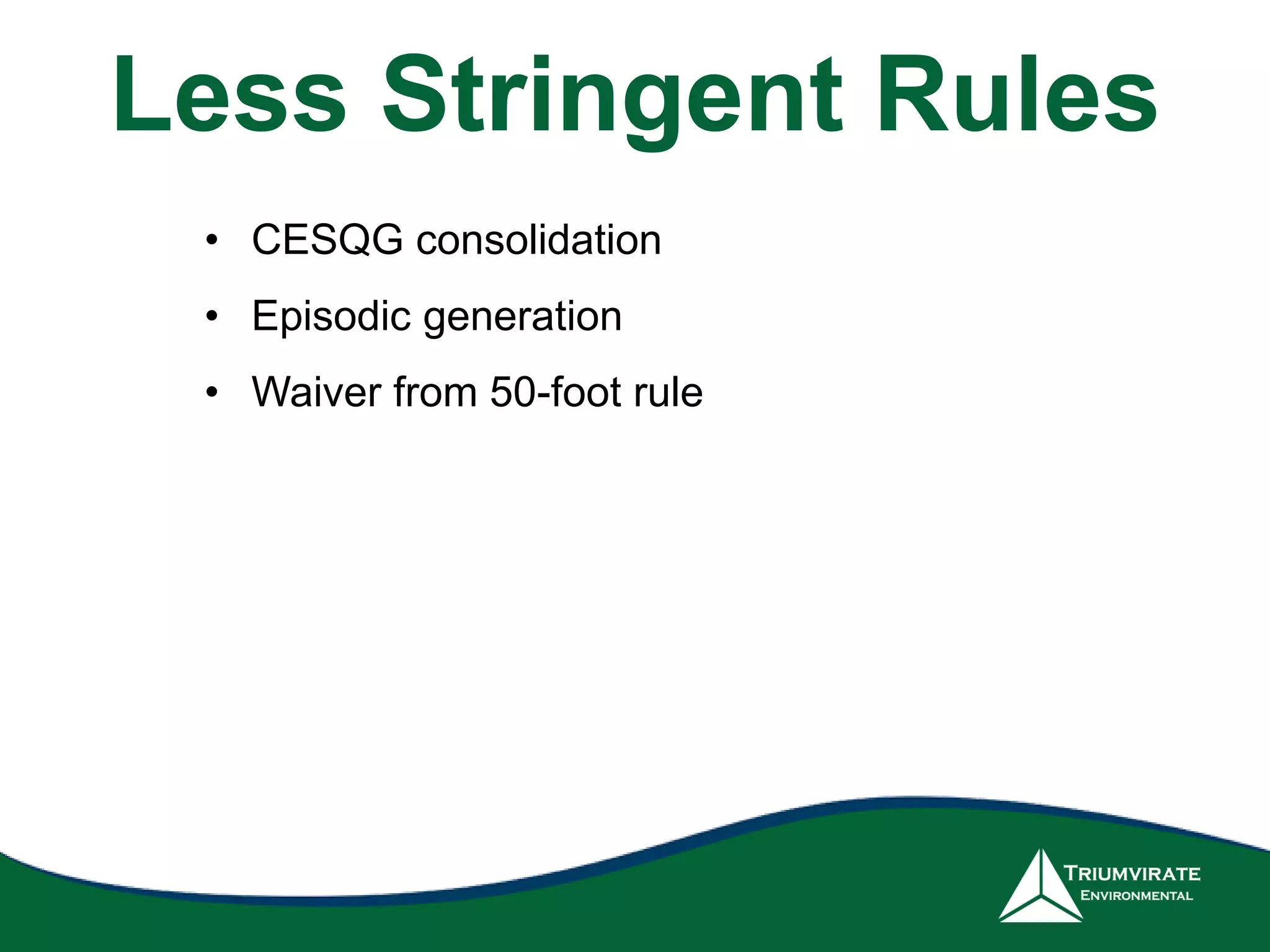
• CESQG consolidation
• Episodic generation
• Waiver from 50-foot rule
Less Stringent Rules
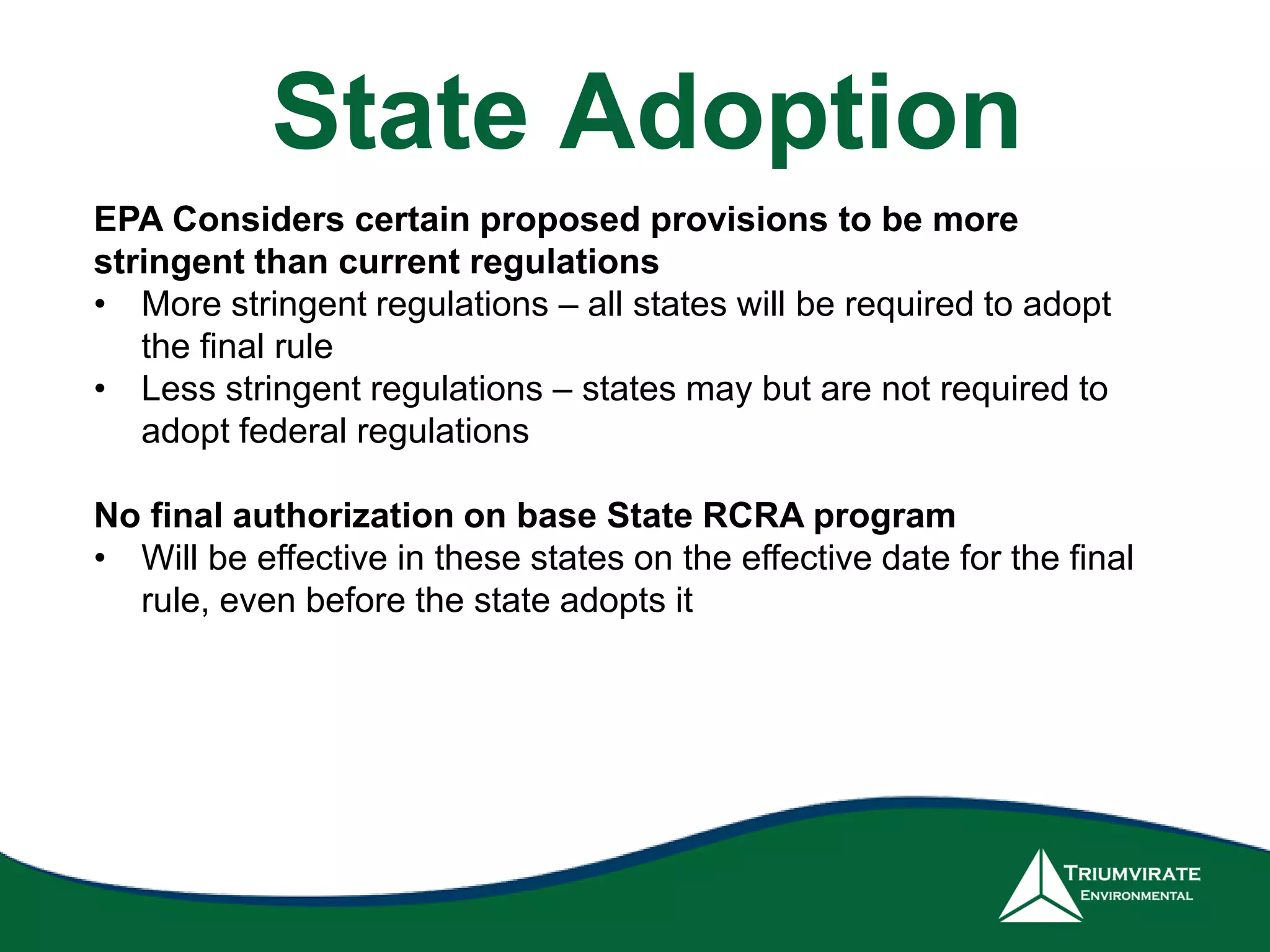
EPA Considers certain proposed provisions to be more
stringent than current regulations
• More stringent regulations – all states will be required to adopt
the final rule
• Less stringent regulations – states may but are not required to
adopt federal regulations
No final authorization on base State RCRA program
• Will be effective in these states on the effective date for the final
rule, even before the state adopts it
State Adoption
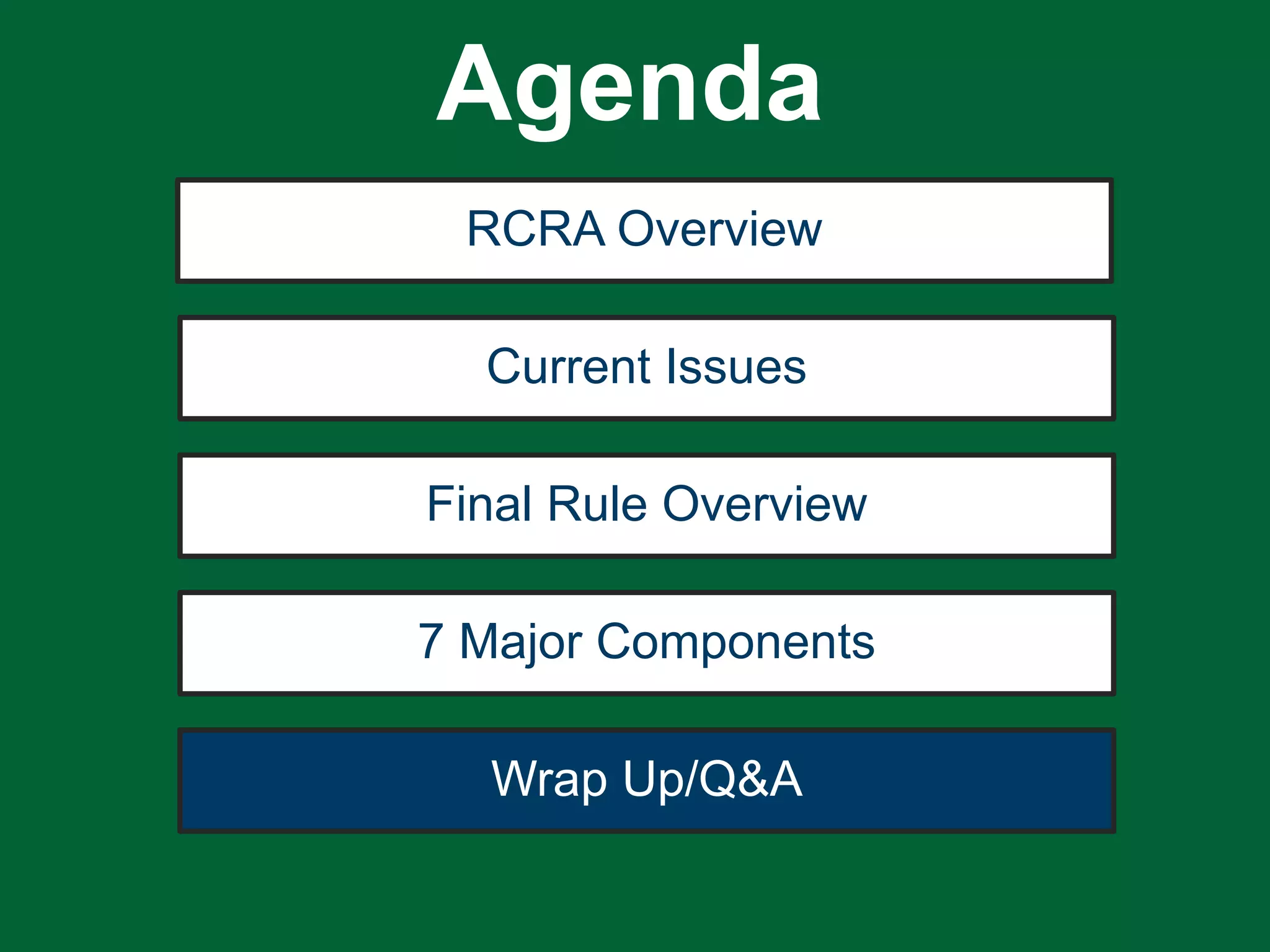
RCRA Overview
Current Issues
Final Rule Overview
7 Major Components
Wrap Up/Q&A
Agenda
Prepare yourself for drastic changes
Understand how you may be affected
Follow up for more information
What’s next?
Wrap Up
Thank You For Attending!
You Will Receive:
• A copy of this presentation and the
webinar recording
• A link to a short survey
• A special offer to help ensure that
your hazardous waste program is
fully compliant
Geraldine “Gigi” Dambreville
gdambreville@triumvirate.com
www.Triumvirate.com
Contact:

The Hazardous Waste Generator Improvements Rule

  • 1.
    The Hazardous Waste GeneratorImprovements Rule Analysis of the provisions and what they mean for you.
  • 2.
  • 3.
    During this Webinar All lines will be muted.  Communicate via the questions tab in your webinar panel.  Unanswered questions will be responded to after the webinar.  Webinar recording and slides will be emailed to you tomorrow.
  • 4.
    Meet Your Presenter Geraldine“Gigi” Dambreville Environmental Health and Safety Consultant, Triumvirate Environmental Inc.
  • 5.
    RCRA Overview Current Issues FinalRule Overview 7 Major Components Wrap Up/Q&A Agenda
  • 6.
    How Concerned Are YouAbout the New Rule? Poll Question
  • 7.
    The Resource Conservationand Recovery Act of 1976: Originally conceived as a law addressing municipal trash disposal, Subtitle C of RCRA was included to give the U.S. Environmental Protection Agency (EPA) the authority to regulate hazardous waste. This includes the generation, transportation, treatment, storage, and disposal of hazardous waste. RCRA and Generators
  • 8.
    HSWA continued whereRCRA, Subtitle C left off, including: adding mandates for the regulation of small quantity generators, restrictions on land disposal of hazardous waste, regulation of underground storage tanks (USTs), and corrective action provisions to prevent RCRA facilities from becoming Superfund sites. The Hazardous and Solid Waste Amendments of 1984: HSWA and Generators
  • 9.
    History of theRule • Hazardous Waste Generator Program evaluation – April 2004 • Hazardous Waste Determination Program evaluation – 2013 • Hazardous Waste Generator Proposed Rule – 2015
  • 10.
    40 CFR Parts260 – 265 mainly Federal register notice September 25th, 2015 Comment period ended December 24th,2015 Proposed Regulations
  • 11.
    Final Rule! Signed bythe EPA Administrator on October 28, 2016 Will be published in the Federal Register in the coming weeks Made effective May 30th 2017
  • 12.
     Generators  Transporters Treatment, Storage and Disposal Facilities (TSDFs) • Part 261- Waste Identification • Part 262- Generator Requirements • Part 263- Transporter Requirements • Part 264- 265- TSDF Requirements • Part 266- Recycling • Part 268- Land Disposal Restrictions • Part 270- TSDF Permitting • Part 271- State RCRA Programs 40 CFR Parts: 260-281 Who’s Covered Under State & Federal RCRA Regulations?
  • 13.
    The amount andtype of hazardous waste generated in a given calendar month will determine your “generator status”. Large Quantity Generators (LQGs) Small Quantity Generators (SQG) Conditionally Exempt Small Quantity Generators (CESQGs) Generator Status
  • 14.
    RCRA Overview Current Issues FinalRule Overview 7 Major Components Wrap Up/Q&A Agenda
  • 15.
  • 16.
    Issue #2 Lack ofFlexibility for Operators of Facility with Different Generator Status
  • 17.
    Issue #3 Lengthy ContingencyPlan Requirements & Lack of Recordkeeping Requirements
  • 18.
  • 19.
    RCRA Overview Current Issues FinalRule Overview 7 Major Components Wrap Up/Q&A Agenda
  • 20.
    Goals of the FinalRule 1. Reorganize the regulations to make them more user friendly and enable improved compliance 2. Provide greater flexibility for hazardous waste generators to manage waste in a cost-effective manner 3. Strengthen environmental protection by addressing identified gaps in the regulations 4. Clarify certain components of the hazardous waste generator program to address ambiguities and foster improved compliance
  • 21.
    40 CFR Part260 – Standards for the classification of hazardous wastes generators and specific Types of Hazardous Waste Management Facilities Part 262 – Management Standards for Hazardous Waste Where Will the Regulations Live?
  • 22.
    RCRA Overview Current Issues FinalRule Overview 7 Major Components Wrap Up/Q&A Agenda
  • 23.
    1. Consolidation ofCESQG Waste at LQG’s: • CESQG to be called VSQG • CESQG’s and LQG’s must be under the control of the same person • Eliminate RCRA permit requirement to accept CESQG’s waste • Additional option for CESQG’s to manage their waste • Increased training and documentation • Potentially decrease generator cost Rule #1
  • 24.
    2. Episodic Generationfor CESQG’s and SQG’s: • Only allowed once a year • Would not change current generator status • Would not have to complete biennial requirement • Notification of planned and unplanned events • Labeling requirement for accumulation of episodic waste • 60 days from initiation and completion of episodic event Rule #2
  • 25.
    3. Emergency Planningand Preparedness: • Only applicable to LQG’s and SQG’s • Require generators to make arrangements with local LEPC’s first • If no local LEPC, generators to make arrangements with local Fire Departments • NEW LQG’s to submit executive summary to LEPC rather than full contingency plans • Eliminating employee personal information in plans Rule #3
  • 26.
    4. Labeling changes: •Applicable to SQG’s, LQG’s and Transporters • Marking containers with hazardous waste codes • Make it easier for TSDF’s to identify content • Relevant areas on site: SAA’s, CAA’s, transfer facilities consolidating waste from different generators • Labeling requirement for tanks, drip pads and containment buildings • Recordkeeping requirements for tanks, drip pads, containment building for 90 and 180 day storage Rule #4
  • 27.
    5. Reporting Requirements: •Biennial reporting required only for LQG’s • Reporting for all hazardous waste generated during reporting year • Not applicable to CESQG’s and SQG’s under episodic rule • Allow new source code for CESQG’s transferred waste Rule #5
  • 28.
    6. Satellite Accumulationareas: • Prohibiting incompatible waste to be mixed in the same container • Limited exception for keeping containers closed at all times at SAA’s • Modify labeling to include flexibility on hazard category type • Clarify the “three day” rule Rule #6
  • 29.
    Rule #7 7. Closure: •Require closure as landfill for when LQG’s accumulating in containers fail to clean close • Notification to EPA or authorized state 30 days prior to closing an accumulation area or within 90 days after closure of unit or facility
  • 30.
    • Documenting hazardouswaste determinations • SQG re-notification • Labeling • Notification of closure • Biennial reporting for the whole year • Executive summary for contingency plan More Stringent Rules
  • 31.
    • CESQG consolidation •Episodic generation • Waiver from 50-foot rule Less Stringent Rules
  • 32.
    EPA Considers certainproposed provisions to be more stringent than current regulations • More stringent regulations – all states will be required to adopt the final rule • Less stringent regulations – states may but are not required to adopt federal regulations No final authorization on base State RCRA program • Will be effective in these states on the effective date for the final rule, even before the state adopts it State Adoption
  • 33.
    RCRA Overview Current Issues FinalRule Overview 7 Major Components Wrap Up/Q&A Agenda
  • 34.
    Prepare yourself fordrastic changes Understand how you may be affected Follow up for more information What’s next? Wrap Up
  • 35.
    Thank You ForAttending! You Will Receive: • A copy of this presentation and the webinar recording • A link to a short survey • A special offer to help ensure that your hazardous waste program is fully compliant Geraldine “Gigi” Dambreville gdambreville@triumvirate.com www.Triumvirate.com Contact: