GUIDE TO CONDUCTING GOOD RESEARCH
Abd Karim Alias
akarim@usm.my
View on Slideshare: http://slidesha.re/rRVSYY
WHAT MAKES AN
OUTSTANDING RESEARCH?
•Novelty/originality
•Clear & specific objectives
•Elegant design & execution
•Contribute new or extended knowledge
IN THEVERY
BEGINNING
RESEARCH PROBLEM
Why did you
undertake the research
in the first place?
How does your
research advance the
knowledge of the
subject?
RESEARCH PROBLEM
•Sufficient background - so that examiner
appreciates the research problem
•Highlight the deficiencies in current
knowledge - put the work in proper
context or perspective.
•Specific research objectives: achievable,
measurable.
RESEARCH PROBLEM
Answer the question...

WHY BOTHER?
SCOPE OFTHE RESEARCH
Have you defined &
articulated the scope
of your research
clearly?
Important to avoid “doing
everything under the sun” — too
broad, insufficient depth.
LITERATURE REVIEW
•Comprehensive but concise
•Include KEY references (seminal
papers) & recent references.
•Critical appraisal - summarize &
synthesize the current state of
knowledge
•Identify gaps in knowledge
•Need to address conflict or
controversial issues
MATERIALS & METHOD
Examiners will scrutinize
very carefully &
meticulously!
MATERIALS & METHOD
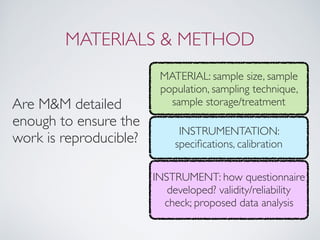
Are M&M detailed
enough to ensure the
work is reproducible?
MATERIAL: sample size, sample
population, sampling technique,
sample storage/treatment
INSTRUMENTATION:
specifications, calibration
INSTRUMENT: how questionnaire
developed? validity/reliability
check; proposed data analysis
MATERIALS & METHOD
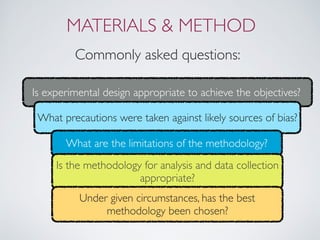
Commonly asked questions:
Is experimental design appropriate to achieve the objectives?
What precautions were taken against likely sources of bias?
What are the limitations of the methodology?
Is the methodology for analysis and data collection
appropriate?
Under given circumstances, has the best
methodology been chosen?
DATA ANALYSIS & PRESENTATION
•What is the basis of choosing certain set
of data to include in the thesis?
•Have the hypothesis been tested?
•Do the solutions obtained relate 

to the questions posed?
•Is the level and form of analysis
appropriate for the data?
DATA ANALYSIS & PRESENTATION
•Could the presentation of results made
clearer?
•Are the pattern in the results 

clearly identified and summarized
DISCUSSION & INTERPRETATION
•Logical progression of ideas & arguments
•Ability to recognize & appreciate the
significance of the data
•Demonstrate higher level of thinking &
analysis
•Ability to recognize & deal 

with contradiction
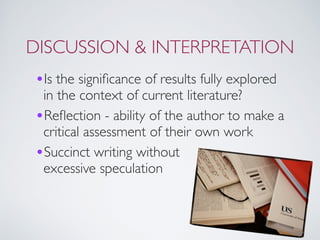
DISCUSSION & INTERPRETATION
•Is the significance of results fully explored
in the context of current literature?
•Reflection - ability of the author to make a
critical assessment of their own work
•Succinct writing without 

excessive speculation
THE END PART
•Succinct conclusion
•Have all the conclusions linked to the
results (i.e., based on available data)?
•Have all the stated objectives of the thesis
been addressed, regardless of the
outcome?
•Have the avenues for future work opened
up by the thesis been articulated clearly?
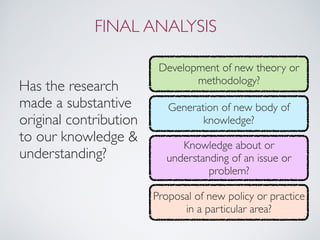
FINAL ANALYSIS
Has the research
made a substantive
original contribution
to our knowledge &
understanding?
Development of new theory or
methodology?
Generation of new body of
knowledge?
Knowledge about or
understanding of an issue or
problem?
Proposal of new policy or practice
in a particular area?
FURTHER READING
Mullins, G and Kiley, M. (2002) “It’s a
PhD, not a Nobel Prize”: how
experienced examiners assess research
theses, Studies in Higher Education, 27, 4,
369-386
THANK YOU FOR YOUR ATTENTION!

Planning and Conducting Research

  • 1.
    GUIDE TO CONDUCTINGGOOD RESEARCH Abd Karim Alias akarim@usm.my View on Slideshare: http://slidesha.re/rRVSYY
  • 2.
    WHAT MAKES AN OUTSTANDINGRESEARCH? •Novelty/originality •Clear & specific objectives •Elegant design & execution •Contribute new or extended knowledge
  • 3.
  • 4.
    RESEARCH PROBLEM Why didyou undertake the research in the first place? How does your research advance the knowledge of the subject?
  • 5.
    RESEARCH PROBLEM •Sufficient background- so that examiner appreciates the research problem •Highlight the deficiencies in current knowledge - put the work in proper context or perspective. •Specific research objectives: achievable, measurable.
  • 6.
    RESEARCH PROBLEM Answer thequestion...
 WHY BOTHER?
  • 7.
    SCOPE OFTHE RESEARCH Haveyou defined & articulated the scope of your research clearly? Important to avoid “doing everything under the sun” — too broad, insufficient depth.
  • 8.
    LITERATURE REVIEW •Comprehensive butconcise •Include KEY references (seminal papers) & recent references. •Critical appraisal - summarize & synthesize the current state of knowledge •Identify gaps in knowledge •Need to address conflict or controversial issues
  • 9.
    MATERIALS & METHOD Examinerswill scrutinize very carefully & meticulously!
  • 10.
    MATERIALS & METHOD AreM&M detailed enough to ensure the work is reproducible? MATERIAL: sample size, sample population, sampling technique, sample storage/treatment INSTRUMENTATION: specifications, calibration INSTRUMENT: how questionnaire developed? validity/reliability check; proposed data analysis
  • 11.
    MATERIALS & METHOD Commonlyasked questions: Is experimental design appropriate to achieve the objectives? What precautions were taken against likely sources of bias? What are the limitations of the methodology? Is the methodology for analysis and data collection appropriate? Under given circumstances, has the best methodology been chosen?
  • 12.
    DATA ANALYSIS &PRESENTATION •What is the basis of choosing certain set of data to include in the thesis? •Have the hypothesis been tested? •Do the solutions obtained relate 
 to the questions posed? •Is the level and form of analysis appropriate for the data?
  • 13.
    DATA ANALYSIS &PRESENTATION •Could the presentation of results made clearer? •Are the pattern in the results 
 clearly identified and summarized
  • 14.
    DISCUSSION & INTERPRETATION •Logicalprogression of ideas & arguments •Ability to recognize & appreciate the significance of the data •Demonstrate higher level of thinking & analysis •Ability to recognize & deal 
 with contradiction
  • 15.
    DISCUSSION & INTERPRETATION •Isthe significance of results fully explored in the context of current literature? •Reflection - ability of the author to make a critical assessment of their own work •Succinct writing without 
 excessive speculation
  • 16.
    THE END PART •Succinctconclusion •Have all the conclusions linked to the results (i.e., based on available data)? •Have all the stated objectives of the thesis been addressed, regardless of the outcome? •Have the avenues for future work opened up by the thesis been articulated clearly?
  • 17.
    FINAL ANALYSIS Has theresearch made a substantive original contribution to our knowledge & understanding? Development of new theory or methodology? Generation of new body of knowledge? Knowledge about or understanding of an issue or problem? Proposal of new policy or practice in a particular area?
  • 18.
    FURTHER READING Mullins, Gand Kiley, M. (2002) “It’s a PhD, not a Nobel Prize”: how experienced examiners assess research theses, Studies in Higher Education, 27, 4, 369-386
  • 19.
    THANK YOU FORYOUR ATTENTION!