Writing Research Grant Proposal
G R Sinha, PhD
IEEE Senior Member, ACM Distinguished Speaker, IEEE Distinguished Speaker
Professor, Myanmar Institute of Information Technology Mandalay
Recipient of ISTE National Award, TCS Award, IEI Award, Expert Engineer Award, Young Engineer Award, Young Scientist Award
Email: drgrsinha@ieee.org, ganeshsinha@acm.com, gr_sinha@miit.edu.mm
 Research and Research Proposal
 How to Write Potential Research Grant Proposal
2
Agenda
Writing Research Grant Proposal G R Sinha
 Research refers to a search for knowledge; is a scientific and systematic search for pertinent
information on a specific topic.
 Descriptive research--surveys and fact-finding enquiries. The researcher has no control over the
variables; can only report what has happened or what is happening.
 Analytical research, the researcher has to use facts or information already available, and analyze
these to make a critical evaluation of the material.
 Applied research aims at finding a solution for an immediate problem facing a society or an
industrial/business organization.
 Empirical research is data-based research, experimental type of research and is thus characterized by
the experimenter’s control over the variables under study and deliberate manipulation of one of
them to study its effects.
Research
3
Writing Research Grant Proposal G R Sinha
4
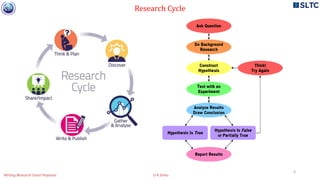
Research Cycle
Writing Research Grant Proposal G R Sinha
 Believe that someone wants to give you the money.
 Consider the long-term goals of your institution.
 Start with the end in mind
 Identify yourself and your strengths.
 Create a comprehensive plan - not just a proposal of what you wish to achieve.
Before we apply for grant
Writing Research Grant Proposal G R Sinha
 Research prospective funding bodies and target funding source that has interest in
your organisation and programme.
Need to do Home work
Writing Research Grant Proposal G R Sinha
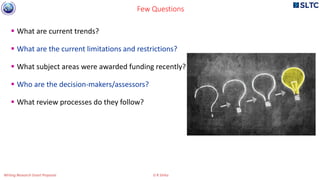
 What are current trends?
 What are the current limitations and restrictions?
 What subject areas were awarded funding recently?
 Who are the decision-makers/assessors?
 What review processes do they follow?
Few Questions
Writing Research Grant Proposal G R Sinha
 Funding bodies look for good researchers.
 Think of them as potential investors in you and your ideas.
 You must ‘sell’ your idea: Be enthusiastic about the work!
 Why should they give a grant? See it from the funder’s point of view.
 Remember that you are NOT begging.
 You have ideas, they have money.
Points to Remember
Writing Research Grant Proposal G R Sinha
 What the objectives of the project?
 What will be the outcomes?
 Does the proposal address a well-formulated problem?
 Is it a research problem or just a routine application of a known technique?
 Is it an important problem, whose solution will have useful effects?
 Is special funding necessary to solve the problem or to solve it quickly enough?
Major Criteria
Writing Research Grant Proposal G R Sinha
 It is like a blue print of a building plan before the construction starts.
 Writing a research proposal is both science and art.
 A good research proposal is based on scientific facts and on the art of clear communication .
Research Proposal
10
Writing Research Grant Proposal G R Sinha
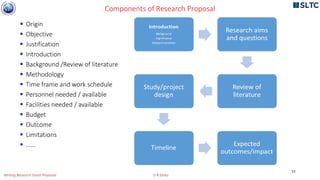
 Origin
 Objective
 Justification
 Introduction
 Background /Review of literature
 Methodology
 Time frame and work schedule
 Personnel needed / available
 Facilities needed / available
 Budget
 Outcome
 Limitations
 ……
Components of Research Proposal
11
Writing Research Grant Proposal G R Sinha
Objectives
 Very important and pivotal part and everything else in the study is centered around it.
 The objective stated should be specific, achievable and measurable.
 Too many objectives to be avoided.
 Even just one clearly stated relevant objective for a study would be good enough.
 If there is more than one objective then the same can be presented in the appropriate
order of importance.
12
Writing Research Grant Proposal G R Sinha
 It should help the reader to acquaint with the topic.
 Introduction should be short about one or two pages .
 The problem should be stated in such a way that it’s importance and relevance is
realized by any one who reads it.
• Deficiencies in the studies and Problem statement
Introduction
Problem Statement
 Declaration of originality (mentioning a knowledge void )
 Indication of the central focus of the study (purpose statement)
 Study significance or benefits to be derived from an investigation of the problem
13
Writing Research Grant Proposal G R Sinha
 This section reflects extensive review of literature.
 What is already known about the topic is written including the lacunae
 Just quoting the literature verbatim will not serve the purpose .
 It is important to make it coherent, relevant and easily readable knowledge
 It helps the investigator to gain good knowledge in that field of inquiry
 It also helps the investigator to have insight on different methodologies that could be
applied.
Background: Related Research
14
Writing Research Grant Proposal G R Sinha
 Identify a research topic
 Identify keywords/descriptors that are useful in locating relevant information material
 Select relevant primary and secondary sources
 Develop themes/concepts that synthesize the literature
 Relate the themes/concepts to one another through an outline of the literature review
 Use the literature review to develop or refine the research objectives, questions, and
hypothesis
Steps of Related Research
15
Writing Research Grant Proposal G R Sinha
 Research methodology is a way to systematically solve the research problem.
• It is essential to discuss procedures clearly with considerable amount of details: Study design; Study
population/ Sampling specifications; Sample size needed ; Instrumentation; Specific procedures etc.
Research Methodology
Study Design
 A study design is a specific plan or protocol for conducting the study, which allows the investigator
to translate the conceptual hypothesis into an operational one.
 The study design should be appropriate for achieving the objective of the study .
 Determination of sample size is a bargain between precision and the price.
16
Writing Research Grant Proposal G R Sinha
 The proposal should include the sequence of tasks to be performed, the anticipated length of time
required for its completion and the personnel required .
 It can be presented in tabular or graphic form (Gantt chart)
 Flow charts and other diagrams are often useful for highlighting the sequencing and interrelationship
of different activities in the study.
Time Frame and Work Schedule
17
Writing Research Grant Proposal G R Sinha
 Proposal should also include the important facilities required / available for the study namely
computers, laboratories, special equipment etc.
 It should also include who are the principal investigator and co- investigators, their qualifications,
research experience etc.
 The proposal may also include the Major roles to be taken up by different investigators .
Facilities/Investigators
18
Writing Research Grant Proposal G R Sinha
 Budget translates project activities into monetary terms.
 Major items:- Salary for staff, Travel, Purchase of equipment, Printing, Consultancy charges,
Institutional overheads etc.
Budget
19
Writing Research Grant Proposal G R Sinha
 Why this study is significant?
 What will it contribute to the existing research literature?
 What implications your findings may have?
 Who will benefit from it?
Significance of Study
20
Writing Research Grant Proposal G R Sinha
 Finding a mentor/sponsor; Choosing a project ; Developing research questions; Writing the proposal
 Meet with the mentor to discuss their previous work & their research projects.
 Ask about time availability and collaborators.
 Review some background papers together.
Few Important Things for Discussion
21
Writing Research Grant Proposal G R Sinha
 Are the research objectives feasible? (Time? Sample size? Technical expertise?)
 Are the questions novel? Interesting? Useful?
 Is the scope of the study well focused?
 Is it ethical to ask these research questions?
Research Questions
22
Writing Research Grant Proposal G R Sinha
 Find a mentor/collaborator EARLY.
 Choose a project EARLY.
 Develop 3 interesting research questions.
 Write & submit the proposal EARLY!!!
Write Research Proposal
23
Writing Research Grant Proposal G R Sinha
 Seek regular feedback from readers as soon as possible during the development of the
proposal, allowing time to receive responses.
 Bear in mind that strong grant proposals take a long time to develop, so plan well ahead
to ensure meeting the deadline.
Revising the Proposal
Writing Research Grant Proposal G R Sinha
 Do not feel embarrassed about asking for money.
 If you never ask for the money, it will never be offered.
 If at first you don’t succeed, try and try again.
 Learn from feedback regarding a rejected proposal.
 Be positive!
Advice
Writing Research Grant Proposal G R Sinha
26
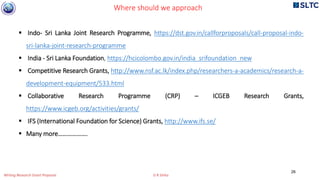
 Indo- Sri Lanka Joint Research Programme, https://dst.gov.in/callforproposals/call-proposal-indo-
sri-lanka-joint-research-programme
 India - Sri Lanka Foundation, https://hcicolombo.gov.in/india_srifoundation_new
 Competitive Research Grants, http://www.nsf.ac.lk/index.php/researchers-a-academics/research-a-
development-equipment/533.html
 Collaborative Research Programme (CRP) – ICGEB Research Grants,
https://www.icgeb.org/activities/grants/
 IFS (International Foundation for Science) Grants, http://www.ifs.se/
 Many more……………….
Where should we approach
Writing Research Grant Proposal G R Sinha
27
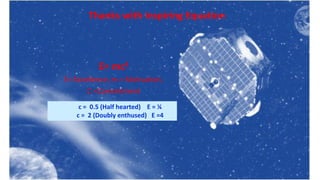
Thanks with Inspiring Equation
E= mc2
E=Excellence, m = Motivation,
C =Commitment
c = 0.5 (Half hearted) E = ¼
c = 2 (Doubly enthused) E =4

Writing research grant proposal

  • 1.
    Writing Research GrantProposal G R Sinha, PhD IEEE Senior Member, ACM Distinguished Speaker, IEEE Distinguished Speaker Professor, Myanmar Institute of Information Technology Mandalay Recipient of ISTE National Award, TCS Award, IEI Award, Expert Engineer Award, Young Engineer Award, Young Scientist Award Email: drgrsinha@ieee.org, ganeshsinha@acm.com, gr_sinha@miit.edu.mm
  • 2.
     Research andResearch Proposal  How to Write Potential Research Grant Proposal 2 Agenda Writing Research Grant Proposal G R Sinha
  • 3.
     Research refersto a search for knowledge; is a scientific and systematic search for pertinent information on a specific topic.  Descriptive research--surveys and fact-finding enquiries. The researcher has no control over the variables; can only report what has happened or what is happening.  Analytical research, the researcher has to use facts or information already available, and analyze these to make a critical evaluation of the material.  Applied research aims at finding a solution for an immediate problem facing a society or an industrial/business organization.  Empirical research is data-based research, experimental type of research and is thus characterized by the experimenter’s control over the variables under study and deliberate manipulation of one of them to study its effects. Research 3 Writing Research Grant Proposal G R Sinha
  • 4.
    4 Research Cycle Writing ResearchGrant Proposal G R Sinha
  • 5.
     Believe thatsomeone wants to give you the money.  Consider the long-term goals of your institution.  Start with the end in mind  Identify yourself and your strengths.  Create a comprehensive plan - not just a proposal of what you wish to achieve. Before we apply for grant Writing Research Grant Proposal G R Sinha
  • 6.
     Research prospectivefunding bodies and target funding source that has interest in your organisation and programme. Need to do Home work Writing Research Grant Proposal G R Sinha
  • 7.
     What arecurrent trends?  What are the current limitations and restrictions?  What subject areas were awarded funding recently?  Who are the decision-makers/assessors?  What review processes do they follow? Few Questions Writing Research Grant Proposal G R Sinha
  • 8.
     Funding bodieslook for good researchers.  Think of them as potential investors in you and your ideas.  You must ‘sell’ your idea: Be enthusiastic about the work!  Why should they give a grant? See it from the funder’s point of view.  Remember that you are NOT begging.  You have ideas, they have money. Points to Remember Writing Research Grant Proposal G R Sinha
  • 9.
     What theobjectives of the project?  What will be the outcomes?  Does the proposal address a well-formulated problem?  Is it a research problem or just a routine application of a known technique?  Is it an important problem, whose solution will have useful effects?  Is special funding necessary to solve the problem or to solve it quickly enough? Major Criteria Writing Research Grant Proposal G R Sinha
  • 10.
     It islike a blue print of a building plan before the construction starts.  Writing a research proposal is both science and art.  A good research proposal is based on scientific facts and on the art of clear communication . Research Proposal 10 Writing Research Grant Proposal G R Sinha
  • 11.
     Origin  Objective Justification  Introduction  Background /Review of literature  Methodology  Time frame and work schedule  Personnel needed / available  Facilities needed / available  Budget  Outcome  Limitations  …… Components of Research Proposal 11 Writing Research Grant Proposal G R Sinha
  • 12.
    Objectives  Very importantand pivotal part and everything else in the study is centered around it.  The objective stated should be specific, achievable and measurable.  Too many objectives to be avoided.  Even just one clearly stated relevant objective for a study would be good enough.  If there is more than one objective then the same can be presented in the appropriate order of importance. 12 Writing Research Grant Proposal G R Sinha
  • 13.
     It shouldhelp the reader to acquaint with the topic.  Introduction should be short about one or two pages .  The problem should be stated in such a way that it’s importance and relevance is realized by any one who reads it. • Deficiencies in the studies and Problem statement Introduction Problem Statement  Declaration of originality (mentioning a knowledge void )  Indication of the central focus of the study (purpose statement)  Study significance or benefits to be derived from an investigation of the problem 13 Writing Research Grant Proposal G R Sinha
  • 14.
     This sectionreflects extensive review of literature.  What is already known about the topic is written including the lacunae  Just quoting the literature verbatim will not serve the purpose .  It is important to make it coherent, relevant and easily readable knowledge  It helps the investigator to gain good knowledge in that field of inquiry  It also helps the investigator to have insight on different methodologies that could be applied. Background: Related Research 14 Writing Research Grant Proposal G R Sinha
  • 15.
     Identify aresearch topic  Identify keywords/descriptors that are useful in locating relevant information material  Select relevant primary and secondary sources  Develop themes/concepts that synthesize the literature  Relate the themes/concepts to one another through an outline of the literature review  Use the literature review to develop or refine the research objectives, questions, and hypothesis Steps of Related Research 15 Writing Research Grant Proposal G R Sinha
  • 16.
     Research methodologyis a way to systematically solve the research problem. • It is essential to discuss procedures clearly with considerable amount of details: Study design; Study population/ Sampling specifications; Sample size needed ; Instrumentation; Specific procedures etc. Research Methodology Study Design  A study design is a specific plan or protocol for conducting the study, which allows the investigator to translate the conceptual hypothesis into an operational one.  The study design should be appropriate for achieving the objective of the study .  Determination of sample size is a bargain between precision and the price. 16 Writing Research Grant Proposal G R Sinha
  • 17.
     The proposalshould include the sequence of tasks to be performed, the anticipated length of time required for its completion and the personnel required .  It can be presented in tabular or graphic form (Gantt chart)  Flow charts and other diagrams are often useful for highlighting the sequencing and interrelationship of different activities in the study. Time Frame and Work Schedule 17 Writing Research Grant Proposal G R Sinha
  • 18.
     Proposal shouldalso include the important facilities required / available for the study namely computers, laboratories, special equipment etc.  It should also include who are the principal investigator and co- investigators, their qualifications, research experience etc.  The proposal may also include the Major roles to be taken up by different investigators . Facilities/Investigators 18 Writing Research Grant Proposal G R Sinha
  • 19.
     Budget translatesproject activities into monetary terms.  Major items:- Salary for staff, Travel, Purchase of equipment, Printing, Consultancy charges, Institutional overheads etc. Budget 19 Writing Research Grant Proposal G R Sinha
  • 20.
     Why thisstudy is significant?  What will it contribute to the existing research literature?  What implications your findings may have?  Who will benefit from it? Significance of Study 20 Writing Research Grant Proposal G R Sinha
  • 21.
     Finding amentor/sponsor; Choosing a project ; Developing research questions; Writing the proposal  Meet with the mentor to discuss their previous work & their research projects.  Ask about time availability and collaborators.  Review some background papers together. Few Important Things for Discussion 21 Writing Research Grant Proposal G R Sinha
  • 22.
     Are theresearch objectives feasible? (Time? Sample size? Technical expertise?)  Are the questions novel? Interesting? Useful?  Is the scope of the study well focused?  Is it ethical to ask these research questions? Research Questions 22 Writing Research Grant Proposal G R Sinha
  • 23.
     Find amentor/collaborator EARLY.  Choose a project EARLY.  Develop 3 interesting research questions.  Write & submit the proposal EARLY!!! Write Research Proposal 23 Writing Research Grant Proposal G R Sinha
  • 24.
     Seek regularfeedback from readers as soon as possible during the development of the proposal, allowing time to receive responses.  Bear in mind that strong grant proposals take a long time to develop, so plan well ahead to ensure meeting the deadline. Revising the Proposal Writing Research Grant Proposal G R Sinha
  • 25.
     Do notfeel embarrassed about asking for money.  If you never ask for the money, it will never be offered.  If at first you don’t succeed, try and try again.  Learn from feedback regarding a rejected proposal.  Be positive! Advice Writing Research Grant Proposal G R Sinha
  • 26.
    26  Indo- SriLanka Joint Research Programme, https://dst.gov.in/callforproposals/call-proposal-indo- sri-lanka-joint-research-programme  India - Sri Lanka Foundation, https://hcicolombo.gov.in/india_srifoundation_new  Competitive Research Grants, http://www.nsf.ac.lk/index.php/researchers-a-academics/research-a- development-equipment/533.html  Collaborative Research Programme (CRP) – ICGEB Research Grants, https://www.icgeb.org/activities/grants/  IFS (International Foundation for Science) Grants, http://www.ifs.se/  Many more………………. Where should we approach Writing Research Grant Proposal G R Sinha
  • 27.
    27 Thanks with InspiringEquation E= mc2 E=Excellence, m = Motivation, C =Commitment c = 0.5 (Half hearted) E = ¼ c = 2 (Doubly enthused) E =4