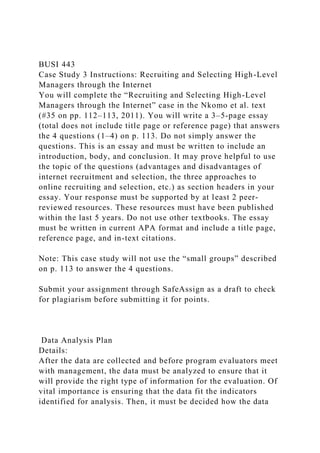
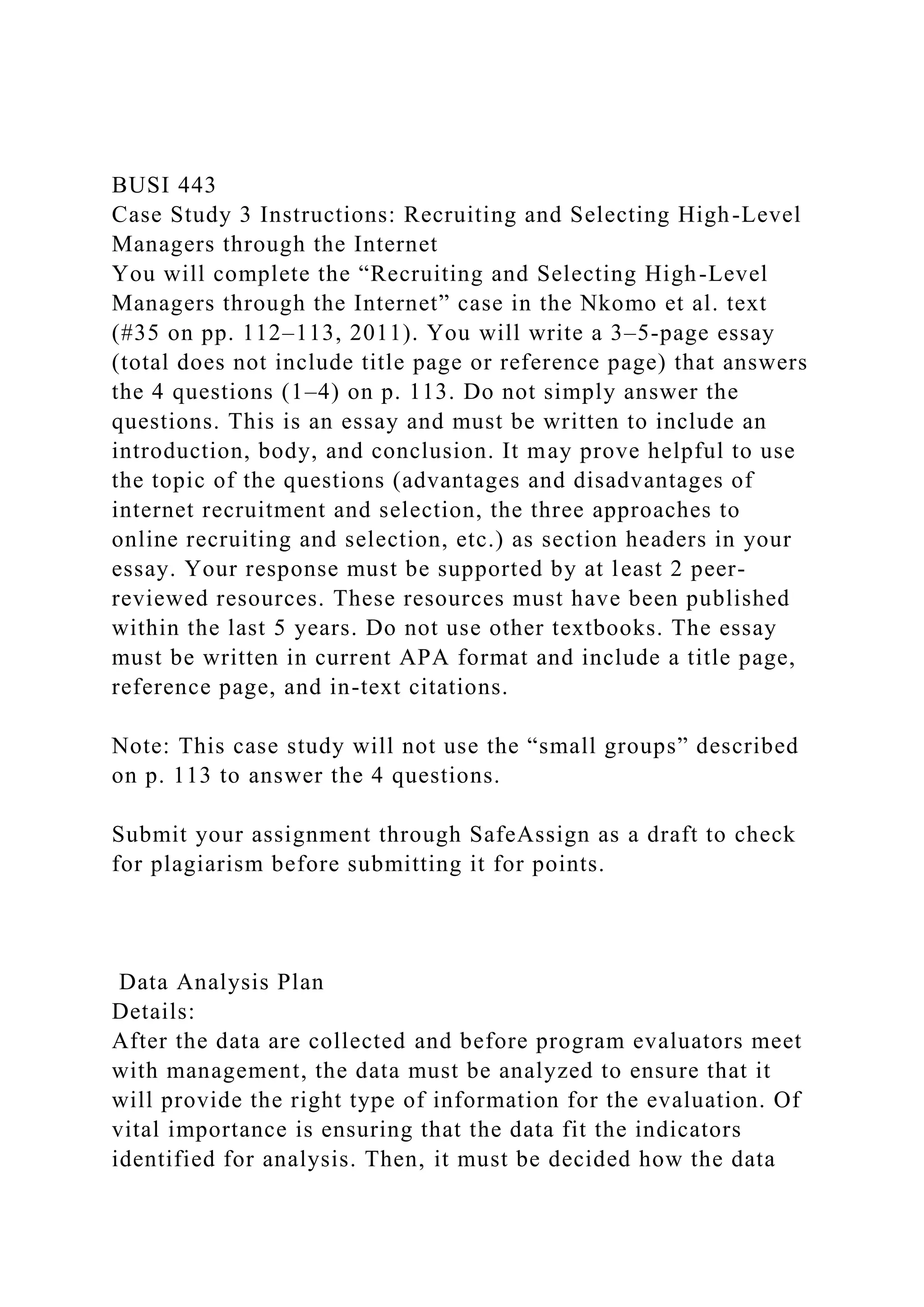
BUSI 443
Case Study 3 Instructions: Recruiting and Selecting High-Level
Managers through the Internet
You will complete the “Recruiting and Selecting High-Level
Managers through the Internet” case in the Nkomo et al. text
(#35 on pp. 112–113, 2011). You will write a 3–5-page essay
(total does not include title page or reference page) that answers
the 4 questions (1–4) on p. 113. Do not simply answer the
questions. This is an essay and must be written to include an
introduction, body, and conclusion. It may prove helpful to use
the topic of the questions (advantages and disadvantages of
internet recruitment and selection, the three approaches to
online recruiting and selection, etc.) as section headers in your
essay. Your response must be supported by at least 2 peer-
reviewed resources. These resources must have been published
within the last 5 years. Do not use other textbooks. The essay
must be written in current APA format and include a title page,
reference page, and in-text citations.
Note: This case study will not use the “small groups” described
on p. 113 to answer the 4 questions.
Submit your assignment through SafeAssign as a draft to check
for plagiarism before submitting it for points.
Data Analysis Plan
Details:
After the data are collected and before program evaluators meet
with management, the data must be analyzed to ensure that it
will provide the right type of information for the evaluation. Of
vital importance is ensuring that the data fit the indicators
identified for analysis. Then, it must be decided how the data
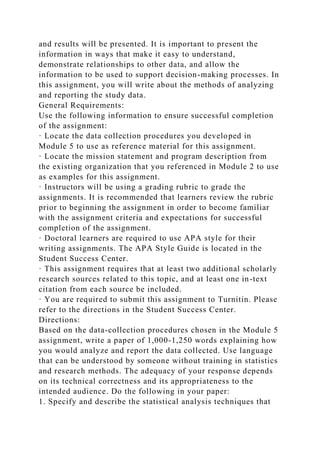
and results will be presented. It is important to present the
information in ways that make it easy to understand,
demonstrate relationships to other data, and allow the
information to be used to support decision-making processes. In
this assignment, you will write about the methods of analyzing
and reporting the study data.
General Requirements:
Use the following information to ensure successful completion
of the assignment:
· Locate the data collection procedures you developed in
Module 5 to use as reference material for this assignment.
· Locate the mission statement and program description from
the existing organization that you referenced in Module 2 to use
as examples for this assignment.
· Instructors will be using a grading rubric to grade the
assignments. It is recommended that learners review the rubric
prior to beginning the assignment in order to become familiar
with the assignment criteria and expectations for successful
completion of the assignment.
· Doctoral learners are required to use APA style for their
writing assignments. The APA Style Guide is located in the
Student Success Center.
· This assignment requires that at least two additional scholarly
research sources related to this topic, and at least one in-text
citation from each source be included.
· You are required to submit this assignment to Turnitin. Please
refer to the directions in the Student Success Center.
Directions:
Based on the data-collection procedures chosen in the Module 5
assignment, write a paper of 1,000-1,250 words explaining how
you would analyze and report the data collected. Use language
that can be understood by someone without training in statistics
and research methods. The adequacy of your response depends
on its technical correctness and its appropriateness to the
intended audience. Do the following in your paper:
1. Specify and describe the statistical analysis techniques that
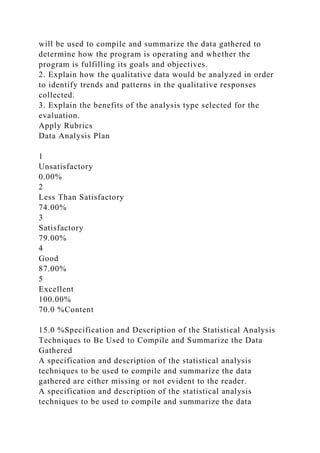
will be used to compile and summarize the data gathered to
determine how the program is operating and whether the
program is fulfilling its goals and objectives.
2. Explain how the qualitative data would be analyzed in order
to identify trends and patterns in the qualitative responses
collected.
3. Explain the benefits of the analysis type selected for the
evaluation.
Apply Rubrics
Data Analysis Plan
1
Unsatisfactory
0.00%
2
Less Than Satisfactory
74.00%
3
Satisfactory
79.00%
4
Good
87.00%
5
Excellent
100.00%
70.0 %Content
15.0 %Specification and Description of the Statistical Analysis
Techniques to Be Used to Compile and Summarize the Data
Gathered
A specification and description of the statistical analysis
techniques to be used to compile and summarize the data
gathered are either missing or not evident to the reader.
A specification and description of the statistical analysis
techniques to be used to compile and summarize the data
gathered are present, but incomplete or inaccurate.
A specification and description of the statistical analysis
techniques to be used to compile and summarize the data
gathered are presented, but cursory and lacking in depth. The
research used for support is outdated.
A specification and description of the statistical analysis
techniques to be used to compile and summarize the data
gathered are thoroughly presented and include a discussion of
all necessary elements. Both are moderately well supported
though some sources of support are outdated.
A specification and description of the statistical analysis
techniques to be used to compile and summarize the data
gathered are thoroughly presented with rich detail and include a
discussion of all necessary elements. Both are well supported
with current and/or seminal research.
25.0 %Explanation of How the Qualitative Data Would be
Analyzed
An explanation of how the qualitative data would be analyzed is
either missing or not evident to the reader.
An explanation of how the qualitative data would be analyzed is
present, but incomplete or inaccurate.
An explanation of how the qualitative data would be analyzed is
present, but cursory. The research used for support is outdated.
An explanation of how the qualitative data would be analyzed is
present and thorough. The explanation is moderately well
supported though some sources of support are outdated.
An explanation of how the qualitative data would be analyzed is
present, thorough, and well-detailed. The explanation is well
supported with current and/or seminal research.
25.0 %Explanation of the Benefits of the Selected Analysis
Type
An explanation of the benefits of the selected analysis type is
either missing or not evident to the reader.
An explanation of the benefits of the selected analysis type is
present, but incomplete or inaccurate.
An explanation of the benefits of the selected analysis type is
present, but cursory. The research used for support is outdated.
An explanation of the benefits of the selected analysis type is
present and thorough. The explanation is moderately well
supported though some sources of support are outdated.
An explanation of the benefits of the selected analysis type is
present, thorough, and well-detailed. The explanation is well
supported with current and/or seminal research.
5.0 %Two Additional Scholarly Research Sources With In-Text
Citations.
None of the required elements (two topic-related scholarly
research sources and two in-text citations) are present.
Not all required elements are present. One or more of the
elements is missing and/or an included source(s) is not
scholarly research or topic-related.
All required elements are present. Scholarly research sources
are topic-related, but the source and quality of one reference is
questionable.
All required elements are present. Scholarly research sources
are topic-related, and obtained from reputable professional
sources.
All required elements are present. Scholarly research sources
are topic-related, and obtained from highly respected,
professional, original sources.
20.0 %Organization and Effectiveness
7.0 %Thesis Development and Purpose
Paper lacks any discernible overall purpose or organizing claim.
Thesis and/or main claim are insufficiently developed and/or
vague; purpose is not clear.
Thesis and/or main claim are apparent and appropriate to
purpose.
Thesis and/or main claim are clear and forecast the development
of the paper. It is descriptive and reflective of the arguments
and appropriate to the purpose.
Thesis and/or main claim are comprehensive. The essence of the
paper is contained within the thesis. Thesis statement makes the
purpose of the paper clear.
8.0 %Argument Logic and Construction
Statement of purpose is not justified by the conclusion. The
conclusion does not support the claim made. Argument is
incoherent and uses noncredible sources.
Sufficient justification of claims is lacking. Argument lacks
consistent unity. There are obvious flaws in the logic. Some
sources have questionable credibility.
Argument is orderly, but may have a few inconsistencies. The
argument presents minimal justification of claims. Argument
logically, but not thoroughly, supports the purpose. Sources
used are credible. Introduction and conclusion bracket the
thesis.
Argument shows logical progressions. Techniques of
argumentation are evident. There is a smooth progression of
claims from introduction to conclusion. Most sources are
authoritative.
Clear and convincing argument that presents a persuasive claim
in a distinctive and compelling manner. All sources are
authoritative.
5.0 %Mechanics of Writing (includes spelling, punctuation,
grammar, language use)
Surface errors are pervasive enough that they impede
communication of meaning. Inappropriate word choice and/or
sentence construction are used.
Frequent and repetitive mechanical errors distract the reader.
Inconsistencies in language choice (register), sentence
structure, and/or word choice are present.
Some mechanical errors or typos are present, but are not overly
distracting to the reader. Correct sentence structure and
audience-appropriate language are used.
Prose is largely free of mechanical errors, although a few may
be present. A variety of sentence structures and effective
figures of speech are used.
Writer is clearly in command of standard, written, academic
English.
10.0 %Format
5.0 %Paper Format (Use of appropriate style for the major and
assignment)
Template is not used appropriately or documentation format is
rarely followed correctly.
Appropriate template is used, but some elements are missing or
mistaken. A lack of control with formatting is apparent.
Appropriate template is used. Formatting is correct, although
some minor errors may be present.
Appropriate template is fully used. There are virtually no errors
in formatting style.
All format elements are correct.
5.0 %Research Citations (In-text citations for paraphrasing and
direct quotes, and reference page listing and formatting, as
appropriate to assignment and style)
No reference page is included. No citations are used.
Reference page is present. Citations are inconsistently used.
Reference page is included and lists sources used in the paper.
Sources are appropriately documented, although some errors
may be present.
Reference page is present and fully inclusive of all cited
sources. Documentation is appropriate and citation style is
usually correct.
In-text citations and a reference page are complete and correct.
The documentation of cited sources is free of error.
100 %Total Weightage
BUSI 443Case Study 3 Instructions Recruiting and Selecting High.docx

BUSI 443Case Study 3 Instructions Recruiting and Selecting High.docx

  • 1.
    BUSI 443 Case Study3 Instructions: Recruiting and Selecting High-Level Managers through the Internet You will complete the “Recruiting and Selecting High-Level Managers through the Internet” case in the Nkomo et al. text (#35 on pp. 112–113, 2011). You will write a 3–5-page essay (total does not include title page or reference page) that answers the 4 questions (1–4) on p. 113. Do not simply answer the questions. This is an essay and must be written to include an introduction, body, and conclusion. It may prove helpful to use the topic of the questions (advantages and disadvantages of internet recruitment and selection, the three approaches to online recruiting and selection, etc.) as section headers in your essay. Your response must be supported by at least 2 peer- reviewed resources. These resources must have been published within the last 5 years. Do not use other textbooks. The essay must be written in current APA format and include a title page, reference page, and in-text citations. Note: This case study will not use the “small groups” described on p. 113 to answer the 4 questions. Submit your assignment through SafeAssign as a draft to check for plagiarism before submitting it for points. Data Analysis Plan Details: After the data are collected and before program evaluators meet with management, the data must be analyzed to ensure that it will provide the right type of information for the evaluation. Of vital importance is ensuring that the data fit the indicators identified for analysis. Then, it must be decided how the data
  • 2.
    and results willbe presented. It is important to present the information in ways that make it easy to understand, demonstrate relationships to other data, and allow the information to be used to support decision-making processes. In this assignment, you will write about the methods of analyzing and reporting the study data. General Requirements: Use the following information to ensure successful completion of the assignment: · Locate the data collection procedures you developed in Module 5 to use as reference material for this assignment. · Locate the mission statement and program description from the existing organization that you referenced in Module 2 to use as examples for this assignment. · Instructors will be using a grading rubric to grade the assignments. It is recommended that learners review the rubric prior to beginning the assignment in order to become familiar with the assignment criteria and expectations for successful completion of the assignment. · Doctoral learners are required to use APA style for their writing assignments. The APA Style Guide is located in the Student Success Center. · This assignment requires that at least two additional scholarly research sources related to this topic, and at least one in-text citation from each source be included. · You are required to submit this assignment to Turnitin. Please refer to the directions in the Student Success Center. Directions: Based on the data-collection procedures chosen in the Module 5 assignment, write a paper of 1,000-1,250 words explaining how you would analyze and report the data collected. Use language that can be understood by someone without training in statistics and research methods. The adequacy of your response depends on its technical correctness and its appropriateness to the intended audience. Do the following in your paper: 1. Specify and describe the statistical analysis techniques that
  • 3.
    will be usedto compile and summarize the data gathered to determine how the program is operating and whether the program is fulfilling its goals and objectives. 2. Explain how the qualitative data would be analyzed in order to identify trends and patterns in the qualitative responses collected. 3. Explain the benefits of the analysis type selected for the evaluation. Apply Rubrics Data Analysis Plan 1 Unsatisfactory 0.00% 2 Less Than Satisfactory 74.00% 3 Satisfactory 79.00% 4 Good 87.00% 5 Excellent 100.00% 70.0 %Content 15.0 %Specification and Description of the Statistical Analysis Techniques to Be Used to Compile and Summarize the Data Gathered A specification and description of the statistical analysis techniques to be used to compile and summarize the data gathered are either missing or not evident to the reader. A specification and description of the statistical analysis techniques to be used to compile and summarize the data
  • 4.
    gathered are present,but incomplete or inaccurate. A specification and description of the statistical analysis techniques to be used to compile and summarize the data gathered are presented, but cursory and lacking in depth. The research used for support is outdated. A specification and description of the statistical analysis techniques to be used to compile and summarize the data gathered are thoroughly presented and include a discussion of all necessary elements. Both are moderately well supported though some sources of support are outdated. A specification and description of the statistical analysis techniques to be used to compile and summarize the data gathered are thoroughly presented with rich detail and include a discussion of all necessary elements. Both are well supported with current and/or seminal research. 25.0 %Explanation of How the Qualitative Data Would be Analyzed An explanation of how the qualitative data would be analyzed is either missing or not evident to the reader. An explanation of how the qualitative data would be analyzed is present, but incomplete or inaccurate. An explanation of how the qualitative data would be analyzed is present, but cursory. The research used for support is outdated. An explanation of how the qualitative data would be analyzed is present and thorough. The explanation is moderately well supported though some sources of support are outdated. An explanation of how the qualitative data would be analyzed is present, thorough, and well-detailed. The explanation is well supported with current and/or seminal research. 25.0 %Explanation of the Benefits of the Selected Analysis Type An explanation of the benefits of the selected analysis type is either missing or not evident to the reader. An explanation of the benefits of the selected analysis type is
  • 5.
    present, but incompleteor inaccurate. An explanation of the benefits of the selected analysis type is present, but cursory. The research used for support is outdated. An explanation of the benefits of the selected analysis type is present and thorough. The explanation is moderately well supported though some sources of support are outdated. An explanation of the benefits of the selected analysis type is present, thorough, and well-detailed. The explanation is well supported with current and/or seminal research. 5.0 %Two Additional Scholarly Research Sources With In-Text Citations. None of the required elements (two topic-related scholarly research sources and two in-text citations) are present. Not all required elements are present. One or more of the elements is missing and/or an included source(s) is not scholarly research or topic-related. All required elements are present. Scholarly research sources are topic-related, but the source and quality of one reference is questionable. All required elements are present. Scholarly research sources are topic-related, and obtained from reputable professional sources. All required elements are present. Scholarly research sources are topic-related, and obtained from highly respected, professional, original sources. 20.0 %Organization and Effectiveness 7.0 %Thesis Development and Purpose Paper lacks any discernible overall purpose or organizing claim. Thesis and/or main claim are insufficiently developed and/or vague; purpose is not clear. Thesis and/or main claim are apparent and appropriate to purpose. Thesis and/or main claim are clear and forecast the development
  • 6.
    of the paper.It is descriptive and reflective of the arguments and appropriate to the purpose. Thesis and/or main claim are comprehensive. The essence of the paper is contained within the thesis. Thesis statement makes the purpose of the paper clear. 8.0 %Argument Logic and Construction Statement of purpose is not justified by the conclusion. The conclusion does not support the claim made. Argument is incoherent and uses noncredible sources. Sufficient justification of claims is lacking. Argument lacks consistent unity. There are obvious flaws in the logic. Some sources have questionable credibility. Argument is orderly, but may have a few inconsistencies. The argument presents minimal justification of claims. Argument logically, but not thoroughly, supports the purpose. Sources used are credible. Introduction and conclusion bracket the thesis. Argument shows logical progressions. Techniques of argumentation are evident. There is a smooth progression of claims from introduction to conclusion. Most sources are authoritative. Clear and convincing argument that presents a persuasive claim in a distinctive and compelling manner. All sources are authoritative. 5.0 %Mechanics of Writing (includes spelling, punctuation, grammar, language use) Surface errors are pervasive enough that they impede communication of meaning. Inappropriate word choice and/or sentence construction are used. Frequent and repetitive mechanical errors distract the reader. Inconsistencies in language choice (register), sentence structure, and/or word choice are present. Some mechanical errors or typos are present, but are not overly distracting to the reader. Correct sentence structure and
  • 7.
    audience-appropriate language areused. Prose is largely free of mechanical errors, although a few may be present. A variety of sentence structures and effective figures of speech are used. Writer is clearly in command of standard, written, academic English. 10.0 %Format 5.0 %Paper Format (Use of appropriate style for the major and assignment) Template is not used appropriately or documentation format is rarely followed correctly. Appropriate template is used, but some elements are missing or mistaken. A lack of control with formatting is apparent. Appropriate template is used. Formatting is correct, although some minor errors may be present. Appropriate template is fully used. There are virtually no errors in formatting style. All format elements are correct. 5.0 %Research Citations (In-text citations for paraphrasing and direct quotes, and reference page listing and formatting, as appropriate to assignment and style) No reference page is included. No citations are used. Reference page is present. Citations are inconsistently used. Reference page is included and lists sources used in the paper. Sources are appropriately documented, although some errors may be present. Reference page is present and fully inclusive of all cited sources. Documentation is appropriate and citation style is usually correct. In-text citations and a reference page are complete and correct. The documentation of cited sources is free of error. 100 %Total Weightage