RESEARCH CRITIQUE
Prof. Asokan R.
I/C of R&D, KINS, KIIT (DU), BBSR
Outline
• Definition
• Purposes
• Importance
• Critique process
• General guidelines
• Elements
What is Research critique
• It is a critical evaluation/appraisal of a research report.
• “A critical estimate of a piece of research which has been carefully and
systematically studied by a critic who has used specific criteria to
appraise the favorable, less favorable and other general features of the
research study”
Leininger
“Systematic, unbiased, careful examination of all aspects of a study to
judge the merits, limitations, meaning and significance based on previous
research experience and knowledge of the topic”
Burns, N. & Grove, S., 2005.
• Requires critical thinking, appraisal & intellectual skill
• Involves a careful examination of all aspects of a study to judge the merits,
limitations, meaning and significance & knowledge of the topic.
Purposes
 To assess students` methodological and analytical skills
(identify limitations & strengths)
 Seasoned researcher to help journal editions
 Written critique is a guide to researcher
 To advance nursing knowledge & profession
Importance
• To broaden understanding for use in practice.
• For implementing an evidence-based nursing practice.
• Encourages nurses to participate in clinical inquiry and provide
evidence for use in practice.
Constructive approaches for research critique
Two principles to remember when critiquing a research are
 Be objective: make comments specific to the work you are reviewing
 Be constructive: Critique should be an advisory and constructive
nature
CRITIQUE PROCESS
 Comprehension
 Comparison
 Analysis
 Evaluation
 Conceptual clustering
GENERAL GUIDELINES
 Read & critique the entire study
 Be objective & realistic
 Comment on strengths and weakness
 Give specific examples
 Suggest alternatives
 Use positive terms whenever possible and say the positive points
first
 Avoid vague generalizations of praise and fault findings
 Be sensitive in handling negative comments
 Evaluate substantive, ethical, methodologic, interpretative &
presentational dimensions
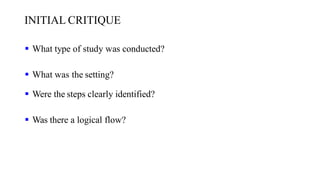
INITIAL CRITIQUE
 What type of study was conducted?
 What was the setting?
 Were the steps clearly identified?
 Was there a logical flow?
ELEMENTS OF ARESEARCH CRITIQUE
 Substantive & theoretical dimensions
Significance of the problem, the soundness of the conceptualization & appropriateness of
the conceptual framework.
 Methodologic dimensions
Design : Unambiguous and meaningful results about the relationship between the independent
and dependent variables? What extraneous variables are to be controlled and how best can this be
accomplished?
Sample : who should participate in the study?
Data collection :What method should be used to collect the data?
Data analysis : What statistical analysis will provide the most appropriate tests of the
research hypotheses?
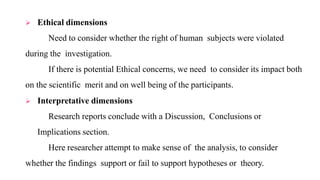
 Ethical dimensions
Need to consider whether the right of human subjects were violated
during the investigation.
If there is potential Ethical concerns, we need to consider its impact both
on the scientific merit and on well being of the participants.
 Interpretative dimensions
Research reports conclude with a Discussion, Conclusions or
Implications section.
Here researcher attempt to make sense of the analysis, to consider
whether the findings support or fail to support hypotheses or theory.
 Presentation/stylistic dimensions
Writing a research report should be clear, grammatical, concise
and well organized.
Unnecessary jargon should be minimized.
Quantitative research reports are written in a more formal, impersonal
fashion, using either the third person or passive voice to connect objectivity
CRITERIA: INTRODUCTION
 Is the purpose of the study presented?
 Is the significance (importance) of the problem discussed?
 Does the investigator provide a sense of what he or she is doing and
why?
PROBLEM STATEMENT
 Is the problem statement clear ?
 Does the investigator identify key research questions and variables
to be examined ?
 Does the study have the potential to help solve a problem that is
currently faced in clinical practice ?
LITERATURE REVIEW
 Does literature review follow a logical sequence leading to a
critical review of supporting and conflicting prior work?
 Is the relationship of the study to previous research
clear?
 Does the investigator describe gaps in the literature and
support the necessity of the present study?
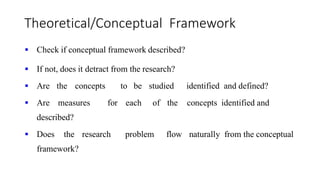
Theoretical/Conceptual Framework
 Check if conceptual framework described?
 If not, does it detract from the research?
 Are the concepts to be studied identified and defined?
 Are measures for each of the concepts identified and
described?
 Does the research problem flow naturally from the conceptual
framework?
RESEARCH QUESTIONS/HYPOTHESES
 Is the hypothesis stated precisely, logically and in a form that
permits it to be tested ?
 Does it express a predictable relationship?
 Do they flow logically?
 Do they include general population of interest?
METHODOLOGY
 Are the relevant variables and concepts clearly and operationally defined?
 Is the design appropriate for the research questions or hypotheses?
 Are methods of data collection sufficiently described?
 What are the identified and potential threats to internal and external
validity that were present in the study?
 If there was more than one data collector, was the inter-rater reliability
adequate?
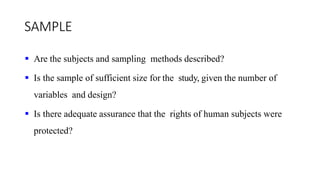
SAMPLE
 Are the subjects and sampling methods described?
 Is the sample of sufficient size for the study, given the number of
variables and design?
 Is there adequate assurance that the rights of human subjects were
protected?
INSTRUMENTS
 Are appropriate instruments for data collection used?
 Are reliability and validity of the instruments adequate?
DATA ANALYSIS
 Are the statistical tests used identified and the values reported?
 Are appropriate statistics used, according to level of measurement,
sample size, sampling method, and hypotheses / research questions?
RESULTS
 Are the results for each hypothesis clearly and objectively presented?
 Do the figures and tables illuminate the presentation of results?
 Are results described in light of the theoretical framework and
supporting literature?
Conclusions / discussion
 Are conclusions based on the results and related to the hypotheses?
 Are study limitations identified?
 Are generalizations made within the scope of the findings?
 Are implications of findings discussed (i.e.,for practice, education and
research)?
 Are recommendations for further research stated?
RESEARCH UTILIZATION IMPLICATIONS
 Is the study of sufficient quality to meet the criterion of scientific
merit?
 Does the study meet the criterion of replicability?
 Is the study of relevance to practice?
 Is the study feasible for nurses to implement?
 Do the benefits of the study outweigh the risks?
Other aspects
 Title- of reasonable length
 Summary- abstract included
 Bibliography- style & citation
 pleasant to read
 Grammatically correct
 No complex sentences
QUALITATIVE RESEARCH EVALUATION
STATEMENT OF THE PHENOMENON OF INTEREST
 Is the phenomenon of interest clearly identified?
 Has the researcher identified why the phenomenon requires a
qualitative format?
 Has the research described the philosophic underpinnings of the
research?
PURPOSE
 Has the research made explicit the purpose of conducting the
research?
 Does the researcher describe the projected significance of the work
to nursing?
METHOD
 Is the method used to collect data compatible with the purpose
of the research?
 Is the method adequate to address the phenomenon of interest?
 If a particular approach is used to guide the inquiry, does the
researcher complete the study according to the processes described?
SAMPLING
 Does the researcher describe the selection of participants? Is
purposive sampling used?
 Are the informants who were chosen appropriate for research?
DATA COLLECTION
 Is data collection focused on human experience?
 Does the researcher describe data collection strategies (i.e.
interview, observation, field notes)?
 Is protection of human participants addressed?
 Is saturation of the data described?
 Has the researcher made explicit the procedures for collecting data ?
DATA ANALYSIS
 Does the researcher describe the strategies used to
analyze the data?
 Has the researcher remained true to the data?
 Does the reader understand the procedures used to
analyze the data?
 Does researcher address the credibility, auditability, and
fittingness of the data?
DATA ANALYSIS
 Credibility
 Do the participants recognize the experience as their own?
 Auditability
 Can the reader follow the researcher’s thinking?
 Does the researcher document the research process?
 Fittingness
 Can the findings be applicable outside the study situation?
 Are the results meaningful to individuals not involved in the research?
 Is the strategy used for analysis compatible with the purpose of the study?
FINDINGS
 Are the findings presented within a context?
 Is the reader able to grasp the essence of the experience from the
report of the findings?
 Are the researcher’s conceptualization true to the data?
 Does the researcher place the report in the context of what already is
known about the phenomenon?
CONCLUSION, IMPLICATION & RECOMMENDATIONS
 Do the conclusions, implications and recommendations give the
reader a context in which to use the findings?
 Do the conclusions reflect the study findings?
 Does the researcher offer recommendations for future study?
 Has the researcher made explicit the significance of the study to
nursing?
Thank You

Research Critique.pptx

  • 1.
    RESEARCH CRITIQUE Prof. AsokanR. I/C of R&D, KINS, KIIT (DU), BBSR
  • 2.
    Outline • Definition • Purposes •Importance • Critique process • General guidelines • Elements
  • 3.
    What is Researchcritique • It is a critical evaluation/appraisal of a research report. • “A critical estimate of a piece of research which has been carefully and systematically studied by a critic who has used specific criteria to appraise the favorable, less favorable and other general features of the research study” Leininger
  • 4.
    “Systematic, unbiased, carefulexamination of all aspects of a study to judge the merits, limitations, meaning and significance based on previous research experience and knowledge of the topic” Burns, N. & Grove, S., 2005. • Requires critical thinking, appraisal & intellectual skill • Involves a careful examination of all aspects of a study to judge the merits, limitations, meaning and significance & knowledge of the topic.
  • 5.
    Purposes  To assessstudents` methodological and analytical skills (identify limitations & strengths)  Seasoned researcher to help journal editions  Written critique is a guide to researcher  To advance nursing knowledge & profession
  • 6.
    Importance • To broadenunderstanding for use in practice. • For implementing an evidence-based nursing practice. • Encourages nurses to participate in clinical inquiry and provide evidence for use in practice.
  • 7.
    Constructive approaches forresearch critique Two principles to remember when critiquing a research are  Be objective: make comments specific to the work you are reviewing  Be constructive: Critique should be an advisory and constructive nature
  • 8.
    CRITIQUE PROCESS  Comprehension Comparison  Analysis  Evaluation  Conceptual clustering
  • 9.
    GENERAL GUIDELINES  Read& critique the entire study  Be objective & realistic  Comment on strengths and weakness  Give specific examples  Suggest alternatives
  • 10.
     Use positiveterms whenever possible and say the positive points first  Avoid vague generalizations of praise and fault findings  Be sensitive in handling negative comments  Evaluate substantive, ethical, methodologic, interpretative & presentational dimensions
  • 11.
    INITIAL CRITIQUE  Whattype of study was conducted?  What was the setting?  Were the steps clearly identified?  Was there a logical flow?
  • 12.
    ELEMENTS OF ARESEARCHCRITIQUE  Substantive & theoretical dimensions Significance of the problem, the soundness of the conceptualization & appropriateness of the conceptual framework.  Methodologic dimensions Design : Unambiguous and meaningful results about the relationship between the independent and dependent variables? What extraneous variables are to be controlled and how best can this be accomplished? Sample : who should participate in the study? Data collection :What method should be used to collect the data? Data analysis : What statistical analysis will provide the most appropriate tests of the research hypotheses?
  • 13.
     Ethical dimensions Needto consider whether the right of human subjects were violated during the investigation. If there is potential Ethical concerns, we need to consider its impact both on the scientific merit and on well being of the participants.  Interpretative dimensions Research reports conclude with a Discussion, Conclusions or Implications section. Here researcher attempt to make sense of the analysis, to consider whether the findings support or fail to support hypotheses or theory.
  • 14.
     Presentation/stylistic dimensions Writinga research report should be clear, grammatical, concise and well organized. Unnecessary jargon should be minimized. Quantitative research reports are written in a more formal, impersonal fashion, using either the third person or passive voice to connect objectivity
  • 15.
    CRITERIA: INTRODUCTION  Isthe purpose of the study presented?  Is the significance (importance) of the problem discussed?  Does the investigator provide a sense of what he or she is doing and why?
  • 16.
    PROBLEM STATEMENT  Isthe problem statement clear ?  Does the investigator identify key research questions and variables to be examined ?  Does the study have the potential to help solve a problem that is currently faced in clinical practice ?
  • 17.
    LITERATURE REVIEW  Doesliterature review follow a logical sequence leading to a critical review of supporting and conflicting prior work?  Is the relationship of the study to previous research clear?  Does the investigator describe gaps in the literature and support the necessity of the present study?
  • 18.
    Theoretical/Conceptual Framework  Checkif conceptual framework described?  If not, does it detract from the research?  Are the concepts to be studied identified and defined?  Are measures for each of the concepts identified and described?  Does the research problem flow naturally from the conceptual framework?
  • 19.
    RESEARCH QUESTIONS/HYPOTHESES  Isthe hypothesis stated precisely, logically and in a form that permits it to be tested ?  Does it express a predictable relationship?  Do they flow logically?  Do they include general population of interest?
  • 20.
    METHODOLOGY  Are therelevant variables and concepts clearly and operationally defined?  Is the design appropriate for the research questions or hypotheses?  Are methods of data collection sufficiently described?  What are the identified and potential threats to internal and external validity that were present in the study?  If there was more than one data collector, was the inter-rater reliability adequate?
  • 21.
    SAMPLE  Are thesubjects and sampling methods described?  Is the sample of sufficient size for the study, given the number of variables and design?  Is there adequate assurance that the rights of human subjects were protected?
  • 22.
    INSTRUMENTS  Are appropriateinstruments for data collection used?  Are reliability and validity of the instruments adequate?
  • 23.
    DATA ANALYSIS  Arethe statistical tests used identified and the values reported?  Are appropriate statistics used, according to level of measurement, sample size, sampling method, and hypotheses / research questions?
  • 24.
    RESULTS  Are theresults for each hypothesis clearly and objectively presented?  Do the figures and tables illuminate the presentation of results?  Are results described in light of the theoretical framework and supporting literature?
  • 25.
    Conclusions / discussion Are conclusions based on the results and related to the hypotheses?  Are study limitations identified?  Are generalizations made within the scope of the findings?  Are implications of findings discussed (i.e.,for practice, education and research)?  Are recommendations for further research stated?
  • 26.
    RESEARCH UTILIZATION IMPLICATIONS Is the study of sufficient quality to meet the criterion of scientific merit?  Does the study meet the criterion of replicability?  Is the study of relevance to practice?  Is the study feasible for nurses to implement?  Do the benefits of the study outweigh the risks?
  • 27.
    Other aspects  Title-of reasonable length  Summary- abstract included  Bibliography- style & citation  pleasant to read  Grammatically correct  No complex sentences
  • 28.
  • 29.
    STATEMENT OF THEPHENOMENON OF INTEREST  Is the phenomenon of interest clearly identified?  Has the researcher identified why the phenomenon requires a qualitative format?  Has the research described the philosophic underpinnings of the research?
  • 30.
    PURPOSE  Has theresearch made explicit the purpose of conducting the research?  Does the researcher describe the projected significance of the work to nursing?
  • 31.
    METHOD  Is themethod used to collect data compatible with the purpose of the research?  Is the method adequate to address the phenomenon of interest?  If a particular approach is used to guide the inquiry, does the researcher complete the study according to the processes described?
  • 32.
    SAMPLING  Does theresearcher describe the selection of participants? Is purposive sampling used?  Are the informants who were chosen appropriate for research?
  • 33.
    DATA COLLECTION  Isdata collection focused on human experience?  Does the researcher describe data collection strategies (i.e. interview, observation, field notes)?  Is protection of human participants addressed?  Is saturation of the data described?  Has the researcher made explicit the procedures for collecting data ?
  • 34.
    DATA ANALYSIS  Doesthe researcher describe the strategies used to analyze the data?  Has the researcher remained true to the data?  Does the reader understand the procedures used to analyze the data?  Does researcher address the credibility, auditability, and fittingness of the data?
  • 35.
    DATA ANALYSIS  Credibility Do the participants recognize the experience as their own?  Auditability  Can the reader follow the researcher’s thinking?  Does the researcher document the research process?  Fittingness  Can the findings be applicable outside the study situation?  Are the results meaningful to individuals not involved in the research?  Is the strategy used for analysis compatible with the purpose of the study?
  • 36.
    FINDINGS  Are thefindings presented within a context?  Is the reader able to grasp the essence of the experience from the report of the findings?  Are the researcher’s conceptualization true to the data?  Does the researcher place the report in the context of what already is known about the phenomenon?
  • 37.
    CONCLUSION, IMPLICATION &RECOMMENDATIONS  Do the conclusions, implications and recommendations give the reader a context in which to use the findings?  Do the conclusions reflect the study findings?  Does the researcher offer recommendations for future study?  Has the researcher made explicit the significance of the study to nursing?
  • 38.