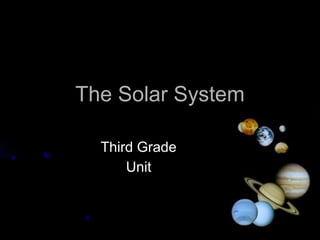
The Solar System

  Third Grade
      Unit
Vocabulary
 Orbit  means to circle around.
  The planets orbit the Sun.
 Our moon is a body in space that circles
  planet Earth. Other planets have moons, too.
 Our solar system includes the Sun and all the
  planets, moons, and stars.
 A star is a body which looks like a bright
  point in the sky at night. A star is not a planet
  or a moon. Our sun is a star.
 Scientists pretend that planets and stars
  have a line drawn through their middles. This
  line is called an axis.
Brainpop


Watch the video clip titled: Planets of the
Solar System
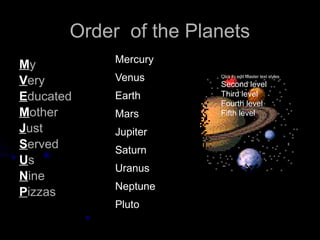
Order of the Planets
            Mercury
My
Very        Venus      Click to edit Master text styles

                       Second level
Educated    Earth      Third level
                       Fourth level
Mother      Mars       Fifth level

Just        Jupiter
Served      Saturn
Us
            Uranus
Nine
            Neptune
Pizzas
            Pluto
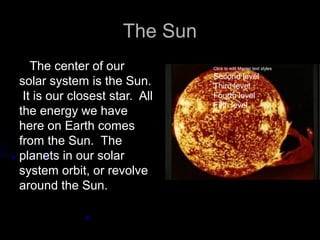
The Sun
   The center of our           Click to edit Master text styles

                               Second level
solar system is the Sun.       Third level
 It is our closest star. All   Fourth level
                               Fifth level
the energy we have
here on Earth comes
from the Sun. The
planets in our solar
system orbit, or revolve
around the Sun.
Click to edit Master text styles

Second level
Third level
Fourth level
                                   Sun Facts
Fifth level
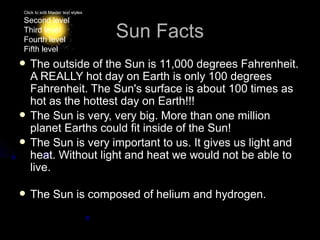
 The   outside of the Sun is 11,000 degrees Fahrenheit.
  A REALLY hot day on Earth is only 100 degrees
  Fahrenheit. The Sun's surface is about 100 times as
  hot as the hottest day on Earth!!!
 The Sun is very, very big. More than one million
  planet Earths could fit inside of the Sun!
 The Sun is very important to us. It gives us light and
  heat. Without light and heat we would not be able to
  live.

 The          Sun is composed of helium and hydrogen.
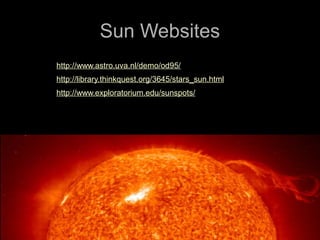
Sun Websites
http://www.astro.uva.nl/demo/od95/
http://library.thinkquest.org/3645/stars_sun.html
http://www.exploratorium.edu/sunspots/
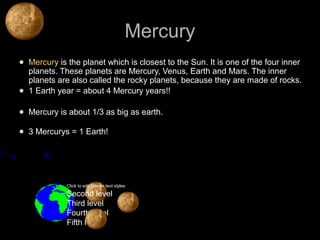
Mercury
   Mercury is the planet which is closest to the Sun. It is one of the four inner
    planets. These planets are Mercury, Venus, Earth and Mars. The inner
    planets are also called the rocky planets, because they are made of rocks.
   1 Earth year = about 4 Mercury years!!

   Mercury is about 1/3 as big as earth.

   3 Mercurys = 1 Earth!


              Click to edit Master text styles

              Second level
              Third level
              Fourth level
              Fifth level
edit Master text styles
nd level                      Venus
d level
Fourth level
   Fifth level
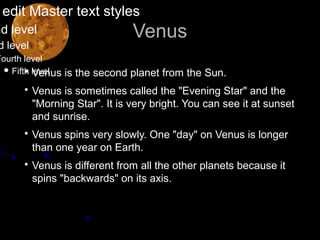
        • Venus is the second planet from the Sun.
      • Venus is sometimes called the "Evening Star" and the
        "Morning Star". It is very bright. You can see it at sunset
        and sunrise.
      • Venus spins very slowly. One "day" on Venus is longer
        than one year on Earth.
      • Venus is different from all the other planets because it
        spins "backwards" on its axis.
Click to edit Master text styles

                                           Second level
Click to edit Master text styles

Second level                       Earth   Third level
                                           Fourth level
Third level                                Fifth level
Fourth level
Fifth level
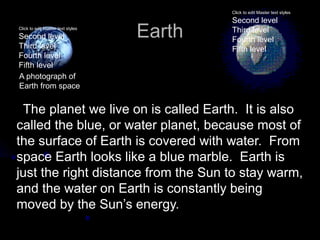
A photograph of
Earth from space


 The planet we live on is called Earth. It is also
called the blue, or water planet, because most of
the surface of Earth is covered with water. From
space Earth looks like a blue marble. Earth is
just the right distance from the Sun to stay warm,
and the water on Earth is constantly being
moved by the Sun’s energy.
Earth Facts
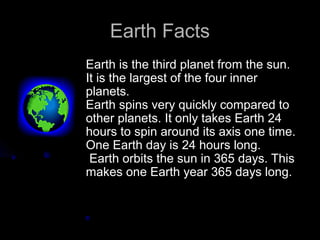
Earth is the third planet from the sun.
It is the largest of the four inner
planets.
Earth spins very quickly compared to
other planets. It only takes Earth 24
hours to spin around its axis one time.
One Earth day is 24 hours long.
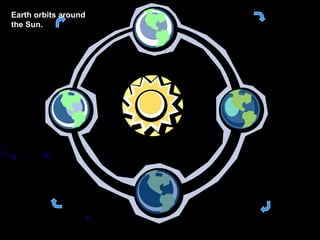
 Earth orbits the sun in 365 days. This
makes one Earth year 365 days long.
Earth orbits around
the Sun.
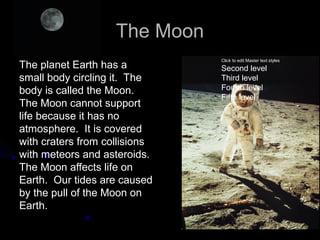
The Moon
                               Click to edit Master text styles
The planet Earth has a         Second level
small body circling it. The    Third level
body is called the Moon.       Fourth level
                               Fifth level
The Moon cannot support
life because it has no
atmosphere. It is covered
with craters from collisions
with meteors and asteroids.
The Moon affects life on
Earth. Our tides are caused
by the pull of the Moon on
Earth.
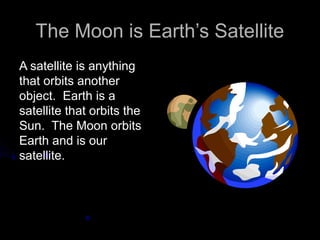
The Moon is Earth’s Satellite
A satellite is anything
that orbits another
object. Earth is a
satellite that orbits the
Sun. The Moon orbits
Earth and is our
satellite.
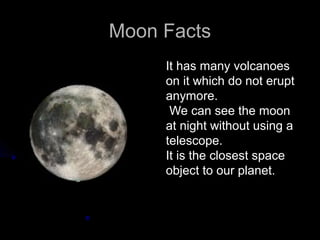
Moon Facts
     It has many volcanoes
     on it which do not erupt
     anymore.
      We can see the moon
     at night without using a
     telescope.
     It is the closest space
     object to our planet.
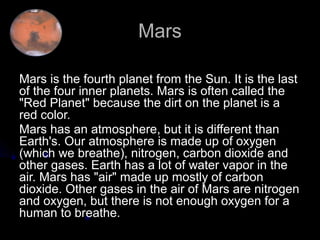
Mars

Mars is the fourth planet from the Sun. It is the last
of the four inner planets. Mars is often called the
"Red Planet" because the dirt on the planet is a
red color.
Mars has an atmosphere, but it is different than
Earth's. Our atmosphere is made up of oxygen
(which we breathe), nitrogen, carbon dioxide and
other gases. Earth has a lot of water vapor in the
air. Mars has "air" made up mostly of carbon
dioxide. Other gases in the air of Mars are nitrogen
and oxygen, but there is not enough oxygen for a
human to breathe.
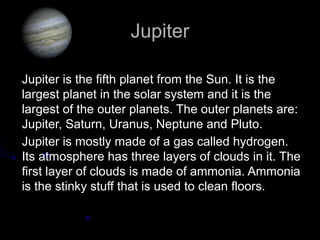
Jupiter

Jupiter is the fifth planet from the Sun. It is the
largest planet in the solar system and it is the
largest of the outer planets. The outer planets are:
Jupiter, Saturn, Uranus, Neptune and Pluto.
Jupiter is mostly made of a gas called hydrogen.
Its atmosphere has three layers of clouds in it. The
first layer of clouds is made of ammonia. Ammonia
is the stinky stuff that is used to clean floors.
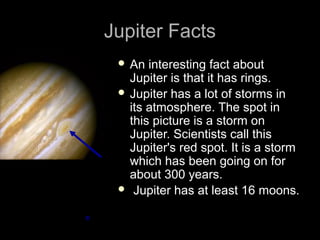
Jupiter Facts
  An  interesting fact about
   Jupiter is that it has rings.
  Jupiter has a lot of storms in
   its atmosphere. The spot in
   this picture is a storm on
   Jupiter. Scientists call this
   Jupiter's red spot. It is a storm
   which has been going on for
   about 300 years.
  Jupiter has at least 16 moons.
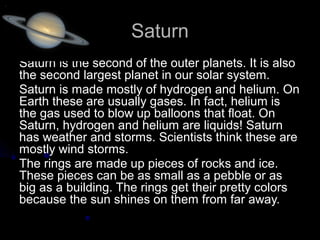
Saturn
Saturn is the second of the outer planets. It is also
the second largest planet in our solar system.
Saturn is made mostly of hydrogen and helium. On
Earth these are usually gases. In fact, helium is
the gas used to blow up balloons that float. On
Saturn, hydrogen and helium are liquids! Saturn
has weather and storms. Scientists think these are
mostly wind storms.
The rings are made up pieces of rocks and ice.
These pieces can be as small as a pebble or as
big as a building. The rings get their pretty colors
because the sun shines on them from far away.
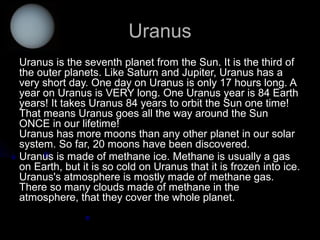
Uranus
Uranus is the seventh planet from the Sun. It is the third of
the outer planets. Like Saturn and Jupiter, Uranus has a
very short day. One day on Uranus is only 17 hours long. A
year on Uranus is VERY long. One Uranus year is 84 Earth
years! It takes Uranus 84 years to orbit the Sun one time!
That means Uranus goes all the way around the Sun
ONCE in our lifetime!
Uranus has more moons than any other planet in our solar
system. So far, 20 moons have been discovered.
Uranus is made of methane ice. Methane is usually a gas
on Earth, but it is so cold on Uranus that it is frozen into ice.
Uranus's atmosphere is mostly made of methane gas.
There so many clouds made of methane in the
atmosphere, that they cover the whole planet.
o edit Master text styles
ond level                   Neptune
hird level
 Fourth  level
     Fifth level

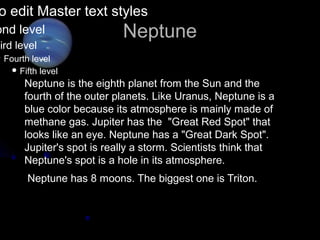
       Neptune is the eighth planet from the Sun and the
       fourth of the outer planets. Like Uranus, Neptune is a
       blue color because its atmosphere is mainly made of
       methane gas. Jupiter has the "Great Red Spot" that
       looks like an eye. Neptune has a "Great Dark Spot".
       Jupiter's spot is really a storm. Scientists think that
       Neptune's spot is a hole in its atmosphere.
        Neptune has 8 moons. The biggest one is Triton.
Second level
                                           Third level
                                           Fourth level

                      Pluto                Fifth level


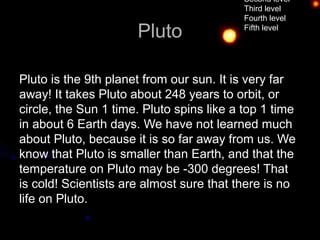
Pluto is the 9th planet from our sun. It is very far
away! It takes Pluto about 248 years to orbit, or
circle, the Sun 1 time. Pluto spins like a top 1 time
in about 6 Earth days. We have not learned much
about Pluto, because it is so far away from us. We
know that Pluto is smaller than Earth, and that the
temperature on Pluto may be -300 degrees! That
is cold! Scientists are almost sure that there is no
life on Pluto.
Additional Material
     There are several other Brainpop movies on different
     planets. The new movie on Mars is good.
     StarChild: A Learning Center for Young Astronomers is
     another great resource.


ck to edit Master text styles
Second level
  Third   level                          Click to edit Master te
       Fourth level                      Second level
           Fifth level
                                          Third level
                                          Fourth level
                                          Fifth level

Planets

  • 1.
    The Solar System Third Grade Unit
  • 2.
    Vocabulary  Orbit means to circle around. The planets orbit the Sun.  Our moon is a body in space that circles planet Earth. Other planets have moons, too.  Our solar system includes the Sun and all the planets, moons, and stars.  A star is a body which looks like a bright point in the sky at night. A star is not a planet or a moon. Our sun is a star.  Scientists pretend that planets and stars have a line drawn through their middles. This line is called an axis.
  • 3.
    Brainpop Watch the videoclip titled: Planets of the Solar System
  • 4.
    Order of thePlanets Mercury My Very Venus Click to edit Master text styles Second level Educated Earth Third level Fourth level Mother Mars Fifth level Just Jupiter Served Saturn Us Uranus Nine Neptune Pizzas Pluto
  • 5.
    The Sun The center of our Click to edit Master text styles Second level solar system is the Sun. Third level It is our closest star. All Fourth level Fifth level the energy we have here on Earth comes from the Sun. The planets in our solar system orbit, or revolve around the Sun.
  • 6.
    Click to editMaster text styles Second level Third level Fourth level Sun Facts Fifth level  The outside of the Sun is 11,000 degrees Fahrenheit. A REALLY hot day on Earth is only 100 degrees Fahrenheit. The Sun's surface is about 100 times as hot as the hottest day on Earth!!!  The Sun is very, very big. More than one million planet Earths could fit inside of the Sun!  The Sun is very important to us. It gives us light and heat. Without light and heat we would not be able to live.  The Sun is composed of helium and hydrogen.
  • 7.
  • 8.
    Mercury  Mercury is the planet which is closest to the Sun. It is one of the four inner planets. These planets are Mercury, Venus, Earth and Mars. The inner planets are also called the rocky planets, because they are made of rocks.  1 Earth year = about 4 Mercury years!!  Mercury is about 1/3 as big as earth.  3 Mercurys = 1 Earth! Click to edit Master text styles Second level Third level Fourth level Fifth level
  • 9.
    edit Master textstyles nd level Venus d level Fourth level  Fifth level • Venus is the second planet from the Sun. • Venus is sometimes called the "Evening Star" and the "Morning Star". It is very bright. You can see it at sunset and sunrise. • Venus spins very slowly. One "day" on Venus is longer than one year on Earth. • Venus is different from all the other planets because it spins "backwards" on its axis.
  • 10.
    Click to editMaster text styles Second level Click to edit Master text styles Second level Earth Third level Fourth level Third level Fifth level Fourth level Fifth level A photograph of Earth from space The planet we live on is called Earth. It is also called the blue, or water planet, because most of the surface of Earth is covered with water. From space Earth looks like a blue marble. Earth is just the right distance from the Sun to stay warm, and the water on Earth is constantly being moved by the Sun’s energy.
  • 11.
    Earth Facts Earth isthe third planet from the sun. It is the largest of the four inner planets. Earth spins very quickly compared to other planets. It only takes Earth 24 hours to spin around its axis one time. One Earth day is 24 hours long. Earth orbits the sun in 365 days. This makes one Earth year 365 days long.
  • 12.
  • 13.
    The Moon Click to edit Master text styles The planet Earth has a Second level small body circling it. The Third level body is called the Moon. Fourth level Fifth level The Moon cannot support life because it has no atmosphere. It is covered with craters from collisions with meteors and asteroids. The Moon affects life on Earth. Our tides are caused by the pull of the Moon on Earth.
  • 14.
    The Moon isEarth’s Satellite A satellite is anything that orbits another object. Earth is a satellite that orbits the Sun. The Moon orbits Earth and is our satellite.
  • 15.
    Moon Facts It has many volcanoes on it which do not erupt anymore. We can see the moon at night without using a telescope. It is the closest space object to our planet.
  • 16.
    Mars Mars is thefourth planet from the Sun. It is the last of the four inner planets. Mars is often called the "Red Planet" because the dirt on the planet is a red color. Mars has an atmosphere, but it is different than Earth's. Our atmosphere is made up of oxygen (which we breathe), nitrogen, carbon dioxide and other gases. Earth has a lot of water vapor in the air. Mars has "air" made up mostly of carbon dioxide. Other gases in the air of Mars are nitrogen and oxygen, but there is not enough oxygen for a human to breathe.
  • 17.
    Jupiter Jupiter is thefifth planet from the Sun. It is the largest planet in the solar system and it is the largest of the outer planets. The outer planets are: Jupiter, Saturn, Uranus, Neptune and Pluto. Jupiter is mostly made of a gas called hydrogen. Its atmosphere has three layers of clouds in it. The first layer of clouds is made of ammonia. Ammonia is the stinky stuff that is used to clean floors.
  • 18.
    Jupiter Facts An interesting fact about Jupiter is that it has rings.  Jupiter has a lot of storms in its atmosphere. The spot in this picture is a storm on Jupiter. Scientists call this Jupiter's red spot. It is a storm which has been going on for about 300 years.  Jupiter has at least 16 moons.
  • 19.
    Saturn Saturn is thesecond of the outer planets. It is also the second largest planet in our solar system. Saturn is made mostly of hydrogen and helium. On Earth these are usually gases. In fact, helium is the gas used to blow up balloons that float. On Saturn, hydrogen and helium are liquids! Saturn has weather and storms. Scientists think these are mostly wind storms. The rings are made up pieces of rocks and ice. These pieces can be as small as a pebble or as big as a building. The rings get their pretty colors because the sun shines on them from far away.
  • 20.
    Uranus Uranus is theseventh planet from the Sun. It is the third of the outer planets. Like Saturn and Jupiter, Uranus has a very short day. One day on Uranus is only 17 hours long. A year on Uranus is VERY long. One Uranus year is 84 Earth years! It takes Uranus 84 years to orbit the Sun one time! That means Uranus goes all the way around the Sun ONCE in our lifetime! Uranus has more moons than any other planet in our solar system. So far, 20 moons have been discovered. Uranus is made of methane ice. Methane is usually a gas on Earth, but it is so cold on Uranus that it is frozen into ice. Uranus's atmosphere is mostly made of methane gas. There so many clouds made of methane in the atmosphere, that they cover the whole planet.
  • 21.
    o edit Mastertext styles ond level Neptune hird level  Fourth level  Fifth level Neptune is the eighth planet from the Sun and the fourth of the outer planets. Like Uranus, Neptune is a blue color because its atmosphere is mainly made of methane gas. Jupiter has the "Great Red Spot" that looks like an eye. Neptune has a "Great Dark Spot". Jupiter's spot is really a storm. Scientists think that Neptune's spot is a hole in its atmosphere. Neptune has 8 moons. The biggest one is Triton.
  • 22.
    Second level Third level Fourth level Pluto Fifth level Pluto is the 9th planet from our sun. It is very far away! It takes Pluto about 248 years to orbit, or circle, the Sun 1 time. Pluto spins like a top 1 time in about 6 Earth days. We have not learned much about Pluto, because it is so far away from us. We know that Pluto is smaller than Earth, and that the temperature on Pluto may be -300 degrees! That is cold! Scientists are almost sure that there is no life on Pluto.
  • 23.
    Additional Material There are several other Brainpop movies on different planets. The new movie on Mars is good. StarChild: A Learning Center for Young Astronomers is another great resource. ck to edit Master text styles Second level  Third level Click to edit Master te  Fourth level Second level  Fifth level Third level Fourth level Fifth level