THE
UNIVERSE
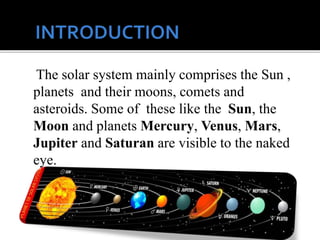
The solar system mainly comprises the Sun ,
planets and their moons, comets and
asteroids. Some of these like the Sun, the
Moon and planets Mercury, Venus, Mars,
Jupiter and Saturan are visible to the naked
eye.
Therefore, they have been observed since
ancient times. The fainter objects like planets
Uranus and Neptune as well as tiny pieces of
rock known as asteroids are also present in
solar system. These have been studied after
the advent of the telescope in the beginning of
the seventeenth century.
What is the universe?
The universe is……… basically, everything.
Scientifically, it’s defined as the totality
of everything that exists, including all
physical matter and energy, ranging
from the smallest atom to the biggest
galaxy-- the planets, stars, everything.
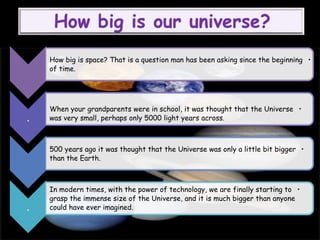
•How big is space? That is a question man has been asking since the beginning
of time.
.
•When your grandparents were in school, it was thought that the Universe
was very small, perhaps only 5000 light years across.
•500 years ago it was thought that the Universe was only a little bit bigger
than the Earth.
.
•In modern times, with the power of technology, we are finally starting to
grasp the immense size of the Universe, and it is much bigger than anyone
could have ever imagined.
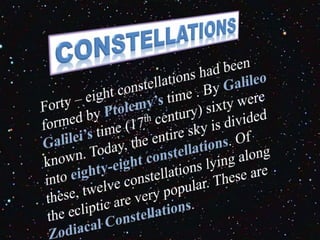
One of the significant contribution of the
ancient observers of the skies is the idea of
grouping stars into patterns imagined after
familiar objects and mythical characters. the
patterns are called constellations.
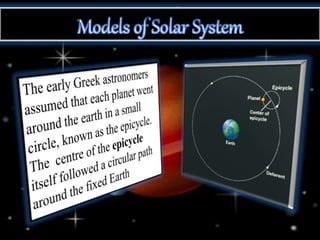
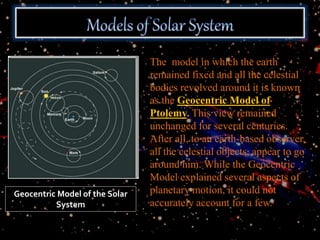
The model in which the earth
remained fixed and all the celestial
bodies revolved around it is known
as the Geocentric Model of
Ptolemy. This view remained
unchanged for several centuries.
After all, to an earth-based observer,
all the celestial objects, appear to go
around him. While the Geocentric
Model explained several aspects of
planetary motion, it could not
accurately account for a few.
Geocentric Model of the Solar
System
Planets venus and mercury are not visible throughout
the night. Planet mercury can be seen for a
maximum duration of about two hours before sunrise
or after sunset. Similarly Venus can be seen for about
three hours. In the Geocentric Model, the visibility of
Venus and Mercury was explained by assuming that
the planets Mercury and Venus went around the Earth
in orbits smaller than the orbit of sun
Johannes Kepler a German mathematician and astronomer,
announced his discovery of a set of simple empirical (that is,
based on observation) "laws" that accurately described the
motions of the planets. While Galileo was the first "modern"
observer, Kepler was a pure theorist. He based his work
almost entirely on the observations of another scientist (in part
because of his own poor eyesight). Those observations, which
predated the telescope by several decades, had been made by
Kepler’s employer, Tycho Brahe (1546-1601), arguably one of
the greatest observational astronomers who ever lived.
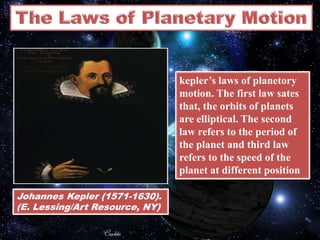
Johannes Kepler (1571-1630).
(E. Lessing/Art Resource, NY)
kepler’s laws of planetory
motion. The first law sates
that, the orbits of planets
are elliptical. The second
law refers to the period of
the planet and third law
refers to the speed of the
planet at different position
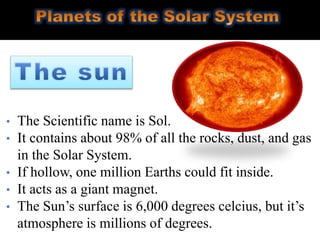
• The Scientific name is Sol.
• It contains about 98% of all the rocks, dust, and gas
in the Solar System.
• If hollow, one million Earths could fit inside.
• It acts as a giant magnet.
• The Sun’s surface is 6,000 degrees celcius, but it’s
atmosphere is millions of degrees.
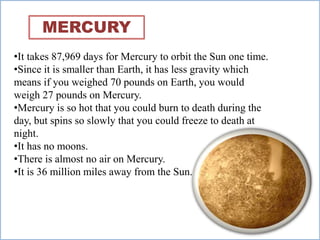
•It takes 87,969 days for Mercury to orbit the Sun one time.
•Since it is smaller than Earth, it has less gravity which
means if you weighed 70 pounds on Earth, you would
weigh 27 pounds on Mercury.
•Mercury is so hot that you could burn to death during the
day, but spins so slowly that you could freeze to death at
night.
•It has no moons.
•There is almost no air on Mercury.
•It is 36 million miles away from the Sun.
MERCURY
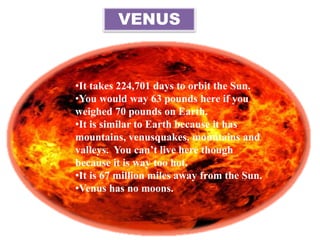
VENUS
•It takes 224,701 days to orbit the Sun.
•You would way 63 pounds here if you
weighed 70 pounds on Earth.
•It is similar to Earth because it has
mountains, venusquakes, mountains and
valleys. You can’t live here though
because it is way too hot.
•It is 67 million miles away from the Sun.
•Venus has no moons.
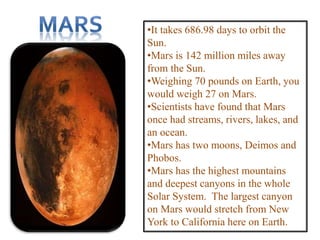
•It takes 686.98 days to orbit the
Sun.
•Mars is 142 million miles away
from the Sun.
•Weighing 70 pounds on Earth, you
would weigh 27 on Mars.
•Scientists have found that Mars
once had streams, rivers, lakes, and
an ocean.
•Mars has two moons, Deimos and
Phobos.
•Mars has the highest mountains
and deepest canyons in the whole
Solar System. The largest canyon
on Mars would stretch from New
York to California here on Earth.
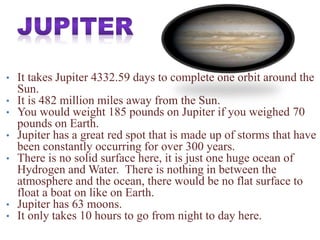
• It takes Jupiter 4332.59 days to complete one orbit around the
Sun.
• It is 482 million miles away from the Sun.
• You would weight 185 pounds on Jupiter if you weighed 70
pounds on Earth.
• Jupiter has a great red spot that is made up of storms that have
been constantly occurring for over 300 years.
• There is no solid surface here, it is just one huge ocean of
Hydrogen and Water. There is nothing in between the
atmosphere and the ocean, there would be no flat surface to
float a boat on like on Earth.
• Jupiter has 63 moons.
• It only takes 10 hours to go from night to day here.
•It takes 10,759.2 days to orbit the Sun.
•You would weigh 82 pounds here if you
weighed 70 pounds on Earth.
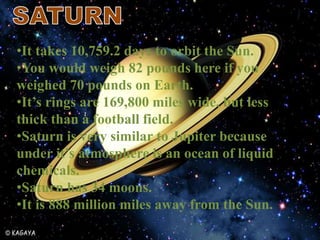
•It’s rings are 169,800 miles wide, but less
thick than a football field.
•Saturn is very similar to Jupiter because
under it’s atmosphere is an ocean of liquid
chemicals.
•Saturn has 34 moons.
•It is 888 million miles away from the Sun.
•It takes 30,684 days for Uranus to orbit
the Sun.
•It is 1, 784 million miles away from the
Sun.
•You would weigh 82 pounds here, if you
weighed 70 pounds on Earth.
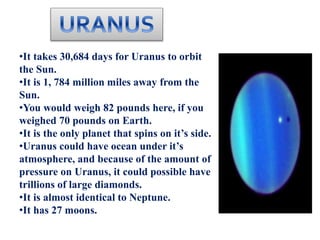
•It is the only planet that spins on it’s side.
•Uranus could have ocean under it’s
atmosphere, and because of the amount of
pressure on Uranus, it could possible have
trillions of large diamonds.
•It is almost identical to Neptune.
•It has 27 moons.
•It takes 60,190 days to orbit the Sun.
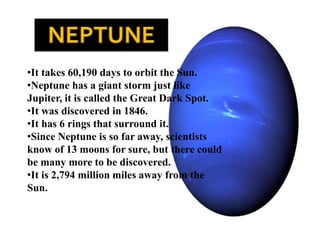
•Neptune has a giant storm just like
Jupiter, it is called the Great Dark Spot.
•It was discovered in 1846.
•It has 6 rings that surround it.
•Since Neptune is so far away, scientists
know of 13 moons for sure, but there could
be many more to be discovered.
•It is 2,794 million miles away from the
Sun.
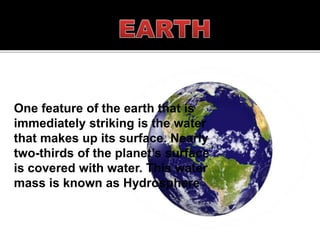
One feature of the earth that is
immediately striking is the water
that makes up its surface. Nearly
two-thirds of the planet’s surface
is covered with water. This water
mass is known as Hydrosphere
International astronomical union (IAU) decision and
the “Great Pluto War”.
From the time of its discovery in 1930
until 2006, pluto was considered the
solar system’s 9th planet. In the late 20th
and 21st centuries, however, many
objects similar to pluto were discovered
in the outer parts of solar system.on
august 24, 2006 the iau defined the term
“planet “ first time. This definition
excluded pluto from planethood and
rclassified it under the new category of
darf planet along with Eris and Ceres.
Planets sometimes appear to temporarily reverse their direction of
motion and udergo retrograde motion. Geocentric models of the
universe, such as the Ptolemaic model have the Sun, the Moon, and
all the other planets orbiting Earth.
Kepler’s three laws of planetary motion state that
(1) planetary orbits are ellipses having the Sun as one focus,
(2) a planet moves faster as its orbit takes it closer to the Sun, and
(3) The semi-major axis of the orbit is related in a simple way to the
planet’s orbit period. Most planets move on orbits
whose eccentricities are quite small, so their paths differ only slightly
from perfect circles of Solar system.
The universe.pptx [Autosaved]

The universe.pptx [Autosaved]

  • 1.
  • 2.
    The solar systemmainly comprises the Sun , planets and their moons, comets and asteroids. Some of these like the Sun, the Moon and planets Mercury, Venus, Mars, Jupiter and Saturan are visible to the naked eye.
  • 3.
    Therefore, they havebeen observed since ancient times. The fainter objects like planets Uranus and Neptune as well as tiny pieces of rock known as asteroids are also present in solar system. These have been studied after the advent of the telescope in the beginning of the seventeenth century.
  • 4.
    What is theuniverse? The universe is……… basically, everything. Scientifically, it’s defined as the totality of everything that exists, including all physical matter and energy, ranging from the smallest atom to the biggest galaxy-- the planets, stars, everything.
  • 5.
    •How big isspace? That is a question man has been asking since the beginning of time. . •When your grandparents were in school, it was thought that the Universe was very small, perhaps only 5000 light years across. •500 years ago it was thought that the Universe was only a little bit bigger than the Earth. . •In modern times, with the power of technology, we are finally starting to grasp the immense size of the Universe, and it is much bigger than anyone could have ever imagined.
  • 6.
    One of thesignificant contribution of the ancient observers of the skies is the idea of grouping stars into patterns imagined after familiar objects and mythical characters. the patterns are called constellations.
  • 9.
    The model inwhich the earth remained fixed and all the celestial bodies revolved around it is known as the Geocentric Model of Ptolemy. This view remained unchanged for several centuries. After all, to an earth-based observer, all the celestial objects, appear to go around him. While the Geocentric Model explained several aspects of planetary motion, it could not accurately account for a few. Geocentric Model of the Solar System
  • 10.
    Planets venus andmercury are not visible throughout the night. Planet mercury can be seen for a maximum duration of about two hours before sunrise or after sunset. Similarly Venus can be seen for about three hours. In the Geocentric Model, the visibility of Venus and Mercury was explained by assuming that the planets Mercury and Venus went around the Earth in orbits smaller than the orbit of sun
  • 11.
    Johannes Kepler aGerman mathematician and astronomer, announced his discovery of a set of simple empirical (that is, based on observation) "laws" that accurately described the motions of the planets. While Galileo was the first "modern" observer, Kepler was a pure theorist. He based his work almost entirely on the observations of another scientist (in part because of his own poor eyesight). Those observations, which predated the telescope by several decades, had been made by Kepler’s employer, Tycho Brahe (1546-1601), arguably one of the greatest observational astronomers who ever lived.
  • 12.
    Johannes Kepler (1571-1630). (E.Lessing/Art Resource, NY) kepler’s laws of planetory motion. The first law sates that, the orbits of planets are elliptical. The second law refers to the period of the planet and third law refers to the speed of the planet at different position
  • 13.
    • The Scientificname is Sol. • It contains about 98% of all the rocks, dust, and gas in the Solar System. • If hollow, one million Earths could fit inside. • It acts as a giant magnet. • The Sun’s surface is 6,000 degrees celcius, but it’s atmosphere is millions of degrees.
  • 14.
    •It takes 87,969days for Mercury to orbit the Sun one time. •Since it is smaller than Earth, it has less gravity which means if you weighed 70 pounds on Earth, you would weigh 27 pounds on Mercury. •Mercury is so hot that you could burn to death during the day, but spins so slowly that you could freeze to death at night. •It has no moons. •There is almost no air on Mercury. •It is 36 million miles away from the Sun. MERCURY
  • 15.
    VENUS •It takes 224,701days to orbit the Sun. •You would way 63 pounds here if you weighed 70 pounds on Earth. •It is similar to Earth because it has mountains, venusquakes, mountains and valleys. You can’t live here though because it is way too hot. •It is 67 million miles away from the Sun. •Venus has no moons.
  • 16.
    •It takes 686.98days to orbit the Sun. •Mars is 142 million miles away from the Sun. •Weighing 70 pounds on Earth, you would weigh 27 on Mars. •Scientists have found that Mars once had streams, rivers, lakes, and an ocean. •Mars has two moons, Deimos and Phobos. •Mars has the highest mountains and deepest canyons in the whole Solar System. The largest canyon on Mars would stretch from New York to California here on Earth.
  • 17.
    • It takesJupiter 4332.59 days to complete one orbit around the Sun. • It is 482 million miles away from the Sun. • You would weight 185 pounds on Jupiter if you weighed 70 pounds on Earth. • Jupiter has a great red spot that is made up of storms that have been constantly occurring for over 300 years. • There is no solid surface here, it is just one huge ocean of Hydrogen and Water. There is nothing in between the atmosphere and the ocean, there would be no flat surface to float a boat on like on Earth. • Jupiter has 63 moons. • It only takes 10 hours to go from night to day here.
  • 18.
    •It takes 10,759.2days to orbit the Sun. •You would weigh 82 pounds here if you weighed 70 pounds on Earth. •It’s rings are 169,800 miles wide, but less thick than a football field. •Saturn is very similar to Jupiter because under it’s atmosphere is an ocean of liquid chemicals. •Saturn has 34 moons. •It is 888 million miles away from the Sun.
  • 19.
    •It takes 30,684days for Uranus to orbit the Sun. •It is 1, 784 million miles away from the Sun. •You would weigh 82 pounds here, if you weighed 70 pounds on Earth. •It is the only planet that spins on it’s side. •Uranus could have ocean under it’s atmosphere, and because of the amount of pressure on Uranus, it could possible have trillions of large diamonds. •It is almost identical to Neptune. •It has 27 moons.
  • 20.
    •It takes 60,190days to orbit the Sun. •Neptune has a giant storm just like Jupiter, it is called the Great Dark Spot. •It was discovered in 1846. •It has 6 rings that surround it. •Since Neptune is so far away, scientists know of 13 moons for sure, but there could be many more to be discovered. •It is 2,794 million miles away from the Sun.
  • 21.
    One feature ofthe earth that is immediately striking is the water that makes up its surface. Nearly two-thirds of the planet’s surface is covered with water. This water mass is known as Hydrosphere
  • 22.
    International astronomical union(IAU) decision and the “Great Pluto War”. From the time of its discovery in 1930 until 2006, pluto was considered the solar system’s 9th planet. In the late 20th and 21st centuries, however, many objects similar to pluto were discovered in the outer parts of solar system.on august 24, 2006 the iau defined the term “planet “ first time. This definition excluded pluto from planethood and rclassified it under the new category of darf planet along with Eris and Ceres.
  • 23.
    Planets sometimes appearto temporarily reverse their direction of motion and udergo retrograde motion. Geocentric models of the universe, such as the Ptolemaic model have the Sun, the Moon, and all the other planets orbiting Earth. Kepler’s three laws of planetary motion state that (1) planetary orbits are ellipses having the Sun as one focus, (2) a planet moves faster as its orbit takes it closer to the Sun, and (3) The semi-major axis of the orbit is related in a simple way to the planet’s orbit period. Most planets move on orbits whose eccentricities are quite small, so their paths differ only slightly from perfect circles of Solar system.