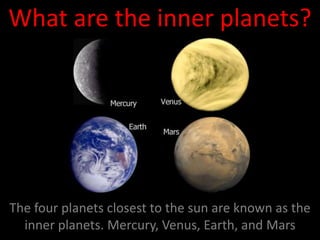
What are the inner planets?
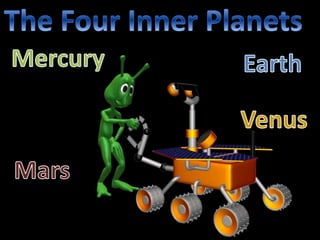
The four planets closest to the sun are known as the
inner planets. Mercury, Venus, Earth, and Mars
Mercury
This picture of
Mercury was
made by joining
many smaller
photos taken by
Mariner 10. No
photos were taken
of the area that
looks smooth.
Mercury is the planet closest to
the Sun.
It is a small planet, a little bigger
than Earth’s moon.
Mercury is covered with
thousands of dents. The dents are
shaped like bowls and are called
craters.
Craters were made when
meteorites crashed into Mercury’s
surface long ago.
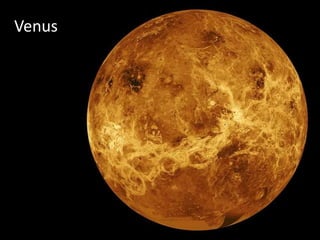
Venus
Venus is the second planet
from the Sun.
It is about the same size as Earth,
but Venus turns in the opposite
direction.
Like Mercury, Venus is very hot
and dry.
Unlike Mercury, Venus has an
atmosphere made of thick,
swirling clouds.
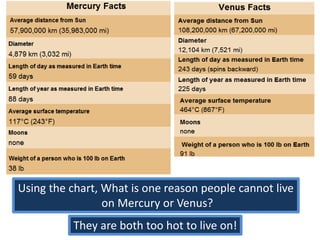
Using the chart, What is one reason people cannot live
on Mercury or Venus?
They are both too hot to live on!
Using the chart, how much longer is Venus’ Earth year?
137 years longer
Earth
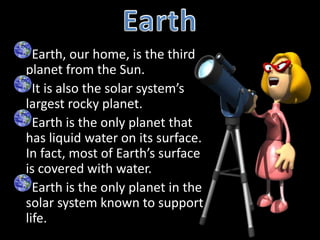
Earth, our home, is the third
planet from the Sun.
It is also the solar system’s
largest rocky planet.
Earth is the only planet that
has liquid water on its surface.
In fact, most of Earth’s surface
is covered with water.
Earth is the only planet in the
solar system known to support
life.
Earth’s
Moon
Moons are satellites of
planets.
A satellite is an object that
orbits another object in space.
Just as planets revolve around
the Sun because of gravity,
moons revolve around planets.
Earth has one large moon.
The diameter of the Moon is
about one-fourth the diameter
of Earth.
Mars
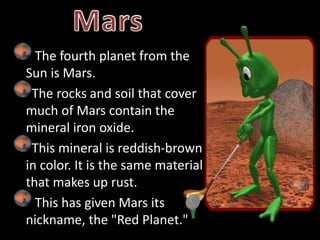
The fourth planet from the
Sun is Mars.
The rocks and soil that cover
much of Mars contain the
mineral iron oxide.
This mineral is reddish-brown
in color. It is the same material
that makes up rust.
This has given Mars its
nickname, the "Red Planet."
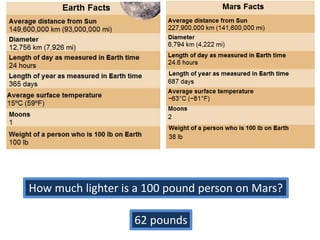
How much lighter is a 100 pound person on Mars?
62 pounds
Why is the average surface temperature considerably
lower on Mars compared to Earth
It is farther from the sun.
Quiz Time!
Let’s see how you do
locating the planet!
Earth Mars
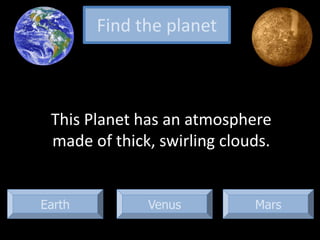
This Planet has an atmosphere
made of thick, swirling clouds.
Find the planet
Venus
Oh no! Quick
guess again!
Great Job Kids!
Earth Mars
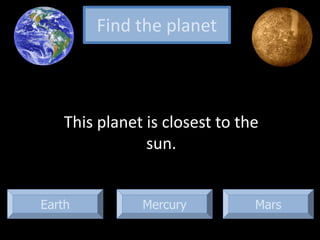
This planet is closest to the
sun.
Find the planet
Mercury
Oh no! Quick
guess again!
Great Job Kids!
Earth Mars
This is the fourth planet from
the sun.
Find the planet
Venus
Oh no! Quick
guess again!
Great Job Kids!
Earth Mercury
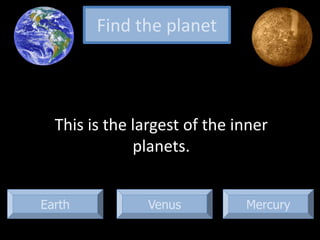
This is the largest of the inner
planets.
Find the planet
Venus
Oh no! Quick
guess again!
Great Job Kids!
What are the Outer planets?
The four planets farthest from the sun are known as the
outer planets. Jupiter, Saturn, Uranus, and Neptune
Jupiter
Jupiter, the fifth planet from
the Sun, is a gas giant.
A gas giant is a very large
planet made mostly of gases.
Jupiter is the largest planet in
our solar system. In fact, if it
were hollow, it is so big that all
of the other planets could fit
inside it!
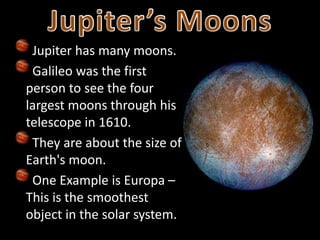
Jupiter has many moons.
Galileo was the first
person to see the four
largest moons through his
telescope in 1610.
They are about the size of
Earth's moon.
One Example is Europa –
This is the smoothest
object in the solar system.
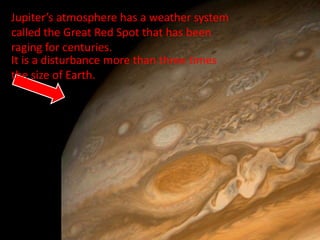
Jupiter’s atmosphere has a weather system
called the Great Red Spot that has been
raging for centuries.
It is a disturbance more than three times
the size of Earth.
Saturn
The sixth planet
from the Sun, Saturn
is also a gas giant.
Like Jupiter, Saturn’s
atmosphere is mostly
hydrogen and helium.
The Voyager space
probe explored
Saturn’s rings. It
showed that the
particles that make up
the rings range in size
from tiny grains to
boulders.
Using the chart, What is one reason people cannot live
on Jupiter and Saturn?
They are both too cold to live on!
Using the chart, What planet has more moons?
Jupiter with at least 63!
hmmm I wonder why
it says “at least” for
the number of
moons??
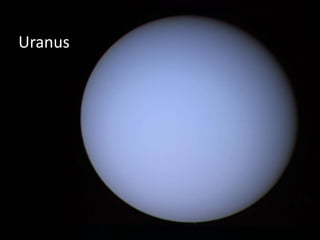
Uranus
In 1781, William Herschel discovered a
seventh planet orbiting the Sun.
The gas giant Uranus is the farthest planet you
can see without a telescope.
Uranus is so cold that the methane is a liquid.
Tiny drops of liquid methane form a thin cloud
that covers the planet.
This gives Uranus its fuzzy blue-green look.
Uranus rotates on its
side. No one knows
for sure why Uranus
has this odd tilt.
Scientists think that a
very large object may
have collided with the
planet when the solar
system was still
forming. This bump
may have knocked
Uranus onto its side.
Neptune
Neptune is the eighth
planet from the Sun. It is the
smallest of the gas giants.
Even so, if Neptune were
hollow, it could hold about
60 Earths.
It is so far away that it can't
be seen without a telescope.
In 1846 astronomers
discovered Neptune.
A few days later they
spotted Triton, Neptune's
largest moon.
Which planet has a larger diameter?
Uranus
How much longer is the Earth day on Uranus?
One hour
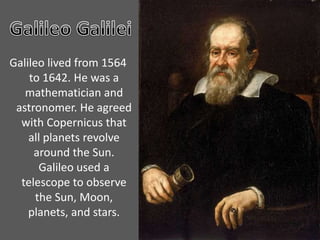
Galileo lived from 1564
to 1642. He was a
mathematician and
astronomer. He agreed
with Copernicus that
all planets revolve
around the Sun.
Galileo used a
telescope to observe
the Sun, Moon,
planets, and stars.
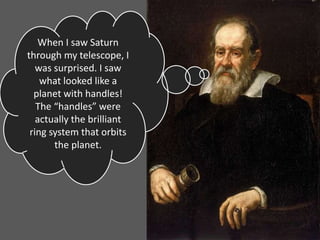
When I saw Saturn
through my telescope, I
was surprised. I saw
what looked like a
planet with handles!
The “handles” were
actually the brilliant
ring system that orbits
the planet.
Until 2006, Pluto was considered a ninth planet. But Pluto is
different from the eight planets in several ways. Now scientists
refer to Pluto as a dwarf planet. A dwarf planet is a small, ball-
shaped object that revolves around the Sun.
Quiz Time!
Let’s see how you do
locating the planet!
Jupiter Neptune
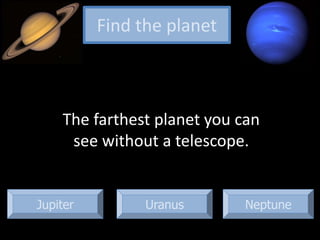
The farthest planet you can
see without a telescope.
Find the planet
Uranus
Oh no! Quick
guess again!
Great Job Kids!
Jupiter Neptune
The largest planet in our solar
system.
Find the planet
Saturn
Oh no! Quick
guess again!
Great Job Kids!
Jupiter Neptune
The smallest planet of all the
gas giants.
Find the planet
Saturn
Oh no! Quick
guess again!
Great Job Kids!
Jupiter Neptune
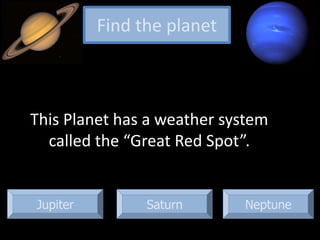
This Planet has a weather system
called the “Great Red Spot”.
Find the planet
Saturn
Oh no! Quick
guess again!
Great Job Kids!
Jupiter Uranus
This Planet rotates on its side.
Find the planet
Saturn
Oh no! Quick
guess again!
Great Job Kids!
You passed!
Thank you for purchasing this product!
If you like what you see, consider
leaving feedback. Visit my Website to
see more of my products!
www.powerpointmaniac.com
Are you on Facebook? If so, join
Power Point Maniac’s Teaching
Resources to get ideas, resources, and
free stuff!
www.facebook.com/powerpointmaniac

Inner and Outer Planets PPT (2).pppppptx

  • 1.
    What are theinner planets? The four planets closest to the sun are known as the inner planets. Mercury, Venus, Earth, and Mars
  • 2.
    Mercury This picture of Mercurywas made by joining many smaller photos taken by Mariner 10. No photos were taken of the area that looks smooth.
  • 3.
    Mercury is theplanet closest to the Sun. It is a small planet, a little bigger than Earth’s moon. Mercury is covered with thousands of dents. The dents are shaped like bowls and are called craters. Craters were made when meteorites crashed into Mercury’s surface long ago.
  • 4.
  • 5.
    Venus is thesecond planet from the Sun. It is about the same size as Earth, but Venus turns in the opposite direction. Like Mercury, Venus is very hot and dry. Unlike Mercury, Venus has an atmosphere made of thick, swirling clouds.
  • 6.
    Using the chart,What is one reason people cannot live on Mercury or Venus? They are both too hot to live on!
  • 7.
    Using the chart,how much longer is Venus’ Earth year? 137 years longer
  • 8.
  • 9.
    Earth, our home,is the third planet from the Sun. It is also the solar system’s largest rocky planet. Earth is the only planet that has liquid water on its surface. In fact, most of Earth’s surface is covered with water. Earth is the only planet in the solar system known to support life.
  • 10.
  • 11.
    Moons are satellitesof planets. A satellite is an object that orbits another object in space. Just as planets revolve around the Sun because of gravity, moons revolve around planets. Earth has one large moon. The diameter of the Moon is about one-fourth the diameter of Earth.
  • 12.
  • 13.
    The fourth planetfrom the Sun is Mars. The rocks and soil that cover much of Mars contain the mineral iron oxide. This mineral is reddish-brown in color. It is the same material that makes up rust. This has given Mars its nickname, the "Red Planet."
  • 14.
    How much lighteris a 100 pound person on Mars? 62 pounds
  • 15.
    Why is theaverage surface temperature considerably lower on Mars compared to Earth It is farther from the sun.
  • 17.
    Quiz Time! Let’s seehow you do locating the planet!
  • 18.
    Earth Mars This Planethas an atmosphere made of thick, swirling clouds. Find the planet Venus
  • 19.
  • 20.
  • 21.
    Earth Mars This planetis closest to the sun. Find the planet Mercury
  • 22.
  • 23.
  • 24.
    Earth Mars This isthe fourth planet from the sun. Find the planet Venus
  • 25.
  • 26.
  • 27.
    Earth Mercury This isthe largest of the inner planets. Find the planet Venus
  • 28.
  • 29.
  • 30.
    What are theOuter planets? The four planets farthest from the sun are known as the outer planets. Jupiter, Saturn, Uranus, and Neptune
  • 31.
  • 32.
    Jupiter, the fifthplanet from the Sun, is a gas giant. A gas giant is a very large planet made mostly of gases. Jupiter is the largest planet in our solar system. In fact, if it were hollow, it is so big that all of the other planets could fit inside it!
  • 33.
    Jupiter has manymoons. Galileo was the first person to see the four largest moons through his telescope in 1610. They are about the size of Earth's moon. One Example is Europa – This is the smoothest object in the solar system.
  • 34.
    Jupiter’s atmosphere hasa weather system called the Great Red Spot that has been raging for centuries. It is a disturbance more than three times the size of Earth.
  • 35.
  • 36.
    The sixth planet fromthe Sun, Saturn is also a gas giant. Like Jupiter, Saturn’s atmosphere is mostly hydrogen and helium. The Voyager space probe explored Saturn’s rings. It showed that the particles that make up the rings range in size from tiny grains to boulders.
  • 38.
    Using the chart,What is one reason people cannot live on Jupiter and Saturn? They are both too cold to live on!
  • 39.
    Using the chart,What planet has more moons? Jupiter with at least 63!
  • 40.
    hmmm I wonderwhy it says “at least” for the number of moons??
  • 41.
  • 42.
    In 1781, WilliamHerschel discovered a seventh planet orbiting the Sun. The gas giant Uranus is the farthest planet you can see without a telescope. Uranus is so cold that the methane is a liquid. Tiny drops of liquid methane form a thin cloud that covers the planet. This gives Uranus its fuzzy blue-green look.
  • 43.
    Uranus rotates onits side. No one knows for sure why Uranus has this odd tilt. Scientists think that a very large object may have collided with the planet when the solar system was still forming. This bump may have knocked Uranus onto its side.
  • 44.
  • 45.
    Neptune is theeighth planet from the Sun. It is the smallest of the gas giants. Even so, if Neptune were hollow, it could hold about 60 Earths. It is so far away that it can't be seen without a telescope. In 1846 astronomers discovered Neptune. A few days later they spotted Triton, Neptune's largest moon.
  • 46.
    Which planet hasa larger diameter? Uranus
  • 47.
    How much longeris the Earth day on Uranus? One hour
  • 49.
    Galileo lived from1564 to 1642. He was a mathematician and astronomer. He agreed with Copernicus that all planets revolve around the Sun. Galileo used a telescope to observe the Sun, Moon, planets, and stars.
  • 50.
    When I sawSaturn through my telescope, I was surprised. I saw what looked like a planet with handles! The “handles” were actually the brilliant ring system that orbits the planet.
  • 52.
    Until 2006, Plutowas considered a ninth planet. But Pluto is different from the eight planets in several ways. Now scientists refer to Pluto as a dwarf planet. A dwarf planet is a small, ball- shaped object that revolves around the Sun.
  • 53.
    Quiz Time! Let’s seehow you do locating the planet!
  • 54.
    Jupiter Neptune The farthestplanet you can see without a telescope. Find the planet Uranus
  • 55.
  • 56.
  • 57.
    Jupiter Neptune The largestplanet in our solar system. Find the planet Saturn
  • 58.
  • 59.
  • 60.
    Jupiter Neptune The smallestplanet of all the gas giants. Find the planet Saturn
  • 61.
  • 62.
  • 63.
    Jupiter Neptune This Planethas a weather system called the “Great Red Spot”. Find the planet Saturn
  • 64.
  • 65.
  • 66.
    Jupiter Uranus This Planetrotates on its side. Find the planet Saturn
  • 67.
  • 68.
  • 69.
    Thank you forpurchasing this product! If you like what you see, consider leaving feedback. Visit my Website to see more of my products! www.powerpointmaniac.com Are you on Facebook? If so, join Power Point Maniac’s Teaching Resources to get ideas, resources, and free stuff! www.facebook.com/powerpointmaniac