Spaceman Joe’s Cool Adventures Learning How Our Solar System Works!
What is revolution and rotation? Revolution is the movement of a planet in an orbit around the sun.  Rotation is the turning of a planet on its axis, which causes day and night.
Rotation of the Earth
How Long is a Day on Each Planet? (Rotation) Mercury – 59 Days Venus- 243 Days Earth- 24 Hours Mars- 24 ½ Hours Jupiter- 10 Hours Saturn-  11 Hours Uranus-  17 Hours Neptune- 16 Hours
Revolution of the Earth
How Long is a Year on Each Planet?(Revolution) Mercury-88 Days  Venus- 225 Days Earth-365 ¼ Days Mars- 687 Days Jupiter- 12 Years Saturn- 30 Years Uranus – 84 Years Neptune – 165 Years
What causes the Earth to have Seasons? The earth is tilted on its axis. If part of the earth is tilted towards the sun, then we would have summer. When we are tilted away from the sun, we would have winter. The tilt of the earth never changes!!
 
 
Phases of the Moon
Phases of the Moon We see the moon because sunlight is reflected off the moon’s surface. It takes the moon 29 ½ days to complete the phase cycle.
 
  New Moon     Waxing Crescent Moon     First Quarter Moon .   Waxing Gibbous Moon   Full Moon                                                                                                                               
Waning Gibbous Last Quarter    Waning Crescent                                                                                                  
 
 
Let’s Review!
 
Our Solar System


Our Star, The Sun
Characteristics of the Sun Average size yellow star made of hydrogen gas. Source of heat and light for all of the solar system. The age of the sun is about 5 billion years old.
Sunspots
 
And now there are eight !
 
2003 UB313 is now known as Eris
Planets in our Solar System There are eight planets in our solar system. There are 3 dwarf planets. Planets can be broken down into 2 types: Inner and Outer.  The inner planets include: Mercury, Venus, Earth and Mars.  The outer planets include: Jupiter, Saturn, Uranus, Neptune.
Mercury —closest planet to the sun. No atmosphere so very hot or very cold. Has craters and travels faster than any other planet.  It only takes Mercury 88 days to make one revolution.
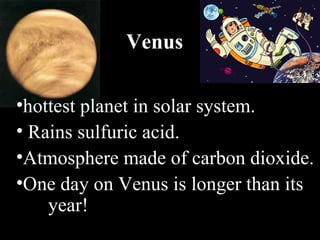
Venus  hottest planet in solar system. Rains sulfuric acid. Atmosphere made of carbon dioxide. One day on Venus is longer than its  year!
 
Earth only planet with liquid water and life. Has weather and clouds Has active volcanoes.
Mars-- largest volcano in the solar system Olympus Mons and may have had water in the past. Has the deepest valleys in the solar system.  Has polar ice caps.  Has 2 moons.
 
 
Asteroid Belt Pieces of rock ranging in size from the grain of sand to miles across.
Jupiter Largest planet with the most moons.  Giant red spot which is a storm.  Has 63 moons and one day is 10 earth hours long.
 
 
Saturn 2nd largest planet with rings. Rings are made up of rock, ice and dust. Has 50 moons. Would float on water
 
Uranus planet that is tilted on its side with sideways rings. Its North Pole faces the sun. Has 27 moons. Its year is 84 earth years long.
Neptune  Blue planet with a dark spot which is also a storm. Neptune’s winds are the strongest in the solar system (2000 km/hour) It has 13 moons.
 
Dwarf Planets Pluto Asteroid Ceres 2003 UB313 (Eris)
Pluto Small and Cold. Smaller than the earth’s moon. Has three moons. One year on Pluto is 248 earth years long.
2003UB313 (Eris)and its Moon
Asteroid Ceres
 

Solar system 4th grade january 2008

  • 1.
    Spaceman Joe’s CoolAdventures Learning How Our Solar System Works!
  • 2.
    What is revolutionand rotation? Revolution is the movement of a planet in an orbit around the sun. Rotation is the turning of a planet on its axis, which causes day and night.
  • 3.
  • 4.
    How Long isa Day on Each Planet? (Rotation) Mercury – 59 Days Venus- 243 Days Earth- 24 Hours Mars- 24 ½ Hours Jupiter- 10 Hours Saturn- 11 Hours Uranus- 17 Hours Neptune- 16 Hours
  • 5.
  • 6.
    How Long isa Year on Each Planet?(Revolution) Mercury-88 Days Venus- 225 Days Earth-365 ¼ Days Mars- 687 Days Jupiter- 12 Years Saturn- 30 Years Uranus – 84 Years Neptune – 165 Years
  • 7.
    What causes theEarth to have Seasons? The earth is tilted on its axis. If part of the earth is tilted towards the sun, then we would have summer. When we are tilted away from the sun, we would have winter. The tilt of the earth never changes!!
  • 8.
  • 9.
  • 10.
  • 11.
    Phases of theMoon We see the moon because sunlight is reflected off the moon’s surface. It takes the moon 29 ½ days to complete the phase cycle.
  • 12.
  • 13.
    NewMoon Waxing Crescent Moon First Quarter Moon . Waxing Gibbous Moon Full Moon                                                                                                                               
  • 14.
    Waning Gibbous LastQuarter Waning Crescent                                                                                                
  • 15.
  • 16.
  • 17.
  • 18.
  • 19.
  • 20.
  • 21.
  • 22.
  • 23.
  • 24.
  • 25.
  • 26.
  • 27.
  • 28.
  • 29.
  • 30.
  • 31.
  • 32.
    Characteristics of theSun Average size yellow star made of hydrogen gas. Source of heat and light for all of the solar system. The age of the sun is about 5 billion years old.
  • 33.
  • 34.
  • 35.
    And now thereare eight !
  • 36.
  • 37.
    2003 UB313 isnow known as Eris
  • 38.
    Planets in ourSolar System There are eight planets in our solar system. There are 3 dwarf planets. Planets can be broken down into 2 types: Inner and Outer. The inner planets include: Mercury, Venus, Earth and Mars. The outer planets include: Jupiter, Saturn, Uranus, Neptune.
  • 39.
    Mercury —closest planetto the sun. No atmosphere so very hot or very cold. Has craters and travels faster than any other planet. It only takes Mercury 88 days to make one revolution.
  • 40.
    Venus hottestplanet in solar system. Rains sulfuric acid. Atmosphere made of carbon dioxide. One day on Venus is longer than its year!
  • 41.
  • 42.
    Earth only planetwith liquid water and life. Has weather and clouds Has active volcanoes.
  • 43.
    Mars-- largest volcanoin the solar system Olympus Mons and may have had water in the past. Has the deepest valleys in the solar system. Has polar ice caps. Has 2 moons.
  • 44.
  • 45.
  • 46.
    Asteroid Belt Piecesof rock ranging in size from the grain of sand to miles across.
  • 47.
    Jupiter Largest planetwith the most moons. Giant red spot which is a storm. Has 63 moons and one day is 10 earth hours long.
  • 48.
  • 49.
  • 50.
    Saturn 2nd largestplanet with rings. Rings are made up of rock, ice and dust. Has 50 moons. Would float on water
  • 51.
  • 52.
    Uranus planet thatis tilted on its side with sideways rings. Its North Pole faces the sun. Has 27 moons. Its year is 84 earth years long.
  • 53.
    Neptune Blueplanet with a dark spot which is also a storm. Neptune’s winds are the strongest in the solar system (2000 km/hour) It has 13 moons.
  • 54.
  • 55.
    Dwarf Planets PlutoAsteroid Ceres 2003 UB313 (Eris)
  • 56.
    Pluto Small andCold. Smaller than the earth’s moon. Has three moons. One year on Pluto is 248 earth years long.
  • 57.
  • 58.
  • 59.