Ast r onomy

Kaitlyn McElveen
The Sun
•   The Sun is a yellow medium-sized
    and medium-hot star.
•   It is composed of gases, mainly
    hydrogen. It also contains helium
    which is formed from two
    hydrogens.
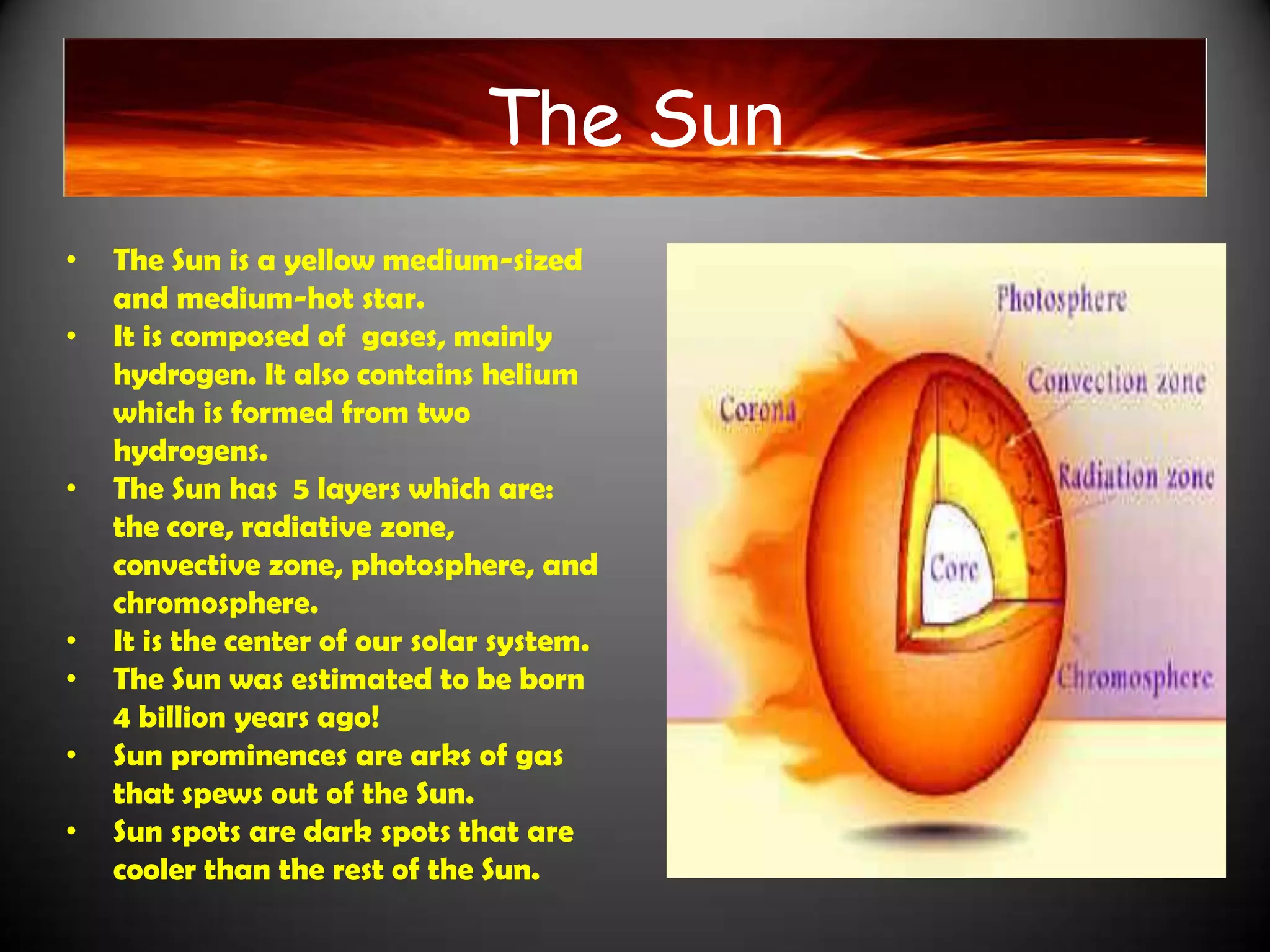
•   The Sun has 5 layers which are:
    the core, radiative zone,
    convective zone, photosphere, and
    chromosphere.
•   It is the center of our solar system.
•   The Sun was estimated to be born
    4 billion years ago!
•   Sun prominences are arks of gas
    that spews out of the Sun.
•   Sun spots are dark spots that are
    cooler than the rest of the Sun.
The Sun CONT’D
                 The Sun CONT’D
• Spicules are jets of gas that leaps from the Sun.
• The Sun also has solar flares, which are magnetic storms that
  releases tons of gas into its atmosphere.
• How the Sun formed:
   1. Explosion occurs from the death of another star.
   2. The energy from the explosion made hydrogen and
       helium fuse together into a compact object.
   3. The Sun was formed.

• Effects on Earth:
  1. Important for life.
  2. Warms the planet.
  3. Controls weather patterns.
  4. Harms the skin with UV radiation.
  5. Serious cable interferences; knocks out power grids on
   satellites
Mercury
Venus
• Venus is the second planet is nearly the size
  of Earth, giving it the nickname “Earth‟s
  Twin.”
• Venus has a thick atmosphere, composed of
  mainly carbon dioxide.
• It is the hottest planet in our solar system.
• Venus rotates slowly. It takes 255 Earth days
  to rotate once on its axis.
• Venus is highly volcanic.
• Venus takes 243 days to revolve the Sun.
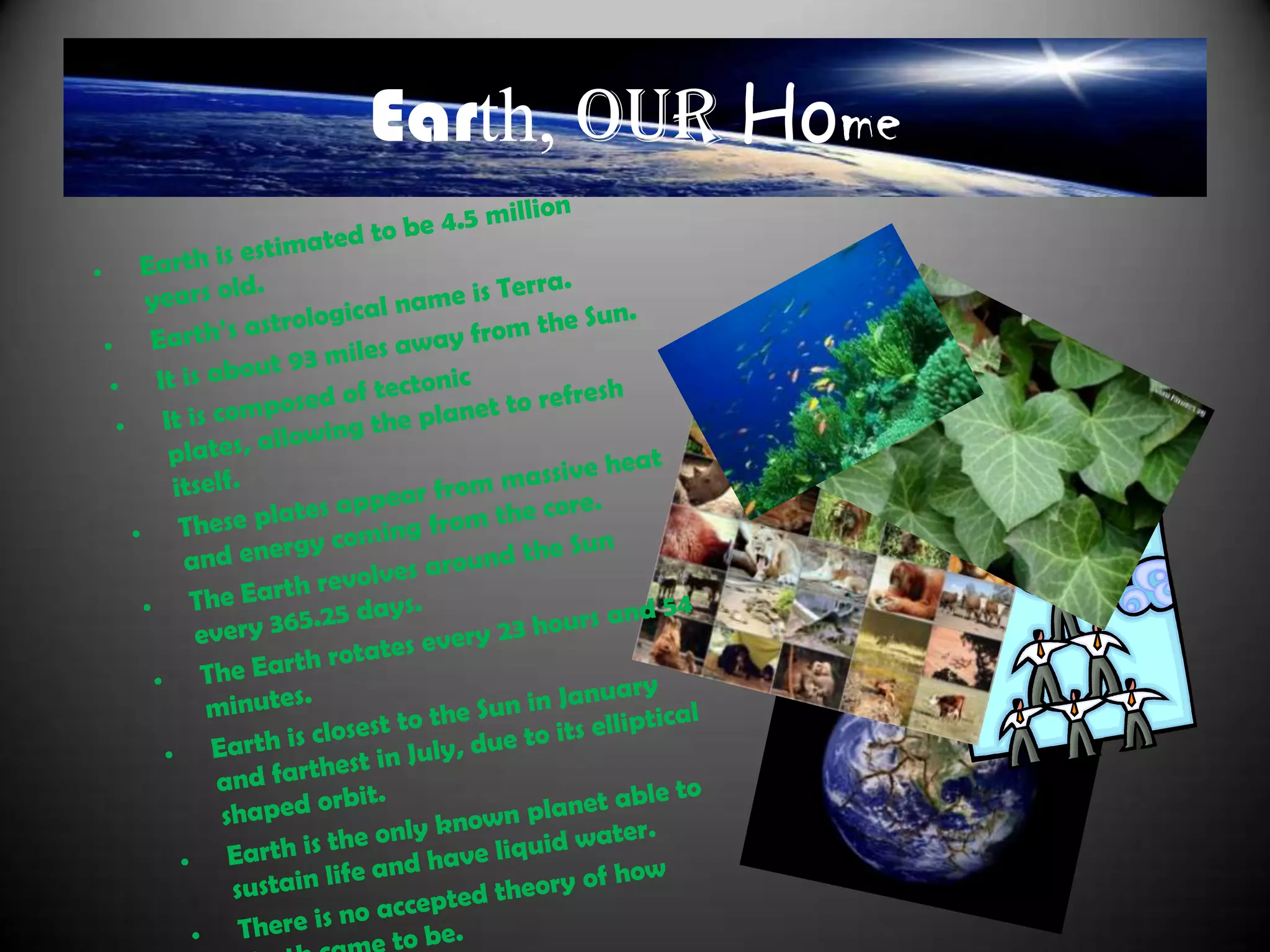
Earth, Our Home
Seasons on Earth
• Seasons on Earth occur from its 23.5 degree
  tilt.
• For example, when it is winter in the
  Northern Hemisphere, it‟s summer in the
  Southern Hemisphere
• The angle of sunlight hitting Earth
  determines the season.
The Moon
• The moon was estimated to be formed 20-30 million
  years after Earth.
• It is composed of similar materials of Earth‟s crust.
• It is about 2,168 miles in diameter.
• The moon is estimated to be about 238,000 miles
  away from Earth and moves 38mm away from Earth
  each year.
• It orbits Earth every 29.5 days.
• Gravity from the moon impacts Earth‟s tides.
• Since the Earth drags the moon along with it, it slows
  its rotation down and the rate slows 15 milliseconds a
  year.
• The moon has no atmosphere.
• It has many craters, revealing it‟s been hit numerous
  times by meteoroids
The Moon Cont’d
• The moonlight is actually
  sunlight reflecting off of the
  moon‟s surface.
• The moon was thought to be
  created from a piece of Earth
  from a meteoroid.
• The moon‟s orbit is tilted.
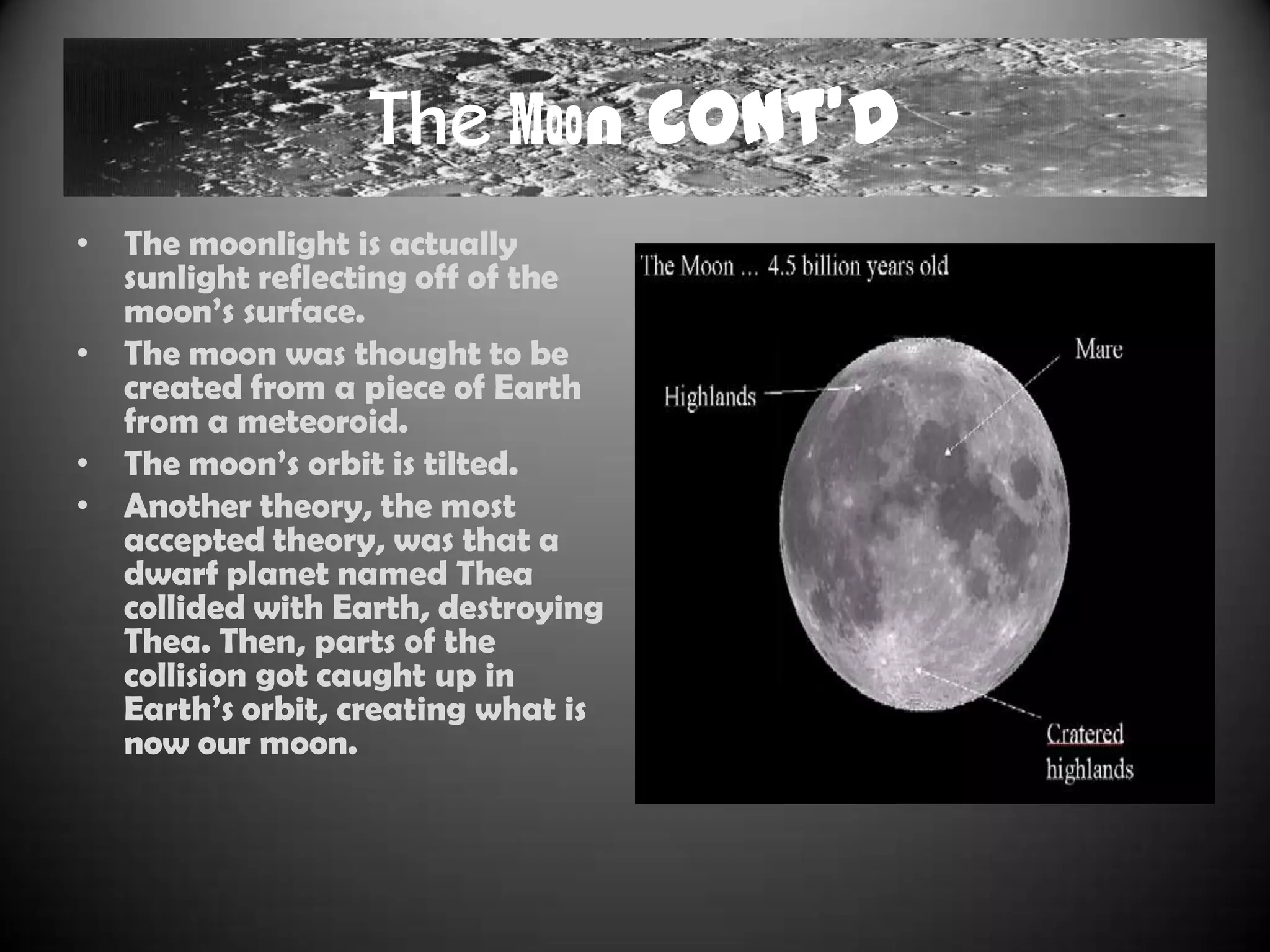
• Another theory, the most
  accepted theory, was that a
  dwarf planet named Thea
  collided with Earth, destroying
  Thea. Then, parts of the
  collision got caught up in
  Earth‟s orbit, creating what is
  now our moon.
Phases of the Moon
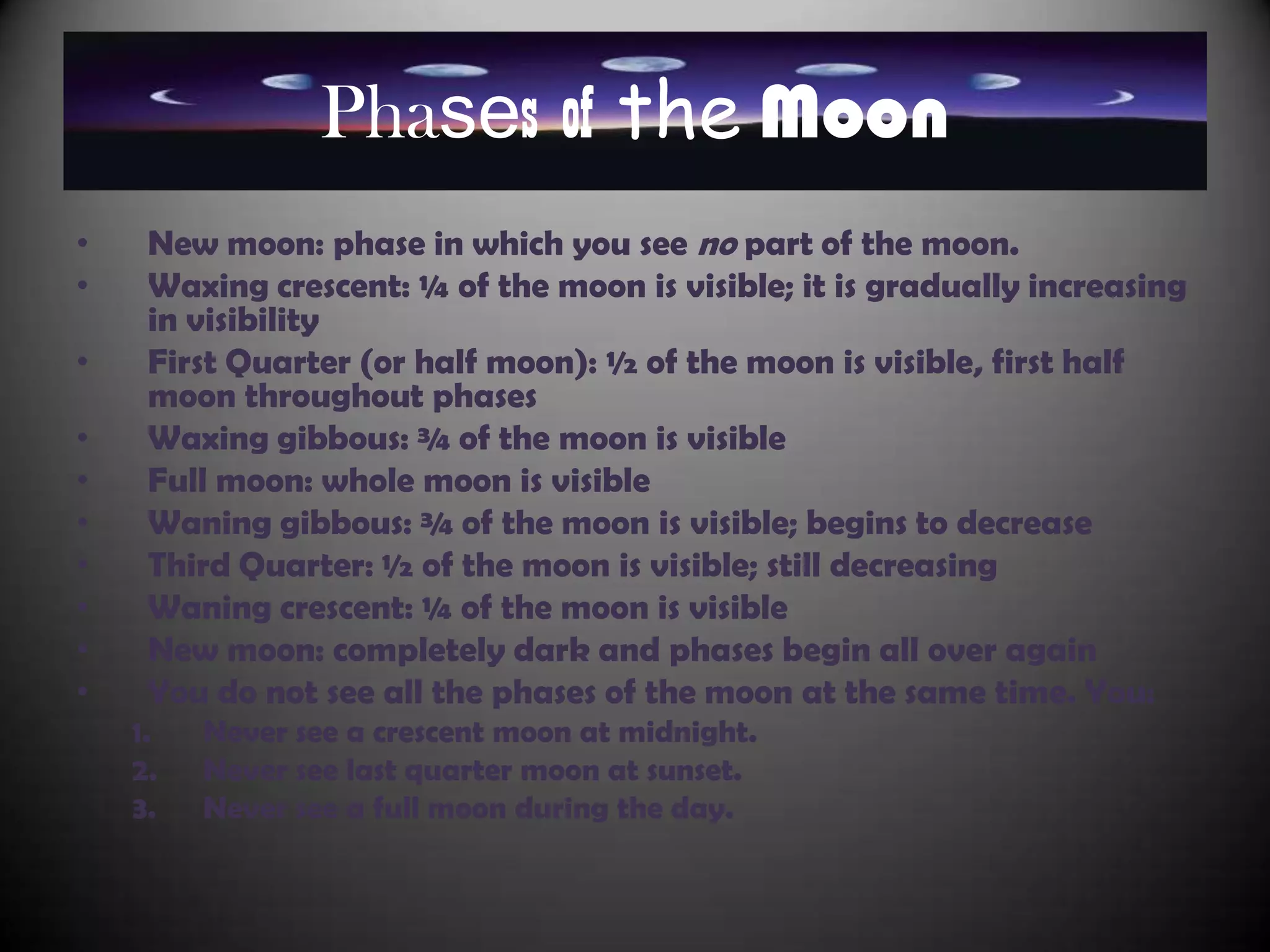
•    New moon: phase in which you see no part of the moon.
•    Waxing crescent: ¼ of the moon is visible; it is gradually increasing
     in visibility
•    First Quarter (or half moon): ½ of the moon is visible, first half
     moon throughout phases
•    Waxing gibbous: ¾ of the moon is visible
•    Full moon: whole moon is visible
•    Waning gibbous: ¾ of the moon is visible; begins to decrease
•    Third Quarter: ½ of the moon is visible; still decreasing
•    Waning crescent: ¼ of the moon is visible
•    New moon: completely dark and phases begin all over again
•    You do not see all the phases of the moon at the same time. You:
    1.   Never see a crescent moon at midnight.
    2.   Never see last quarter moon at sunset.
    3.   Never see a full moon during the day.
Tides
• The moon controls the tides on Earth.
• There are two high and low tides in a
  single day.
• There are two different types of tides
  during a month; Neap tide and Spring
  tide.
• Neap tide occurs during First and Third
  Quarter.
• Spring tide occurs during Full and New
  Moon.
Lunar and Solar Eclipses
• Solar eclipses occur when the moon is between the Earth and
  Sun.
• Lunar eclipses occur when the Earth is between the moon and
  Sun.
• Each can be classified in three ways; Partial eclipse, total
  eclipse, and annular eclipse.
• Partial eclipse: a portion of it is blocked
• Total eclipse: blocks it entirely
• Annular eclipse: furthest point in orbit
• Solar eclipses are uncommon, but lunar eclipses happen more
  often.
• The phases of an eclipse, in order, are First Contact, Second
  Contact, Bailey‟s Beads, Diamond Ring, Corona, Totality, and
  the Ending Contacts.
Lunar and Solar Eclipses Cont’d
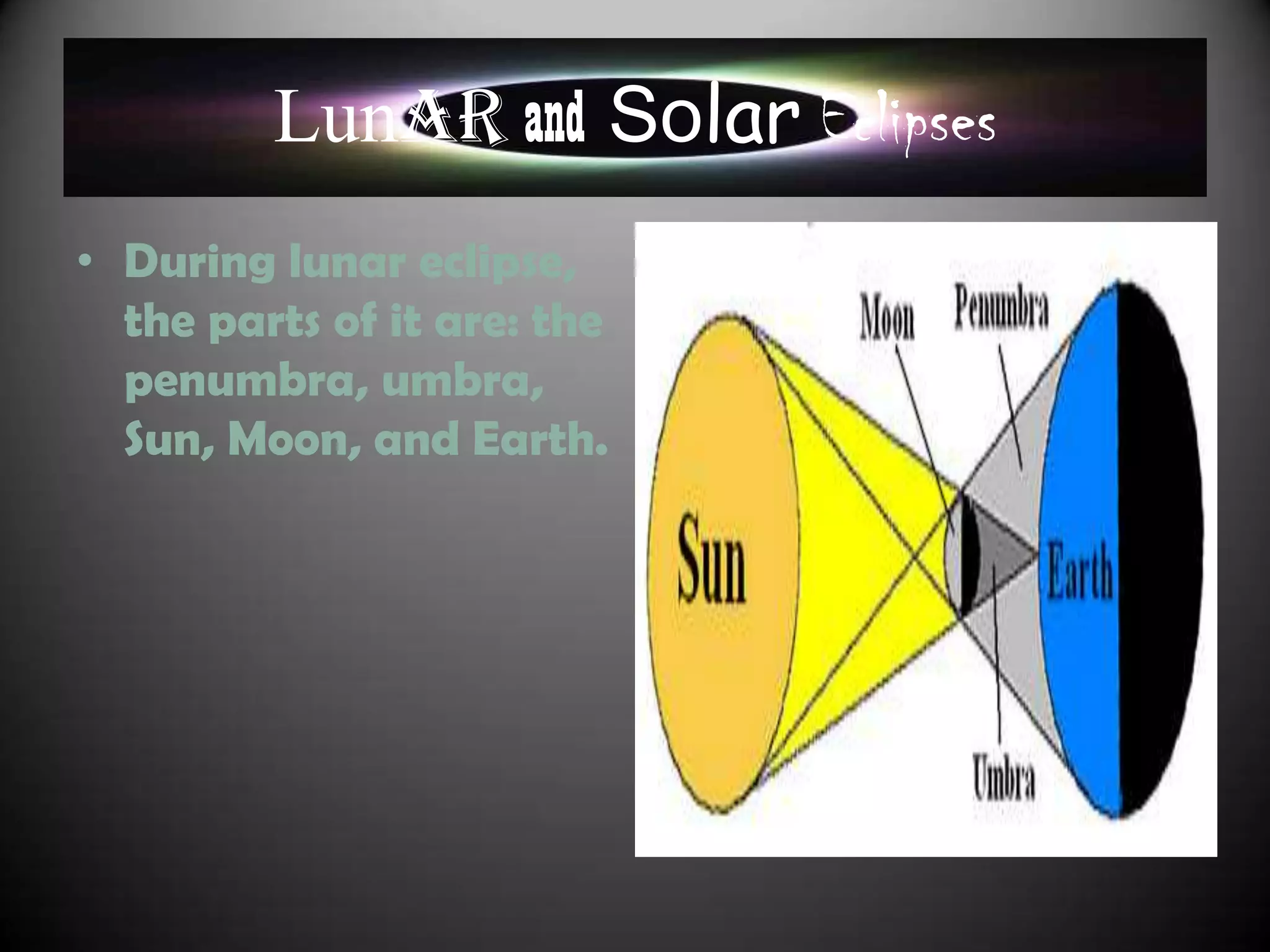
• During lunar eclipse,
  the parts of it are: the
  penumbra, umbra,
  Sun, Moon, and Earth.
Mars
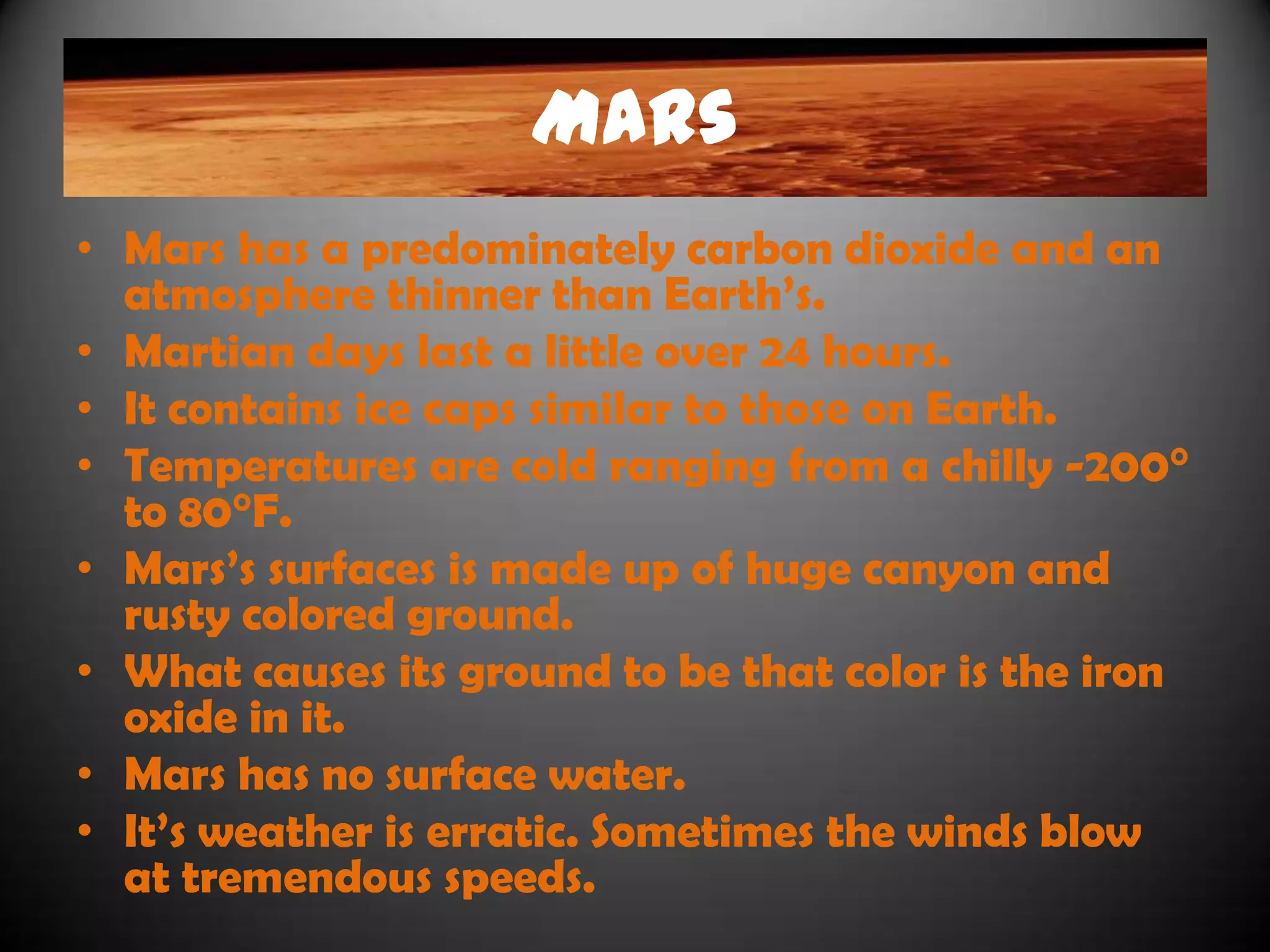
• Mars has a predominately carbon dioxide and an
  atmosphere thinner than Earth‟s.
• Martian days last a little over 24 hours.
• It contains ice caps similar to those on Earth.
• Temperatures are cold ranging from a chilly -200°
  to 80°F.
• Mars‟s surfaces is made up of huge canyon and
  rusty colored ground.
• What causes its ground to be that color is the iron
  oxide in it.
• Mars has no surface water.
• It‟s weather is erratic. Sometimes the winds blow
  at tremendous speeds.
Asteroid Belt
• The Asteroid Belt is in between Mars and
  Jupiter.
• It separates the inner and outer planets.
• It is not as densely packed as many
  believe.
• Some scientists believe that the Asteroid
  Belt‟s asteroids were once pieces of ancient
  planets.
Jupiter
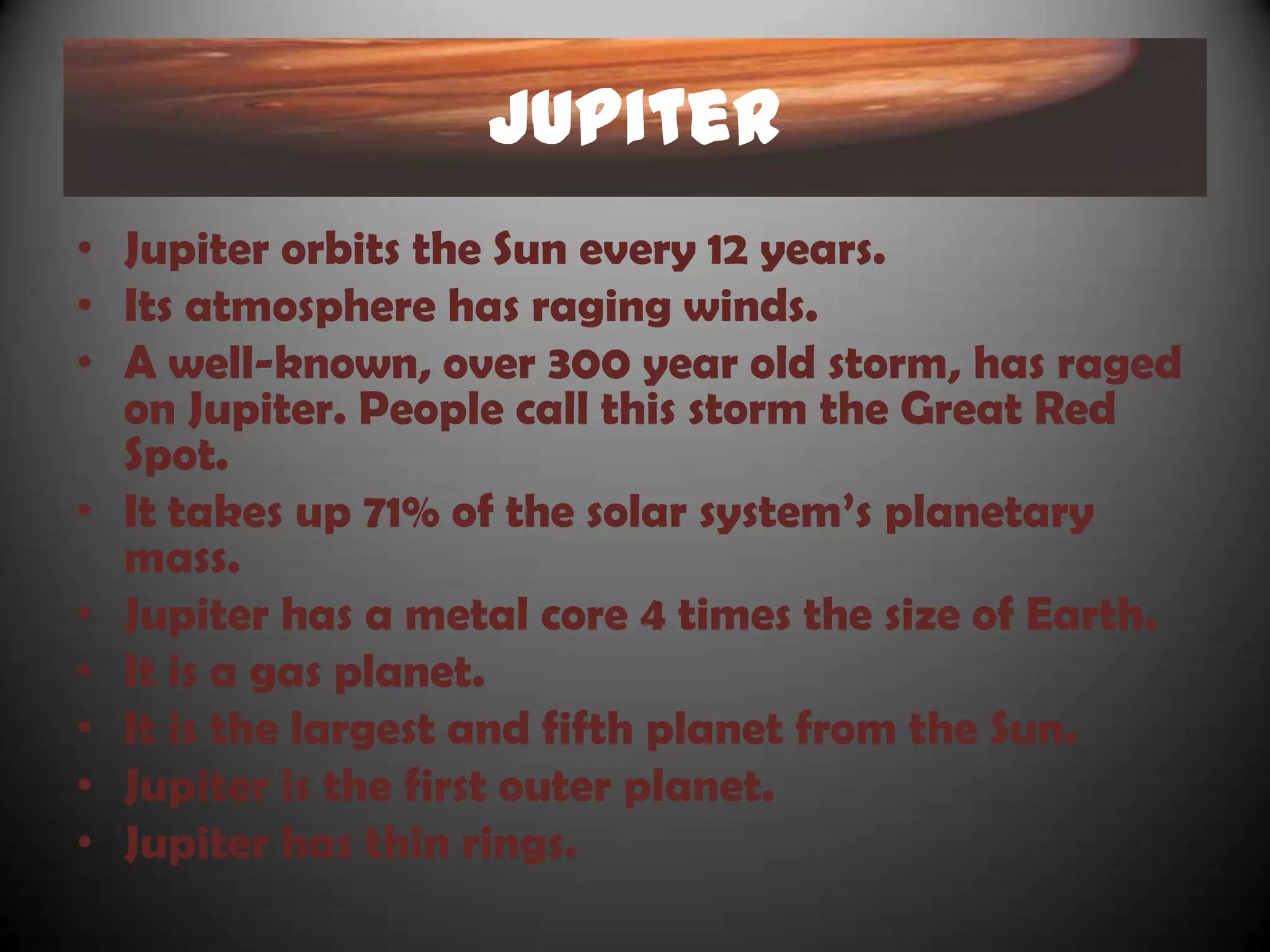
• Jupiter orbits the Sun every 12 years.
• Its atmosphere has raging winds.
• A well-known, over 300 year old storm, has raged
  on Jupiter. People call this storm the Great Red
  Spot.
• It takes up 71% of the solar system‟s planetary
  mass.
• Jupiter has a metal core 4 times the size of Earth.
• It is a gas planet.
• It is the largest and fifth planet from the Sun.
• Jupiter is the first outer planet.
• Jupiter has thin rings.
Saturn
• Saturn is the sixth planet and is yet, another gas
  planet.
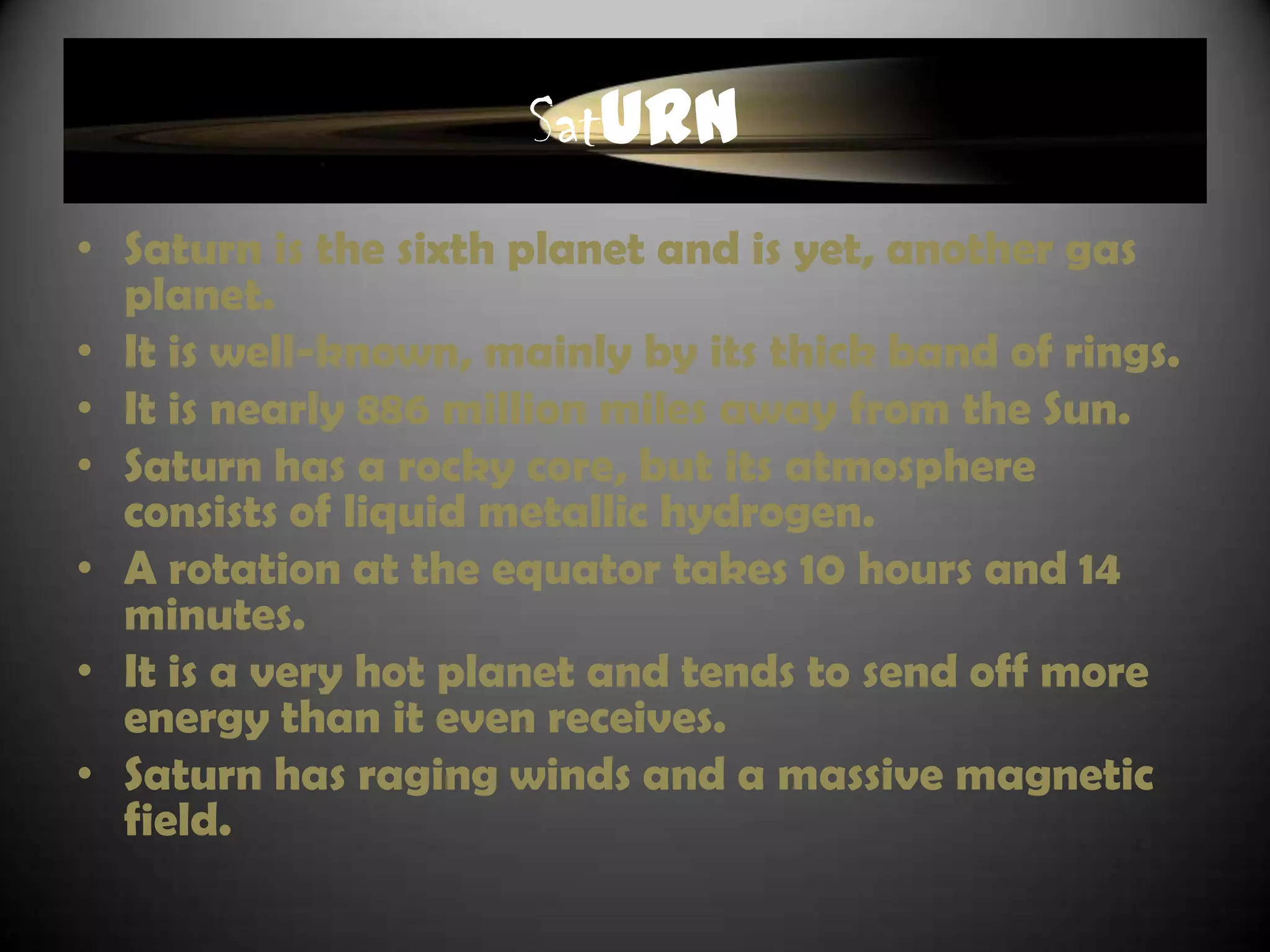
• It is well-known, mainly by its thick band of rings.
• It is nearly 886 million miles away from the Sun.
• Saturn has a rocky core, but its atmosphere
  consists of liquid metallic hydrogen.
• A rotation at the equator takes 10 hours and 14
  minutes.
• It is a very hot planet and tends to send off more
  energy than it even receives.
• Saturn has raging winds and a massive magnetic
  field.
Uranus
• Uranus is the seventh planet in our solar system.
• It spins sideways. The most accepted theory of how
  Uranus became tilted the way it did was that a
  space object collided the planet and the impact
  tilted the axis.
• The tilt is nearly 98 .
• For a full revolution around the Sun, it takes 84
  years.
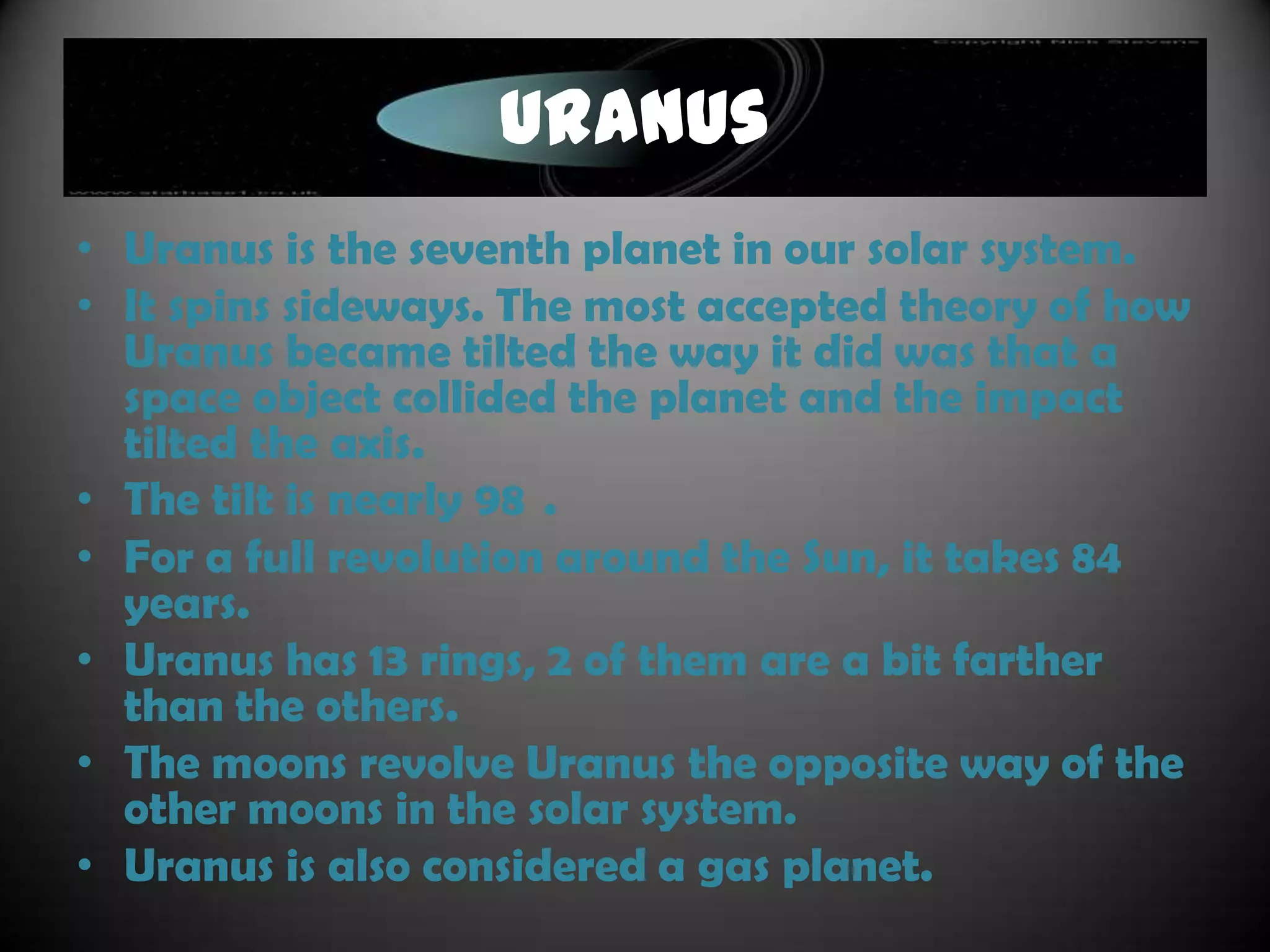
• Uranus has 13 rings, 2 of them are a bit farther
  than the others.
• The moons revolve Uranus the opposite way of the
  other moons in the solar system.
• Uranus is also considered a gas planet.
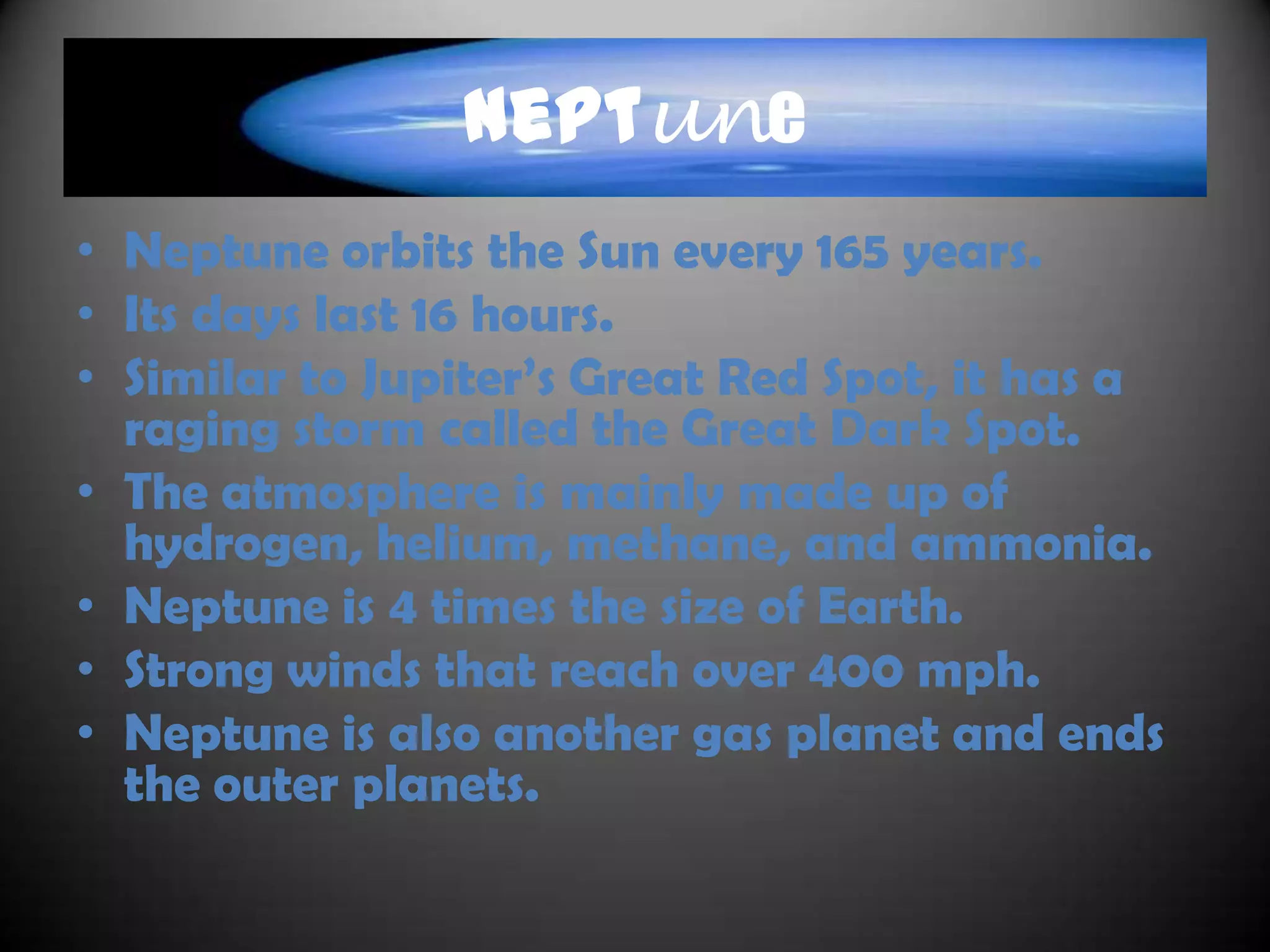
Neptune
• Neptune orbits the Sun every 165 years.
• Its days last 16 hours.
• Similar to Jupiter‟s Great Red Spot, it has a
  raging storm called the Great Dark Spot.
• The atmosphere is mainly made up of
  hydrogen, helium, methane, and ammonia.
• Neptune is 4 times the size of Earth.
• Strong winds that reach over 400 mph.
• Neptune is also another gas planet and ends
  the outer planets.
Pluto and Other Dwarf Planets
Pluto and Other Dwarf Planets Cont’d
                Dwarf Planets

• Because it didn‟t meet criteria 3, they
  decided to call Pluto and other similar
  space objects „plutoids‟ or „dwarf planets.‟
• Pluto, along with many others, lie in the
  Kuiper Belt.
• The Kuiper Belt consists of many space
  objects and is right at the breach of our
  solar system.
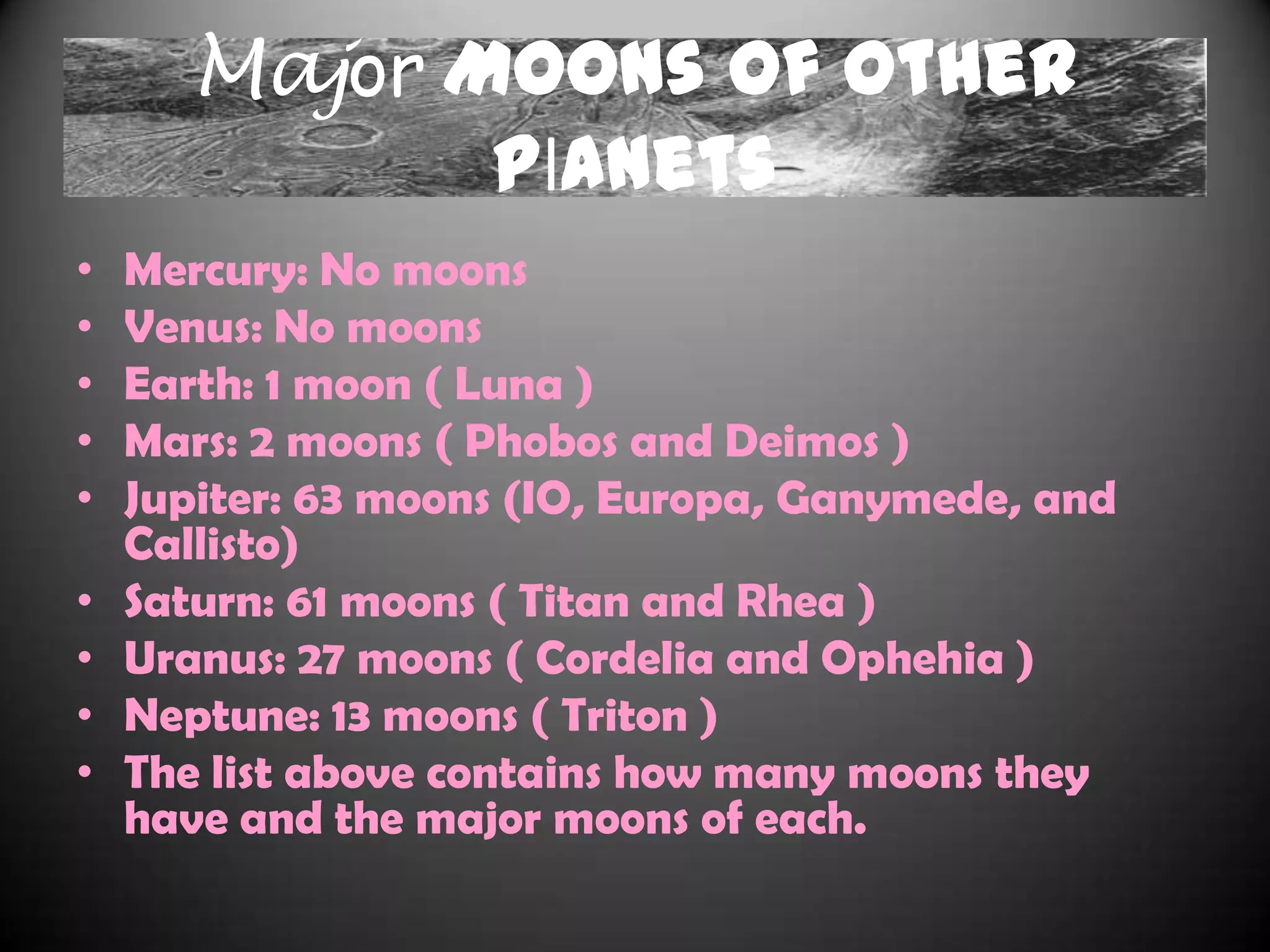
Major Moons of Other Planets
•   Mercury: No moons
•   Venus: No moons
•   Earth: 1 moon ( Luna )
•   Mars: 2 moons ( Phobos and Deimos )
•   Jupiter: 63 moons (IO, Europa, Ganymede, and
    Callisto)
•   Saturn: 61 moons ( Titan and Rhea )
•   Uranus: 27 moons ( Cordelia and Ophehia )
•   Neptune: 13 moons ( Triton )
•   The list above contains how many moons they
    have and the major moons of each.
Galaxies
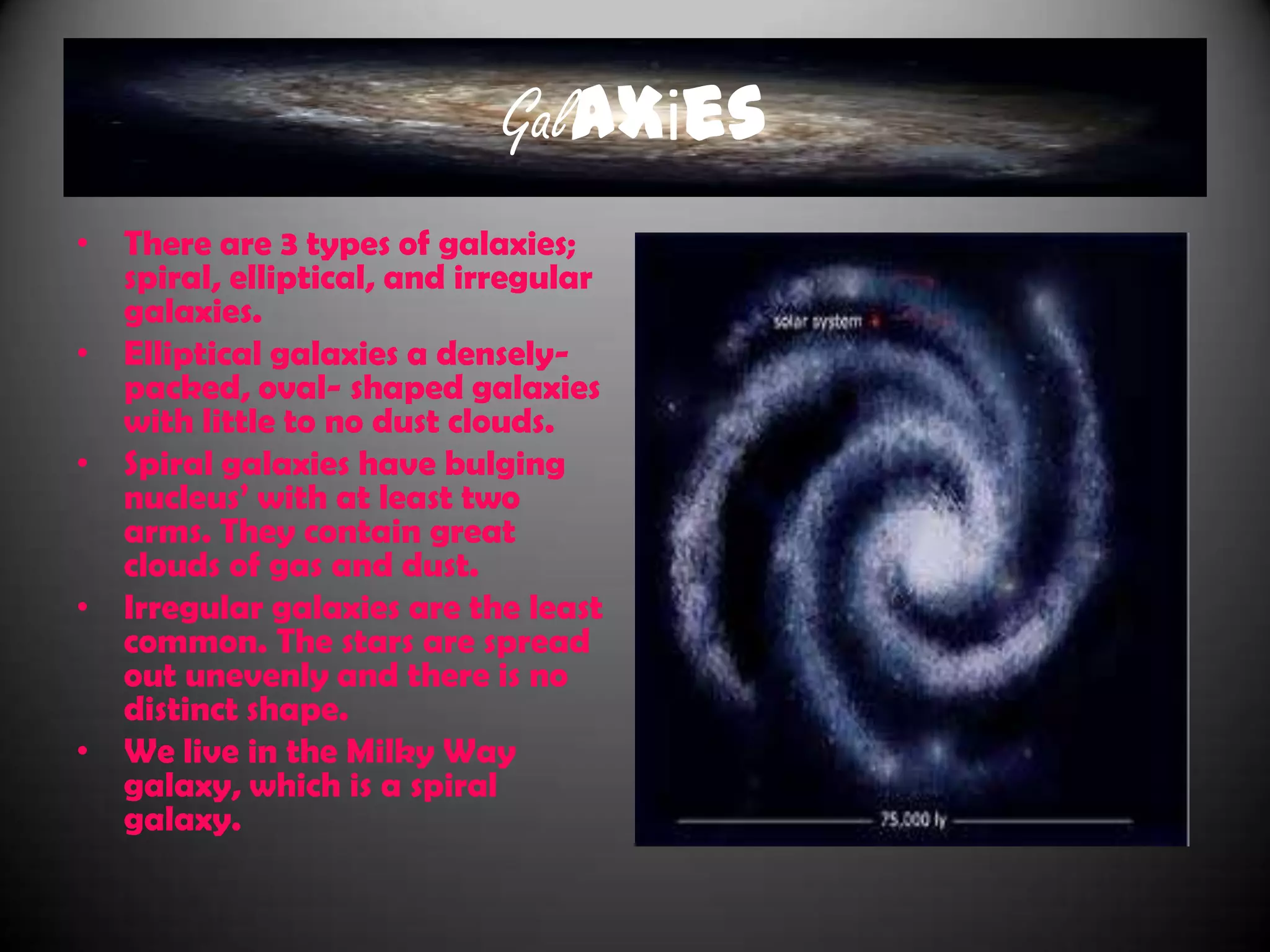
• There are 3 types of galaxies;
  spiral, elliptical, and irregular
  galaxies.
• Elliptical galaxies a densely-
  packed, oval- shaped galaxies
  with little to no dust clouds.
• Spiral galaxies have bulging
  nucleus‟ with at least two
  arms. They contain great
  clouds of gas and dust.
• Irregular galaxies are the least
  common. The stars are spread
  out unevenly and there is no
  distinct shape.
• We live in the Milky Way
  galaxy, which is a spiral
  galaxy.
Asteroids, Meteoroids, and Comets
Gravitational forces, Mass and
                      Distance
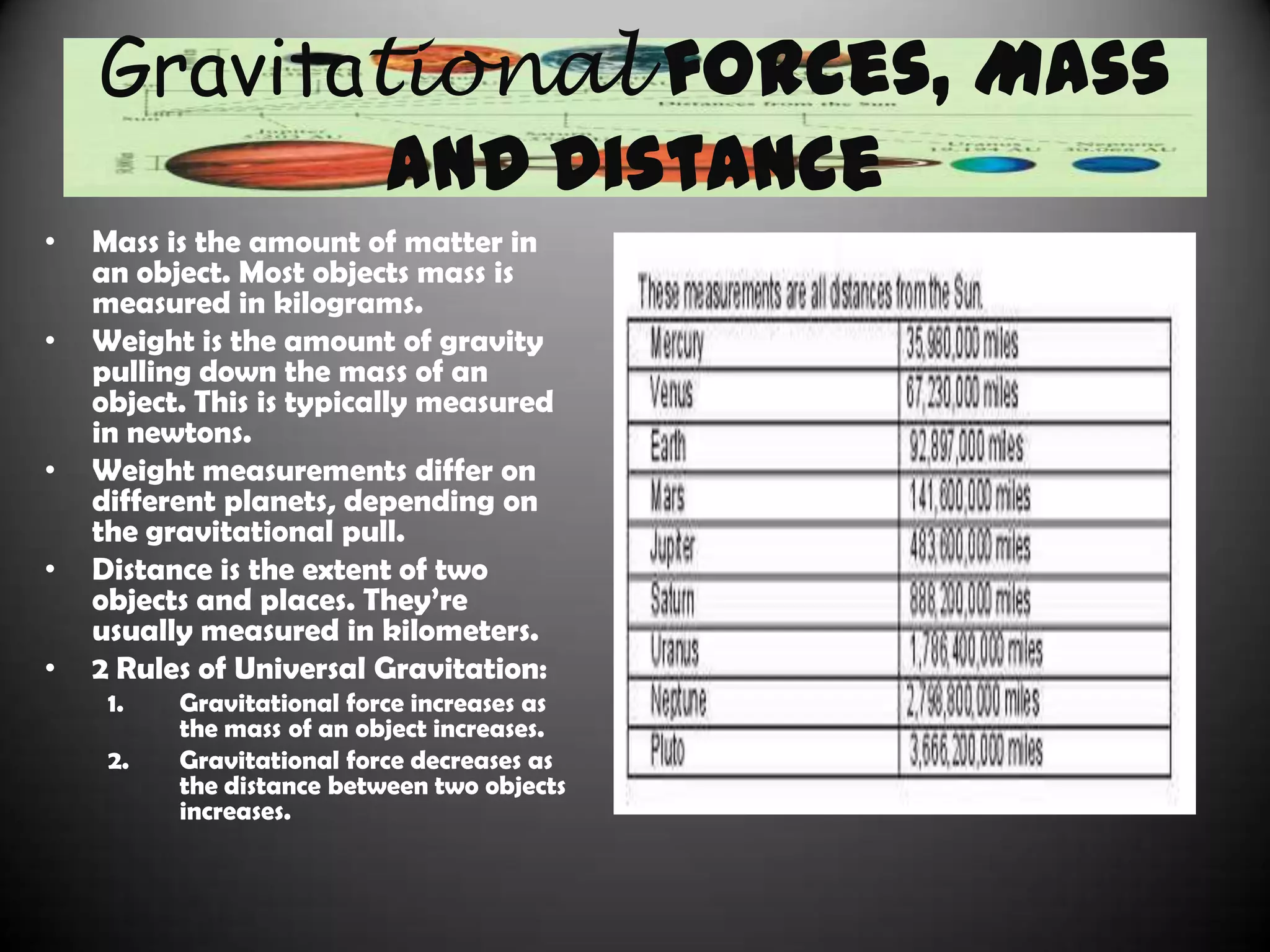
•   Mass is the amount of matter in
    an object. Most objects mass is
    measured in kilograms.
•   Weight is the amount of gravity
    pulling down the mass of an
    object. This is typically measured
    in newtons.
•   Weight measurements differ on
    different planets, depending on
    the gravitational pull.
•   Distance is the extent of two
    objects and places. They‟re
    usually measured in kilometers.
•   2 Rules of Universal Gravitation:
     1.   Gravitational force increases as
          the mass of an object increases.
     2.   Gravitational force decreases as
          the distance between two objects
          increases.
Light Years
• Light years don‟t measure the speed light
  travels. It is actually a measurement of
  how far light can travel in a year, so it is
  measuring distance.
• The stellar parallax is the difference of
  direction of two widely spread objects to
  an observer.
Space Technology
• One tool to study space are telescopes.
• There are two types of telescopes; the optical
  telescopes and the radio telescopes.
• Optical telescopes can be divided into two groups;
  refracting and reflecting.
• Refracting telescopes uses double convex lenses.
• Reflecting telescopes use concave mirrors. An example
  of a reflecting telescope is the Hubble Space Telescope.
• Radio telescopes study radio waves that travel through
  space and easily travel through atmospheres.
Space Technology Cont’d
• Another tool used to study space is satellites. These
  tools are objects that can revolve around another
  object.
• They are controlled by gravity.
• There are two types of satellites; communication
  satellites and scientific satellites.
• Communication satellites provide signal for radio and
  TV.
• Scientific satellites are used to monitor weather.
• Spectroscopes are also another type of space
  technology.
• They usually use light waves to measure how hot and
  the composition of an object.
• Spectroscopes are used for planets, galaxies, and stars.
Space Technology Cont’d Pt.2
• Lastly, a space technology are also space
  probes.
• Space probes can travel to, on, and from
  planets.
• They are used to gather information to send
  back to Earth.
• Space probes can travel the farthest into the
  solar system than any other space instrument
  known.
• An example of a space probe is Pioneer 10,
  which passed Jupiter.
Some Pretty Interesting Facts
• Did you know? Pluto is also the name of a pet of a popular
    Disney character.
• Did you know? Pluto’s name was suggested by a young girl
    who at the moment was studying Greek mythology. She
    thought that the planet was dark and suggested the god of
    the underworld, Pluto.
•   Did you know? Our solar system is estimated to be 15
    trillion kilometers wide.
•   Did you know? Scientists believe our solar system formed
    when a nebula flattened.
•   Did you know? Scientists believe that Andromeda consumed
    another galaxy. They think this from its double center.
    Scientists think one day it’ll consume the Milky Way!
•   Did you know? Venus was named after the Roman goddess
    of love and beauty.
Astronomy

Astronomy

  • 1.
  • 2.
    The Sun • The Sun is a yellow medium-sized and medium-hot star. • It is composed of gases, mainly hydrogen. It also contains helium which is formed from two hydrogens. • The Sun has 5 layers which are: the core, radiative zone, convective zone, photosphere, and chromosphere. • It is the center of our solar system. • The Sun was estimated to be born 4 billion years ago! • Sun prominences are arks of gas that spews out of the Sun. • Sun spots are dark spots that are cooler than the rest of the Sun.
  • 3.
    The Sun CONT’D The Sun CONT’D • Spicules are jets of gas that leaps from the Sun. • The Sun also has solar flares, which are magnetic storms that releases tons of gas into its atmosphere. • How the Sun formed: 1. Explosion occurs from the death of another star. 2. The energy from the explosion made hydrogen and helium fuse together into a compact object. 3. The Sun was formed. • Effects on Earth: 1. Important for life. 2. Warms the planet. 3. Controls weather patterns. 4. Harms the skin with UV radiation. 5. Serious cable interferences; knocks out power grids on satellites
  • 4.
  • 5.
    Venus • Venus isthe second planet is nearly the size of Earth, giving it the nickname “Earth‟s Twin.” • Venus has a thick atmosphere, composed of mainly carbon dioxide. • It is the hottest planet in our solar system. • Venus rotates slowly. It takes 255 Earth days to rotate once on its axis. • Venus is highly volcanic. • Venus takes 243 days to revolve the Sun.
  • 6.
  • 7.
    Seasons on Earth •Seasons on Earth occur from its 23.5 degree tilt. • For example, when it is winter in the Northern Hemisphere, it‟s summer in the Southern Hemisphere • The angle of sunlight hitting Earth determines the season.
  • 8.
    The Moon • Themoon was estimated to be formed 20-30 million years after Earth. • It is composed of similar materials of Earth‟s crust. • It is about 2,168 miles in diameter. • The moon is estimated to be about 238,000 miles away from Earth and moves 38mm away from Earth each year. • It orbits Earth every 29.5 days. • Gravity from the moon impacts Earth‟s tides. • Since the Earth drags the moon along with it, it slows its rotation down and the rate slows 15 milliseconds a year. • The moon has no atmosphere. • It has many craters, revealing it‟s been hit numerous times by meteoroids
  • 9.
    The Moon Cont’d •The moonlight is actually sunlight reflecting off of the moon‟s surface. • The moon was thought to be created from a piece of Earth from a meteoroid. • The moon‟s orbit is tilted. • Another theory, the most accepted theory, was that a dwarf planet named Thea collided with Earth, destroying Thea. Then, parts of the collision got caught up in Earth‟s orbit, creating what is now our moon.
  • 10.
    Phases of theMoon • New moon: phase in which you see no part of the moon. • Waxing crescent: ¼ of the moon is visible; it is gradually increasing in visibility • First Quarter (or half moon): ½ of the moon is visible, first half moon throughout phases • Waxing gibbous: ¾ of the moon is visible • Full moon: whole moon is visible • Waning gibbous: ¾ of the moon is visible; begins to decrease • Third Quarter: ½ of the moon is visible; still decreasing • Waning crescent: ¼ of the moon is visible • New moon: completely dark and phases begin all over again • You do not see all the phases of the moon at the same time. You: 1. Never see a crescent moon at midnight. 2. Never see last quarter moon at sunset. 3. Never see a full moon during the day.
  • 11.
    Tides • The mooncontrols the tides on Earth. • There are two high and low tides in a single day. • There are two different types of tides during a month; Neap tide and Spring tide. • Neap tide occurs during First and Third Quarter. • Spring tide occurs during Full and New Moon.
  • 12.
    Lunar and SolarEclipses • Solar eclipses occur when the moon is between the Earth and Sun. • Lunar eclipses occur when the Earth is between the moon and Sun. • Each can be classified in three ways; Partial eclipse, total eclipse, and annular eclipse. • Partial eclipse: a portion of it is blocked • Total eclipse: blocks it entirely • Annular eclipse: furthest point in orbit • Solar eclipses are uncommon, but lunar eclipses happen more often. • The phases of an eclipse, in order, are First Contact, Second Contact, Bailey‟s Beads, Diamond Ring, Corona, Totality, and the Ending Contacts.
  • 13.
    Lunar and SolarEclipses Cont’d • During lunar eclipse, the parts of it are: the penumbra, umbra, Sun, Moon, and Earth.
  • 14.
    Mars • Mars hasa predominately carbon dioxide and an atmosphere thinner than Earth‟s. • Martian days last a little over 24 hours. • It contains ice caps similar to those on Earth. • Temperatures are cold ranging from a chilly -200° to 80°F. • Mars‟s surfaces is made up of huge canyon and rusty colored ground. • What causes its ground to be that color is the iron oxide in it. • Mars has no surface water. • It‟s weather is erratic. Sometimes the winds blow at tremendous speeds.
  • 15.
    Asteroid Belt • TheAsteroid Belt is in between Mars and Jupiter. • It separates the inner and outer planets. • It is not as densely packed as many believe. • Some scientists believe that the Asteroid Belt‟s asteroids were once pieces of ancient planets.
  • 16.
    Jupiter • Jupiter orbitsthe Sun every 12 years. • Its atmosphere has raging winds. • A well-known, over 300 year old storm, has raged on Jupiter. People call this storm the Great Red Spot. • It takes up 71% of the solar system‟s planetary mass. • Jupiter has a metal core 4 times the size of Earth. • It is a gas planet. • It is the largest and fifth planet from the Sun. • Jupiter is the first outer planet. • Jupiter has thin rings.
  • 17.
    Saturn • Saturn isthe sixth planet and is yet, another gas planet. • It is well-known, mainly by its thick band of rings. • It is nearly 886 million miles away from the Sun. • Saturn has a rocky core, but its atmosphere consists of liquid metallic hydrogen. • A rotation at the equator takes 10 hours and 14 minutes. • It is a very hot planet and tends to send off more energy than it even receives. • Saturn has raging winds and a massive magnetic field.
  • 18.
    Uranus • Uranus isthe seventh planet in our solar system. • It spins sideways. The most accepted theory of how Uranus became tilted the way it did was that a space object collided the planet and the impact tilted the axis. • The tilt is nearly 98 . • For a full revolution around the Sun, it takes 84 years. • Uranus has 13 rings, 2 of them are a bit farther than the others. • The moons revolve Uranus the opposite way of the other moons in the solar system. • Uranus is also considered a gas planet.
  • 19.
    Neptune • Neptune orbitsthe Sun every 165 years. • Its days last 16 hours. • Similar to Jupiter‟s Great Red Spot, it has a raging storm called the Great Dark Spot. • The atmosphere is mainly made up of hydrogen, helium, methane, and ammonia. • Neptune is 4 times the size of Earth. • Strong winds that reach over 400 mph. • Neptune is also another gas planet and ends the outer planets.
  • 20.
    Pluto and OtherDwarf Planets
  • 21.
    Pluto and OtherDwarf Planets Cont’d Dwarf Planets • Because it didn‟t meet criteria 3, they decided to call Pluto and other similar space objects „plutoids‟ or „dwarf planets.‟ • Pluto, along with many others, lie in the Kuiper Belt. • The Kuiper Belt consists of many space objects and is right at the breach of our solar system.
  • 22.
    Major Moons ofOther Planets • Mercury: No moons • Venus: No moons • Earth: 1 moon ( Luna ) • Mars: 2 moons ( Phobos and Deimos ) • Jupiter: 63 moons (IO, Europa, Ganymede, and Callisto) • Saturn: 61 moons ( Titan and Rhea ) • Uranus: 27 moons ( Cordelia and Ophehia ) • Neptune: 13 moons ( Triton ) • The list above contains how many moons they have and the major moons of each.
  • 23.
    Galaxies • There are3 types of galaxies; spiral, elliptical, and irregular galaxies. • Elliptical galaxies a densely- packed, oval- shaped galaxies with little to no dust clouds. • Spiral galaxies have bulging nucleus‟ with at least two arms. They contain great clouds of gas and dust. • Irregular galaxies are the least common. The stars are spread out unevenly and there is no distinct shape. • We live in the Milky Way galaxy, which is a spiral galaxy.
  • 24.
  • 25.
    Gravitational forces, Massand Distance • Mass is the amount of matter in an object. Most objects mass is measured in kilograms. • Weight is the amount of gravity pulling down the mass of an object. This is typically measured in newtons. • Weight measurements differ on different planets, depending on the gravitational pull. • Distance is the extent of two objects and places. They‟re usually measured in kilometers. • 2 Rules of Universal Gravitation: 1. Gravitational force increases as the mass of an object increases. 2. Gravitational force decreases as the distance between two objects increases.
  • 26.
    Light Years • Lightyears don‟t measure the speed light travels. It is actually a measurement of how far light can travel in a year, so it is measuring distance. • The stellar parallax is the difference of direction of two widely spread objects to an observer.
  • 27.
    Space Technology • Onetool to study space are telescopes. • There are two types of telescopes; the optical telescopes and the radio telescopes. • Optical telescopes can be divided into two groups; refracting and reflecting. • Refracting telescopes uses double convex lenses. • Reflecting telescopes use concave mirrors. An example of a reflecting telescope is the Hubble Space Telescope. • Radio telescopes study radio waves that travel through space and easily travel through atmospheres.
  • 28.
    Space Technology Cont’d •Another tool used to study space is satellites. These tools are objects that can revolve around another object. • They are controlled by gravity. • There are two types of satellites; communication satellites and scientific satellites. • Communication satellites provide signal for radio and TV. • Scientific satellites are used to monitor weather. • Spectroscopes are also another type of space technology. • They usually use light waves to measure how hot and the composition of an object. • Spectroscopes are used for planets, galaxies, and stars.
  • 29.
    Space Technology Cont’dPt.2 • Lastly, a space technology are also space probes. • Space probes can travel to, on, and from planets. • They are used to gather information to send back to Earth. • Space probes can travel the farthest into the solar system than any other space instrument known. • An example of a space probe is Pioneer 10, which passed Jupiter.
  • 30.
    Some Pretty InterestingFacts • Did you know? Pluto is also the name of a pet of a popular Disney character. • Did you know? Pluto’s name was suggested by a young girl who at the moment was studying Greek mythology. She thought that the planet was dark and suggested the god of the underworld, Pluto. • Did you know? Our solar system is estimated to be 15 trillion kilometers wide. • Did you know? Scientists believe our solar system formed when a nebula flattened. • Did you know? Scientists believe that Andromeda consumed another galaxy. They think this from its double center. Scientists think one day it’ll consume the Milky Way! • Did you know? Venus was named after the Roman goddess of love and beauty.