Ta 102
Workshop practice
Shaping, Planing and Slotting Operations
Lec No. 12- 13
BY
Prof .A.Chandrashekhar
Introduction
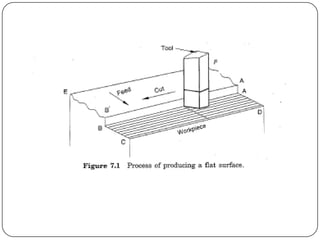
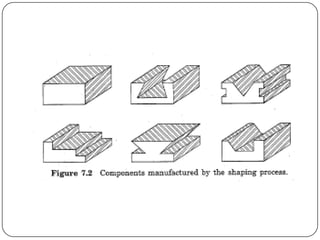
Shaping, planning and slotting can be defined as the
process of removing metal from a surface in horizontal,
vertical and inclined position to produce a flat or plane
surface, slots and grooves by means of a relative
reciprocating motion between the tool and work piece.
 The difference between the three processes of shaping,
planing and slotting is that in shaping and slotting, the
tool is reciprocating and the work piece is fed in to the
cutting tool while in planning, the work piece is
reciprocating and the tool is fed in.
 The tool reciprocates horizontally in the shaping and
vertically in slotting.
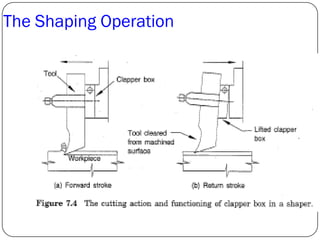
 The cutting is intermittent in all the three processes
because in the relative reciprocating motion the tool cuts
only in forward- working ( or cutting) stroke followed by
the idle-return stroke.
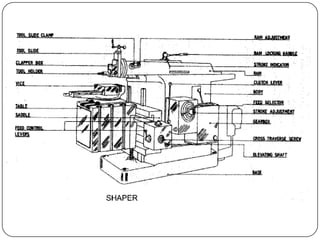
The Shaper
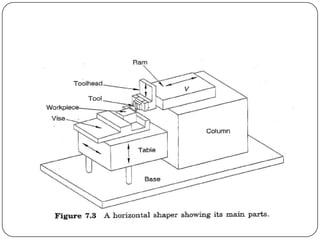
 The machine tool used for shaping operation is called shaper.
 It is designed for machining flat surfaces on small sized jobs. If the
size of the job is large, then planing is used.
 In a shaper , the work piece is held stationary during cutting, while
the tool reciprocates horizontally. the feed and depth of cut are
normally provided by moving the work. Such shaper is called a
horizontal shaper.
Types of Shaping Machines
 Shaping machines are the reciprocating type of machine
tools in which the work piece is held stationary and the
tool reciprocates.
 Most shapers have reciprocating motion in horizontal
position ( horizontal shapers) but shapers are also
designed with reciprocating motion in vertical position(
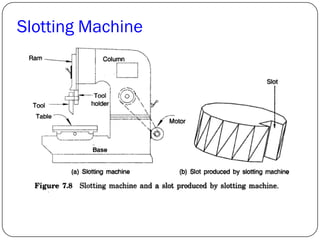
vertical shapers) or slotting machines or slotters.
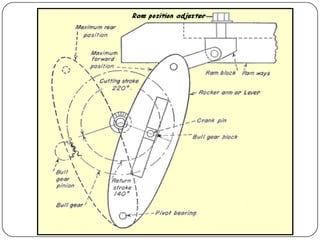
The Shaping Operation
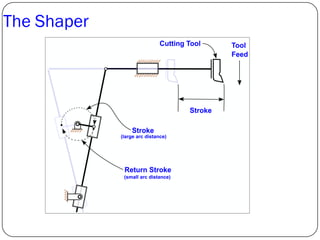
The Shaper
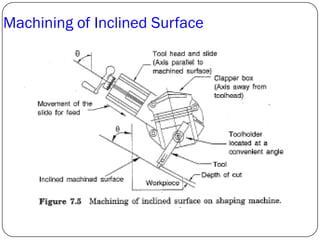
Machining of Inclined Surface
Operating conditions in a Shaping Machine
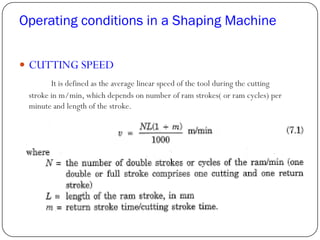
 CUTTING SPEED
It is defined as the average linear speed of the tool during the cutting
stroke in m/min, which depends on number of ram strokes( or ram cycles) per
minute and length of the stroke.
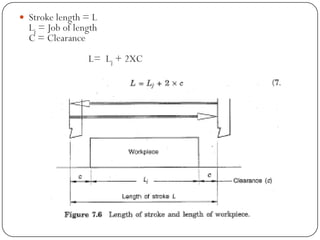
 Stroke length = L
Lj = Job of length
C = Clearance
L= Lj + 2XC
Feed
 Feed f is the relative motion of the work piece in a direction
perpendicular to the axis of the reciprocation of the arm.
 In shaper, feed is normally given to the work piece and can be
automatic or manual.
 It is expressed in mm/double stroke or simply mm/stroke
because no cutting is done in return stroke
Depth of Cut
 Depth of cut d is the thickness of the material removed in
one cut, in mm.
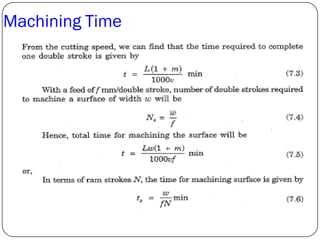
Machining Time
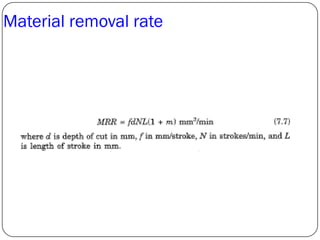
Material removal rate
The Planer
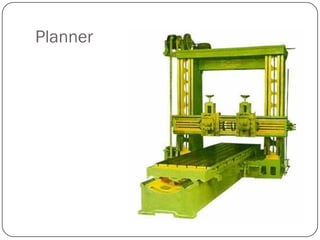
Planner
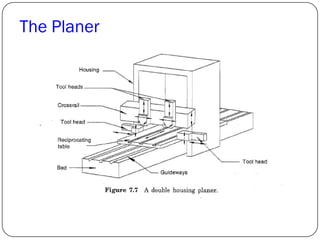
The Planer
 The planer or planing machine is a machine tool, which
like the shaper produces flat surfaces in horizontal,
vertical or inclined plane.
 The fundamental difference is that the planer operates
with an action opposite to that of the shapers, i.e., the
work piece reciprocates past one or mare stationary
single point cutting tools.
 Planers are meant for machining large sized work pieces,
which cannot be machined by the shaping machines.
Types of Planing Machines
 Some other types of planing machines include
Universal planer, pit type planer and edge
planer.
Operating Conditions in planers
 Cutting speed
similar to shaper
Feed
the feed in a planing machine is the distance the tool
travels at the beginning of each cutting stroke and is
expressed in mm/double stroke
Depth of cut, Material Removal rate.
Size of shaper and planers
 The size of planer and shaper are specified by the maximum
length of stroke.
 The normal maximum stroke length of the stroke is 800mm.
Slotting Machine
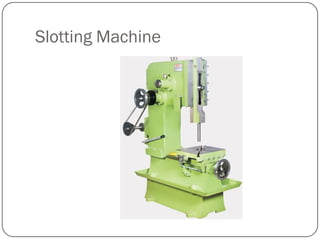
Slotting Machine
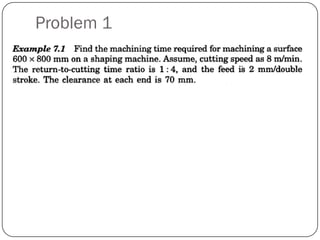
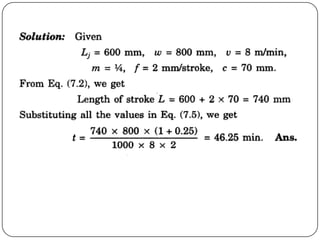
Problem 1
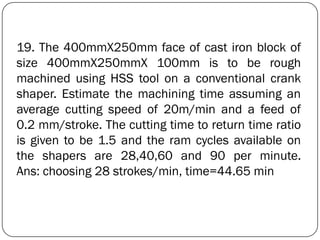
19. The 400mmX250mm face of cast iron block of
size 400mmX250mmX 100mm is to be rough
machined using HSS tool on a conventional crank
shaper. Estimate the machining time assuming an
average cutting speed of 20m/min and a feed of
0.2 mm/stroke. The cutting time to return time ratio
is given to be 1.5 and the ram cycles available on
the shapers are 28,40,60 and 90 per minute.
Ans: choosing 28 strokes/min, time=44.65 min
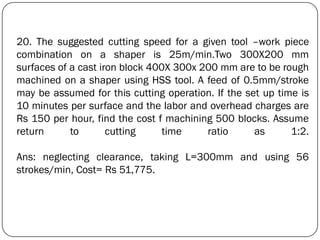
20. The suggested cutting speed for a given tool –work piece
combination on a shaper is 25m/min.Two 300X200 mm
surfaces of a cast iron block 400X 300x 200 mm are to be rough
machined on a shaper using HSS tool. A feed of 0.5mm/stroke
may be assumed for this cutting operation. If the set up time is
10 minutes per surface and the labor and overhead charges are
Rs 150 per hour, find the cost f machining 500 blocks. Assume
return to cutting time ratio as 1:2.
Ans: neglecting clearance, taking L=300mm and using 56
strokes/min, Cost= Rs 51,775.
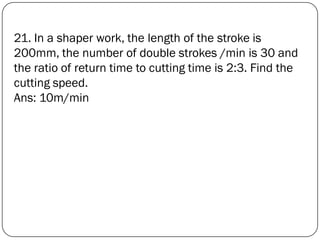
21. In a shaper work, the length of the stroke is
200mm, the number of double strokes /min is 30 and
the ratio of return time to cutting time is 2:3. Find the
cutting speed.
Ans: 10m/min

__lec_12_-_13_shaping_planing_and_slotting_operations.pdf

  • 1.
    Ta 102 Workshop practice Shaping,Planing and Slotting Operations Lec No. 12- 13 BY Prof .A.Chandrashekhar
  • 2.
    Introduction Shaping, planning andslotting can be defined as the process of removing metal from a surface in horizontal, vertical and inclined position to produce a flat or plane surface, slots and grooves by means of a relative reciprocating motion between the tool and work piece.
  • 3.
     The differencebetween the three processes of shaping, planing and slotting is that in shaping and slotting, the tool is reciprocating and the work piece is fed in to the cutting tool while in planning, the work piece is reciprocating and the tool is fed in.
  • 4.
     The toolreciprocates horizontally in the shaping and vertically in slotting.  The cutting is intermittent in all the three processes because in the relative reciprocating motion the tool cuts only in forward- working ( or cutting) stroke followed by the idle-return stroke.
  • 7.
    The Shaper  Themachine tool used for shaping operation is called shaper.  It is designed for machining flat surfaces on small sized jobs. If the size of the job is large, then planing is used.  In a shaper , the work piece is held stationary during cutting, while the tool reciprocates horizontally. the feed and depth of cut are normally provided by moving the work. Such shaper is called a horizontal shaper.
  • 10.
    Types of ShapingMachines  Shaping machines are the reciprocating type of machine tools in which the work piece is held stationary and the tool reciprocates.  Most shapers have reciprocating motion in horizontal position ( horizontal shapers) but shapers are also designed with reciprocating motion in vertical position( vertical shapers) or slotting machines or slotters.
  • 11.
  • 12.
  • 14.
  • 15.
    Operating conditions ina Shaping Machine  CUTTING SPEED It is defined as the average linear speed of the tool during the cutting stroke in m/min, which depends on number of ram strokes( or ram cycles) per minute and length of the stroke.
  • 16.
     Stroke length= L Lj = Job of length C = Clearance L= Lj + 2XC
  • 17.
    Feed  Feed fis the relative motion of the work piece in a direction perpendicular to the axis of the reciprocation of the arm.  In shaper, feed is normally given to the work piece and can be automatic or manual.  It is expressed in mm/double stroke or simply mm/stroke because no cutting is done in return stroke
  • 18.
    Depth of Cut Depth of cut d is the thickness of the material removed in one cut, in mm.
  • 19.
  • 20.
  • 21.
  • 22.
  • 23.
    The Planer  Theplaner or planing machine is a machine tool, which like the shaper produces flat surfaces in horizontal, vertical or inclined plane.  The fundamental difference is that the planer operates with an action opposite to that of the shapers, i.e., the work piece reciprocates past one or mare stationary single point cutting tools.  Planers are meant for machining large sized work pieces, which cannot be machined by the shaping machines.
  • 24.
    Types of PlaningMachines  Some other types of planing machines include Universal planer, pit type planer and edge planer.
  • 25.
    Operating Conditions inplaners  Cutting speed similar to shaper Feed the feed in a planing machine is the distance the tool travels at the beginning of each cutting stroke and is expressed in mm/double stroke Depth of cut, Material Removal rate.
  • 26.
    Size of shaperand planers  The size of planer and shaper are specified by the maximum length of stroke.  The normal maximum stroke length of the stroke is 800mm.
  • 27.
  • 28.
  • 29.
  • 34.
    19. The 400mmX250mmface of cast iron block of size 400mmX250mmX 100mm is to be rough machined using HSS tool on a conventional crank shaper. Estimate the machining time assuming an average cutting speed of 20m/min and a feed of 0.2 mm/stroke. The cutting time to return time ratio is given to be 1.5 and the ram cycles available on the shapers are 28,40,60 and 90 per minute. Ans: choosing 28 strokes/min, time=44.65 min
  • 35.
    20. The suggestedcutting speed for a given tool –work piece combination on a shaper is 25m/min.Two 300X200 mm surfaces of a cast iron block 400X 300x 200 mm are to be rough machined on a shaper using HSS tool. A feed of 0.5mm/stroke may be assumed for this cutting operation. If the set up time is 10 minutes per surface and the labor and overhead charges are Rs 150 per hour, find the cost f machining 500 blocks. Assume return to cutting time ratio as 1:2. Ans: neglecting clearance, taking L=300mm and using 56 strokes/min, Cost= Rs 51,775.
  • 36.
    21. In ashaper work, the length of the stroke is 200mm, the number of double strokes /min is 30 and the ratio of return time to cutting time is 2:3. Find the cutting speed. Ans: 10m/min