This programme has been funded with
support from the European Commission
Innovating New Products: Plan your
adventure initiative
Module 1
INTRODUCTION
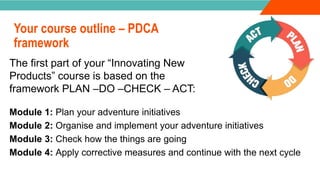
Your course outline – PDCA
framework
Module 1: Plan your adventure initiatives
Module 2: Organise and implement your adventure initiatives
Module 3: Check how the things are going
Module 4: Apply corrective measures and continue with the next cycle
The first part of your “Innovating New
Products” course is based on the
framework PLAN –DO –CHECK – ACT:
If you want to achieve market success with your
adventure initiative you have to plan it well in
advance. Planning takes place in all
organizations in some form or other, whether it
be formal or informal, and at a variety of levels.
The plan is the tactical means of implementing
strategy and achieving objectives.
In order to fully develop your adventure initiative
you will need to measure the supply and
demand and set specific goals. It is immensely
important to also measure the impact of the
initiative, weather positive or negative, on the
cultural and natural environment.
Module 1 Introduction
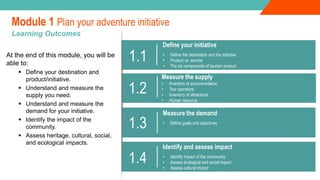
1.1
Define your initiative
• Define the destination and the initiative
• Product vs. service
• The six components of tourism product
1.2
Measure the supply
• Inventory of accommodation
• Tour operators
• Inventory of attractions
• Human resource
At the end of this module, you will be
able to:
 Define your destination and
product/initiative.
 Understand and measure the
supply you need.
 Understand and measure the
demand for your initiative.
 Identify the impact of the
community.
 Assess heritage, cultural, social,
and ecological impacts.
Module 1 Plan your adventure initiative
Learning Outcomes
Measure the demand
• Define goals and objectives
1.3
1.4
Identify and assess impact
• Identify impact of the community
• Assess ecological and social impact
• Assess cultural impact
Adventure Tourism I www.adventuretourism.eu
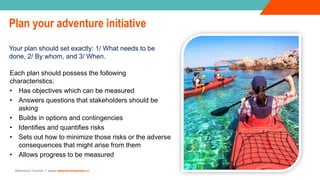
Plan your adventure initiative
Your plan should set exactly: 1/ What needs to be
done, 2/ By whom, and 3/ When.
Each plan should possess the following
characteristics:
• Has objectives which can be measured
• Answers questions that stakeholders should be
asking
• Builds in options and contingencies
• Identifies and quantifies risks
• Sets out how to minimize those risks or the adverse
consequences that might arise from them
• Allows progress to be measured
Adventure Tourism I www.adventuretourism.eu
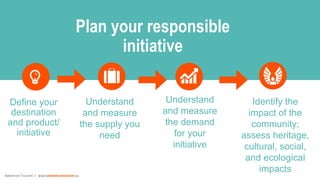
Define your
destination
and product/
initiative
Identify the
impact of the
community;
assess heritage,
cultural, social,
and ecological
impacts
Plan your responsible
initiative
Understand
and measure
the supply you
need
Understand
and measure
the demand
for your
initiative
Adventure Tourism I www.adventuretourism.eu
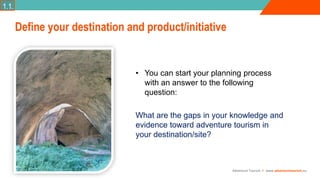
• You can start your planning process
with an answer to the following
question:
What are the gaps in your knowledge and
evidence toward adventure tourism in
your destination/site?
Define your destination and product/initiative
1.1.
Adventure Tourism I www.adventuretourism.eu
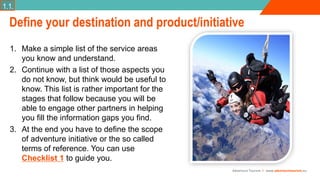
1. Make a simple list of the service areas
you know and understand.
2. Continue with a list of those aspects you
do not know, but think would be useful to
know. This list is rather important for the
stages that follow because you will be
able to engage other partners in helping
you fill the information gaps you find.
3. At the end you have to define the scope
of adventure initiative or the so called
terms of reference. You can use
Checklist 1 to guide you.
Define your destination and product/initiative
1.1.
Adventure Tourism I www.adventuretourism.eu
If you cannot answer these questions, or similar
questions specific to your site, you must spend some time
to trying to find these answers before starting to develop
anything.
During the process of defining your adventure service
keep in mind that by definition adventure tourism as a
part of alternative tourism should achieve a balance
between the environmental, economic, and socio-cultural
aspects of tourism development (the so called triple
bottom line). Try to develop an integrated tourism
experience — socially, economically, environmentally.
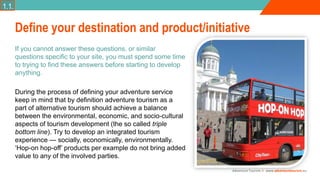
‘Hop-on hop-off’ products per example do not bring added
value to any of the involved parties.
Define your destination and product/initiative
1.1.
Goods vs. Services
Goods Services Resulting implications
Tangible Intangible
 Services cannot be inventoried.
 Services cannot be easily patented.
 Services cannot be readily displayed or
communicated.
 Pricing is difficult.
Standardized Heterogeneous
 Service delivery and customer satisfaction
depend on employee and customer actions.
 Service quality depends on many uncontrollable
factors.
 There is no sure knowledge that the service
delivered matches what was planned and
promoted.
Production
separate from
consumption
Simultaneous
production and
consumption
 Customers affect each other.
 Employees affect the service outcome.
 Decentralisation may be essential.
 Mass production is difficult.
Nonperishable Perishable
 It is difficult to synchronise supply and demand
with services.
 Services cannot be returned or resold.
Source: Parasuraman, A., Zeithaml, V. and Berry, L. (1985), “A conceptual model of service quality and its implications for further
research”, Journal of Marketing, Vol. 48, Fall, pp. 41-50 (cited in: Zeithaml, et al., 2006, p. 22)
1.1.
Are you
developing a
product or a
service?
?
Adventure Tourism I www.adventuretourism.eu
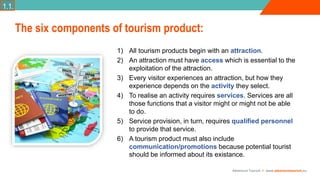
The six components of tourism product:
1) All tourism products begin with an attraction.
2) An attraction must have access which is essential to the
exploitation of the attraction.
3) Every visitor experiences an attraction, but how they
experience depends on the activity they select.
4) To realise an activity requires services. Services are all
those functions that a visitor might or might not be able
to do.
5) Service provision, in turn, requires qualified personnel
to provide that service.
6) A tourism product must also include
communication/promotions because potential tourist
should be informed about its existance.
1.1.
Adventure Tourism I www.adventuretourism.eu
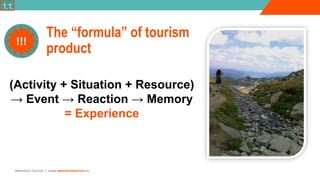
The “formula” of tourism
product
(Activity + Situation + Resource)
→ Event → Reaction → Memory
= Experience
!!!
1.1.
Adventure Tourism I www.adventuretourism.eu
Understanding adventure tourism
and defining the service is the first
step to managing successful
adventure tourism initiatives.
Reliable data is the key to both
being able to monitor threats to
your initiative, and ensuring market
segments are effectively targeted.
Understand and measure the supply you need
1.2.
Adventure Tourism I www.adventuretourism.eu
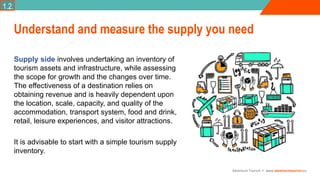
Supply side involves undertaking an inventory of
tourism assets and infrastructure, while assessing
the scope for growth and the changes over time.
The effectiveness of a destination relies on
obtaining revenue and is heavily dependent upon
the location, scale, capacity, and quality of the
accommodation, transport system, food and drink,
retail, leisure experiences, and visitor attractions.
It is advisable to start with a simple tourism supply
inventory.
Understand and measure the supply you need
1.2.
Adventure Tourism I www.adventuretourism.eu
Inventory of accommodations
An inventory of accommodations considers all existing providers in the destination including
hotels, guesthouses, resorts, B&Bs, self-catering rentals, and camping sites. Important data
about accommodations include the following:
1.2.
 Number of rooms and beds
 Segmentation mix of accommodations
 Average rack rate (per season)
 Employment
 Occupancy rate (per season)
 Average length of stay
 Other elements to the destination’s strategy
such as key markets, use of green
technologies, involvement with local
communities
Adventure Tourism I www.adventuretourism.eu
Inventory of accommodations
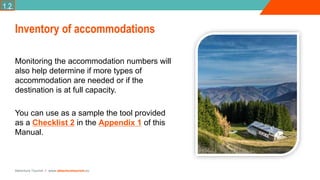
Monitoring the accommodation numbers will
also help determine if more types of
accommodation are needed or if the
destination is at full capacity.
You can use as a sample the tool provided
as a Checklist 2 in the Appendix 1 of this
Manual.
1.2.
Adventure Tourism I www.adventuretourism.eu
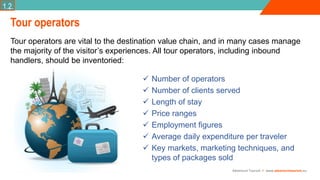
Tour operators
Tour operators are vital to the destination value chain, and in many cases manage
the majority of the visitor’s experiences. All tour operators, including inbound
handlers, should be inventoried:
1.2.
 Number of operators
 Number of clients served
 Length of stay
 Price ranges
 Employment figures
 Average daily expenditure per traveler
 Key markets, marketing techniques, and
types of packages sold
Adventure Tourism I www.adventuretourism.eu
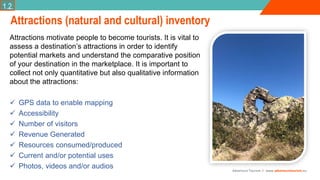
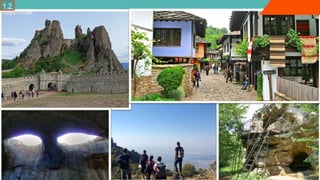
Attractions (natural and cultural) inventory
Attractions motivate people to become tourists. It is vital to
assess a destination’s attractions in order to identify
potential markets and understand the comparative position
of your destination in the marketplace. It is important to
collect not only quantitative but also qualitative information
about the attractions:
 GPS data to enable mapping
 Accessibility
 Number of visitors
 Revenue Generated
 Resources consumed/produced
 Current and/or potential uses
 Photos, videos and/or audios
1.2.
Adventure Tourism I www.adventuretourism.eu
1.2.
Human and institutional capacity
Tourism is a people-oriented business and depends
on quality service from trained managers and
employees. Understanding the actual and potential
human resource base of a destination is critical in
determining to what degree a community can
meaningfully participate in the development of
responsible tourism. Institutional support is also a
factor, in some cases a critical one.
1.2.
Click on the logos to visit the website of the organization:
Adventure Tourism I www.adventuretourism.eu
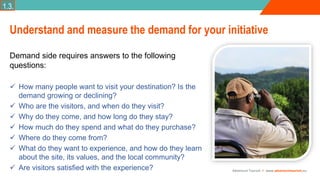
Understand and measure the demand for your initiative
Demand side requires answers to the following
questions:
 How many people want to visit your destination? Is the
demand growing or declining?
 Who are the visitors, and when do they visit?
 Why do they come, and how long do they stay?
 How much do they spend and what do they purchase?
 Where do they come from?
 What do they want to experience, and how do they learn
about the site, its values, and the local community?
 Are visitors satisfied with the experience?
1.3.
Adventure Tourism I www.adventuretourism.eu
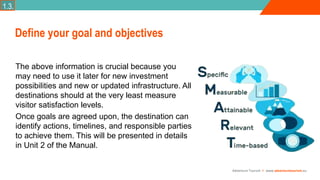
Define your goal and objectives
The above information is crucial because you
may need to use it later for new investment
possibilities and new or updated infrastructure. All
destinations should at the very least measure
visitor satisfaction levels.
Once goals are agreed upon, the destination can
identify actions, timelines, and responsible parties
to achieve them. This will be presented in details
in Unit 2 of the Manual.
1.3.
Adventure Tourism I www.adventuretourism.eu
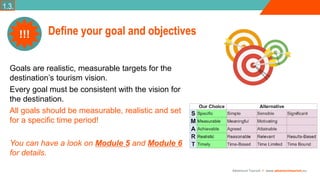
Define your goal and objectives
Goals are realistic, measurable targets for the
destination’s tourism vision.
Every goal must be consistent with the vision for
the destination.
All goals should be measurable, realistic and set
for a specific time period!
You can have a look on Module 5 and Module 6
for details.
1.3.
!!!
Adventure Tourism I www.adventuretourism.eu
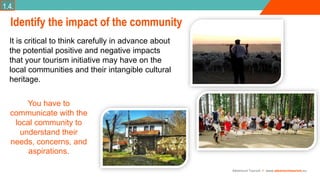
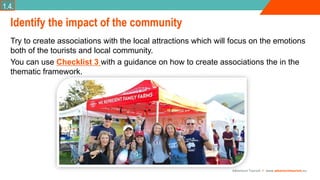
Identify the impact of the community
It is critical to think carefully in advance about
the potential positive and negative impacts
that your tourism initiative may have on the
local communities and their intangible cultural
heritage.
You have to
communicate with the
local community to
understand their
needs, concerns, and
aspirations.
1.4.
Adventure Tourism I www.adventuretourism.eu
Identify the impact of the community
Try to create associations with the local attractions which will focus on the emotions
both of the tourists and local community.
You can use Checklist 3 with a guidance on how to create associations the in the
thematic framework.
1.4.
Adventure Tourism I www.adventuretourism.eu
Assess heritage, cultural, social, and
ecological impacts
The degree to which tourism businesses provide local career
opportunities (with fair wages), equal opportunities, and
occupational safety are important and worthy of analysis. It is
also important to monitor risks and negative impacts over time
so that areas of concern can be managed in the appropriate
way at the appropriate times.
1.5.
Adventure Tourism I www.adventuretourism.eu
Assess heritage, cultural, social, and ecological impacts
You have to take into account the following Critical Success Factors (CSFs):
 Agreed objectives and clear concepts
 Financial planning for budgeting, capital raising and price setting
 Effective marketing strategies based on sound market research
 Destination and proximity to major markets and visitor flows
 Human resource management, including paid staff and volunteers
 Planning for product differentiation, life cycles and value adding
 Quality and authenticity of products and experiences
 Engage cultural heritage and tourism expertise in conservation and promotion
 Design interpretation as an integral part of the heritage tourism experience
1.5.
05
1. Target Setting
2. Critical Success Factors (CSFs) and Key Performance
Indicators (KPIs)
3. Financial Modelling
4. Business Examples & Resources
03
Gutierrez, E. 2011. Project Development
for Sustainable Tourism: A Step by Step
Approach. Online Learning Tools and
Resources. Sustainable Tourism:
International Cooperation for
Development. The George Washington
University and USAID.
Hawkins, D. E. & Mann, S. 2007. The
World Bank’s Role in Tourism
Development. Annals of Tourism
Research: A Social Sciences Journal, 9 (1),
115-132.
References:
Adventure Tourism I www.adventuretourism.eu
Hawkins, D. & Nikolova, M. 2005. Knowledge Applications
for Competitive Destinations: A Visitor Experience Value
Chain Approach. The WTO Education Council Conference,
the XVI General Assembly of the World Tourism
Organization, Senegal, December 1.
Lee, C.L. & Yang, J. 2000. Knowledge Value Chain. Journal of
Management Development, October 2000, 19 (9).
Normann, R. & Ramírez, R. 2004. Designing Interactive
Strategy: From Value Chain to Value Constellation, John
Wiley & Sons, Inc.
05
1. Target Setting
2. Critical Success Factors (CSFs) and Key Performance
Indicators (KPIs)
3. Financial Modelling
4. Business Examples & Resources
03
Web Resurces:
https://quizlet.com/91838461/sustainabl
e-tourism-vocabulary-flash-cards/
http://visokaturisticka.edu.rs/pitanja/oba
vezne_reci_a3_ema.pdf
https://prezi.com/klvmoyi0v34_/responsi
ble-tourism/
http://www.ttra.com/assets/1/7/Respons
ible_Tourism_and_the_Future_-
_John_Swarbrooke.pdf
References:
Adventure Tourism I www.adventuretourism.eu
Additional Resources:
Culture and Heritage Tourism: Understanding the Issues
and Success Factors, www.crctourism.com.au
(permanently archived on
http://www.webcitation.org/5sjXNipDH)
CDC Development Solutions:
www.cdcdevelopmentsolutions.org
Center of Excellence for Destinations: www.ced.travel
International Union for Conservation of Nature:
www.iucn.org
Joliba Trust: www.jolibatrust.org.uk
Lindblad Expeditions: www.expeditions.com
National Geographic Center for Sustainable Destinations:
http://travel.nationalgeographic.com/travel/sustainable/
www.adventuretourism.eu
AVIP Facebook
Contact Us
Thank You!

Plan your adventure initiative - Module 1

  • 1.
    This programme hasbeen funded with support from the European Commission Innovating New Products: Plan your adventure initiative Module 1
  • 2.
    INTRODUCTION Your course outline– PDCA framework Module 1: Plan your adventure initiatives Module 2: Organise and implement your adventure initiatives Module 3: Check how the things are going Module 4: Apply corrective measures and continue with the next cycle The first part of your “Innovating New Products” course is based on the framework PLAN –DO –CHECK – ACT:
  • 3.
    If you wantto achieve market success with your adventure initiative you have to plan it well in advance. Planning takes place in all organizations in some form or other, whether it be formal or informal, and at a variety of levels. The plan is the tactical means of implementing strategy and achieving objectives. In order to fully develop your adventure initiative you will need to measure the supply and demand and set specific goals. It is immensely important to also measure the impact of the initiative, weather positive or negative, on the cultural and natural environment. Module 1 Introduction
  • 4.
    1.1 Define your initiative •Define the destination and the initiative • Product vs. service • The six components of tourism product 1.2 Measure the supply • Inventory of accommodation • Tour operators • Inventory of attractions • Human resource At the end of this module, you will be able to:  Define your destination and product/initiative.  Understand and measure the supply you need.  Understand and measure the demand for your initiative.  Identify the impact of the community.  Assess heritage, cultural, social, and ecological impacts. Module 1 Plan your adventure initiative Learning Outcomes Measure the demand • Define goals and objectives 1.3 1.4 Identify and assess impact • Identify impact of the community • Assess ecological and social impact • Assess cultural impact
  • 5.
    Adventure Tourism Iwww.adventuretourism.eu Plan your adventure initiative Your plan should set exactly: 1/ What needs to be done, 2/ By whom, and 3/ When. Each plan should possess the following characteristics: • Has objectives which can be measured • Answers questions that stakeholders should be asking • Builds in options and contingencies • Identifies and quantifies risks • Sets out how to minimize those risks or the adverse consequences that might arise from them • Allows progress to be measured
  • 6.
    Adventure Tourism Iwww.adventuretourism.eu Define your destination and product/ initiative Identify the impact of the community; assess heritage, cultural, social, and ecological impacts Plan your responsible initiative Understand and measure the supply you need Understand and measure the demand for your initiative
  • 7.
    Adventure Tourism Iwww.adventuretourism.eu • You can start your planning process with an answer to the following question: What are the gaps in your knowledge and evidence toward adventure tourism in your destination/site? Define your destination and product/initiative 1.1.
  • 8.
    Adventure Tourism Iwww.adventuretourism.eu 1. Make a simple list of the service areas you know and understand. 2. Continue with a list of those aspects you do not know, but think would be useful to know. This list is rather important for the stages that follow because you will be able to engage other partners in helping you fill the information gaps you find. 3. At the end you have to define the scope of adventure initiative or the so called terms of reference. You can use Checklist 1 to guide you. Define your destination and product/initiative 1.1.
  • 9.
    Adventure Tourism Iwww.adventuretourism.eu If you cannot answer these questions, or similar questions specific to your site, you must spend some time to trying to find these answers before starting to develop anything. During the process of defining your adventure service keep in mind that by definition adventure tourism as a part of alternative tourism should achieve a balance between the environmental, economic, and socio-cultural aspects of tourism development (the so called triple bottom line). Try to develop an integrated tourism experience — socially, economically, environmentally. ‘Hop-on hop-off’ products per example do not bring added value to any of the involved parties. Define your destination and product/initiative 1.1.
  • 10.
    Goods vs. Services GoodsServices Resulting implications Tangible Intangible  Services cannot be inventoried.  Services cannot be easily patented.  Services cannot be readily displayed or communicated.  Pricing is difficult. Standardized Heterogeneous  Service delivery and customer satisfaction depend on employee and customer actions.  Service quality depends on many uncontrollable factors.  There is no sure knowledge that the service delivered matches what was planned and promoted. Production separate from consumption Simultaneous production and consumption  Customers affect each other.  Employees affect the service outcome.  Decentralisation may be essential.  Mass production is difficult. Nonperishable Perishable  It is difficult to synchronise supply and demand with services.  Services cannot be returned or resold. Source: Parasuraman, A., Zeithaml, V. and Berry, L. (1985), “A conceptual model of service quality and its implications for further research”, Journal of Marketing, Vol. 48, Fall, pp. 41-50 (cited in: Zeithaml, et al., 2006, p. 22) 1.1. Are you developing a product or a service? ?
  • 11.
    Adventure Tourism Iwww.adventuretourism.eu The six components of tourism product: 1) All tourism products begin with an attraction. 2) An attraction must have access which is essential to the exploitation of the attraction. 3) Every visitor experiences an attraction, but how they experience depends on the activity they select. 4) To realise an activity requires services. Services are all those functions that a visitor might or might not be able to do. 5) Service provision, in turn, requires qualified personnel to provide that service. 6) A tourism product must also include communication/promotions because potential tourist should be informed about its existance. 1.1.
  • 12.
    Adventure Tourism Iwww.adventuretourism.eu The “formula” of tourism product (Activity + Situation + Resource) → Event → Reaction → Memory = Experience !!! 1.1.
  • 13.
    Adventure Tourism Iwww.adventuretourism.eu Understanding adventure tourism and defining the service is the first step to managing successful adventure tourism initiatives. Reliable data is the key to both being able to monitor threats to your initiative, and ensuring market segments are effectively targeted. Understand and measure the supply you need 1.2.
  • 14.
    Adventure Tourism Iwww.adventuretourism.eu Supply side involves undertaking an inventory of tourism assets and infrastructure, while assessing the scope for growth and the changes over time. The effectiveness of a destination relies on obtaining revenue and is heavily dependent upon the location, scale, capacity, and quality of the accommodation, transport system, food and drink, retail, leisure experiences, and visitor attractions. It is advisable to start with a simple tourism supply inventory. Understand and measure the supply you need 1.2.
  • 15.
    Adventure Tourism Iwww.adventuretourism.eu Inventory of accommodations An inventory of accommodations considers all existing providers in the destination including hotels, guesthouses, resorts, B&Bs, self-catering rentals, and camping sites. Important data about accommodations include the following: 1.2.  Number of rooms and beds  Segmentation mix of accommodations  Average rack rate (per season)  Employment  Occupancy rate (per season)  Average length of stay  Other elements to the destination’s strategy such as key markets, use of green technologies, involvement with local communities
  • 16.
    Adventure Tourism Iwww.adventuretourism.eu Inventory of accommodations Monitoring the accommodation numbers will also help determine if more types of accommodation are needed or if the destination is at full capacity. You can use as a sample the tool provided as a Checklist 2 in the Appendix 1 of this Manual. 1.2.
  • 17.
    Adventure Tourism Iwww.adventuretourism.eu Tour operators Tour operators are vital to the destination value chain, and in many cases manage the majority of the visitor’s experiences. All tour operators, including inbound handlers, should be inventoried: 1.2.  Number of operators  Number of clients served  Length of stay  Price ranges  Employment figures  Average daily expenditure per traveler  Key markets, marketing techniques, and types of packages sold
  • 18.
    Adventure Tourism Iwww.adventuretourism.eu Attractions (natural and cultural) inventory Attractions motivate people to become tourists. It is vital to assess a destination’s attractions in order to identify potential markets and understand the comparative position of your destination in the marketplace. It is important to collect not only quantitative but also qualitative information about the attractions:  GPS data to enable mapping  Accessibility  Number of visitors  Revenue Generated  Resources consumed/produced  Current and/or potential uses  Photos, videos and/or audios 1.2.
  • 19.
    Adventure Tourism Iwww.adventuretourism.eu 1.2.
  • 20.
    Human and institutionalcapacity Tourism is a people-oriented business and depends on quality service from trained managers and employees. Understanding the actual and potential human resource base of a destination is critical in determining to what degree a community can meaningfully participate in the development of responsible tourism. Institutional support is also a factor, in some cases a critical one. 1.2. Click on the logos to visit the website of the organization:
  • 21.
    Adventure Tourism Iwww.adventuretourism.eu Understand and measure the demand for your initiative Demand side requires answers to the following questions:  How many people want to visit your destination? Is the demand growing or declining?  Who are the visitors, and when do they visit?  Why do they come, and how long do they stay?  How much do they spend and what do they purchase?  Where do they come from?  What do they want to experience, and how do they learn about the site, its values, and the local community?  Are visitors satisfied with the experience? 1.3.
  • 22.
    Adventure Tourism Iwww.adventuretourism.eu Define your goal and objectives The above information is crucial because you may need to use it later for new investment possibilities and new or updated infrastructure. All destinations should at the very least measure visitor satisfaction levels. Once goals are agreed upon, the destination can identify actions, timelines, and responsible parties to achieve them. This will be presented in details in Unit 2 of the Manual. 1.3.
  • 23.
    Adventure Tourism Iwww.adventuretourism.eu Define your goal and objectives Goals are realistic, measurable targets for the destination’s tourism vision. Every goal must be consistent with the vision for the destination. All goals should be measurable, realistic and set for a specific time period! You can have a look on Module 5 and Module 6 for details. 1.3. !!!
  • 24.
    Adventure Tourism Iwww.adventuretourism.eu Identify the impact of the community It is critical to think carefully in advance about the potential positive and negative impacts that your tourism initiative may have on the local communities and their intangible cultural heritage. You have to communicate with the local community to understand their needs, concerns, and aspirations. 1.4.
  • 25.
    Adventure Tourism Iwww.adventuretourism.eu Identify the impact of the community Try to create associations with the local attractions which will focus on the emotions both of the tourists and local community. You can use Checklist 3 with a guidance on how to create associations the in the thematic framework. 1.4.
  • 26.
    Adventure Tourism Iwww.adventuretourism.eu Assess heritage, cultural, social, and ecological impacts The degree to which tourism businesses provide local career opportunities (with fair wages), equal opportunities, and occupational safety are important and worthy of analysis. It is also important to monitor risks and negative impacts over time so that areas of concern can be managed in the appropriate way at the appropriate times. 1.5.
  • 27.
    Adventure Tourism Iwww.adventuretourism.eu Assess heritage, cultural, social, and ecological impacts You have to take into account the following Critical Success Factors (CSFs):  Agreed objectives and clear concepts  Financial planning for budgeting, capital raising and price setting  Effective marketing strategies based on sound market research  Destination and proximity to major markets and visitor flows  Human resource management, including paid staff and volunteers  Planning for product differentiation, life cycles and value adding  Quality and authenticity of products and experiences  Engage cultural heritage and tourism expertise in conservation and promotion  Design interpretation as an integral part of the heritage tourism experience 1.5.
  • 28.
    05 1. Target Setting 2.Critical Success Factors (CSFs) and Key Performance Indicators (KPIs) 3. Financial Modelling 4. Business Examples & Resources 03 Gutierrez, E. 2011. Project Development for Sustainable Tourism: A Step by Step Approach. Online Learning Tools and Resources. Sustainable Tourism: International Cooperation for Development. The George Washington University and USAID. Hawkins, D. E. & Mann, S. 2007. The World Bank’s Role in Tourism Development. Annals of Tourism Research: A Social Sciences Journal, 9 (1), 115-132. References: Adventure Tourism I www.adventuretourism.eu Hawkins, D. & Nikolova, M. 2005. Knowledge Applications for Competitive Destinations: A Visitor Experience Value Chain Approach. The WTO Education Council Conference, the XVI General Assembly of the World Tourism Organization, Senegal, December 1. Lee, C.L. & Yang, J. 2000. Knowledge Value Chain. Journal of Management Development, October 2000, 19 (9). Normann, R. & Ramírez, R. 2004. Designing Interactive Strategy: From Value Chain to Value Constellation, John Wiley & Sons, Inc.
  • 29.
    05 1. Target Setting 2.Critical Success Factors (CSFs) and Key Performance Indicators (KPIs) 3. Financial Modelling 4. Business Examples & Resources 03 Web Resurces: https://quizlet.com/91838461/sustainabl e-tourism-vocabulary-flash-cards/ http://visokaturisticka.edu.rs/pitanja/oba vezne_reci_a3_ema.pdf https://prezi.com/klvmoyi0v34_/responsi ble-tourism/ http://www.ttra.com/assets/1/7/Respons ible_Tourism_and_the_Future_- _John_Swarbrooke.pdf References: Adventure Tourism I www.adventuretourism.eu Additional Resources: Culture and Heritage Tourism: Understanding the Issues and Success Factors, www.crctourism.com.au (permanently archived on http://www.webcitation.org/5sjXNipDH) CDC Development Solutions: www.cdcdevelopmentsolutions.org Center of Excellence for Destinations: www.ced.travel International Union for Conservation of Nature: www.iucn.org Joliba Trust: www.jolibatrust.org.uk Lindblad Expeditions: www.expeditions.com National Geographic Center for Sustainable Destinations: http://travel.nationalgeographic.com/travel/sustainable/
  • 30.