Plan 111: Human Settlement Development
PLAN 111: HUMAN SETTLEMENT DEVELOPMENT
ORIGIN OF CITIES
Md. Mashrur Rahman
Lecturer,
Department of Urban and Regional Planning
Bangladesh University of Engineering and Technology (BUET)
3/3/2015
11/3/2015 Plan 111: Human Settlement Development
ORIGIN OF CITIES:
Hunting and Gathering Society (Paleolithic
Period):
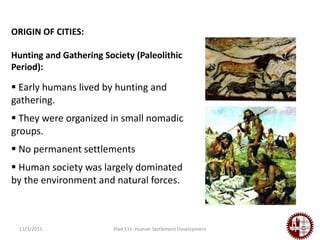
 Early humans lived by hunting and
gathering.
 They were organized in small nomadic
groups.
 No permanent settlements
 Human society was largely dominated
by the environment and natural forces.
11/3/2015 Plan 111: Human Settlement Development
ORIGIN OF CITIES:
End of Last Ice Age: 10,000 BC (Neolithic Period):
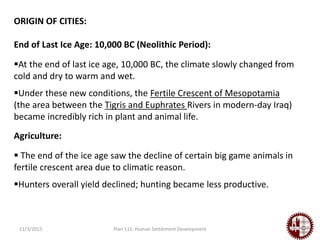
At the end of last ice age, 10,000 BC, the climate slowly changed from
cold and dry to warm and wet.
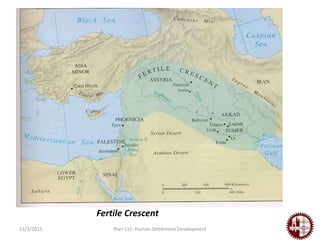
Under these new conditions, the Fertile Crescent of Mesopotamia
(the area between the Tigris and Euphrates Rivers in modern-day Iraq)
became incredibly rich in plant and animal life.
Agriculture:
 The end of the ice age saw the decline of certain big game animals in
fertile crescent area due to climatic reason.
Hunters overall yield declined; hunting became less productive.
11/3/2015 Plan 111: Human Settlement Development
Fertile Crescent
11/3/2015 Plan 111: Human Settlement Development
ORIGIN OF CITIES:
Agriculture:
 It prompted people to search for new and more reliable sources of food.
 The initial stage of agriculture was deliberate planting of seeds and the
improvement of key grains through the selection of seeds from the best
plants.
Domestication of animals: Animals were used mostly for food, clothing,
and their bones for tools
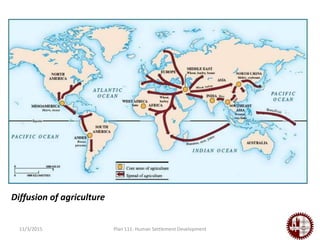
Farming was initially developed in the Middle East; in the fertile crescent
area (present-day Turkey to Iraq and Israel )
Gradually during the Neolithic centuries, knowledge of agriculture spread
to other centers, including parts of India, north Africa, and Europe
11/3/2015 Plan 111: Human Settlement Development
Diffusion of agriculture
11/3/2015 Plan 111: Human Settlement Development
ORIGIN OF CITIES:
Sedentary Life Style:
 Early agriculture could support far more people per square mile than
hunting ever could.
 It also allowed people to settle more permanently in one area as crops
required constant care from planting to harvest
Surplus of Food:
 Systematic and organized agriculture resulted in substantial surplus beyond
the own needs of the farmers.
Division of Labor:
 Agricultural society insisted the development of pottery and metallurgy.
 Greater wealth and larger populations freed some people for other
specializations.
11/3/2015 Plan 111: Human Settlement Development
Hydraulic Theory of Early Settlement (Wittfogel)
 Efficient farming of plains alongside rivers requires intelligent
management of water resources for irrigation.
 The development of irrigation works in the areas such as
Mesopotamia and Egypt led to the use of-
 mass labor,
 an organizational hierarchy for coordinating and directing its
activities,
 and to government control for ensuring proper distribution of the
water.
11/3/2015 Plan 111: Human Settlement Development
Concentration of social surplus: Government, administration and
Priesthood
 Concentration of social surplus to the government and accumulation of
capital
 Public administration; defense; military force
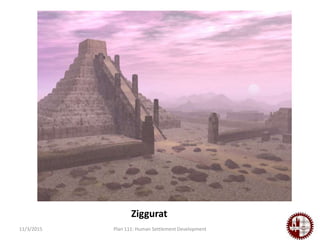
 Development of priesthood, temples, ziggurats
 Agricultural surplus; specialization of labour also gave rise to trade and
commerce
 As symbols of cosmic, social, and moral order, public ceremonial
structures such as pyramids, mounds, and temples were centers of
political, social, economic and sacred space.
11/3/2015 Plan 111: Human Settlement Development
Ziggurat
11/3/2015 Plan 111: Human Settlement Development
Concentrated population and social surplus
Social hierarchy & formal institutions
Defense against outsiders (wall)
Monumental architecture (temples, palaces)
Management of resources
Creation of irrigation systems, granaries, etc.
Collection of taxes/tribute
Distribution to members of the court
Distribution to subjects in times of famine
Factors behind the emergence of cities
11/3/2015 Plan 111: Human Settlement Development
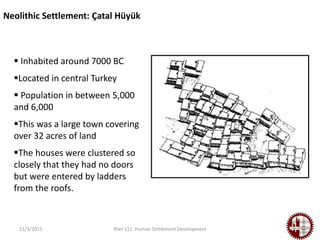
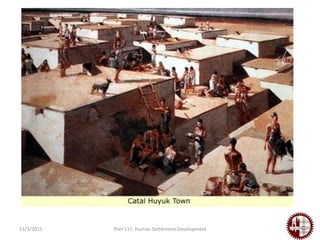
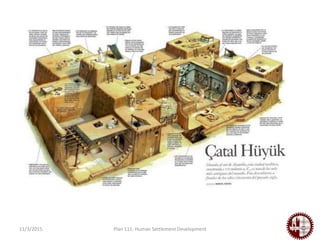
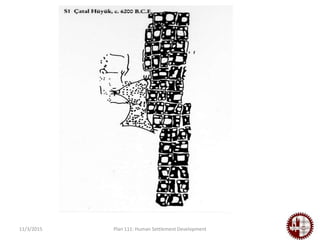
Neolithic Settlement: Çatal Hüyük
 Inhabited around 7000 BC
Located in central Turkey
 Population in between 5,000
and 6,000
This was a large town covering
over 32 acres of land
The houses were clustered so
closely that they had no doors
but were entered by ladders
from the roofs.
11/3/2015 Plan 111: Human Settlement Development
The economy of Catal Huyuk was based on simple irrigation
agriculture, sheep and cattle breeding, and the trade of obsidian,
textiles, skins, food items and information.
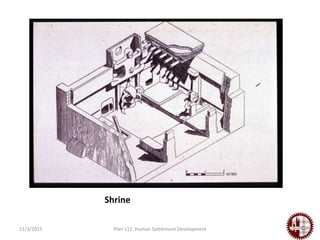
The many religious shrines found at the site also indicate the
existence of a powerful Priesthood.
The obvious importance of the cult shrines and the elaborate burial
practices of the peoples of Catal Huyuk reveal the growing role of
religion in the lives of Neolithic peoples
Neolithic Settlement: Çatal Hüyük
11/3/2015 Plan 111: Human Settlement Development
Shrine
11/3/2015 Plan 111: Human Settlement Development
Neolithic Settlement: Jericho
 Inhabited around 9000 BC
 Jericho is the most ancient town located in the Jordan Valley close to
the Jordan River.
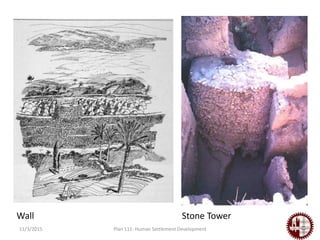
 A wall was built around it, enclosing an area of 10 acres.
 The wall itself was 6.5 feet thick and is preserved to a height of almost
20 feet.
 This is the earliest known fortification in the world.
An extraordinary circular stone tower constructed just inside the wall.
An enclosed stairway led to its top.
11/3/2015 Plan 111: Human Settlement Development
Wall Stone Tower
11/3/2015 Plan 111: Human Settlement Development
Main Reading List:
1. Diamond J (1997) Guns, Germs, and Steel: The Fates of Human
Societies. New York: W W Norton
2. Mumford, L. (1961). The city in history: Its origins, its transformations,
and its prospects. New York: Harcourt, Brace & World.
11/3/2015 Plan 111: Human Settlement Development

Origin of cities

  • 1.
    Plan 111: HumanSettlement Development PLAN 111: HUMAN SETTLEMENT DEVELOPMENT ORIGIN OF CITIES Md. Mashrur Rahman Lecturer, Department of Urban and Regional Planning Bangladesh University of Engineering and Technology (BUET) 3/3/2015
  • 2.
    11/3/2015 Plan 111:Human Settlement Development ORIGIN OF CITIES: Hunting and Gathering Society (Paleolithic Period):  Early humans lived by hunting and gathering.  They were organized in small nomadic groups.  No permanent settlements  Human society was largely dominated by the environment and natural forces.
  • 3.
    11/3/2015 Plan 111:Human Settlement Development ORIGIN OF CITIES: End of Last Ice Age: 10,000 BC (Neolithic Period): At the end of last ice age, 10,000 BC, the climate slowly changed from cold and dry to warm and wet. Under these new conditions, the Fertile Crescent of Mesopotamia (the area between the Tigris and Euphrates Rivers in modern-day Iraq) became incredibly rich in plant and animal life. Agriculture:  The end of the ice age saw the decline of certain big game animals in fertile crescent area due to climatic reason. Hunters overall yield declined; hunting became less productive.
  • 4.
    11/3/2015 Plan 111:Human Settlement Development Fertile Crescent
  • 5.
    11/3/2015 Plan 111:Human Settlement Development ORIGIN OF CITIES: Agriculture:  It prompted people to search for new and more reliable sources of food.  The initial stage of agriculture was deliberate planting of seeds and the improvement of key grains through the selection of seeds from the best plants. Domestication of animals: Animals were used mostly for food, clothing, and their bones for tools Farming was initially developed in the Middle East; in the fertile crescent area (present-day Turkey to Iraq and Israel ) Gradually during the Neolithic centuries, knowledge of agriculture spread to other centers, including parts of India, north Africa, and Europe
  • 6.
    11/3/2015 Plan 111:Human Settlement Development Diffusion of agriculture
  • 7.
    11/3/2015 Plan 111:Human Settlement Development ORIGIN OF CITIES: Sedentary Life Style:  Early agriculture could support far more people per square mile than hunting ever could.  It also allowed people to settle more permanently in one area as crops required constant care from planting to harvest Surplus of Food:  Systematic and organized agriculture resulted in substantial surplus beyond the own needs of the farmers. Division of Labor:  Agricultural society insisted the development of pottery and metallurgy.  Greater wealth and larger populations freed some people for other specializations.
  • 8.
    11/3/2015 Plan 111:Human Settlement Development Hydraulic Theory of Early Settlement (Wittfogel)  Efficient farming of plains alongside rivers requires intelligent management of water resources for irrigation.  The development of irrigation works in the areas such as Mesopotamia and Egypt led to the use of-  mass labor,  an organizational hierarchy for coordinating and directing its activities,  and to government control for ensuring proper distribution of the water.
  • 9.
    11/3/2015 Plan 111:Human Settlement Development Concentration of social surplus: Government, administration and Priesthood  Concentration of social surplus to the government and accumulation of capital  Public administration; defense; military force  Development of priesthood, temples, ziggurats  Agricultural surplus; specialization of labour also gave rise to trade and commerce  As symbols of cosmic, social, and moral order, public ceremonial structures such as pyramids, mounds, and temples were centers of political, social, economic and sacred space.
  • 10.
    11/3/2015 Plan 111:Human Settlement Development Ziggurat
  • 11.
    11/3/2015 Plan 111:Human Settlement Development Concentrated population and social surplus Social hierarchy & formal institutions Defense against outsiders (wall) Monumental architecture (temples, palaces) Management of resources Creation of irrigation systems, granaries, etc. Collection of taxes/tribute Distribution to members of the court Distribution to subjects in times of famine Factors behind the emergence of cities
  • 12.
    11/3/2015 Plan 111:Human Settlement Development Neolithic Settlement: Çatal Hüyük  Inhabited around 7000 BC Located in central Turkey  Population in between 5,000 and 6,000 This was a large town covering over 32 acres of land The houses were clustered so closely that they had no doors but were entered by ladders from the roofs.
  • 13.
    11/3/2015 Plan 111:Human Settlement Development
  • 14.
    11/3/2015 Plan 111:Human Settlement Development
  • 15.
    11/3/2015 Plan 111:Human Settlement Development The economy of Catal Huyuk was based on simple irrigation agriculture, sheep and cattle breeding, and the trade of obsidian, textiles, skins, food items and information. The many religious shrines found at the site also indicate the existence of a powerful Priesthood. The obvious importance of the cult shrines and the elaborate burial practices of the peoples of Catal Huyuk reveal the growing role of religion in the lives of Neolithic peoples Neolithic Settlement: Çatal Hüyük
  • 16.
    11/3/2015 Plan 111:Human Settlement Development Shrine
  • 17.
    11/3/2015 Plan 111:Human Settlement Development
  • 18.
    11/3/2015 Plan 111:Human Settlement Development Neolithic Settlement: Jericho  Inhabited around 9000 BC  Jericho is the most ancient town located in the Jordan Valley close to the Jordan River.  A wall was built around it, enclosing an area of 10 acres.  The wall itself was 6.5 feet thick and is preserved to a height of almost 20 feet.  This is the earliest known fortification in the world. An extraordinary circular stone tower constructed just inside the wall. An enclosed stairway led to its top.
  • 19.
    11/3/2015 Plan 111:Human Settlement Development Wall Stone Tower
  • 20.
    11/3/2015 Plan 111:Human Settlement Development Main Reading List: 1. Diamond J (1997) Guns, Germs, and Steel: The Fates of Human Societies. New York: W W Norton 2. Mumford, L. (1961). The city in history: Its origins, its transformations, and its prospects. New York: Harcourt, Brace & World.
  • 21.
    11/3/2015 Plan 111:Human Settlement Development