Social
                      Studies for 8 th

FIRST CIVILIZATIONS   E.G.B.
                      Teacher:
                      Mauricio
                      Torres
REVIEWING: CIVILIZATION

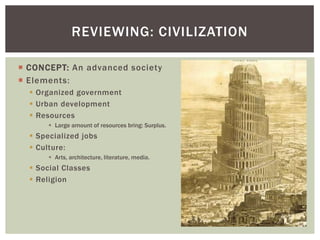
 CONCEPT: An advanced society
 Elements:
   Organized government
   Urban development
   Resources
        Large amount of resources bring: Surplus.
   Specialized jobs
   Culture:
        Arts, architecture, literature, media.
   Social Classes
   Religion
FIRST CAME THE TEMPLE, THEN CAME
              THE CIT Y
 With the building of
  Megaliths such as Göbekli
  Tepe, modern day Turkey,
  humans began to gather
  around permanent areas.
 Göbekli Tepe was an hilltop
  sanctuary at the top of a
  mountain ridge.
 The importance of the site is
  because its shows that
  hunter-gatherer societies
  could also erect monumental
  complexes.
BEGINNINGS

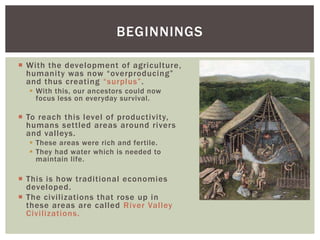
 With the development of agriculture,
  humanity was now “overproducing”
  and thus creating “surplus”.
   With this, our ancestors could now
    focus less on everyday survival.

 To reach this level of productivity,
  humans settled areas around rivers
  and valleys.
   These areas were rich and fertile.
   They had water which is needed to
    maintain life.

 This is how traditional economies
  developed.
 The civilizations that rose up in
  these areas are called River Valley
  Civilizations.
RIVER VALLEY CIVILIZATIONS
THE FIRST: ÇÄTALHÖYÜK

               Çätalhöyük was a very
                large settlement from
                the Neolithic in what is
                modern day Turkey.
               Archaeological finds
                show us that there was
                a canal that ran in
                between the area,
                probably used to keep
                the soil fertile for
                agriculture.
THE FIRST: ÇÄTALHÖYÜK

 It was composed of domestic
  buildings.
 Estimated population is 8,000.
 The dead were buried in the
  village. Some of the bodies
  found had no heads on them!
 Murals have been discovered,
  with many religious themes.
 With no distinctive differences
  on each house, archaeologists
  believe there were no social
  classes.
 The first benefits of
  agriculture are found, and
  even traded items from far
  away lands are here.
WHY DID THESE CIVILIZATIONS
                DISAPPEAR?
 They were always in constant change.
   This change usually involved a shift in the environment.

 Environments affect people’s lives:
   Civilizations have always relied on resources.
   If a resource is depleted, they will need to find a need source or
    something to replace it.
 Cultural diffusion:
   The spread of ideas, customs and technologies from one people to
    another.
   This was usually a product of trade or migration.
 Expansion:
   Villages expanded into city-states (a political unit that included a city
    and its surrounding lands and villages).
   The next step, was creating empires, which is a group of territories or
    states controlled by one ruler.
SUMMARY: CAUSE AND EFFECTS

 Cause
   Neolithic people learn to farm > They
    settle into communities > They settle in
    river valleys > New technologies improve
    farming > Food surplus leads to
    population growth > First cities are built.


 Ef fects
     Complex forms of government develop.
     Arts become more elaborate.
     Job specialization leads to classes.
     People invent writing.
     Early civilization create empires.
THEREFORE


We can now say that a civilization is a
 complex, highly organized social order.
BIBLIOGRAPHY

 Ellis, E. G., & Esler, A . (2009). World Histor y. (P. Hall, Ed.)
  Upper Saddle River, New Jersey, US: Pearson Education INC.
 Burstein, S. M., & Shek, R. (2012). World Histor y (Teacher´s
  Edition) (1st Edition ed.). (H. McDougal, Ed.) Orlando, Florida,
  US.: Houghton Mif flin Harcourt Publishing Company.
 Wikipedia. (n.d.). Catal Huyuk. Retrieved May 14, 2012, from
  Wikipedia: http://en.wikipedia.org/wiki/Catal_Huyuk
 Wikipedia. (n.d.). Gobelki Tepe. Retrieved May 14, 2012, from
  Wikipedia: http://en.wikipedia.org/wiki/G%C3%B6bekli_Tepe
 Images taken from Google.com

Early Civilizations

  • 1.
    Social Studies for 8 th FIRST CIVILIZATIONS E.G.B. Teacher: Mauricio Torres
  • 2.
    REVIEWING: CIVILIZATION  CONCEPT:An advanced society  Elements:  Organized government  Urban development  Resources  Large amount of resources bring: Surplus.  Specialized jobs  Culture:  Arts, architecture, literature, media.  Social Classes  Religion
  • 3.
    FIRST CAME THETEMPLE, THEN CAME THE CIT Y  With the building of Megaliths such as Göbekli Tepe, modern day Turkey, humans began to gather around permanent areas.  Göbekli Tepe was an hilltop sanctuary at the top of a mountain ridge.  The importance of the site is because its shows that hunter-gatherer societies could also erect monumental complexes.
  • 4.
    BEGINNINGS  With thedevelopment of agriculture, humanity was now “overproducing” and thus creating “surplus”.  With this, our ancestors could now focus less on everyday survival.  To reach this level of productivity, humans settled areas around rivers and valleys.  These areas were rich and fertile.  They had water which is needed to maintain life.  This is how traditional economies developed.  The civilizations that rose up in these areas are called River Valley Civilizations.
  • 5.
  • 6.
    THE FIRST: ÇÄTALHÖYÜK  Çätalhöyük was a very large settlement from the Neolithic in what is modern day Turkey.  Archaeological finds show us that there was a canal that ran in between the area, probably used to keep the soil fertile for agriculture.
  • 7.
    THE FIRST: ÇÄTALHÖYÜK It was composed of domestic buildings.  Estimated population is 8,000.  The dead were buried in the village. Some of the bodies found had no heads on them!  Murals have been discovered, with many religious themes.  With no distinctive differences on each house, archaeologists believe there were no social classes.  The first benefits of agriculture are found, and even traded items from far away lands are here.
  • 8.
    WHY DID THESECIVILIZATIONS DISAPPEAR?  They were always in constant change.  This change usually involved a shift in the environment.  Environments affect people’s lives:  Civilizations have always relied on resources.  If a resource is depleted, they will need to find a need source or something to replace it.  Cultural diffusion:  The spread of ideas, customs and technologies from one people to another.  This was usually a product of trade or migration.  Expansion:  Villages expanded into city-states (a political unit that included a city and its surrounding lands and villages).  The next step, was creating empires, which is a group of territories or states controlled by one ruler.
  • 9.
    SUMMARY: CAUSE ANDEFFECTS  Cause  Neolithic people learn to farm > They settle into communities > They settle in river valleys > New technologies improve farming > Food surplus leads to population growth > First cities are built.  Ef fects  Complex forms of government develop.  Arts become more elaborate.  Job specialization leads to classes.  People invent writing.  Early civilization create empires.
  • 10.
    THEREFORE We can nowsay that a civilization is a complex, highly organized social order.
  • 11.
    BIBLIOGRAPHY  Ellis, E.G., & Esler, A . (2009). World Histor y. (P. Hall, Ed.) Upper Saddle River, New Jersey, US: Pearson Education INC.  Burstein, S. M., & Shek, R. (2012). World Histor y (Teacher´s Edition) (1st Edition ed.). (H. McDougal, Ed.) Orlando, Florida, US.: Houghton Mif flin Harcourt Publishing Company.  Wikipedia. (n.d.). Catal Huyuk. Retrieved May 14, 2012, from Wikipedia: http://en.wikipedia.org/wiki/Catal_Huyuk  Wikipedia. (n.d.). Gobelki Tepe. Retrieved May 14, 2012, from Wikipedia: http://en.wikipedia.org/wiki/G%C3%B6bekli_Tepe  Images taken from Google.com