AR-213:Human Settlements &
Vernacular Architecture
L-03 [Evolution of Planning]
Part -2: Ancient Cities
Date: 07-02-2019
Ar. Somi Sareen
ANCIENT CIVILISATION
Mesopotamian Civilisation
Greek Civilisation
Ancient Rome Civilisation
Indus Valley Civilisation
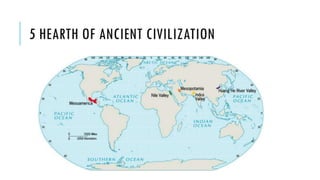
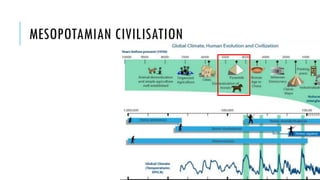
5 HEARTH OF ANCIENT CIVILIZATION
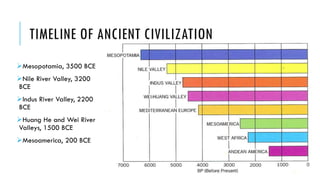
TIMELINE OF ANCIENT CIVILIZATION
Mesopotamia, 3500 BCE
Nile River Valley, 3200
BCE
Indus River Valley, 2200
BCE
Huang He and Wei River
Valleys, 1500 BCE
Mesoamerica, 200 BCE
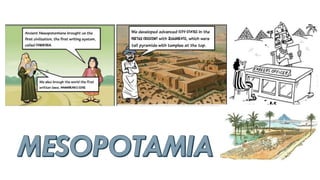
MESOPOTAMIAN CIVILISATION
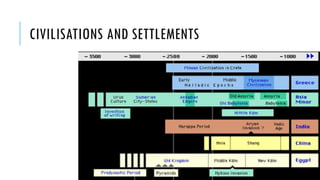
CIVILISATIONS AND SETTLEMENTS
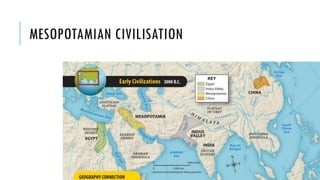
MESOPOTAMIAN CIVILISATION
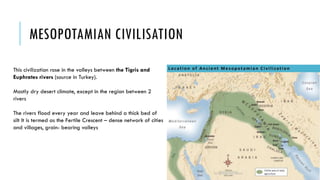
This civilization rose in the valleys between the Tigris and
Euphrates rivers (source in Turkey).
Mostly dry desert climate, except in the region between 2
rivers
The rivers flood every year and leave behind a thick bed of
silt It is termed as the Fertile Crescent – dense network of cities
and villages, grain- bearing valleys
MESOPOTAMIAN CIVILISATION
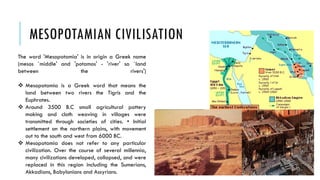
The word 'Mesopotamia' is in origin a Greek name
(mesos `middle' and 'potamos' - 'river' so `land
between the rivers')
 Mesopotamia is a Greek word that means the
land between two rivers the Tigris and the
Euphrates.
 Around 3500 B.C small agricultural pottery
making and cloth weaving in villages were
transmitted through societies of cities. • Initial
settlement on the northern plains, with movement
out to the south and west from 6000 BC.
 Mesopotamia does not refer to any particular
civilization. Over the course of several millennia,
many civilizations developed, collapsed, and were
replaced in this region including the Sumerians,
Akkadians, Babylonians and Assyrians.
MESOPOTAMIAN CIVILISATION
 Beginning in Mesopotamia, civilization spread west to Egypt and east to
India and China. These three civilizations formed an early international
trading network that eventually extended across the connected lands of
Eurasia and North Africa, a vast region that lies in a temperate climate
zone where most of the world’s people have lived since prehistoric times.
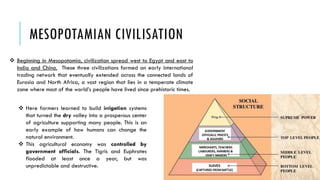
 Here farmers learned to build irrigation systems
that turned the dry valley into a prosperous center
of agriculture supporting many people. This is an
early example of how humans can change the
natural environment.
 This agricultural economy was controlled by
government officials. The Tigris and Euphrates
flooded at least once a year, but was
unpredictable and destructive.
MESOPOTAMIAN CIVILISATION
GEOGRAPHY:
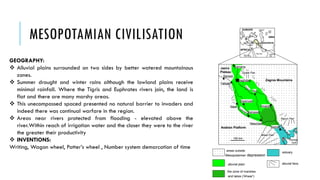
 Alluvial plains surrounded on two sides by better watered mountainous
zones.
 Summer drought and winter rains although the lowland plains receive
minimal rainfall. Where the Tigris and Euphrates rivers join, the land is
flat and there are many marshy areas.
 This unecompassed spaced presented no natural barrier to invaders and
indeed there was continual warfare in the region.
 Areas near rivers protected from flooding - elevated above the
river.Within reach of irrigation water and the closer they were to the river
the greater their productivity
 INVENTIONS:
Writing, Wagon wheel, Potter’s wheel , Number system demarcation of time
MESOPOTAMIAN CIVILISATION
FAVOURABLE CONDITION
 Favorable geographic circumstances allowed the people of Mesopotamia
to evolve from a hunter-gatherer culture to a culture based on husbandry,
agriculture, and permanent settlements.
 Trade with other regions also flourished, as indicated by the presence in
early burial sites of metals and precious stones not locally available
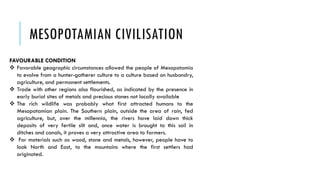
 The rich wildlife was probably what first attracted humans to the
Mesopotamian plain. The Southern plain, outside the area of rain, fed
agriculture, but, over the millennia, the rivers have laid down thick
deposits of very fertile silt and, once water is brought to this soil in
ditches and canals, it proves a very attractive area to farmers.
 For materials such as wood, stone and metals, however, people have to
look North and East, to the mountains where the first settlers had
originated.
MESOPOTAMIAN CIVILISATION
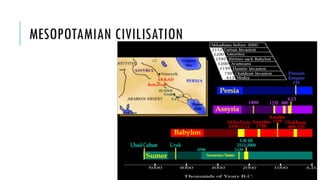
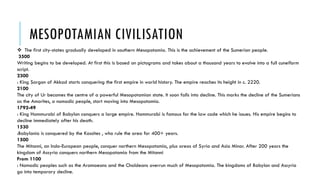
 The first city-states gradually developed in southern Mesopotamia. This is the achievement of the Sumerian people.
3500
Writing begins to be developed. At first this is based on pictograms and takes about a thousand years to evolve into a full cuneiform
script.
2300
: King Sargon of Akkad starts conquering the first empire in world history. The empire reaches its height in c. 2220.
2100
The city of Ur becomes the centre of a powerful Mesopotamian state. It soon falls into decline. This marks the decline of the Sumerians
as the Amorites, a nomadic people, start moving into Mesopotamia.
1792-49
: King Hammurabi of Babylon conquers a large empire. Hammurabi is famous for the law code which he issues. His empire begins to
decline immediately after his death.
1530
:Babylonia is conquered by the Kassites , who rule the area for 400+ years.
1500
The Mitanni, an Indo-European people, conquer northern Mesopotamia, plus areas of Syria and Asia Minor. After 200 years the
kingdom of Assyria conquers northern Mesopotamia from the Mitanni
From 1100
: Nomadic peoples such as the Aramaeans and the Chaldeans overrun much of Mesopotamia. The kingdoms of Babylon and Assyria
go into temporary decline.
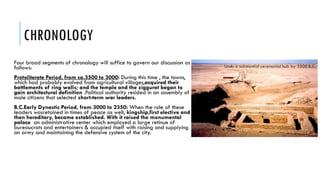
CHRONOLOGY
Four broad segments of chronology will suffice to govern our discussion as
follows:
Protoliterate Period, from ca.3500 to 3000: During this time , the towns,
which had probably evolved from agricultural villages,acquired their
battlements of ring walls; and the temple and the ziggurat began to
gain architectural definition .Political authority resided in an assembly of
male citizens that selected short-term war leaders.
B.C.Early Dynastic Period, from 3000 to 2350: When the role of these
leaders wasretained in times of peace as well, kingship,first elective and
then hereditary, became established. With it raised the monumental
palace an administrative center which employed a large retinue of
bureaucrats and entertainers & occupied itself with raising and supplying
an army and maintaining the defensive system of the city.
CHRONOLOGY
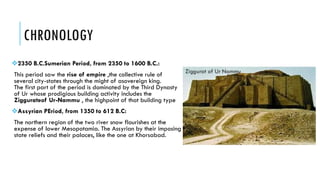
2350 B.C.Sumerian Period, from 2350 to 1600 B.C.:
This period saw the rise of empire ,the collective rule of
several city-states through the might of asovereign king.
The first part of the period is dominated by the Third Dynasty
of Ur whose prodigious building activity includes the
Ziggurateof Ur-Nammu , the highpoint of that building type
Assyrian PEriod, from 1350 to 612 B.C:
The northern region of the two river snow flourishes at the
expense of lower Mesopotamia. The Assyrian by their imposing
state reliefs and their palaces, like the one at Khorsabad.
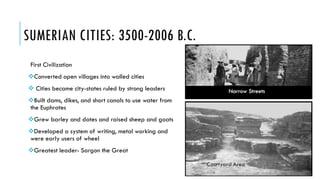
SUMERIAN CITIES: 3500-2006 B.C.
First Civilization
Converted open villages into walled cities
 Cities became city-states ruled by strong leaders
Built dams, dikes, and short canals to use water from
the Euphrates
Grew barley and dates and raised sheep and goats
Developed a system of writing, metal working and
were early users of wheel
Greatest leader- Sargon the Great
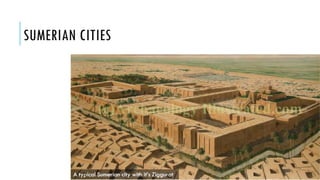
SUMERIAN CITIES
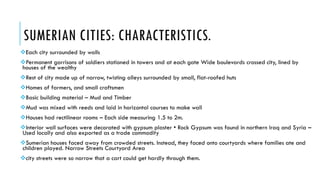
SUMERIAN CITIES: CHARACTERISTICS.
Each city surrounded by walls
Permanent garrisons of soldiers stationed in towers and at each gate Wide boulevards crossed city, lined by
houses of the wealthy
Rest of city made up of narrow, twisting alleys surrounded by small, flat-roofed huts
Homes of farmers, and small craftsmen
Basic building material – Mud and Timber
Mud was mixed with reeds and laid in horizontal courses to make wall
Houses had rectilinear rooms – Each side measuring 1.5 to 2m.
Interior wall surfaces were decorated with gypsum plaster • Rock Gypsum was found in northern Iraq and Syria –
Used locally and also exported as a trade commodity
Sumerian houses faced away from crowded streets. Instead, they faced onto courtyards where families ate and
children played. Narrow Streets Courtyard Area
city streets were so narrow that a cart could get hardly through them.
SETTLEMENT PATTERN
Small villages that surrounded the cities disappear and the cities themselves grow in size.
Many of the rural people moved to the new fortified cities such as Uruk. In response to
increased inter-city warfare related to the dominance of the secular-based ruling elite.The
growing power of a military based authority could have been a crucial factor in the rise of
cities and state society
Neolithic: No substantial settlement in southern Mesopotamia before 5500BC. From 6000BC
to 4000BC settlement expanded from the uplands to incorporate more and more of the
Mesopotamian plain.
The Ubaid :culture expands to northern Mesopotamia, seen by the presence of shared
material culture particularly painted pottery. The Ubaid culture was the foundation culture of
Mesopotamia with temple centered settlements that administered exchange.
 Eridu: Eridu established by 5400 BC initially 1-2 ha for the whole site. Located in the
extreme south of the Mesopotamian plain. Agriculture around Eridu is dependent on irrigation
with wheat, barley, sheep, goats and cattle. Possible that irrigation management is responsible
for the expansion and elaboration of the temple institution
SETTLEMENT PATTERN
Uruk: Uruk earliest urban centre to form a city state. A number of cities develop at the same
time. From the middle of the 4th millennium BC one city in each of the proto-states becomes
dominant, the most important being Uruk. Development concentrated in the south. The cities
have large walls, and mud brick buildings that create tells.
At Uruk a precinct where several temples were adjacent. Temples associated with ziggurats -
stepped towers the temples have large storage facilities. They are the redistributive centers
for both agricultural produce and craft goods. The temple joined by a palace suggesting
religion supporting secular control. Some temples built on a large platform or ziggurat to
make them even more impressive.
Akkadian Empire. The city states only ever unified for short periods of time before they
collapsed back to individual cities. Sargon of Agade conquered Kish and spread south from
there. His success led to the fall of the last of the Sumerian rulers and the establishment of the
Akkadian empire. The empire lasted from 2350-2150 BC. A more integrated system of trade
developed controlled by the palace. But it did not create a long-lived political or economic
system
GOVERNMENT
Mesopotamia did not have protection from natural boundaries. This led to constant
migrations of Indo-European people from the area between the Black and Caspian
seas.
This lead to a constant migration and 'Cultural Diffusion', or the process where an
existing culture adopts the traits of another and the two eventually merge into a new
culture.
As a result, a strong central government failed to develop in Mesopotamia. The
dominant political unit was the 'City-State', a small area surrounding a large, complex
city.
UR, THE CAPITAL CITY OF MESOPOTAMIA
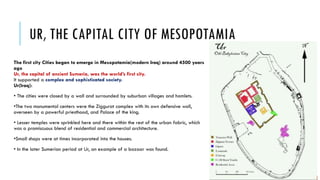
The first city Cities began to emerge in Mesopotamia(modern Iraq) around 4500 years
ago
Ur, the capital of ancient Sumeria, was the world’s first city.
It supported a complex and sophisticated society.
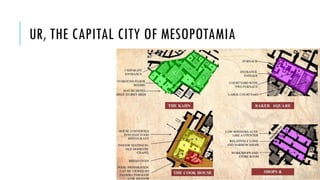
Ur(Iraq):
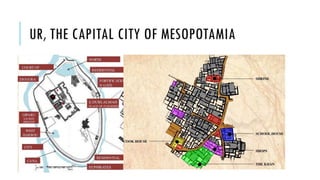
• The cities were closed by a wall and surrounded by suburban villages and hamlets.
•The two monumental centers were the Ziggurat complex with its own defensive wall,
overseen by a powerful priesthood, and Palace of the king.
• Lesser temples were sprinkled here and there within the rest of the urban fabric, which
was a promiscuous blend of residential and commercial architecture.
•Small shops were at times incorporated into the houses.
• In the later Sumerian period at Ur, an example of a bazaar was found.
UR, THE CAPITAL CITY OF MESOPOTAMIA
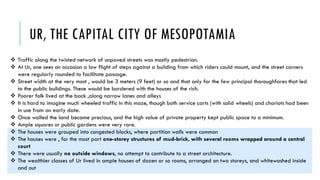
 Traffic along the twisted network of unpaved streets was mostly pedestrian.
 At Ur, one sees on occasion a low flight of steps against a building from which riders could mount, and the street corners
were regularly rounded to facilitate passage.
 Street width at the very most , would be 3 meters (9 feet) or so and that only for the few principal thoroughfares that led
to the public buildings. These would be bordered with the houses of the rich.
 Poorer folk lived at the back ,along narrow lanes and alleys
 It is hard to imagine much wheeled traffic in this maze, though both service carts (with solid wheels) and chariots had been
in use from an early date.
 Once walled the land became precious, and the high value of private property kept public space to a minimum.
 Ample squares or public gardens were very rare.
 The houses were grouped into congested blocks, where partition walls were common
 The houses were , for the most part one-storey structures of mud-brick, with several rooms wrapped around a central
court
 There were usually no outside windows, no attempt to contribute to a street architecture.
 The wealthier classes of Ur lived in ample houses of dozen or so rooms, arranged on two storeys, and whitewashed inside
and out
UR, THE CAPITAL CITY OF MESOPOTAMIA
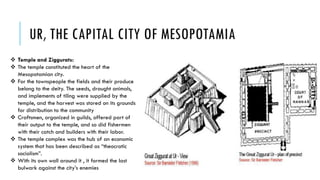
 Temple and Ziggurats:
 The temple constituted the heart of the
Mesopotamian city.
 For the townspeople the fields and their produce
belong to the deity. The seeds, draught animals,
and implements of tiling were supplied by the
temple, and the harvest was stored on its grounds
for distribution to the community
 Craftsmen, organized in guilds, offered part of
their output to the temple, and so did fishermen
with their catch and builders with their labor.
 The temple complex was the hub of an economic
system that has been described as “theocratic
socialism”.
 With its own wall around it , it formed the last
bulwark against the city’s enemies
UR, THE CAPITAL CITY OF MESOPOTAMIA
FEW MORE…….
Uruk-The city of Warka
Khorsabad
Babylonia
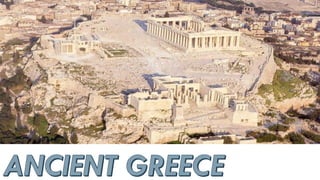
ANCIENT GREEK CIVILISATION
Beginning of Civilization:
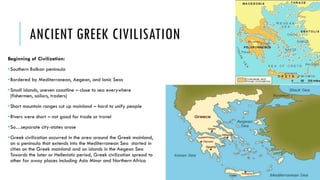
•Southern Balkan peninsula
•Bordered by Mediterranean, Aegean, and Ionic Seas
•Small islands, uneven coastline – close to sea everywhere
(fishermen, sailors, traders)
•Short mountain ranges cut up mainland – hard to unify people
•Rivers were short – not good for trade or travel
•So…separate city-states arose
•Greek civilization occurred in the area around the Greek mainland,
on a peninsula that extends into the Mediterranean Sea started in
cities on the Greek mainland and on islands in the Aegean Sea
Towards the later or Hellenistic period, Greek civilization spread to
other far away places including Asia Minor and Northern Africa
ANCIENT GREEK CIVILISATION
Most of the Greek main land was rocky and barren and therefore bad for agriculture. Most Greeks therefore lived along the coastline or on
islands where the soil was good for farming The Aegean and Mediterranean Seas provided a means of communication and trade with other
places.
Timeline 1800 BC to 300 BC
Prehistoric Greece (2000 BC) – Island, coastal towns
Classical Greek (1000 BC) – Mainland Cities
The period of Greek history can be divided in four segments:
a. 1100 B.C- 750 B.C. Greek Dark Ages
b. 750 B.C.- 490 B.C- Archaic Period
c. 500 B.C.- 323 B.C Classical Period
d. 323 B.C- 147 B.C. Hellenistic Period.
The classical and archaic period are sometimes collectively referred to as Hellenic period
Because Greece is made up of many islands, and has many tall mountains, the Greeks began to build city-states instead of one country.A city-
state is a city with its own laws, rulers, and money.City-states were cities that acted like countries.
ANCIENT GREEK CIVILISATION
Greek Dark Ages (1100-750 BC)
The Mycenaean people were Greek in Origin
Greek civilization is therefore usually viewed as a continuation of the Mycenaean civilization
The start of the Greek civilization is therefore dated to the end of the Mycenaean civilization in 1100BC
Following the decline of Mycenae, the area around the Greek mainland went into a period of decline that is referred to as the
Greek Dark ages
Greece became depopulated with groups of people moving out of mainland Greece towards the islands of the Aegean
Mycenaean and Greek culture dwindled and many cultural elements including writing, art and architectural techniques were lost
Trade with Asia Minor, the Middle East and Egypt, which was at the root of Cretan prosperity stopped entirely
As Greek people migrated from the mainland, other people from other less prosperous mountain regions of the north migrated
to the more fertile coastline regions
ANCIENT GREEK CIVILISATION
Greek Dark Ages (1100-750 BC)
They invade the Greek mainland villages and established their rule
The northerners brought with them a Greek dialect called Dorian, as opposed to the Ionic Greek spoken by the main settlers
The two dialects and cultures later mixed together to create a Hellenic culture, which is at the root of ancient Greek civilization
These two dialects became equated with characteristic architectural forms that evolved in them
In the period following the invasion by the Dorians, there was a shift in lifestyle that produced a sedentary agricultural lifestyle and society.
Sedentary lifestyle allowed the Greeks to rediscover urbanized culture that ultimately led to evolution of classical Greek culture
Archaic Period (750 - 500 BC)
The revival of Greece from the dark ages started during the eight century BC
The Greeks developed a new political form called city states
City states are cities which are ruled as independent nations
The archaic period saw the renewal interest in overseas trading contact
ANCIENT GREEK CIVILISATION
Greek societies that were engaged in trade became rich and by joining with other their neighbors, sometimes forcefully, formed large states
The polis or city state emerged as the natural and desirable political entity
Early examples of these city states include Athens, Corinth, Argos, and Sparta on the mainland, and in the Eastern Aegean, Samos, Chios,
Smyrna, Ephesus and Miletus
The archaic period marked the rise of the aristocratic families; families that are considered noble or of higher status
The archaic period was dominated politically by the leading aristocratic families in each city state acting in concert or squabbling amongst
themselves for supremacy
At times individual aristocrats were able to take advantage of popular dissatisfaction to seize authoritarian power
Such rulers were called tyrants
ANCIENT GREEK CIVILISATION
Classical period (500 - 323 BC)
The Classical period of ancient Greek history occurred between 500 BC, and 323 BC.
The period started with the Greek city states coming into conflict with the rising Persian Empire
The free Greek cities saw the threat that was developing from the Persian Empire and prepared for resistance
A seaborne expedition by the Persians to Athens was defeated at Marathon in 490 BC
Under the Persian King Xerxes, Persia attempted a retribution in 479 BC and was defeated by an alliance of the Greek states headed by
Sparta
The Greek alliance soon transformed into an Empire under the leadership of Athens
Pericles, the ruler of Athens between 444 and 429 BC became a driving force for the development of temple architecture
Pericles used the defense revenue from the alliance for temple building in Athens to thank the Gods
ANCIENT GREEK CIVILISATION
Athens reached its greatest political and cultural heights during the classical period
The full development of the democratic system of government occurred under Pericles
The Parthenon on the Acropolis at Athens was built
Philosophical schools such as those of Socrates and Plato were founded
Between 431 and 404, Athens entered into a series of wars with Sparta which left it in ruins
The fall of Athens gradually led to political chaos in the whole of Greece
Alexander undertook a lot of military campaigns to extend the Greek empire and founded many new cities such as Alexandria in Egypt
He died in 323 BC without a heir to inherit him
The Death of Alexander marked the end of the classical period of Greece civilization
ANCIENT GREEK CIVILISATION
Hellenistic period (323 - 147 BC)
The Hellenistic period of ancient Greek civilization started with the death of Alexander in 323 BC
When Alexander died, he did not have a heir to inherit him
The Greek empire split into smaller states with Alexander’s generals as their rulers
The period saw the transplanting of Greek art, civic life and culture to newly conquered areas
The period also saw a marked increase in interest in civic buildings
The Hellenistic period ended in 147 BC, when the Roman Empire conquered Greece and incorporated the city states into it
ANCIENT GREEK CIVILISATION
Societal Organization- The city state
 Every polis was different from another, even though there were similarities between them
 They were all bounded by common language and religious beliefs
It was a major center for learning and the arts.
 When city-states were first formed, they were ruled by a few wealthy men.
 However, they gradually moved towards democracy.
 Athens developed an early form of democracy
 The ideal size of a city state was fixed at 5040 males by Plato
 Citizens in any polis were related by blood and so family ties were very strong.
 Membership of the polis was hereditary and could not be passed to persons outside the family
 The society of the polis had a social hierarchy with citizens at the top, followed by people who are not citizens and finally
slaves
 Public life was for male citizens while women were secluded in the house
ANCIENT GREEK CIVILISATION
Religious Belief
 The ancient Greeks were polytheistic, believing in many different gods and goddesses
 The God were regarded as all powerful but similar to human beings in their passions, desires and appetite
 Temples were the focus of Greek religious worships
 Temples were usually built in the cities of the Gods called “Acropolis”
 Temples were built in every town and city for one or more god or goddess
 The Greeks regarded beauty as an attribute of the gods and the conscious pursuit of beauty as a religious exercise
ANCIENT GREEK CIVILISATION
 The Greeks convinced themselves that the secrets of beauty lie in proportions
 Man was viewed by the Greeks as having the most ideal proportions and is the measure of all things
 Greek developed a system of building proportion that reflected those of the human body
 With time, they refined their system of building proportion, and developed the classical Greek orders
 The principal building material of the ancient Greeks was stone
 Clay and timber were also used
 Greek society also made buildings other than temples
 These evolved in response to changes in need with time
 The most common buildings are amphitheaters, council halls, public fountains and theatres, gymnasia, schools and libraries,
public baths and lavatories
 As these civic buildings emerge, treatment once reserved for temple was extended to them even though on a less grander scale
than in the temples
ANCIENT GREEK CIVILISATION
 Greek construction was of a simple post and lintel or trabeated construction
 Their ground plans were always very simple, usually rectangular
 With a combination of simple ground plans and trabeated construction, they were able to create amazing buildings
 Buildings were constructed by skilled craftsmen who were in demand and traveled from one state to the other for construction
work
 Designs were done on the ground by measuring out the foundation
 Blocks of stone were ordered from the quarry
 Blocks were given initial preparation on the building site
 Blocks were large and retained in position by their own weight; it was not necessary to fix them together in any way
 Roofs were of wood beams and rafters cut to square shapes with tile roof
 Carvings and other decorative work were finished when the building is completed
GREEK CITY PLANNING & DESIGN
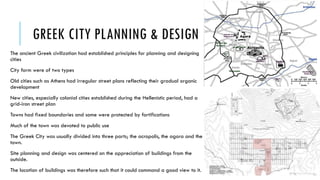
The ancient Greek civilization had established principles for planning and designing
cities
City form were of two types
Old cities such as Athens had irregular street plans reflecting their gradual organic
development
New cities, especially colonial cities established during the Hellenistic period, had a
grid-iron street plan
Towns had fixed boundaries and some were protected by fortifications
Much of the town was devoted to public use
The Greek City was usually divided into three parts; the acropolis, the agora and the
town.
Site planning and design was centered on the appreciation of buildings from the
outside.
The location of buildings was therefore such that it could command a good view to it.
GREEK CITY PLANNING & DESIGN
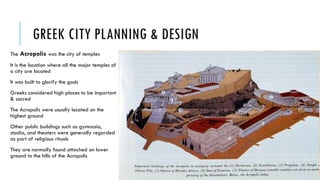
The Acropolis was the city of temples
It is the location where all the major temples of
a city are located
It was built to glorify the gods
Greeks considered high places to be important
& sacred
The Acropolis were usually located on the
highest ground
Other public buildings such as gymnasia,
stadia, and theaters were generally regarded
as part of religious rituals
They are normally found attached on lower
ground to the hills of the Acropolis
GREEK CITY PLANNING & DESIGN
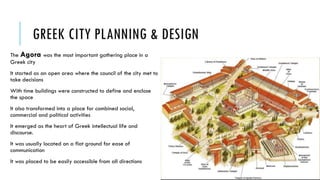
The Agora was the most important gathering place in a
Greek city
It started as an open area where the council of the city met to
take decisions
With time buildings were constructed to define and enclose
the space
It also transformed into a place for combined social,
commercial and political activities
It emerged as the heart of Greek intellectual life and
discourse.
It was usually located on a flat ground for ease of
communication
It was placed to be easily accessible from all directions
GREEK CITY PLANNING & DESIGN
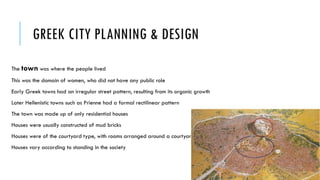
The town was where the people lived
This was the domain of women, who did not have any public role
Early Greek towns had an irregular street pattern, resulting from its organic growth
Later Hellenistic towns such as Prienne had a formal rectilinear pattern
The town was made up of only residential houses
Houses were usually constructed of mud bricks
Houses were of the courtyard type, with rooms arranged around a courtyard
Houses vary according to standing in the society
GREEK CITY PLANNING & DESIGN
Physical features of the ancient cities –
constructed with an eye toward public life: temples for worship, markets for commerce,
theaters for entertainment, and for a (plural of the Latin for him) for debate/discussion. Built
environment a reflection of nature of government: highly centralized/militaristic. Ancient
Greece partially planned, main roads converging on marketplace /temple. Every city
fortified, surrounded by walls, contain one or more forts located in a high place (Acropolis)
Like Athens center of Rome contained plazas, markets, public buildings such as the Forum and
Coliseum;
FEW MORE…….
Athens
Miletus
Priene
Messene
ROMAN CIVILISATION
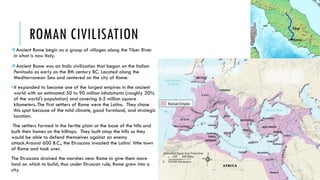
Ancient Rome begin as a group of villages along the Tiber River
in what is now Italy.
Ancient Rome was an Italic civilization that began on the Italian
Peninsula as early as the 8th century BC. Located along the
Mediterranean Sea and centered on the city of Rome.
•It expanded to become one of the largest empires in the ancient
world with an estimated 50 to 90 million inhabitants (roughly 20%
of the world's population) and covering 6.5 million square
kilometers..The first settlers of Rome were the Latins. They chose
this spot because of the mild climate, good farmland, and strategic
location.
The settlers farmed in the fertile plain at the base of the hills and
built their homes on the hilltops. They built atop the hills so they
would be able to defend themselves against an enemy
attack.Around 600 B.C., the Etruscans invaded the Latins’ little town
of Rome and took over.
The Etruscans drained the marshes near Rome to give them more
land on which to build, thus under Etruscan rule, Rome grew into a
city.
ROMAN CIVILISATION
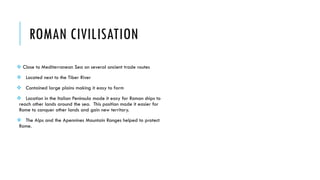
 Close to Mediterranean Sea on several ancient trade routes
 Located next to the Tiber River
 Contained large plains making it easy to farm
 Location in the Italian Peninsula made it easy for Roman ships to
reach other lands around the sea. This position made it easier for
Rome to conquer other lands and gain new territory.
 The Alps and the Apennines Mountain Ranges helped to protect
Rome.
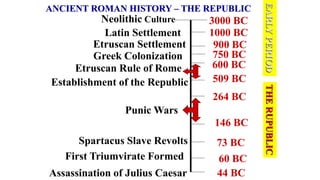
1000 BC
3000 BC
900 BC
Neolithic Culture
Latin Settlement
Etruscan Settlement
600 BC
509 BC
264 BC
146 BC
73 BC
Etruscan Rule of Rome
Establishment of the Republic
Punic Wars
Spartacus Slave Revolts
60 BC
44 BC
First Triumvirate Formed
Assassination of Julius Caesar
ANCIENT ROMAN HISTORY – THE REPUBLIC
Greek Colonization 750 BC
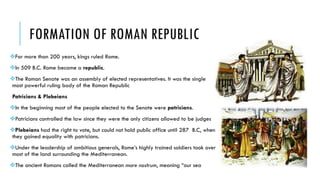
FORMATION OF ROMAN REPUBLIC
For more than 200 years, kings ruled Rome.
In 509 B.C. Rome became a republic.
The Roman Senate was an assembly of elected representatives. It was the single
most powerful ruling body of the Roman Republic
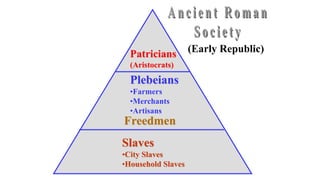
Patricians & Plebeians
In the beginning most of the people elected to the Senate were patricians.
Patricians controlled the law since they were the only citizens allowed to be judges
Plebeians had the right to vote, but could not hold public office until 287 B.C, when
they gained equality with patricians.
Under the leadership of ambitious generals, Rome’s highly trained soldiers took over
most of the land surrounding the Mediterranean.
The ancient Romans called the Mediterranean mare nostrum, meaning “our sea
Patricians
(Aristocrats)
Plebeians
•Farmers
•Merchants
•Artisans
Freedmen
Slaves
•City Slaves
•Household Slaves
(Early Republic)
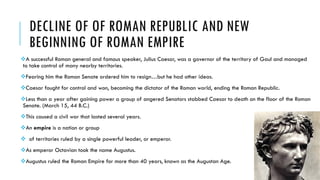
DECLINE OF OF ROMAN REPUBLIC AND NEW
BEGINNING OF ROMAN EMPIRE
A successful Roman general and famous speaker, Julius Caesar, was a governor of the territory of Gaul and managed
to take control of many nearby territories.
Fearing him the Roman Senate ordered him to resign…but he had other ideas.
Caesar fought for control and won, becoming the dictator of the Roman world, ending the Roman Republic.
Less than a year after gaining power a group of angered Senators stabbed Caesar to death on the floor of the Roman
Senate. (March 15, 44 B.C.)
This caused a civil war that lasted several years.
An empire is a nation or group
 of territories ruled by a single powerful leader, or emperor.
As emperor Octavian took the name Augustus.
Augustus ruled the Roman Empire for more than 40 years, known as the Augustan Age.
THE AUGUSTAN AGE
During the rule of Augustus the Roman empire continued to expand.
Augustus kept soldiers along all the borders to keep peace in the Roman world.
During this time architects and engineers built many new public buildings.
During this time trade increased with olive oil, wine, pottery, marble, and grain being shipped all across the
Mediterranean.
Lighthouses were constructed to guide ships into port.
This was also a time of great Roman literature.
Rise of Christianity
After the death of Augustus in 14 A.D. a new religion begin to spread: Christianity.
At first it took hold in the eastern half of the Roman Empire.
By 200 A.D. this religion had spread throughout the empire.
PLANNING PRINCIPLE OF ROMAN CIVILISATION
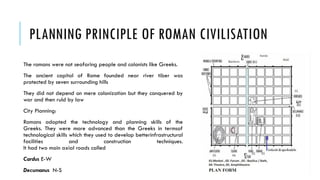
The romans were not seafaring people and colonists like Greeks.
The ancient capital of Rome founded near river tiber was
protected by seven surrounding hills
They did not depend on mere colonization but they conquered by
war and then ruld by law
City Planning:
Romans adopted the technology and planning skills of the
Greeks. They were more advanced than the Greeks in termsof
technological skills which they used to develop betterinfrastructural
facilities and construction techniques.
It had two main axial roads called
Cardus E-W
Decumanus N-S
PLANNING PRINCIPLE OF ROMAN CIVILISATION

"Secondary streets" complete the gridiron layout and formthe building blocks known as “ Insulae
Perimeter of the city was usually square/rectangular withbassions.
Cross streets occasionally stepped and bridged around thecity due to topographical condition.
Generally rectangular walled city entered by several gates,showing complete town organization.
From the religious significance of the Temples by theGreeks there was a change to the civic influence of LawCourts "
Basilica which became more important than thepublic buildings.
The most important part of the city was the forum, where political, economic, administrative, social and religious activity
were centred.“ Forum Area" usually located centre of the town formed by the intersection of the Decamanus and
cardo.similar to Greek “Agora’’ In big cities there were theatres, circuses, stadiums,odeons.
PLANNING PRINCIPLE OF ROMAN CIVILISATION
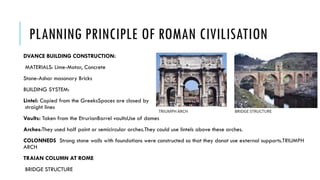
DVANCE BUILDING CONSTRUCTION:
MATERIALS: Lime-Motar, Concrete
Stone-Ashar masonary Bricks
BUILDING SYSTEM:
Lintel: Copied from the GreeksSpaces are closed by
straight lines
Vaults: Taken from the EtrurianBarrel vaultsUse of domes
Arches:They used half point or semicircular arches.They could use lintels above these arches.
COLONNEDS Strong stone walls with foundations were constructed so that they donot use external supports.TRIUMPH
ARCH
TRAIAN COLUMN AT ROME
BRIDGE STRUCTURE
PLANNING PRINCIPLE OF ROMAN CIVILISATION
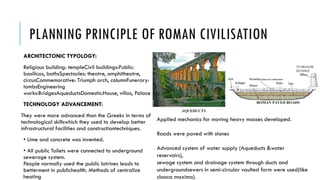
ARCHITECTONIC TYPOLOGY:
Religious building: templeCivil buildings:Public:
basilicas, bathsSpectacles: theatre, amphitheatre,
circusCommemorative: Triumph arch, columnFunerary:
tombsEngineering
works:BridgesAqueductsDomestic:House, villas, Palace
TECHNOLOGY ADVANCEMENT:
They were more advanced than the Greeks in terms of
technological skillswhich they used to develop better
infrastructural facilities and constructiontechniques.
• Lime and concrete was invented.
• All public Toilets were connected to underground
sewerage system.
People normally used the public latrines leads to
betterment in publichealth. Methods of centralize
heating
Applied mechanics for moving heavy masses developed.
Roads were paved with stones
Advanced system of water supply (Aqueducts &water
reservoirs),
sewage system and drainage system through ducts and
undergroundsewers in semi-circular vaulted form were used(like
cloaca maxima).
PLANNING PRINCIPLE OF ROMAN CIVILISATION
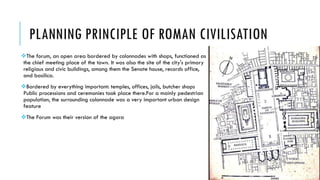
The forum, an open area bordered by colonnades with shops, functioned as
the chief meeting place of the town. It was also the site of the city's primary
religious and civic buildings, among them the Senate house, records office,
and basilica.
Bordered by everything important: temples, offices, jails, butcher shops
Public processions and ceremonies took place there.For a mainly pedestrian
population, the surrounding colonnade was a very important urban design
feature
The Forum was their version of the agora
PLANNING PRINCIPLE OF ROMAN CIVILISATION
City walls for protection
Roads, bridges and aqueducts for transport and water access
A theatre to watch plays
A stadium to watch sports and chariot races
Public baths to wash themselves, to meet friends,to exercise and to relax
Markets for the people to buy things
A Temple to honour the Gods
A Basilica to do business
FEW MORE…….
Timgad
Pompeii

Human Settlements- Ancient cities

  • 1.
    AR-213:Human Settlements & VernacularArchitecture L-03 [Evolution of Planning] Part -2: Ancient Cities Date: 07-02-2019 Ar. Somi Sareen
  • 2.
    ANCIENT CIVILISATION Mesopotamian Civilisation GreekCivilisation Ancient Rome Civilisation Indus Valley Civilisation
  • 3.
    5 HEARTH OFANCIENT CIVILIZATION
  • 5.
    TIMELINE OF ANCIENTCIVILIZATION Mesopotamia, 3500 BCE Nile River Valley, 3200 BCE Indus River Valley, 2200 BCE Huang He and Wei River Valleys, 1500 BCE Mesoamerica, 200 BCE
  • 6.
  • 7.
  • 8.
  • 9.
    MESOPOTAMIAN CIVILISATION This civilizationrose in the valleys between the Tigris and Euphrates rivers (source in Turkey). Mostly dry desert climate, except in the region between 2 rivers The rivers flood every year and leave behind a thick bed of silt It is termed as the Fertile Crescent – dense network of cities and villages, grain- bearing valleys
  • 10.
    MESOPOTAMIAN CIVILISATION The word'Mesopotamia' is in origin a Greek name (mesos `middle' and 'potamos' - 'river' so `land between the rivers')  Mesopotamia is a Greek word that means the land between two rivers the Tigris and the Euphrates.  Around 3500 B.C small agricultural pottery making and cloth weaving in villages were transmitted through societies of cities. • Initial settlement on the northern plains, with movement out to the south and west from 6000 BC.  Mesopotamia does not refer to any particular civilization. Over the course of several millennia, many civilizations developed, collapsed, and were replaced in this region including the Sumerians, Akkadians, Babylonians and Assyrians.
  • 11.
    MESOPOTAMIAN CIVILISATION  Beginningin Mesopotamia, civilization spread west to Egypt and east to India and China. These three civilizations formed an early international trading network that eventually extended across the connected lands of Eurasia and North Africa, a vast region that lies in a temperate climate zone where most of the world’s people have lived since prehistoric times.  Here farmers learned to build irrigation systems that turned the dry valley into a prosperous center of agriculture supporting many people. This is an early example of how humans can change the natural environment.  This agricultural economy was controlled by government officials. The Tigris and Euphrates flooded at least once a year, but was unpredictable and destructive.
  • 12.
    MESOPOTAMIAN CIVILISATION GEOGRAPHY:  Alluvialplains surrounded on two sides by better watered mountainous zones.  Summer drought and winter rains although the lowland plains receive minimal rainfall. Where the Tigris and Euphrates rivers join, the land is flat and there are many marshy areas.  This unecompassed spaced presented no natural barrier to invaders and indeed there was continual warfare in the region.  Areas near rivers protected from flooding - elevated above the river.Within reach of irrigation water and the closer they were to the river the greater their productivity  INVENTIONS: Writing, Wagon wheel, Potter’s wheel , Number system demarcation of time
  • 13.
    MESOPOTAMIAN CIVILISATION FAVOURABLE CONDITION Favorable geographic circumstances allowed the people of Mesopotamia to evolve from a hunter-gatherer culture to a culture based on husbandry, agriculture, and permanent settlements.  Trade with other regions also flourished, as indicated by the presence in early burial sites of metals and precious stones not locally available  The rich wildlife was probably what first attracted humans to the Mesopotamian plain. The Southern plain, outside the area of rain, fed agriculture, but, over the millennia, the rivers have laid down thick deposits of very fertile silt and, once water is brought to this soil in ditches and canals, it proves a very attractive area to farmers.  For materials such as wood, stone and metals, however, people have to look North and East, to the mountains where the first settlers had originated.
  • 14.
  • 15.
    MESOPOTAMIAN CIVILISATION  Thefirst city-states gradually developed in southern Mesopotamia. This is the achievement of the Sumerian people. 3500 Writing begins to be developed. At first this is based on pictograms and takes about a thousand years to evolve into a full cuneiform script. 2300 : King Sargon of Akkad starts conquering the first empire in world history. The empire reaches its height in c. 2220. 2100 The city of Ur becomes the centre of a powerful Mesopotamian state. It soon falls into decline. This marks the decline of the Sumerians as the Amorites, a nomadic people, start moving into Mesopotamia. 1792-49 : King Hammurabi of Babylon conquers a large empire. Hammurabi is famous for the law code which he issues. His empire begins to decline immediately after his death. 1530 :Babylonia is conquered by the Kassites , who rule the area for 400+ years. 1500 The Mitanni, an Indo-European people, conquer northern Mesopotamia, plus areas of Syria and Asia Minor. After 200 years the kingdom of Assyria conquers northern Mesopotamia from the Mitanni From 1100 : Nomadic peoples such as the Aramaeans and the Chaldeans overrun much of Mesopotamia. The kingdoms of Babylon and Assyria go into temporary decline.
  • 16.
    CHRONOLOGY Four broad segmentsof chronology will suffice to govern our discussion as follows: Protoliterate Period, from ca.3500 to 3000: During this time , the towns, which had probably evolved from agricultural villages,acquired their battlements of ring walls; and the temple and the ziggurat began to gain architectural definition .Political authority resided in an assembly of male citizens that selected short-term war leaders. B.C.Early Dynastic Period, from 3000 to 2350: When the role of these leaders wasretained in times of peace as well, kingship,first elective and then hereditary, became established. With it raised the monumental palace an administrative center which employed a large retinue of bureaucrats and entertainers & occupied itself with raising and supplying an army and maintaining the defensive system of the city.
  • 17.
    CHRONOLOGY 2350 B.C.Sumerian Period,from 2350 to 1600 B.C.: This period saw the rise of empire ,the collective rule of several city-states through the might of asovereign king. The first part of the period is dominated by the Third Dynasty of Ur whose prodigious building activity includes the Ziggurateof Ur-Nammu , the highpoint of that building type Assyrian PEriod, from 1350 to 612 B.C: The northern region of the two river snow flourishes at the expense of lower Mesopotamia. The Assyrian by their imposing state reliefs and their palaces, like the one at Khorsabad.
  • 18.
    SUMERIAN CITIES: 3500-2006B.C. First Civilization Converted open villages into walled cities  Cities became city-states ruled by strong leaders Built dams, dikes, and short canals to use water from the Euphrates Grew barley and dates and raised sheep and goats Developed a system of writing, metal working and were early users of wheel Greatest leader- Sargon the Great
  • 19.
  • 20.
    SUMERIAN CITIES: CHARACTERISTICS. Eachcity surrounded by walls Permanent garrisons of soldiers stationed in towers and at each gate Wide boulevards crossed city, lined by houses of the wealthy Rest of city made up of narrow, twisting alleys surrounded by small, flat-roofed huts Homes of farmers, and small craftsmen Basic building material – Mud and Timber Mud was mixed with reeds and laid in horizontal courses to make wall Houses had rectilinear rooms – Each side measuring 1.5 to 2m. Interior wall surfaces were decorated with gypsum plaster • Rock Gypsum was found in northern Iraq and Syria – Used locally and also exported as a trade commodity Sumerian houses faced away from crowded streets. Instead, they faced onto courtyards where families ate and children played. Narrow Streets Courtyard Area city streets were so narrow that a cart could get hardly through them.
  • 21.
    SETTLEMENT PATTERN Small villagesthat surrounded the cities disappear and the cities themselves grow in size. Many of the rural people moved to the new fortified cities such as Uruk. In response to increased inter-city warfare related to the dominance of the secular-based ruling elite.The growing power of a military based authority could have been a crucial factor in the rise of cities and state society Neolithic: No substantial settlement in southern Mesopotamia before 5500BC. From 6000BC to 4000BC settlement expanded from the uplands to incorporate more and more of the Mesopotamian plain. The Ubaid :culture expands to northern Mesopotamia, seen by the presence of shared material culture particularly painted pottery. The Ubaid culture was the foundation culture of Mesopotamia with temple centered settlements that administered exchange.  Eridu: Eridu established by 5400 BC initially 1-2 ha for the whole site. Located in the extreme south of the Mesopotamian plain. Agriculture around Eridu is dependent on irrigation with wheat, barley, sheep, goats and cattle. Possible that irrigation management is responsible for the expansion and elaboration of the temple institution
  • 22.
    SETTLEMENT PATTERN Uruk: Urukearliest urban centre to form a city state. A number of cities develop at the same time. From the middle of the 4th millennium BC one city in each of the proto-states becomes dominant, the most important being Uruk. Development concentrated in the south. The cities have large walls, and mud brick buildings that create tells. At Uruk a precinct where several temples were adjacent. Temples associated with ziggurats - stepped towers the temples have large storage facilities. They are the redistributive centers for both agricultural produce and craft goods. The temple joined by a palace suggesting religion supporting secular control. Some temples built on a large platform or ziggurat to make them even more impressive. Akkadian Empire. The city states only ever unified for short periods of time before they collapsed back to individual cities. Sargon of Agade conquered Kish and spread south from there. His success led to the fall of the last of the Sumerian rulers and the establishment of the Akkadian empire. The empire lasted from 2350-2150 BC. A more integrated system of trade developed controlled by the palace. But it did not create a long-lived political or economic system
  • 23.
    GOVERNMENT Mesopotamia did nothave protection from natural boundaries. This led to constant migrations of Indo-European people from the area between the Black and Caspian seas. This lead to a constant migration and 'Cultural Diffusion', or the process where an existing culture adopts the traits of another and the two eventually merge into a new culture. As a result, a strong central government failed to develop in Mesopotamia. The dominant political unit was the 'City-State', a small area surrounding a large, complex city.
  • 24.
    UR, THE CAPITALCITY OF MESOPOTAMIA The first city Cities began to emerge in Mesopotamia(modern Iraq) around 4500 years ago Ur, the capital of ancient Sumeria, was the world’s first city. It supported a complex and sophisticated society. Ur(Iraq): • The cities were closed by a wall and surrounded by suburban villages and hamlets. •The two monumental centers were the Ziggurat complex with its own defensive wall, overseen by a powerful priesthood, and Palace of the king. • Lesser temples were sprinkled here and there within the rest of the urban fabric, which was a promiscuous blend of residential and commercial architecture. •Small shops were at times incorporated into the houses. • In the later Sumerian period at Ur, an example of a bazaar was found.
  • 25.
    UR, THE CAPITALCITY OF MESOPOTAMIA
  • 26.
    UR, THE CAPITALCITY OF MESOPOTAMIA  Traffic along the twisted network of unpaved streets was mostly pedestrian.  At Ur, one sees on occasion a low flight of steps against a building from which riders could mount, and the street corners were regularly rounded to facilitate passage.  Street width at the very most , would be 3 meters (9 feet) or so and that only for the few principal thoroughfares that led to the public buildings. These would be bordered with the houses of the rich.  Poorer folk lived at the back ,along narrow lanes and alleys  It is hard to imagine much wheeled traffic in this maze, though both service carts (with solid wheels) and chariots had been in use from an early date.  Once walled the land became precious, and the high value of private property kept public space to a minimum.  Ample squares or public gardens were very rare.  The houses were grouped into congested blocks, where partition walls were common  The houses were , for the most part one-storey structures of mud-brick, with several rooms wrapped around a central court  There were usually no outside windows, no attempt to contribute to a street architecture.  The wealthier classes of Ur lived in ample houses of dozen or so rooms, arranged on two storeys, and whitewashed inside and out
  • 27.
    UR, THE CAPITALCITY OF MESOPOTAMIA  Temple and Ziggurats:  The temple constituted the heart of the Mesopotamian city.  For the townspeople the fields and their produce belong to the deity. The seeds, draught animals, and implements of tiling were supplied by the temple, and the harvest was stored on its grounds for distribution to the community  Craftsmen, organized in guilds, offered part of their output to the temple, and so did fishermen with their catch and builders with their labor.  The temple complex was the hub of an economic system that has been described as “theocratic socialism”.  With its own wall around it , it formed the last bulwark against the city’s enemies
  • 28.
    UR, THE CAPITALCITY OF MESOPOTAMIA
  • 29.
    FEW MORE……. Uruk-The cityof Warka Khorsabad Babylonia
  • 31.
    ANCIENT GREEK CIVILISATION Beginningof Civilization: •Southern Balkan peninsula •Bordered by Mediterranean, Aegean, and Ionic Seas •Small islands, uneven coastline – close to sea everywhere (fishermen, sailors, traders) •Short mountain ranges cut up mainland – hard to unify people •Rivers were short – not good for trade or travel •So…separate city-states arose •Greek civilization occurred in the area around the Greek mainland, on a peninsula that extends into the Mediterranean Sea started in cities on the Greek mainland and on islands in the Aegean Sea Towards the later or Hellenistic period, Greek civilization spread to other far away places including Asia Minor and Northern Africa
  • 32.
    ANCIENT GREEK CIVILISATION Mostof the Greek main land was rocky and barren and therefore bad for agriculture. Most Greeks therefore lived along the coastline or on islands where the soil was good for farming The Aegean and Mediterranean Seas provided a means of communication and trade with other places. Timeline 1800 BC to 300 BC Prehistoric Greece (2000 BC) – Island, coastal towns Classical Greek (1000 BC) – Mainland Cities The period of Greek history can be divided in four segments: a. 1100 B.C- 750 B.C. Greek Dark Ages b. 750 B.C.- 490 B.C- Archaic Period c. 500 B.C.- 323 B.C Classical Period d. 323 B.C- 147 B.C. Hellenistic Period. The classical and archaic period are sometimes collectively referred to as Hellenic period Because Greece is made up of many islands, and has many tall mountains, the Greeks began to build city-states instead of one country.A city- state is a city with its own laws, rulers, and money.City-states were cities that acted like countries.
  • 33.
    ANCIENT GREEK CIVILISATION GreekDark Ages (1100-750 BC) The Mycenaean people were Greek in Origin Greek civilization is therefore usually viewed as a continuation of the Mycenaean civilization The start of the Greek civilization is therefore dated to the end of the Mycenaean civilization in 1100BC Following the decline of Mycenae, the area around the Greek mainland went into a period of decline that is referred to as the Greek Dark ages Greece became depopulated with groups of people moving out of mainland Greece towards the islands of the Aegean Mycenaean and Greek culture dwindled and many cultural elements including writing, art and architectural techniques were lost Trade with Asia Minor, the Middle East and Egypt, which was at the root of Cretan prosperity stopped entirely As Greek people migrated from the mainland, other people from other less prosperous mountain regions of the north migrated to the more fertile coastline regions
  • 34.
    ANCIENT GREEK CIVILISATION GreekDark Ages (1100-750 BC) They invade the Greek mainland villages and established their rule The northerners brought with them a Greek dialect called Dorian, as opposed to the Ionic Greek spoken by the main settlers The two dialects and cultures later mixed together to create a Hellenic culture, which is at the root of ancient Greek civilization These two dialects became equated with characteristic architectural forms that evolved in them In the period following the invasion by the Dorians, there was a shift in lifestyle that produced a sedentary agricultural lifestyle and society. Sedentary lifestyle allowed the Greeks to rediscover urbanized culture that ultimately led to evolution of classical Greek culture Archaic Period (750 - 500 BC) The revival of Greece from the dark ages started during the eight century BC The Greeks developed a new political form called city states City states are cities which are ruled as independent nations The archaic period saw the renewal interest in overseas trading contact
  • 35.
    ANCIENT GREEK CIVILISATION Greeksocieties that were engaged in trade became rich and by joining with other their neighbors, sometimes forcefully, formed large states The polis or city state emerged as the natural and desirable political entity Early examples of these city states include Athens, Corinth, Argos, and Sparta on the mainland, and in the Eastern Aegean, Samos, Chios, Smyrna, Ephesus and Miletus The archaic period marked the rise of the aristocratic families; families that are considered noble or of higher status The archaic period was dominated politically by the leading aristocratic families in each city state acting in concert or squabbling amongst themselves for supremacy At times individual aristocrats were able to take advantage of popular dissatisfaction to seize authoritarian power Such rulers were called tyrants
  • 36.
    ANCIENT GREEK CIVILISATION Classicalperiod (500 - 323 BC) The Classical period of ancient Greek history occurred between 500 BC, and 323 BC. The period started with the Greek city states coming into conflict with the rising Persian Empire The free Greek cities saw the threat that was developing from the Persian Empire and prepared for resistance A seaborne expedition by the Persians to Athens was defeated at Marathon in 490 BC Under the Persian King Xerxes, Persia attempted a retribution in 479 BC and was defeated by an alliance of the Greek states headed by Sparta The Greek alliance soon transformed into an Empire under the leadership of Athens Pericles, the ruler of Athens between 444 and 429 BC became a driving force for the development of temple architecture Pericles used the defense revenue from the alliance for temple building in Athens to thank the Gods
  • 37.
    ANCIENT GREEK CIVILISATION Athensreached its greatest political and cultural heights during the classical period The full development of the democratic system of government occurred under Pericles The Parthenon on the Acropolis at Athens was built Philosophical schools such as those of Socrates and Plato were founded Between 431 and 404, Athens entered into a series of wars with Sparta which left it in ruins The fall of Athens gradually led to political chaos in the whole of Greece Alexander undertook a lot of military campaigns to extend the Greek empire and founded many new cities such as Alexandria in Egypt He died in 323 BC without a heir to inherit him The Death of Alexander marked the end of the classical period of Greece civilization
  • 38.
    ANCIENT GREEK CIVILISATION Hellenisticperiod (323 - 147 BC) The Hellenistic period of ancient Greek civilization started with the death of Alexander in 323 BC When Alexander died, he did not have a heir to inherit him The Greek empire split into smaller states with Alexander’s generals as their rulers The period saw the transplanting of Greek art, civic life and culture to newly conquered areas The period also saw a marked increase in interest in civic buildings The Hellenistic period ended in 147 BC, when the Roman Empire conquered Greece and incorporated the city states into it
  • 39.
    ANCIENT GREEK CIVILISATION SocietalOrganization- The city state  Every polis was different from another, even though there were similarities between them  They were all bounded by common language and religious beliefs It was a major center for learning and the arts.  When city-states were first formed, they were ruled by a few wealthy men.  However, they gradually moved towards democracy.  Athens developed an early form of democracy  The ideal size of a city state was fixed at 5040 males by Plato  Citizens in any polis were related by blood and so family ties were very strong.  Membership of the polis was hereditary and could not be passed to persons outside the family  The society of the polis had a social hierarchy with citizens at the top, followed by people who are not citizens and finally slaves  Public life was for male citizens while women were secluded in the house
  • 40.
    ANCIENT GREEK CIVILISATION ReligiousBelief  The ancient Greeks were polytheistic, believing in many different gods and goddesses  The God were regarded as all powerful but similar to human beings in their passions, desires and appetite  Temples were the focus of Greek religious worships  Temples were usually built in the cities of the Gods called “Acropolis”  Temples were built in every town and city for one or more god or goddess  The Greeks regarded beauty as an attribute of the gods and the conscious pursuit of beauty as a religious exercise
  • 41.
    ANCIENT GREEK CIVILISATION The Greeks convinced themselves that the secrets of beauty lie in proportions  Man was viewed by the Greeks as having the most ideal proportions and is the measure of all things  Greek developed a system of building proportion that reflected those of the human body  With time, they refined their system of building proportion, and developed the classical Greek orders  The principal building material of the ancient Greeks was stone  Clay and timber were also used  Greek society also made buildings other than temples  These evolved in response to changes in need with time  The most common buildings are amphitheaters, council halls, public fountains and theatres, gymnasia, schools and libraries, public baths and lavatories  As these civic buildings emerge, treatment once reserved for temple was extended to them even though on a less grander scale than in the temples
  • 42.
    ANCIENT GREEK CIVILISATION Greek construction was of a simple post and lintel or trabeated construction  Their ground plans were always very simple, usually rectangular  With a combination of simple ground plans and trabeated construction, they were able to create amazing buildings  Buildings were constructed by skilled craftsmen who were in demand and traveled from one state to the other for construction work  Designs were done on the ground by measuring out the foundation  Blocks of stone were ordered from the quarry  Blocks were given initial preparation on the building site  Blocks were large and retained in position by their own weight; it was not necessary to fix them together in any way  Roofs were of wood beams and rafters cut to square shapes with tile roof  Carvings and other decorative work were finished when the building is completed
  • 43.
    GREEK CITY PLANNING& DESIGN The ancient Greek civilization had established principles for planning and designing cities City form were of two types Old cities such as Athens had irregular street plans reflecting their gradual organic development New cities, especially colonial cities established during the Hellenistic period, had a grid-iron street plan Towns had fixed boundaries and some were protected by fortifications Much of the town was devoted to public use The Greek City was usually divided into three parts; the acropolis, the agora and the town. Site planning and design was centered on the appreciation of buildings from the outside. The location of buildings was therefore such that it could command a good view to it.
  • 44.
    GREEK CITY PLANNING& DESIGN The Acropolis was the city of temples It is the location where all the major temples of a city are located It was built to glorify the gods Greeks considered high places to be important & sacred The Acropolis were usually located on the highest ground Other public buildings such as gymnasia, stadia, and theaters were generally regarded as part of religious rituals They are normally found attached on lower ground to the hills of the Acropolis
  • 45.
    GREEK CITY PLANNING& DESIGN The Agora was the most important gathering place in a Greek city It started as an open area where the council of the city met to take decisions With time buildings were constructed to define and enclose the space It also transformed into a place for combined social, commercial and political activities It emerged as the heart of Greek intellectual life and discourse. It was usually located on a flat ground for ease of communication It was placed to be easily accessible from all directions
  • 46.
    GREEK CITY PLANNING& DESIGN The town was where the people lived This was the domain of women, who did not have any public role Early Greek towns had an irregular street pattern, resulting from its organic growth Later Hellenistic towns such as Prienne had a formal rectilinear pattern The town was made up of only residential houses Houses were usually constructed of mud bricks Houses were of the courtyard type, with rooms arranged around a courtyard Houses vary according to standing in the society
  • 47.
    GREEK CITY PLANNING& DESIGN Physical features of the ancient cities – constructed with an eye toward public life: temples for worship, markets for commerce, theaters for entertainment, and for a (plural of the Latin for him) for debate/discussion. Built environment a reflection of nature of government: highly centralized/militaristic. Ancient Greece partially planned, main roads converging on marketplace /temple. Every city fortified, surrounded by walls, contain one or more forts located in a high place (Acropolis) Like Athens center of Rome contained plazas, markets, public buildings such as the Forum and Coliseum;
  • 48.
  • 50.
    ROMAN CIVILISATION Ancient Romebegin as a group of villages along the Tiber River in what is now Italy. Ancient Rome was an Italic civilization that began on the Italian Peninsula as early as the 8th century BC. Located along the Mediterranean Sea and centered on the city of Rome. •It expanded to become one of the largest empires in the ancient world with an estimated 50 to 90 million inhabitants (roughly 20% of the world's population) and covering 6.5 million square kilometers..The first settlers of Rome were the Latins. They chose this spot because of the mild climate, good farmland, and strategic location. The settlers farmed in the fertile plain at the base of the hills and built their homes on the hilltops. They built atop the hills so they would be able to defend themselves against an enemy attack.Around 600 B.C., the Etruscans invaded the Latins’ little town of Rome and took over. The Etruscans drained the marshes near Rome to give them more land on which to build, thus under Etruscan rule, Rome grew into a city.
  • 51.
    ROMAN CIVILISATION  Closeto Mediterranean Sea on several ancient trade routes  Located next to the Tiber River  Contained large plains making it easy to farm  Location in the Italian Peninsula made it easy for Roman ships to reach other lands around the sea. This position made it easier for Rome to conquer other lands and gain new territory.  The Alps and the Apennines Mountain Ranges helped to protect Rome.
  • 52.
    1000 BC 3000 BC 900BC Neolithic Culture Latin Settlement Etruscan Settlement 600 BC 509 BC 264 BC 146 BC 73 BC Etruscan Rule of Rome Establishment of the Republic Punic Wars Spartacus Slave Revolts 60 BC 44 BC First Triumvirate Formed Assassination of Julius Caesar ANCIENT ROMAN HISTORY – THE REPUBLIC Greek Colonization 750 BC
  • 53.
    FORMATION OF ROMANREPUBLIC For more than 200 years, kings ruled Rome. In 509 B.C. Rome became a republic. The Roman Senate was an assembly of elected representatives. It was the single most powerful ruling body of the Roman Republic Patricians & Plebeians In the beginning most of the people elected to the Senate were patricians. Patricians controlled the law since they were the only citizens allowed to be judges Plebeians had the right to vote, but could not hold public office until 287 B.C, when they gained equality with patricians. Under the leadership of ambitious generals, Rome’s highly trained soldiers took over most of the land surrounding the Mediterranean. The ancient Romans called the Mediterranean mare nostrum, meaning “our sea
  • 54.
  • 55.
    DECLINE OF OFROMAN REPUBLIC AND NEW BEGINNING OF ROMAN EMPIRE A successful Roman general and famous speaker, Julius Caesar, was a governor of the territory of Gaul and managed to take control of many nearby territories. Fearing him the Roman Senate ordered him to resign…but he had other ideas. Caesar fought for control and won, becoming the dictator of the Roman world, ending the Roman Republic. Less than a year after gaining power a group of angered Senators stabbed Caesar to death on the floor of the Roman Senate. (March 15, 44 B.C.) This caused a civil war that lasted several years. An empire is a nation or group  of territories ruled by a single powerful leader, or emperor. As emperor Octavian took the name Augustus. Augustus ruled the Roman Empire for more than 40 years, known as the Augustan Age.
  • 56.
    THE AUGUSTAN AGE Duringthe rule of Augustus the Roman empire continued to expand. Augustus kept soldiers along all the borders to keep peace in the Roman world. During this time architects and engineers built many new public buildings. During this time trade increased with olive oil, wine, pottery, marble, and grain being shipped all across the Mediterranean. Lighthouses were constructed to guide ships into port. This was also a time of great Roman literature. Rise of Christianity After the death of Augustus in 14 A.D. a new religion begin to spread: Christianity. At first it took hold in the eastern half of the Roman Empire. By 200 A.D. this religion had spread throughout the empire.
  • 57.
    PLANNING PRINCIPLE OFROMAN CIVILISATION The romans were not seafaring people and colonists like Greeks. The ancient capital of Rome founded near river tiber was protected by seven surrounding hills They did not depend on mere colonization but they conquered by war and then ruld by law City Planning: Romans adopted the technology and planning skills of the Greeks. They were more advanced than the Greeks in termsof technological skills which they used to develop betterinfrastructural facilities and construction techniques. It had two main axial roads called Cardus E-W Decumanus N-S
  • 58.
    PLANNING PRINCIPLE OFROMAN CIVILISATION  "Secondary streets" complete the gridiron layout and formthe building blocks known as “ Insulae Perimeter of the city was usually square/rectangular withbassions. Cross streets occasionally stepped and bridged around thecity due to topographical condition. Generally rectangular walled city entered by several gates,showing complete town organization. From the religious significance of the Temples by theGreeks there was a change to the civic influence of LawCourts " Basilica which became more important than thepublic buildings. The most important part of the city was the forum, where political, economic, administrative, social and religious activity were centred.“ Forum Area" usually located centre of the town formed by the intersection of the Decamanus and cardo.similar to Greek “Agora’’ In big cities there were theatres, circuses, stadiums,odeons.
  • 59.
    PLANNING PRINCIPLE OFROMAN CIVILISATION DVANCE BUILDING CONSTRUCTION: MATERIALS: Lime-Motar, Concrete Stone-Ashar masonary Bricks BUILDING SYSTEM: Lintel: Copied from the GreeksSpaces are closed by straight lines Vaults: Taken from the EtrurianBarrel vaultsUse of domes Arches:They used half point or semicircular arches.They could use lintels above these arches. COLONNEDS Strong stone walls with foundations were constructed so that they donot use external supports.TRIUMPH ARCH TRAIAN COLUMN AT ROME BRIDGE STRUCTURE
  • 60.
    PLANNING PRINCIPLE OFROMAN CIVILISATION ARCHITECTONIC TYPOLOGY: Religious building: templeCivil buildings:Public: basilicas, bathsSpectacles: theatre, amphitheatre, circusCommemorative: Triumph arch, columnFunerary: tombsEngineering works:BridgesAqueductsDomestic:House, villas, Palace TECHNOLOGY ADVANCEMENT: They were more advanced than the Greeks in terms of technological skillswhich they used to develop better infrastructural facilities and constructiontechniques. • Lime and concrete was invented. • All public Toilets were connected to underground sewerage system. People normally used the public latrines leads to betterment in publichealth. Methods of centralize heating Applied mechanics for moving heavy masses developed. Roads were paved with stones Advanced system of water supply (Aqueducts &water reservoirs), sewage system and drainage system through ducts and undergroundsewers in semi-circular vaulted form were used(like cloaca maxima).
  • 61.
    PLANNING PRINCIPLE OFROMAN CIVILISATION The forum, an open area bordered by colonnades with shops, functioned as the chief meeting place of the town. It was also the site of the city's primary religious and civic buildings, among them the Senate house, records office, and basilica. Bordered by everything important: temples, offices, jails, butcher shops Public processions and ceremonies took place there.For a mainly pedestrian population, the surrounding colonnade was a very important urban design feature The Forum was their version of the agora
  • 62.
    PLANNING PRINCIPLE OFROMAN CIVILISATION City walls for protection Roads, bridges and aqueducts for transport and water access A theatre to watch plays A stadium to watch sports and chariot races Public baths to wash themselves, to meet friends,to exercise and to relax Markets for the people to buy things A Temple to honour the Gods A Basilica to do business
  • 63.