PLACENTA PRAEVIA
Presented by:
Naveeda Anjum
M.Sc. (OBG) 1st Year
Baba Farid University
INTRODUCTION
 The placenta is implanted partially or
completely over the lower uterine segment it is
called placenta.
DEFINITION
 In placenta praevia the placenta is implanted
in the lower uterine segment such that it
completely or partially cover the cervix or is
close enough to the cervix to cause bleeding
when the cervix dilated or the lower uterine
segment effaces.
(Hull and Resnik, 2009)
INCIDENCE
 In 80% cases it is found in multiparous
women.
 The incidence is increased beyond the age of
35, with high birth order pregnancies and in
multiple pregnancy.
 The incidence approximately 4-5 per thousand
pregnancies.
RISK FACTOR
 Multiparity
 Increased maternal age
 Higher altitude
 History of pervious scar in the uterus
 smoking
TYPES
 There are four types of placenta praevia
depending up on the degree of extension of
placenta to the lower segment.
 Type 1 (Low lying)
 Type 2 (Marginal)
 Type 3 (Incomplete or partial central)
 Type 4 (Central or total)
CONTD...
 Type 1 (Low lying) :
The major part of the placenta is attached to
the upper segment and only the lower margin
encroaches onto the lower segment but not on
the os.
CONTD...
 Type 2 (Marginal):
The placenta reaches the margin of internal os
but does not cover it.
CONTD...
 Type 3 (Incomplete or partial central):
The placenta covers the internal os partially
(cover the internal os when closed but does
not entirely do so when fully dilated)
CONTD...
 Type 4 (Central or total):
The placenta completely covers the internal os
even after it is fully dilated.
CLINICAL FEATURES
 Symptoms
Vaginal bleeding:
 Sudden in onset, painless
 Revealed bleeding (fresh blood)
 Bright red or dark coloured
 Unrelated to activity
CONTD...
Signs:
 General conditions and anaemia are
proportionate to the visible blood loss.
Abdominal examination: the size of the uterus
 Uterus feels relaxed and soft.
 The head is floating in contrast to the period of
gestation.
 Fetal heart sound is usually present.
CONTD...
 Vaginal inspection:
Placenta is felt on the lower segment.
COMPLICATIOINS
Complications of placenta praevia:
1. Maternal complications:
 During pregnancy
 During labour
 Puerperium
2. Fetal complications
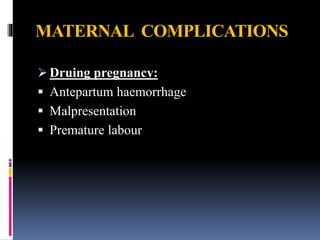
MATERNAL COMPLICATIONS
 Druing pregnancy:
 Antepartum haemorrhage
 Malpresentation
 Premature labour
CONTD...
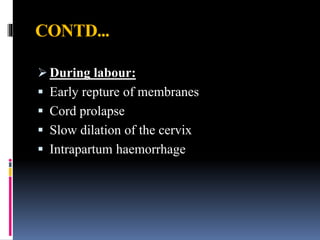
 During labour:
 Early repture of membranes
 Cord prolapse
 Slow dilation of the cervix
 Intrapartum haemorrhage
CONTD...
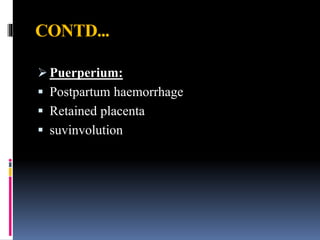
 Puerperium:
 Postpartum haemorrhage
 Retained placenta
 suvinvolution
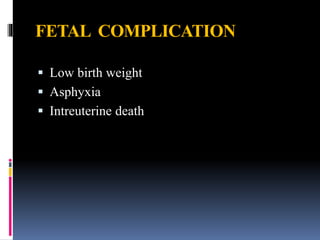
FETAL COMPLICATION
 Low birth weight
 Asphyxia
 Intreuterine death
DIAGNOSIS
 Placentagraphy:
Sonography
Colour dopler flow study
Magnetic resonance
Vaginal examination
MANAGEMENT
 Prevention
 Immediate management
 Expectant management
 Active management
 Nursing management
PREVENTION
To minimize the risks, the following guidelines are
useful.
 Adequate antenatal care.
 Significance of warning haemorrhage
At home-
 Put the patient on bed
 Abdominal examination
 Vaginal examination must not be done
Transfer to hospital
 Admission to hospital
IMMEDIATE ATTENTION
 To ensure an adequate blood supply to a
women and fetus place the women immediatly
on bed rest in a side lying position.
 A large bore IV cannula is cited and infusion
of normal sline
 Gentle abdominal palpation
SCHEME OF MANAGEMENT
 All APH patients are to be admitted
- general and abdominal examination
- Clinical assessment of blood loss
- Resuscitation if necessary
- Localisation of placenta
1.Excpectant management 2. Active interference
EXPECTANT MANAGEMENT
The expectant management is carried upto 37
weeks.
Aim: The aim is to continue pregnancy for fetal
maturity without compromising the maternal
health.
Indications:
 No active bleeding
 Patient stable haemo-dynamically
 FHS-good
 CTG-reactive fetus
CONTD...
 Interventions:
 Bed rest
 Periodic inspection of vulvul pads
 Supplementary haematinics if patient is
anaemic
 Use of tocolytics
 Rh immunoglobulins to all Rh negative
women
ACTIVE MANAGEMENT
Indications:
 Bleeding occurs at or after 37 weeks of
pregnancy
 Patient is in labour
 FHS- absent
 Gross fetal malformation
 Dead fetus
CONTD...
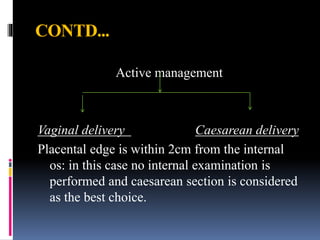
Active management
Vaginal delivery Caesarean delivery
Placental edge is within 2cm from the internal
os: in this case no internal examination is
performed and caesarean section is considered
as the best choice.
NURSING MANAGEMENT
Nursing diagnosis:
Decreased cardiac output related to blood loss
as manifested by increase in heart rate.
Interventions:
 Monitor vital signs
 Provide adequate rest
 Encourage relaxation techniques
 Evaluate Hb of the client
Ineffective tissue perfusion related to
decrease in Hb in blood as menifested by
dyspnea.
Interventions:
 Monitor vital signs
 Encourage quiet and restful environment
 Encourage use of relaxation techniques
 Provide supplemental oxygen to the client as
prescribed by the physician.
Deficient fluid volume related to blood
loss as manifested by vital signs
changes.
Interventions:
 Monitor vital signs.
 Monitor FHR.
 Initiate IV fluids as ordered by the physician.
 Place the patient in left lateral position.
THANK YOU

PLACENTA PRAEVIA-1.pptx

  • 1.
    PLACENTA PRAEVIA Presented by: NaveedaAnjum M.Sc. (OBG) 1st Year Baba Farid University
  • 2.
    INTRODUCTION  The placentais implanted partially or completely over the lower uterine segment it is called placenta.
  • 3.
    DEFINITION  In placentapraevia the placenta is implanted in the lower uterine segment such that it completely or partially cover the cervix or is close enough to the cervix to cause bleeding when the cervix dilated or the lower uterine segment effaces. (Hull and Resnik, 2009)
  • 4.
    INCIDENCE  In 80%cases it is found in multiparous women.  The incidence is increased beyond the age of 35, with high birth order pregnancies and in multiple pregnancy.  The incidence approximately 4-5 per thousand pregnancies.
  • 5.
    RISK FACTOR  Multiparity Increased maternal age  Higher altitude  History of pervious scar in the uterus  smoking
  • 6.
    TYPES  There arefour types of placenta praevia depending up on the degree of extension of placenta to the lower segment.  Type 1 (Low lying)  Type 2 (Marginal)  Type 3 (Incomplete or partial central)  Type 4 (Central or total)
  • 7.
    CONTD...  Type 1(Low lying) : The major part of the placenta is attached to the upper segment and only the lower margin encroaches onto the lower segment but not on the os.
  • 8.
    CONTD...  Type 2(Marginal): The placenta reaches the margin of internal os but does not cover it.
  • 9.
    CONTD...  Type 3(Incomplete or partial central): The placenta covers the internal os partially (cover the internal os when closed but does not entirely do so when fully dilated)
  • 10.
    CONTD...  Type 4(Central or total): The placenta completely covers the internal os even after it is fully dilated.
  • 11.
    CLINICAL FEATURES  Symptoms Vaginalbleeding:  Sudden in onset, painless  Revealed bleeding (fresh blood)  Bright red or dark coloured  Unrelated to activity
  • 12.
    CONTD... Signs:  General conditionsand anaemia are proportionate to the visible blood loss. Abdominal examination: the size of the uterus  Uterus feels relaxed and soft.  The head is floating in contrast to the period of gestation.  Fetal heart sound is usually present.
  • 13.
    CONTD...  Vaginal inspection: Placentais felt on the lower segment.
  • 14.
    COMPLICATIOINS Complications of placentapraevia: 1. Maternal complications:  During pregnancy  During labour  Puerperium 2. Fetal complications
  • 15.
    MATERNAL COMPLICATIONS  Druingpregnancy:  Antepartum haemorrhage  Malpresentation  Premature labour
  • 16.
    CONTD...  During labour: Early repture of membranes  Cord prolapse  Slow dilation of the cervix  Intrapartum haemorrhage
  • 17.
    CONTD...  Puerperium:  Postpartumhaemorrhage  Retained placenta  suvinvolution
  • 18.
    FETAL COMPLICATION  Lowbirth weight  Asphyxia  Intreuterine death
  • 19.
    DIAGNOSIS  Placentagraphy: Sonography Colour doplerflow study Magnetic resonance Vaginal examination
  • 20.
    MANAGEMENT  Prevention  Immediatemanagement  Expectant management  Active management  Nursing management
  • 21.
    PREVENTION To minimize therisks, the following guidelines are useful.  Adequate antenatal care.  Significance of warning haemorrhage At home-  Put the patient on bed  Abdominal examination  Vaginal examination must not be done Transfer to hospital  Admission to hospital
  • 22.
    IMMEDIATE ATTENTION  Toensure an adequate blood supply to a women and fetus place the women immediatly on bed rest in a side lying position.  A large bore IV cannula is cited and infusion of normal sline  Gentle abdominal palpation
  • 23.
    SCHEME OF MANAGEMENT All APH patients are to be admitted - general and abdominal examination - Clinical assessment of blood loss - Resuscitation if necessary - Localisation of placenta 1.Excpectant management 2. Active interference
  • 24.
    EXPECTANT MANAGEMENT The expectantmanagement is carried upto 37 weeks. Aim: The aim is to continue pregnancy for fetal maturity without compromising the maternal health. Indications:  No active bleeding  Patient stable haemo-dynamically  FHS-good  CTG-reactive fetus
  • 25.
    CONTD...  Interventions:  Bedrest  Periodic inspection of vulvul pads  Supplementary haematinics if patient is anaemic  Use of tocolytics  Rh immunoglobulins to all Rh negative women
  • 26.
    ACTIVE MANAGEMENT Indications:  Bleedingoccurs at or after 37 weeks of pregnancy  Patient is in labour  FHS- absent  Gross fetal malformation  Dead fetus
  • 27.
    CONTD... Active management Vaginal deliveryCaesarean delivery Placental edge is within 2cm from the internal os: in this case no internal examination is performed and caesarean section is considered as the best choice.
  • 28.
    NURSING MANAGEMENT Nursing diagnosis: Decreasedcardiac output related to blood loss as manifested by increase in heart rate. Interventions:  Monitor vital signs  Provide adequate rest  Encourage relaxation techniques  Evaluate Hb of the client
  • 29.
    Ineffective tissue perfusionrelated to decrease in Hb in blood as menifested by dyspnea. Interventions:  Monitor vital signs  Encourage quiet and restful environment  Encourage use of relaxation techniques  Provide supplemental oxygen to the client as prescribed by the physician.
  • 30.
    Deficient fluid volumerelated to blood loss as manifested by vital signs changes. Interventions:  Monitor vital signs.  Monitor FHR.  Initiate IV fluids as ordered by the physician.  Place the patient in left lateral position.
  • 31.