PKI
Do You Know your Exposure?
Kent King
Information Security Manager
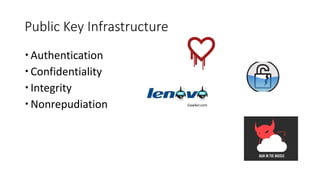
Public Key Infrastructure
Authentication
Confidentiality
Integrity
Nonrepudiation Gawker.com
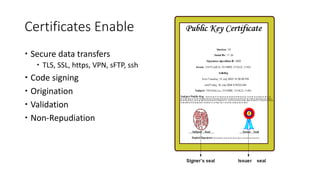
Certificates Enable
 Secure data transfers
 TLS, SSL, https, VPN, sFTP, ssh
 Code signing
 Origination
 Validation
 Non-Repudiation
Certificate Authorities
 Trust in the certificate itself
 Validate owner of certificate
 Auditability
 Revocation & Renewal
 Intermediate CAs
 Self-Signed Certificates
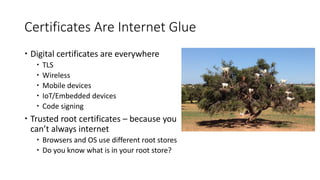
Certificates Are Internet Glue
 Digital certificates are everywhere
 TLS
 Wireless
 Mobile devices
 IoT/Embedded devices
 Code signing
 Trusted root certificates – because you
can’t always internet
 Browsers and OS use different root stores
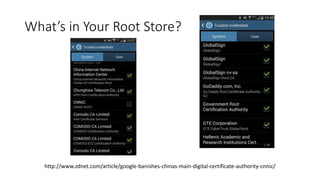
 Do you know what is in your root store?
What’s in Your Root Store?
http://www.zdnet.com/article/google-banishes-chinas-main-digital-certificate-authority-cnnic/
Self-Signed Certificates
 Who is the owner?
 Did the issuer have the permission of the domain owner?
 What is the status?
 How recently was it issued? How long is it valid?
 Contain both public and private key data
 Vendor failure: Superfish
http://blog.erratasec.com/2015/02/extracting-superfish-certificate.html#.VuXin-IrLct
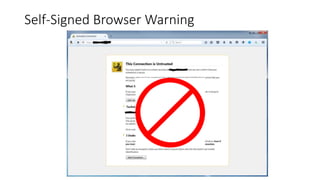
Self-Signed Browser Warning
Certificates – The Bad
 Certificate Authorities
Compromised
 2011 – Diginotar, Comodo
 2014 - NIC of India -intermediate CA
 Root Certificate pain
 Google revoked 20 year Verisign Cert
 Implementation errors
 Heartbleed, DROWN
http://www.darkreading.com/attacks-breaches/digital-certificate-authority-hacked-dozens-of-phony-digital-certificates-issued/d/d-id/1136244
• Vulnerable algorithms: MD5 and
SHA-1
• Malware steals legitimate and
installs malicious certificates
• Process errors
• A test or self-signed certificate
gets into production
• Letting your certificates expire
• 2013 - Azure
More bad…
http://arstechnica.com/security/2015/10/sha1-crypto-algorithm-securing-internet-could-break-by-years-end/
Real attacks
 Stuxnet – Certificate Theft
 Signed code
 Operation Emmental – Fake Certificates
 Malware places certificate and no warning
is seen at phishing web sites
 POODLE – Protocol attacks
 Goodbye SSL v3
 Man In The Middle
 The story of Bob, Alice and Mallory
http://www.computerweekly.com/news/4500242932/Google-warns-of-fake-digital-certificates
Pidgin, Dsniff, Fiddler2, Subterfuge
Threat Review
 Certificate Compromise
 CA failures
 Malware
 Certificate Insertion
 Vulnerable Algorithms
 Implementation Issues
 Process Errors
 Ensuring validation and revocation status
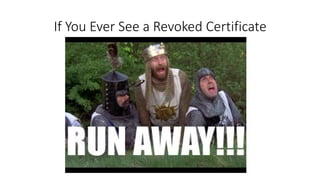
If You Ever See a Revoked Certificate
Mitigation
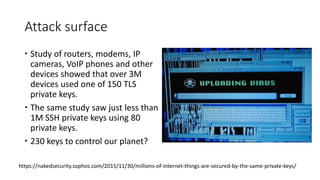
Attack surface
 Study of routers, modems, IP
cameras, VoIP phones and other
devices showed that over 3M
devices used one of 150 TLS
private keys.
 The same study saw just less than
1M SSH private keys using 80
private keys.
 230 keys to control our planet?
https://nakedsecurity.sophos.com/2015/11/30/millions-of-internet-things-are-secured-by-the-same-private-keys/
How Many Certificates Do You Have?
 Purchased?
 Self-Signed?
 Wildcard?
 Functions?
If your company name is on the certificate, it’s an asset worth tracking!
Certificates As Assets
 Track as an asset category or use a vendor product
 Monitor expiration and renewal dates
 Know certificate function
 How are you handling revoked certificates?
 Choose a reliable CA
 Self-signed
 Policies for generation and use
 Clear process that is auditable
Certificates on the Web
 All public pages present a verifiable EV
certificate from a reputable CA
 Use secure cookie flag
 Don’t mix secure/non-secure content
 Avoid redirect from http to https
 Use wildcard certificates carefully
 Review your web server TLS protocols
 Consider using HSTS
 Pin it?
Wildcard Certificates
 Wildcards enable sub-domains (*.yourorg.com)
 support.yourorg.com and purchasing.yourorg.com
 Trust extends over many systems
 Avoid using wildcards for
 Login/validation pages
 Entering sensitive personal data
 Ecommerce purchase/checkout
 Certificate compromise means numerous pages are affected
http://news.softpedia.com/news/PayPal-Phishing-Page-Hosted-on-Secure-Website-of-Malaysian-Police-Portal-359166.shtml
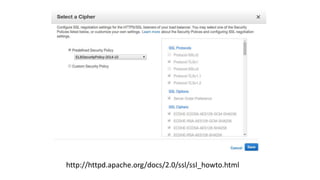
http://httpd.apache.org/docs/2.0/ssl/ssl_howto.html
HSTS – HTTPS Strict Transport Security
 Helps mitigate SSL stripping
 Reduces TLS downgrade attacks
 Makes MITM harder
 Protects cookie-based web login credentials
 First connection can be leveraged
https://tools.ietf.org/html/rfc6797
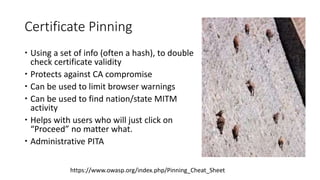
Certificate Pinning
 Using a set of info (often a hash), to double
check certificate validity
 Protects against CA compromise
 Can be used to limit browser warnings
 Can be used to find nation/state MITM
activity
 Helps with users who will just click on
“Proceed” no matter what.
 Administrative PITA
https://www.owasp.org/index.php/Pinning_Cheat_Sheet
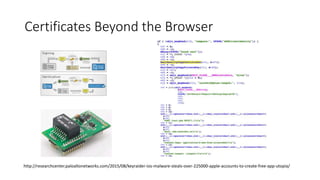
Certificates Beyond the Browser
http://researchcenter.paloaltonetworks.com/2015/08/keyraider-ios-malware-steals-over-225000-apple-accounts-to-create-free-app-utopia/
If You Sign Code
 Policy Awareness
 Don’t share or reuse private keys
 Customize firmware keys and use once
 Time stamping
 Library code
 Signed code attests
 Where the code came from
 That it has not been altered
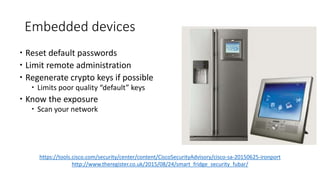
Embedded devices
 Reset default passwords
 Limit remote administration
 Regenerate crypto keys if possible
 Limits poor quality “default” keys
 Know the exposure
 Scan your network
https://tools.cisco.com/security/center/content/CiscoSecurityAdvisory/cisco-sa-20150625-ironport
http://www.theregister.co.uk/2015/08/24/smart_fridge_security_fubar/
Monitor for Malware that Steals Certificates
 Backdoor.Beasty, Infostealer.Snifula
 Downloader.Parshell, Trojan.Spyeye, W32.Cridex, W32.Qakbot,
Infostealer.Shiz, Trojan.Carberp, Trojan.Zbot
Mitigation Review
 Treat certificates as assets
 Review certificate stores in deployed systems (CNNIC)
 Establish clear web policies and standards for PKI management
 Establish clear code-signing policies and standards
 Be aware of certificate issues in embedded systems
 Track certificate-related events – internal and external
 Have a plan for certificate loss or root revocation
 Monitor for malware known to steal certificates
 It’s not all about key lengths and algorithms – many process issues
After Today’s Talk
 Government in the Middle
 http://www.slate.com/blogs/future_tense/2015/12/14/kazakhstan_wants_citizens_to_download_a_mandatory_nat
ional_security_certificate.html
 Perspectives from C-M
 http://perspectives-project.org/
 Sovereign Keys from EFF
 https://www.eff.org/deeplinks/2011/11/sovereign-keys-proposal-make-https-and-email-more-secure
 DNSSEC in conjunction with SSL - HSTS
Kent King - PKI: Do You Know Your Exposure?

Kent King - PKI: Do You Know Your Exposure?

  • 1.
    PKI Do You Knowyour Exposure? Kent King Information Security Manager
  • 2.
  • 3.
    Certificates Enable  Securedata transfers  TLS, SSL, https, VPN, sFTP, ssh  Code signing  Origination  Validation  Non-Repudiation
  • 5.
    Certificate Authorities  Trustin the certificate itself  Validate owner of certificate  Auditability  Revocation & Renewal  Intermediate CAs  Self-Signed Certificates
  • 6.
    Certificates Are InternetGlue  Digital certificates are everywhere  TLS  Wireless  Mobile devices  IoT/Embedded devices  Code signing  Trusted root certificates – because you can’t always internet  Browsers and OS use different root stores  Do you know what is in your root store?
  • 7.
    What’s in YourRoot Store? http://www.zdnet.com/article/google-banishes-chinas-main-digital-certificate-authority-cnnic/
  • 8.
    Self-Signed Certificates  Whois the owner?  Did the issuer have the permission of the domain owner?  What is the status?  How recently was it issued? How long is it valid?  Contain both public and private key data  Vendor failure: Superfish http://blog.erratasec.com/2015/02/extracting-superfish-certificate.html#.VuXin-IrLct
  • 9.
  • 10.
    Certificates – TheBad  Certificate Authorities Compromised  2011 – Diginotar, Comodo  2014 - NIC of India -intermediate CA  Root Certificate pain  Google revoked 20 year Verisign Cert  Implementation errors  Heartbleed, DROWN http://www.darkreading.com/attacks-breaches/digital-certificate-authority-hacked-dozens-of-phony-digital-certificates-issued/d/d-id/1136244
  • 11.
    • Vulnerable algorithms:MD5 and SHA-1 • Malware steals legitimate and installs malicious certificates • Process errors • A test or self-signed certificate gets into production • Letting your certificates expire • 2013 - Azure More bad… http://arstechnica.com/security/2015/10/sha1-crypto-algorithm-securing-internet-could-break-by-years-end/
  • 12.
    Real attacks  Stuxnet– Certificate Theft  Signed code  Operation Emmental – Fake Certificates  Malware places certificate and no warning is seen at phishing web sites  POODLE – Protocol attacks  Goodbye SSL v3  Man In The Middle  The story of Bob, Alice and Mallory http://www.computerweekly.com/news/4500242932/Google-warns-of-fake-digital-certificates
  • 13.
  • 14.
    Threat Review  CertificateCompromise  CA failures  Malware  Certificate Insertion  Vulnerable Algorithms  Implementation Issues  Process Errors  Ensuring validation and revocation status
  • 15.
    If You EverSee a Revoked Certificate
  • 16.
  • 17.
    Attack surface  Studyof routers, modems, IP cameras, VoIP phones and other devices showed that over 3M devices used one of 150 TLS private keys.  The same study saw just less than 1M SSH private keys using 80 private keys.  230 keys to control our planet? https://nakedsecurity.sophos.com/2015/11/30/millions-of-internet-things-are-secured-by-the-same-private-keys/
  • 18.
    How Many CertificatesDo You Have?  Purchased?  Self-Signed?  Wildcard?  Functions? If your company name is on the certificate, it’s an asset worth tracking!
  • 19.
    Certificates As Assets Track as an asset category or use a vendor product  Monitor expiration and renewal dates  Know certificate function  How are you handling revoked certificates?  Choose a reliable CA  Self-signed  Policies for generation and use  Clear process that is auditable
  • 20.
    Certificates on theWeb  All public pages present a verifiable EV certificate from a reputable CA  Use secure cookie flag  Don’t mix secure/non-secure content  Avoid redirect from http to https  Use wildcard certificates carefully  Review your web server TLS protocols  Consider using HSTS  Pin it?
  • 21.
    Wildcard Certificates  Wildcardsenable sub-domains (*.yourorg.com)  support.yourorg.com and purchasing.yourorg.com  Trust extends over many systems  Avoid using wildcards for  Login/validation pages  Entering sensitive personal data  Ecommerce purchase/checkout  Certificate compromise means numerous pages are affected http://news.softpedia.com/news/PayPal-Phishing-Page-Hosted-on-Secure-Website-of-Malaysian-Police-Portal-359166.shtml
  • 22.
  • 23.
    HSTS – HTTPSStrict Transport Security  Helps mitigate SSL stripping  Reduces TLS downgrade attacks  Makes MITM harder  Protects cookie-based web login credentials  First connection can be leveraged https://tools.ietf.org/html/rfc6797
  • 24.
    Certificate Pinning  Usinga set of info (often a hash), to double check certificate validity  Protects against CA compromise  Can be used to limit browser warnings  Can be used to find nation/state MITM activity  Helps with users who will just click on “Proceed” no matter what.  Administrative PITA https://www.owasp.org/index.php/Pinning_Cheat_Sheet
  • 25.
    Certificates Beyond theBrowser http://researchcenter.paloaltonetworks.com/2015/08/keyraider-ios-malware-steals-over-225000-apple-accounts-to-create-free-app-utopia/
  • 26.
    If You SignCode  Policy Awareness  Don’t share or reuse private keys  Customize firmware keys and use once  Time stamping  Library code  Signed code attests  Where the code came from  That it has not been altered
  • 27.
    Embedded devices  Resetdefault passwords  Limit remote administration  Regenerate crypto keys if possible  Limits poor quality “default” keys  Know the exposure  Scan your network https://tools.cisco.com/security/center/content/CiscoSecurityAdvisory/cisco-sa-20150625-ironport http://www.theregister.co.uk/2015/08/24/smart_fridge_security_fubar/
  • 28.
    Monitor for Malwarethat Steals Certificates  Backdoor.Beasty, Infostealer.Snifula  Downloader.Parshell, Trojan.Spyeye, W32.Cridex, W32.Qakbot, Infostealer.Shiz, Trojan.Carberp, Trojan.Zbot
  • 29.
    Mitigation Review  Treatcertificates as assets  Review certificate stores in deployed systems (CNNIC)  Establish clear web policies and standards for PKI management  Establish clear code-signing policies and standards  Be aware of certificate issues in embedded systems  Track certificate-related events – internal and external  Have a plan for certificate loss or root revocation  Monitor for malware known to steal certificates  It’s not all about key lengths and algorithms – many process issues
  • 30.
    After Today’s Talk Government in the Middle  http://www.slate.com/blogs/future_tense/2015/12/14/kazakhstan_wants_citizens_to_download_a_mandatory_nat ional_security_certificate.html  Perspectives from C-M  http://perspectives-project.org/  Sovereign Keys from EFF  https://www.eff.org/deeplinks/2011/11/sovereign-keys-proposal-make-https-and-email-more-secure  DNSSEC in conjunction with SSL - HSTS

Editor's Notes

  • #3 Not just Lenovo, Dell released self-signed certificates too.
  • #8 Government Root Certificate Authority is Taiwan
  • #9 Superfish – private key extracted, used strings to locate password within software.
  • #20 Has an auditor asked you for an inventory of certificates?
  • #24 Browsers may contain lists of sites, not scalable. Proposals to use DNSSEC flag to indicate HSTS sites.
  • #27 Signed code is not bug free, but should be reasonably malware free.
  • #28 Cisco alert was for default SSH keys released with products. Refrig failed to verify cert, allowed trivial MITM to capture gmail credentials.
  • #29 Pay special attention to code signing environments, servers with certificates, and all systems if you use self-signed internally.