INTRODUCTION :
- Adrug injected intravascular directly enters the systemic circulation and exerts its
pharmacological effects.
- But , majority of drugs are administered orally which is intended to act systemically.
- Such drugs can exert their pharmacological actions only when they enter into systemic
circulation by the process of absorption.
- Drug absorption is defined as the process of movement of unchanged drug from the site
of administration to systemic circulation.
3.
PH PARTITIONTHEORY:
• ThePH Partition Theory explains in simple terms , the process of drug absorption from the
GIT and its distribution across all biological membranes.
• The theory states that for drug compounds of mol.wt greater than 100, which are primarily
transported across the biomembrane by passive diffusion.
• The process of absorption is governed by : (parameters of ph-partition theory);
• the dissociation constant (pKa ) of the drug.
• the lipid solubility of unionised drug (Ko/w).
• the PH at the absorption site .
4.
• The abovestatement of the hypothesis was based on the assumptions that:
• 1.The GIT is a simple lipoidal barrier to the transport of drug.
• 2. Larger the fraction of unionised drug, faster the absorption.
• 3. Greater the lipophilicity (K ow) of the unionised drug, better the absorption.
5.
• Brodie proposedthe partition theory to explain the influence of GI PH & drug pKa on
the extent of drug transfer or drug absorption.
• PH partition theory of drug absorption is based on the GIT is a simple barrier to the
transport of drugs and chemicals.
• Accordingly , the unionised form of an acid or basic drug, if sufficient lipid soluble, is
absorbed but the ionised form is not.
• The larger the fraction of drug is in the unionised form at a specific absorption site , the
faster is the absorption.
6.
DRUG PKA ANDGI PH:
• The amount of drug that exists in unionised form is a function of both dissociation constant
of the drug and PH of the fluid at the absorption site.
• The dissociation constant is often expressed for both acids and bases as pKa.
• It is customary to express the dissociation constants of both acidic and basic drugs by pKa
values.
• The lower the pKa of an acidic drug, the stronger the acid i.e, greater the proportion of
ionised form at a particular PH .
• The higher the pKa of a basic drug , the stronger the base .
7.
HENDERSON – HASSELBACHEQUATION :
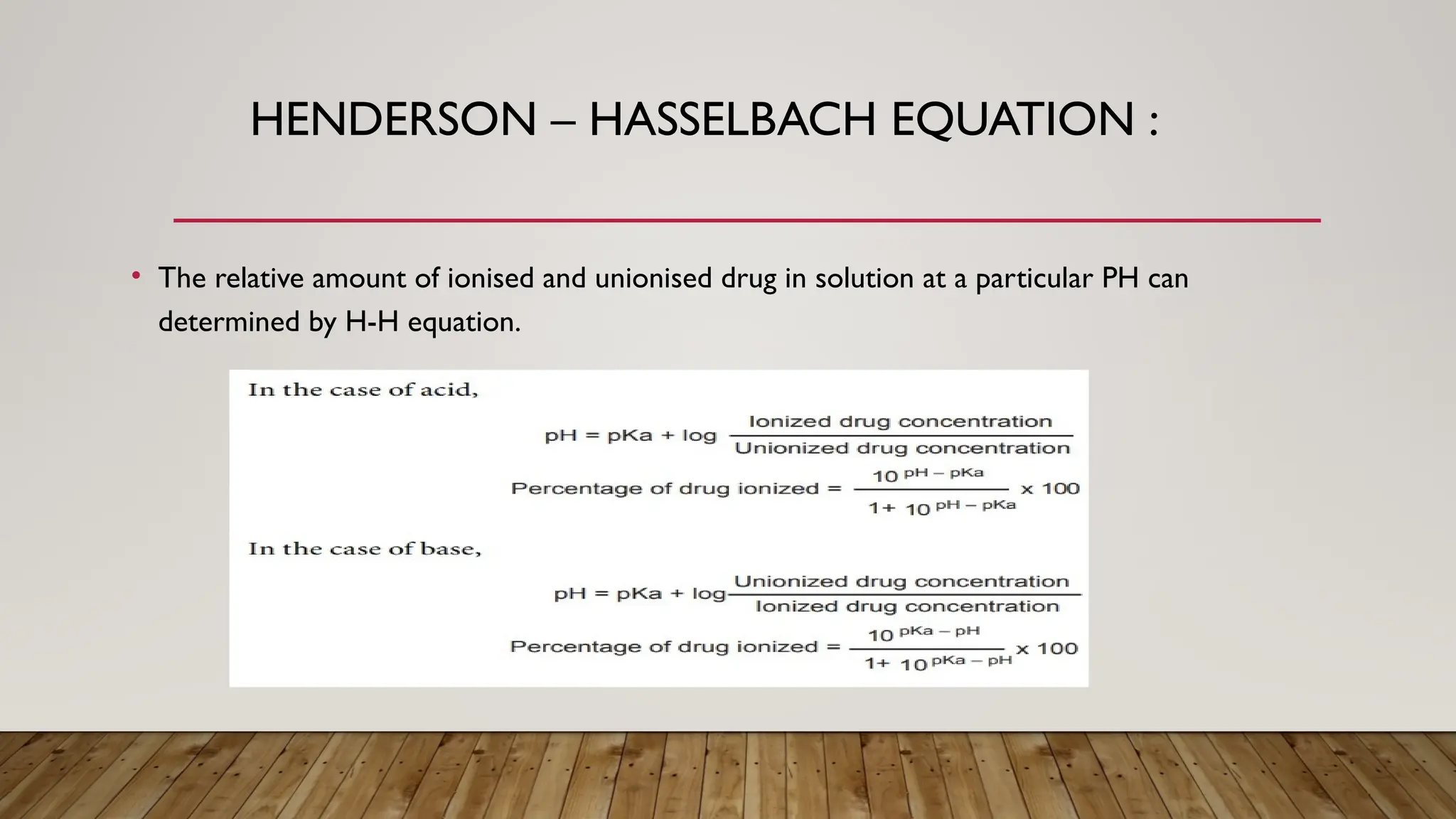
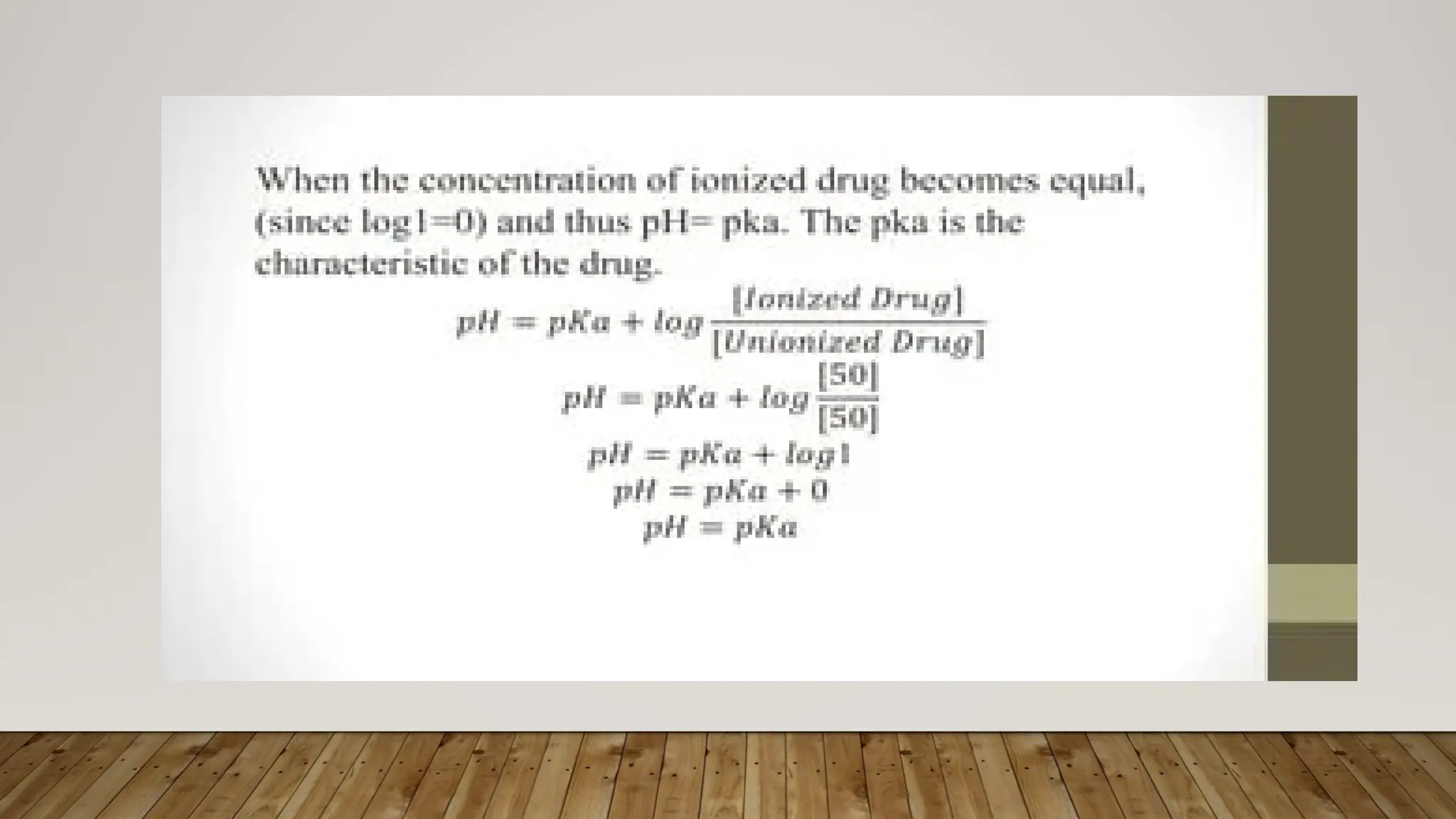
• The relative amount of ionised and unionised drug in solution at a particular PH can
determined by H-H equation.
9.
INFLUENCE OF DRUGPKA AND GI PH ON
DRUG ABSORPTION :-
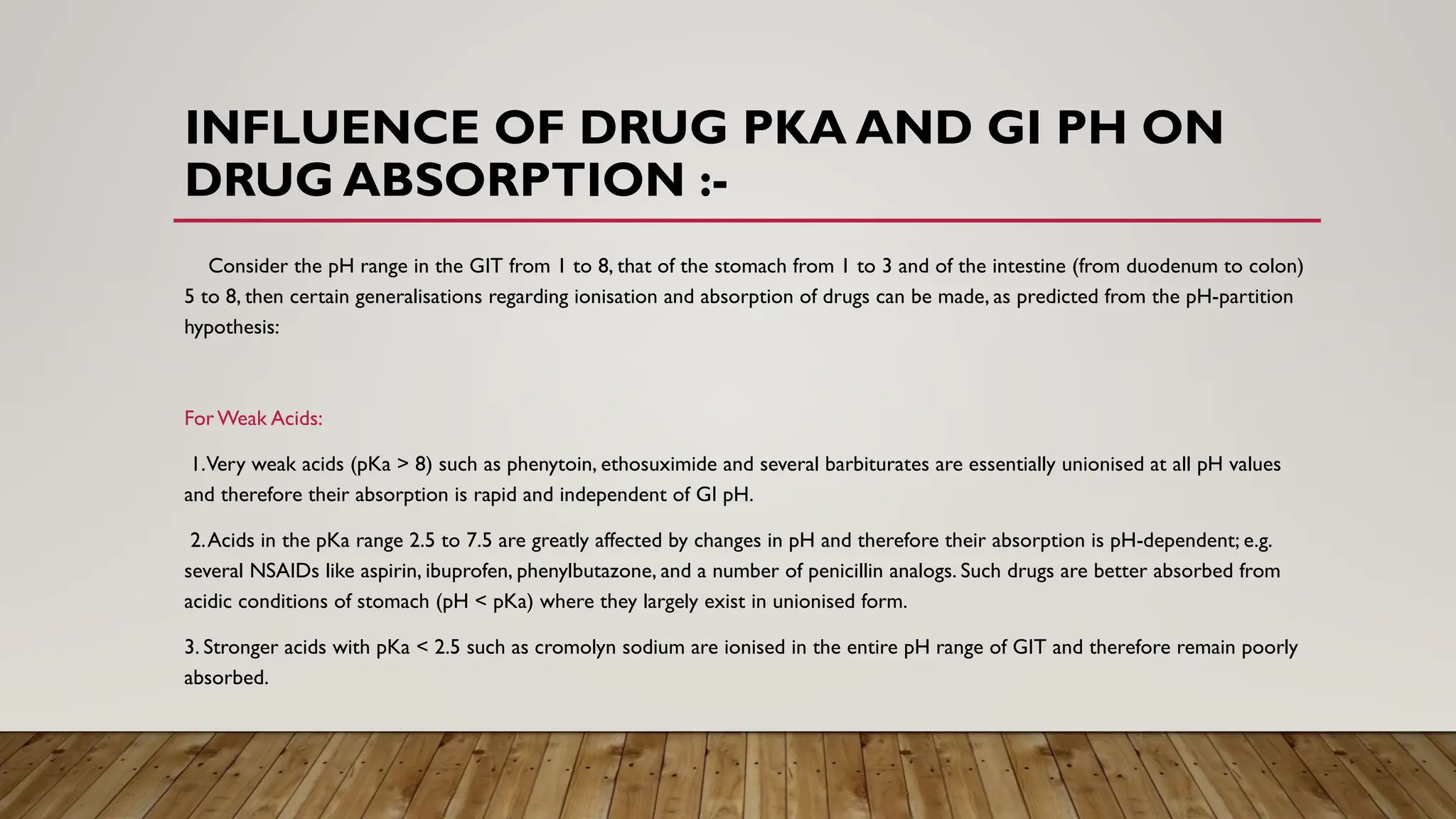
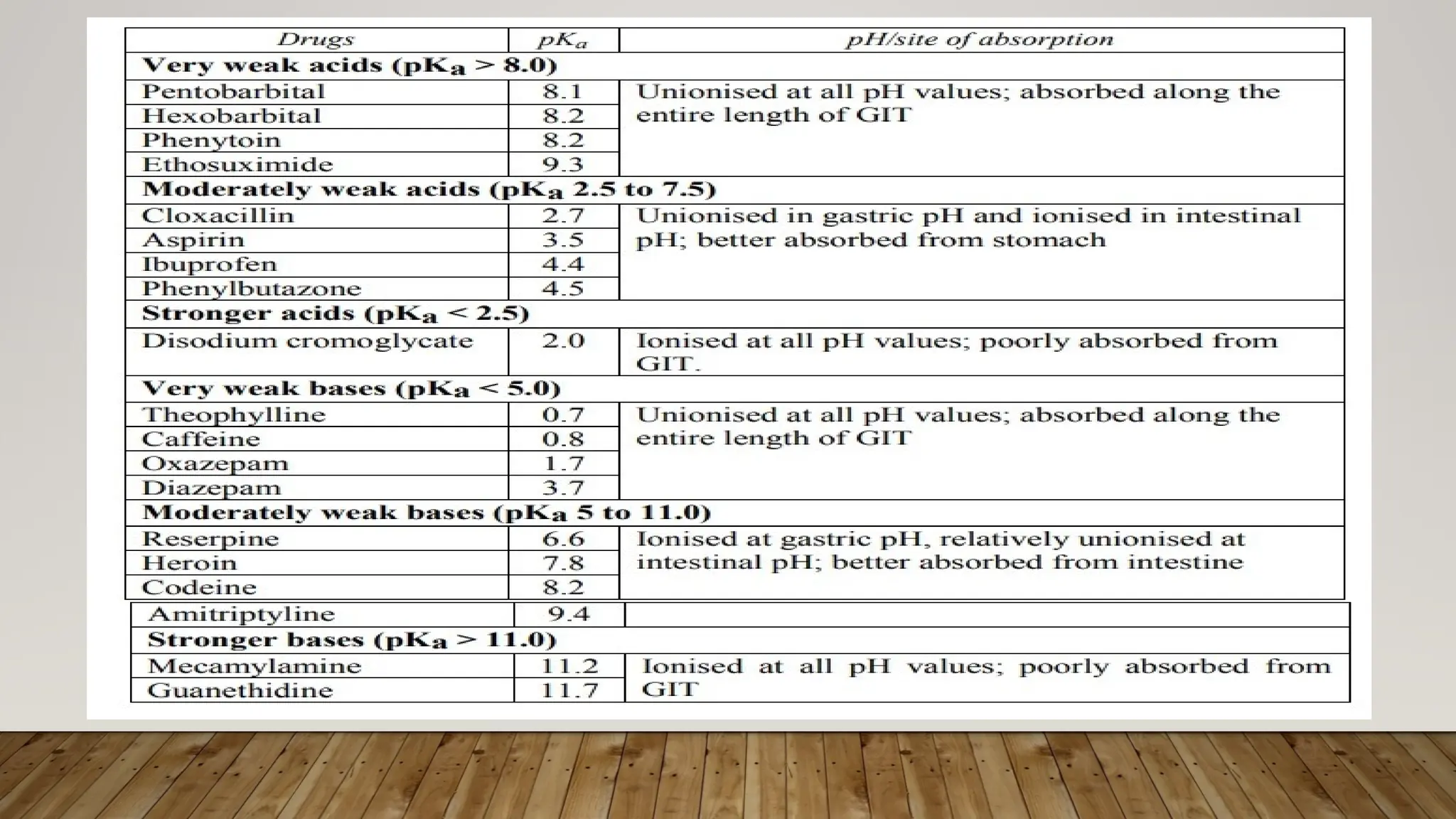
Consider the pH range in the GIT from 1 to 8, that of the stomach from 1 to 3 and of the intestine (from duodenum to colon)
5 to 8, then certain generalisations regarding ionisation and absorption of drugs can be made, as predicted from the pH-partition
hypothesis:
ForWeak Acids:
1.Very weak acids (pKa > 8) such as phenytoin, ethosuximide and several barbiturates are essentially unionised at all pH values
and therefore their absorption is rapid and independent of GI pH.
2.Acids in the pKa range 2.5 to 7.5 are greatly affected by changes in pH and therefore their absorption is pH-dependent; e.g.
several NSAIDs like aspirin, ibuprofen, phenylbutazone, and a number of penicillin analogs. Such drugs are better absorbed from
acidic conditions of stomach (pH < pKa) where they largely exist in unionised form.
3. Stronger acids with pKa < 2.5 such as cromolyn sodium are ionised in the entire pH range of GIT and therefore remain poorly
absorbed.
10.
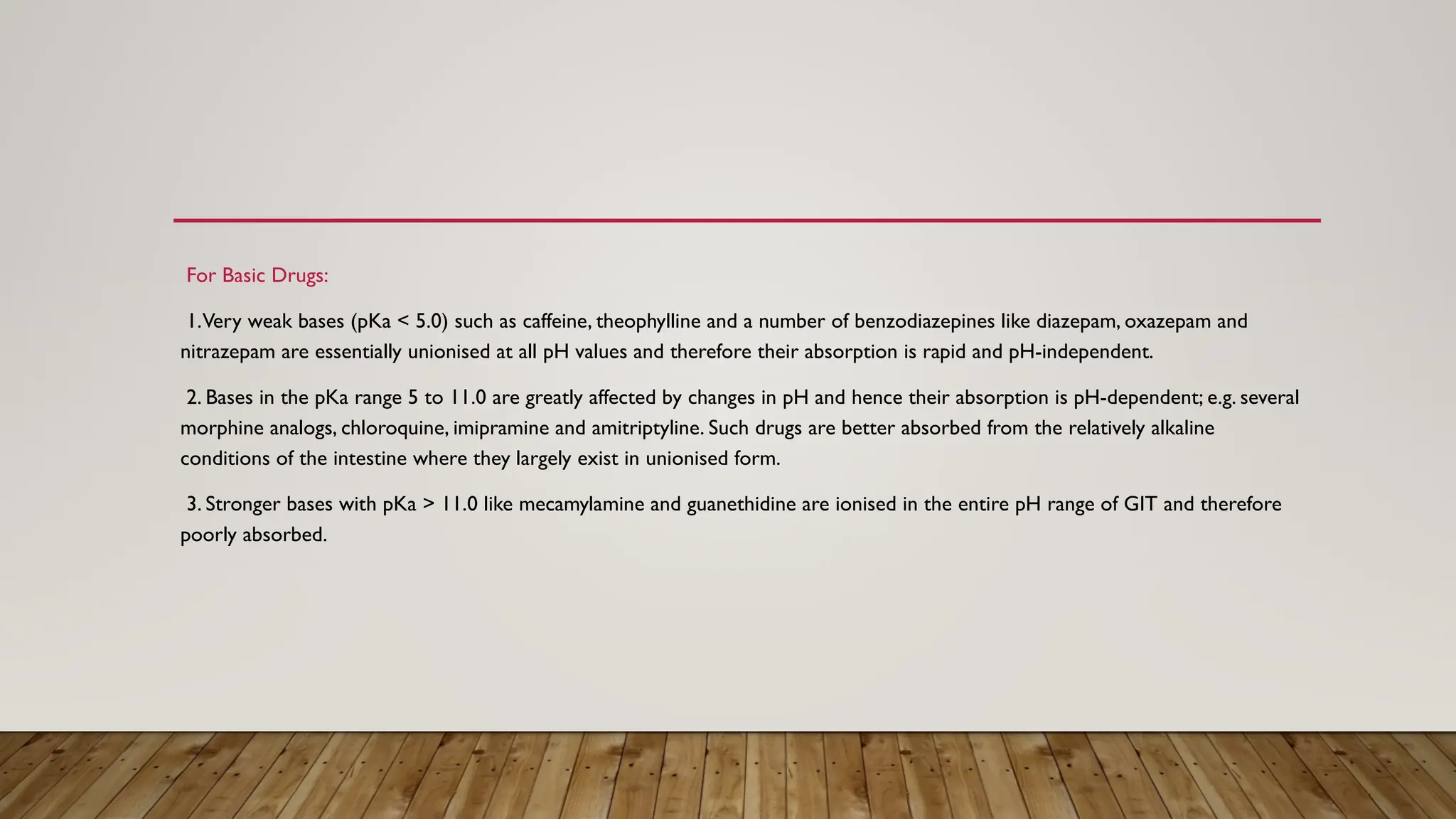
For Basic Drugs:
1.Veryweak bases (pKa < 5.0) such as caffeine, theophylline and a number of benzodiazepines like diazepam, oxazepam and
nitrazepam are essentially unionised at all pH values and therefore their absorption is rapid and pH-independent.
2. Bases in the pKa range 5 to 11.0 are greatly affected by changes in pH and hence their absorption is pH-dependent; e.g. several
morphine analogs, chloroquine, imipramine and amitriptyline. Such drugs are better absorbed from the relatively alkaline
conditions of the intestine where they largely exist in unionised form.
3. Stronger bases with pKa > 11.0 like mecamylamine and guanethidine are ionised in the entire pH range of GIT and therefore
poorly absorbed.
12.
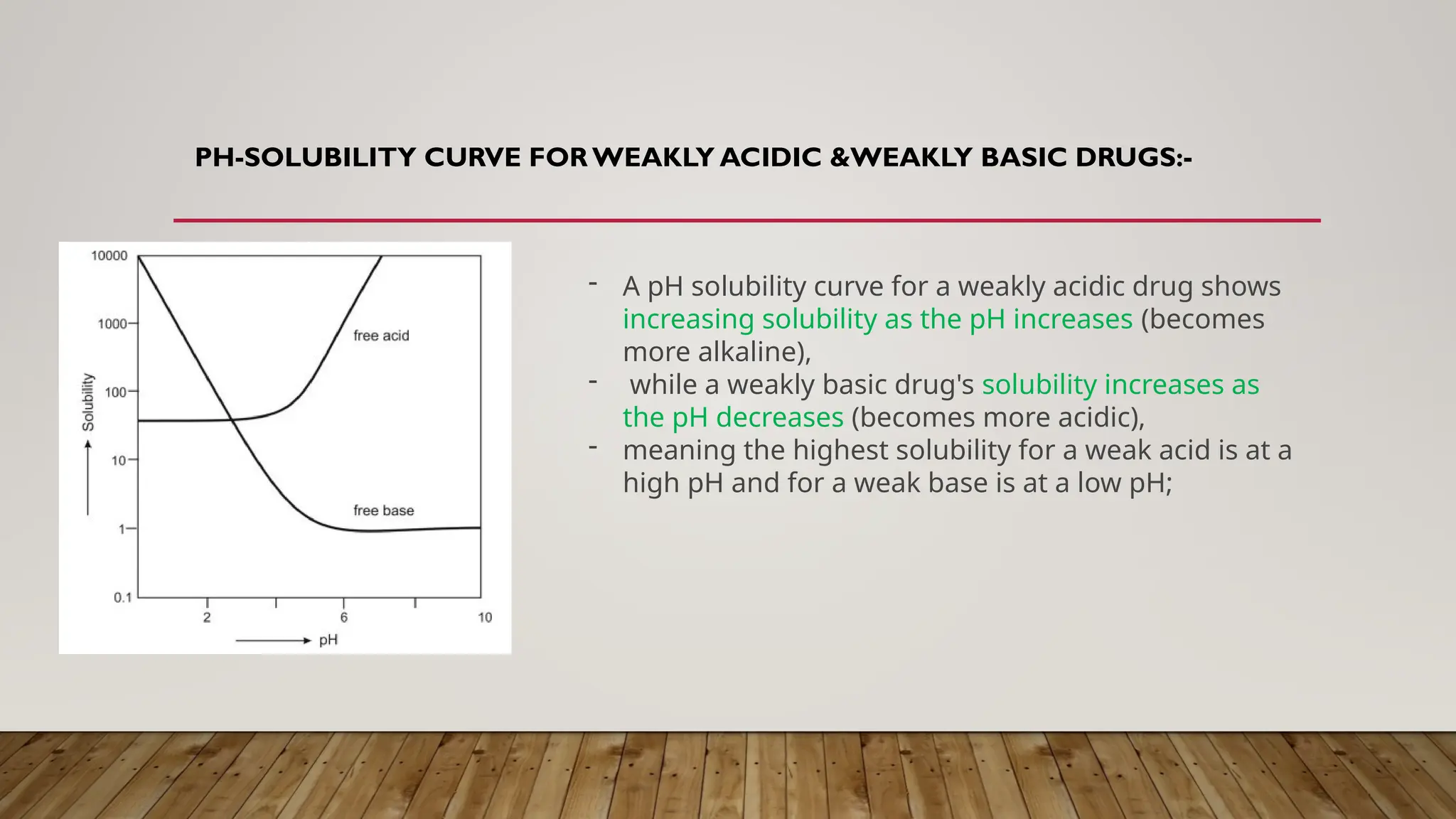
PH-SOLUBILITY CURVE FORWEAKLY ACIDIC &WEAKLY BASIC DRUGS:-
- A pH solubility curve for a weakly acidic drug shows
increasing solubility as the pH increases (becomes
more alkaline),
- while a weakly basic drug's solubility increases as
the pH decreases (becomes more acidic),
- meaning the highest solubility for a weak acid is at a
high pH and for a weak base is at a low pH;
13.
LIMITATIONS OF PH– PARTITION HYPOTHESIS
• The PH-partition hypothesis over-simplified the otherwise complicated process of drug
absorption and therefore has its own limitations .
• Some of the deviations from the theory are:
• A)Presence of virtual membrane PH.
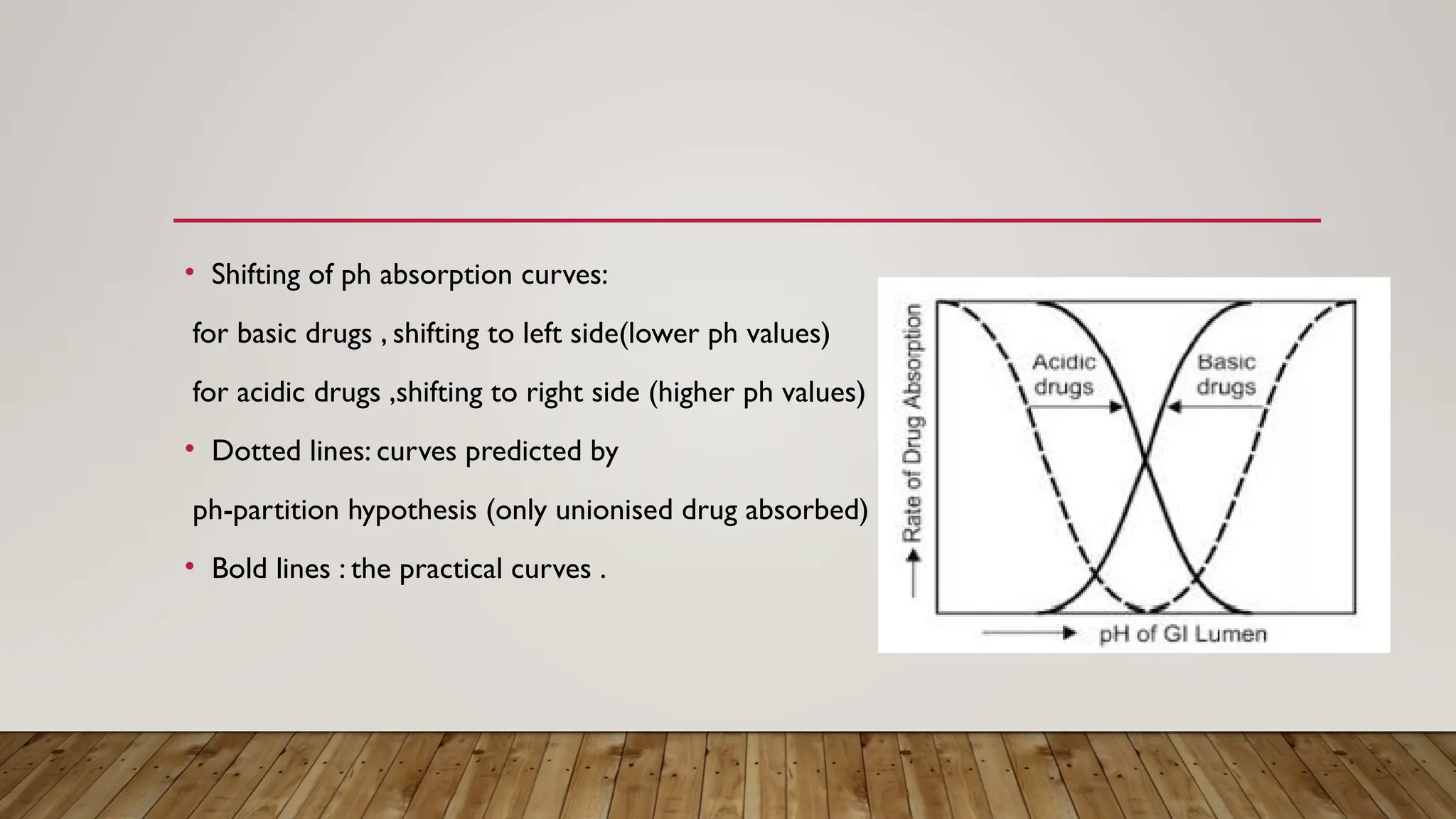
• B)Absorption of ionised drug.
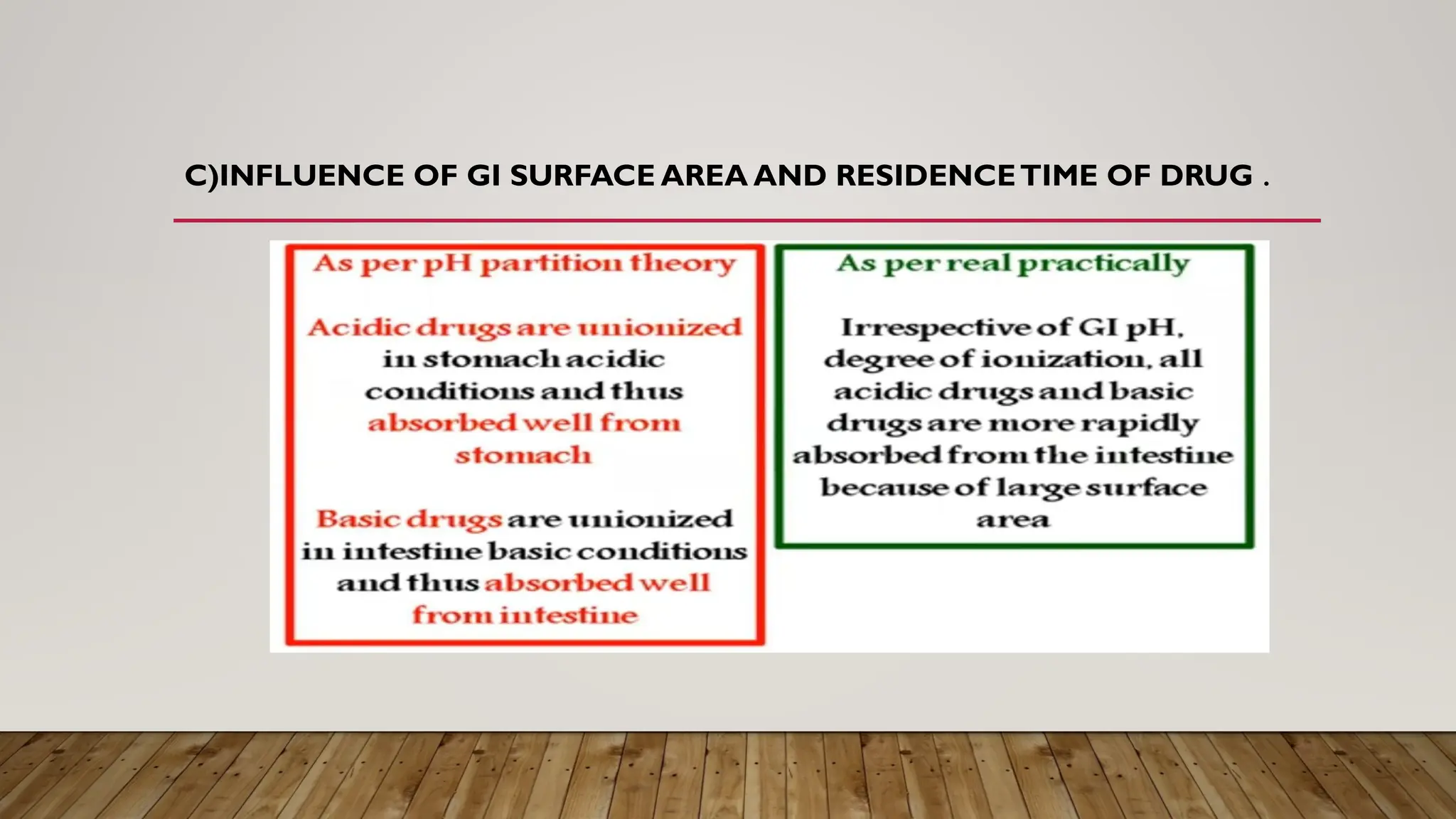
• C)Influence of GI surface area and residence time of drug .
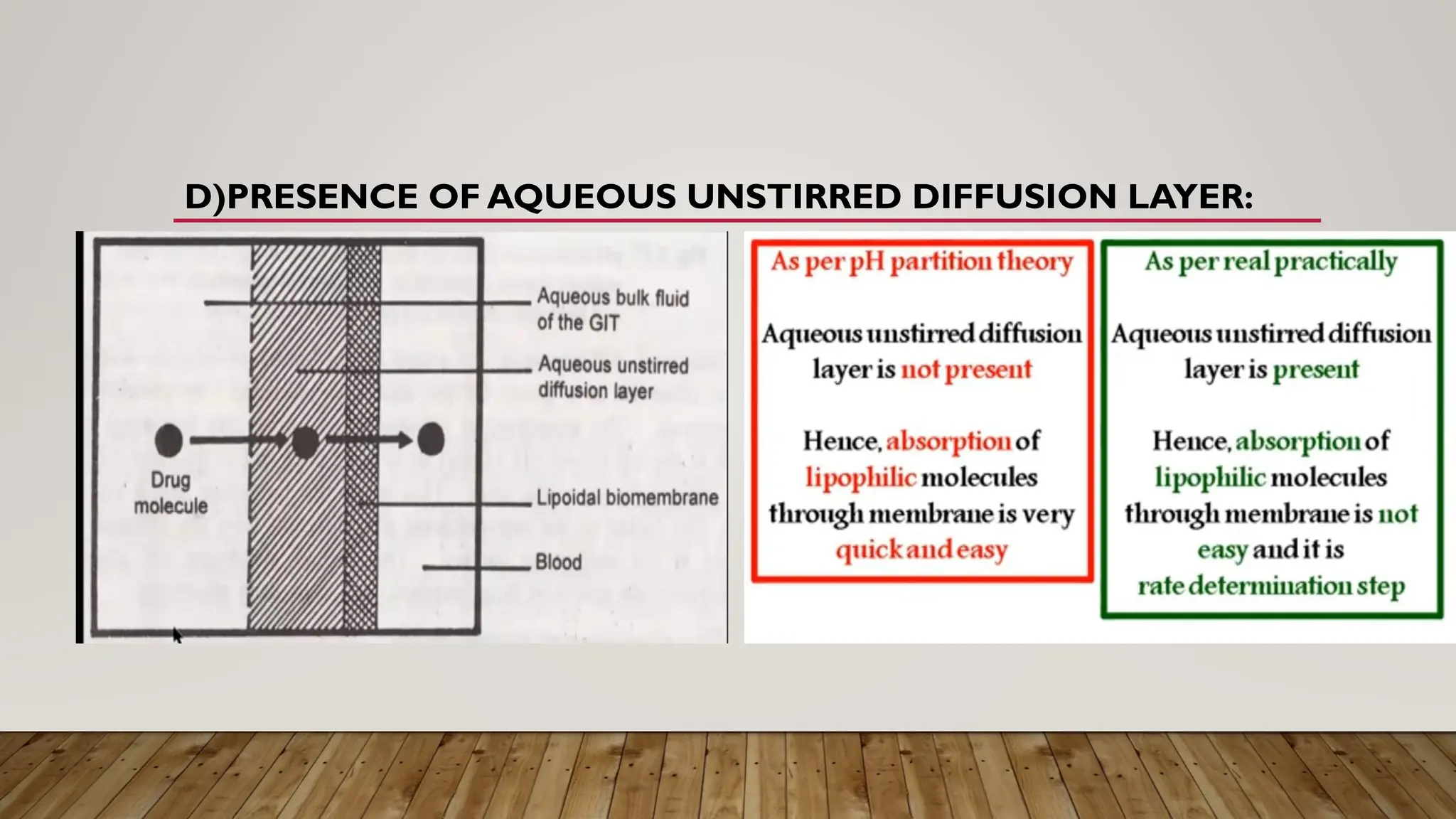
• D)Presence of aq.unstirred diffusion layer.
14.
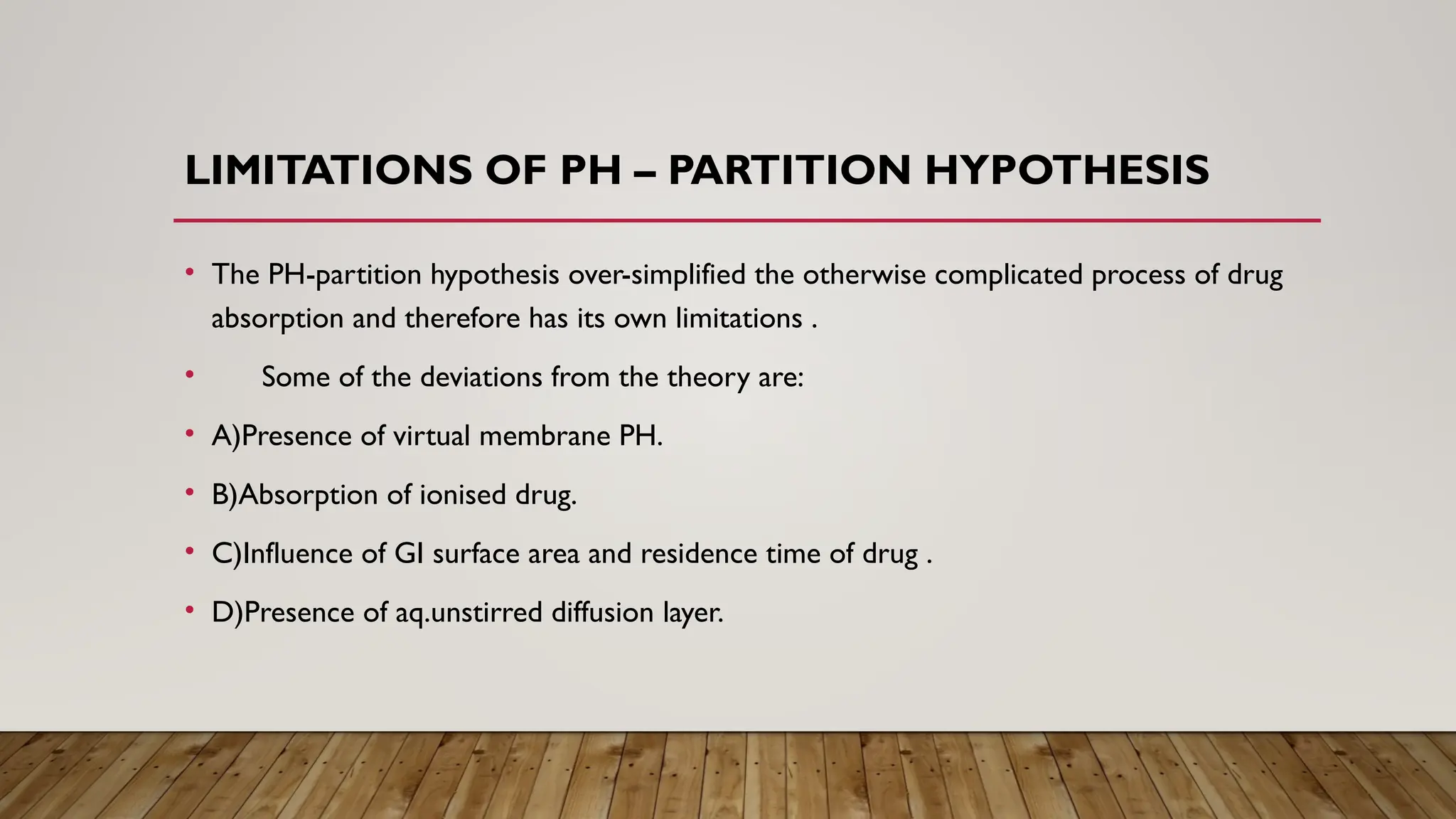
A)PRESENCE OFVIRTUAL MEMBRANEPH:
• Virtual membrane is not considered by
PH partition hypothesis.
• Virtual membrane is always present in micro
environment and it influences the process of
absorption.
• The virtual ph is also called as the microclimate ph,
is different from the luminal ph exists at the membrane
surface.
15.
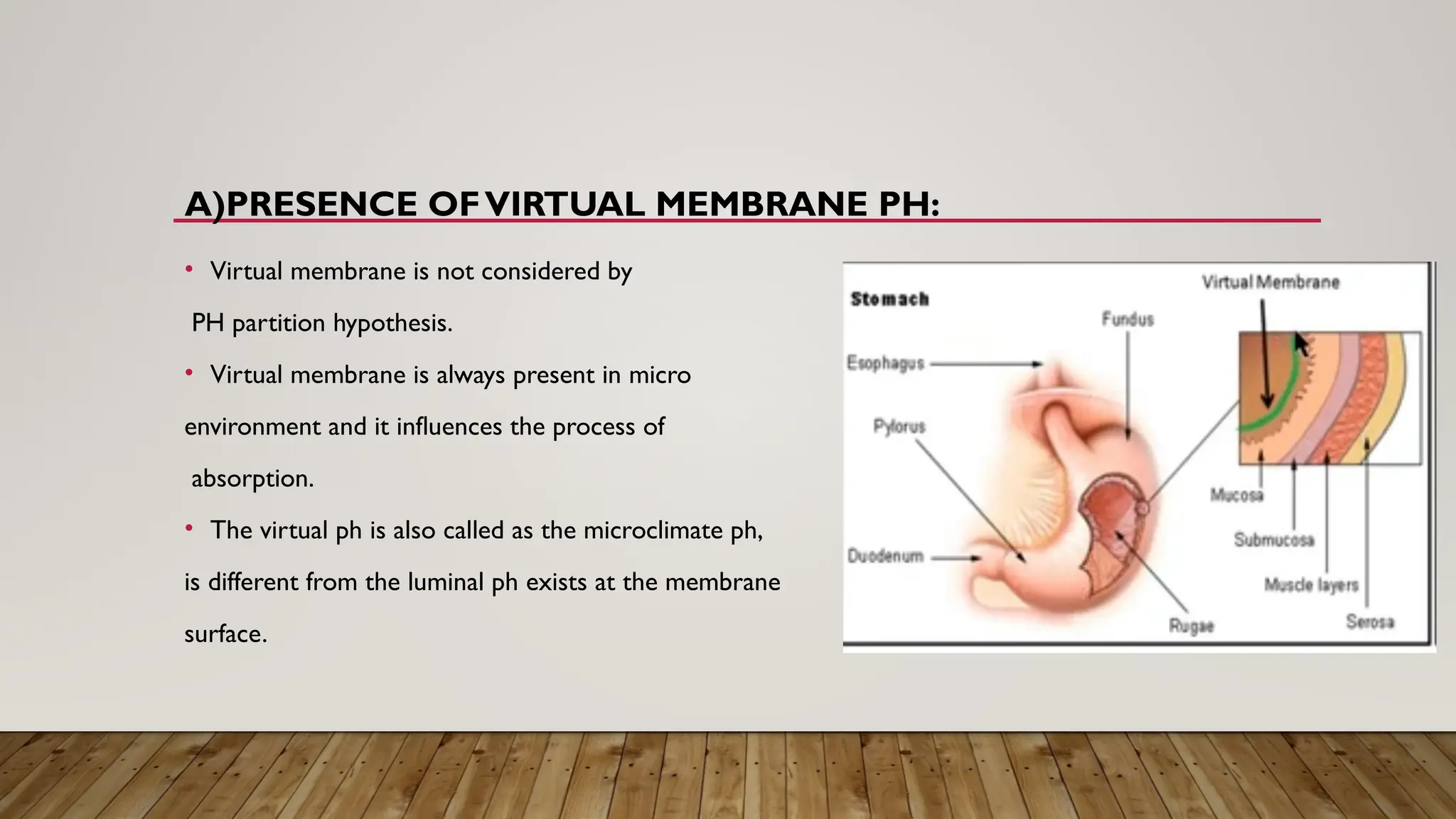
• Shifting ofph absorption curves:
for basic drugs , shifting to left side(lower ph values)
for acidic drugs ,shifting to right side (higher ph values)
• Dotted lines: curves predicted by
ph-partition hypothesis (only unionised drug absorbed)
• Bold lines : the practical curves .