SMART STREET LIGHT
SYSTEM
CONTENTS
 Problem Statement
 Project scope/objective
 Design and Implementation
 System features
 Infrared and proximity sensor
 Arduino
 System Design
PROBLEM STATEMENT
 Automatic switching of street lights considering the intensity of sunlight,
brightness control of lights on detecting movement of vehicles and error
reporting to electric sub sections
PROJECT SCOPE/OBJECTIVE
 Smart street light system tries to find solution for the faster depletion of
energy resources due to the inefficient usage and wastage of these
resources.
 Increasing electricity bill is something that can be witnessed by these
practices.
 This project help to decrease the wastage of electricity by controlling the
working of street light system that attributes to a good amount of
electricity bills in our nation.
 This project does not include methods to incorporate usage of renewable
resources like solar energy.
DESIGN AND IMPLEMENTATION
CONSTRAINTS
 Constraints are mainly in the module that regulate the
brightness of the light by considering the traffic on the street
at a specific time.
 Infrared proximity sensors are costly and at the same time
maximum distance to which the sensor can sense is limited to
1 meter, which may not be sufficient for a 45 meter road.
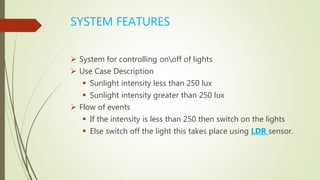
SYSTEM FEATURES
 System for controlling onoff of lights
 Use Case Description
 Sunlight intensity less than 250 lux
 Sunlight intensity greater than 250 lux
 Flow of events
 If the intensity is less than 250 then switch on the lights
 Else switch off the light this takes place using LDR sensor.
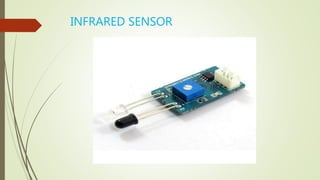
INFRARED PROXIMITY SENSOR
 An infrared sensor is an electronic instrument that is used to sense
certain characteristics of its surroundings by either emitting and/or
detecting infrared radiation.
 It is also capable of measuring heat of an object and detecting
motion. Infrared waves are not visible to the human eye.
 Infrared technology is found in many of our everyday products. For
example, a television has an IR detector for interpreting the signal
from the remote control. Key benefits of infrared sensors include low
power requirements, simple circuitry, and their portable feature
ARDUINO
 Arduino is a single-board microcontroller, intended to make
the application of interactive objects or environments more
accessible.
 The hardware consists of an open- source hardware board
designed around an 8-bit Atmel AVR microcontroller, or a 32-
bit Atmel ARM.
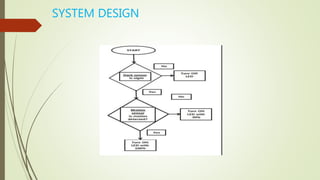
SYSTEM DESIGN
INFRARED SENSOR
Thank You

Smart street light system

  • 1.
  • 2.
    CONTENTS  Problem Statement Project scope/objective  Design and Implementation  System features  Infrared and proximity sensor  Arduino  System Design
  • 3.
    PROBLEM STATEMENT  Automaticswitching of street lights considering the intensity of sunlight, brightness control of lights on detecting movement of vehicles and error reporting to electric sub sections
  • 4.
    PROJECT SCOPE/OBJECTIVE  Smartstreet light system tries to find solution for the faster depletion of energy resources due to the inefficient usage and wastage of these resources.  Increasing electricity bill is something that can be witnessed by these practices.  This project help to decrease the wastage of electricity by controlling the working of street light system that attributes to a good amount of electricity bills in our nation.  This project does not include methods to incorporate usage of renewable resources like solar energy.
  • 5.
    DESIGN AND IMPLEMENTATION CONSTRAINTS Constraints are mainly in the module that regulate the brightness of the light by considering the traffic on the street at a specific time.  Infrared proximity sensors are costly and at the same time maximum distance to which the sensor can sense is limited to 1 meter, which may not be sufficient for a 45 meter road.
  • 6.
    SYSTEM FEATURES  Systemfor controlling onoff of lights  Use Case Description  Sunlight intensity less than 250 lux  Sunlight intensity greater than 250 lux  Flow of events  If the intensity is less than 250 then switch on the lights  Else switch off the light this takes place using LDR sensor.
  • 7.
    INFRARED PROXIMITY SENSOR An infrared sensor is an electronic instrument that is used to sense certain characteristics of its surroundings by either emitting and/or detecting infrared radiation.  It is also capable of measuring heat of an object and detecting motion. Infrared waves are not visible to the human eye.  Infrared technology is found in many of our everyday products. For example, a television has an IR detector for interpreting the signal from the remote control. Key benefits of infrared sensors include low power requirements, simple circuitry, and their portable feature
  • 8.
    ARDUINO  Arduino isa single-board microcontroller, intended to make the application of interactive objects or environments more accessible.  The hardware consists of an open- source hardware board designed around an 8-bit Atmel AVR microcontroller, or a 32- bit Atmel ARM.
  • 9.
  • 10.
  • 11.