How fast does light travel?
• Light travels in a straight line. It does not naturally bend
around corners.
• It travels at about 186,000 miles per second in air and
space.
• Compare this with sound, which travels only about
1,100 feet per second.
The first recorded discovery of the
pinhole phenomena
occurred 500 years B.C.
• It was the Chinese philosopher Mo-Ti, who first
described the optical phenomenon he called a
"collecting place” or “locked treasure room."Light
passing through a tiny hole in the wall of a darkened
room would cast a full-color, upside-down image of
what was outside on the opposite wall.
• By the 17th century this principle had evolved and
been named the camera obscura.
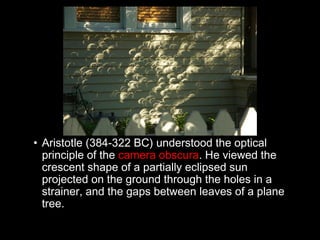
• Aristotle (384-322 BC) understood the optical
principle of the camera obscura. He viewed the
crescent shape of a partially eclipsed sun
projected on the ground through the holes in a
strainer, and the gaps between leaves of a plane
tree.
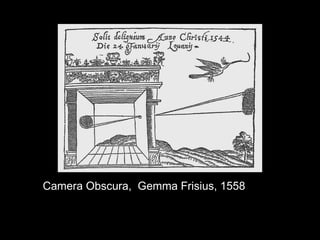
Camera Obscura, Gemma Frisius, 1558
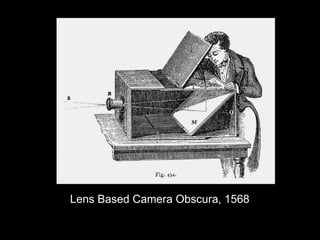
Lens Based Camera Obscura, 1568
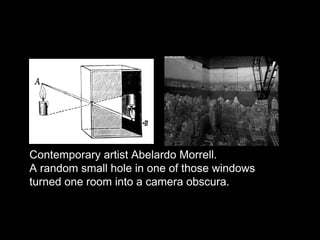
Contemporary artist Abelardo Morrell.
A random small hole in one of those windows
turned one room into a camera obscura.
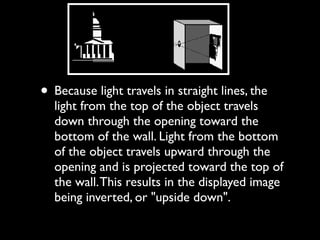
• Because light travels in straight lines, the
light from the top of the object travels
down through the opening toward the
bottom of the wall. Light from the bottom
of the object travels upward through the
opening and is projected toward the top of
the wall.This results in the displayed image
being inverted, or "upside down".
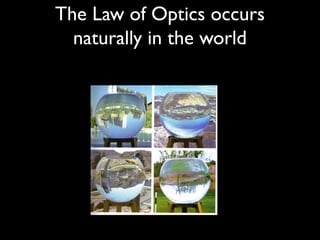
The Law of Optics occurs
naturally in the world
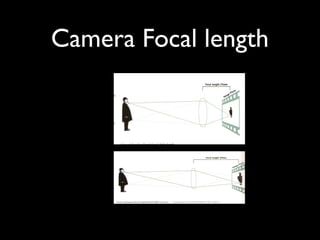
Camera Focal length
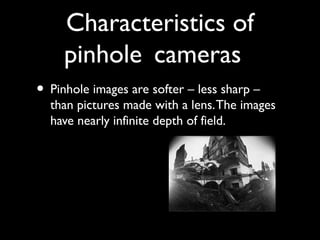
Characteristics of
pinhole cameras
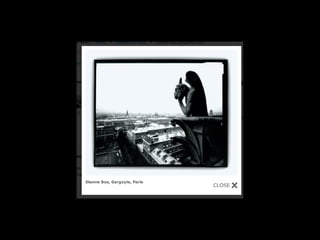
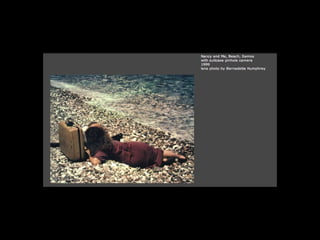
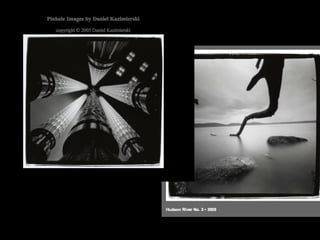
• Pinhole images are softer – less sharp –
than pictures made with a lens.The images
have nearly infinite depth of field.
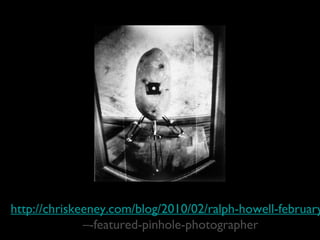
http://chriskeeney.com/blog/2010/02/ralph-howell-february
–-featured-pinhole-photographer
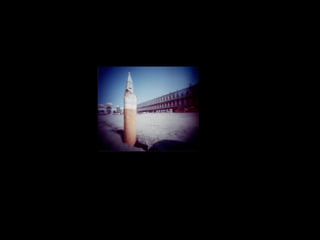
Extra Strong Segafredo Coffee, Pinhole Photograph
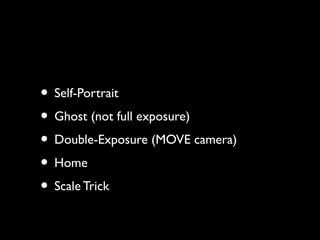
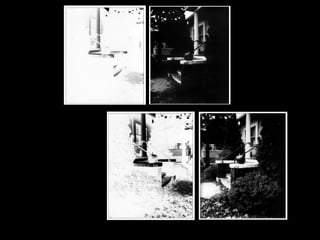
• Self-Portrait
• Ghost (not full exposure)
• Double-Exposure (MOVE camera)
• Home
• Scale Trick
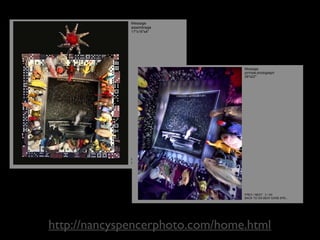
Anne Frank, 11"x14" Silver Gelatin print, from anamorph camera, 2000
http://www.pinholeresource.com/shop/gallery
http://nancyspencerphoto.com/home.html

Pinhole

  • 3.
    How fast doeslight travel? • Light travels in a straight line. It does not naturally bend around corners. • It travels at about 186,000 miles per second in air and space. • Compare this with sound, which travels only about 1,100 feet per second.
  • 4.
    The first recordeddiscovery of the pinhole phenomena occurred 500 years B.C. occurred 500 years B.C. occurred 500 years B.C. • It was the Chinese philosopher Mo-Ti, who first described the optical phenomenon he called a "collecting place” or “locked treasure room."Light passing through a tiny hole in the wall of a darkened room would cast a full-color, upside-down image of what was outside on the opposite wall. • By the 17th century this principle had evolved and been named the camera obscura.
  • 5.
    • Aristotle (384-322BC) understood the optical principle of the camera obscura. He viewed the crescent shape of a partially eclipsed sun projected on the ground through the holes in a strainer, and the gaps between leaves of a plane tree.
  • 6.
    Camera Obscura, GemmaFrisius, 1558
  • 7.
    Lens Based CameraObscura, 1568
  • 9.
    Contemporary artist AbelardoMorrell. A random small hole in one of those windows turned one room into a camera obscura.
  • 10.
    • Because lighttravels in straight lines, the light from the top of the object travels down through the opening toward the bottom of the wall. Light from the bottom of the object travels upward through the opening and is projected toward the top of the wall.This results in the displayed image being inverted, or "upside down".
  • 11.
    The Law ofOptics occurs naturally in the world
  • 12.
  • 14.
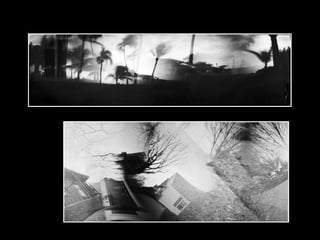
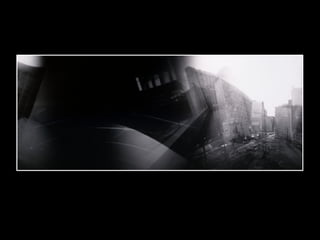
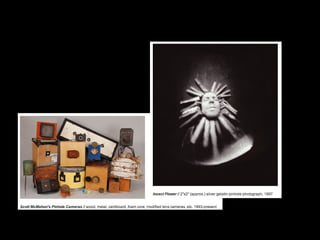
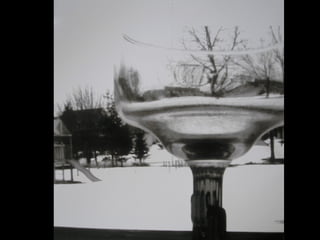
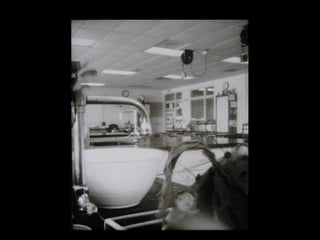
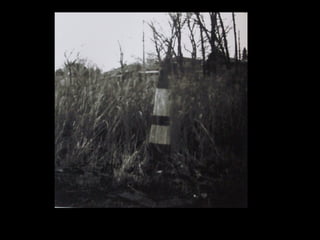
    Characteristics of pinhole cameras •Pinhole images are softer – less sharp – than pictures made with a lens.The images have nearly infinite depth of field.
  • 21.
  • 22.
    Extra Strong SegafredoCoffee, Pinhole Photograph
  • 25.
    • Self-Portrait • Ghost(not full exposure) • Double-Exposure (MOVE camera) • Home • Scale Trick
  • 34.
    Anne Frank, 11"x14"Silver Gelatin print, from anamorph camera, 2000 http://www.pinholeresource.com/shop/gallery
  • 36.