Focal Point – Selective Focus, Placement, Framing


                        Crabbing at Pauley’s, 1989
                        Sally Mann
                        Edwyn Honk Gallery
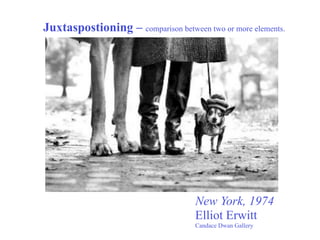
Juxtaspostioning – comparison between two or more elements.


                                     New York, 1974
                                     Elliot Erwitt
                                     Candace Dwan Gallery
“Quiz”
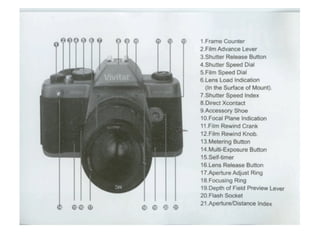
•   1.What kind of camera will we
    use?
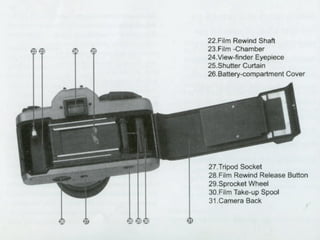
•   2. Where do the batteries go?
•   3. What is film speed?
•   4. What is a cassette?
•   5. What is a film leader?
•   6. What is the take-up spool?
•   7. Sprocket holes?
•   8. Where is the shutter release
    button? What does it do?
•   9. Where is the film counter?
•   10. Where/what is the
    viewfinder?
•   11. ISO?
•   12. Where is the rewind button?
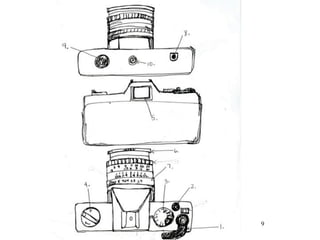
•   1. SLR –Single Lens Reflex

•   2. Bottom.
•   3. Tells you how quickly the film
    responds to light (outdoors/
    indoors/stop action/detail).
•   4. Light-tight container for the
    film.
•   5. Curved first part of film.
•   6. Part of the camera that you lead
    your film into (vertical slots).
•   7. Holes on sides of film.
•   8. Top- takes the picture.
•   9. Above the film advance lever.
•   10. Window you look through.
•   11. ASA-film speed.
•   12. Bottom.
Requirements for a Camera
•   Light-tight
•   Opening
•   Shutter
•   Shutter Release
•   Viewfinder
•   Advance/winder
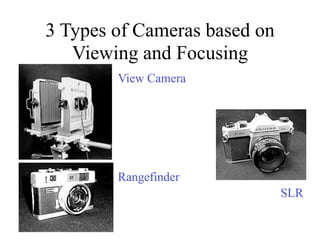
3 Types of Cameras based on
   Viewing and Focusing
        View Camera


        Rangefinder
                              SLR
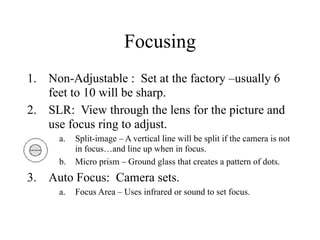
Focusing
1. Non-Adjustable : Set at the factory –usually 6
   feet to 10 will be sharp.
2. SLR: View through the lens for the picture and
   use focus ring to adjust.
      a.   Split-image – A vertical line will be split if the camera is not
           in focus…and line up when in focus.
      b.   Micro prism – Ground glass that creates a pattern of dots.
3. Auto Focus: Camera sets.
      a.   Focus Area – Uses infrared or sound to set focus.
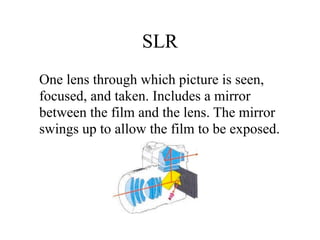
SLR
One lens through which picture is seen,
focused, and taken. Includes a mirror
between the film and the lens. The mirror
swings up to allow the film to be exposed.
9
10
12
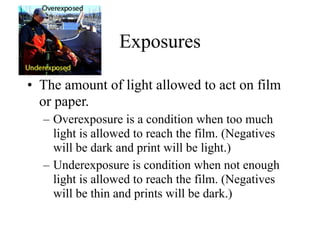
Exposures

• The amount of light allowed to act on film
  or paper.
  – Overexposure is a condition when too much
    light is allowed to reach the film. (Negatives
    will be dark and print will be light.)
  – Underexposure is condition when not enough
    light is allowed to reach the film. (Negatives
    will be thin and prints will be dark.)
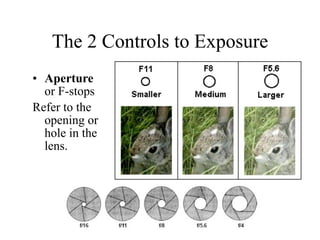
The 2 Controls to Exposure
• Aperture
  or F-stops
Refer to the
  opening or
  hole in the
  lens.
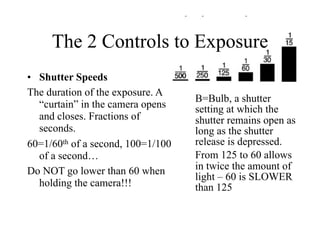
The 2 Controls to Exposure
• Shutter Speeds
The duration of the exposure. A
                                   B=Bulb, a shutter
  “curtain” in the camera opens    setting at which the
  and closes. Fractions of         shutter remains open as
  seconds.                         long as the shutter
60=1/60th of a second, 100=1/100   release is depressed.
  of a second…                     From 125 to 60 allows
Do NOT go lower than 60 when       in twice the amount of
                                   light – 60 is SLOWER
  holding the camera!!!            than 125
QUIZ on
       Shutter Speeds and Apertures
1. 500=?
2. T        F 500 is twice as fast as 1000.
3. T F 250 is slower than 500.
4. 1=?
5. What is the lowest handheld shutter?
6. F-stop is ?
7. T F f4 will let in ½ the amount of light as f5.6.
8. T F f8 will let in more light than f16.
9. What is wide-open?
10. What is B?
1. 500= Is 1/500th of a second.
2. T        F 500 is twice as fast as 1000.
3. T F 250 is slower than 500.
4. 1=Is one second.
5. The lowest shutter one can use handheld is 60.
6. F-stop is ? The opening in the lens or aperture.
7. T F f4 will let in ½ the amount of light as f5.6.
8. T F f8 will let in more light than f16.
9. What is wide-open? Wide-open is the largest hole.
10.What is B? Is BULB or an indefinite shutter speed.
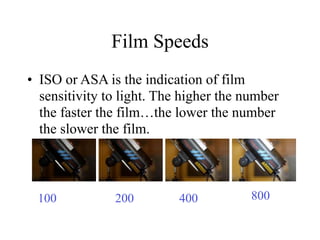
Film Speeds
• ISO or ASA is the indication of film
  sensitivity to light. The higher the number
  the faster the film…the lower the number
  the slower the film.


 100           200         400          800
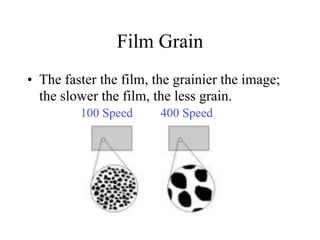
Film Grain
• The faster the film, the grainier the image;
  the slower the film, the less grain.
         100 Speed      400 Speed
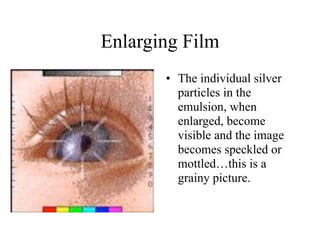
Enlarging Film
       • The individual silver
         particles in the
         emulsion, when
         enlarged, become
         visible and the image
         becomes speckled or
         mottled…this is a
         grainy picture.
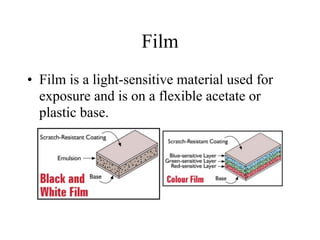
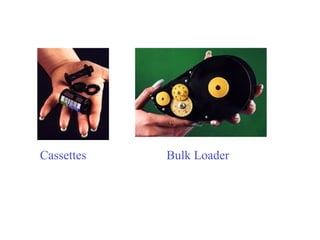
Film
• Film is a light-sensitive material used for
  exposure and is on a flexible acetate or
  plastic base.
Cassettes   Bulk Loader
Metering!!
A light meter is an instrument to measure the light
  and translate that measurement into the correct
  combination of f-stop and shutter speed for the
  given light conditions.
Meter off of “18% gray”:
  Green grass, mixed foliage, mixed values, old
  asphalt, grass, or “your hand and OPEN one.”

Assignment:Meter off several things and places in
  the room to see the difference.
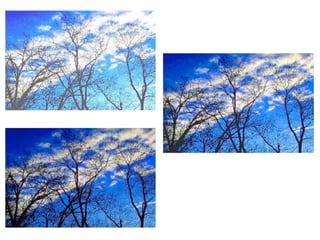
Bracketing
• Because you may never get the exact
  exposure the first time, you should take a
  number of different exposure of the same
  subject at different settings for under and
  over exposure.
Practice and QUIZ
Then, use your slide to answer the questions:
1. What are 3 exposures the SAME as f5.6 and 60?
2. Open f5.6 and 60 one stop (like you metered off your
   hand). What are 4 exposures you could shoot?
3. If you metered off BLACK and got a reading of f5.6 and
   500, what do you need to compensate to?
4. Bracket for f4 and 125: + and -.
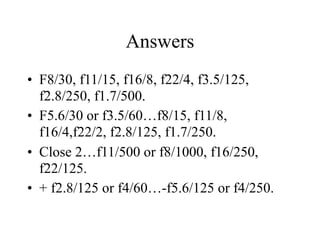
Answers
• F8/30, f11/15, f16/8, f22/4, f3.5/125,
  f2.8/250, f1.7/500.
• F5.6/30 or f3.5/60…f8/15, f11/8,
  f16/4,f22/2, f2.8/125, f1.7/250.
• Close 2…f11/500 or f8/1000, f16/250,
  f22/125.
• + f2.8/125 or f4/60…-f5.6/125 or f4/250.
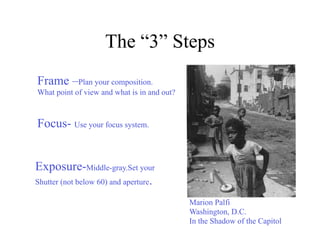
The “3” Steps
Frame –Plan your composition.
What point of view and what is in and out?


Focus- Use your focus system.


Exposure-Middle-gray.Set your
Shutter (not below 60) and aperture.

                                             Marion Palfi
                                             Washington, D.C.
                                             In the Shadow of the Capitol
WHY do we need 2 settings to
 change the exposure of our
          camera!!
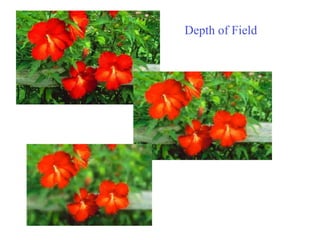
Depth of Field
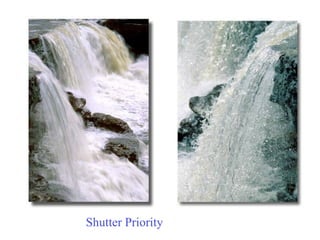
Shutter Priority

Review for Photo Camera

  • 1.
    Focal Point –Selective Focus, Placement, Framing Crabbing at Pauley’s, 1989 Sally Mann Edwyn Honk Gallery
  • 2.
    Juxtaspostioning – comparisonbetween two or more elements. New York, 1974 Elliot Erwitt Candace Dwan Gallery
  • 3.
    “Quiz” • 1.What kind of camera will we use? • 2. Where do the batteries go? • 3. What is film speed? • 4. What is a cassette? • 5. What is a film leader? • 6. What is the take-up spool? • 7. Sprocket holes? • 8. Where is the shutter release button? What does it do? • 9. Where is the film counter? • 10. Where/what is the viewfinder? • 11. ISO? • 12. Where is the rewind button?
  • 4.
    1. SLR –Single Lens Reflex • 2. Bottom. • 3. Tells you how quickly the film responds to light (outdoors/ indoors/stop action/detail). • 4. Light-tight container for the film. • 5. Curved first part of film. • 6. Part of the camera that you lead your film into (vertical slots). • 7. Holes on sides of film. • 8. Top- takes the picture. • 9. Above the film advance lever. • 10. Window you look through. • 11. ASA-film speed. • 12. Bottom.
  • 5.
    Requirements for aCamera • Light-tight • Opening • Shutter • Shutter Release • Viewfinder • Advance/winder
  • 6.
    3 Types ofCameras based on Viewing and Focusing View Camera Rangefinder SLR
  • 7.
    Focusing 1. Non-Adjustable :Set at the factory –usually 6 feet to 10 will be sharp. 2. SLR: View through the lens for the picture and use focus ring to adjust. a. Split-image – A vertical line will be split if the camera is not in focus…and line up when in focus. b. Micro prism – Ground glass that creates a pattern of dots. 3. Auto Focus: Camera sets. a. Focus Area – Uses infrared or sound to set focus.
  • 8.
    SLR One lens throughwhich picture is seen, focused, and taken. Includes a mirror between the film and the lens. The mirror swings up to allow the film to be exposed.
  • 9.
  • 10.
  • 12.
  • 13.
    Exposures • The amountof light allowed to act on film or paper. – Overexposure is a condition when too much light is allowed to reach the film. (Negatives will be dark and print will be light.) – Underexposure is condition when not enough light is allowed to reach the film. (Negatives will be thin and prints will be dark.)
  • 14.
    The 2 Controlsto Exposure • Aperture or F-stops Refer to the opening or hole in the lens.
  • 15.
    The 2 Controlsto Exposure • Shutter Speeds The duration of the exposure. A B=Bulb, a shutter “curtain” in the camera opens setting at which the and closes. Fractions of shutter remains open as seconds. long as the shutter 60=1/60th of a second, 100=1/100 release is depressed. of a second… From 125 to 60 allows Do NOT go lower than 60 when in twice the amount of light – 60 is SLOWER holding the camera!!! than 125
  • 16.
    QUIZ on Shutter Speeds and Apertures 1. 500=? 2. T F 500 is twice as fast as 1000. 3. T F 250 is slower than 500. 4. 1=? 5. What is the lowest handheld shutter? 6. F-stop is ? 7. T F f4 will let in ½ the amount of light as f5.6. 8. T F f8 will let in more light than f16. 9. What is wide-open? 10. What is B?
  • 17.
    1. 500= Is1/500th of a second. 2. T F 500 is twice as fast as 1000. 3. T F 250 is slower than 500. 4. 1=Is one second. 5. The lowest shutter one can use handheld is 60. 6. F-stop is ? The opening in the lens or aperture. 7. T F f4 will let in ½ the amount of light as f5.6. 8. T F f8 will let in more light than f16. 9. What is wide-open? Wide-open is the largest hole. 10.What is B? Is BULB or an indefinite shutter speed.
  • 18.
    Film Speeds • ISOor ASA is the indication of film sensitivity to light. The higher the number the faster the film…the lower the number the slower the film. 100 200 400 800
  • 19.
    Film Grain • Thefaster the film, the grainier the image; the slower the film, the less grain. 100 Speed 400 Speed
  • 20.
    Enlarging Film • The individual silver particles in the emulsion, when enlarged, become visible and the image becomes speckled or mottled…this is a grainy picture.
  • 21.
    Film • Film isa light-sensitive material used for exposure and is on a flexible acetate or plastic base.
  • 22.
    Cassettes Bulk Loader
  • 23.
    Metering!! A light meteris an instrument to measure the light and translate that measurement into the correct combination of f-stop and shutter speed for the given light conditions. Meter off of “18% gray”: Green grass, mixed foliage, mixed values, old asphalt, grass, or “your hand and OPEN one.” Assignment:Meter off several things and places in the room to see the difference.
  • 24.
    Bracketing • Because youmay never get the exact exposure the first time, you should take a number of different exposure of the same subject at different settings for under and over exposure.
  • 26.
    Practice and QUIZ Then,use your slide to answer the questions: 1. What are 3 exposures the SAME as f5.6 and 60? 2. Open f5.6 and 60 one stop (like you metered off your hand). What are 4 exposures you could shoot? 3. If you metered off BLACK and got a reading of f5.6 and 500, what do you need to compensate to? 4. Bracket for f4 and 125: + and -.
  • 27.
    Answers • F8/30, f11/15,f16/8, f22/4, f3.5/125, f2.8/250, f1.7/500. • F5.6/30 or f3.5/60…f8/15, f11/8, f16/4,f22/2, f2.8/125, f1.7/250. • Close 2…f11/500 or f8/1000, f16/250, f22/125. • + f2.8/125 or f4/60…-f5.6/125 or f4/250.
  • 28.
    The “3” Steps Frame–Plan your composition. What point of view and what is in and out? Focus- Use your focus system. Exposure-Middle-gray.Set your Shutter (not below 60) and aperture. Marion Palfi Washington, D.C. In the Shadow of the Capitol
  • 29.
    WHY do weneed 2 settings to change the exposure of our camera!!
  • 30.
  • 31.