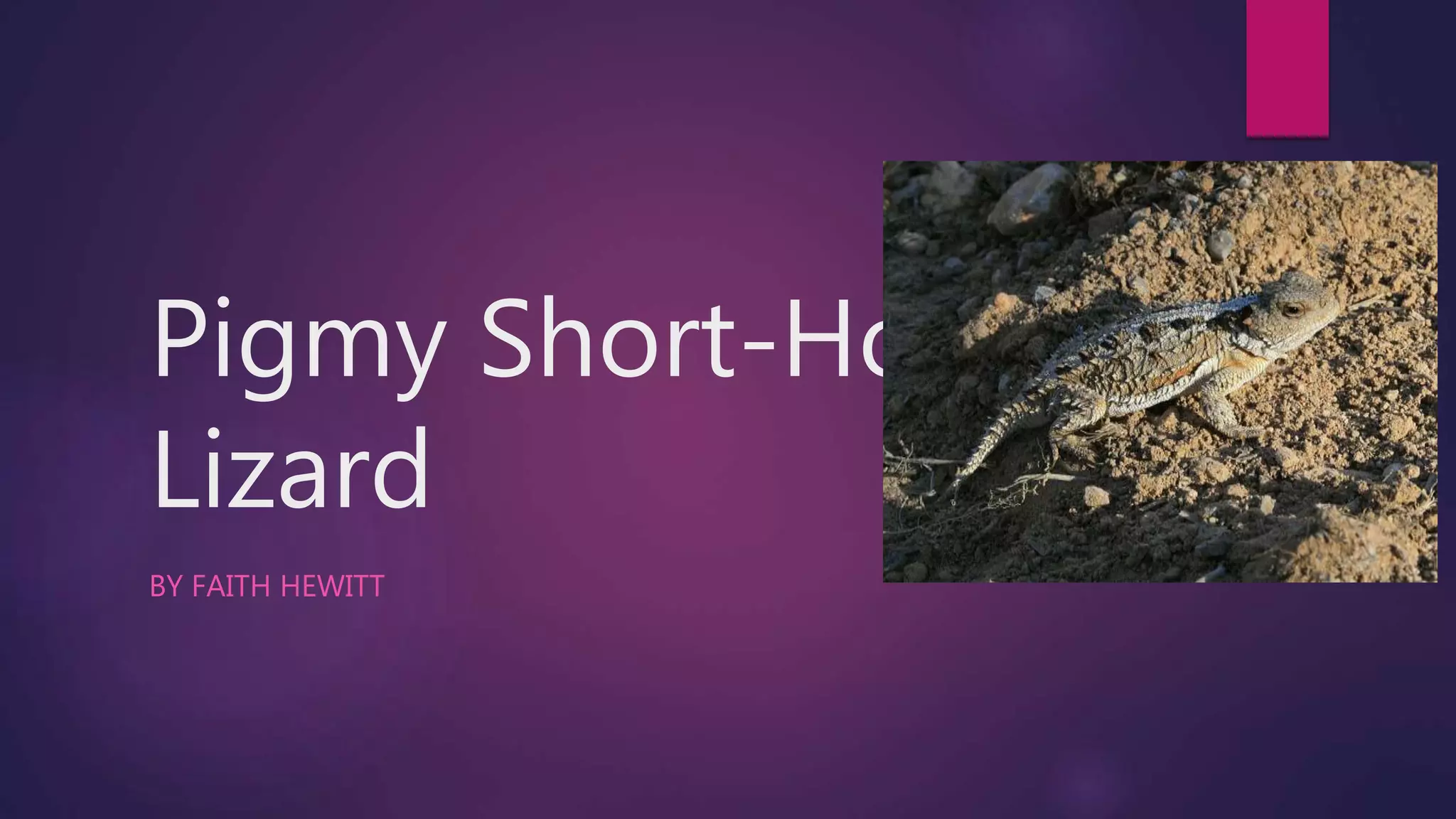
Pigmy Short-Horned
Lizard
BY FAITH HEWITT
Breif Discription
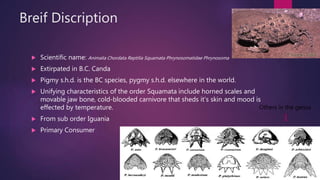
 Scientific name: Animalia Chordata Reptilia Squamata Phrynosomatidae Phrynosoma
 Extirpated in B.C. Canda
 Pigmy s.h.d. is the BC species, pygmy s.h.d. elsewhere in the world.
 Unifying characteristics of the order Squamata include horned scales and
movable jaw bone, cold-blooded carnivore that sheds it’s skin and mood is
effected by temperature.
 From sub order Iguania
 Primary Consumer
Others in the genus
Reasons for Extirpation in B.C.
 Extensive habitat loss
 By 20th Century already rare – possibly because of B.C.’s cold winters
If reintroduced to B.C. current risks would be……….
 Extensive habitat loss
 Roads, and careless hikers
 Predation from local and exotic animals (mainly birds and cats)
Protected under the federal Species at Risk Act (SARA)
 You cannot posses, collect, buy, sell, trade, kill, harm, harass, or destroy
their den (if somehow found they are reintroduced)
Characteristics of Life 1-3
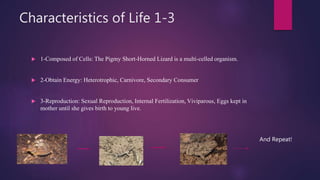
 1-Composed of Cells: The Pigmy Short-Horned Lizard is a multi-celled organism.
 2-Obtain Energy: Heterotrophic, Carnivore, Secondary Consumer
 3-Reproduction: Sexual Reproduction, Internal Fertilization, Viviparous, Eggs kept in
mother until she gives birth to young live.
And Repeat!
Characteristics of Life 4-7
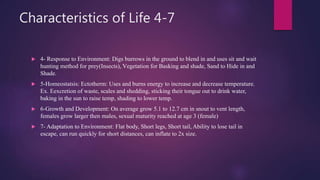
 4- Response to Environment: Digs burrows in the ground to blend in and uses sit and wait
hunting method for prey(Insects), Vegetation for Basking and shade, Sand to Hide in and
Shade.
 5-Homeostatsis: Ectotherm: Uses and burns energy to increase and decrease temperature.
Ex. Eexcretion of waste, scales and shedding, sticking their tongue out to drink water,
baking in the sun to raise temp, shading to lower temp.
 6-Growth and Development: On average grow 5.1 to 12.7 cm in snout to vent length,
females grow larger then males, sexual maturity reached at age 3 (female)
 7- Adaptation to Environment: Flat body, Short legs, Short tail, Ability to lose tail in
escape, can run quickly for short distances, can inflate to 2x size.
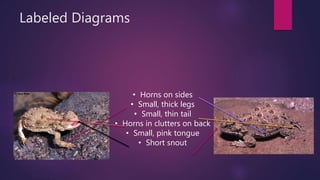
Labeled Diagrams
• Horns on sides
• Small, thick legs
• Small, thin tail
• Horns in clutters on back
• Small, pink tongue
• Short snout
The Squamata Order
Facts
 Over 9,000 Species – Not
endangered
 The order is recognised for their
horned scales/shields
 Has movable quadrate bones
 All Lizards and Snakes belong to
this Order
 Many sizes(16mm-5.21m)
Historically as large as 14m
Some Include……………
Giant horned lizard, (Phrynosoma asio)
Short-tailed horned lizard, (Phrynosoma braconnieri)
Cedros Island horned lizard, (Phrynosoma cerroense)
Texas horned lizard, (Phrynosoma cornutum)
Coast horned lizard, (Phrynosoma coronatum)
Cape horned lizard, (P. c. coronatum)
San Diego horned lizard, (P. c. blainvillii)
California horned lizard, (P. c. frontale)
Central peninsular horned lizard, (P. c. jamesi)
Northern peninsular horned lizard, (P. c. schmidti)
Ditmars' horned lizard or rock horned lizard, (Phrynosoma ditmarsi)
Pygmy short-horned lizard, (Phrynosoma douglasii)
P. d. brachycercum
P. d. douglasii
Greater short-horned lizard, Phrynosoma hernandesi
Flat-tail horned lizard, (Phrynosoma mcallii)
Roundtail horned lizard, (Phrynosoma modestum Girard)
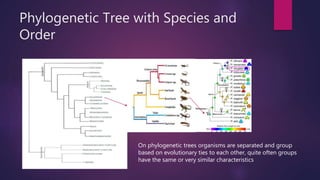
Phylogenetic Tree with Species and
Order
On phylogenetic trees organisms are separated and group
based on evolutionary ties to each other, quite often groups
have the same or very similar characteristics
Ecosystem & Niche
 They typically live in a Desert, Bunchgrass, Sagebrush or dry forest
Ecosystem, preferring warm or hot areas with loose soil to burrow in.
 In Canada they are located in Southern Central B.C.
 They eat mainly ants but will also eat other insects and small invertebrates.
(Carnivore Insectivore)- If they went extinct or left the ant population
would rise.
 Their predators are mainly birds, cats and curious dogs. – If they were
forced to leave the ecosystem birds and cats would rely more heavily on
their other sources of food causing the number of that species to dwindle,
or the predators themselves if they cannot find another source of prey.
Niche
Abiotic Factors Biotic Factors
• Buries under sand for shade
• Basks in sunlight on sand or rocks
• Will drink moving water if available
• Eats ants and other insects
• Will use plants to shade and drink from
• Sometimes will eat small invertebrates
Current Status
 In B.C. the and the species Pygmy short-horned dragon are currently red
listed(Extirpated).
 The Squamata order is one of the largest orders with over 9,00 species.
Containing all lizards and snakes ex. European Wall Lizards (Only on
Vancouver Island) and Mountain Horned Dragon (Mainly Asia).(No record
for estimated amount in B.C., only areas on sightings.)
 The worldwide status extirpated located in Great Basin, N California to
Nevada through E Oregon and Washington and most of S and E Idaho and
extreme S Central BC
Threats
 The order itself is not endangered but individual species within it are
endangered both within and outside of B.C.
 Urban and Industrial development (ex. Factories and roads.)
 Temperature- Cold and often harsh.
 Isolation of species – Only found in Southern Interior of B.C.
 Off Road Rec. Vehicles (Ex. Quad, Dirt Bike, and Snow mobiles)
 Agricultural Irrigation and Cultivation
 Birds, cats and curious humans/ dogs
 Forest fires and declining habitat suitability.
 The threats are likely to increase as population/ building rates rise.
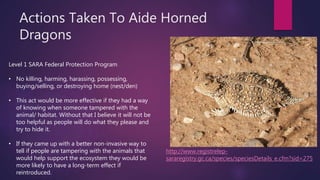
Actions Taken To Aide Horned
Dragons
Level 1 SARA Federal Protection Program
• No killing, harming, harassing, possessing,
buying/selling, or destroying home (nest/den)
• This act would be more effective if they had a way
of knowing when someone tampered with the
animal/ habitat. Without that I believe it will not be
too helpful as people will do what they please and
try to hide it.
• If they came up with a better non-invasive way to
tell if people are tampering with the animals that
would help support the ecosystem they would be
more likely to have a long-term effect if
reintroduced.
http://www.registrelep-
sararegistry.gc.ca/species/speciesDetails_e.cfm?sid=275
International Convention of Biological Diversity and
Youth Accord for Biodiversity
 WHO: Various individuals from different levels of power united as one large
group whos focus is on preserving biodiversity on an international level and
stopping the unnatural decline.
 WHAT DID THEY DO: They require the government to “Recognize youth’s
contribution in the protection of biodiversity, Provide funding for educational
programs on the value of and need for biological diversity, Incorporate the
voice of youth in decision-making through, for example, supporting youth
delegates and sharing information with youth networks, Craft programs to
engage youth in the implementation of the Convention in meaningful ways,
Incorporate natural infrastructure values in decision-making concerning land
use and practices, Establish a carbon, water, and environmental impact
footprint for all countries, Set a defined target date to stop the preventable
loss of biodiversity, Instill laws and regulations to protect against the loss of
biodiversity, Implement sustainable development practices in all areas, Include
urban areas, subterranean, and arctic lands in thematic programs.”
Ways to Become Involved
 To start with be aware of your day-to-day life and think about everything
you do and how much of it is bad for the environment.
 You could start a blog that focus of the environment and brings forth
issues in a comical way.
 You can look for volunteer groups/organizations that go out and help the
environment. Ex. pulling out invasive plant species
 You could write letters or start a fuss about how awful it is that many
animal species are becoming extinct/ extirpated/ endangered because of
the way we live.
 Also encourage people not to go off-roading as this can a fair bit of
damage and greatly disturb an area

Pigmy short horned lizard

  • 1.
  • 2.
    Breif Discription  Scientificname: Animalia Chordata Reptilia Squamata Phrynosomatidae Phrynosoma  Extirpated in B.C. Canda  Pigmy s.h.d. is the BC species, pygmy s.h.d. elsewhere in the world.  Unifying characteristics of the order Squamata include horned scales and movable jaw bone, cold-blooded carnivore that sheds it’s skin and mood is effected by temperature.  From sub order Iguania  Primary Consumer Others in the genus
  • 3.
    Reasons for Extirpationin B.C.  Extensive habitat loss  By 20th Century already rare – possibly because of B.C.’s cold winters If reintroduced to B.C. current risks would be……….  Extensive habitat loss  Roads, and careless hikers  Predation from local and exotic animals (mainly birds and cats) Protected under the federal Species at Risk Act (SARA)  You cannot posses, collect, buy, sell, trade, kill, harm, harass, or destroy their den (if somehow found they are reintroduced)
  • 4.
    Characteristics of Life1-3  1-Composed of Cells: The Pigmy Short-Horned Lizard is a multi-celled organism.  2-Obtain Energy: Heterotrophic, Carnivore, Secondary Consumer  3-Reproduction: Sexual Reproduction, Internal Fertilization, Viviparous, Eggs kept in mother until she gives birth to young live. And Repeat!
  • 5.
    Characteristics of Life4-7  4- Response to Environment: Digs burrows in the ground to blend in and uses sit and wait hunting method for prey(Insects), Vegetation for Basking and shade, Sand to Hide in and Shade.  5-Homeostatsis: Ectotherm: Uses and burns energy to increase and decrease temperature. Ex. Eexcretion of waste, scales and shedding, sticking their tongue out to drink water, baking in the sun to raise temp, shading to lower temp.  6-Growth and Development: On average grow 5.1 to 12.7 cm in snout to vent length, females grow larger then males, sexual maturity reached at age 3 (female)  7- Adaptation to Environment: Flat body, Short legs, Short tail, Ability to lose tail in escape, can run quickly for short distances, can inflate to 2x size.
  • 6.
    Labeled Diagrams • Hornson sides • Small, thick legs • Small, thin tail • Horns in clutters on back • Small, pink tongue • Short snout
  • 7.
    The Squamata Order Facts Over 9,000 Species – Not endangered  The order is recognised for their horned scales/shields  Has movable quadrate bones  All Lizards and Snakes belong to this Order  Many sizes(16mm-5.21m) Historically as large as 14m Some Include…………… Giant horned lizard, (Phrynosoma asio) Short-tailed horned lizard, (Phrynosoma braconnieri) Cedros Island horned lizard, (Phrynosoma cerroense) Texas horned lizard, (Phrynosoma cornutum) Coast horned lizard, (Phrynosoma coronatum) Cape horned lizard, (P. c. coronatum) San Diego horned lizard, (P. c. blainvillii) California horned lizard, (P. c. frontale) Central peninsular horned lizard, (P. c. jamesi) Northern peninsular horned lizard, (P. c. schmidti) Ditmars' horned lizard or rock horned lizard, (Phrynosoma ditmarsi) Pygmy short-horned lizard, (Phrynosoma douglasii) P. d. brachycercum P. d. douglasii Greater short-horned lizard, Phrynosoma hernandesi Flat-tail horned lizard, (Phrynosoma mcallii) Roundtail horned lizard, (Phrynosoma modestum Girard)
  • 8.
    Phylogenetic Tree withSpecies and Order On phylogenetic trees organisms are separated and group based on evolutionary ties to each other, quite often groups have the same or very similar characteristics
  • 9.
    Ecosystem & Niche They typically live in a Desert, Bunchgrass, Sagebrush or dry forest Ecosystem, preferring warm or hot areas with loose soil to burrow in.  In Canada they are located in Southern Central B.C.  They eat mainly ants but will also eat other insects and small invertebrates. (Carnivore Insectivore)- If they went extinct or left the ant population would rise.  Their predators are mainly birds, cats and curious dogs. – If they were forced to leave the ecosystem birds and cats would rely more heavily on their other sources of food causing the number of that species to dwindle, or the predators themselves if they cannot find another source of prey.
  • 10.
    Niche Abiotic Factors BioticFactors • Buries under sand for shade • Basks in sunlight on sand or rocks • Will drink moving water if available • Eats ants and other insects • Will use plants to shade and drink from • Sometimes will eat small invertebrates
  • 11.
    Current Status  InB.C. the and the species Pygmy short-horned dragon are currently red listed(Extirpated).  The Squamata order is one of the largest orders with over 9,00 species. Containing all lizards and snakes ex. European Wall Lizards (Only on Vancouver Island) and Mountain Horned Dragon (Mainly Asia).(No record for estimated amount in B.C., only areas on sightings.)  The worldwide status extirpated located in Great Basin, N California to Nevada through E Oregon and Washington and most of S and E Idaho and extreme S Central BC
  • 12.
    Threats  The orderitself is not endangered but individual species within it are endangered both within and outside of B.C.  Urban and Industrial development (ex. Factories and roads.)  Temperature- Cold and often harsh.  Isolation of species – Only found in Southern Interior of B.C.  Off Road Rec. Vehicles (Ex. Quad, Dirt Bike, and Snow mobiles)  Agricultural Irrigation and Cultivation  Birds, cats and curious humans/ dogs  Forest fires and declining habitat suitability.  The threats are likely to increase as population/ building rates rise.
  • 13.
    Actions Taken ToAide Horned Dragons Level 1 SARA Federal Protection Program • No killing, harming, harassing, possessing, buying/selling, or destroying home (nest/den) • This act would be more effective if they had a way of knowing when someone tampered with the animal/ habitat. Without that I believe it will not be too helpful as people will do what they please and try to hide it. • If they came up with a better non-invasive way to tell if people are tampering with the animals that would help support the ecosystem they would be more likely to have a long-term effect if reintroduced. http://www.registrelep- sararegistry.gc.ca/species/speciesDetails_e.cfm?sid=275
  • 14.
    International Convention ofBiological Diversity and Youth Accord for Biodiversity  WHO: Various individuals from different levels of power united as one large group whos focus is on preserving biodiversity on an international level and stopping the unnatural decline.  WHAT DID THEY DO: They require the government to “Recognize youth’s contribution in the protection of biodiversity, Provide funding for educational programs on the value of and need for biological diversity, Incorporate the voice of youth in decision-making through, for example, supporting youth delegates and sharing information with youth networks, Craft programs to engage youth in the implementation of the Convention in meaningful ways, Incorporate natural infrastructure values in decision-making concerning land use and practices, Establish a carbon, water, and environmental impact footprint for all countries, Set a defined target date to stop the preventable loss of biodiversity, Instill laws and regulations to protect against the loss of biodiversity, Implement sustainable development practices in all areas, Include urban areas, subterranean, and arctic lands in thematic programs.”
  • 15.
    Ways to BecomeInvolved  To start with be aware of your day-to-day life and think about everything you do and how much of it is bad for the environment.  You could start a blog that focus of the environment and brings forth issues in a comical way.  You can look for volunteer groups/organizations that go out and help the environment. Ex. pulling out invasive plant species  You could write letters or start a fuss about how awful it is that many animal species are becoming extinct/ extirpated/ endangered because of the way we live.  Also encourage people not to go off-roading as this can a fair bit of damage and greatly disturb an area