Green Building Festival

        Biomimicry in Building


Christopher Sweetnam-Holmes,
Principal, EcoCité Developments
www.ecocite.ca
Outline
   Introduction
   What is biomimicry?
   Why biomimicry?
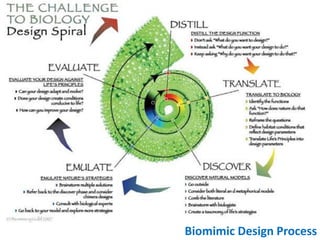
   Biomimic design process
   Historical examples
   Biomimicry today as it relates to building
   Final words
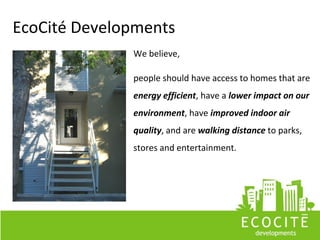
EcoCité Developments
              We believe,

              people should have access to homes that are
              energy efficient, have a lower impact on our
              environment, have improved indoor air
              quality, and are walking distance to parks,
              stores and entertainment.
EcoCité Developments
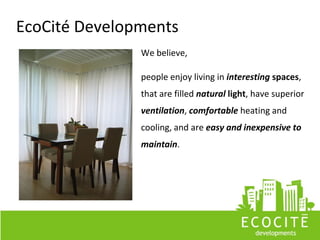
               We believe,

               people enjoy living in interesting spaces,
               that are filled natural light, have superior
               ventilation, comfortable heating and
               cooling, and are easy and inexpensive to
               maintain.
EcoCité Developments
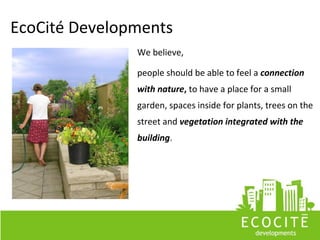
               We believe,

               people should be able to feel a connection
               with nature, to have a place for a small
               garden, spaces inside for plants, trees on the
               street and vegetation integrated with the
               building.
That is to say...
I’m not really an expert in
biomimicry.

But I do find it amazing, inspiring, and filled with
potential.
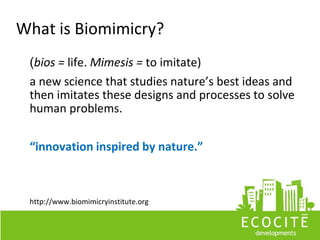
What is Biomimicry?
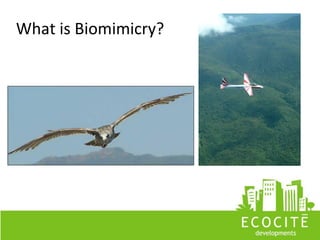
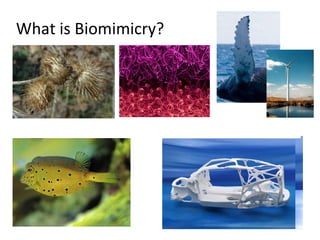
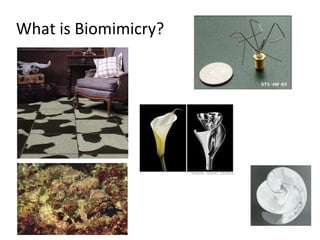
 (bios = life. Mimesis = to imitate)
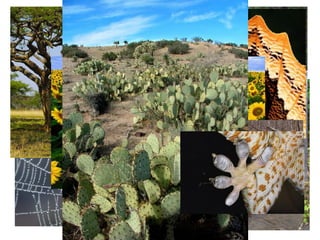
 a new science that studies nature’s best ideas and
 then imitates these designs and processes to solve
 human problems.

 “innovation inspired by nature.”


 http://www.biomimicryinstitute.org
What is Biomimicry?
What is Biomimicry?
What is Biomimicry?
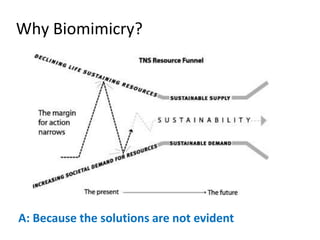
Why Biomimicry?


A: Because the solutions are not evident
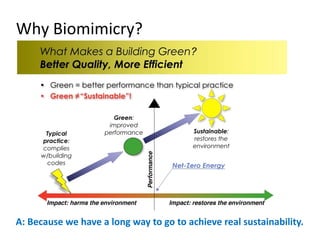
Why Biomimicry?


A: Because we have a long way to go to achieve real sustainability.
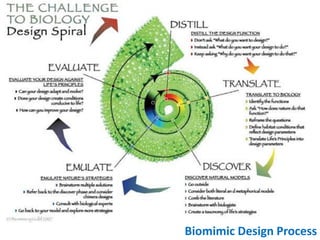
Biomimic Design Process
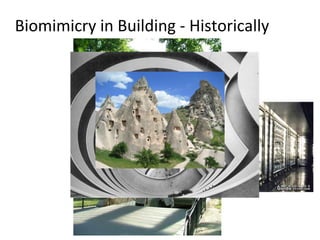
Biomimicry in Building - Historically
Why Nature as Inspiration?
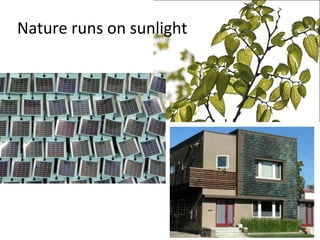
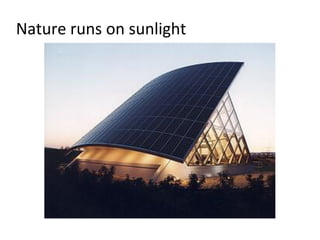
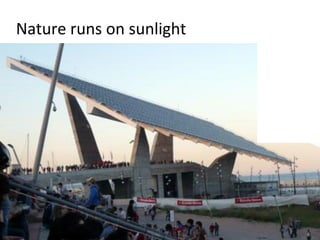
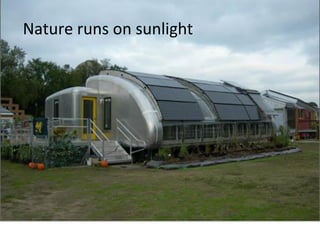
1. Nature runs on sunlight
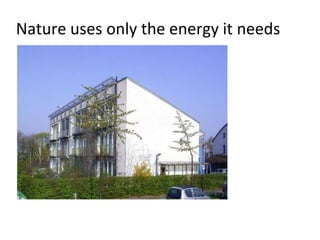
2. Nature uses only the energy it needs
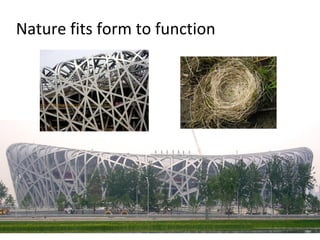
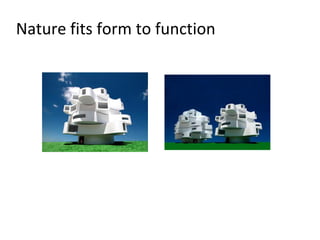
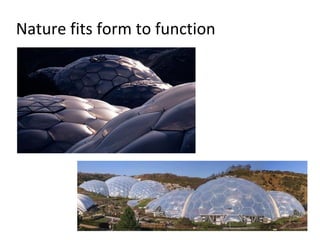
3. Nature fits form to function
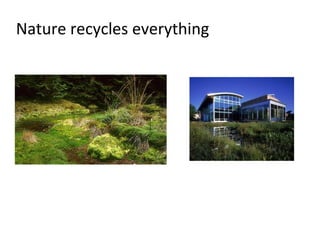
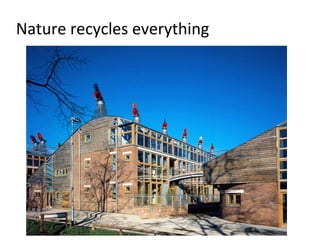
4. Nature recycles everything
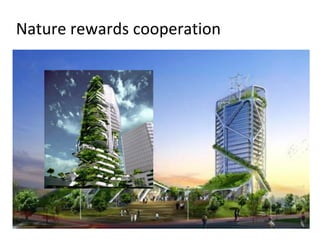
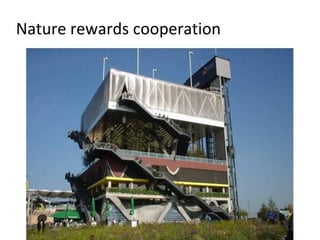
5. Nature rewards cooperation
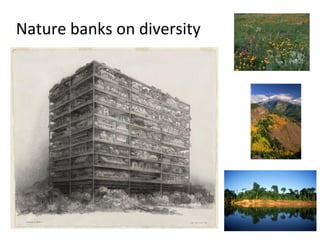
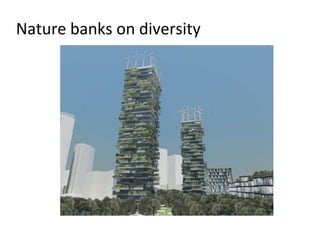
6. Nature banks on diversity
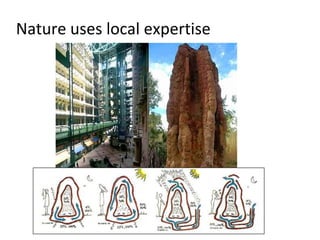
7. Nature uses local expertise
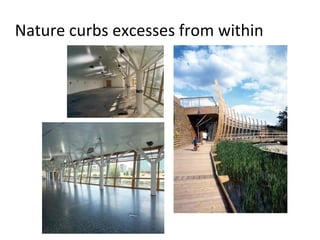
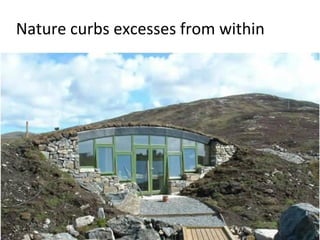
8. Nature curbs excesses from within
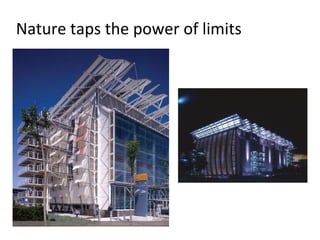
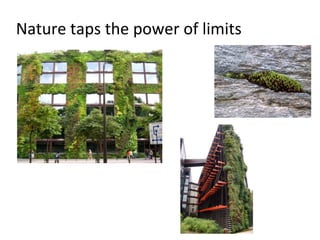
9. Nature taps the power of limits
Nature runs on sunlight
Nature uses only the energy it needs
Nature fits form to function
Nature recycles everything
Nature rewards cooperation
Nature banks on diversity
Nature uses local expertise
Nature curbs excesses from within
Nature taps the power of limits
Nature…
1. … runs on sunlight
2. … uses only the energy it needs
3. … fits form to function
4. … recycles everything
5. … rewards cooperation
6. … banks on diversity
7. … uses local expertise
8. … curbs excesses from within
9. … taps the power of limits
Biomimic Design Process
Credits
Janine Benyus and her book Biomimicry: Innovation Inspired by Nature
The Biomimicry Guild
The Biomimicry Institute www.biomimicryinstitute.org
Big and Green : Toward Sustainable Architecture in the 21st Century Ed: David Gissen
www.n100best.org
www.humanshelter.org Michael Jantzen
The Natural Step Institute
Huston Eubank
PeakEnergy.blogspot.com Biomimicry: Are humans Smarter than Sea Sponges?
Strategy and Business Magazine – Janine Benyus: The Though Leader
MOMA Archives
Building’s imitation of a human body’s thermal behavior: B. Todorovic

Gbf08 holmes biomimicry