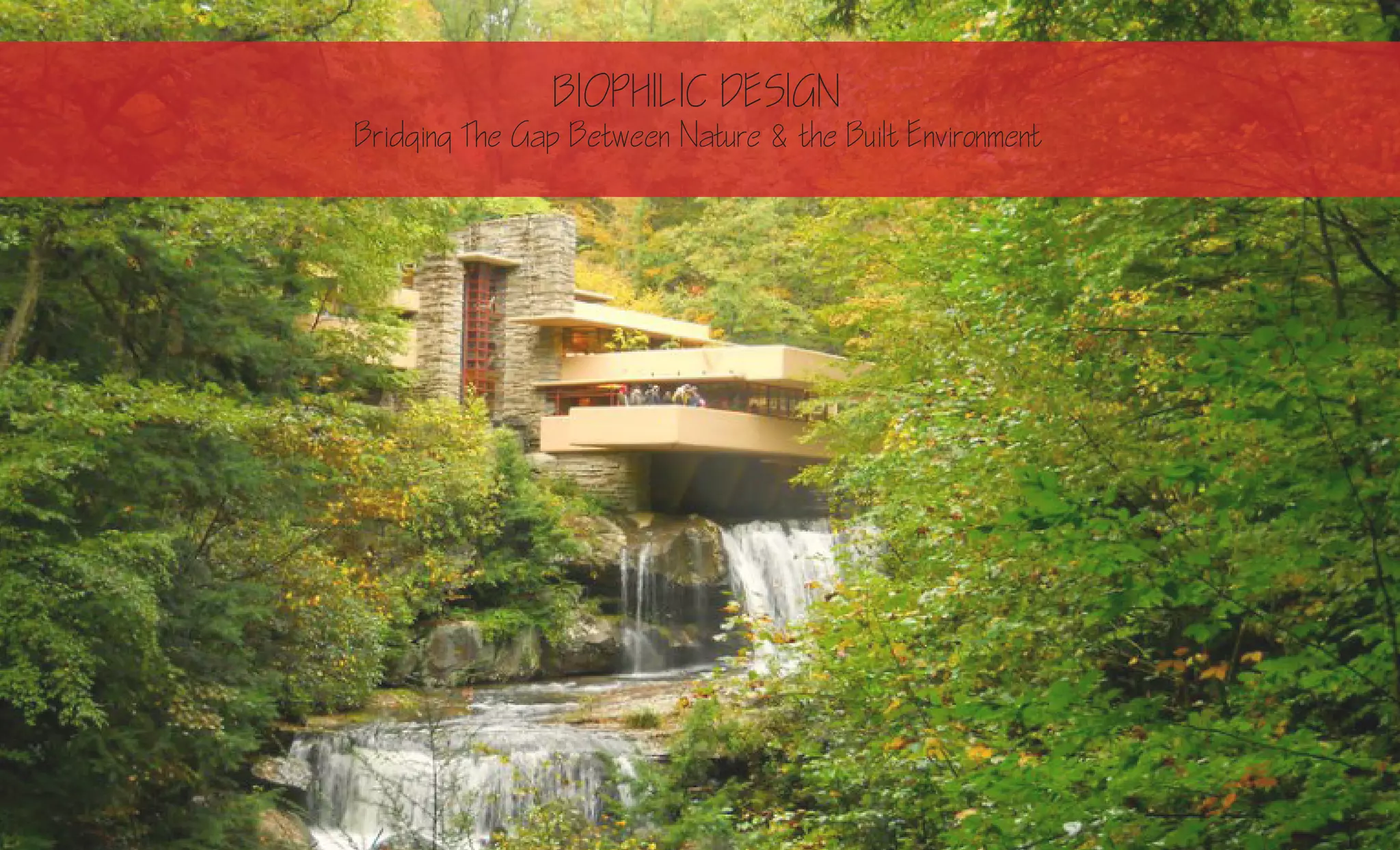
BIOPHILIC DESIGN
Bridging The Gap Between Nature & the Built Environment
ABSTRACT
Since the Industrial Revolution, the built environment and urban areas have exploded at an
unprecedentedratenotseeninanyothertimeinhumanhistory.Whereweonceevolvedanddevelopedin
naturalsettings,todaywespendover90%ofourtimeindoorssurroundedbydrywall,concrete,wood,andsteel.
Biophilic design aims to remedy this modern disconnect with nature and fulfill the
longing that humans have to be immersed in the natural environment. This thesis will
examine biophilia, the theory that we are innately and evolutionarily programmed to respond
positively to nature, and that maintaining this connection is crucial to human health and well-being. 	
Thisthesiswillexploreandemphasizekeyresearchofbiophilicdesign,implementation,howitgoesbeyond
"green"designorbeinga"fad",reducesstress,increasesproductivity,creativity,andimprovesover-allhealth.
BIOPHILIC DESIGN
Bridging The Gap Between Nature & the Built Environment
© 2014 Paul Ramoie
1
"Psychologist Erich Fromm coined the term
["biophilia"] in 1964 as a way of describing the
innate attraction to processes of life and growth."
~ Adam Leith Gollner
Wait, what is Biophilia?
Biophilia is the theory that humans have an innate or
evolutionary-based affinity for nature.
It is the belief that we have a connection and a reliance on
nature that has been passed along through evolution.
Contact with nature is essential to human health and
well-being.
Based on this theory, a framework has been developed that
will reconnect humans and nature within the built
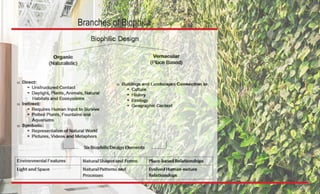
environment. This framework is biophilic design, which
incorporates organic design and vernacular design princi-
ples to interior and exterior architecture.
Biophilic design seeks to create a positive connection
between people and the environment as well as promoting
health and well-being.
2
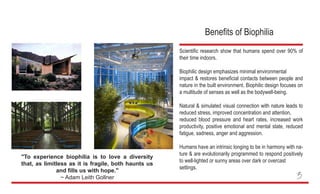
"To experience biophilia is to love a diversity
that, as limitless as it is fragile, both haunts us
and fills us with hope."
~ Adam Leith Gollner
Benefits of Biophilia
Scientific research show that humans spend over 90% of
their time indoors.
Biophilic design emphasizes minimal environmental
impact & restores beneficial contacts between people and
nature in the built environment. Biophilic design focuses on
a multitude of senses as well as the bodywell-being.
Natural & simulated visual connection with nature leads to
reduced stress, improved concentration and attention,
reduced blood pressure and heart rates, increased work
productivity, positive emotional and mental state, reduced
fatigue, sadness, anger and aggression.
Humans have an intrinsic longing to be in harmony with na-
ture & are evolutionarily programmed to respond positively
to well-lighted or sunny areas over dark or overcast
settings.
3
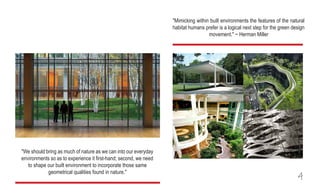
"We should bring as much of nature as we can into our everyday
environments so as to experience it first-hand; second, we need
to shape our built environment to incorporate those same
geometrical qualities found in nature."
4
"Mimicking within built environments the features of the natural
habitat humans prefer is a logical next step for the green design
movement." ~ Herman Miller
Branches of Biophilia
5
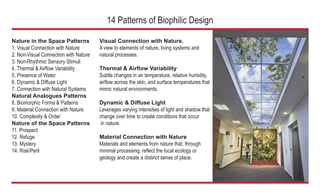
Nature in the Space Patterns
1. Visual Connection with Nature
2. Non-Visual Connection with Nature
3. Non-Rhythmic Sensory Stimuli
4. Thermal & Airflow Variability
5. Presence of Water
6. Dynamic & Diffuse Light
7. Connection with Natural Systems
Natural Analogues Patterns
8. Biomorphic Forms & Patterns
9. Material Connection with Nature
10. Complexity & Order
Nature of the Space Patterns
11. Prospect
12. Refuge
13. Mystery
14. Risk/Peril
	 Visual Connection with Nature.
	 A view to elements of nature, living systems and
	 natural processes.
	 Thermal & Airflow Variability
	 Subtle changes in air temperature, relative humidity, 	
	 airflow across the skin, and surface temperatures that 	
	 mimic natural environments.
	 Dynamic & Diffuse Light
	 Leverages varying intensities of light and shadow that 	
	 change over time to create conditions that occur
	 in nature.
	 Material Connection with Nature
	 Materials and elements from nature that, through
	 minimal processing, reflect the local ecology or
	 geology and create a distinct sense of place.
14 Patterns of Biophilic Design
6
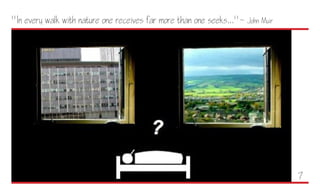
"In every walk with nature one receives far more than one seeks..."~ John Muir
7
Look deep into nature, and then you
will understand everything better.
~ Albert Einstein
THANK YOU
© 2014 Paul Ramoie

THESIS PRESENTATION_BIOPHILIC DESIGN

  • 1.
    BIOPHILIC DESIGN Bridging TheGap Between Nature & the Built Environment
  • 2.
    ABSTRACT Since the IndustrialRevolution, the built environment and urban areas have exploded at an unprecedentedratenotseeninanyothertimeinhumanhistory.Whereweonceevolvedanddevelopedin naturalsettings,todaywespendover90%ofourtimeindoorssurroundedbydrywall,concrete,wood,andsteel. Biophilic design aims to remedy this modern disconnect with nature and fulfill the longing that humans have to be immersed in the natural environment. This thesis will examine biophilia, the theory that we are innately and evolutionarily programmed to respond positively to nature, and that maintaining this connection is crucial to human health and well-being. Thisthesiswillexploreandemphasizekeyresearchofbiophilicdesign,implementation,howitgoesbeyond "green"designorbeinga"fad",reducesstress,increasesproductivity,creativity,andimprovesover-allhealth. BIOPHILIC DESIGN Bridging The Gap Between Nature & the Built Environment © 2014 Paul Ramoie 1
  • 3.
    "Psychologist Erich Frommcoined the term ["biophilia"] in 1964 as a way of describing the innate attraction to processes of life and growth." ~ Adam Leith Gollner Wait, what is Biophilia? Biophilia is the theory that humans have an innate or evolutionary-based affinity for nature. It is the belief that we have a connection and a reliance on nature that has been passed along through evolution. Contact with nature is essential to human health and well-being. Based on this theory, a framework has been developed that will reconnect humans and nature within the built environment. This framework is biophilic design, which incorporates organic design and vernacular design princi- ples to interior and exterior architecture. Biophilic design seeks to create a positive connection between people and the environment as well as promoting health and well-being. 2
  • 4.
    "To experience biophiliais to love a diversity that, as limitless as it is fragile, both haunts us and fills us with hope." ~ Adam Leith Gollner Benefits of Biophilia Scientific research show that humans spend over 90% of their time indoors. Biophilic design emphasizes minimal environmental impact & restores beneficial contacts between people and nature in the built environment. Biophilic design focuses on a multitude of senses as well as the bodywell-being. Natural & simulated visual connection with nature leads to reduced stress, improved concentration and attention, reduced blood pressure and heart rates, increased work productivity, positive emotional and mental state, reduced fatigue, sadness, anger and aggression. Humans have an intrinsic longing to be in harmony with na- ture & are evolutionarily programmed to respond positively to well-lighted or sunny areas over dark or overcast settings. 3
  • 5.
    "We should bringas much of nature as we can into our everyday environments so as to experience it first-hand; second, we need to shape our built environment to incorporate those same geometrical qualities found in nature." 4 "Mimicking within built environments the features of the natural habitat humans prefer is a logical next step for the green design movement." ~ Herman Miller
  • 6.
  • 7.
    Nature in theSpace Patterns 1. Visual Connection with Nature 2. Non-Visual Connection with Nature 3. Non-Rhythmic Sensory Stimuli 4. Thermal & Airflow Variability 5. Presence of Water 6. Dynamic & Diffuse Light 7. Connection with Natural Systems Natural Analogues Patterns 8. Biomorphic Forms & Patterns 9. Material Connection with Nature 10. Complexity & Order Nature of the Space Patterns 11. Prospect 12. Refuge 13. Mystery 14. Risk/Peril Visual Connection with Nature. A view to elements of nature, living systems and natural processes. Thermal & Airflow Variability Subtle changes in air temperature, relative humidity, airflow across the skin, and surface temperatures that mimic natural environments. Dynamic & Diffuse Light Leverages varying intensities of light and shadow that change over time to create conditions that occur in nature. Material Connection with Nature Materials and elements from nature that, through minimal processing, reflect the local ecology or geology and create a distinct sense of place. 14 Patterns of Biophilic Design 6
  • 8.
    "In every walkwith nature one receives far more than one seeks..."~ John Muir 7
  • 9.
    Look deep intonature, and then you will understand everything better. ~ Albert Einstein THANK YOU © 2014 Paul Ramoie