Announcements April 4, 2011 Program in Ecology, Evolution, and Conservation Biology Bradley Cosentino " Metapopulation dynamics and spatial genetics of the tiger salamander ” Wednesday, March 16, 2011 4:00 P.M. B102 CLSL Auditorium
Invasive Species Lecture Objectives: Be introduced to biological invasions Know several examples of invasive species Learn what you can do to stop the spread of invasive species
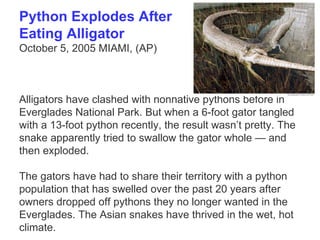
Python Explodes After  Eating Alligator October 5, 2005 MIAMI, (AP) Alligators have clashed with nonnative pythons before in Everglades National Park. But when a 6-foot gator tangled with a 13-foot python recently, the result wasn ’t pretty. The snake apparently tried to swallow the gator whole — and then exploded.  The gators have had to share their territory with a python population that has swelled over the past 20 years after owners dropped off pythons they no longer wanted in the Everglades. The Asian snakes have thrived in the wet, hot climate.
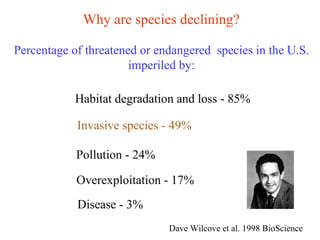
Percentage of threatened or endangered  species in the U.S. imperiled by: Why are species declining? Disease - 3% Overexploitation - 17% Pollution - 24% Invasive species - 49% Habitat degradation and loss - 85% Dave Wilcove et al. 1998 BioScience
Introduced  (non-native, exotic) -  species introduced deliberately or accidentally from  somewhere else Definitions: Domestic/Feral  (released pets, livestock and game animals) -  can spread disease, compete with native species Human commensal or subsidized   (out of control natives) -  native species that benefit from our land use (disturbance) Invasive species -  species that spread subsequent to establishment usually at some cost.
Transport of Invasive Species Introduced deliberately: naturalization societies Shakespeare fans game animals domestic animals plants for agriculture Accidental: ballasts of ships unprocessed wood fruit shipments by-pass natural barriers escapees (from zoos)
Snake Escape Makes Zoo Squirm MARCH 28, 2011 An Egyptian cobra was still on the loose at the Bronx Zoo Sunday after slithering out of its enclosure Friday afternoon. Zoo keepers shut down the Reptile House "until further notice" to look for the venomous 20-inch snake. Officials said the cobra's reclusive nature meant it posed little danger to the public.
 
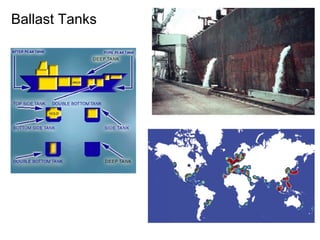
Ballast Tanks
Movement of/ increased exposure to exotic species includes pathogens!! Emerging Infectious Disease – never known before or absent for 20 years  Schistosomiasis, AIDS, SARS, etc.
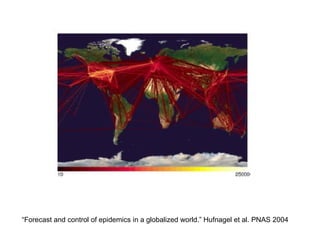
“ Forecast and control of epidemics in a globalized world.” Hufnagel et al. PNAS 2004
There are tens of thousands of introduced species in the USA including: over 5000 plant species, 150 ant species
Why study biological invasions? Unique opportunities for basic research community ecology animal behavior evolution Consequences threaten biodiversity costly widespread
Estimated annual costs associated with non-native species: Group costs (in millions) Plants (purple loosestrife, weeds) 34,000 Mammals (feral pigs, rats) 37,000 Birds (pigeons, starlings)   2,000 Fishes   1,000 Arthropods (ants, termites, other pests) 19,000 Mollusks (zebra mussel, asian clam)   1,200 Microbes (plant pathogens, animal disease) 41,000 All organisms  over $136 billion per year Source: Pimentel et al. 2000 BioScience
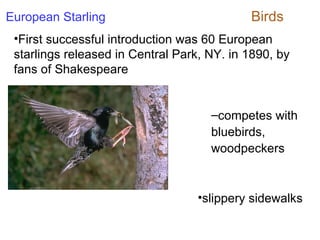
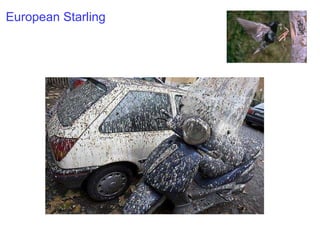
First successful introduction was 60 European starlings released in Central Park, NY. in 1890, by fans of Shakespeare  European Starling slippery sidewalks competes with bluebirds, woodpeckers Birds
European Starling
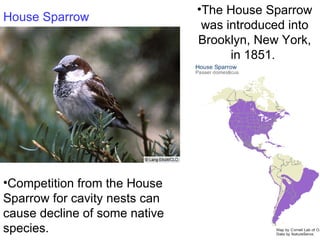
The House Sparrow was introduced into Brooklyn, New York, in 1851.  House Sparrow Competition from the House Sparrow for cavity nests can cause decline of some native species.
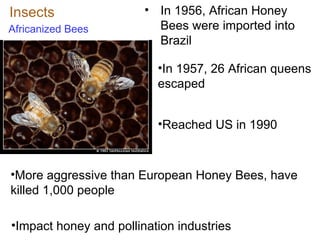
Insects Africanized Bees In 1956, African Honey Bees were imported into Brazil  In 1957, 26 African queens escaped Reached US in 1990 More aggressive than European Honey Bees, have killed 1,000 people Impact honey and pollination industries
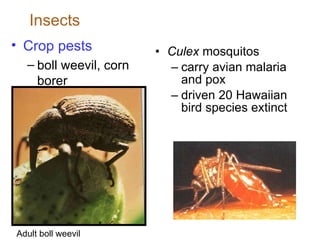
Insects Culex  mosquitos carry avian malaria and pox driven 20 Hawaiian bird species extinct Crop pests boll weevil, corn borer Adult boll weevil
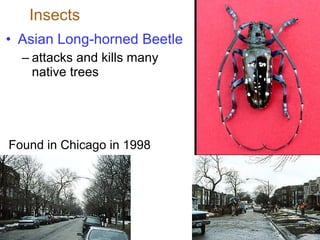
Insects Asian Long-horned Beetle attacks and kills many native trees Found in Chicago in 1998
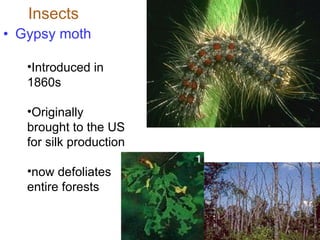
Gypsy moth Insects Introduced in 1860s Originally brought to the US for silk production now defoliates entire forests
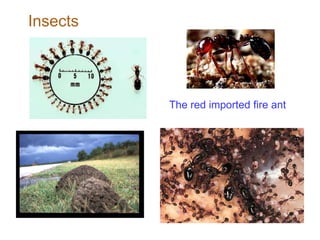
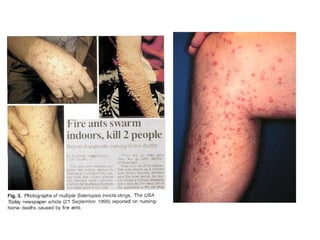
The red imported fire ant Insects
 
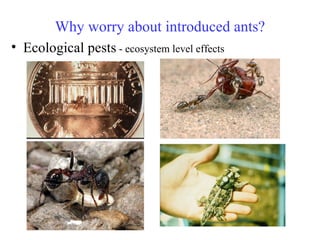
Why worry about introduced ants? Ecological pests  - ecosystem level effects
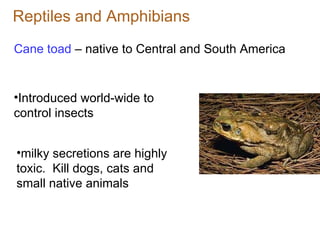
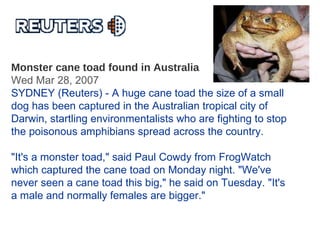
Reptiles and Amphibians Cane toad  – native to Central and South America milky secretions are highly toxic.  Kill dogs, cats and small native animals Introduced world-wide to control insects
Monster cane toad found in Australia Wed Mar 28, 2007  SYDNEY (Reuters) - A huge cane toad the size of a small dog has been captured in the Australian tropical city of Darwin, startling environmentalists who are fighting to stop the poisonous amphibians spread across the country.  "It's a monster toad," said Paul Cowdy from FrogWatch which captured the cane toad on Monday night. "We've never seen a cane toad this big," he said on Tuesday. "It's a male and normally females are bigger."
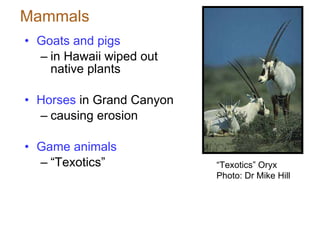
Mammals Goats and pigs in Hawaii wiped out native plants Horses  in Grand Canyon causing erosion Game animals “ Texotics” “ Texotics” Oryx  Photo: Dr Mike Hill
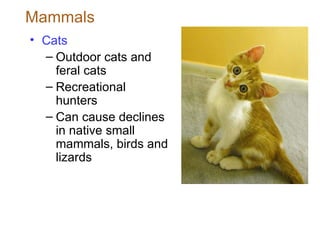
Mammals Cats Outdoor cats and feral cats Recreational hunters Can cause declines in native small mammals, birds and lizards
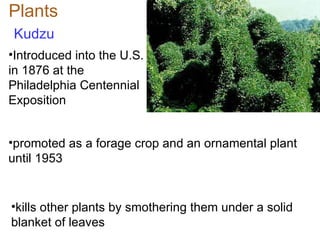
Plants Kudzu kills other plants by smothering them under a solid blanket of leaves  Introduced into the U.S. in 1876 at the Philadelphia Centennial Exposition promoted as a forage crop and an ornamental plant until 1953
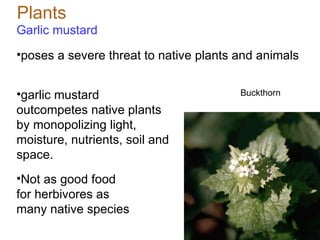
Plants Garlic mustard Buckthorn garlic mustard outcompetes native plants by monopolizing light, moisture, nutrients, soil and space.  Not as good food for herbivores as many native species poses a severe threat to native plants and animals
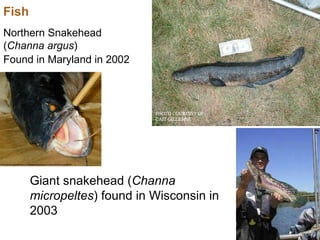
Northern Snakehead ( Channa argus ) Found in Maryland in 2002 Giant snakehead ( Channa micropeltes ) found in Wisconsin in 2003 Fish
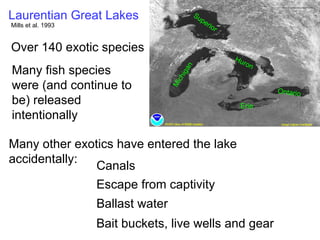
Laurentian Great Lakes www1.ncdc.noaa.gov/pub/data/images/ great-lakes-ice-avhrr.gi  Superior Michigan Huron Erie Ontario Mills et al. 1993 Over 140 exotic species Many fish species were (and continue to be) released intentionally Many other exotics have entered the lake accidentally: Escape from captivity Canals Bait buckets, live wells and gear Ballast water
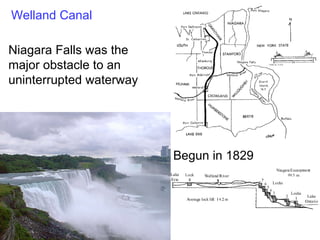
Welland Canal Begun in 1829 Niagara Falls was the major obstacle to an uninterrupted waterway
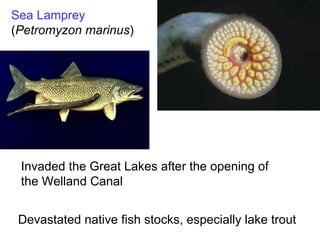
Sea Lamprey  ( Petromyzon marinus )  Invaded the Great Lakes after the opening of the Welland Canal Devastated native fish stocks, especially lake trout
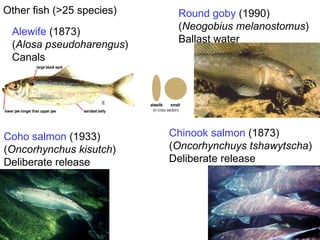
Other fish (>25 species) Alewife  (1873) ( Alosa pseudoharengus ) Canals Coho salmon  (1933) ( Oncorhynchus kisutch ) Deliberate release Round goby  (1990) ( Neogobius melanostomus ) Ballast water Chinook salmon  (1873) ( Oncorhynchuys tshawytscha ) Deliberate release
Asian Carp in the Great Lakes?  This Means War! By Bryan Walsh Tuesday, Feb. 09, 2010  There are illegal immigrants on the loose in the Midwest. Originally hailing from Asia, they're about 3 ft. (90 cm) long and weigh up to 100 lb. (45 kg), and are known to resist capture. Once they establish residency, they can eat you out of house and home. They're called Asian carp, and they emigrated to the lower reaches of the Mississippi River in the 1970s. Now they're knocking on the door of the Great Lakes, threatening to destroy one of the most valuable aquatic regions in the U.S., unless the often fractious Great Lakes states manage to pull together and keep them out. The situation is so serious that the White House convened an "Asian carp summit" on Monday to work out a defense plan.
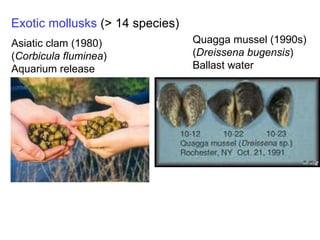
Exotic mollusks  (> 14 species) Asiatic clam (1980) ( Corbicula fluminea ) Aquarium release Quagga mussel (1990s) ( Dreissena bugensis ) Ballast water
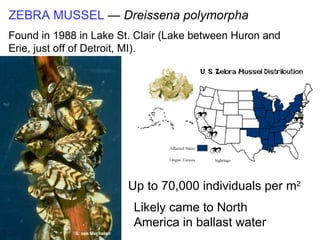
ZEBRA MUSSEL  —  Dreissena polymorpha Found in 1988 in Lake St. Clair (Lake between Huron and Erie, just off of Detroit, MI). Likely came to North America in ballast water Up to 70,000 individuals per m 2
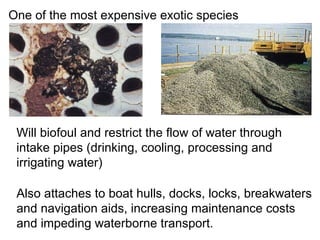
Also attaches to boat hulls, docks, locks, breakwaters and navigation aids, increasing maintenance costs and impeding waterborne transport. One of the most expensive exotic species Will biofoul and restrict the flow of water through intake pipes (drinking, cooling, processing and irrigating water)
How to prevent the spread of aquatic nuisance species? Empty all water before leaving site Never dump bait buckets!! Before leaving site, inspect gear, boats and trailers for exotics Let equipment dry for several days (does not work for species with resting eggs) Rinse your boat and equipment with high pressure hot water, especially if moored for more than a day
How do we control invasive species?  In urban and agricultural areas pesticide use still common Natural enemies - Biological Control Manage the landscape to minimize disturbance Turn off the water; landscape with native plants
Results of pesticide use Kills native competitors May select for resistance Health risks for people
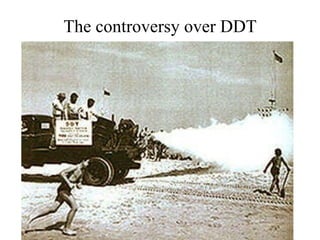
The controversy over DDT
Biological Control: The use of one species to control another. Usually a specialist predator or parasite of an invasive species. Needs to be species specific or could cause even worse problems.
Prevention Education is key Research is still needed - generalities? Monitoring programs - early detection Prevent establishment - quarantine Increased communication among agencies Increase regulations
What can you do to stop the spread of exotics? http://www.invasivespeciesinfo.gov/
Why should we be concerned about, invasive species. How are they often introduced? Be able to recognize common introduced species in the U.S. and Laurentian Great Lakes What is biocontrol? Know how individuals can help prevent the spread of invasive species. Points to know

18 invasive spp

  • 1.
    Announcements April 4,2011 Program in Ecology, Evolution, and Conservation Biology Bradley Cosentino " Metapopulation dynamics and spatial genetics of the tiger salamander ” Wednesday, March 16, 2011 4:00 P.M. B102 CLSL Auditorium
  • 2.
    Invasive Species LectureObjectives: Be introduced to biological invasions Know several examples of invasive species Learn what you can do to stop the spread of invasive species
  • 3.
    Python Explodes After Eating Alligator October 5, 2005 MIAMI, (AP) Alligators have clashed with nonnative pythons before in Everglades National Park. But when a 6-foot gator tangled with a 13-foot python recently, the result wasn ’t pretty. The snake apparently tried to swallow the gator whole — and then exploded. The gators have had to share their territory with a python population that has swelled over the past 20 years after owners dropped off pythons they no longer wanted in the Everglades. The Asian snakes have thrived in the wet, hot climate.
  • 4.
    Percentage of threatenedor endangered species in the U.S. imperiled by: Why are species declining? Disease - 3% Overexploitation - 17% Pollution - 24% Invasive species - 49% Habitat degradation and loss - 85% Dave Wilcove et al. 1998 BioScience
  • 5.
    Introduced (non-native,exotic) - species introduced deliberately or accidentally from somewhere else Definitions: Domestic/Feral (released pets, livestock and game animals) - can spread disease, compete with native species Human commensal or subsidized (out of control natives) - native species that benefit from our land use (disturbance) Invasive species - species that spread subsequent to establishment usually at some cost.
  • 6.
    Transport of InvasiveSpecies Introduced deliberately: naturalization societies Shakespeare fans game animals domestic animals plants for agriculture Accidental: ballasts of ships unprocessed wood fruit shipments by-pass natural barriers escapees (from zoos)
  • 7.
    Snake Escape MakesZoo Squirm MARCH 28, 2011 An Egyptian cobra was still on the loose at the Bronx Zoo Sunday after slithering out of its enclosure Friday afternoon. Zoo keepers shut down the Reptile House "until further notice" to look for the venomous 20-inch snake. Officials said the cobra's reclusive nature meant it posed little danger to the public.
  • 8.
  • 9.
  • 10.
    Movement of/ increasedexposure to exotic species includes pathogens!! Emerging Infectious Disease – never known before or absent for 20 years Schistosomiasis, AIDS, SARS, etc.
  • 11.
    “ Forecast andcontrol of epidemics in a globalized world.” Hufnagel et al. PNAS 2004
  • 12.
    There are tensof thousands of introduced species in the USA including: over 5000 plant species, 150 ant species
  • 13.
    Why study biologicalinvasions? Unique opportunities for basic research community ecology animal behavior evolution Consequences threaten biodiversity costly widespread
  • 14.
    Estimated annual costsassociated with non-native species: Group costs (in millions) Plants (purple loosestrife, weeds) 34,000 Mammals (feral pigs, rats) 37,000 Birds (pigeons, starlings) 2,000 Fishes 1,000 Arthropods (ants, termites, other pests) 19,000 Mollusks (zebra mussel, asian clam) 1,200 Microbes (plant pathogens, animal disease) 41,000 All organisms over $136 billion per year Source: Pimentel et al. 2000 BioScience
  • 15.
    First successful introductionwas 60 European starlings released in Central Park, NY. in 1890, by fans of Shakespeare European Starling slippery sidewalks competes with bluebirds, woodpeckers Birds
  • 16.
  • 17.
    The House Sparrowwas introduced into Brooklyn, New York, in 1851. House Sparrow Competition from the House Sparrow for cavity nests can cause decline of some native species.
  • 18.
    Insects Africanized BeesIn 1956, African Honey Bees were imported into Brazil In 1957, 26 African queens escaped Reached US in 1990 More aggressive than European Honey Bees, have killed 1,000 people Impact honey and pollination industries
  • 19.
    Insects Culex mosquitos carry avian malaria and pox driven 20 Hawaiian bird species extinct Crop pests boll weevil, corn borer Adult boll weevil
  • 20.
    Insects Asian Long-hornedBeetle attacks and kills many native trees Found in Chicago in 1998
  • 21.
    Gypsy moth InsectsIntroduced in 1860s Originally brought to the US for silk production now defoliates entire forests
  • 22.
    The red importedfire ant Insects
  • 23.
  • 24.
    Why worry aboutintroduced ants? Ecological pests - ecosystem level effects
  • 25.
    Reptiles and AmphibiansCane toad – native to Central and South America milky secretions are highly toxic. Kill dogs, cats and small native animals Introduced world-wide to control insects
  • 26.
    Monster cane toadfound in Australia Wed Mar 28, 2007 SYDNEY (Reuters) - A huge cane toad the size of a small dog has been captured in the Australian tropical city of Darwin, startling environmentalists who are fighting to stop the poisonous amphibians spread across the country. "It's a monster toad," said Paul Cowdy from FrogWatch which captured the cane toad on Monday night. "We've never seen a cane toad this big," he said on Tuesday. "It's a male and normally females are bigger."
  • 27.
    Mammals Goats andpigs in Hawaii wiped out native plants Horses in Grand Canyon causing erosion Game animals “ Texotics” “ Texotics” Oryx Photo: Dr Mike Hill
  • 28.
    Mammals Cats Outdoorcats and feral cats Recreational hunters Can cause declines in native small mammals, birds and lizards
  • 29.
    Plants Kudzu killsother plants by smothering them under a solid blanket of leaves Introduced into the U.S. in 1876 at the Philadelphia Centennial Exposition promoted as a forage crop and an ornamental plant until 1953
  • 30.
    Plants Garlic mustardBuckthorn garlic mustard outcompetes native plants by monopolizing light, moisture, nutrients, soil and space. Not as good food for herbivores as many native species poses a severe threat to native plants and animals
  • 31.
    Northern Snakehead (Channa argus ) Found in Maryland in 2002 Giant snakehead ( Channa micropeltes ) found in Wisconsin in 2003 Fish
  • 32.
    Laurentian Great Lakeswww1.ncdc.noaa.gov/pub/data/images/ great-lakes-ice-avhrr.gi Superior Michigan Huron Erie Ontario Mills et al. 1993 Over 140 exotic species Many fish species were (and continue to be) released intentionally Many other exotics have entered the lake accidentally: Escape from captivity Canals Bait buckets, live wells and gear Ballast water
  • 33.
    Welland Canal Begunin 1829 Niagara Falls was the major obstacle to an uninterrupted waterway
  • 34.
    Sea Lamprey ( Petromyzon marinus ) Invaded the Great Lakes after the opening of the Welland Canal Devastated native fish stocks, especially lake trout
  • 35.
    Other fish (>25species) Alewife (1873) ( Alosa pseudoharengus ) Canals Coho salmon (1933) ( Oncorhynchus kisutch ) Deliberate release Round goby (1990) ( Neogobius melanostomus ) Ballast water Chinook salmon (1873) ( Oncorhynchuys tshawytscha ) Deliberate release
  • 36.
    Asian Carp inthe Great Lakes? This Means War! By Bryan Walsh Tuesday, Feb. 09, 2010 There are illegal immigrants on the loose in the Midwest. Originally hailing from Asia, they're about 3 ft. (90 cm) long and weigh up to 100 lb. (45 kg), and are known to resist capture. Once they establish residency, they can eat you out of house and home. They're called Asian carp, and they emigrated to the lower reaches of the Mississippi River in the 1970s. Now they're knocking on the door of the Great Lakes, threatening to destroy one of the most valuable aquatic regions in the U.S., unless the often fractious Great Lakes states manage to pull together and keep them out. The situation is so serious that the White House convened an "Asian carp summit" on Monday to work out a defense plan.
  • 37.
    Exotic mollusks (> 14 species) Asiatic clam (1980) ( Corbicula fluminea ) Aquarium release Quagga mussel (1990s) ( Dreissena bugensis ) Ballast water
  • 38.
    ZEBRA MUSSEL — Dreissena polymorpha Found in 1988 in Lake St. Clair (Lake between Huron and Erie, just off of Detroit, MI). Likely came to North America in ballast water Up to 70,000 individuals per m 2
  • 39.
    Also attaches toboat hulls, docks, locks, breakwaters and navigation aids, increasing maintenance costs and impeding waterborne transport. One of the most expensive exotic species Will biofoul and restrict the flow of water through intake pipes (drinking, cooling, processing and irrigating water)
  • 40.
    How to preventthe spread of aquatic nuisance species? Empty all water before leaving site Never dump bait buckets!! Before leaving site, inspect gear, boats and trailers for exotics Let equipment dry for several days (does not work for species with resting eggs) Rinse your boat and equipment with high pressure hot water, especially if moored for more than a day
  • 41.
    How do wecontrol invasive species? In urban and agricultural areas pesticide use still common Natural enemies - Biological Control Manage the landscape to minimize disturbance Turn off the water; landscape with native plants
  • 42.
    Results of pesticideuse Kills native competitors May select for resistance Health risks for people
  • 43.
  • 44.
    Biological Control: Theuse of one species to control another. Usually a specialist predator or parasite of an invasive species. Needs to be species specific or could cause even worse problems.
  • 45.
    Prevention Education iskey Research is still needed - generalities? Monitoring programs - early detection Prevent establishment - quarantine Increased communication among agencies Increase regulations
  • 46.
    What can youdo to stop the spread of exotics? http://www.invasivespeciesinfo.gov/
  • 47.
    Why should webe concerned about, invasive species. How are they often introduced? Be able to recognize common introduced species in the U.S. and Laurentian Great Lakes What is biocontrol? Know how individuals can help prevent the spread of invasive species. Points to know