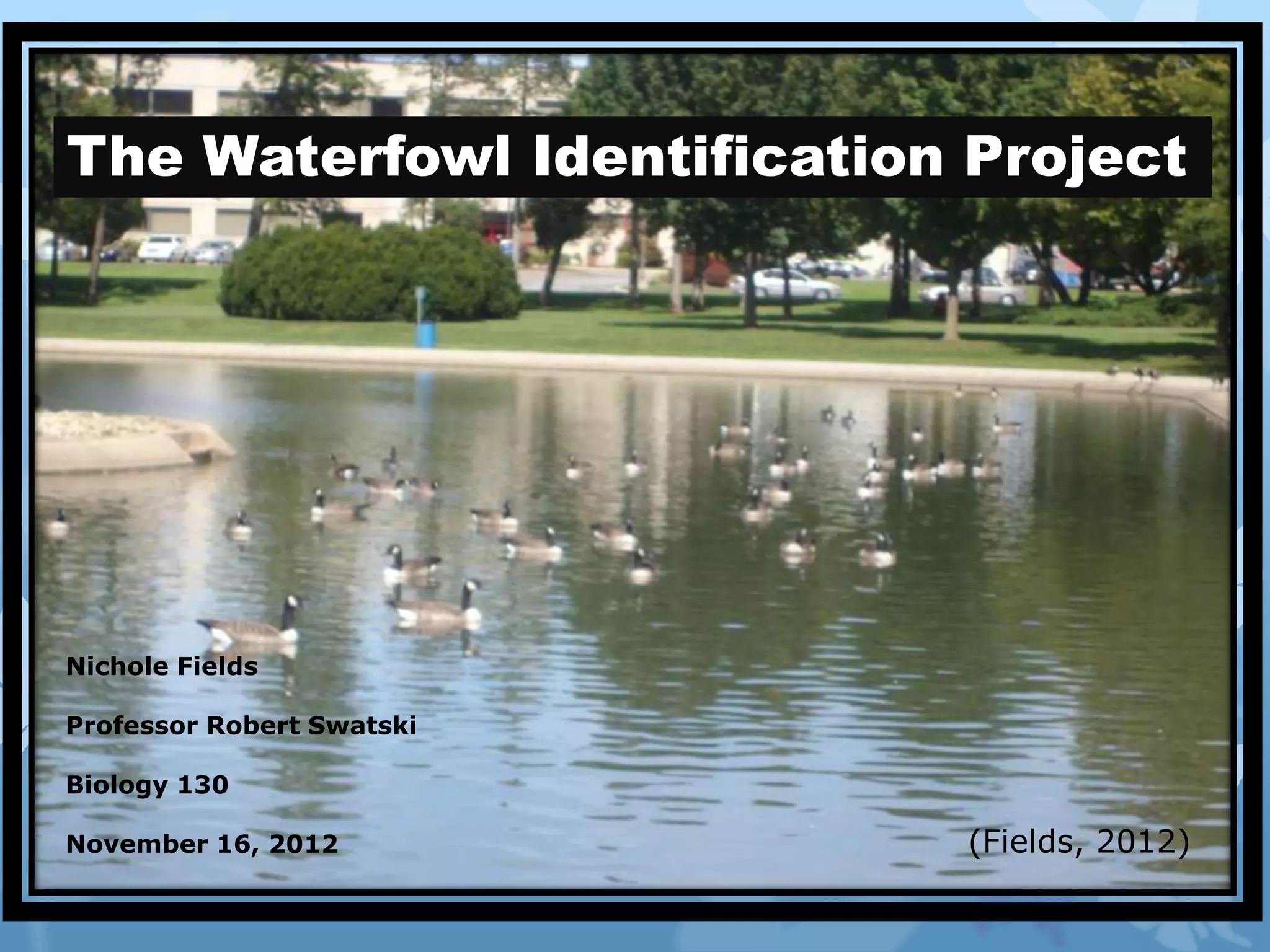
The Waterfowl Identification Project


Nichole Fields

Professor Robert Swatski

Biology 130

November 16, 2012           (Fields, 2012)
Project Overview:

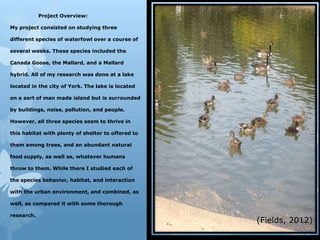
My project consisted of studying three

different species of waterfowl over a course of

several weeks. These species included the

Canada Goose, the Mallard, and a Mallard

hybrid. All of my research was done at a lake

located in the city of York. The lake is located

on a sort of man made island but is surrounded

by buildings, noise, pollution, and people.

However, all three species seem to thrive in

this habitat with plenty of shelter to offered to

them among trees, and an abundant natural

food supply, as well as, whatever scraps

humans throw to them. While there I studied

each of the species behavior, habitat, and

interaction with the urban environment. I

combined and compared this information with

some thorough research.
                                                    (Fields, 2012)
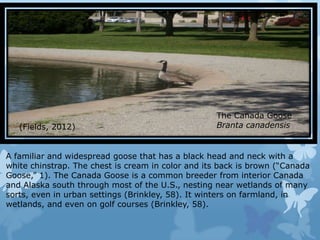
The Canada Goose
   (Fields, 2012)                                   Branta canadensis


A familiar and widespread goose that has a black head and neck with a
white chinstrap. The chest is cream in color and its back is brown (“Canada
Goose,” 1). The Canada Goose is a common breeder from interior Canada
and Alaska south through most of the U.S., nesting near wetlands of many
sorts, even in urban settings (Brinkley, 58). It winters on farmland, in
wetlands, and even on golf courses (Brinkley, 58).
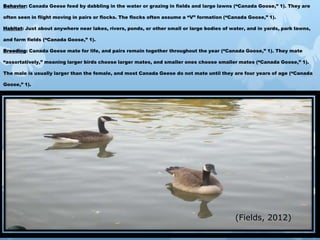
Behavior: Canada Geese feed by dabbling in the water or grazing in fields and large lawns (“Canada Goose,” 1). They are

often seen in flight moving in pairs or flocks. The flocks often assume a “V” formation (“Canada Goose,” 1).

Habitat: Just about anywhere near lakes, rivers, ponds, or other small or large bodies of water, and in yards, park lawns,

and farm fields (“Canada Goose,” 1).

Breeding: Canada Geese mate for life, and pairs remain together throughout the year (“Canada Goose,” 1). They mate

“assortatively,” meaning larger birds choose larger mates, and smaller ones choose smaller mates (“Canada Goose,” 1).

The male is usually larger than the female, and most Canada Geese do not mate until they are four years of age (“Canada

Goose,” 1).


                                                                                            (Fields, 2012)
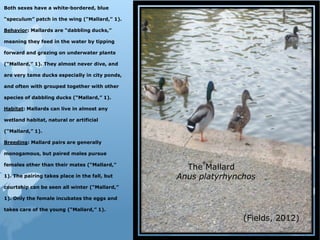
Both sexes have a white-bordered, blue

“speculum” patch in the wing (“Mallard,” 1).

Behavior: Mallards are “dabbling ducks,”

meaning they feed in the water by tipping

forward and grazing on underwater plants

(“Mallard,” 1). They almost never dive, and

are very tame ducks especially in city ponds,

and often when grouped together with other

species of dabbling ducks (“Mallard,” 1).

Habitat: Mallards can live in almost any

wetland habitat, natural or artificial

(“Mallard,” 1).

Breeding: Mallard pairs are generally

monogamous, but paired males pursue

females other than their mates (“Mallard,”
                                                  The Mallard
1). The pairing takes place in the fall, but    Anus platyrhynchos
courtship can be seen all winter (“Mallard,”

1). Only the female incubates the eggs and

takes care of the young (“Mallard,” 1).

                                                               (Fields, 2012)
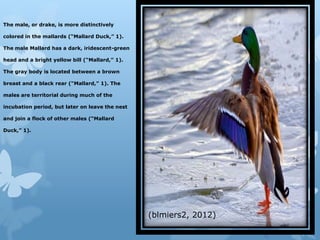
The male, or drake, is more distinctively

colored in the mallards (“Mallard Duck,” 1).

The male Mallard has a dark, iridescent-green

head and a bright yellow bill (“Mallard,” 1).

The gray body is located between a brown

breast and a black rear (“Mallard,” 1). The

males are territorial during much of the

incubation period, but later on leave the nest

and join a flock of other males (“Mallard

Duck,” 1).


                                                 (blmiers2, 2012)
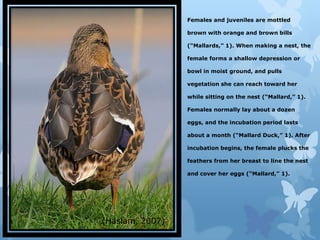
Females and juveniles are mottled

                 brown with orange and brown bills

                 (“Mallards,” 1). When making a nest, the

                 female forms a shallow depression or

                 bowl in moist ground, and pulls any

                 vegetation that she can reach toward her

                 while sitting on the nest (“Mallard,” 1).

                 Females normally lay about a dozen

                 eggs, and the incubation period lasts

                 about a month (“Mallard Duck,” 1). After

                 incubation begins, the female plucks the

                 feathers from her breast to line the nest

                 and cover her eggs (“Mallard,” 1).


(Haslam, 2007)
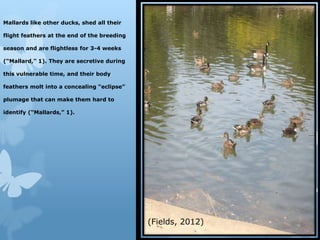
Mallards like other ducks, shed all their

flight feathers at the end of the breeding

season and are flightless for 3-4 weeks

(“Mallard,” 1). They are secretive during

this vulnerable time, and their body

feathers molt into a concealing “eclipse”

plumage that can make them hard to

identify (“Mallards,” 1).


                                             (Fields, 2012)
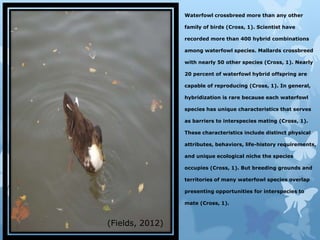
Waterfowl crossbreed more than any other

                                  family of birds (Cross, 1). Scientist have
The Mallard Hybrid…..
                                  recorded more than 400 hybrid combinations

                                  among waterfowl species. Mallards crossbreed

                                  with nearly 50 other species (Cross, 1). Nearly

                                  20 percent of waterfowl hybrid offspring are

                                  capable of reproducing (Cross, 1). In general,

                                  hybridization is rare because each waterfowl

                                  species has unique characteristics that serves

                                  as barriers to interspecies mating (Cross, 1).

                                  These characteristics include distinct physical

                                  attributes, behaviors, life-history requirements,

                                  and an unique ecological niche the species

                                  occupies (Cross, 1). But breeding grounds and

                                  territories of many waterfowl species overlap

                                  presenting opportunities for interspecies to

                                  mate (Cross, 1).


                 (Fields, 2012)
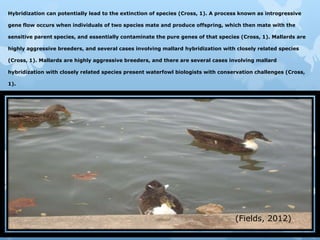
Hybridization can potentially lead to the extinction of species (Cross, 1). A process known as introgressive

gene flow occurs when individuals of two species mate and produce offspring, which then mate with the

sensitive parent species, and essentially contaminate the pure genes of that species (Cross, 1). Mallards are

highly aggressive breeders, and several cases involving mallard hybridization with closely related species

(Cross, 1). Mallards are highly aggressive breeders, and there are several cases involving mallard

hybridization with closely related species present waterfowl biologists with conservation challenges (Cross,

1).


                                                                                   (Fields, 2012)
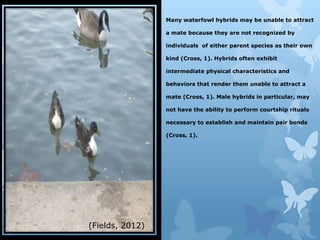
Many waterfowl hybrids may be unable to attract

                 a mate because they are not recognized by

                 individuals of either parent species as their own

                 kind (Cross, 1). Hybrids often exhibit

                 intermediate physical characteristics and

                 behaviors that render them unable to attract a

                 mate (Cross, 1). Male hybrids in particular, may

                 not have the ability to perform courtship rituals

                 necessary to establish and maintain pair bonds

                 (Cross, 1).


(Fields, 2012)
Works Cited:
Brinkley, Edward. Field Guide to Birds of North America. National Wildlife Federation. New York: Sterling, 2007.

            Print.

“Canada Goose.” All About Birds. The Cornell Lab of Ornithology. n.d. Web.

            5 Oct.2012. http://www.allaboutbirds.org/guide/Canada_Goose/lifehistory.

“Canada Goose Branta Canadensis.” National Geographic Society. n.d. Web.5 Oct.2012.

            <http://animals.nationalgeographic.com/animals/birds/canada-goose/>....

Cross, Jennifer. “Waterfowl Hybrids.” Ducks Unlimited. n.d. Web. 5 Oct. 2012.

            http://www.ducks.org/conservation/waterfowl-biology/waterfowl-hybrids.

“Mallard.” All About Birds. The Cornell Lab of Ornithology. n.d. Web. 5 Oct. 2012.

            http://www.allaboutbirds.org/guide/Mallard/id.

“Mallard Duck Anus platyrhynchos.” National Geographic. National Geographic Society. n.d. Web. 5 Oct.

            2012. http://animals.nationalgeographic.com/animals/birds/mallard-duck/.
Works Cited: Images
Blmiers2. “Male Mallard.” Photograph. Flickr.Yahoo. 22 Jan. 2012. Web. 16 Nov. 2012.

Fields, Nichole. “Ducks 1.” Photograph. 22 Oct. 2012. Web. 16 Nov. 2012.

Fields, Nichole. “Ducks 2.” Photograph. 22 Oct. 2012. Web. 16 Nov. 2012.

Fields, Nichole. “Canada Goose 1.” Photograph. 31 Oct. 2012. Web. 16 Nov. 2012.

Fields, Nichole. “Canada Goose 2.” Photograph. 31 Oct. 2012. Web. 16 Nov. 2012.

Fields, Nichole. “Mallard Couple.” Photograph. 31 Oct. 2012. Web. 16 Nov. 2012.

Fields, Nichole. “Ducks 3.” Photograph. 31 Oct. 2012. Web. 16 Nov. 2012.

Fields, Nichole. “Mallard Hybrid 1.” Photograph. 22 Oct. 2012. Web. 16 Nov. 2012.

Fields, Nichole. “Mallard Hybrid 2.” Photograph. 22 Oct. 2012. Web. 16 Nov. 2012.

Fields, Nichole. “Mallard Hybrid 3.” Photograph. 22 Oct. 2012. Web. 16 Nov. 2012.

Haslam, John. “Female Mallard, rear view.” 18 Oct. 2007. Web. 16 Nov. 2012.
Works Cited: Video

“Geese Fly Together.” 15 Sept. 2009. YouTube. Web. 16 Nov.

       2012.

“Mallard Duck.” 13 Oct. 2011. YouTube. Web. 1 Dec. 2012.

“Mallard Hybrids Filmed at Jubilee Lakes on 02/04/12.” 4 Apr.

       2012. YouTube. Web. 1 Dec. 2012.

The waterfowl identification project

  • 1.
    The Waterfowl IdentificationProject Nichole Fields Professor Robert Swatski Biology 130 November 16, 2012 (Fields, 2012)
  • 2.
    Project Overview: My projectconsisted of studying three different species of waterfowl over a course of several weeks. These species included the Canada Goose, the Mallard, and a Mallard hybrid. All of my research was done at a lake located in the city of York. The lake is located on a sort of man made island but is surrounded by buildings, noise, pollution, and people. However, all three species seem to thrive in this habitat with plenty of shelter to offered to them among trees, and an abundant natural food supply, as well as, whatever scraps humans throw to them. While there I studied each of the species behavior, habitat, and interaction with the urban environment. I combined and compared this information with some thorough research. (Fields, 2012)
  • 3.
    The Canada Goose (Fields, 2012) Branta canadensis A familiar and widespread goose that has a black head and neck with a white chinstrap. The chest is cream in color and its back is brown (“Canada Goose,” 1). The Canada Goose is a common breeder from interior Canada and Alaska south through most of the U.S., nesting near wetlands of many sorts, even in urban settings (Brinkley, 58). It winters on farmland, in wetlands, and even on golf courses (Brinkley, 58).
  • 4.
    Behavior: Canada Geesefeed by dabbling in the water or grazing in fields and large lawns (“Canada Goose,” 1). They are often seen in flight moving in pairs or flocks. The flocks often assume a “V” formation (“Canada Goose,” 1). Habitat: Just about anywhere near lakes, rivers, ponds, or other small or large bodies of water, and in yards, park lawns, and farm fields (“Canada Goose,” 1). Breeding: Canada Geese mate for life, and pairs remain together throughout the year (“Canada Goose,” 1). They mate “assortatively,” meaning larger birds choose larger mates, and smaller ones choose smaller mates (“Canada Goose,” 1). The male is usually larger than the female, and most Canada Geese do not mate until they are four years of age (“Canada Goose,” 1). (Fields, 2012)
  • 5.
    Both sexes havea white-bordered, blue “speculum” patch in the wing (“Mallard,” 1). Behavior: Mallards are “dabbling ducks,” meaning they feed in the water by tipping forward and grazing on underwater plants (“Mallard,” 1). They almost never dive, and are very tame ducks especially in city ponds, and often when grouped together with other species of dabbling ducks (“Mallard,” 1). Habitat: Mallards can live in almost any wetland habitat, natural or artificial (“Mallard,” 1). Breeding: Mallard pairs are generally monogamous, but paired males pursue females other than their mates (“Mallard,” The Mallard 1). The pairing takes place in the fall, but Anus platyrhynchos courtship can be seen all winter (“Mallard,” 1). Only the female incubates the eggs and takes care of the young (“Mallard,” 1). (Fields, 2012)
  • 6.
    The male, ordrake, is more distinctively colored in the mallards (“Mallard Duck,” 1). The male Mallard has a dark, iridescent-green head and a bright yellow bill (“Mallard,” 1). The gray body is located between a brown breast and a black rear (“Mallard,” 1). The males are territorial during much of the incubation period, but later on leave the nest and join a flock of other males (“Mallard Duck,” 1). (blmiers2, 2012)
  • 7.
    Females and juvenilesare mottled brown with orange and brown bills (“Mallards,” 1). When making a nest, the female forms a shallow depression or bowl in moist ground, and pulls any vegetation that she can reach toward her while sitting on the nest (“Mallard,” 1). Females normally lay about a dozen eggs, and the incubation period lasts about a month (“Mallard Duck,” 1). After incubation begins, the female plucks the feathers from her breast to line the nest and cover her eggs (“Mallard,” 1). (Haslam, 2007)
  • 8.
    Mallards like otherducks, shed all their flight feathers at the end of the breeding season and are flightless for 3-4 weeks (“Mallard,” 1). They are secretive during this vulnerable time, and their body feathers molt into a concealing “eclipse” plumage that can make them hard to identify (“Mallards,” 1). (Fields, 2012)
  • 9.
    Waterfowl crossbreed morethan any other family of birds (Cross, 1). Scientist have The Mallard Hybrid….. recorded more than 400 hybrid combinations among waterfowl species. Mallards crossbreed with nearly 50 other species (Cross, 1). Nearly 20 percent of waterfowl hybrid offspring are capable of reproducing (Cross, 1). In general, hybridization is rare because each waterfowl species has unique characteristics that serves as barriers to interspecies mating (Cross, 1). These characteristics include distinct physical attributes, behaviors, life-history requirements, and an unique ecological niche the species occupies (Cross, 1). But breeding grounds and territories of many waterfowl species overlap presenting opportunities for interspecies to mate (Cross, 1). (Fields, 2012)
  • 10.
    Hybridization can potentiallylead to the extinction of species (Cross, 1). A process known as introgressive gene flow occurs when individuals of two species mate and produce offspring, which then mate with the sensitive parent species, and essentially contaminate the pure genes of that species (Cross, 1). Mallards are highly aggressive breeders, and several cases involving mallard hybridization with closely related species (Cross, 1). Mallards are highly aggressive breeders, and there are several cases involving mallard hybridization with closely related species present waterfowl biologists with conservation challenges (Cross, 1). (Fields, 2012)
  • 11.
    Many waterfowl hybridsmay be unable to attract a mate because they are not recognized by individuals of either parent species as their own kind (Cross, 1). Hybrids often exhibit intermediate physical characteristics and behaviors that render them unable to attract a mate (Cross, 1). Male hybrids in particular, may not have the ability to perform courtship rituals necessary to establish and maintain pair bonds (Cross, 1). (Fields, 2012)
  • 12.
    Works Cited: Brinkley, Edward.Field Guide to Birds of North America. National Wildlife Federation. New York: Sterling, 2007. Print. “Canada Goose.” All About Birds. The Cornell Lab of Ornithology. n.d. Web. 5 Oct.2012. http://www.allaboutbirds.org/guide/Canada_Goose/lifehistory. “Canada Goose Branta Canadensis.” National Geographic Society. n.d. Web.5 Oct.2012. <http://animals.nationalgeographic.com/animals/birds/canada-goose/>.... Cross, Jennifer. “Waterfowl Hybrids.” Ducks Unlimited. n.d. Web. 5 Oct. 2012. http://www.ducks.org/conservation/waterfowl-biology/waterfowl-hybrids. “Mallard.” All About Birds. The Cornell Lab of Ornithology. n.d. Web. 5 Oct. 2012. http://www.allaboutbirds.org/guide/Mallard/id. “Mallard Duck Anus platyrhynchos.” National Geographic. National Geographic Society. n.d. Web. 5 Oct. 2012. http://animals.nationalgeographic.com/animals/birds/mallard-duck/.
  • 13.
    Works Cited: Images Blmiers2.“Male Mallard.” Photograph. Flickr.Yahoo. 22 Jan. 2012. Web. 16 Nov. 2012. Fields, Nichole. “Ducks 1.” Photograph. 22 Oct. 2012. Web. 16 Nov. 2012. Fields, Nichole. “Ducks 2.” Photograph. 22 Oct. 2012. Web. 16 Nov. 2012. Fields, Nichole. “Canada Goose 1.” Photograph. 31 Oct. 2012. Web. 16 Nov. 2012. Fields, Nichole. “Canada Goose 2.” Photograph. 31 Oct. 2012. Web. 16 Nov. 2012. Fields, Nichole. “Mallard Couple.” Photograph. 31 Oct. 2012. Web. 16 Nov. 2012. Fields, Nichole. “Ducks 3.” Photograph. 31 Oct. 2012. Web. 16 Nov. 2012. Fields, Nichole. “Mallard Hybrid 1.” Photograph. 22 Oct. 2012. Web. 16 Nov. 2012. Fields, Nichole. “Mallard Hybrid 2.” Photograph. 22 Oct. 2012. Web. 16 Nov. 2012. Fields, Nichole. “Mallard Hybrid 3.” Photograph. 22 Oct. 2012. Web. 16 Nov. 2012. Haslam, John. “Female Mallard, rear view.” 18 Oct. 2007. Web. 16 Nov. 2012.
  • 14.
    Works Cited: Video “GeeseFly Together.” 15 Sept. 2009. YouTube. Web. 16 Nov. 2012. “Mallard Duck.” 13 Oct. 2011. YouTube. Web. 1 Dec. 2012. “Mallard Hybrids Filmed at Jubilee Lakes on 02/04/12.” 4 Apr. 2012. YouTube. Web. 1 Dec. 2012.