Audiometry
By: Dr Mukul Goswami
Assam Medical College & Hospital
Dibrugarh
SOUND
• When ever an object vibrates in an elastic
medium(air), it produces succesive waves of
compression and rarefrection by disturbing the
surrounding air molecule, which are termed as
sound waves.
• In other words “Sound is a variation in pressure
with time”
• Frequency: Number of sound waves produced in 1 sec. When
it is measured in cycles per sec it is called as Hertz.
– Human ear is most sensitive to sound at 1000-2000Htz
• Sine wave: Sinusoidal wave pattern produced when objects
vibrate in single fixed frequ7ency.
• Sound produced by such a sine wave is called pure tone sound.
– A pure tone sound can be described by a sine function
where we use the cosine function that is the common standard in
engineering applications, p(t) describes the variation in sound
pressure with time, A describes the peak amplitude or magnitude
of the pressure, f is the frequency of the sinusoid, and φ is the
phase.
• Complex sound: Is a mixture of different pure tone sound (with
different frequency and intensity)
• In PTA hearing sensitivity are tested for pure tone sounds.
• Decibel: Unit of by which intensity of sound pressure exerted
by a sound stimulus is measured
• Sound just audible to a normal ear-
• 0.00024 dynes/sq cm (in unit of pressure)
• 10-16 watts sq cm (in terms of intensity)
• Maximum Tolerabale Sound:
• 2400 dynes/sq cm (in unit of pressure)
• 10-2 watts sq cm (in terms of intensity)
• The range between min and maximum is huge so to
simplify it Sir Alexander Graham Bell used concept of
logarithm scale to compare sound intensities and
used the term Bell as unit of measurement of sound
intensuty.
 Bel=log Io/IR (Io-intensity of sound IR-intensity of reference
sound)
• To further simplify the calculation 1/10th of Bell
was used called as Decibel.
• 1 Bell = 10 Decibel
• Decibel=10log Io/IR
• Zero Decibel: Is just audible sound for a particular
frequency.
SOUND TRANSMISSION
IN THE NORMAL EAR
• Acoustic signals are transmitted from the air of the
external environment to the fluid-filled inner ear.
• The transmission of sound power at an air–fluid interface
depends on the relative impedances of air and fluid. In
the case of the inner ear, only about 0.1% of intensity of
an incident sound wave is transmitted to the fluid, and
this is equivalent to a 30-dB loss.
• The external and middle ears act to better match the
sound conducting properties of air and cochlear fluid by
increasing the sound pressures that reach the inner ear at
certain frequencies(impedence matching).
• EXTERNAL EAR
FUNCTIONS OF EXTERNALEAR:
Sound
collection
Increasing
pressure on
tympanic
membrane in a
frequency
sensitive way
Sound
localisation
EXTERNAL EAR
 Act as a resonator
 It increases the
pressure at the ear
drum in a frequency
sensitive way
 Helps in localisation of
direction of sound
SOUND COLLECTION
 Pinna- concha system catches sound over large area and
concentrate it to smaller area of ext. auditory meatus.
 This increases the total energy available to the tympanic
membrane
PRESSURE INCREASE BYEAC
 If a tube which is closed at one end and open at other
is placed in a sound field then pressure is low at open
end and high at closed end.
 This phenomenon is seen in EAC at 3kHz frequency ,
and at concha at 5kHz
SOUND LOCALISATION:
Because of its shape, the pinna shield the
sound from rear end,change timbre,and helps to
localize sound from in front or back
Cues for sound localization from right/left
 Sound wave reaches the ear closer to sound
source before it arise in farthest ear
 Sound is less intense as it reaches the
farthest ear because head act as barrier
Auditory cortex integrates these cues to
determine location
TOTALEXTERNALEARGAIN
 The total effect of reflection of sound from head,pinna and
external canal resonances is to add 15-20dB to sound
pressure, over frequency range of 2-7kHz.
MIDDLE EAR
• MIDDLE EAR helps in transformation of sound
power from external ear to inner ear via two
mechanisms:
– action of tympanic membrane(Major transformer)
– Action of ossicular chain.
ACTION OF TYMPANIC MEMBRANE
• It is the major transformer.
• AREA RATIO: It is the ratio of tympanic membrane area
(60mm2) to the stapes footplate area(3.2mm2)
• The TM gathers forces over its entire surface and
couples force to the stapes footplate.
• Pressure = Force per Area
• Human TM area 20 times larger than Stapes footplate.
• So in “ideal” condition the sound pressure applied to
the inner ear should be 20 times larger than the sound
pressure at TM(equal to 26 dB gain)
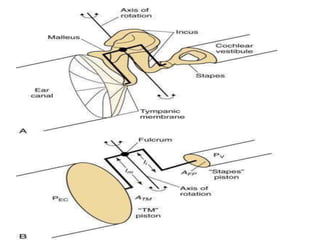
LEVER ACTION OF EAROSSICLES
• Results from the different length of rotating
malleus manubrium and incus long process
around the axis of roation of ossicles
• Axis of rotaion is an imaginary line joining the
Ant. Malleal Ligament to the post. Incudal
Ligament.
• Ratio of this length is 1.3:1, which causes only a
small 2dB increase in sound pressure
• Thus if the transformer action ios ideal the
theoretical middle ear sound pressure gain is
about 28dB(26dB Area Ratio + 2 dB Ossicular
Lever)
• But the actual measured maximum gain is only
about 20dB near 1000Hz.
• The difference between measured and theoritical
gain is the result of several non ideal conditions
1. At low frequencies the entire TM moves with the
same phase but with different magnitude. At
frequencies above 1000Hz the TM breaks into smaller
vibrating portions that vibrate with different phases.
This decreases the efficency of TM as coupler of
sound pressure.
2. Part of the sound pressure in EAC is utilised to move
TM and ossicles themselves(Ossicular inertia)
3. Middle ear spaces use up some of the sound pressure
4. Slippage in the ossicular system reduces the motion
of stapes related to manubrium. Slippage causes
translational movement in the raotational axis of
rotation.
• Effective stimmulation of inner ear requires
1. Ossicular coupling/Tympano ossicular System
Area Ratio
Ossicular Lever
2. Acoustic Coupling
3. Middle ear Air permits round window to move freely.
When the stapes footplate moves in the round
window moves out due to movement of
incompressible cochlear fluid.
4. Difference in sound pressure in oval and round
window- window pressure difference
5. Intact TM protects/shields the round window from
sound in Ear Canal(reduces 10-20dB sound pressure)
– shielding effect
Phase Difference between
the Cochlear Windows
• In normal ear there is a significant difference in
magnitude between the oval and round window sound
pressure(due to ossicular and acoustic coupling) so
differences in phase have little effect in determing the
window pressure difference.
• However when the magnitude of sound pressure at round
and oval window are similar (interrupted ossicular chain),
phase difference becomes important.
– When the individual window pressures are of similar
magnitude and similar phase, they tend to cancel each other
and produce only a small net window pressure difference.
– On the other hand, if the individual window pressures are of
similar magnitude but opposite phase, then they will add to
each other, resulting in a window pressure difference that
is similar in magnitude to the applied pressures.
MIDDLE EAR MUSCLES
• The stapedius and tensor tympani muscles contract under
a variety of circumstances, including loud sounds, before
and during vocalization, tactile stimulation of the head
or face, and fight or flight behavioral responses.
• Such protective contractions reduce the transmission of low
frequency sound through the middle ear but have little
effect on high-frequency sound.
• Contraction of the stapedius muscle in response to sound is known
as the acoustic reflex. The reflex is thought to help in speech
discrimination (the reflex reduces masking by low frequency sound
of high-frequency stimuli) and in protecting the inner ear from
acoustic trauma of loud continuous sound.
• Contractions of the tensor tympani have also been associated with
opening of the eustachian tube, where the inward motion of the
tympanic membrane that results from the contraction produces an
overpressure in the middle ear that helps open the tube.
Middle Ear Joints
• The incudomalleal and incudostapedial joints add
flexibility to the ossicular system, which allows the
middle ear to withstand large variations in the static
pressure difference across the tympanic membrane
without producing damage to the ear. Middle ear
static pressure variations that occur regularly in day-
to-day activities (eg, those produced by sneezing and
swallowing) generate millimeter-sized motions of the
tympanic membrane; such large motions are not
transmitted to the stapes because of the flexibility of
the incudomalleal and incudostapedial joints.
Acoustics and mechanics of diseased
middle ear
1. Ossicular interuption with intact TM:
– Ossicular coupling lost
– Sound input to the cochlea via the middle ear
occours through acoustic coupling
– Since acoustic coupling 60dB smaller than
ossicular coupling, there is a 60 dB conductive
haring loss.
– Partial ossicular innteruption(replaced by band of
fibrous tissue)- there is a air bone gap at higher
frequency
2. LOSS OF TM AMD MALLEUS AND INCUS
• Conductive Hearing Loss Of 40-50dB- due to loss
of ossicular coupling together with an
enhancement of acoustic coupling by 10-20
dB(because of loss of shielding effect)
3. Ossicular Fixation(Partial or complete)
Eg. Otoslcleoris, Tymapnosclerosis
• conductive Hearing loss of 5-60dB depending
on degree of fixation
– Fixation of Anterior Malleolar ligament=10dB
hearing loss
– Fixation of Head of malleus= 15-25 Hearing Loss
– Fixation of both malleus and incus=30-50dB loss
4. TM Perforation
– Haering loss ranges from negligible to 50
– There is loss of ossicular coupling
– Hearing loss deoends on
• Frequency(loss is loss at greater frequency)
• Perforation size(larger perforation results in loss of larger
hearing loss)
• Middle ear space volume(small middle ear space volume
results in larger air bone gap)
5. Middle Ear Effusion
30-35dB conductive Hearing Loss
Decreased in ossicular coupling
increases in impedence of middle ear air
space
6. TM Atelectasis
Negligible to 50dB
Reduction in ossicular coupling
6. 3rd Window lesion of inner ear
apparent conductive hearing loss in absence
of true middle ear disease
Abnormal pathologic 3rd window in addition
to two normal window, this 3rd window
permits dissception of sound energy away
from cochlea .
ACOUSTICS AND MECHANICS OF
RECONSTRUCTED MIDDLE EARS
1. Reconstruction of the Sound Conduction Mechanisms
The goal of tympanoplasty is to restore sound pressure
transformation at the oval window by coupling an intact
tympanic membrane with a mobile stapes footplate via
an intact or reconstructed ossicular chain and to provide
sound protection for the round window membrane by
means of a closed, air-containing, mucosa-lined middle
ear.
2. Aeration of the Middle Ear
Aeration of the middle ear (including the round window)
is critical to the success of any tympanoplasty procedure.
Aeration allows the tympanic membrane, ossicles, and
round window to move.
Clinical experience has shown that nonaerated ears often
demonstrate 40- to 60-dB air–bone gaps.36 The large gap in
nonaerated ears occurs because ossicular coupling is greatly
reduced and stapes motion is reduced because the round
window membrane (which is coupled to the stapes by
incompressible cochlear fluids) cannot move freely.
The normal, average volume of the middle ear and mastoid is
6 cc; a combined middle ear and mastoid volume of 0.4 cc is
predicted to result in a 10-dB conductive hearing loss. Volumes
smaller than 0.4 cc should lead to progressively larger gaps,
whereas increases in volume above about 1.0 cc should
provide little additional acoustic benefit.
3.Tympanoplasty Techniques without Ossicular
Linkage: Types IV and V
In both type IV and type V procedures, there is
no ossicular coupling, and residual hearing
depends on acoustic coupling.
The introduction of a tissue graft to shield the
round window from sound enhances acoustic
coupling by increasing the sound pressure
difference between the oval and round windows.
The following surgical guidelines can be used to optimize
the postoperative hearing results:
(1) one should preserve normal stapes mobility by
covering the footplate with a thin split-thickness skin graft
and not a fascia graft (fascia is much thicker than skin and
can increase footplate impedance),
(2) one should reinforce the round window fascia graft
shield with cartilage or 1-mm-thick Silastic™ (reinforcing
the graft shield in this manner increases its stiffness and
improves its performance as an acoustic shield), and
(3) one should create conditions that promote aeration of
the round window niche and preserve mobility of the
round window membrane (eg, by preserving all healthy
mucosa in the protympanum and hypotympanum).
4. Tympanoplasty Techniques with Reconstruction
or Preservation of Ossicular Linkage: Types I, II,
and III
i)Tympanic Membrane Reconstruction
Although the tympanic membrane is responsible
for most of the middle ear sound pressure gain,
the details of how that gain is achieved are not
well understood. Motion of the normal tympanic
membrane is complex, especially at frequencies
above 1,000 Hz
ii) Ossicular Reconstruction
Factors that can influence the acoustic performance of an
ossicular prosthesis include its stiffness, mass, and position;
the tension imposed by the prosthesis on the drum and
annular ligament; and mechanical features associated with
coupling of the prosthesis to the drum and stapes.
The positioning of the prosthesis appears to be important to
its function. Angle between the stapes and a prosthesis
should be less than 45 degrees for optimal sound
transmission.
The large static displacements produced by a prosthesis that
is too long would stretch the annular ligament and tympanic
membrane, resulting in a stiffening of these structures,
a reduction in tympano-ossicular motion, and an air–bone
gap.
iii) Type III Tympanoplasty, Stapes Columella
A classic type III or stapes columella
tympanoplasty involves placement of a tympanic
membrane graft such as temporalis fascia directly
onto the stapes head; that is, the ossicular chain is
replaced by the single columella of the stapes.
This tympanoplasty is typically performed in
conjunction with a canal wall down
mastoidectomy.
Large air–bone gaps (40 to 60 dB) occur as a
result of stapes fixation, nonaeration of the
middle ear, or both.
iv) Canal Wall Up versus Canal Wall Down Mastoidectomy
In a canal wall down mastoidectomy, the bony tympanic
annulus and much of the ear canal are removed, and the
tympanic membrane graft is placed onto the facial ridge
and medial attic wall. This results in a significant reduction
in the size of the residual middle ear air space.
However, as long as this air space is ≥ 0.4 cc, the resultant
loss of sound transmission should be < 10 dB. Since the
average volume of the tympanic cavity is 0.5 to 1.0 cc, a
canal wall down procedure should create no significant
acoustic detriment as long as the middle ear is aerated.
This mastoid bowl and ear canal air space generate
resonances that can influence middle ear sound
transmission favorably or unfavorably.
• PURE TONE AUDIOMETRY
• PTA is a non invasive subjective test in which the graphical
recording of the Hearing Sensitivity done both
quantitatively and qualitatively.
• Uses of PTA
1. Measure of thresholds of AC and BC tells the degree and
type of hearing loss (mild-profound, CHL/SNHL).
2. The progress of the disease and response to the
treatment can be documented (improving/progressive).
3. The type and necessary setting of hearing aids can be
determined.
4. The degree of handicap for medicolegal purposes can be
determined.
5. Speech reception threshold (SRT) can be predicted.
• Hearing Threshold: the lowest sound pressure
level, at which under specified conditions, a
person gives a predetermined % of correct
response on repeated trials.
The results plotted graphically is called pure tone
audiogram.
Instrument used to measure is called pure tone
audiometer.
The range of normal human hearing is 20- 20,000 HZ.
The graph plotted in x –axis frequency in hertz are
250,500, 1000,2000,4000 & 8000 (cycles per second
).
In y –axis hearing loss in decibels from -10 to 110 db.
PURE TONEAUDIOGRAM
PROCEDURE - AIR CONDUCTION TEST
Calibration of the instrument.
A reasonably noiseless test environment.
Position of headphones
Instructions to the patient.
Technique of air conduction test- First is Conventional
Method Hughson-Westlake technique , modified by
CALIBRATION OF
INSTRUMENTS
ISO – 1964 Specifications for calibration are used
Electronic calibration – atleast once in 6 months
Biological calibration – should be done each day
before the audiometer is used.
Micro-processor based audiometers are used
nowadays.
A REASONABLY NOISELESSTEST
ENVIRONMENT
Level of Test Environment < Level of Masking
Sound
Cause A Threshold Shift In NormalHearing
Subject
ISO / DIS 8253 – maximum permissible ambient
noise for the different frequencies required for air and
bone conduction tests.
 Air Conduction - 25 - 30 db
 Bone Conduction - 10 -15 db
POSITION OF
HEADPHONES
Diaphragm of headphone – over the opening of
EAC.
If the headphones are not properly placed ,
threshold variations of 15dB or more may occur
No wax , discharge , cotton in EAC
Collapse of ear canal – supraaural earphones /
headphones are placed over ear – Cause small Air-
Bone gap.
INSTRUCTION TO PATIENT
Test needs should be thoroughly explained.
Little time spent in getting acquainted with the
patient and his problems prior to the test , helps in
establishing a rapport.
TECHNIQUES - CONVENTIONAL
METHOD
A detailed clinical history & examination should
precede the test.
Better ear is tested first, start with 1000 Hz & then
2k,4k,8k,10k,then 500 , 250 Hz.
If difference is more than 20 db then half octaves is
to be tested.
Tones are lowered in 10 db steps and increased in
5 db steps.
TECHNIQUES - CONVENTIONAL
METHOD
Second ear – may start with last frequency used to
test the first ear ( no need to start with 1000 Hz )
5-up-10-down ( tones are lowered in 10 db steps
and increased in 5 db steps )
STEP 3 - RAISE SOUND BY 10 db (i.e 60 db)
RESPONSE PRESENT –
PROCEED TO STEP 5
RESPONSE ABSENT –
PROCEED TO STEP 4
STEP 2 - RAISE SOUND BY 20 db (i.e 50 db)
RESPONSE PRESENT –
PROCEED TO STEP 5
RESPONSE ABSENT –
PROCEED TO STEP 3
STEP 1 - START WITH 30 db HL SOUND
RESPONSE PRESENT –
PROCEED TO STEP 5
RESPONSE ABSENT –
PROCEED TO STEP 2
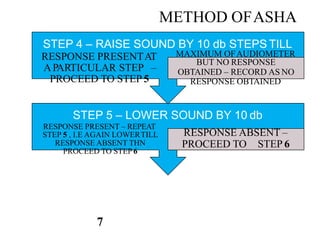
METHOD OFASHA
7
STEP 5 – LOWER SOUND BY 10 db
RESPONSE PRESENT – REPEAT
STEP 5 , I.E AGAIN LOWERTILL
RESPONSE ABSENT THN
PROCEED TO STEP 6
RESPONSE ABSENT –
PROCEED TO STEP 6
STEP 4 – RAISE SOUND BY 10 db STEPS TILL
RESPONSE PRESENTAT
APARTICULAR STEP –
PROCEED TO STEP 5
MAXIMUM OFAUDIOMETER
BUT NO RESPONSE
OBTAINED – RECORD AS NO
RESPONSE OBTAINED
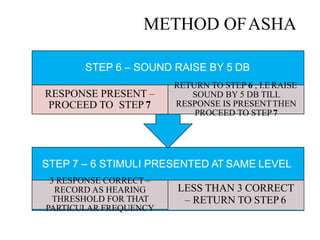
METHOD OFASHA
METHOD OFASHA
STEP 7 – 6 STIMULI PRESENTED AT SAME LEVEL
3 RESPONSE CORRECT –
RECORD AS HEARING
THRESHOLD FOR THAT
PARTICULAR FREQUENCY
LESS THAN 3 CORRECT
– RETURN TO STEP 6
STEP 6 – SOUND RAISE BY 5 DB
RESPONSE PRESENT –
PROCEED TO STEP 7
RETURN TO STEP 6 , I.E RAISE
SOUND BY 5 DB TILL
RESPONSE IS PRESENTTHEN
PROCEED TO STEP7
BONE CONDUCTION
COMPRESSIONAL / DISTORTIONAL BONE CONDUCTION
Vibratory energy ( Sound ) reaches the cochlea
Alternate expansion and compression of cochlear shell
(due to flexiblity of round window memb and cochlear
equeduct)
Movement of cochlear fluid
Displacement of basilar membrance
Leads to changes that result ultimately in sound being
heard
BONE CONDUCTION
INERTIAL BONE CONDUCTION
Vibratory energy ( Sound ) strikes the skull
Sets the skull into vibration
Ossicles in middle ear lag behind & do not move due to
inertia of ossicles
Sets up relative motion b/w footplate of stapes & cochlear
fluid deep to oval window
Vibration of cochlear fluid
BONE CONDUCTION
OSSEO-TYMPANIC BONE CONDUCTION
Vibratory energy ( Sound ) reaches the skull
Skull starts vibrating
Sets into vibration the column of air in EAC
Partially transmitted to TM
Thro’ the ossicles in the middle ear
To Cochlear fluid of inner ear ( like air - conducted sound)
CONDUCTION
 Calibration of instrument
 Reasonably noiseless test environment
 Placement of bone conduction vibrator
 Instructions to the patient
 Technique – same as air conduction.
CONDUCTION
MASTOID PLACEMENT OF BONE VIBRATOR
Tension of spring metal headband over the mastoid -
500 gm / sq.cm
Should be free of hair as possible , should not touch
the pinna
A constant sound is given and B.C vibrator is moved
over the mastoid – till a point of maximum sound is
heard.
When ears without any conductive pathology are
covered by earphones or occluded by any
apparatus , there is a false increase in the bone
CONDUCTION
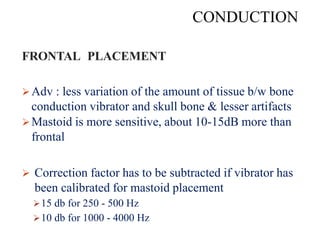
FRONTAL PLACEMENT OF BONE VIBRATOR
Adv : less variation of the amount of tissue b/w bone
conduction vibrator and skull bone & lesser artifacts
Mastoid is more sensitive, about 10-15dB more than
frontal
 Correction factor has to be subtracted if vibrator has
been calibrated for mastoid placement
15 db for 250 - 500 Hz
10 db for 1000 - 4000 Hz
• Bone conduction audiometry has lots of inherent
problems and is prone to errors:
1. Chances of ambient external noise masking the
test tone and thereby producing elevated
threshold is quite high in bone conduction as
the external EAC is unoccluded.
2. Bone conductions test are possible only upto a
maximum of 40 dB at 250 Hz, 50 dB at 500 Hz,
and upto 60-70dB from 1000-4000Hz.
3. Different subjects have different thickness over
the mastoid.
4. Sensitivity of sound is different in different areas
of mastoid.
5. Vibrotactile stimulation is very common at 250-
500Hz. So it is difficult to know whether the bone
conduction threshold at 250, 500 Hz is actually
response from auditory stimulation or from vibro
tactile stimulation.
6. The bone conductive vibrator stimulates the
cochlea of both ears equally irrespective of side of
stimulation.
7. If the EAC is blocked by air conduction headphone,
then due to a phenomenon called ‘occlusion effect’
there is a false betterment of the bone conduction
hearing in low frequency, due to increase in
osseotympanic bone conduction sound.
LEFT RIGHT
AIR CONDUCTION SOUNDS ARE HEARD
UNMASKED
MASKED
BONE CONDUCTION
UNMASKED
(MASTOID)
MASKED
MASKED (
FOREHEAD)
AIR CONDUCTION SOUNDS NOT
HEARD
UNMASKED
MASKED
BONE CONDUCTION
UNMASKED
(MASTOID)
MASKING
Noise presented to the non-test ear to prevent it from
responding to a signal presented to the test ear
WHEN TO MASK ?
- All bone conduction
- When interaural attenuation is more than 45 db .
- When air conduction more than 45 db HL
- Cross – hearing in air conduction if
AC ( test ear ) – BC ( non test ear ) > IA
HOW TO MASK ?
For bone conduction
- minimum masking = B t +( A m – Bm)
For air conduction
- minimum masking = At – 40 + (Am – B m)
Maximum masking = B t + 45 (for both BC & AC)
MASKING
Over masking
If the masking sound used is so loud thai it crosses over
from the non-test ear and obliterates or mask the test
signal in test ear , the subject will not hear the test
signal in the test ear until it is much above the actual
threshold.
Under masking
if the masking sound presented to the non test ear is not
loud enough to eliminate the non-test ear from
participating in the test process when test sound are
presented to test ear.
SOUNDS USED FOR MASKING
WHITE NOISE
Broadband or wideband noise ( equal amt of sound of all
frequencies , starting from low to very high frequencies )
NARROW BAND NOISE
Narrow band of noise centered on test tone freq. with
100 – 200 Hz above and below that freq.
The band width which will provide the maximum
effective masking for a tone of particular frequency at
minimum intensity is called ‘critical band width’
COMPLEX NOISE
Low freq. fundamentals plus the multiples of that freq.
up to 4000 Hz
INTERPRETATION OFAUDIOGRAM
• 0-25 db - Normal
• 26-40 db - Mild deafness
• 41-55 db - Moderate deafne
• 56-70 db - Severe deafness
• 71-90 db - Very severe deafn
• Above 90 db - Profound deaf
% of Handicap
Formula for calculating % of handicap for unilateral
deafness –{ [( a+b+c+d)÷ 4 ]- 25} x 1.5%
where a,b,c and d are air conduction threshold at
500, 1000,2000, and 3000Hz respectively
Bilateral – [ (5x +y) ÷6 ]%
where x and y are the percentage of handicap for the
better and worse ear respectively
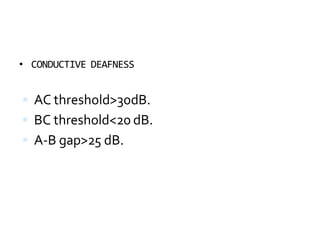
• CONDUCTIVE DEAFNESS
 AC threshold>30dB.
 BC threshold<20 dB.
 A-B gap>25 dB.
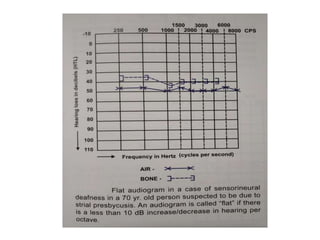
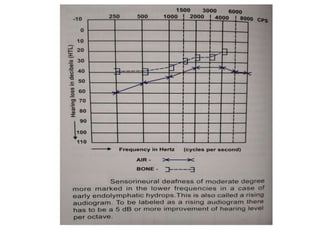
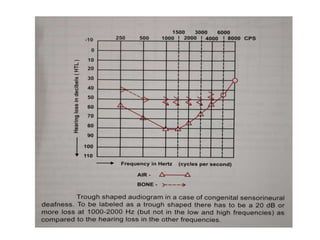
• SENSORINEURAL DEAFNESS
 AC threshold>30 dB.
 BC threshold>20 dB.
 A-B gap<20 dB
• MIXED DEAFNESS
 AC threshold>45 dB.
 BC threshold>20 dB.
 A-B gap>20 dB.
SOME OTHER TESTS WITH THE PURE TONE
AUDIOMETER
Threshold Equalizing Noise Test
• Test for identifying dead regions in the cochlea.
• Person with dead regions may not benefit from
hearing aid.
• TEN test is useful in Hearing Aid fitting only, as it
identifies the dead region of the cochlea i.e. the
frequencies where amplification will not serve
any purpose.
Differential Limen for Intensity test
• For establishing the subject’s capability of small
variations of intensity in a tone signal.
• Test for recruitment.
• Patient with cochlear damage have recruitment and
hence can detect very small changes in loudness.
• Test consit of superimposing breif brusts of 0.2-5dB
intensity increments on a sustained tone 20 dB above
threshold.
• Patient instructed to report any variation in loudness.
• The DLI score 20dB above supra-threshold levels
compared with normal and three possibilities
obtained: no recruitment/partial recruitment/complete
recruitment
STENGER TEST
• For detecting malingering.
• A pure tone audiometry is first done and the thresholds as per the
patient’s responses recorded.
• The test is applicable only if the audiometric thresholds as per the
patient’s responses show a difference of at least 20 dB between the
better ear and the ear in which the patient is feigning deafness .
• The level for the better ear is set at 10 dB above recorded threshold
and the level in the poorer ear is set at 10 dB below recorded
threshold.
• If the patient truly has a hearing loss in the poorer ear, the patient will
only hear the presented tone in the better ear and will respond that
the tone is present. This is a negative Stenger response and indicates
that the patient is not malingering i.e., has a true hearing loss.
• If the patient does not truly have a hearing loss in the poorer ear, the
patient will only hear the presented tone in the reportedly poorer ear.
As the patient is trying to show as if the patient has a hearing loss in
that ear, the patient will not respond to the tone. This is a positive
Stenger response and indicates that the patient is malingering.
Speech Uncomfortable Loudness Level (UCL)
• UCL is the level at which the sound appears to
the patient to be uncomfortable but just
about tolerable and not painful.
• UCL is not the threshold of pain caused by the
sound.
• So the patient has to be clearly instructed that
the purpose is to find out the level at which
the sound appears uncomfortable loud but
does not cause pain in the ear.
Most Comfortable Loudness Level (MCL)
• Procedure is more or less the same as that for
determining the UCL; only the instructions to the
patient are a bit different.
• The patient is instructed that the purpose of the
test is to try to find the level at which he/she is
most comfortable listening to the sounds.
• The test is started by presenting sounds at a
moderate level say 50 dB and the patient is asked if
the current level is comfortable or if he/ she would
prefer it louder or softer.
• The intensity level of the sound is increased and
decreased until the patient’s preferred level is
determined. This is the MCL.
BING TEST OR OCCLUSION TEST
 BC Vibrator is placed over mastoid process
 BC threshold at certain freq. b/w 250 – 1000 Hz
ascertained twice , once with EAC open & EAC
occluded.
 No change in BC thershold – Conductive
deafness
 Hearing threshold found better with EAC
Occluded – No Conductive deafness
GELLE’S TEST
• BC Vibrator is placed over mastoid process of test ear
Audiometer ear phone is placed over the other ear
• Masked BC hearing threshold of test ear is determined at air
pressure of -400 , 0 , +400 mm of water pressure.
• In normal middle ear - the BC hearing threshold is found to
become poorer at -400 & +400 as compared to 0.
• In stapes fixation - no change in BC threshold
TONE DECAY
• Most common test for detection of the site of pathology
in the sensorlneural pathway.
• Can be carried out on any pure tone audiometer.
• Helps in diagnosing neural lesion like aucostic neuroma,
Audiotory Neuropathy
• Mecahanism: a pathology in the auditory nerve causes
an abnormally rapid deterioration in the threshold of
hearing of a tone if that tone is presented continuously
(i.e., as a sustained signal) to the ear.
• A lesion damaging some fibers of the auditory nerve,
whether it is a tumor pressing on the auditory nerve or a
neuritis or atrophy of the auditory nerve fibers hinders
the transmission of a sustained or continuous tone.
• Methods
Carhart’s Method (Most Common)
Olsen and Noffsinger Test
Rosenberg’s Method
Suprathreshold Adaptation Test
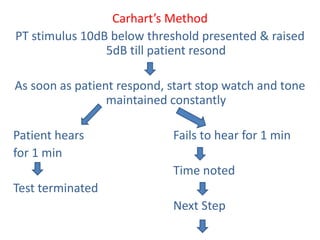
Carhart’s Method
PT stimulus 10dB below threshold presented & raised
5dB till patient resond
As soon as patient respond, start stop watch and tone
maintained constantly
Patient hears Fails to hear for 1 min
for 1 min
Time noted
Test terminated
Next Step
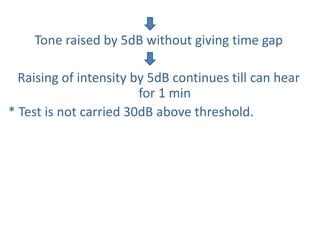
Tone raised by 5dB without giving time gap
Raising of intensity by 5dB continues till can hear
for 1 min
* Test is not carried 30dB above threshold.
Results
Tone Decay Type
0-5dB Normal
10-15dB Mild
20-25dB Moderate
30dB or above Severe (Retrochoclear
lesion)
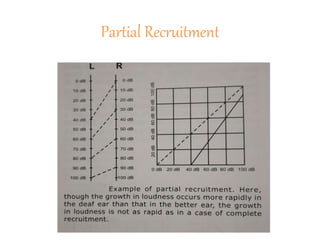
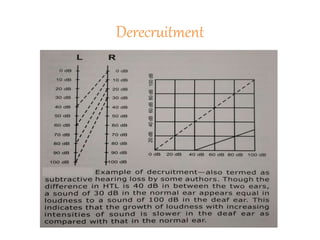
Recruitment
• An abnormally steep growth of loudness with
increasing intensity and is usually associated
with a SNHL due to cochlear pathology.
• Believed due to damage to OHC
• Can be tested by: i) ABLB(Direct Test)
ii) SISI (Indirect Test)
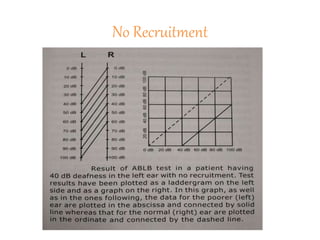
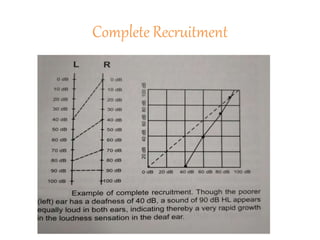
Alternate Binaural Loudness Balance Test (ABLB)
• Tone is presented alternately between two
ears
• One is fixed ear and other variable ear.
• Patient is asked to report where the sound is
louder in which ear or equal in both ear.
No Recruitment
Complete Recruitment
HyperRecruitment
Partial Recruitment
Derecruitment
SHORT INCREMENT SENSITIVITY INDEX TEST
• To differentiate between cochlear and retro
cochlear lesion.
• Used to measure the recruitment in cochlear
pathology.
• SISI determines the capacity of a patient to detect a
brief 1dB increment in a 20dB supra threshold tone
in various frequency.
• Brief increase in intensity done at interval of 5
seconds.
• 20 such 1dB increment presented to the Ear &
patient is asked to count
• Total count x 5 = % SISI score
• Interpretation (Jerger’s Categorization)
Scores Indicates
70-100%-------------------- Cochlear Pathology
0-20% ----------------------- Retro cochlear Pathology
Limitations:
i) Requires active co-operation of patient
ii) Patient having very severe deafness (above
85dBHL) can’t be tested.
SPEECH AUDIOMETRY
• In speech audiometry, the hearing sensitivity of a
subject for speech is assessed.
• The main use of speech audiometry to the
neurotologist is in the identification of neural
types of hearing loss in which both the reception
as well as the discrimination of speech is
impaired more markedly than in cochlear or
conductive hearing loss.
• Comprises of the following tests:
– Speech Reception Threshold
– Speech Discrimination Score
Speech Reception Threshold
• The speech reception threshold (SRT) is the lowest hearing
level in decibel hearing level at which 50% of a list of
spondee words is correctly identified by a subject.
• A spondee is a two syllable word with equal stress on each
syllable, e.g., eardrum, toothbrush, armchair, workshop,
baseball, horseshoe, whitewash, headlight, etc.
• The simplest way of estimating the SRT is to present
groups of six spondee words first at a step 25 dB above the
pure tone hearing threshold level, and then at successively
lower intensities till a level is reached at which the subject
correctly identifies just three of the six spondee words
presented.
• This is the SRT for the subject.
• In normal subject SRT is very closely related to his pure
tone hearing threshold
• In neural lesions, the SRT is much poorer than this pure
tone average.
Speech Discrimination Score
• The speech discrimination score (SDS) is the
percentage of correctly identified words, when
words from a specially prepared list called
‘phonetically balanced word list (PB list)’ is
presented to the subject.
• To ascertain the speech discrimination score, 50
words from the PB word list is presented to the
subject at 35 dB above the speech reception
threshold.
• The percentage of the total number of such
presented words that the subject correctly
identifies gives the SDS.
• The SDS is normally from 90% to 100%.
• But in neural lesions SDS considerably low.

Pure Tone Audiometry

  • 1.
    Audiometry By: Dr MukulGoswami Assam Medical College & Hospital Dibrugarh
  • 2.
    SOUND • When everan object vibrates in an elastic medium(air), it produces succesive waves of compression and rarefrection by disturbing the surrounding air molecule, which are termed as sound waves. • In other words “Sound is a variation in pressure with time”
  • 4.
    • Frequency: Numberof sound waves produced in 1 sec. When it is measured in cycles per sec it is called as Hertz. – Human ear is most sensitive to sound at 1000-2000Htz • Sine wave: Sinusoidal wave pattern produced when objects vibrate in single fixed frequ7ency. • Sound produced by such a sine wave is called pure tone sound. – A pure tone sound can be described by a sine function where we use the cosine function that is the common standard in engineering applications, p(t) describes the variation in sound pressure with time, A describes the peak amplitude or magnitude of the pressure, f is the frequency of the sinusoid, and φ is the phase. • Complex sound: Is a mixture of different pure tone sound (with different frequency and intensity) • In PTA hearing sensitivity are tested for pure tone sounds.
  • 5.
    • Decibel: Unitof by which intensity of sound pressure exerted by a sound stimulus is measured • Sound just audible to a normal ear- • 0.00024 dynes/sq cm (in unit of pressure) • 10-16 watts sq cm (in terms of intensity) • Maximum Tolerabale Sound: • 2400 dynes/sq cm (in unit of pressure) • 10-2 watts sq cm (in terms of intensity) • The range between min and maximum is huge so to simplify it Sir Alexander Graham Bell used concept of logarithm scale to compare sound intensities and used the term Bell as unit of measurement of sound intensuty.
  • 6.
     Bel=log Io/IR(Io-intensity of sound IR-intensity of reference sound) • To further simplify the calculation 1/10th of Bell was used called as Decibel. • 1 Bell = 10 Decibel • Decibel=10log Io/IR • Zero Decibel: Is just audible sound for a particular frequency.
  • 8.
    SOUND TRANSMISSION IN THENORMAL EAR • Acoustic signals are transmitted from the air of the external environment to the fluid-filled inner ear. • The transmission of sound power at an air–fluid interface depends on the relative impedances of air and fluid. In the case of the inner ear, only about 0.1% of intensity of an incident sound wave is transmitted to the fluid, and this is equivalent to a 30-dB loss. • The external and middle ears act to better match the sound conducting properties of air and cochlear fluid by increasing the sound pressures that reach the inner ear at certain frequencies(impedence matching).
  • 9.
  • 10.
    FUNCTIONS OF EXTERNALEAR: Sound collection Increasing pressureon tympanic membrane in a frequency sensitive way Sound localisation
  • 11.
    EXTERNAL EAR  Actas a resonator  It increases the pressure at the ear drum in a frequency sensitive way  Helps in localisation of direction of sound
  • 12.
    SOUND COLLECTION  Pinna-concha system catches sound over large area and concentrate it to smaller area of ext. auditory meatus.  This increases the total energy available to the tympanic membrane
  • 13.
    PRESSURE INCREASE BYEAC If a tube which is closed at one end and open at other is placed in a sound field then pressure is low at open end and high at closed end.  This phenomenon is seen in EAC at 3kHz frequency , and at concha at 5kHz
  • 14.
    SOUND LOCALISATION: Because ofits shape, the pinna shield the sound from rear end,change timbre,and helps to localize sound from in front or back Cues for sound localization from right/left  Sound wave reaches the ear closer to sound source before it arise in farthest ear  Sound is less intense as it reaches the farthest ear because head act as barrier Auditory cortex integrates these cues to determine location
  • 15.
    TOTALEXTERNALEARGAIN  The totaleffect of reflection of sound from head,pinna and external canal resonances is to add 15-20dB to sound pressure, over frequency range of 2-7kHz.
  • 16.
    MIDDLE EAR • MIDDLEEAR helps in transformation of sound power from external ear to inner ear via two mechanisms: – action of tympanic membrane(Major transformer) – Action of ossicular chain.
  • 17.
    ACTION OF TYMPANICMEMBRANE • It is the major transformer. • AREA RATIO: It is the ratio of tympanic membrane area (60mm2) to the stapes footplate area(3.2mm2) • The TM gathers forces over its entire surface and couples force to the stapes footplate. • Pressure = Force per Area • Human TM area 20 times larger than Stapes footplate. • So in “ideal” condition the sound pressure applied to the inner ear should be 20 times larger than the sound pressure at TM(equal to 26 dB gain)
  • 19.
    LEVER ACTION OFEAROSSICLES • Results from the different length of rotating malleus manubrium and incus long process around the axis of roation of ossicles • Axis of rotaion is an imaginary line joining the Ant. Malleal Ligament to the post. Incudal Ligament. • Ratio of this length is 1.3:1, which causes only a small 2dB increase in sound pressure • Thus if the transformer action ios ideal the theoretical middle ear sound pressure gain is about 28dB(26dB Area Ratio + 2 dB Ossicular Lever)
  • 21.
    • But theactual measured maximum gain is only about 20dB near 1000Hz. • The difference between measured and theoritical gain is the result of several non ideal conditions 1. At low frequencies the entire TM moves with the same phase but with different magnitude. At frequencies above 1000Hz the TM breaks into smaller vibrating portions that vibrate with different phases. This decreases the efficency of TM as coupler of sound pressure. 2. Part of the sound pressure in EAC is utilised to move TM and ossicles themselves(Ossicular inertia) 3. Middle ear spaces use up some of the sound pressure 4. Slippage in the ossicular system reduces the motion of stapes related to manubrium. Slippage causes translational movement in the raotational axis of rotation.
  • 22.
    • Effective stimmulationof inner ear requires 1. Ossicular coupling/Tympano ossicular System Area Ratio Ossicular Lever 2. Acoustic Coupling 3. Middle ear Air permits round window to move freely. When the stapes footplate moves in the round window moves out due to movement of incompressible cochlear fluid. 4. Difference in sound pressure in oval and round window- window pressure difference 5. Intact TM protects/shields the round window from sound in Ear Canal(reduces 10-20dB sound pressure) – shielding effect
  • 24.
    Phase Difference between theCochlear Windows • In normal ear there is a significant difference in magnitude between the oval and round window sound pressure(due to ossicular and acoustic coupling) so differences in phase have little effect in determing the window pressure difference. • However when the magnitude of sound pressure at round and oval window are similar (interrupted ossicular chain), phase difference becomes important. – When the individual window pressures are of similar magnitude and similar phase, they tend to cancel each other and produce only a small net window pressure difference. – On the other hand, if the individual window pressures are of similar magnitude but opposite phase, then they will add to each other, resulting in a window pressure difference that is similar in magnitude to the applied pressures.
  • 25.
    MIDDLE EAR MUSCLES •The stapedius and tensor tympani muscles contract under a variety of circumstances, including loud sounds, before and during vocalization, tactile stimulation of the head or face, and fight or flight behavioral responses. • Such protective contractions reduce the transmission of low frequency sound through the middle ear but have little effect on high-frequency sound. • Contraction of the stapedius muscle in response to sound is known as the acoustic reflex. The reflex is thought to help in speech discrimination (the reflex reduces masking by low frequency sound of high-frequency stimuli) and in protecting the inner ear from acoustic trauma of loud continuous sound. • Contractions of the tensor tympani have also been associated with opening of the eustachian tube, where the inward motion of the tympanic membrane that results from the contraction produces an overpressure in the middle ear that helps open the tube.
  • 26.
    Middle Ear Joints •The incudomalleal and incudostapedial joints add flexibility to the ossicular system, which allows the middle ear to withstand large variations in the static pressure difference across the tympanic membrane without producing damage to the ear. Middle ear static pressure variations that occur regularly in day- to-day activities (eg, those produced by sneezing and swallowing) generate millimeter-sized motions of the tympanic membrane; such large motions are not transmitted to the stapes because of the flexibility of the incudomalleal and incudostapedial joints.
  • 27.
    Acoustics and mechanicsof diseased middle ear 1. Ossicular interuption with intact TM: – Ossicular coupling lost – Sound input to the cochlea via the middle ear occours through acoustic coupling – Since acoustic coupling 60dB smaller than ossicular coupling, there is a 60 dB conductive haring loss. – Partial ossicular innteruption(replaced by band of fibrous tissue)- there is a air bone gap at higher frequency
  • 28.
    2. LOSS OFTM AMD MALLEUS AND INCUS • Conductive Hearing Loss Of 40-50dB- due to loss of ossicular coupling together with an enhancement of acoustic coupling by 10-20 dB(because of loss of shielding effect)
  • 29.
    3. Ossicular Fixation(Partialor complete) Eg. Otoslcleoris, Tymapnosclerosis • conductive Hearing loss of 5-60dB depending on degree of fixation – Fixation of Anterior Malleolar ligament=10dB hearing loss – Fixation of Head of malleus= 15-25 Hearing Loss – Fixation of both malleus and incus=30-50dB loss
  • 30.
    4. TM Perforation –Haering loss ranges from negligible to 50 – There is loss of ossicular coupling – Hearing loss deoends on • Frequency(loss is loss at greater frequency) • Perforation size(larger perforation results in loss of larger hearing loss) • Middle ear space volume(small middle ear space volume results in larger air bone gap)
  • 31.
    5. Middle EarEffusion 30-35dB conductive Hearing Loss Decreased in ossicular coupling increases in impedence of middle ear air space
  • 32.
    6. TM Atelectasis Negligibleto 50dB Reduction in ossicular coupling
  • 33.
    6. 3rd Windowlesion of inner ear apparent conductive hearing loss in absence of true middle ear disease Abnormal pathologic 3rd window in addition to two normal window, this 3rd window permits dissception of sound energy away from cochlea .
  • 35.
    ACOUSTICS AND MECHANICSOF RECONSTRUCTED MIDDLE EARS
  • 36.
    1. Reconstruction ofthe Sound Conduction Mechanisms The goal of tympanoplasty is to restore sound pressure transformation at the oval window by coupling an intact tympanic membrane with a mobile stapes footplate via an intact or reconstructed ossicular chain and to provide sound protection for the round window membrane by means of a closed, air-containing, mucosa-lined middle ear.
  • 37.
    2. Aeration ofthe Middle Ear Aeration of the middle ear (including the round window) is critical to the success of any tympanoplasty procedure. Aeration allows the tympanic membrane, ossicles, and round window to move. Clinical experience has shown that nonaerated ears often demonstrate 40- to 60-dB air–bone gaps.36 The large gap in nonaerated ears occurs because ossicular coupling is greatly reduced and stapes motion is reduced because the round window membrane (which is coupled to the stapes by incompressible cochlear fluids) cannot move freely. The normal, average volume of the middle ear and mastoid is 6 cc; a combined middle ear and mastoid volume of 0.4 cc is predicted to result in a 10-dB conductive hearing loss. Volumes smaller than 0.4 cc should lead to progressively larger gaps, whereas increases in volume above about 1.0 cc should provide little additional acoustic benefit.
  • 38.
    3.Tympanoplasty Techniques withoutOssicular Linkage: Types IV and V In both type IV and type V procedures, there is no ossicular coupling, and residual hearing depends on acoustic coupling. The introduction of a tissue graft to shield the round window from sound enhances acoustic coupling by increasing the sound pressure difference between the oval and round windows.
  • 39.
    The following surgicalguidelines can be used to optimize the postoperative hearing results: (1) one should preserve normal stapes mobility by covering the footplate with a thin split-thickness skin graft and not a fascia graft (fascia is much thicker than skin and can increase footplate impedance), (2) one should reinforce the round window fascia graft shield with cartilage or 1-mm-thick Silastic™ (reinforcing the graft shield in this manner increases its stiffness and improves its performance as an acoustic shield), and (3) one should create conditions that promote aeration of the round window niche and preserve mobility of the round window membrane (eg, by preserving all healthy mucosa in the protympanum and hypotympanum).
  • 41.
    4. Tympanoplasty Techniqueswith Reconstruction or Preservation of Ossicular Linkage: Types I, II, and III i)Tympanic Membrane Reconstruction Although the tympanic membrane is responsible for most of the middle ear sound pressure gain, the details of how that gain is achieved are not well understood. Motion of the normal tympanic membrane is complex, especially at frequencies above 1,000 Hz
  • 42.
    ii) Ossicular Reconstruction Factorsthat can influence the acoustic performance of an ossicular prosthesis include its stiffness, mass, and position; the tension imposed by the prosthesis on the drum and annular ligament; and mechanical features associated with coupling of the prosthesis to the drum and stapes. The positioning of the prosthesis appears to be important to its function. Angle between the stapes and a prosthesis should be less than 45 degrees for optimal sound transmission. The large static displacements produced by a prosthesis that is too long would stretch the annular ligament and tympanic membrane, resulting in a stiffening of these structures, a reduction in tympano-ossicular motion, and an air–bone gap.
  • 43.
    iii) Type IIITympanoplasty, Stapes Columella A classic type III or stapes columella tympanoplasty involves placement of a tympanic membrane graft such as temporalis fascia directly onto the stapes head; that is, the ossicular chain is replaced by the single columella of the stapes. This tympanoplasty is typically performed in conjunction with a canal wall down mastoidectomy. Large air–bone gaps (40 to 60 dB) occur as a result of stapes fixation, nonaeration of the middle ear, or both.
  • 45.
    iv) Canal WallUp versus Canal Wall Down Mastoidectomy In a canal wall down mastoidectomy, the bony tympanic annulus and much of the ear canal are removed, and the tympanic membrane graft is placed onto the facial ridge and medial attic wall. This results in a significant reduction in the size of the residual middle ear air space. However, as long as this air space is ≥ 0.4 cc, the resultant loss of sound transmission should be < 10 dB. Since the average volume of the tympanic cavity is 0.5 to 1.0 cc, a canal wall down procedure should create no significant acoustic detriment as long as the middle ear is aerated. This mastoid bowl and ear canal air space generate resonances that can influence middle ear sound transmission favorably or unfavorably.
  • 46.
    • PURE TONEAUDIOMETRY
  • 47.
    • PTA isa non invasive subjective test in which the graphical recording of the Hearing Sensitivity done both quantitatively and qualitatively. • Uses of PTA 1. Measure of thresholds of AC and BC tells the degree and type of hearing loss (mild-profound, CHL/SNHL). 2. The progress of the disease and response to the treatment can be documented (improving/progressive). 3. The type and necessary setting of hearing aids can be determined. 4. The degree of handicap for medicolegal purposes can be determined. 5. Speech reception threshold (SRT) can be predicted.
  • 48.
    • Hearing Threshold:the lowest sound pressure level, at which under specified conditions, a person gives a predetermined % of correct response on repeated trials.
  • 49.
    The results plottedgraphically is called pure tone audiogram. Instrument used to measure is called pure tone audiometer. The range of normal human hearing is 20- 20,000 HZ. The graph plotted in x –axis frequency in hertz are 250,500, 1000,2000,4000 & 8000 (cycles per second ). In y –axis hearing loss in decibels from -10 to 110 db. PURE TONEAUDIOGRAM
  • 50.
    PROCEDURE - AIRCONDUCTION TEST Calibration of the instrument. A reasonably noiseless test environment. Position of headphones Instructions to the patient. Technique of air conduction test- First is Conventional Method Hughson-Westlake technique , modified by
  • 51.
    CALIBRATION OF INSTRUMENTS ISO –1964 Specifications for calibration are used Electronic calibration – atleast once in 6 months Biological calibration – should be done each day before the audiometer is used. Micro-processor based audiometers are used nowadays.
  • 52.
    A REASONABLY NOISELESSTEST ENVIRONMENT Levelof Test Environment < Level of Masking Sound Cause A Threshold Shift In NormalHearing Subject ISO / DIS 8253 – maximum permissible ambient noise for the different frequencies required for air and bone conduction tests.  Air Conduction - 25 - 30 db  Bone Conduction - 10 -15 db
  • 53.
    POSITION OF HEADPHONES Diaphragm ofheadphone – over the opening of EAC. If the headphones are not properly placed , threshold variations of 15dB or more may occur No wax , discharge , cotton in EAC Collapse of ear canal – supraaural earphones / headphones are placed over ear – Cause small Air- Bone gap.
  • 54.
    INSTRUCTION TO PATIENT Testneeds should be thoroughly explained. Little time spent in getting acquainted with the patient and his problems prior to the test , helps in establishing a rapport.
  • 55.
    TECHNIQUES - CONVENTIONAL METHOD Adetailed clinical history & examination should precede the test. Better ear is tested first, start with 1000 Hz & then 2k,4k,8k,10k,then 500 , 250 Hz. If difference is more than 20 db then half octaves is to be tested. Tones are lowered in 10 db steps and increased in 5 db steps.
  • 56.
    TECHNIQUES - CONVENTIONAL METHOD Secondear – may start with last frequency used to test the first ear ( no need to start with 1000 Hz ) 5-up-10-down ( tones are lowered in 10 db steps and increased in 5 db steps )
  • 57.
    STEP 3 -RAISE SOUND BY 10 db (i.e 60 db) RESPONSE PRESENT – PROCEED TO STEP 5 RESPONSE ABSENT – PROCEED TO STEP 4 STEP 2 - RAISE SOUND BY 20 db (i.e 50 db) RESPONSE PRESENT – PROCEED TO STEP 5 RESPONSE ABSENT – PROCEED TO STEP 3 STEP 1 - START WITH 30 db HL SOUND RESPONSE PRESENT – PROCEED TO STEP 5 RESPONSE ABSENT – PROCEED TO STEP 2 METHOD OFASHA
  • 58.
    7 STEP 5 –LOWER SOUND BY 10 db RESPONSE PRESENT – REPEAT STEP 5 , I.E AGAIN LOWERTILL RESPONSE ABSENT THN PROCEED TO STEP 6 RESPONSE ABSENT – PROCEED TO STEP 6 STEP 4 – RAISE SOUND BY 10 db STEPS TILL RESPONSE PRESENTAT APARTICULAR STEP – PROCEED TO STEP 5 MAXIMUM OFAUDIOMETER BUT NO RESPONSE OBTAINED – RECORD AS NO RESPONSE OBTAINED METHOD OFASHA
  • 59.
    METHOD OFASHA STEP 7– 6 STIMULI PRESENTED AT SAME LEVEL 3 RESPONSE CORRECT – RECORD AS HEARING THRESHOLD FOR THAT PARTICULAR FREQUENCY LESS THAN 3 CORRECT – RETURN TO STEP 6 STEP 6 – SOUND RAISE BY 5 DB RESPONSE PRESENT – PROCEED TO STEP 7 RETURN TO STEP 6 , I.E RAISE SOUND BY 5 DB TILL RESPONSE IS PRESENTTHEN PROCEED TO STEP7
  • 60.
    BONE CONDUCTION COMPRESSIONAL /DISTORTIONAL BONE CONDUCTION Vibratory energy ( Sound ) reaches the cochlea Alternate expansion and compression of cochlear shell (due to flexiblity of round window memb and cochlear equeduct) Movement of cochlear fluid Displacement of basilar membrance Leads to changes that result ultimately in sound being heard
  • 61.
    BONE CONDUCTION INERTIAL BONECONDUCTION Vibratory energy ( Sound ) strikes the skull Sets the skull into vibration Ossicles in middle ear lag behind & do not move due to inertia of ossicles Sets up relative motion b/w footplate of stapes & cochlear fluid deep to oval window Vibration of cochlear fluid
  • 62.
    BONE CONDUCTION OSSEO-TYMPANIC BONECONDUCTION Vibratory energy ( Sound ) reaches the skull Skull starts vibrating Sets into vibration the column of air in EAC Partially transmitted to TM Thro’ the ossicles in the middle ear To Cochlear fluid of inner ear ( like air - conducted sound)
  • 63.
    CONDUCTION  Calibration ofinstrument  Reasonably noiseless test environment  Placement of bone conduction vibrator  Instructions to the patient  Technique – same as air conduction.
  • 64.
    CONDUCTION MASTOID PLACEMENT OFBONE VIBRATOR Tension of spring metal headband over the mastoid - 500 gm / sq.cm Should be free of hair as possible , should not touch the pinna A constant sound is given and B.C vibrator is moved over the mastoid – till a point of maximum sound is heard. When ears without any conductive pathology are covered by earphones or occluded by any apparatus , there is a false increase in the bone
  • 65.
    CONDUCTION FRONTAL PLACEMENT OFBONE VIBRATOR Adv : less variation of the amount of tissue b/w bone conduction vibrator and skull bone & lesser artifacts Mastoid is more sensitive, about 10-15dB more than frontal  Correction factor has to be subtracted if vibrator has been calibrated for mastoid placement 15 db for 250 - 500 Hz 10 db for 1000 - 4000 Hz
  • 66.
    • Bone conductionaudiometry has lots of inherent problems and is prone to errors: 1. Chances of ambient external noise masking the test tone and thereby producing elevated threshold is quite high in bone conduction as the external EAC is unoccluded. 2. Bone conductions test are possible only upto a maximum of 40 dB at 250 Hz, 50 dB at 500 Hz, and upto 60-70dB from 1000-4000Hz. 3. Different subjects have different thickness over the mastoid. 4. Sensitivity of sound is different in different areas of mastoid.
  • 67.
    5. Vibrotactile stimulationis very common at 250- 500Hz. So it is difficult to know whether the bone conduction threshold at 250, 500 Hz is actually response from auditory stimulation or from vibro tactile stimulation. 6. The bone conductive vibrator stimulates the cochlea of both ears equally irrespective of side of stimulation. 7. If the EAC is blocked by air conduction headphone, then due to a phenomenon called ‘occlusion effect’ there is a false betterment of the bone conduction hearing in low frequency, due to increase in osseotympanic bone conduction sound.
  • 68.
    LEFT RIGHT AIR CONDUCTIONSOUNDS ARE HEARD UNMASKED MASKED BONE CONDUCTION UNMASKED (MASTOID) MASKED MASKED ( FOREHEAD) AIR CONDUCTION SOUNDS NOT HEARD UNMASKED MASKED BONE CONDUCTION UNMASKED (MASTOID)
  • 69.
    MASKING Noise presented tothe non-test ear to prevent it from responding to a signal presented to the test ear WHEN TO MASK ? - All bone conduction - When interaural attenuation is more than 45 db . - When air conduction more than 45 db HL - Cross – hearing in air conduction if AC ( test ear ) – BC ( non test ear ) > IA HOW TO MASK ? For bone conduction - minimum masking = B t +( A m – Bm) For air conduction - minimum masking = At – 40 + (Am – B m) Maximum masking = B t + 45 (for both BC & AC)
  • 70.
    MASKING Over masking If themasking sound used is so loud thai it crosses over from the non-test ear and obliterates or mask the test signal in test ear , the subject will not hear the test signal in the test ear until it is much above the actual threshold. Under masking if the masking sound presented to the non test ear is not loud enough to eliminate the non-test ear from participating in the test process when test sound are presented to test ear.
  • 71.
    SOUNDS USED FORMASKING WHITE NOISE Broadband or wideband noise ( equal amt of sound of all frequencies , starting from low to very high frequencies ) NARROW BAND NOISE Narrow band of noise centered on test tone freq. with 100 – 200 Hz above and below that freq. The band width which will provide the maximum effective masking for a tone of particular frequency at minimum intensity is called ‘critical band width’ COMPLEX NOISE Low freq. fundamentals plus the multiples of that freq. up to 4000 Hz
  • 72.
    INTERPRETATION OFAUDIOGRAM • 0-25db - Normal • 26-40 db - Mild deafness • 41-55 db - Moderate deafne • 56-70 db - Severe deafness • 71-90 db - Very severe deafn • Above 90 db - Profound deaf
  • 73.
    % of Handicap Formulafor calculating % of handicap for unilateral deafness –{ [( a+b+c+d)÷ 4 ]- 25} x 1.5% where a,b,c and d are air conduction threshold at 500, 1000,2000, and 3000Hz respectively Bilateral – [ (5x +y) ÷6 ]% where x and y are the percentage of handicap for the better and worse ear respectively
  • 74.
    • CONDUCTIVE DEAFNESS AC threshold>30dB.  BC threshold<20 dB.  A-B gap>25 dB.
  • 75.
    • SENSORINEURAL DEAFNESS AC threshold>30 dB.  BC threshold>20 dB.  A-B gap<20 dB
  • 76.
    • MIXED DEAFNESS AC threshold>45 dB.  BC threshold>20 dB.  A-B gap>20 dB.
  • 91.
    SOME OTHER TESTSWITH THE PURE TONE AUDIOMETER
  • 92.
    Threshold Equalizing NoiseTest • Test for identifying dead regions in the cochlea. • Person with dead regions may not benefit from hearing aid. • TEN test is useful in Hearing Aid fitting only, as it identifies the dead region of the cochlea i.e. the frequencies where amplification will not serve any purpose.
  • 93.
    Differential Limen forIntensity test • For establishing the subject’s capability of small variations of intensity in a tone signal. • Test for recruitment. • Patient with cochlear damage have recruitment and hence can detect very small changes in loudness. • Test consit of superimposing breif brusts of 0.2-5dB intensity increments on a sustained tone 20 dB above threshold. • Patient instructed to report any variation in loudness. • The DLI score 20dB above supra-threshold levels compared with normal and three possibilities obtained: no recruitment/partial recruitment/complete recruitment
  • 94.
    STENGER TEST • Fordetecting malingering. • A pure tone audiometry is first done and the thresholds as per the patient’s responses recorded. • The test is applicable only if the audiometric thresholds as per the patient’s responses show a difference of at least 20 dB between the better ear and the ear in which the patient is feigning deafness . • The level for the better ear is set at 10 dB above recorded threshold and the level in the poorer ear is set at 10 dB below recorded threshold. • If the patient truly has a hearing loss in the poorer ear, the patient will only hear the presented tone in the better ear and will respond that the tone is present. This is a negative Stenger response and indicates that the patient is not malingering i.e., has a true hearing loss. • If the patient does not truly have a hearing loss in the poorer ear, the patient will only hear the presented tone in the reportedly poorer ear. As the patient is trying to show as if the patient has a hearing loss in that ear, the patient will not respond to the tone. This is a positive Stenger response and indicates that the patient is malingering.
  • 95.
    Speech Uncomfortable LoudnessLevel (UCL) • UCL is the level at which the sound appears to the patient to be uncomfortable but just about tolerable and not painful. • UCL is not the threshold of pain caused by the sound. • So the patient has to be clearly instructed that the purpose is to find out the level at which the sound appears uncomfortable loud but does not cause pain in the ear.
  • 96.
    Most Comfortable LoudnessLevel (MCL) • Procedure is more or less the same as that for determining the UCL; only the instructions to the patient are a bit different. • The patient is instructed that the purpose of the test is to try to find the level at which he/she is most comfortable listening to the sounds. • The test is started by presenting sounds at a moderate level say 50 dB and the patient is asked if the current level is comfortable or if he/ she would prefer it louder or softer. • The intensity level of the sound is increased and decreased until the patient’s preferred level is determined. This is the MCL.
  • 97.
    BING TEST OROCCLUSION TEST  BC Vibrator is placed over mastoid process  BC threshold at certain freq. b/w 250 – 1000 Hz ascertained twice , once with EAC open & EAC occluded.  No change in BC thershold – Conductive deafness  Hearing threshold found better with EAC Occluded – No Conductive deafness
  • 98.
    GELLE’S TEST • BCVibrator is placed over mastoid process of test ear Audiometer ear phone is placed over the other ear • Masked BC hearing threshold of test ear is determined at air pressure of -400 , 0 , +400 mm of water pressure. • In normal middle ear - the BC hearing threshold is found to become poorer at -400 & +400 as compared to 0. • In stapes fixation - no change in BC threshold
  • 99.
    TONE DECAY • Mostcommon test for detection of the site of pathology in the sensorlneural pathway. • Can be carried out on any pure tone audiometer. • Helps in diagnosing neural lesion like aucostic neuroma, Audiotory Neuropathy • Mecahanism: a pathology in the auditory nerve causes an abnormally rapid deterioration in the threshold of hearing of a tone if that tone is presented continuously (i.e., as a sustained signal) to the ear. • A lesion damaging some fibers of the auditory nerve, whether it is a tumor pressing on the auditory nerve or a neuritis or atrophy of the auditory nerve fibers hinders the transmission of a sustained or continuous tone.
  • 100.
    • Methods Carhart’s Method(Most Common) Olsen and Noffsinger Test Rosenberg’s Method Suprathreshold Adaptation Test
  • 101.
    Carhart’s Method PT stimulus10dB below threshold presented & raised 5dB till patient resond As soon as patient respond, start stop watch and tone maintained constantly Patient hears Fails to hear for 1 min for 1 min Time noted Test terminated Next Step
  • 102.
    Tone raised by5dB without giving time gap Raising of intensity by 5dB continues till can hear for 1 min * Test is not carried 30dB above threshold.
  • 103.
    Results Tone Decay Type 0-5dBNormal 10-15dB Mild 20-25dB Moderate 30dB or above Severe (Retrochoclear lesion)
  • 104.
    Recruitment • An abnormallysteep growth of loudness with increasing intensity and is usually associated with a SNHL due to cochlear pathology. • Believed due to damage to OHC • Can be tested by: i) ABLB(Direct Test) ii) SISI (Indirect Test)
  • 105.
    Alternate Binaural LoudnessBalance Test (ABLB) • Tone is presented alternately between two ears • One is fixed ear and other variable ear. • Patient is asked to report where the sound is louder in which ear or equal in both ear.
  • 106.
  • 107.
  • 108.
  • 109.
  • 110.
  • 111.
    SHORT INCREMENT SENSITIVITYINDEX TEST • To differentiate between cochlear and retro cochlear lesion. • Used to measure the recruitment in cochlear pathology. • SISI determines the capacity of a patient to detect a brief 1dB increment in a 20dB supra threshold tone in various frequency. • Brief increase in intensity done at interval of 5 seconds. • 20 such 1dB increment presented to the Ear & patient is asked to count • Total count x 5 = % SISI score
  • 112.
    • Interpretation (Jerger’sCategorization) Scores Indicates 70-100%-------------------- Cochlear Pathology 0-20% ----------------------- Retro cochlear Pathology Limitations: i) Requires active co-operation of patient ii) Patient having very severe deafness (above 85dBHL) can’t be tested.
  • 113.
    SPEECH AUDIOMETRY • Inspeech audiometry, the hearing sensitivity of a subject for speech is assessed. • The main use of speech audiometry to the neurotologist is in the identification of neural types of hearing loss in which both the reception as well as the discrimination of speech is impaired more markedly than in cochlear or conductive hearing loss. • Comprises of the following tests: – Speech Reception Threshold – Speech Discrimination Score
  • 114.
    Speech Reception Threshold •The speech reception threshold (SRT) is the lowest hearing level in decibel hearing level at which 50% of a list of spondee words is correctly identified by a subject. • A spondee is a two syllable word with equal stress on each syllable, e.g., eardrum, toothbrush, armchair, workshop, baseball, horseshoe, whitewash, headlight, etc. • The simplest way of estimating the SRT is to present groups of six spondee words first at a step 25 dB above the pure tone hearing threshold level, and then at successively lower intensities till a level is reached at which the subject correctly identifies just three of the six spondee words presented. • This is the SRT for the subject. • In normal subject SRT is very closely related to his pure tone hearing threshold • In neural lesions, the SRT is much poorer than this pure tone average.
  • 115.
    Speech Discrimination Score •The speech discrimination score (SDS) is the percentage of correctly identified words, when words from a specially prepared list called ‘phonetically balanced word list (PB list)’ is presented to the subject. • To ascertain the speech discrimination score, 50 words from the PB word list is presented to the subject at 35 dB above the speech reception threshold. • The percentage of the total number of such presented words that the subject correctly identifies gives the SDS. • The SDS is normally from 90% to 100%. • But in neural lesions SDS considerably low.