Physiological Effects of
Stretching
Ayisha Mubeena
2nd Year BPT
Table of contents
• Introduction
• Indication of stretching
• Contraindication of stretching
• Physiological effects of stretching
• The stretch reflex
• Conclusion
• Reference
Introduction
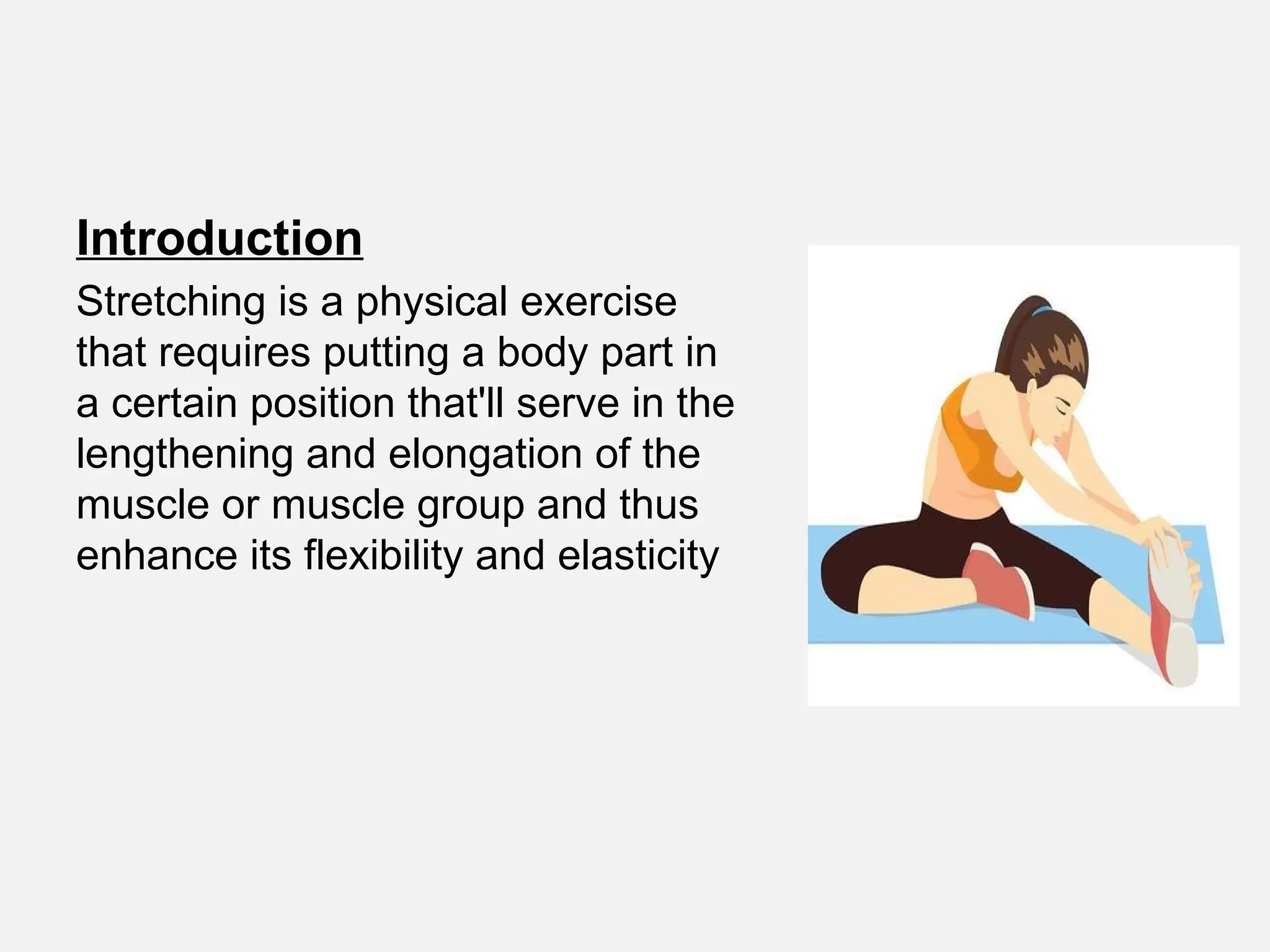
Stretching is a physical exercise
that requires putting a body part in
a certain position that'll serve in the
lengthening and elongation of the
muscle or muscle group and thus
enhance its flexibility and elasticity
Indication
• To improve the joint range of motion
• To improve posture
• Restores normal neuromuscular balance
between muscle groups
• Reduce injuries, strains and damage
• Before and after exercise to reduce muscle
soreness
Contraindication
Limited movement at the joint due to the
presence of a bony block
• Directly after fracture when it has not
completely healed
• Acute inflammation or infection
• Sharp pain during joint movement
• Hematoma or other soft tissue trauma
• Hypermobility
Physiological effects of stretching
• Improved flexibility: Stretching can help increase
flexibility and range of motion in your joints. This can
help you perform better in physical activities and reduce
your risk of injury
• Reduced muscle tension: Stretching can help reduce
muscle tension, which can help reverse the cycle of
tension, tightening, and pain
• Increased serotonin levels: Stretching can increase
serotonin levels, which can help reduce stress,
depression, and anxiety.
• Improved posture: Stretching can help improve your
postural awareness and body posture
• Increased circulation: Stretching can increase
circulation, which can help decrease your recovery
period after exercise
• Reduced risk of injury: Stretching can help reduce the
risk of muscle strains and other injuries.
• Better balance: Stretching can help people with balance
problems avoid falls.
• Improved athletic performance: Stretching can help
improve your athletic performance
• increased blood flow to the brain and throughout the
body
The Stretch Reflex
The stretch reflex, also known as the myotatic reflex, is an
involuntary muscle contraction that occurs when a muscle is
stretched. It's a rapid response to mechanical disturbances
that helps prevent muscles from being stretched too far.
When a muscle is stretched,
• Muscle spindle : Detects the stretch and send
signal to the spine
• Sensory impulses: The sensory impulses are
transmitted to the spinal cord.
• Alpha motor neuron: The impulses synapse on
the alpha motor neuron in the spinal cord.
• Action potential: The alpha motor neuron sends
an action potential to the neuromuscular
junction of the muscle, causing it to contract.
• Antagonist muscles: The stretch reflex also
causes the antagonist muscles to relax.
Conclusion
Stretching keeps the muscles flexible and healthy, and we
need that flexibility to maintain a range of motion in the
joints. Without it, the muscles shorten and become tight.
It improve your performance in physical activities and
decrease your risk of injuries, increase muscle blood flow
and it enable your muscles to work most effectively.
It improve your ability to do daily activities.
Reference
• Therapeutic exercise Foundations and
Techniques, 6th edition -Carolyn Kisner, Lynn
Allen Colby.
• https://www.physio-pedia.com
• Mayo Clinic Stretching Available from:
https://www.mayoclinic.org/healthy-lifestyle/fitnes
s/in-depth/stretching/art-20047931
Physiological Effects of Stretching Therapy

Physiological Effects of Stretching Therapy

  • 1.
  • 2.
    Table of contents •Introduction • Indication of stretching • Contraindication of stretching • Physiological effects of stretching • The stretch reflex • Conclusion • Reference
  • 3.
    Introduction Stretching is aphysical exercise that requires putting a body part in a certain position that'll serve in the lengthening and elongation of the muscle or muscle group and thus enhance its flexibility and elasticity
  • 4.
    Indication • To improvethe joint range of motion • To improve posture • Restores normal neuromuscular balance between muscle groups • Reduce injuries, strains and damage • Before and after exercise to reduce muscle soreness
  • 5.
    Contraindication Limited movement atthe joint due to the presence of a bony block • Directly after fracture when it has not completely healed • Acute inflammation or infection • Sharp pain during joint movement • Hematoma or other soft tissue trauma • Hypermobility
  • 6.
    Physiological effects ofstretching • Improved flexibility: Stretching can help increase flexibility and range of motion in your joints. This can help you perform better in physical activities and reduce your risk of injury • Reduced muscle tension: Stretching can help reduce muscle tension, which can help reverse the cycle of tension, tightening, and pain • Increased serotonin levels: Stretching can increase serotonin levels, which can help reduce stress, depression, and anxiety. • Improved posture: Stretching can help improve your postural awareness and body posture
  • 7.
    • Increased circulation:Stretching can increase circulation, which can help decrease your recovery period after exercise • Reduced risk of injury: Stretching can help reduce the risk of muscle strains and other injuries. • Better balance: Stretching can help people with balance problems avoid falls. • Improved athletic performance: Stretching can help improve your athletic performance • increased blood flow to the brain and throughout the body
  • 8.
    The Stretch Reflex Thestretch reflex, also known as the myotatic reflex, is an involuntary muscle contraction that occurs when a muscle is stretched. It's a rapid response to mechanical disturbances that helps prevent muscles from being stretched too far.
  • 9.
    When a muscleis stretched, • Muscle spindle : Detects the stretch and send signal to the spine • Sensory impulses: The sensory impulses are transmitted to the spinal cord. • Alpha motor neuron: The impulses synapse on the alpha motor neuron in the spinal cord. • Action potential: The alpha motor neuron sends an action potential to the neuromuscular junction of the muscle, causing it to contract. • Antagonist muscles: The stretch reflex also causes the antagonist muscles to relax.
  • 10.
    Conclusion Stretching keeps themuscles flexible and healthy, and we need that flexibility to maintain a range of motion in the joints. Without it, the muscles shorten and become tight. It improve your performance in physical activities and decrease your risk of injuries, increase muscle blood flow and it enable your muscles to work most effectively. It improve your ability to do daily activities.
  • 11.
    Reference • Therapeutic exerciseFoundations and Techniques, 6th edition -Carolyn Kisner, Lynn Allen Colby. • https://www.physio-pedia.com • Mayo Clinic Stretching Available from: https://www.mayoclinic.org/healthy-lifestyle/fitnes s/in-depth/stretching/art-20047931