

Nootan Physiotherapy College,
Visnagar.
Prepared By:
Dr. Nidhi Vedawala
Introduction
 The postural alignment starts its development from early
period of life with development of the spine and its
curvature.
 At first ,at birth the spine has C – shaped curve with one
convexity and one concavity.
 Then , as the child is trying to raise his head ‘from prone
lying position cervical curve start to develop and in the
early phase of education of walking , another curves are
considered as “secondary curve” to the first one which is
called “primary curve”.
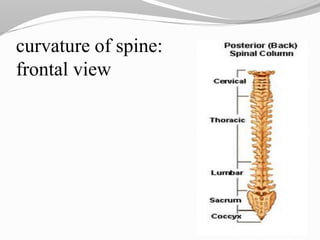
curvature of spine:
frontal view
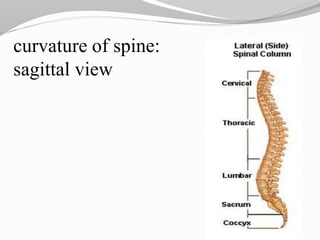
curvature of spine:
sagittal view
POSTURE
“Posture is the attitude assumed by the body either
with support during muscular inactivity, or by
means of coordinated action of many muscles
working to maintain stability or form an essential
basis which is being adapted constantly to the
movement.”
 Ligaments, fasciae, bones, joints – inert structures that
support the body
 Muscles and their tendinous attachments are the
dynamic structures that maintain the body in a posture
or move it from one posture to another.
Types of Posture
Inactive Posture
 Muscular activity reduce
to a minimum
 e.g.. Resting, sleeping.
Active Posture
 Maintained by integrated
action of many muscles
 It has two types.
static and dynamic
posture.
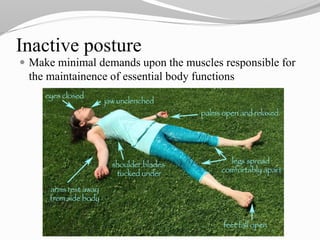
Inactive posture
 Make minimal demands upon the muscles responsible for
the maintainence of essential body functions
Active Posture
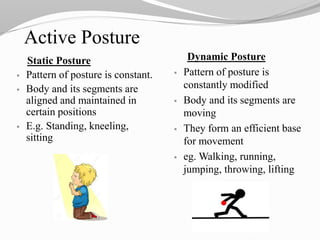
Static Posture
 Pattern of posture is constant.
 Body and its segments are
aligned and maintained in
certain positions
 E.g. Standing, kneeling,
sitting
Dynamic Posture
 Pattern of posture is
constantly modified
 Body and its segments are
moving
 They form an efficient base
for movement
 eg. Walking, running,
jumping, throwing, lifting
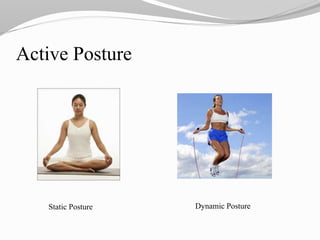
Active Posture
Static Posture Dynamic Posture
• Muscles
• Nervous Control
Postural Mechanism
Muscles
 Muscle requirement depends on static or dynamic
posture
 Mostly some specific group of muscles are working
to maintain erect position, they are working to
counteract the effects of gravity.
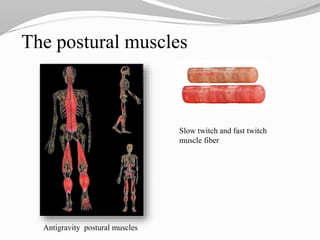
 They are known as Antigravity Muscles usually
extensor group of muscles
The postural muscles
Antigravity postural muscles
Slow twitch and fast twitch
muscle fiber
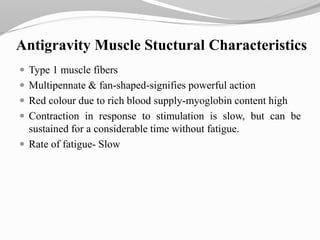
Antigravity Muscle Stuctural Characteristics
 Type 1 muscle fibers
 Multipennate & fan-shaped-signifies powerful action
 Red colour due to rich blood supply-myoglobin content high
 Contraction in response to stimulation is slow, but can be
sustained for a considerable time without fatigue.
 Rate of fatigue- Slow
Nervous Control
 Postural reflexes are the major component to maintained
any kind of posture.
 Postures are maintained or adapted as a result of
neuromuscular co-ordination, the appropriate muscles
being innervated by means of very complex reflex
mechanism.
Postural Reflexes
 Reflex is defined by efferent response to afferent stimuli
 Afferent stimuli > higher centre > efferent response
 The efferent response is a motor one, the anti-gravity
muscles being the principal effector organs
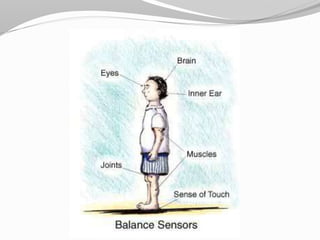
 Afferent stimuli arise from variety of source all over the
body, the most important being situated in the muscles
them selves, the eyes & ears
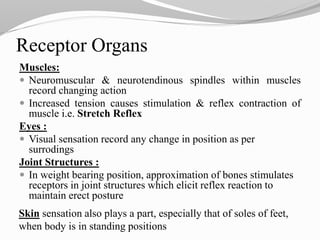
Receptor Organs
Muscles:
 Neuromuscular & neurotendinous spindles within muscles
record changing action
 Increased tension causes stimulation & reflex contraction of
muscle i.e. Stretch Reflex
Eyes :
 Visual sensation record any change in position as per
surrodings
Joint Structures :
 In weight bearing position, approximation of bones stimulates
receptors in joint structures which elicit reflex reaction to
maintain erect posture
Skin sensation also plays a part, especially that of soles of feet,
when body is in standing positions
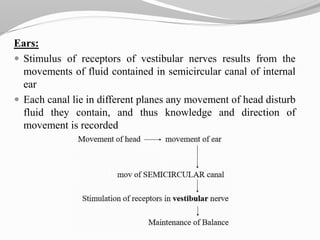
Ears:
 Stimulus of receptors of vestibular nerves results from the
movements of fluid contained in semicircular canal of internal
ear
 Each canal lie in different planes any movement of head disturb
fluid they contain, and thus knowledge and direction of
movement is recorded
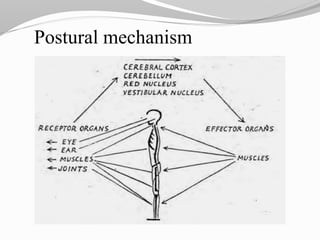
Postural mechanism
Central Nervous System Organs
 Cerebral cortex
 Cerebellum
 Red nucleus
 Vestibular nucleus
Pattern Of Posture
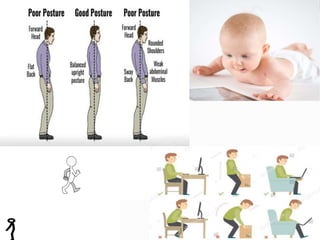
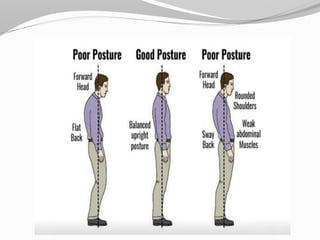
1. Good posture
Good posture is the attitude which, is assumed
by body parts to maintain stability and balance
with minimum effort and least strain during
supportive and non supportive position
2. Poor posture
Poor posture is a position resulting from any
deviation from ideally aligned erect posture
(good posture)
 Patterns of posture, both static and dynamic, are gradually
build up by integration of the many reflexes which together
make up the postural reflex.
 Some of these component reflexes are inborn and some are
conditioned, being developed as the result of constant
repetition of posture maintained by voluntary control.
Pattern Of Posture
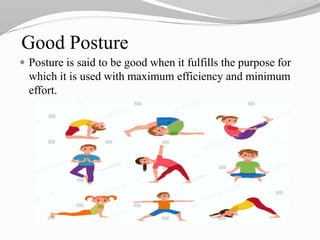
Good Posture
 Posture is said to be good when it fulfills the purpose for
which it is used with maximum efficiency and minimum
effort.
 As the physical characteristics of no two people are
identical, the precise pattern of good posture must vary with
the individual. It is possible, however , to generalize to
some extent.
 For example, in the erect posture the alignment of specific
parts of the body usually leads to perfect balance of one
segment upon another, a state which is aesthetically
pleasing to the eye.
 As dynamic posture involve constant readjustment to
maintain the efficiency of posture background throughout
the progress of the movement , they are much more difficult
to assess.
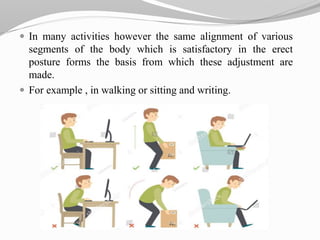
 In many activities however the same alignment of various
segments of the body which is satisfactory in the erect
posture forms the basis from which these adjustment are
made.
 For example , in walking or sitting and writing.
Development of good posture
 Efficient posture develops quite naturally, provided the essential
mechanisms for its maintenance and adjustment are intact and
healthy.
 The chief factors which predispose to the health and development
of the muscles and the posture reflex are:-
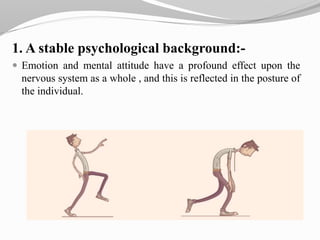
1. A stable psychological background
 Joy, happiness - posture in which position of extension.
 Sad, unhappy - in which position of flexion.
2. Good hygienic condition.
3. Opportunity for plenty of natural free movement.
1. A stable psychological background:-
 Emotion and mental attitude have a profound effect upon the
nervous system as a whole , and this is reflected in the posture of
the individual.
2. Good hygienic condition:
 particularly with regard to nutrition
and sleep, are essential for a healthy
nervous system and for the growth
and development of bones and
muscles.
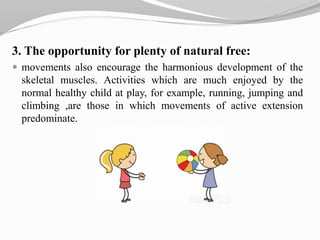
3. The opportunity for plenty of natural free:
 movements also encourage the harmonious development of the
skeletal muscles. Activities which are much enjoyed by the
normal healthy child at play, for example, running, jumping and
climbing ,are those in which movements of active extension
predominate.
Poor posture
 Posture is poor when it is inefficient , that is, when it fails to
serve the purpose for which it was designed, or if an unnecessary
amount of muscular effort is used to maintain it.
 Poor alignment of the body segment in the erect positions may
lead to the necessity for additional muscle work to maintain
balance.
 On the other hand, efficient compensation may take place, in
which case no additional muscular effort is required , but the
attendant ligamentous stain or cramping of thoracic movement
are disadvantages which cannot be ignored.
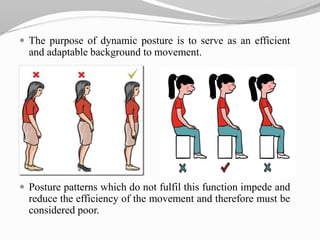
 The purpose of dynamic posture is to serve as an efficient
and adaptable background to movement.
 Posture patterns which do not fulfil this function impede and
reduce the efficiency of the movement and therefore must be
considered poor.
Causes of poor posture
 The causes of poor posture are often very
obscure, and even if they are known are difficult
to remove.
 Poor posture may occur due to:-
1. Defects in:
 Joints : such as stiffness or immobilization.
 Bones :such as shortening or deformity.
 Muscle: such as weakness, paralysis or contracture.
 Vision or Hearing.
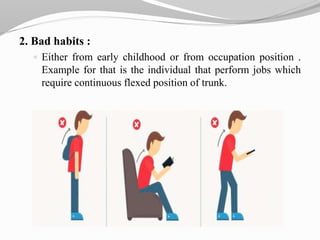
2. Bad habits :
 Either from early childhood or from occupation position .
Example for that is the individual that perform jobs which
require continuous flexed position of trunk.
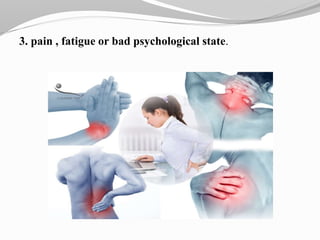
3. pain , fatigue or bad psychological state.
Effects of poor posture :
 Poor posture causes deviations from the normally aligned
posture.
 As a result the body function are altered and this may lead to
dysfunction and diseases.
 Poor posture may cause one or more of following
dysfunction:
1. Easy fatigability and high energy expenditure.
2. Decrease both respiratory and circulatory efficiency.
3. Pain , bad cosmetic appearance and psychological
disturbances.
Re-education
 The measure which can be taken by PT to correct the faulty
posture and to train another and more efficient postural pattern
depend largely on the cause.
 The success of any physical treatment depends on her ability
to gain the co-operation of the patient.
Techniques Of Re-education
 Good Atmosphere should be established for postural re-
education
 make patient feel that acquisition of good posture is worth
while , efforts will be noticed & appreciated
 Individual instructions-as no two patients have identical
difficulties
 But have much common to learn so group activity enables
atmosphere of enjoyment & patient is stimulated by working
with others
 Relaxation
 Muscle Strengthening Exercise
 Muscle Stretching Exercise
 Postural corrections
 Taping
 Myofascial Release
Procedure to Relieve Pain from Stress
and Muscle Tension
 Muscle relaxation techniques
 External postural supports such as lumbar pillow
 Education: demonstrate relationship of patient’s posture to
development of pain
 Modalities and massage
Procedure to increase mobility
 the maintenance of normal mobility is essential to
enable a wide variety of postures to be assumed.
 Normal mobility is maintained by general free exercises
which are rhythmical in character and include full-range
movement of all joints.
 Emphasis is laid on full extension-as it is most liable to
limitation
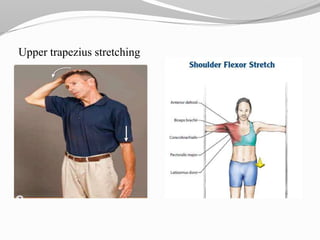
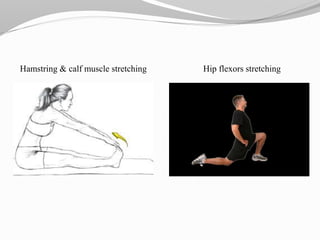
 Stretching of tight specific Muscle by manual mechanical
or by self stretching exs.
Exercises to lengthen the muscles
 Muscles that have become short and weak may restrict the
normal range of motion in a joint, preventing realignment.
 Active stretching that performed only by the client and
passive stretching may be of beneficial for correction of
posture .
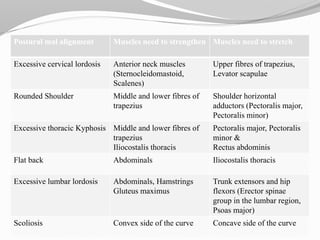
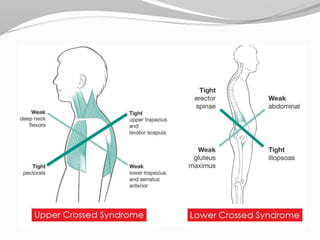
Postural mal alignment Muscles need to strengthen Muscles need to stretch
Excessive cervical lordosis Anterior neck muscles
(Sternocleidomastoid,
Scalenes)
Upper fibres of trapezius,
Levator scapulae
Rounded Shoulder Middle and lower fibres of
trapezius
Shoulder horizontal
adductors (Pectoralis major,
Pectoralis minor)
Excessive thoracic Kyphosis Middle and lower fibres of
trapezius
Iliocostalis thoracis
Pectoralis major, Pectoralis
minor &
Rectus abdominis
Flat back Abdominals Iliocostalis thoracis
Excessive lumbar lordosis Abdominals, Hamstrings
Gluteus maximus
Trunk extensors and hip
flexors (Erector spinae
group in the lumbar region,
Psoas major)
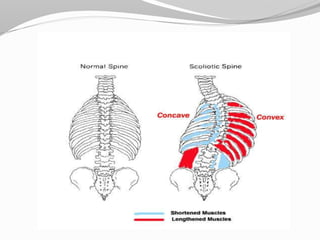
Scoliosis Convex side of the curve Concave side of the curve
Upper trapezius stretching
Hamstring & calf muscle stretching Hip flexors stretching
To train and Strengthen Muscle And to Develop
Endurance For Postural Control
 Stabilization exs: progress by repetition and challenge
with extremity motions, progress to dynamic neck and
trunk strengthening exs.
Procedure to retrain kinaesthetic
awareness for postural correction
 Reinforcement techniques
 Reinforce learning and teach to maintain correct Posture
during functional daily activities.
 Those who have habitual poor posture often feel
uncomfortable and unnatural in any position other than the
one to which they have accustomed
 A mirror or posture recorder or photographs are useful to
compare with image of good posture
 Video-tapes also be used
Postural Correction
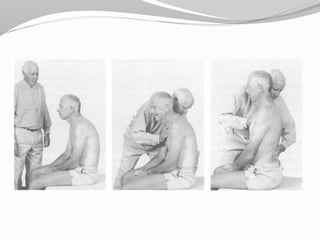
 Sitting on a stool , the patient relaxes into the fully flexed
slouched posture , with the head and chin pro truding .
 The patient then smoothly moves in to the erect sitting
posture , with the lumbar spine positioned in maximal
lordosis and the head retracted and chin pulled in.
 The sequence should be repeated several times in a flowing
manner.
 The patient is thus instructed to move into an extreme of
lordosis, but then release the last 10% of the movement.
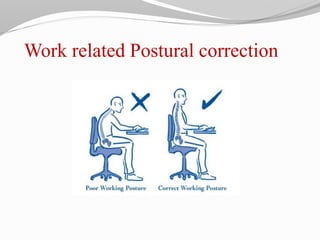
Work related Postural correction
Muscular Strength and Posture
 The basic principles of working correctly and safely is to
plan balanced activity that helps to maintain both muscle
strength and flexibility.
 Imbalance between groups of antagonist muscles alters the
balance of forces exerted on the specific joints and affects
their position.
 An integral part of therapeutic exercise involves bringing
muscles to the appropriate length and strength for
maintaining optimal posture and function.
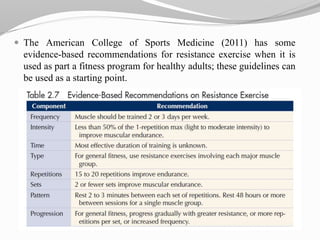
 The American College of Sports Medicine (2011) has some
evidence-based recommendations for resistance exercise when it is
used as part a fitness program for healthy adults; these guidelines can
be used as a starting point.
 If this procedure is practiced three times daily, ten to
fifteen times at each session , in a matter of a few weeks
the patient will have re educated their postural habit .
 This is useful in training dynamic postures in activities such
as tennis, diving and lifting-where faulty posture decrease
efficiency of movement
 Static postures are trained in erect position as people spend
most of working hours in upright positions-standing and
sitting
 In erect posture position of whole is influenced by position of
head, pelvic tilt and by state of comfort and position of feet
 Head: an upward thrust of the vertex in the erect positions
may be sufficient to
 achieve satisfactory alignment of the whole body.
 1. Crook lying or lying with feet support; body lengthening.
 2. Half lying, sitting or standing; head stretching upwards.
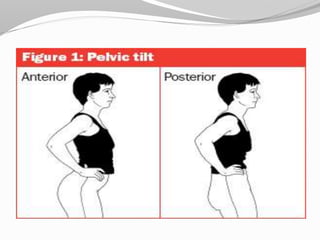
 The pelvic tilt:
 Voluntary control of pelvic tilt teaches patient to
recognise any deviation from normal
 In crook lying trunk is in supported position of alignment
and pelvis is free to move in anterior-posterior direction-
so this position is selected to start with
 Contraction of hip extensors, as to lift the hips off the
floor, and straight abdominal muscles-tilts pelvis
backwards
 Reverse movement by hollowing lumbar spine
 Once ability to adjust pelvic tilt has been learnt it can be
performed in sitting and standing
 1. Crook lying; gluteal and abdominal contraction, followed
by relaxation, then hollowing of back.
 2. Low wing sitting; pelvis tilting and adjustment.
 3 Low wing standing : pelvis tilting and adjustment
 The feet:
 Painless, mobile and strong feet form stable base of
support
 The arches are braced and body weight adjusted so that it
falls through summit of arch
 By str ex for intrinsic foot muscle
 Proper foot wear advice
 If LLD is there than correction by shoe modification.
Complete Picture
 If complete pattern of good posture by above mentioned
protocols, it must be build up gradually and progressively
 Much concentration is required at first but effort and
tension are progressively reduced by repetition and as the
passage of co-ordinating impulses on neuro-muscular
pathway is facilitated
 The new posture becomes habitual and no longer requires
voluntary efforts, it is maintained by conditional reflex
Taping
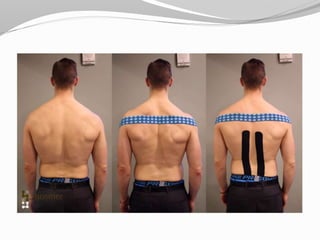
 Taping can correct posture by relieving stress on
overstretched tissues and by guiding soft tissues into a
new position.
 Elastic tape is advocated for use in postural correction
because it does not limit movement entirely and is more
comfortable than rigid tape.
Myofascial Release
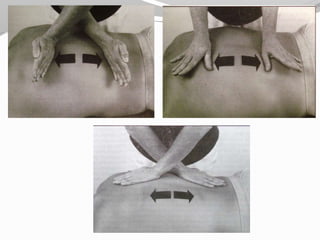
 Tension in fascia restricts movement and may aggravate
abnormal postures.
 Myofascial release is a distinct therapy that acts on fascia
and may be significant in helping to correct posture by
facilitating a more optimal resting position for tissues.
Posture by Dr. Nidhi

Posture by Dr. Nidhi

  • 1.
  • 3.
    Introduction  The posturalalignment starts its development from early period of life with development of the spine and its curvature.  At first ,at birth the spine has C – shaped curve with one convexity and one concavity.  Then , as the child is trying to raise his head ‘from prone lying position cervical curve start to develop and in the early phase of education of walking , another curves are considered as “secondary curve” to the first one which is called “primary curve”.
  • 4.
  • 5.
  • 6.
    POSTURE “Posture is theattitude assumed by the body either with support during muscular inactivity, or by means of coordinated action of many muscles working to maintain stability or form an essential basis which is being adapted constantly to the movement.”  Ligaments, fasciae, bones, joints – inert structures that support the body  Muscles and their tendinous attachments are the dynamic structures that maintain the body in a posture or move it from one posture to another.
  • 7.
    Types of Posture InactivePosture  Muscular activity reduce to a minimum  e.g.. Resting, sleeping. Active Posture  Maintained by integrated action of many muscles  It has two types. static and dynamic posture.
  • 8.
    Inactive posture  Makeminimal demands upon the muscles responsible for the maintainence of essential body functions
  • 9.
    Active Posture Static Posture Pattern of posture is constant.  Body and its segments are aligned and maintained in certain positions  E.g. Standing, kneeling, sitting Dynamic Posture  Pattern of posture is constantly modified  Body and its segments are moving  They form an efficient base for movement  eg. Walking, running, jumping, throwing, lifting
  • 10.
  • 11.
    • Muscles • NervousControl Postural Mechanism
  • 12.
    Muscles  Muscle requirementdepends on static or dynamic posture  Mostly some specific group of muscles are working to maintain erect position, they are working to counteract the effects of gravity.  They are known as Antigravity Muscles usually extensor group of muscles
  • 13.
    The postural muscles Antigravitypostural muscles Slow twitch and fast twitch muscle fiber
  • 14.
    Antigravity Muscle StucturalCharacteristics  Type 1 muscle fibers  Multipennate & fan-shaped-signifies powerful action  Red colour due to rich blood supply-myoglobin content high  Contraction in response to stimulation is slow, but can be sustained for a considerable time without fatigue.  Rate of fatigue- Slow
  • 15.
    Nervous Control  Posturalreflexes are the major component to maintained any kind of posture.  Postures are maintained or adapted as a result of neuromuscular co-ordination, the appropriate muscles being innervated by means of very complex reflex mechanism.
  • 16.
    Postural Reflexes  Reflexis defined by efferent response to afferent stimuli  Afferent stimuli > higher centre > efferent response  The efferent response is a motor one, the anti-gravity muscles being the principal effector organs  Afferent stimuli arise from variety of source all over the body, the most important being situated in the muscles them selves, the eyes & ears
  • 18.
    Receptor Organs Muscles:  Neuromuscular& neurotendinous spindles within muscles record changing action  Increased tension causes stimulation & reflex contraction of muscle i.e. Stretch Reflex Eyes :  Visual sensation record any change in position as per surrodings Joint Structures :  In weight bearing position, approximation of bones stimulates receptors in joint structures which elicit reflex reaction to maintain erect posture Skin sensation also plays a part, especially that of soles of feet, when body is in standing positions
  • 19.
    Ears:  Stimulus ofreceptors of vestibular nerves results from the movements of fluid contained in semicircular canal of internal ear  Each canal lie in different planes any movement of head disturb fluid they contain, and thus knowledge and direction of movement is recorded
  • 20.
  • 21.
    Central Nervous SystemOrgans  Cerebral cortex  Cerebellum  Red nucleus  Vestibular nucleus
  • 22.
    Pattern Of Posture 1.Good posture Good posture is the attitude which, is assumed by body parts to maintain stability and balance with minimum effort and least strain during supportive and non supportive position 2. Poor posture Poor posture is a position resulting from any deviation from ideally aligned erect posture (good posture)
  • 23.
     Patterns ofposture, both static and dynamic, are gradually build up by integration of the many reflexes which together make up the postural reflex.  Some of these component reflexes are inborn and some are conditioned, being developed as the result of constant repetition of posture maintained by voluntary control. Pattern Of Posture
  • 25.
    Good Posture  Postureis said to be good when it fulfills the purpose for which it is used with maximum efficiency and minimum effort.
  • 26.
     As thephysical characteristics of no two people are identical, the precise pattern of good posture must vary with the individual. It is possible, however , to generalize to some extent.  For example, in the erect posture the alignment of specific parts of the body usually leads to perfect balance of one segment upon another, a state which is aesthetically pleasing to the eye.  As dynamic posture involve constant readjustment to maintain the efficiency of posture background throughout the progress of the movement , they are much more difficult to assess.
  • 27.
     In manyactivities however the same alignment of various segments of the body which is satisfactory in the erect posture forms the basis from which these adjustment are made.  For example , in walking or sitting and writing.
  • 28.
    Development of goodposture  Efficient posture develops quite naturally, provided the essential mechanisms for its maintenance and adjustment are intact and healthy.  The chief factors which predispose to the health and development of the muscles and the posture reflex are:- 1. A stable psychological background  Joy, happiness - posture in which position of extension.  Sad, unhappy - in which position of flexion. 2. Good hygienic condition. 3. Opportunity for plenty of natural free movement.
  • 29.
    1. A stablepsychological background:-  Emotion and mental attitude have a profound effect upon the nervous system as a whole , and this is reflected in the posture of the individual.
  • 30.
    2. Good hygieniccondition:  particularly with regard to nutrition and sleep, are essential for a healthy nervous system and for the growth and development of bones and muscles.
  • 31.
    3. The opportunityfor plenty of natural free:  movements also encourage the harmonious development of the skeletal muscles. Activities which are much enjoyed by the normal healthy child at play, for example, running, jumping and climbing ,are those in which movements of active extension predominate.
  • 32.
    Poor posture  Postureis poor when it is inefficient , that is, when it fails to serve the purpose for which it was designed, or if an unnecessary amount of muscular effort is used to maintain it.  Poor alignment of the body segment in the erect positions may lead to the necessity for additional muscle work to maintain balance.  On the other hand, efficient compensation may take place, in which case no additional muscular effort is required , but the attendant ligamentous stain or cramping of thoracic movement are disadvantages which cannot be ignored.
  • 33.
     The purposeof dynamic posture is to serve as an efficient and adaptable background to movement.  Posture patterns which do not fulfil this function impede and reduce the efficiency of the movement and therefore must be considered poor.
  • 34.
    Causes of poorposture  The causes of poor posture are often very obscure, and even if they are known are difficult to remove.  Poor posture may occur due to:- 1. Defects in:  Joints : such as stiffness or immobilization.  Bones :such as shortening or deformity.  Muscle: such as weakness, paralysis or contracture.  Vision or Hearing.
  • 35.
    2. Bad habits:  Either from early childhood or from occupation position . Example for that is the individual that perform jobs which require continuous flexed position of trunk.
  • 36.
    3. pain ,fatigue or bad psychological state.
  • 37.
    Effects of poorposture :  Poor posture causes deviations from the normally aligned posture.  As a result the body function are altered and this may lead to dysfunction and diseases.  Poor posture may cause one or more of following dysfunction: 1. Easy fatigability and high energy expenditure. 2. Decrease both respiratory and circulatory efficiency. 3. Pain , bad cosmetic appearance and psychological disturbances.
  • 38.
    Re-education  The measurewhich can be taken by PT to correct the faulty posture and to train another and more efficient postural pattern depend largely on the cause.  The success of any physical treatment depends on her ability to gain the co-operation of the patient.
  • 39.
    Techniques Of Re-education Good Atmosphere should be established for postural re- education  make patient feel that acquisition of good posture is worth while , efforts will be noticed & appreciated  Individual instructions-as no two patients have identical difficulties  But have much common to learn so group activity enables atmosphere of enjoyment & patient is stimulated by working with others
  • 40.
     Relaxation  MuscleStrengthening Exercise  Muscle Stretching Exercise  Postural corrections  Taping  Myofascial Release
  • 41.
    Procedure to RelievePain from Stress and Muscle Tension  Muscle relaxation techniques  External postural supports such as lumbar pillow  Education: demonstrate relationship of patient’s posture to development of pain  Modalities and massage
  • 42.
    Procedure to increasemobility  the maintenance of normal mobility is essential to enable a wide variety of postures to be assumed.  Normal mobility is maintained by general free exercises which are rhythmical in character and include full-range movement of all joints.  Emphasis is laid on full extension-as it is most liable to limitation  Stretching of tight specific Muscle by manual mechanical or by self stretching exs.
  • 43.
    Exercises to lengthenthe muscles  Muscles that have become short and weak may restrict the normal range of motion in a joint, preventing realignment.  Active stretching that performed only by the client and passive stretching may be of beneficial for correction of posture .
  • 46.
    Postural mal alignmentMuscles need to strengthen Muscles need to stretch Excessive cervical lordosis Anterior neck muscles (Sternocleidomastoid, Scalenes) Upper fibres of trapezius, Levator scapulae Rounded Shoulder Middle and lower fibres of trapezius Shoulder horizontal adductors (Pectoralis major, Pectoralis minor) Excessive thoracic Kyphosis Middle and lower fibres of trapezius Iliocostalis thoracis Pectoralis major, Pectoralis minor & Rectus abdominis Flat back Abdominals Iliocostalis thoracis Excessive lumbar lordosis Abdominals, Hamstrings Gluteus maximus Trunk extensors and hip flexors (Erector spinae group in the lumbar region, Psoas major) Scoliosis Convex side of the curve Concave side of the curve
  • 48.
  • 49.
    Hamstring & calfmuscle stretching Hip flexors stretching
  • 51.
    To train andStrengthen Muscle And to Develop Endurance For Postural Control  Stabilization exs: progress by repetition and challenge with extremity motions, progress to dynamic neck and trunk strengthening exs.
  • 52.
    Procedure to retrainkinaesthetic awareness for postural correction  Reinforcement techniques  Reinforce learning and teach to maintain correct Posture during functional daily activities.  Those who have habitual poor posture often feel uncomfortable and unnatural in any position other than the one to which they have accustomed  A mirror or posture recorder or photographs are useful to compare with image of good posture  Video-tapes also be used
  • 53.
    Postural Correction  Sittingon a stool , the patient relaxes into the fully flexed slouched posture , with the head and chin pro truding .  The patient then smoothly moves in to the erect sitting posture , with the lumbar spine positioned in maximal lordosis and the head retracted and chin pulled in.  The sequence should be repeated several times in a flowing manner.  The patient is thus instructed to move into an extreme of lordosis, but then release the last 10% of the movement.
  • 55.
  • 56.
    Muscular Strength andPosture  The basic principles of working correctly and safely is to plan balanced activity that helps to maintain both muscle strength and flexibility.  Imbalance between groups of antagonist muscles alters the balance of forces exerted on the specific joints and affects their position.  An integral part of therapeutic exercise involves bringing muscles to the appropriate length and strength for maintaining optimal posture and function.
  • 57.
     The AmericanCollege of Sports Medicine (2011) has some evidence-based recommendations for resistance exercise when it is used as part a fitness program for healthy adults; these guidelines can be used as a starting point.
  • 58.
     If thisprocedure is practiced three times daily, ten to fifteen times at each session , in a matter of a few weeks the patient will have re educated their postural habit .
  • 59.
     This isuseful in training dynamic postures in activities such as tennis, diving and lifting-where faulty posture decrease efficiency of movement  Static postures are trained in erect position as people spend most of working hours in upright positions-standing and sitting  In erect posture position of whole is influenced by position of head, pelvic tilt and by state of comfort and position of feet
  • 60.
     Head: anupward thrust of the vertex in the erect positions may be sufficient to  achieve satisfactory alignment of the whole body.  1. Crook lying or lying with feet support; body lengthening.  2. Half lying, sitting or standing; head stretching upwards.
  • 61.
     The pelvictilt:  Voluntary control of pelvic tilt teaches patient to recognise any deviation from normal  In crook lying trunk is in supported position of alignment and pelvis is free to move in anterior-posterior direction- so this position is selected to start with  Contraction of hip extensors, as to lift the hips off the floor, and straight abdominal muscles-tilts pelvis backwards  Reverse movement by hollowing lumbar spine
  • 63.
     Once abilityto adjust pelvic tilt has been learnt it can be performed in sitting and standing  1. Crook lying; gluteal and abdominal contraction, followed by relaxation, then hollowing of back.  2. Low wing sitting; pelvis tilting and adjustment.  3 Low wing standing : pelvis tilting and adjustment
  • 64.
     The feet: Painless, mobile and strong feet form stable base of support  The arches are braced and body weight adjusted so that it falls through summit of arch  By str ex for intrinsic foot muscle  Proper foot wear advice  If LLD is there than correction by shoe modification.
  • 65.
    Complete Picture  Ifcomplete pattern of good posture by above mentioned protocols, it must be build up gradually and progressively  Much concentration is required at first but effort and tension are progressively reduced by repetition and as the passage of co-ordinating impulses on neuro-muscular pathway is facilitated  The new posture becomes habitual and no longer requires voluntary efforts, it is maintained by conditional reflex
  • 66.
    Taping  Taping cancorrect posture by relieving stress on overstretched tissues and by guiding soft tissues into a new position.  Elastic tape is advocated for use in postural correction because it does not limit movement entirely and is more comfortable than rigid tape.
  • 68.
    Myofascial Release  Tensionin fascia restricts movement and may aggravate abnormal postures.  Myofascial release is a distinct therapy that acts on fascia and may be significant in helping to correct posture by facilitating a more optimal resting position for tissues.