Stretching
By: Radhika Chintamani1
Content
*Introduction
*Interventions to increase mobility of the soft tissues
*Stretch Reflex
*Types of stretching
*Effects of stretching
*Response of soft tissue towards stretching
*Determinants
*Guidelines for application of stretching
2
Introduction
*Flexibility: The capacity of joint to move through its full
range of motion.
*Extensibility: Ability to be stretched or increase in length
and return back to its normal length after release of stretch.
*Spasm: An involuntary muscle contractions, which is a
protective phenomenon to avoid pain during movement.
*Tightness: shortening of contractile and non-contractile
elements.
3
*Contracture: adaptive shortening of the muscle-tendon unit
and other soft tissues that cross or surround a joint that
results in significant resistance to passive or active stretch
and limitation of ROM, and it may compromise functional
abilities.
4
Interventions
There are various types of interventions to increase mobility
of the soft tissues. Those are as follows:
*Stretching
*Proprioceptive neuromuscular facilitation
*Muscle Energy Technique
*Neural tissue mobilization
*Transverse friction massage
*Myofascial release
5
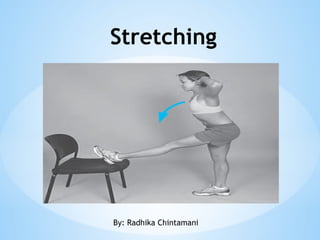
Stretching
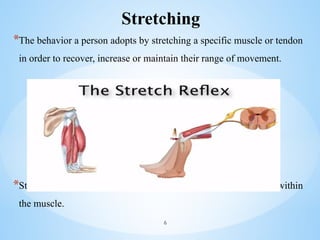
*The behavior a person adopts by stretching a specific muscle or tendon
in order to recover, increase or maintain their range of movement.
*Stretch reflex is a muscle contraction in response to stretching within
the muscle.
6
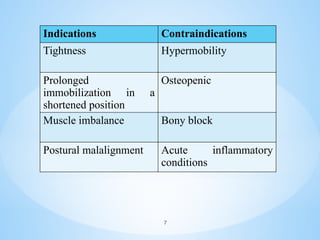
Indications Contraindications
Tightness Hypermobility
Prolonged
immobilization in a
shortened position
Osteopenic
Muscle imbalance Bony block
Postural malalignment Acute inflammatory
conditions
7
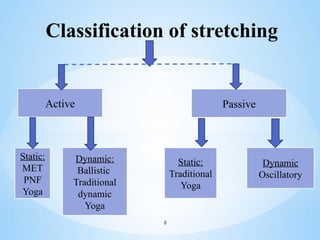
Classification of stretching
Active Passive
Static:
MET
PNF
Yoga
Dynamic:
Ballistic
Traditional
dynamic
Yoga
Static:
Traditional
Yoga
Dynamic
Oscillatory
8
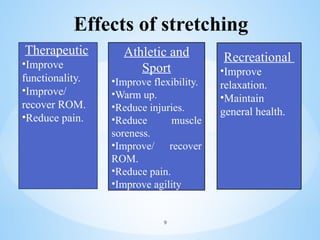
Effects of stretching
Therapeutic
•Improve
functionality.
•Improve/
recover ROM.
•Reduce pain.
Athletic and
Sport
•Improve flexibility.
•Warm up.
•Reduce injuries.
•Reduce muscle
soreness.
•Improve/ recover
ROM.
•Reduce pain.
•Improve agility
Recreational
•Improve
relaxation.
•Maintain
general health.
9
Mechanical Properties of soft
tissue
Elasticity
Viscoelasticity
Plasticity
Both contractile and noncontractile tissues have elastic and
plastic qualities; however, only connective tissues, not the
contractile elements of muscle, have viscoelastic properties.
10
11
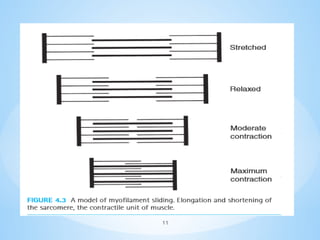
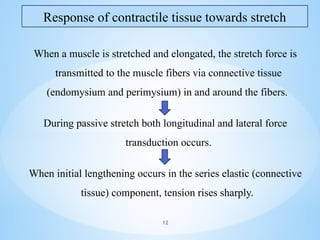
When a muscle is stretched and elongated, the stretch force is
transmitted to the muscle fibers via connective tissue
(endomysium and perimysium) in and around the fibers.
During passive stretch both longitudinal and lateral force
transduction occurs.
When initial lengthening occurs in the series elastic (connective
tissue) component, tension rises sharply.
Response of contractile tissue towards stretch
12
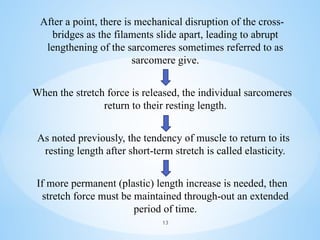
After a point, there is mechanical disruption of the cross-
bridges as the filaments slide apart, leading to abrupt
lengthening of the sarcomeres sometimes referred to as
sarcomere give.
When the stretch force is released, the individual sarcomeres
return to their resting length.
As noted previously, the tendency of muscle to return to its
resting length after short-term stretch is called elasticity.
If more permanent (plastic) length increase is needed, then
stretch force must be maintained through-out an extended
period of time.
13
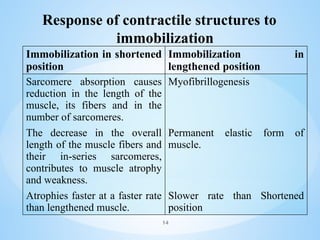
Response of contractile structures to
immobilization
Immobilization in shortened
position
Immobilization in
lengthened position
Sarcomere absorption causes
reduction in the length of the
muscle, its fibers and in the
number of sarcomeres.
The decrease in the overall
length of the muscle fibers and
their in-series sarcomeres,
contributes to muscle atrophy
and weakness.
Atrophies faster at a faster rate
than lengthened muscle.
Myofibrillogenesis
Permanent elastic form of
muscle.
Slower rate than Shortened
position
14
Decreased muscle capacity
to produce maximum
tension at its normal
resting length as it
contracts.
Decreased extensibility.
______________________
___
____________________
15
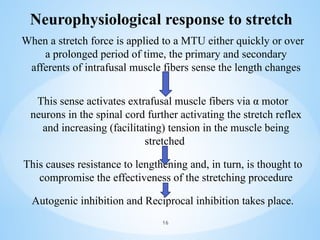
Neurophysiological response to stretch
When a stretch force is applied to a MTU either quickly or over
a prolonged period of time, the primary and secondary
afferents of intrafusal muscle fibers sense the length changes
This sense activates extrafusal muscle fibers via α motor
neurons in the spinal cord further activating the stretch reflex
and increasing (facilitating) tension in the muscle being
stretched
This causes resistance to lengthening and, in turn, is thought to
compromise the effectiveness of the stretching procedure
Autogenic inhibition and Reciprocal inhibition takes place.
16
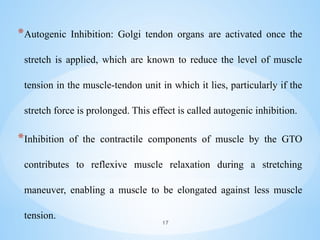
*Autogenic Inhibition: Golgi tendon organs are activated once the
stretch is applied, which are known to reduce the level of muscle
tension in the muscle-tendon unit in which it lies, particularly if the
stretch force is prolonged. This effect is called autogenic inhibition.
*Inhibition of the contractile components of muscle by the GTO
contributes to reflexive muscle relaxation during a stretching
maneuver, enabling a muscle to be elongated against less muscle
tension.
17
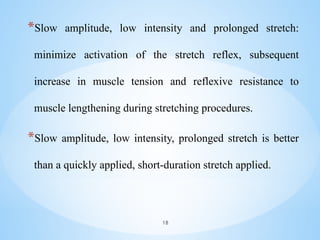
*Slow amplitude, low intensity and prolonged stretch:
minimize activation of the stretch reflex, subsequent
increase in muscle tension and reflexive resistance to
muscle lengthening during stretching procedures.
*Slow amplitude, low intensity, prolonged stretch is better
than a quickly applied, short-duration stretch applied.
18
*It is thought that if a low-intensity, slow stretch force is
applied to muscle, the stretch reflex is less likely to be
activated as the GTO fires and inhibits tension in the muscle,
allowing the parallel elastic component (the sarcomeres) of
the muscle to remain relaxed and to lengthen.
19
Cyclic loading
*Repetitive loading of tissue increases heat production and may
cause failure below the yield point.
*The greater the applied load, the fewer number of cycles
needed for failure. This principle can be used for stretching by
applying repetitive (cyclic) loads at a submaximal level on
successive days.
*The intensity of the load is determined by the patient’s
tolerance. A minimum load is required for this failure.
20
*Below the minimum load an apparently infinite number of
cycles do not cause failure. This is the endurance limit.
*Rest interval is allowed between bouts of cyclic stretching
to allow for remodeling and healing in the new range.
21
Mechanical principles for stretching
the connective tissues
*Connective tissue deformation : occurs to different degrees at
different intensities of force. It requires breaking of collagen
bonds and realignment of the fibers for there to be permanent
elongation or increased flexibility
*Healing and adaptive remodeling: capabilities allow the tissue
to respond to repetitive and sustained loads if time is allowed
between bouts. This is important for increasing both
flexibility and tensile strength of the tissue.
*Eventual return of shortened length: use any newly gained
range to allow the remodeling of tissue and to train the
muscle to control the new range,
22
Determinants
*Alignment: positioning a limb or the body such that the stretch
force is directed to the appropriate muscle group
*Stabilization: fixation of one site of attachment of the muscle as
the stretch force is applied to the other bony attachment
*Intensity of stretch: magnitude of the stretch force applied
*Duration of stretch: length of time the stretch force is applied
during a stretch cycle
*Speed of stretch: speed of initial application of the stretch force
*Frequency of stretch: number of stretching sessions per day or
per week.
*Mode of stretch: form or manner in which the stretch force is
applied (static, ballistic, cyclic); degree of patient participation
(passive, active); source of the stretch force (manual,
mechanical, self). 23
Principle Guidelines for Stretching
*Initial assessment of patient: muscle length tests, ROM,
muscle strength etc.
*Preparation for stretching: selecting the type of stretch, warm
up, position of patient and therapist.
*Application of stretch technique: grasp, stabilize, align, all
other determinants.
*After stretch protocol: application of cryotherapy,
performance of active ROM post-stretching and
strengthening protocol.
24
Precautions
*No forcing beyond normal ROM.
*Extra caution in osteoporotic subjects.
*Avoid vigorous stretching procedures.
*Progressive dosage.
*Avoid stretching edematous soft tissues.
*Avoid overstretching weak muscles.
25
Thank
You
26

Stretching

  • 1.
  • 2.
    Content *Introduction *Interventions to increasemobility of the soft tissues *Stretch Reflex *Types of stretching *Effects of stretching *Response of soft tissue towards stretching *Determinants *Guidelines for application of stretching 2
  • 3.
    Introduction *Flexibility: The capacityof joint to move through its full range of motion. *Extensibility: Ability to be stretched or increase in length and return back to its normal length after release of stretch. *Spasm: An involuntary muscle contractions, which is a protective phenomenon to avoid pain during movement. *Tightness: shortening of contractile and non-contractile elements. 3
  • 4.
    *Contracture: adaptive shorteningof the muscle-tendon unit and other soft tissues that cross or surround a joint that results in significant resistance to passive or active stretch and limitation of ROM, and it may compromise functional abilities. 4
  • 5.
    Interventions There are varioustypes of interventions to increase mobility of the soft tissues. Those are as follows: *Stretching *Proprioceptive neuromuscular facilitation *Muscle Energy Technique *Neural tissue mobilization *Transverse friction massage *Myofascial release 5
  • 6.
    Stretching *The behavior aperson adopts by stretching a specific muscle or tendon in order to recover, increase or maintain their range of movement. *Stretch reflex is a muscle contraction in response to stretching within the muscle. 6
  • 7.
    Indications Contraindications Tightness Hypermobility Prolonged immobilizationin a shortened position Osteopenic Muscle imbalance Bony block Postural malalignment Acute inflammatory conditions 7
  • 8.
    Classification of stretching ActivePassive Static: MET PNF Yoga Dynamic: Ballistic Traditional dynamic Yoga Static: Traditional Yoga Dynamic Oscillatory 8
  • 9.
    Effects of stretching Therapeutic •Improve functionality. •Improve/ recoverROM. •Reduce pain. Athletic and Sport •Improve flexibility. •Warm up. •Reduce injuries. •Reduce muscle soreness. •Improve/ recover ROM. •Reduce pain. •Improve agility Recreational •Improve relaxation. •Maintain general health. 9
  • 10.
    Mechanical Properties ofsoft tissue Elasticity Viscoelasticity Plasticity Both contractile and noncontractile tissues have elastic and plastic qualities; however, only connective tissues, not the contractile elements of muscle, have viscoelastic properties. 10
  • 11.
  • 12.
    When a muscleis stretched and elongated, the stretch force is transmitted to the muscle fibers via connective tissue (endomysium and perimysium) in and around the fibers. During passive stretch both longitudinal and lateral force transduction occurs. When initial lengthening occurs in the series elastic (connective tissue) component, tension rises sharply. Response of contractile tissue towards stretch 12
  • 13.
    After a point,there is mechanical disruption of the cross- bridges as the filaments slide apart, leading to abrupt lengthening of the sarcomeres sometimes referred to as sarcomere give. When the stretch force is released, the individual sarcomeres return to their resting length. As noted previously, the tendency of muscle to return to its resting length after short-term stretch is called elasticity. If more permanent (plastic) length increase is needed, then stretch force must be maintained through-out an extended period of time. 13
  • 14.
    Response of contractilestructures to immobilization Immobilization in shortened position Immobilization in lengthened position Sarcomere absorption causes reduction in the length of the muscle, its fibers and in the number of sarcomeres. The decrease in the overall length of the muscle fibers and their in-series sarcomeres, contributes to muscle atrophy and weakness. Atrophies faster at a faster rate than lengthened muscle. Myofibrillogenesis Permanent elastic form of muscle. Slower rate than Shortened position 14
  • 15.
    Decreased muscle capacity toproduce maximum tension at its normal resting length as it contracts. Decreased extensibility. ______________________ ___ ____________________ 15
  • 16.
    Neurophysiological response tostretch When a stretch force is applied to a MTU either quickly or over a prolonged period of time, the primary and secondary afferents of intrafusal muscle fibers sense the length changes This sense activates extrafusal muscle fibers via α motor neurons in the spinal cord further activating the stretch reflex and increasing (facilitating) tension in the muscle being stretched This causes resistance to lengthening and, in turn, is thought to compromise the effectiveness of the stretching procedure Autogenic inhibition and Reciprocal inhibition takes place. 16
  • 17.
    *Autogenic Inhibition: Golgitendon organs are activated once the stretch is applied, which are known to reduce the level of muscle tension in the muscle-tendon unit in which it lies, particularly if the stretch force is prolonged. This effect is called autogenic inhibition. *Inhibition of the contractile components of muscle by the GTO contributes to reflexive muscle relaxation during a stretching maneuver, enabling a muscle to be elongated against less muscle tension. 17
  • 18.
    *Slow amplitude, lowintensity and prolonged stretch: minimize activation of the stretch reflex, subsequent increase in muscle tension and reflexive resistance to muscle lengthening during stretching procedures. *Slow amplitude, low intensity, prolonged stretch is better than a quickly applied, short-duration stretch applied. 18
  • 19.
    *It is thoughtthat if a low-intensity, slow stretch force is applied to muscle, the stretch reflex is less likely to be activated as the GTO fires and inhibits tension in the muscle, allowing the parallel elastic component (the sarcomeres) of the muscle to remain relaxed and to lengthen. 19
  • 20.
    Cyclic loading *Repetitive loadingof tissue increases heat production and may cause failure below the yield point. *The greater the applied load, the fewer number of cycles needed for failure. This principle can be used for stretching by applying repetitive (cyclic) loads at a submaximal level on successive days. *The intensity of the load is determined by the patient’s tolerance. A minimum load is required for this failure. 20
  • 21.
    *Below the minimumload an apparently infinite number of cycles do not cause failure. This is the endurance limit. *Rest interval is allowed between bouts of cyclic stretching to allow for remodeling and healing in the new range. 21
  • 22.
    Mechanical principles forstretching the connective tissues *Connective tissue deformation : occurs to different degrees at different intensities of force. It requires breaking of collagen bonds and realignment of the fibers for there to be permanent elongation or increased flexibility *Healing and adaptive remodeling: capabilities allow the tissue to respond to repetitive and sustained loads if time is allowed between bouts. This is important for increasing both flexibility and tensile strength of the tissue. *Eventual return of shortened length: use any newly gained range to allow the remodeling of tissue and to train the muscle to control the new range, 22
  • 23.
    Determinants *Alignment: positioning alimb or the body such that the stretch force is directed to the appropriate muscle group *Stabilization: fixation of one site of attachment of the muscle as the stretch force is applied to the other bony attachment *Intensity of stretch: magnitude of the stretch force applied *Duration of stretch: length of time the stretch force is applied during a stretch cycle *Speed of stretch: speed of initial application of the stretch force *Frequency of stretch: number of stretching sessions per day or per week. *Mode of stretch: form or manner in which the stretch force is applied (static, ballistic, cyclic); degree of patient participation (passive, active); source of the stretch force (manual, mechanical, self). 23
  • 24.
    Principle Guidelines forStretching *Initial assessment of patient: muscle length tests, ROM, muscle strength etc. *Preparation for stretching: selecting the type of stretch, warm up, position of patient and therapist. *Application of stretch technique: grasp, stabilize, align, all other determinants. *After stretch protocol: application of cryotherapy, performance of active ROM post-stretching and strengthening protocol. 24
  • 25.
    Precautions *No forcing beyondnormal ROM. *Extra caution in osteoporotic subjects. *Avoid vigorous stretching procedures. *Progressive dosage. *Avoid stretching edematous soft tissues. *Avoid overstretching weak muscles. 25
  • 26.