STRETCHING
VIVEK PATEL, MPT
• Application of force to musculo-tendinous structure to achieve a change in their length, usually for
the purposes of improving joint ROM, reducing stiffness or soreness, or preparing for activity.
• lengthened position for a prescribed period of time.
TERMS RELATED TO
MOBILITY AND STRETCHING
• Flexibility
Ability to move a single joint or series of
joints smoothly and easily through an
unrestricted, pain-free ROM.
1. Dynamic flexibility – active mobility
or active ROM
2. Passive flexibility – passive mobility or
passive ROM
• Hypomobility – Adaptive shortening of soft tissues
1. Prolonged immobilization – extrinsic / intrinsic
2. sedentary lifestyle
3. postural malalignment and muscle imbalances
4. impaired muscle performance (weakness)
5. tissue trauma resulting in inflammation and pain
6. congenital or acquired deformities
7. UMN
Contracture
• Adaptive shortening of the muscle-tendon unit and other soft tissues that cross or surround a
joint that results in significant resistance to passive or active stretch and limitation of ROM, and
it may compromise functional abilities.
 Types of Contracture
• Myostatic Contracture
• PseudoMyostatic Contracture
• Arthrogenic and Periarticular
• Fibrotic Contracture and Irreversible Contracture
• Muscle spasm—prolonged muscle contraction in response to circulatory and metabolic
changes.
• Muscle spasticity—increased tone and contraction in muscle in response to central
nervous system influences.
•Spasticity - damaged motor neurons to regulate descending pathways
gives rise to disordered spinal reflexes, increased excitability of muscle
spindles, and decreased synaptic inhibition
• Uni- directional, and is velocity and amplitude dependent.
•Rigidity - Bi-directional, and is non velocity or amplitude dependent.
• Velocity independent – does not vary with speed of movement of muscle groups involved
Why do we need flexibility?
Range of Motion
 Static Flexibility – passive movement; range of possible movement
around a joint; no muscle activity- a person/machine/gravity provides the
force to stretch the muscle
 Dynamic Flexibility - active movement; voluntary muscle actions to gain
flexibility
Flexibility
Factors That Influence Flexibility
• Genetics
• Joint Structure (shoulder, knee)
• Sedentary living
• Soft Body Tissue
• Muscle, connective, fat, scar
• Pregnancy
Factors
affecting
flexibility
Muscle temperature: affects the muscle’s stretch
beyond it’s normal elasticity
Age: adults tend to lose the elastic properties and
without a flexibility program the muscle tissue
isn’t as compliant to stretch
Gender: females tend to be more flexible than
males
Tissue interference: body fat or musculature can
create joint limitations
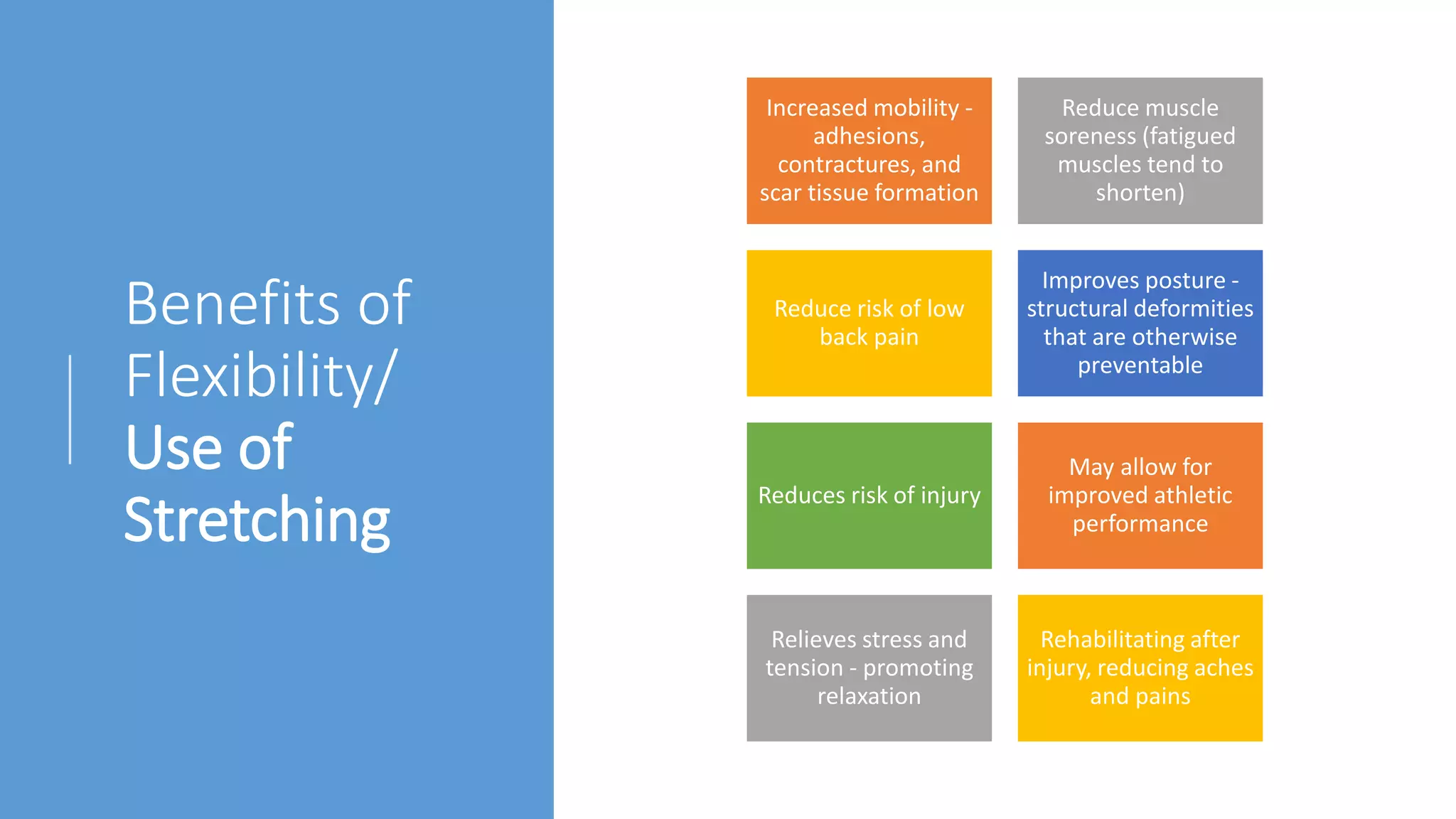
Benefits of
Flexibility/
Use of
Stretching
Increased mobility -
adhesions,
contractures, and
scar tissue formation
Reduce muscle
soreness (fatigued
muscles tend to
shorten)
Reduce risk of low
back pain
Improves posture -
structural deformities
that are otherwise
preventable
Reduces risk of injury
May allow for
improved athletic
performance
Relieves stress and
tension - promoting
relaxation
Rehabilitating after
injury, reducing aches
and pains
Maintains and Improves Range of
Motion
• ADL
• Restricted knee flexion/plantar flexor
tightness
• Range-challenging sport
• Flexibility perspective - ballet, martial arts,
or gymnastics
Prevention of Injuries
Little evidence – alone stretching
Athletes with restricted ROM
Workplace stretching programs
Injury Rehabilitation
• Acute / chronic
• Pain, inflammation, and scar tissue formation loss of motion, strength, and
function.
• limiting excessive or inappropriate scar tissue formation
• effects at the cellular level - appropriate stage of healing
• cell proliferation,
• Differentiation
• matrix formation
Posture
• shortened or contracted muscles
• Pectorals – hamstrings
Counteracts Sedentary Lifestyle
• Computer work - chronic neck, shoulder, and back
Relaxation
• stimulation of the stretch receptors in muscle, tendon, and ligament tissue
Treatment and Prevention of Lower Back
Pain
• Shortened muscles affect the resting and functioning positions of the spine.
•Reduces Age-related Declines in Health and
Fitness
• Stiffening of connective tissues such as cartilage, ligaments, and tendons.
CONTRAINDICATIO
N OF STRETCHING
Pre-activity to Prevent Injury - decrease performance in a number of
tasks
Bony block
Recent fracture/ Incomplete bony union / An acute inflammatory or
infectious process
Existing Hypermobility
Shortened soft tissues improve function
DETERMINAN
TS, TYPES,
AND EFFECTS
OF
STRETCHING
INTERVENTIO
NS
Alignment and Stabilization
Intensity of Stretch
Duration of Stretch
Speed of Stretch
Frequency of Stretch
Mode of Stretch
Types of stretching
• Static: slow sustained stretch for 10-30 sec.
• Dynamic / Ballistic: bouncy stretch reserved for those involved in
sports that require quick movements
• Active: the person stretching provides the force of stretch
• Passive: a partner provides the force of the stretch
• PNF: combination of active/passive stretch usually with a partner or
some kind of ‘aid’
• Muscle energy technique
Static Stretching (Slow
Sustained Stretching)
Most common
Most often recommended
Associated with limited muscle soreness
May help reduce muscle soreness
Associated with little risk of injury
Static Stretching
Cont’d
Stretch the
muscle to the
point of slight
or mild
discomfort
(overload)
Hold each
stretch for 10
to 30 seconds
Repeat the
stretch 4 times
Flexibility
exercise
sessions should
occur 3 to 5
times per week
Dynamic /
Ballistic
Stretching
Most dangerous of the stretching procedures
Involves the use of repetitive, bouncing.
Virtually abandoned
May lead to soreness and muscle injury
Do not confuse dynamic stretching with ballistic stretching.
Dynamic stretching is slow, gentle, and very purposeful.
Active Stretching
Without any aid or assistance from an external force.
Stretching involves using only the strength of the opposing muscles
(antagonists) to generate a stretch within the targeted muscle group
(agonists).
Useful as a rehabilitation tool and a very effective form of conditioning
before moving on to dynamic stretching exercises
Passive (or Assisted) Stretching
Similar to static stretching; however, another person or apparatus is
used
Greater force applied to the muscle, slightly more hazardous.
Apparatus used is both solid and stable
No jerky or bouncing force - Safety of the muscles and joints
Helping to attain a greater range of movement
MECHANICS OF STRETCHING
1. Tissues Involved in Stretching
• bones, muscles ligaments, skin, fascia, fat, and vascular, lymphatic, and nervous
tissues.
• primarily the fascial component of the muscle-tendon unit
2. Possible Mechanisms Contributing to Tissue
Lengthening
• HYPERPLASIA
• PLASTIC DEFORMATION
• elastic, viscoelastic, and plastic properties
• OTHER POSSIBLE MECHANISMS
• Tolerance to stretch, decreased muscular stiffness, and decreases in
neuromuscular tone
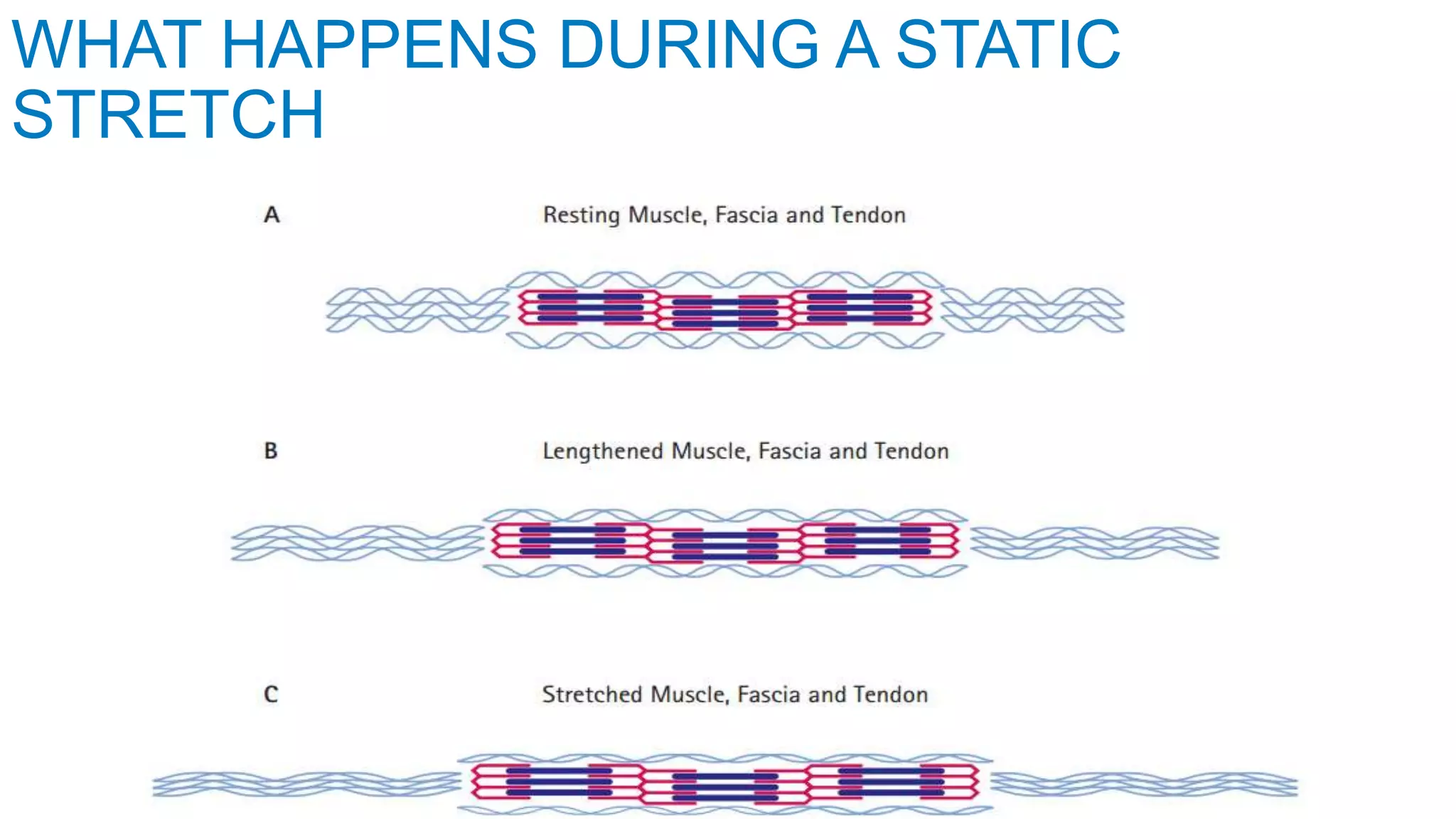
WHAT HAPPENS DURING A STATIC
STRETCH
• Holding a stretch with sufficient force – Golgi tendon organ (GTO), by
overriding the input of the muscle spindles
Factors affecting flexibility of the tissue
• Tissue water content
• Tissue chemical structure
• Relation between collagen and elastic fibers
• Complex matrix structure of connective
tissue fibers
• Structures between and that bind together
connective tissue fibers
• Amount and direction of
connective tissue fibers
• Extent of fibers running
transverse to each other
• Relation between slow
and fast muscle fibers
• Shape of muscles.
ADJUNCTS TO
STRETCHING
INTERVENTIO
NS
Relaxation Training
Heat
Massage
Biofeedback
Joint Traction or Oscillation
PHYSIOTHERAPY
TREATMENTS PRIOR
TO STRETCHING
SUPERFICIAL HEAT
Heat lamps, hot
packs, paraffin, clay,
hydrotherapy,
and sauna to
broader areas of the
body.
DEEP HEAT
TREATMENTS
Ultrasound (US),
shortwave
diathermy
(SWD) and
microwave
diathermy (MWD).
Cold
Treatments
Decreases the speed of neuron conductivity
Reducing inflammation and swelling.
Increases in length were best maintained
Effectively in cases where stretching has become
impossible due to intense pain
Fibrous Adhesions
MASSAGE
VIBRATION
Proprioceptive
Neuromuscular
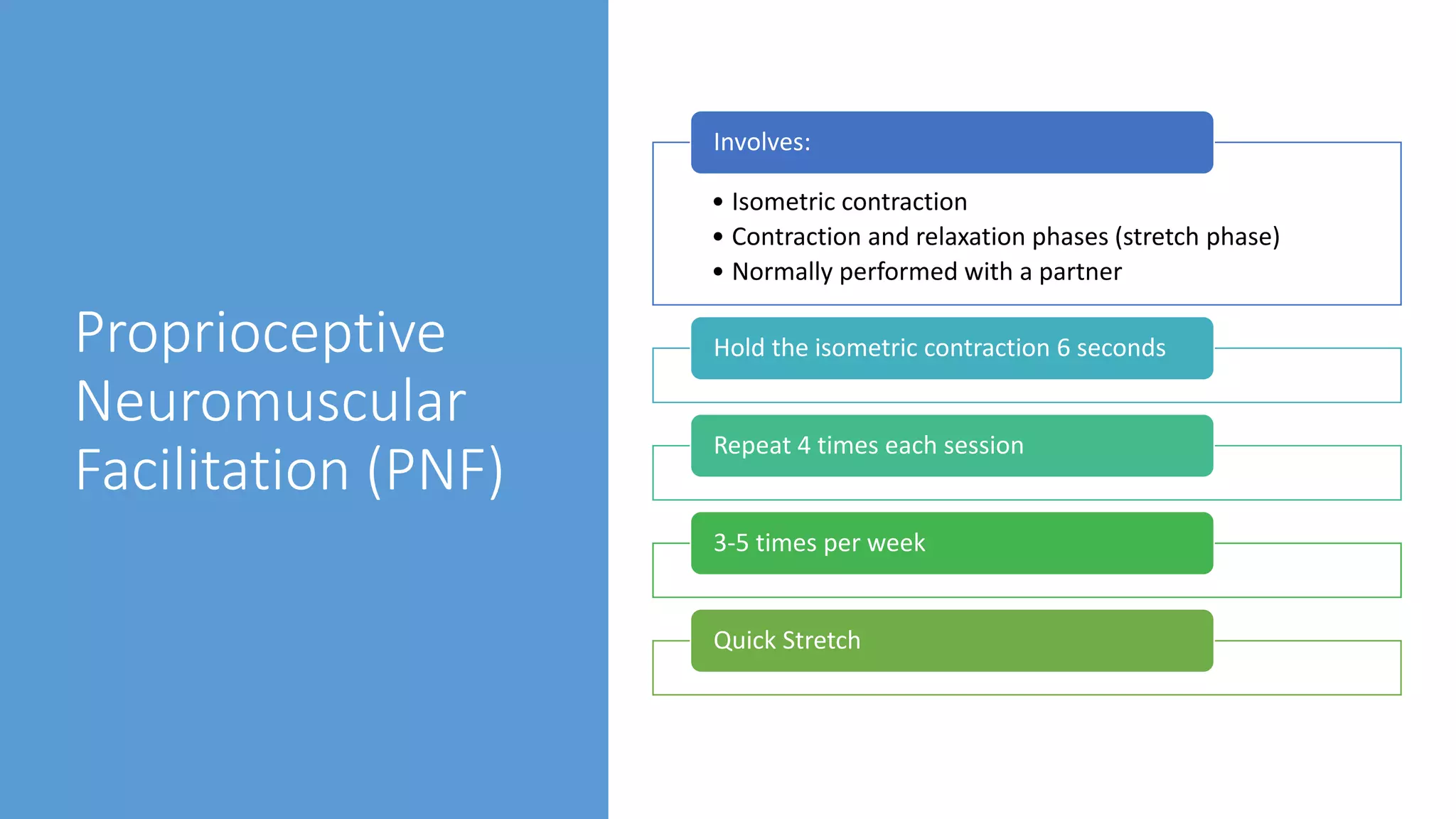
Facilitation (PNF)
• Isometric contraction
• Contraction and relaxation phases (stretch phase)
• Normally performed with a partner
Involves:
Hold the isometric contraction 6 seconds
Repeat 4 times each session
3-5 times per week
Quick Stretch
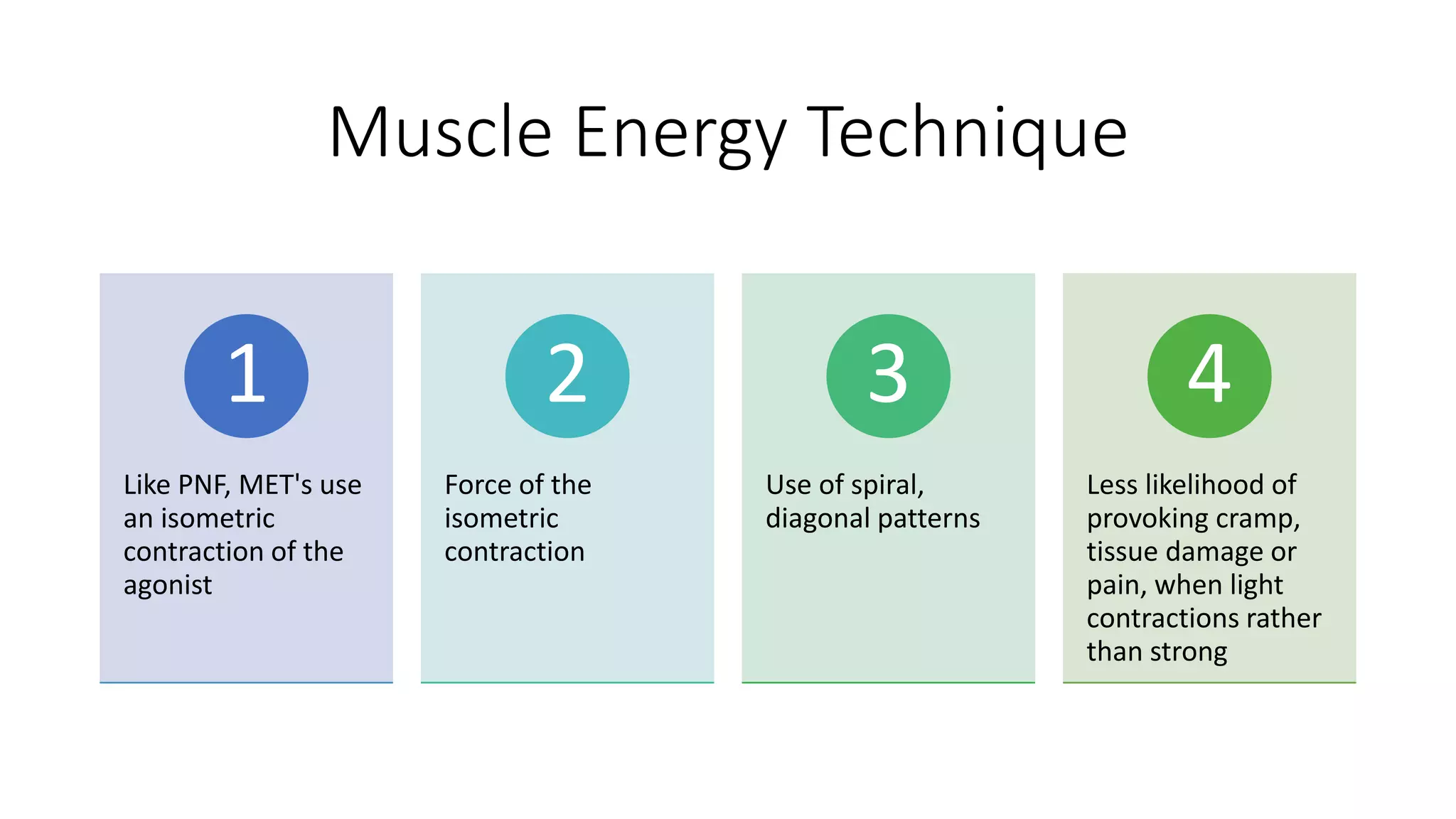
Muscle Energy Technique
Like PNF, MET's use
an isometric
contraction of the
agonist
1
Force of the
isometric
contraction
2
Use of spiral,
diagonal patterns
3
Less likelihood of
provoking cramp,
tissue damage or
pain, when light
contractions rather
than strong
4
Proprioceptors and Stretching
Autogenic inhibition vs reciprocal inhibition
GTO
Muscle Spindle and Stretch Reflex – sudden rapid stretch tells the muscle to
respond with a stretch reflex and contract the muscle which will decrease the
amount of stretch; Ballistic stretching causes this so you want to static stretch
Level I
• Hold the stretching position for 5 to 10 seconds.
• Rest for 5 to 10 seconds between each stretch.
• Repeat each stretch two times.
• Use an intensity level on the scale from 1 to 3, with light pain.
• Duration is 15 to 20 minutes each session.
• Stretch two or three times per week.
Level II
• Hold the stretching position for 10 to 15 seconds.
• Rest for 10 to 15 seconds between each stretch.
• Repeat each stretch three times.
• Use an intensity level on the scale from 2 to 4, with light to moderate pain, one
or two times per week.
• Use an intensity level on the scale from 1 to 2, one or two times per week.
• Duration is 20 to 30 minutes each session.
• Stretch three or four times per week.
Level III
• Hold the stretching position for 15 to 20 seconds.
• Rest for 15 to 20 seconds between each stretch.
• Repeat each stretch four times.
• Use an intensity level on the scale from 4 to 6, with moderate pain, two or three
times per week.
• Use an intensity level on the scale from 1 to 4, two or three times per week.
• Duration is 30 to 40 minutes each session.
• Stretch four or five times per week.
Level IV
• Hold the stretching position for 20 to 25 seconds.
• Rest for 20 to 25 seconds between each stretch.
• Repeat each stretch five times.
• Use an intensity level on the scale from 6 to 8, with moderate to heavy pain, two
or three times per week.
• Use an intensity level on the scale from 1 to 6, two or three times per week.
• Duration is 40 to 50 minutes each session.
• Stretch four or five times per week.
Level V
• Hold the stretching position for 25 to 30 seconds.
• Rest for 25 to 30 seconds between each stretch.
• Repeat each stretch five or six times.
• Use an intensity level on the scale from 8 to 10, with heavy pain, two or three
times per week.
• Use an intensity level on the scale from 1 to 8, two or three times per week.
• Duration is 50 to 60 minutes each session.
• Stretch four or five times per week.

Stretching.pptx

  • 1.
  • 2.
    • Application offorce to musculo-tendinous structure to achieve a change in their length, usually for the purposes of improving joint ROM, reducing stiffness or soreness, or preparing for activity. • lengthened position for a prescribed period of time.
  • 4.
    TERMS RELATED TO MOBILITYAND STRETCHING • Flexibility Ability to move a single joint or series of joints smoothly and easily through an unrestricted, pain-free ROM. 1. Dynamic flexibility – active mobility or active ROM 2. Passive flexibility – passive mobility or passive ROM
  • 5.
    • Hypomobility –Adaptive shortening of soft tissues 1. Prolonged immobilization – extrinsic / intrinsic 2. sedentary lifestyle 3. postural malalignment and muscle imbalances 4. impaired muscle performance (weakness) 5. tissue trauma resulting in inflammation and pain 6. congenital or acquired deformities 7. UMN
  • 6.
    Contracture • Adaptive shorteningof the muscle-tendon unit and other soft tissues that cross or surround a joint that results in significant resistance to passive or active stretch and limitation of ROM, and it may compromise functional abilities.  Types of Contracture • Myostatic Contracture • PseudoMyostatic Contracture • Arthrogenic and Periarticular • Fibrotic Contracture and Irreversible Contracture
  • 7.
    • Muscle spasm—prolongedmuscle contraction in response to circulatory and metabolic changes. • Muscle spasticity—increased tone and contraction in muscle in response to central nervous system influences. •Spasticity - damaged motor neurons to regulate descending pathways gives rise to disordered spinal reflexes, increased excitability of muscle spindles, and decreased synaptic inhibition • Uni- directional, and is velocity and amplitude dependent. •Rigidity - Bi-directional, and is non velocity or amplitude dependent. • Velocity independent – does not vary with speed of movement of muscle groups involved
  • 8.
    Why do weneed flexibility? Range of Motion  Static Flexibility – passive movement; range of possible movement around a joint; no muscle activity- a person/machine/gravity provides the force to stretch the muscle  Dynamic Flexibility - active movement; voluntary muscle actions to gain flexibility Flexibility
  • 9.
    Factors That InfluenceFlexibility • Genetics • Joint Structure (shoulder, knee) • Sedentary living • Soft Body Tissue • Muscle, connective, fat, scar • Pregnancy
  • 10.
    Factors affecting flexibility Muscle temperature: affectsthe muscle’s stretch beyond it’s normal elasticity Age: adults tend to lose the elastic properties and without a flexibility program the muscle tissue isn’t as compliant to stretch Gender: females tend to be more flexible than males Tissue interference: body fat or musculature can create joint limitations
  • 11.
    Benefits of Flexibility/ Use of Stretching Increasedmobility - adhesions, contractures, and scar tissue formation Reduce muscle soreness (fatigued muscles tend to shorten) Reduce risk of low back pain Improves posture - structural deformities that are otherwise preventable Reduces risk of injury May allow for improved athletic performance Relieves stress and tension - promoting relaxation Rehabilitating after injury, reducing aches and pains
  • 12.
    Maintains and ImprovesRange of Motion • ADL • Restricted knee flexion/plantar flexor tightness • Range-challenging sport • Flexibility perspective - ballet, martial arts, or gymnastics
  • 13.
    Prevention of Injuries Littleevidence – alone stretching Athletes with restricted ROM Workplace stretching programs
  • 14.
    Injury Rehabilitation • Acute/ chronic • Pain, inflammation, and scar tissue formation loss of motion, strength, and function. • limiting excessive or inappropriate scar tissue formation • effects at the cellular level - appropriate stage of healing • cell proliferation, • Differentiation • matrix formation
  • 15.
    Posture • shortened orcontracted muscles • Pectorals – hamstrings Counteracts Sedentary Lifestyle • Computer work - chronic neck, shoulder, and back Relaxation • stimulation of the stretch receptors in muscle, tendon, and ligament tissue
  • 16.
    Treatment and Preventionof Lower Back Pain • Shortened muscles affect the resting and functioning positions of the spine. •Reduces Age-related Declines in Health and Fitness • Stiffening of connective tissues such as cartilage, ligaments, and tendons.
  • 17.
    CONTRAINDICATIO N OF STRETCHING Pre-activityto Prevent Injury - decrease performance in a number of tasks Bony block Recent fracture/ Incomplete bony union / An acute inflammatory or infectious process Existing Hypermobility Shortened soft tissues improve function
  • 18.
    DETERMINAN TS, TYPES, AND EFFECTS OF STRETCHING INTERVENTIO NS Alignmentand Stabilization Intensity of Stretch Duration of Stretch Speed of Stretch Frequency of Stretch Mode of Stretch
  • 19.
    Types of stretching •Static: slow sustained stretch for 10-30 sec. • Dynamic / Ballistic: bouncy stretch reserved for those involved in sports that require quick movements • Active: the person stretching provides the force of stretch • Passive: a partner provides the force of the stretch • PNF: combination of active/passive stretch usually with a partner or some kind of ‘aid’ • Muscle energy technique
  • 20.
    Static Stretching (Slow SustainedStretching) Most common Most often recommended Associated with limited muscle soreness May help reduce muscle soreness Associated with little risk of injury
  • 21.
    Static Stretching Cont’d Stretch the muscleto the point of slight or mild discomfort (overload) Hold each stretch for 10 to 30 seconds Repeat the stretch 4 times Flexibility exercise sessions should occur 3 to 5 times per week
  • 22.
    Dynamic / Ballistic Stretching Most dangerousof the stretching procedures Involves the use of repetitive, bouncing. Virtually abandoned May lead to soreness and muscle injury Do not confuse dynamic stretching with ballistic stretching. Dynamic stretching is slow, gentle, and very purposeful.
  • 23.
    Active Stretching Without anyaid or assistance from an external force. Stretching involves using only the strength of the opposing muscles (antagonists) to generate a stretch within the targeted muscle group (agonists). Useful as a rehabilitation tool and a very effective form of conditioning before moving on to dynamic stretching exercises
  • 24.
    Passive (or Assisted)Stretching Similar to static stretching; however, another person or apparatus is used Greater force applied to the muscle, slightly more hazardous. Apparatus used is both solid and stable No jerky or bouncing force - Safety of the muscles and joints Helping to attain a greater range of movement
  • 25.
    MECHANICS OF STRETCHING 1.Tissues Involved in Stretching • bones, muscles ligaments, skin, fascia, fat, and vascular, lymphatic, and nervous tissues. • primarily the fascial component of the muscle-tendon unit
  • 26.
    2. Possible MechanismsContributing to Tissue Lengthening • HYPERPLASIA • PLASTIC DEFORMATION • elastic, viscoelastic, and plastic properties • OTHER POSSIBLE MECHANISMS • Tolerance to stretch, decreased muscular stiffness, and decreases in neuromuscular tone
  • 27.
    WHAT HAPPENS DURINGA STATIC STRETCH
  • 28.
    • Holding astretch with sufficient force – Golgi tendon organ (GTO), by overriding the input of the muscle spindles
  • 29.
    Factors affecting flexibilityof the tissue • Tissue water content • Tissue chemical structure • Relation between collagen and elastic fibers • Complex matrix structure of connective tissue fibers • Structures between and that bind together connective tissue fibers
  • 30.
    • Amount anddirection of connective tissue fibers • Extent of fibers running transverse to each other • Relation between slow and fast muscle fibers • Shape of muscles.
  • 31.
  • 32.
    PHYSIOTHERAPY TREATMENTS PRIOR TO STRETCHING SUPERFICIALHEAT Heat lamps, hot packs, paraffin, clay, hydrotherapy, and sauna to broader areas of the body. DEEP HEAT TREATMENTS Ultrasound (US), shortwave diathermy (SWD) and microwave diathermy (MWD).
  • 33.
    Cold Treatments Decreases the speedof neuron conductivity Reducing inflammation and swelling. Increases in length were best maintained Effectively in cases where stretching has become impossible due to intense pain Fibrous Adhesions MASSAGE VIBRATION
  • 34.
    Proprioceptive Neuromuscular Facilitation (PNF) • Isometriccontraction • Contraction and relaxation phases (stretch phase) • Normally performed with a partner Involves: Hold the isometric contraction 6 seconds Repeat 4 times each session 3-5 times per week Quick Stretch
  • 35.
    Muscle Energy Technique LikePNF, MET's use an isometric contraction of the agonist 1 Force of the isometric contraction 2 Use of spiral, diagonal patterns 3 Less likelihood of provoking cramp, tissue damage or pain, when light contractions rather than strong 4
  • 36.
    Proprioceptors and Stretching Autogenicinhibition vs reciprocal inhibition GTO Muscle Spindle and Stretch Reflex – sudden rapid stretch tells the muscle to respond with a stretch reflex and contract the muscle which will decrease the amount of stretch; Ballistic stretching causes this so you want to static stretch
  • 37.
    Level I • Holdthe stretching position for 5 to 10 seconds. • Rest for 5 to 10 seconds between each stretch. • Repeat each stretch two times. • Use an intensity level on the scale from 1 to 3, with light pain. • Duration is 15 to 20 minutes each session. • Stretch two or three times per week.
  • 38.
    Level II • Holdthe stretching position for 10 to 15 seconds. • Rest for 10 to 15 seconds between each stretch. • Repeat each stretch three times. • Use an intensity level on the scale from 2 to 4, with light to moderate pain, one or two times per week. • Use an intensity level on the scale from 1 to 2, one or two times per week. • Duration is 20 to 30 minutes each session. • Stretch three or four times per week.
  • 39.
    Level III • Holdthe stretching position for 15 to 20 seconds. • Rest for 15 to 20 seconds between each stretch. • Repeat each stretch four times. • Use an intensity level on the scale from 4 to 6, with moderate pain, two or three times per week. • Use an intensity level on the scale from 1 to 4, two or three times per week. • Duration is 30 to 40 minutes each session. • Stretch four or five times per week.
  • 40.
    Level IV • Holdthe stretching position for 20 to 25 seconds. • Rest for 20 to 25 seconds between each stretch. • Repeat each stretch five times. • Use an intensity level on the scale from 6 to 8, with moderate to heavy pain, two or three times per week. • Use an intensity level on the scale from 1 to 6, two or three times per week. • Duration is 40 to 50 minutes each session. • Stretch four or five times per week.
  • 41.
    Level V • Holdthe stretching position for 25 to 30 seconds. • Rest for 25 to 30 seconds between each stretch. • Repeat each stretch five or six times. • Use an intensity level on the scale from 8 to 10, with heavy pain, two or three times per week. • Use an intensity level on the scale from 1 to 8, two or three times per week. • Duration is 50 to 60 minutes each session. • Stretch four or five times per week.