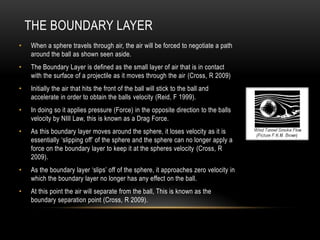
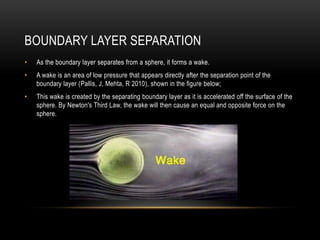
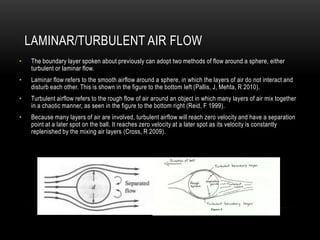
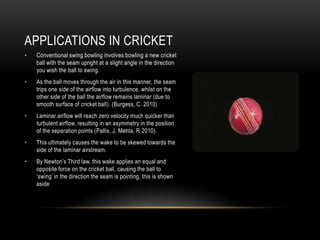
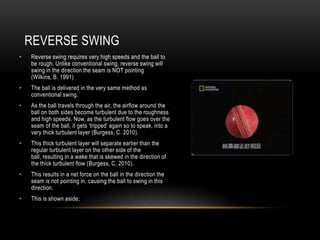
The document discusses the aerodynamic principles behind swing in cricket bowling. It explains that when a cricket ball travels through the air, the boundary layer of air separates asymmetrically on either side due to factors like seam placement and ball speed. This asymmetric separation causes an uneven wake and net force on the ball, making it swing. The boundary layer can separate earlier on one side if the airflow is laminar rather than turbulent, producing conventional swing. Reverse swing occurs when the turbulent layer separates earlier, swinging the ball in the opposite direction of the seam. Optimal swing is achieved at ball speeds of 112-135 km/h for conventional swing and 140-150 km/h for reverse swing.