Slide 3 :- What is statistics?
Slide 4 :- Introduction.
Slide 6 :- Use of Statistics at present.
Slide 7 :- usage of statistics in our day-to-day life.
Slide 8 :- Presenting data in graphical form.
Slide 9 :- Image of different types of graphs.
Slide 10:- use of statistics in Cricket.
Slide 11:- General Statistics.
Slide 12:- Cricket statistics.
Slide 13:- Batting Statistics.
Slide 16:- Bowling Statistics.
Slide 20:- Graphical Statistics.
Slide 22:- Image of different types of graphs used in cricket.
Slide 23:- Association of Cricket Statisticians and Historians.
Slide 24:- Cricket world cup 2011 stats.
Slide 37:- Conclusion.
Slide 38:- Reference/Source.
 Statistics is the study of the collection, organization,
analysis, interpretation and presentation of data.
 It deals with all aspects of data including the
planning of data collection in terms of the design of
surveys and experiments. happening in the world
around use sets of mathematical equations that are used
to analyze in the world around us
What is Statistics?
Introduction :
 Statistics are sets of mathematical equations that are
used to analyze what is happening in the world
around us.of
 Everyday we come across a wide variety of
information in the form of facts, numerical figures,
tables, graphs, etc…
 These are provided by newspapers, televisions,
magazines and other means of communications.
 These facts or figures, which are numerical are
called data.
 This is studied in a branch of Mathematics called
statistics.
 These may relate to Cricket batting or bowling,
averages, profits of a company, temperatures of
cities, polling results, and so on.
Use of statistics at present :
 We know that today we live in the Information Age
where we understand a great deal about the world
around us.
 Much of this information are determined
mathematically by using statistics. When used
correctly, statistics tell us any trends in what
happened in the past and can be useful in predicting
what may happen in the future.
Usage of statistics in our day-to-
day life
 Weather Forecasts
 Predicting Disease
 Medical Studies
 Political Campaigns
 Insurance
 Quality Testing
 Stock Market
 Consumer Goods
 Polling Results, and many more….
Presenting data in graphical form
 There are many ways to present data, the most
commonly used way of presenting data is of
graphical form.
 graphical form makes it easier to understand.
Graphs tells something with visuals rather than in
words or numbers.
 There are numerous graphing options when it comes
to presenting data.
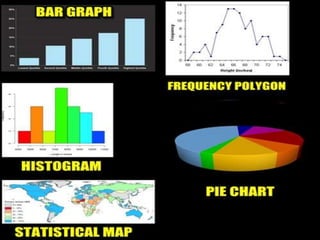
 Pie charts, bar graphs, statistical maps, histograms,
and frequency polygons are some popular way of
presenting data in graphical form.
Use of statistics in CRICKET
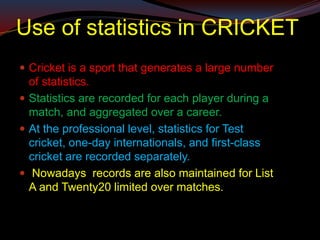
 Cricket is a sport that generates a large number
of statistics.
 Statistics are recorded for each player during a
match, and aggregated over a career.
 At the professional level, statistics for Test
cricket, one-day internationals, and first-class
cricket are recorded separately.
 Nowadays records are also maintained for List
A and Twenty20 limited over matches.
General statistics
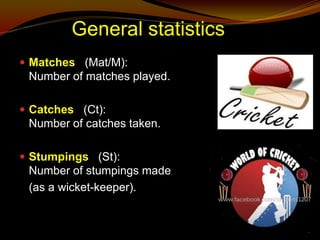
 Matches (Mat/M):
Number of matches played.
 Catches (Ct):
Number of catches taken.
 Stumpings (St):
Number of stumpings made
(as a wicket-keeper).
Cricket statistics
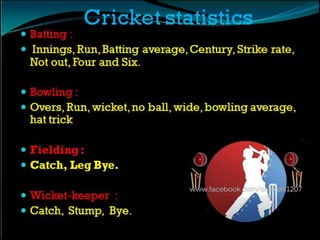
 Batting :
 Innings, Run, Batting average, Century, Strike rate, Not
out, Four and Six.
 Bowling :
 Overs, Run, wicket, no ball, wide, bowling average, hat
trick
 Fielding :
 Catch, Leg Bye.
 Wicket-keeper :
 Catch, Stump, Bye.
Batting statistics
 Matches (Mat/M):
Number of matches the batsman played.
 Innings (I):
The number of innings in which the batsman actually
batted.
 Runs (R):
The number of runs scored.
 Highest score (HS/Best):
The highest score ever made by the batsman.
 Not outs (NO):
The number of times the batsman was not out
at the conclusion of an innings they batted in.
 Centuries (100):
The number of innings in which the batsman
scored one hundred runs or more.
 Half-centuries (50):
The number of innings in which the batsman
scored fifty to ninety-nine runs (centuries do
not count as half-centuries).
 Balls faced (BF):
The total number of balls received, including
no balls but not including wides.
 Batting average (Avg.):
The total number of runs divided by the total number of
innings in which the batsman was out.
 Avg. = Runs/[I – NO]
 Strike rate (SR):
The average number of runs scored per 100 balls faced.
 SR = [100 * Runs]/BF)
 Run rate (RR):
The average number of runs a batsman (or the batting
side) scores in an over of 6 balls.
 Net run rate (NRR):
A method of ranking teams with equal points in limited
overs league competitions.
Bowling statistics
• Overs (O):
The number of overs bowled.
 Balls (B):
The number of balls bowled.
 Maiden overs (M):
The number of maiden overs (overs in which the
bowler conceded zero runs) bowled.
 Runs (R):
The number of runs conceded by the bowler.
 Wickets (W):
The number of wickets taken.
 No balls (Nb):
The number of no balls bowled.
 Wides (Wd):
The number of wides bowled.
 Bowling average (Ave):
The average number of runs conceded per wicket.
 Ave = Runs/W
 Strike Rate (SR):
The average number of balls bowled per wicket
taken.
 SR = Balls/W
 Economy rate (Econ):
The average number of runs conceded per over.
 Econ = Runs/Overs bowled
 Best bowling (BB):
The bowler's best bowling performance, defined as
firstly the greatest number of wickets, secondly the
fewest runs conceded for that number of wickets.
 Five wickets in an innings (5w):
The number of innings in which the bowler took at
least five wickets.
 Ten wickets in a match (10w):
The number of matches in which the bowler took at
least ten wickets; recorded for Tests and first-class
matches only.
Graphical statistics
 The television coverage of professional cricket has
developed new and interesting forms of presenting
statistical data to viewers. Television networks have
thus invented several new ways of presenting
statistics.
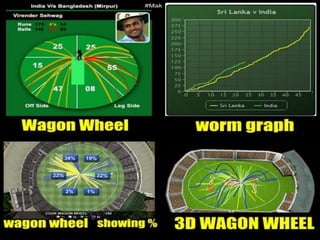
 These include displaying two-dimensional and even
three-dimensional plots of shot directions and
distances on an overhead view of a cricket field,
commonly referred to as a Wagon-Wheel.
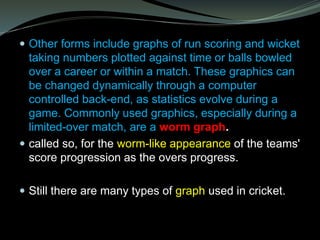
 Other forms include graphs of run scoring and wicket
taking numbers plotted against time or balls bowled
over a career or within a match. These graphics can
be changed dynamically through a computer
controlled back-end, as statistics evolve during a
game. Commonly used graphics, especially during a
limited-over match, are a worm graph.
 called so, for the worm-like appearance of the teams'
score progression as the overs progress.
 Still there are many types of graph used in cricket.
Association of Cricket
Statisticians and Historians
 ACS was founded in England in 1973 for the
purpose of researching and collating information
about the history and statistics of cricket.
 ACS headquarters were formerly in Nottingham,
opposite Trent Bridge Cricket Ground, but since
2006 it has been based in Cardiff at Sophia Gardens
Cricket Ground.
 Although constituted in England, the ACS has a
worldwide membership and is open to anyone with a
relevant interest. The membership in 2010 numbered
about 1,300.
Cricket world cup 2011 stats.
 Here’s the statistics of the cricket world
cup 2011.
 Highest Team Totals :
 The following table lists the highest team scores
during this tournament.
Highest team totals :
310
320
330
340
350
360
370
380
INDIA iINDIA ENGLAND SRI LANKA WEST
INDIES
RUNS
Batting Statistics
 Most runs in World Cup 2011 :
 This table contains top 5 players with most runs
in the tournament.
Most runs in World Cup 2011 :
0
50
100
150
200
250
300
350
400
450
500
500 482 465
422
393
9 9 9 7 9
Runs
Matches
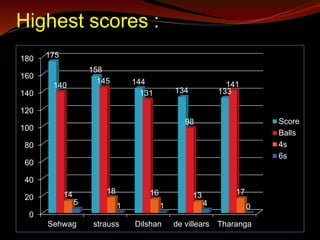
 Highest scores :
 This table contains the top 5 players with highest
scores of the tournament made by a batsman in a
single innings.
Highest scores :
0
20
40
60
80
100
120
140
160
180
Sehwag strauss Dilshan de villears Tharanga
175
158
144
134 133
140
145
131
98
141
14 18 16 13 17
5 1 1 4 0
Score
Balls
4s
6s
Bowling Statistics
 Most wickets :
 The following table contains the top 5 leading
wicket-takers of the tournament.
Bowling Statistics :
 Best bowling figures :
 This table lists the top 5 players with the best
bowling figures in the tournament.
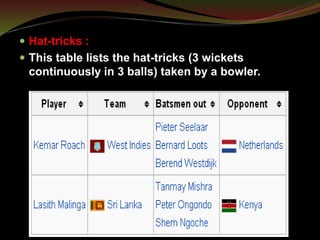
 Hat-tricks :
 This table lists the hat-tricks (3 wickets
continuously in 3 balls) taken by a bowler.
Fielding statistics
 Most dismissals :
 This is a list of the wicketkeepers who have made
the most dismissals in the tournament.
 Most catches :
 This is a list of the outfielders who have taken the
most catches in the tournament.
2011 world cup final
 Worm Graph :
 This graph shows the runs scored by two teams in
the final of 2011 world cup.
Conclusion
From this Presentation we come to know that,
Statistics is very important in CRICKET.
Cricket is a sport that generates a large number
of statistics.
Statistics in cricket includes :
Graphical data.
Numerical data.
This stats, helps to maintain record. Record may be
about Batting, Bowling, Fielding.
Records are very useful in the field of CRICKET.
Source/Reference
 INTERNET :
 Wikipedia -
 http://en.wikipedia.org/wiki/Cricket_statistics
 http://en.wikipedia.org/wiki/2011_Cricket_World_Cup
_statistics
 ESPN Cricinfo –
 http://www.espncricinfo.com/icc-cricket-world-cup-
2011
 And many more websites…..
Statistics used in Cricket

Statistics used in Cricket

  • 2.
    Slide 3 :-What is statistics? Slide 4 :- Introduction. Slide 6 :- Use of Statistics at present. Slide 7 :- usage of statistics in our day-to-day life. Slide 8 :- Presenting data in graphical form. Slide 9 :- Image of different types of graphs. Slide 10:- use of statistics in Cricket. Slide 11:- General Statistics. Slide 12:- Cricket statistics. Slide 13:- Batting Statistics. Slide 16:- Bowling Statistics. Slide 20:- Graphical Statistics. Slide 22:- Image of different types of graphs used in cricket. Slide 23:- Association of Cricket Statisticians and Historians. Slide 24:- Cricket world cup 2011 stats. Slide 37:- Conclusion. Slide 38:- Reference/Source.
  • 3.
     Statistics isthe study of the collection, organization, analysis, interpretation and presentation of data.  It deals with all aspects of data including the planning of data collection in terms of the design of surveys and experiments. happening in the world around use sets of mathematical equations that are used to analyze in the world around us What is Statistics?
  • 4.
    Introduction :  Statisticsare sets of mathematical equations that are used to analyze what is happening in the world around us.of  Everyday we come across a wide variety of information in the form of facts, numerical figures, tables, graphs, etc…  These are provided by newspapers, televisions, magazines and other means of communications.
  • 5.
     These factsor figures, which are numerical are called data.  This is studied in a branch of Mathematics called statistics.  These may relate to Cricket batting or bowling, averages, profits of a company, temperatures of cities, polling results, and so on.
  • 6.
    Use of statisticsat present :  We know that today we live in the Information Age where we understand a great deal about the world around us.  Much of this information are determined mathematically by using statistics. When used correctly, statistics tell us any trends in what happened in the past and can be useful in predicting what may happen in the future.
  • 7.
    Usage of statisticsin our day-to- day life  Weather Forecasts  Predicting Disease  Medical Studies  Political Campaigns  Insurance  Quality Testing  Stock Market  Consumer Goods  Polling Results, and many more….
  • 8.
    Presenting data ingraphical form  There are many ways to present data, the most commonly used way of presenting data is of graphical form.  graphical form makes it easier to understand. Graphs tells something with visuals rather than in words or numbers.  There are numerous graphing options when it comes to presenting data.  Pie charts, bar graphs, statistical maps, histograms, and frequency polygons are some popular way of presenting data in graphical form.
  • 10.
    Use of statisticsin CRICKET  Cricket is a sport that generates a large number of statistics.  Statistics are recorded for each player during a match, and aggregated over a career.  At the professional level, statistics for Test cricket, one-day internationals, and first-class cricket are recorded separately.  Nowadays records are also maintained for List A and Twenty20 limited over matches.
  • 11.
    General statistics  Matches(Mat/M): Number of matches played.  Catches (Ct): Number of catches taken.  Stumpings (St): Number of stumpings made (as a wicket-keeper).
  • 12.
    Cricket statistics  Batting:  Innings, Run, Batting average, Century, Strike rate, Not out, Four and Six.  Bowling :  Overs, Run, wicket, no ball, wide, bowling average, hat trick  Fielding :  Catch, Leg Bye.  Wicket-keeper :  Catch, Stump, Bye.
  • 13.
    Batting statistics  Matches(Mat/M): Number of matches the batsman played.  Innings (I): The number of innings in which the batsman actually batted.  Runs (R): The number of runs scored.  Highest score (HS/Best): The highest score ever made by the batsman.
  • 14.
     Not outs(NO): The number of times the batsman was not out at the conclusion of an innings they batted in.  Centuries (100): The number of innings in which the batsman scored one hundred runs or more.  Half-centuries (50): The number of innings in which the batsman scored fifty to ninety-nine runs (centuries do not count as half-centuries).  Balls faced (BF): The total number of balls received, including no balls but not including wides.
  • 15.
     Batting average(Avg.): The total number of runs divided by the total number of innings in which the batsman was out.  Avg. = Runs/[I – NO]  Strike rate (SR): The average number of runs scored per 100 balls faced.  SR = [100 * Runs]/BF)  Run rate (RR): The average number of runs a batsman (or the batting side) scores in an over of 6 balls.  Net run rate (NRR): A method of ranking teams with equal points in limited overs league competitions.
  • 16.
    Bowling statistics • Overs(O): The number of overs bowled.  Balls (B): The number of balls bowled.  Maiden overs (M): The number of maiden overs (overs in which the bowler conceded zero runs) bowled.  Runs (R): The number of runs conceded by the bowler.
  • 17.
     Wickets (W): Thenumber of wickets taken.  No balls (Nb): The number of no balls bowled.  Wides (Wd): The number of wides bowled.  Bowling average (Ave): The average number of runs conceded per wicket.  Ave = Runs/W
  • 18.
     Strike Rate(SR): The average number of balls bowled per wicket taken.  SR = Balls/W  Economy rate (Econ): The average number of runs conceded per over.  Econ = Runs/Overs bowled  Best bowling (BB): The bowler's best bowling performance, defined as firstly the greatest number of wickets, secondly the fewest runs conceded for that number of wickets.
  • 19.
     Five wicketsin an innings (5w): The number of innings in which the bowler took at least five wickets.  Ten wickets in a match (10w): The number of matches in which the bowler took at least ten wickets; recorded for Tests and first-class matches only.
  • 20.
    Graphical statistics  Thetelevision coverage of professional cricket has developed new and interesting forms of presenting statistical data to viewers. Television networks have thus invented several new ways of presenting statistics.  These include displaying two-dimensional and even three-dimensional plots of shot directions and distances on an overhead view of a cricket field, commonly referred to as a Wagon-Wheel.
  • 21.
     Other formsinclude graphs of run scoring and wicket taking numbers plotted against time or balls bowled over a career or within a match. These graphics can be changed dynamically through a computer controlled back-end, as statistics evolve during a game. Commonly used graphics, especially during a limited-over match, are a worm graph.  called so, for the worm-like appearance of the teams' score progression as the overs progress.  Still there are many types of graph used in cricket.
  • 23.
    Association of Cricket Statisticiansand Historians  ACS was founded in England in 1973 for the purpose of researching and collating information about the history and statistics of cricket.  ACS headquarters were formerly in Nottingham, opposite Trent Bridge Cricket Ground, but since 2006 it has been based in Cardiff at Sophia Gardens Cricket Ground.  Although constituted in England, the ACS has a worldwide membership and is open to anyone with a relevant interest. The membership in 2010 numbered about 1,300.
  • 24.
    Cricket world cup2011 stats.  Here’s the statistics of the cricket world cup 2011.  Highest Team Totals :  The following table lists the highest team scores during this tournament.
  • 25.
    Highest team totals: 310 320 330 340 350 360 370 380 INDIA iINDIA ENGLAND SRI LANKA WEST INDIES RUNS
  • 26.
    Batting Statistics  Mostruns in World Cup 2011 :  This table contains top 5 players with most runs in the tournament.
  • 27.
    Most runs inWorld Cup 2011 : 0 50 100 150 200 250 300 350 400 450 500 500 482 465 422 393 9 9 9 7 9 Runs Matches
  • 28.
     Highest scores:  This table contains the top 5 players with highest scores of the tournament made by a batsman in a single innings.
  • 29.
    Highest scores : 0 20 40 60 80 100 120 140 160 180 Sehwagstrauss Dilshan de villears Tharanga 175 158 144 134 133 140 145 131 98 141 14 18 16 13 17 5 1 1 4 0 Score Balls 4s 6s
  • 30.
    Bowling Statistics  Mostwickets :  The following table contains the top 5 leading wicket-takers of the tournament.
  • 31.
  • 32.
     Best bowlingfigures :  This table lists the top 5 players with the best bowling figures in the tournament.
  • 33.
     Hat-tricks : This table lists the hat-tricks (3 wickets continuously in 3 balls) taken by a bowler.
  • 34.
    Fielding statistics  Mostdismissals :  This is a list of the wicketkeepers who have made the most dismissals in the tournament.
  • 35.
     Most catches:  This is a list of the outfielders who have taken the most catches in the tournament.
  • 36.
    2011 world cupfinal  Worm Graph :  This graph shows the runs scored by two teams in the final of 2011 world cup.
  • 37.
    Conclusion From this Presentationwe come to know that, Statistics is very important in CRICKET. Cricket is a sport that generates a large number of statistics. Statistics in cricket includes : Graphical data. Numerical data. This stats, helps to maintain record. Record may be about Batting, Bowling, Fielding. Records are very useful in the field of CRICKET.
  • 38.
    Source/Reference  INTERNET : Wikipedia -  http://en.wikipedia.org/wiki/Cricket_statistics  http://en.wikipedia.org/wiki/2011_Cricket_World_Cup _statistics  ESPN Cricinfo –  http://www.espncricinfo.com/icc-cricket-world-cup- 2011  And many more websites…..