CRICKET
HISTORY
 Early cricket was at some time or another described as "a
club striking a ball (like) the ancient games of club-ball,
stool-ball, trap-ball, stob-ball".[4] Cricket can definitely
be traced back to Tudor times in early 16th-century
England. Written evidence exists of a game known
as creag being played by Prince Edward, the son
of Edward I (Longshanks), at Newenden, Kent in
1301[5] and there has been speculation, but no evidence,
that this was a form of cricket.
 A number of other words have been suggested as sources
for the term "cricket". In the
.
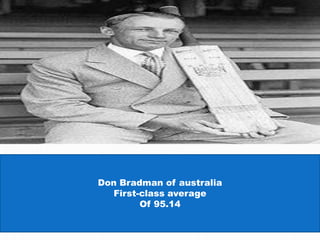
Don Bradman of australia
First-class average
Of 95.14
RULES AND GAME-PLAY
 SUMMRAY….
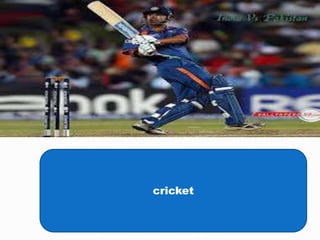
 Cricket is a bat and ball game, played between two teams of
eleven players each.[20][21] One team bats, attempting to
score runs, while the other bowls and fields the ball,
attempting to restrict the scoring and dismiss the batsmen.
The objective of the game is for a team to score more runs
than its opponent. In some forms of cricket, it may also be
necessary to dismiss the opposition in order to win the
match, which would otherwise be drawn.

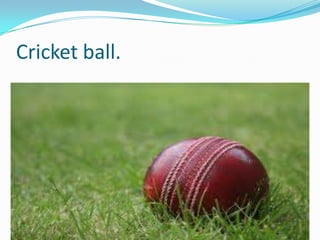
Cricket ball.
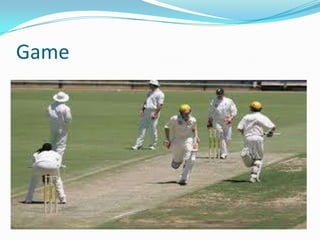
Game
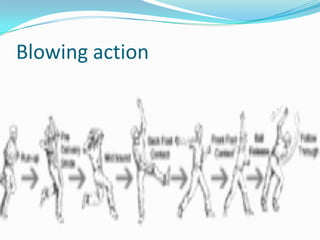
Blowing action
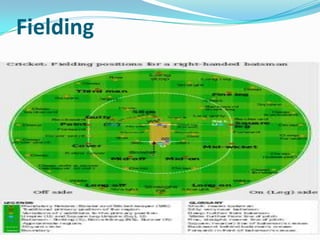
Fielding
Batting
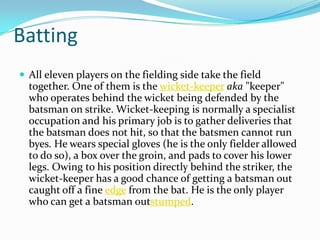
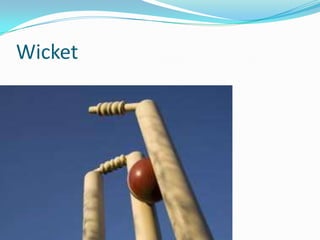
 All eleven players on the fielding side take the field
together. One of them is the wicket-keeper aka "keeper"
who operates behind the wicket being defended by the
batsman on strike. Wicket-keeping is normally a specialist
occupation and his primary job is to gather deliveries that
the batsman does not hit, so that the batsmen cannot run
byes. He wears special gloves (he is the only fielder allowed
to do so), a box over the groin, and pads to cover his lower
legs. Owing to his position directly behind the striker, the
wicket-keeper has a good chance of getting a batsman out
caught off a fine edge from the bat. He is the only player
who can get a batsman outstumped.
cricket
Wicket

presentation on cricket

  • 1.
  • 2.
    HISTORY  Early cricketwas at some time or another described as "a club striking a ball (like) the ancient games of club-ball, stool-ball, trap-ball, stob-ball".[4] Cricket can definitely be traced back to Tudor times in early 16th-century England. Written evidence exists of a game known as creag being played by Prince Edward, the son of Edward I (Longshanks), at Newenden, Kent in 1301[5] and there has been speculation, but no evidence, that this was a form of cricket.  A number of other words have been suggested as sources for the term "cricket". In the
  • 3.
    . Don Bradman ofaustralia First-class average Of 95.14
  • 4.
    RULES AND GAME-PLAY SUMMRAY….  Cricket is a bat and ball game, played between two teams of eleven players each.[20][21] One team bats, attempting to score runs, while the other bowls and fields the ball, attempting to restrict the scoring and dismiss the batsmen. The objective of the game is for a team to score more runs than its opponent. In some forms of cricket, it may also be necessary to dismiss the opposition in order to win the match, which would otherwise be drawn. 
  • 5.
  • 6.
  • 7.
  • 8.
  • 9.
    Batting  All elevenplayers on the fielding side take the field together. One of them is the wicket-keeper aka "keeper" who operates behind the wicket being defended by the batsman on strike. Wicket-keeping is normally a specialist occupation and his primary job is to gather deliveries that the batsman does not hit, so that the batsmen cannot run byes. He wears special gloves (he is the only fielder allowed to do so), a box over the groin, and pads to cover his lower legs. Owing to his position directly behind the striker, the wicket-keeper has a good chance of getting a batsman out caught off a fine edge from the bat. He is the only player who can get a batsman outstumped.
  • 10.
  • 11.