Force and
Motion
Review
• A force is simply a push or a pull.
• All forces have both Magnitude and direction.
• It is an action that can change the shape ,size and
motion of a object.
The following examples show the different effects
of forces.
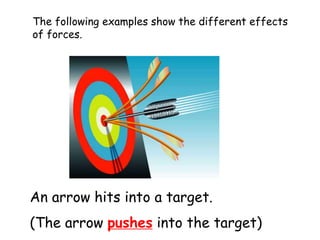
An arrow hits into a target.
(The arrow pushes into the target)
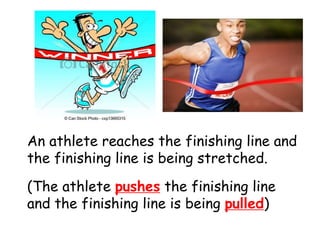
An athlete reaches the finishing line and
the finishing line is being stretched.
(The athlete pushes the finishing line
and the finishing line is being pulled)
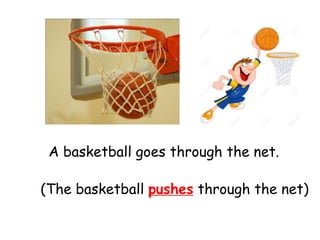
A basketball goes through the net.
(The basketball pushes through the net)
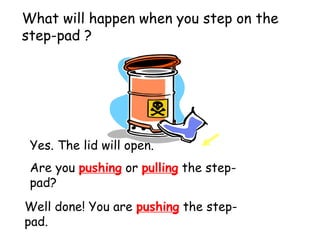
What will happen when you step on the
step-pad ?
Yes. The lid will open.
Are you pushing or pulling the step-
pad?
Well done! You are pushing the step-
pad.
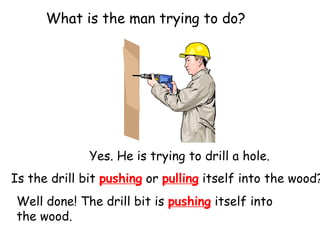
What is the man trying to do?
Yes. He is trying to drill a hole.
Is the drill bit pushing or pulling itself into the wood?
Well done! The drill bit is pushing itself into
the wood.
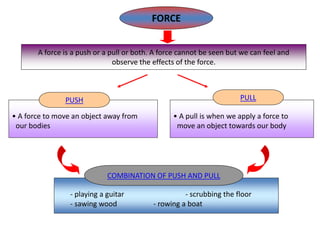
- playing a guitar - scrubbing the floor
- sawing wood - rowing a boat
• A pull is when we apply a force to
move an object towards our body
• A force to move an object away from
our bodies
FORCE
A force is a push or a pull or both. A force cannot be seen but we can feel and
observe the effects of the force.
PUSH PULL
COMBINATION OF PUSH AND PULL
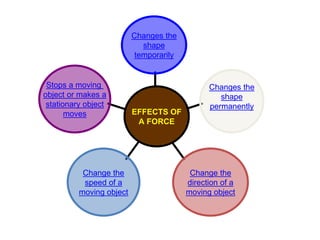
Stops a moving
object or makes a
stationary object
moves
Change the
speed of a
moving object
Change the
direction of a
moving object
Changes the
shape
permanently
Changes the
shape
temporarily
EFFECTS OF
A FORCE
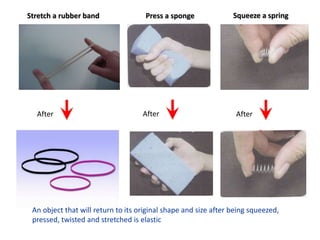
Stretch a rubber band
After
An object that will return to its original shape and size after being squeezed,
pressed, twisted and stretched is elastic
After After
Press a sponge Squeeze a spring
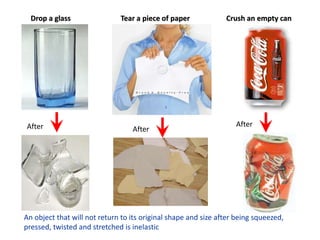
Drop a glass
After After
Tear a piece of paper
After
Crush an empty can
An object that will not return to its original shape and size after being squeezed,
pressed, twisted and stretched is inelastic
A solid cannot be compressed or stretched!!
IMPORTANT POINT
EXPLANATION
The shape of a solid object changes when a force is applied
to it whether it’s temporarily or permanently
Example: crushing a can – changes the shape permanently
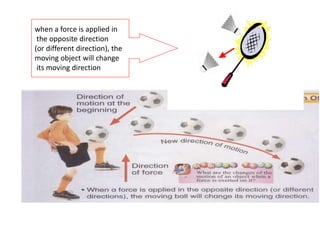
when a force is applied in
the opposite direction
(or different direction), the
moving object will change
its moving direction
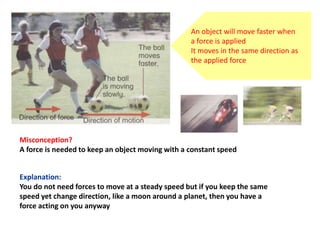
Misconception?
A force is needed to keep an object moving with a constant speed
Explanation:
You do not need forces to move at a steady speed but if you keep the same
speed yet change direction, like a moon around a planet, then you have a
force acting on you anyway
An object will move faster when
a force is applied
It moves in the same direction as
the applied force
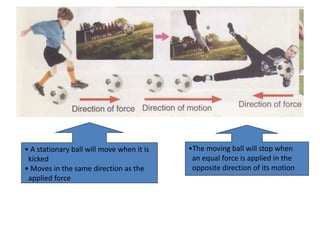
• A stationary ball will move when it is
kicked
• Moves in the same direction as the
applied force
•The moving ball will stop when
an equal force is applied in the
opposite direction of its motion
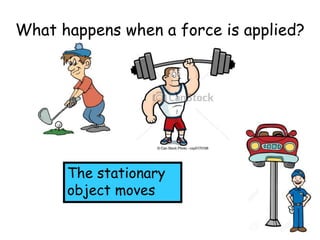
What happens when a force is applied?
The stationary
object moves
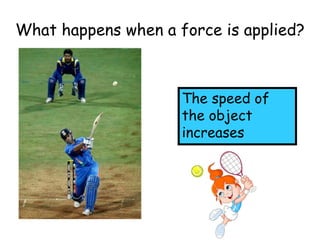
What happens when a force is applied?
The speed of
the object
increases
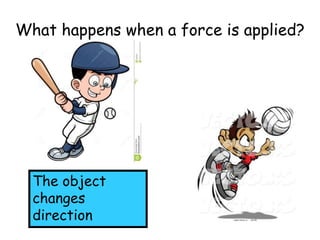
What happens when a force is applied?
The object
changes
direction
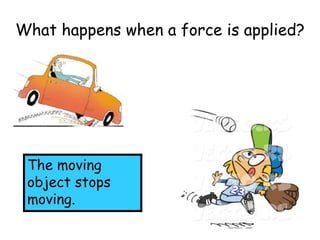
What happens when a force is applied?
The moving
object stops
moving.
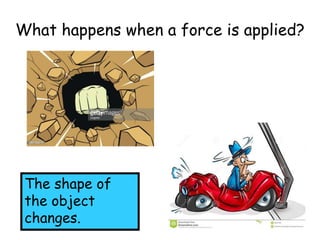
What happens when a force is applied?
The shape of
the object
changes.
Effects of forces
1. Force can move a stationary object.
2. Force can change the speed of a
moving object.
3. Force can stop a moving object.
4. Force can change direction of a
moving object.
5. Force can change the shape of an
object.
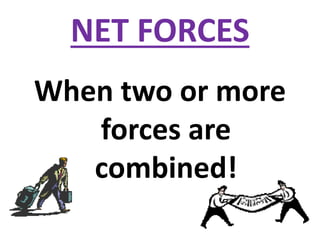
NET FORCES
When two or more
forces are
combined!
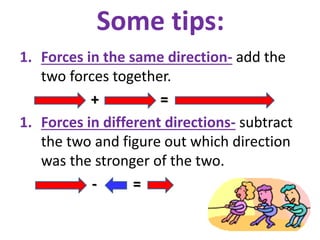
Some tips:
1. Forces in the same direction- add the
two forces together.
+ =
1. Forces in different directions- subtract
the two and figure out which direction
was the stronger of the two.
- =
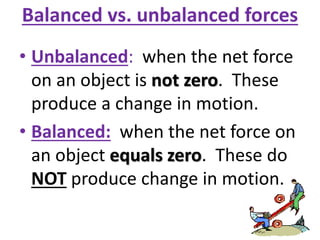
Balanced vs. unbalanced forces
• Unbalanced: when the net force
on an object is not zero. These
produce a change in motion.
• Balanced: when the net force on
an object equals zero. These do
NOT produce change in motion.
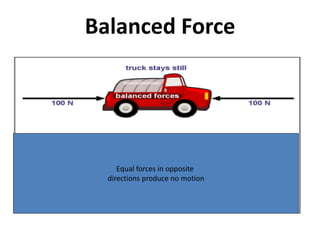
Balanced Force
Equal forces in opposite
directions produce no motion
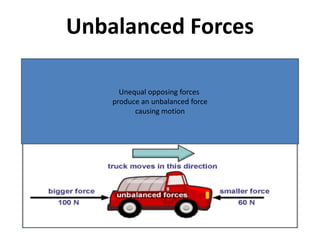
Unbalanced Forces
Unequal opposing forces
produce an unbalanced force
causing motion
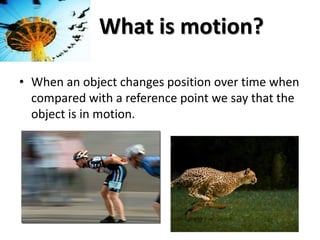
What is motion?
• When an object changes position over time when
compared with a reference point we say that the
object is in motion.
What is motion?
• An object is in motion
when it is continuously
changing its position
based on a reference
point and as observed
by a person or a device.
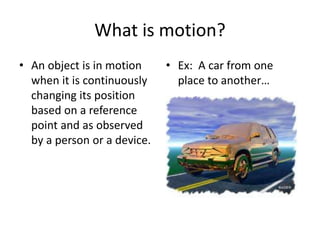
• Ex: A car from one
place to another…
4 General types of motion
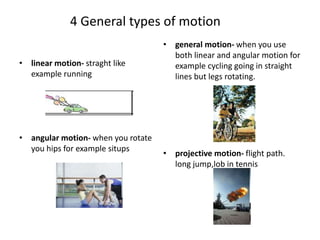
• linear motion- straght like
example running
• angular motion- when you rotate
you hips for example situps
• general motion- when you use
both linear and angular motion for
example cycling going in straight
lines but legs rotating.
• projective motion- flight path.
long jump,lob in tennis
6 types of mechanical motion
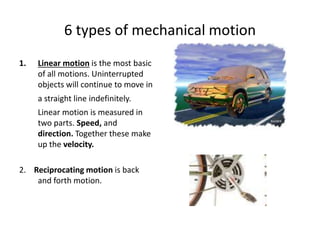
1. Linear motion is the most basic
of all motions. Uninterrupted
objects will continue to move in
a straight line indefinitely.
Linear motion is measured in
two parts. Speed, and
direction. Together these make
up the velocity.
2. Reciprocating motion is back
and forth motion.
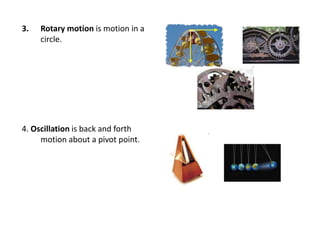
3. Rotary motion is motion in a
circle.
4. Oscillation is back and forth
motion about a pivot point.
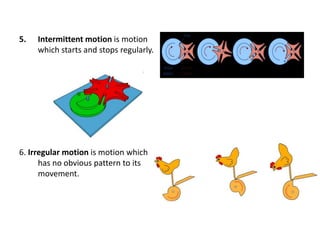
5. Intermittent motion is motion
which starts and stops regularly.
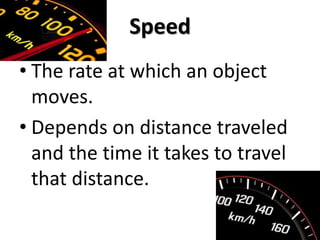
6. Irregular motion is motion which
has no obvious pattern to its
movement.
Speed
• The rate at which an object
moves.
• Depends on distance traveled
and the time it takes to travel
that distance.
Speed Formula
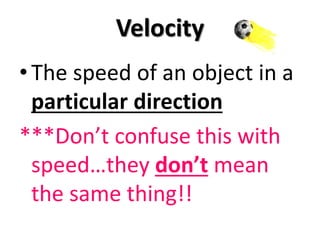
Average speed = total distance
total time
Velocity
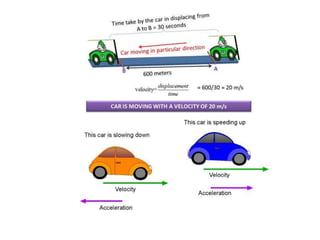
•The speed of an object in a
particular direction
***Don’t confuse this with
speed…they don’t mean
the same thing!!
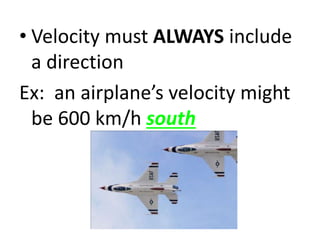
• Velocity must ALWAYS include
a direction
Ex: an airplane’s velocity might
be 600 km/h south
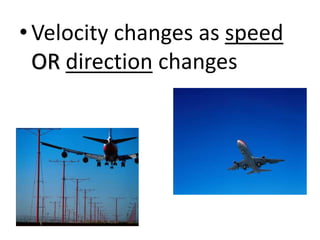
•Velocity changes as speed
OR direction changes
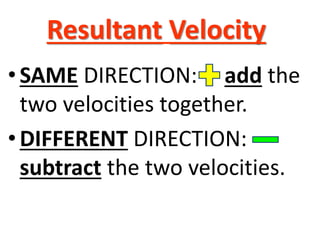
Resultant Velocity.
•SAME DIRECTION: add the
two velocities together.
•DIFFERENT DIRECTION:
subtract the two velocities.
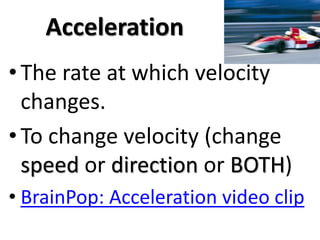
Acceleration
•The rate at which velocity
changes.
•To change velocity (change
speed or direction or BOTH)
• BrainPop: Acceleration video clip
• It is not just HOW MUCH
velocity changes, but it is also
HOW FAST it changes.
• The faster velocity changes,
the greater the acceleration is.
Acceleration Formula
Acceleration= final velocity – starting velocity
time it takes to change velocity
• Velocity is expressed in meters per second (m/s)
and time is expressed in seconds (s), so acceleration
is expressed in meters per second per second
(m/s/s)
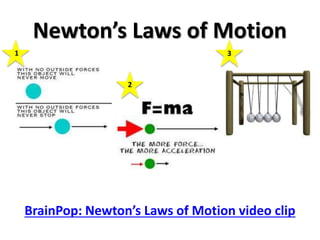
Newton’s Laws of Motion
BrainPop: Newton’s Laws of Motion video clip
1
2
3
Newton’s First Law
(law of inertia)
An object at rest tends to stay at rest
and an object in motion tends to stay
in motion unless acted upon by an
unbalanced force.
1
Newton’s First Law (law of inertia)
• Mass (kg)is the measure of the
amount of matter in an object.
• INERTIA is a property of an object
that describes how much it will resist
change to the motion of the object
• More mass an object has means
more inertia the object will have.
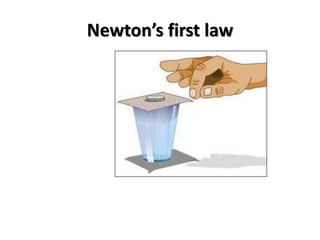
Newton’s first law
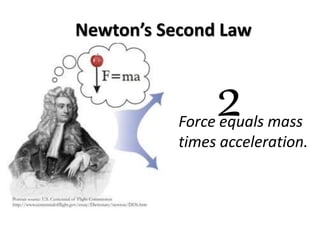
Newton’s Second Law
Force equals mass
times acceleration.
2
Newton’s Second Law
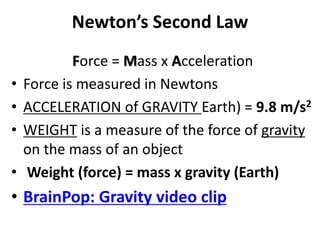
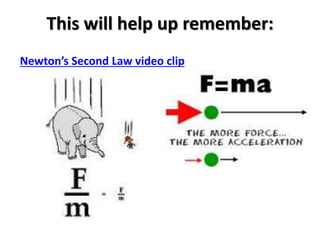
Force = Mass x Acceleration
• Force is measured in Newtons
• ACCELERATION of GRAVITY Earth) = 9.8 m/s2
• WEIGHT is a measure of the force of gravity
on the mass of an object
• Weight (force) = mass x gravity (Earth)
• BrainPop: Gravity video clip
This will help up remember:
Newton’s Second Law video clip
Newton’s Third Law
For every action there is an equal and
opposite reaction.
3
Newton’s 3rd Law
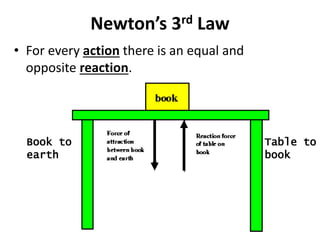
• For every action there is an equal and
opposite reaction.
Book to
earth
Table to
book
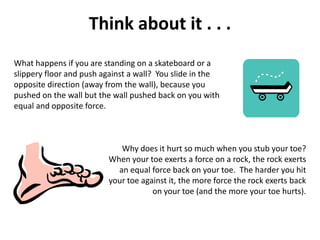
Think about it . . .
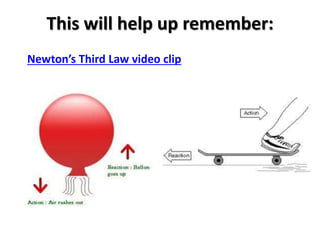
What happens if you are standing on a skateboard or a
slippery floor and push against a wall? You slide in the
opposite direction (away from the wall), because you
pushed on the wall but the wall pushed back on you with
equal and opposite force.
Why does it hurt so much when you stub your toe?
When your toe exerts a force on a rock, the rock exerts
an equal force back on your toe. The harder you hit
your toe against it, the more force the rock exerts back
on your toe (and the more your toe hurts).
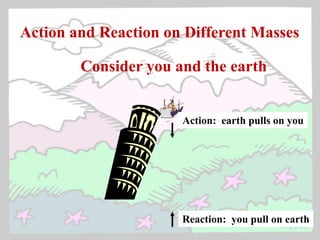
Action: earth pulls on you
Reaction: you pull on earth
Action and Reaction on Different Masses
Consider you and the earth
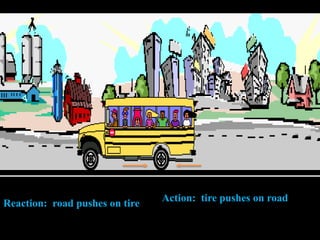
Action: tire pushes on road
Reaction: road pushes on tire
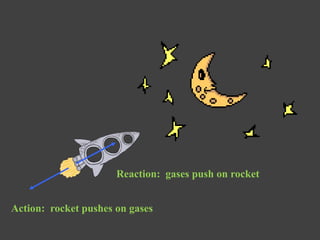
Action: rocket pushes on gases
Reaction: gases push on rocket
This will help up remember:
Newton’s Third Law video clip
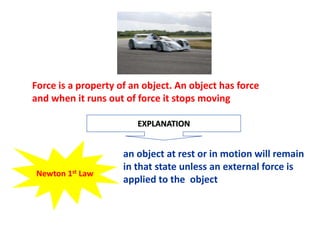
Force is a property of an object. An object has force
and when it runs out of force it stops moving
EXPLANATION
an object at rest or in motion will remain
in that state unless an external force is
applied to the object
Newton 1st Law
Force
Force