CHAPTER 11 FORCE
NEWTON’S FIRST LAW
An object at rest will remain at rest and
an object in motion will continue in
motion at a constant velocity unless
acted upon by a net force
NEWTON’S FIRST LAW
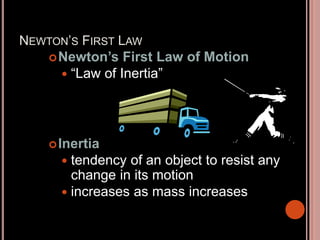
Newton’s First Law of Motion
 “Law of Inertia”
Inertia
 tendency of an object to resist any
change in its motion
 increases as mass increases
INERTIA
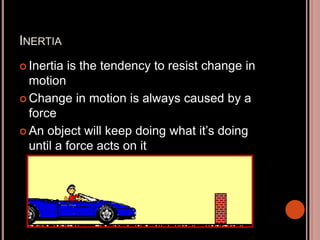
 Inertia is the tendency to resist change in
motion
 Change in motion is always caused by a
force
 An object will keep doing what it’s doing
until a force acts on it
MASS AND INERTIA
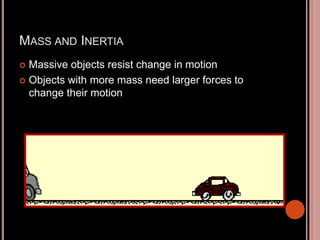
 Massive objects resist change in motion
 Objects with more mass need larger forces to
change their motion
NEWTON’S 1ST LAW
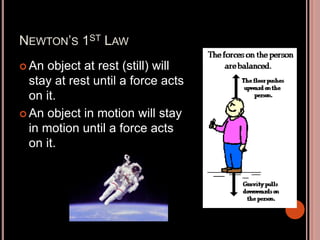
 An object at rest (still) will
stay at rest until a force acts
on it.
 An object in motion will stay
in motion until a force acts
on it.
NEWTON’S 1ST LAW
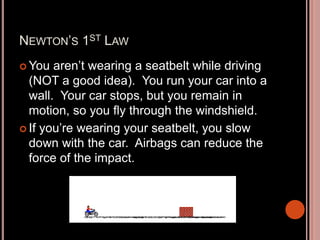
 You aren’t wearing a seatbelt while driving
(NOT a good idea). You run your car into a
wall. Your car stops, but you remain in
motion, so you fly through the windshield.
 If you’re wearing your seatbelt, you slow
down with the car. Airbags can reduce the
force of the impact.
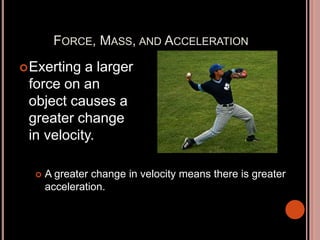
FORCE, MASS, AND ACCELERATION
Exerting a larger
force on an
object causes a
greater change
in velocity.
 A greater change in velocity means there is greater
acceleration.
NEWTON’S SECOND LAW
Newton’s Second Law of Motion
 The acceleration of an object is
directly proportional to the net force
acting on it and inversely
proportional to its mass.
 AKA-When mass goes up,
acceleration goes down, and when
force goes up, acceleration goes up
F = ma
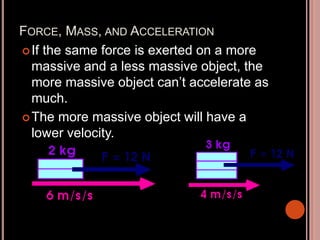
FORCE, MASS, AND ACCELERATION
If the same force is exerted on a more
massive and a less massive object, the
more massive object can’t accelerate as
much.
The more massive object will have a
lower velocity.
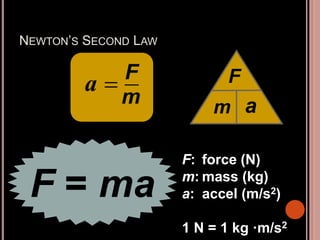
NEWTON’S SECOND LAW
F = ma
F: force (N)
m: mass (kg)
a: accel (m/s2)
1 N = 1 kg ·m/s2

a
m
F
a
F
m
GRAVITY
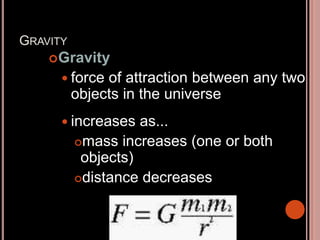
Gravity
 force of attraction between any two
objects in the universe
 increases as...
mass increases (one or both
objects)
distance decreases
GRAVITY
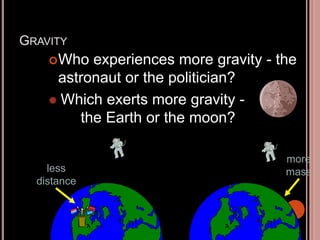
Who experiences more gravity - the
astronaut or the politician?
less
distance
more
mass
 Which exerts more gravity -
the Earth or the moon?
GRAVITY
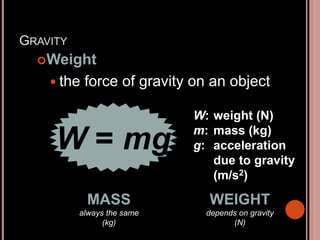
Weight
 the force of gravity on an object
MASS
always the same
(kg)
WEIGHT
depends on gravity
(N)
W = mg
W: weight (N)
m: mass (kg)
g: acceleration
due to gravity
(m/s2)
GRAVITY
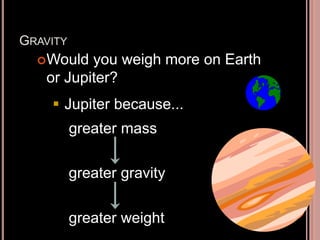
Would you weigh more on Earth
or Jupiter?
greater gravity
greater weight
greater mass
 Jupiter because...
GRAVITY
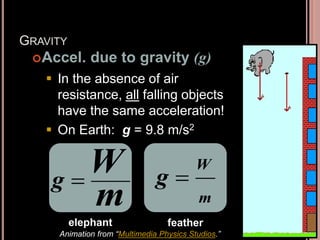
Accel. due to gravity (g)
 In the absence of air
resistance, all falling objects
have the same acceleration!
 On Earth: g = 9.8 m/s2
m
W
g 
elephant
m
W
g 
feather
Animation from “Multimedia Physics Studios.”
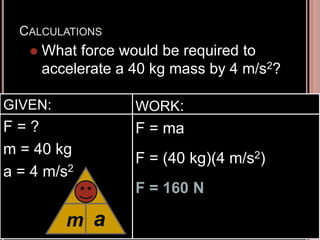
CALCULATIONS
 What force would be required to
accelerate a 40 kg mass by 4 m/s2?
GIVEN:
F = ?
m = 40 kg
a = 4 m/s2
WORK:
F = ma
F = (40 kg)(4 m/s2)
F = 160 N
m
F
a
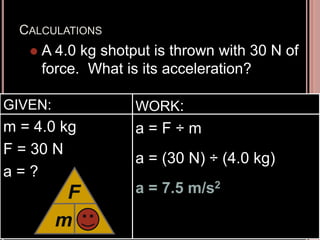
CALCULATIONS
 A 4.0 kg shotput is thrown with 30 N of
force. What is its acceleration?
GIVEN:
m = 4.0 kg
F = 30 N
a = ?
WORK:
a = F ÷ m
a = (30 N) ÷ (4.0 kg)
a = 7.5 m/s2
m
F
a
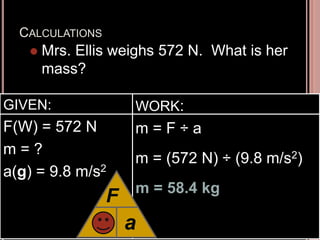
CALCULATIONS
 Mrs. Ellis weighs 572 N. What is her
mass?
GIVEN:
F(W) = 572 N
m = ?
a(g) = 9.8 m/s2
WORK:
m = F ÷ a
m = (572 N) ÷ (9.8 m/s2)
m = 58.4 kg
m
F
a
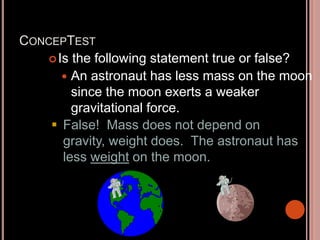
CONCEPTEST
Is the following statement true or false?
 An astronaut has less mass on the moon
since the moon exerts a weaker
gravitational force.
 False! Mass does not depend on
gravity, weight does. The astronaut has
less weight on the moon.
FREE-FALL
Free-Fall
 when an object is influenced only
by the force of gravity
Weightlessness
 sensation produced when an
object and its surroundings are in
free-fall
 object is not weightless!
CUP DEMO
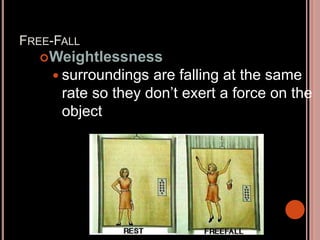
FREE-FALL
Weightlessness
 surroundings are falling at the same
rate so they don’t exert a force on the
object
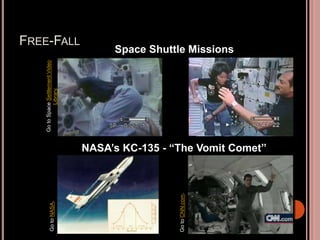
FREE-FALL
NASA’s KC-135 - “The Vomit Comet”
Go
to
NASA.
Go
to
CNN.com.
Go
to
Space
Settlement
Video
Library.
Space Shuttle Missions
CONCEPTEST 1
TRUE or FALSE:
An astronaut on the Space Shuttle
feels weightless because there is no
gravity in space.
FALSE!
There is gravity which is causing the
Shuttle to free-fall towards the Earth.
She feels weightless because she’s
free-falling at the same rate.
NEWTON’S THIRD LAW
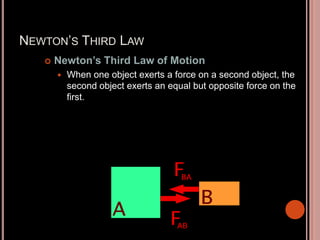
 Newton’s Third Law of Motion
 When one object exerts a force on a second object, the
second object exerts an equal but opposite force on the
first.
NEWTON’S THIRD LAW
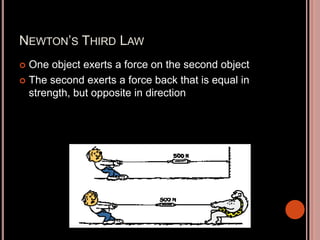
 One object exerts a force on the second object
 The second exerts a force back that is equal in
strength, but opposite in direction
NEWTON’S THIRD LAW
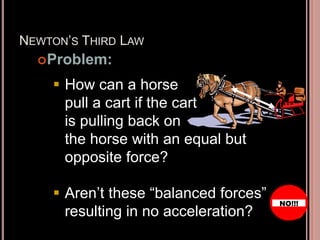
Problem:
 How can a horse
pull a cart if the cart
is pulling back on
the horse with an equal but
opposite force?
NO!!!
 Aren’t these “balanced forces”
resulting in no acceleration?
NEWTON’S THIRD LAW
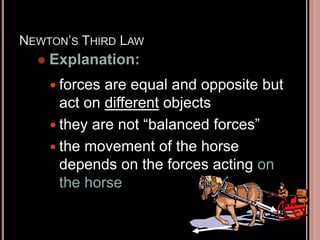
 forces are equal and opposite but
act on different objects
 they are not “balanced forces”
 the movement of the horse
depends on the forces acting on
the horse
 Explanation:
NEWTON’S THIRD LAW
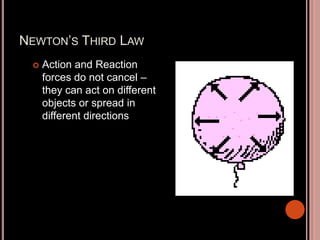
 Action and Reaction
forces do not cancel –
they can act on different
objects or spread in
different directions
NEWTON’S THIRD LAW
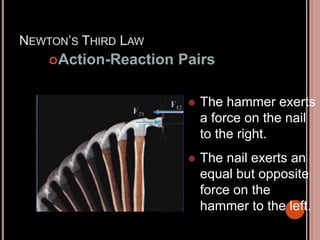
Action-Reaction Pairs
 The hammer exerts
a force on the nail
to the right.
 The nail exerts an
equal but opposite
force on the
hammer to the left.
NEWTON’S THIRD LAW
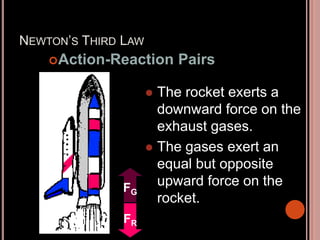
Action-Reaction Pairs
 The rocket exerts a
downward force on the
exhaust gases.
 The gases exert an
equal but opposite
upward force on the
rocket.
FG
FR
NEWTON’S THIRD LAW
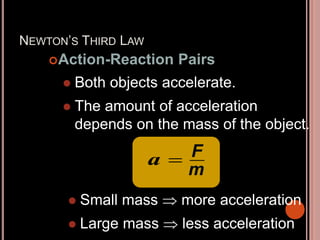
Action-Reaction Pairs
 Both objects accelerate.
 The amount of acceleration
depends on the mass of the object.

a F
m
 Small mass  more acceleration
 Large mass  less acceleration
MOMENTUM
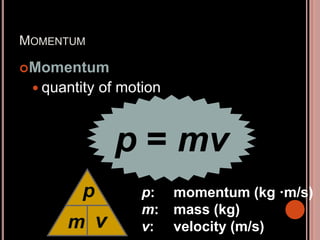
Momentum
 quantity of motion
p = mv
p: momentum (kg ·m/s)
m: mass (kg)
v: velocity (m/s)
m
p
v
MOMENTUM:
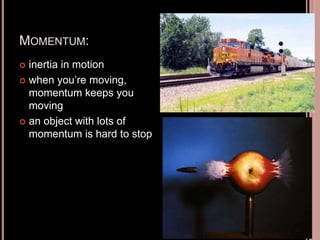
 inertia in motion
 when you’re moving,
momentum keeps you
moving
 an object with lots of
momentum is hard to stop
MOMENTUM:
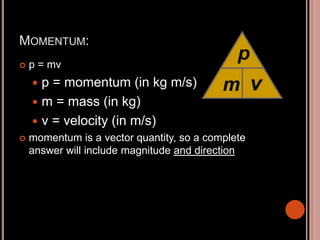
 p = mv
 p = momentum (in kg m/s)
 m = mass (in kg)
 v = velocity (in m/s)
 momentum is a vector quantity, so a complete
answer will include magnitude and direction
m
p
v
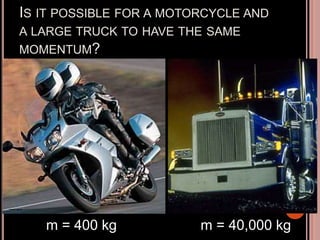
IS IT POSSIBLE FOR A MOTORCYCLE AND
A LARGE TRUCK TO HAVE THE SAME
MOMENTUM?
m = 40,000 kg
m = 400 kg
MOMENTUM
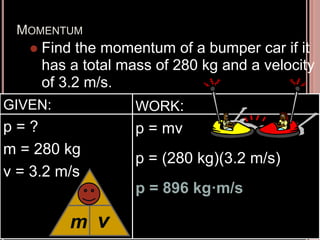
 Find the momentum of a bumper car if it
has a total mass of 280 kg and a velocity
of 3.2 m/s.
GIVEN:
p = ?
m = 280 kg
v = 3.2 m/s
WORK:
p = mv
p = (280 kg)(3.2 m/s)
p = 896 kg·m/s
m
p
v
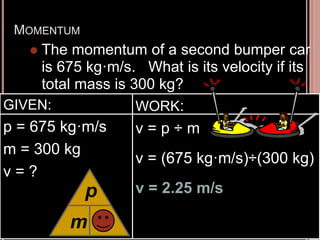
MOMENTUM
 The momentum of a second bumper car
is 675 kg·m/s. What is its velocity if its
total mass is 300 kg?
GIVEN:
p = 675 kg·m/s
m = 300 kg
v = ?
WORK:
v = p ÷ m
v = (675 kg·m/s)÷(300 kg)
v = 2.25 m/s
m
p
v
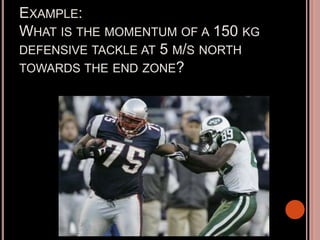
EXAMPLE:
WHAT IS THE MOMENTUM OF A 150 KG
DEFENSIVE TACKLE AT 5 M/S NORTH
TOWARDS THE END ZONE?
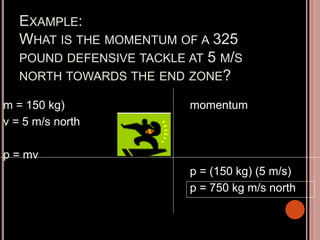
EXAMPLE:
WHAT IS THE MOMENTUM OF A 325
POUND DEFENSIVE TACKLE AT 5 M/S
NORTH TOWARDS THE END ZONE?
m = 150 kg)
v = 5 m/s north
p = mv
momentum
p = (150 kg) (5 m/s)
p = 750 kg m/s north
TO CHANGE THE MOMENTUM OF AN
OBJECT, YOU MUST CHANGE…
 mass and/or velocity
 usually velocity changes
 change in velocity is acceleration
 to make an object accelerate, a force is required
 So a force causes a change in the momentum of an
object.
 Size of force and the time the force acts both affect
change in momentum.
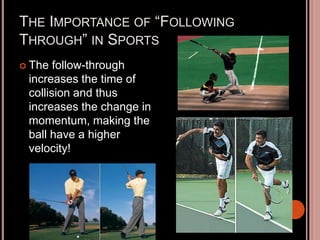
THE IMPORTANCE OF “FOLLOWING
THROUGH” IN SPORTS
 The follow-through
increases the time of
collision and thus
increases the change in
momentum, making the
ball have a higher
velocity!
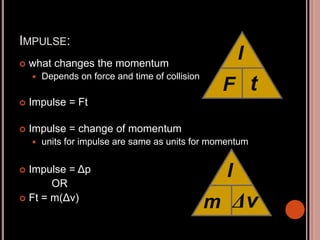
IMPULSE:
 what changes the momentum
 Depends on force and time of collision
 Impulse = Ft
 Impulse = change of momentum
 units for impulse are same as units for momentum
 Impulse = Δp
OR
 Ft = m(Δv)
F
I
t
m
I
Δv
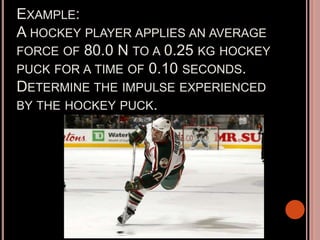
EXAMPLE:
A HOCKEY PLAYER APPLIES AN AVERAGE
FORCE OF 80.0 N TO A 0.25 KG HOCKEY
PUCK FOR A TIME OF 0.10 SECONDS.
DETERMINE THE IMPULSE EXPERIENCED
BY THE HOCKEY PUCK.
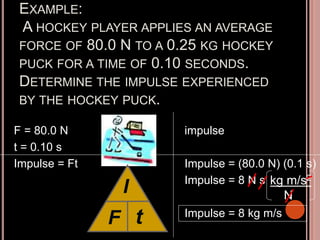
EXAMPLE:
A HOCKEY PLAYER APPLIES AN AVERAGE
FORCE OF 80.0 N TO A 0.25 KG HOCKEY
PUCK FOR A TIME OF 0.10 SECONDS.
DETERMINE THE IMPULSE EXPERIENCED
BY THE HOCKEY PUCK.
F = 80.0 N
t = 0.10 s
Impulse = Ft
impulse
Impulse = (80.0 N) (0.1 s)
Impulse = 8 N s
Impulse = 8 kg m/s
kg m/s2
N
F
I
t
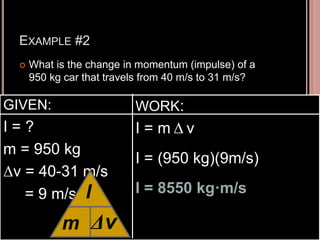
EXAMPLE #2
 What is the change in momentum (impulse) of a
950 kg car that travels from 40 m/s to 31 m/s?
GIVEN:
I = ?
m = 950 kg
Δv = 40-31 m/s
= 9 m/s
WORK:
I = m Δ v
I = (950 kg)(9m/s)
I = 8550 kg·m/s
m
I
Δv
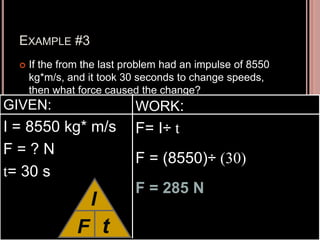
EXAMPLE #3
 If the from the last problem had an impulse of 8550
kg*m/s, and it took 30 seconds to change speeds,
then what force caused the change?
GIVEN:
I = 8550 kg* m/s
F = ? N
t= 30 s
WORK:
F= I÷ t
F = (8550)÷ (30)
F = 285 N
F
I
t
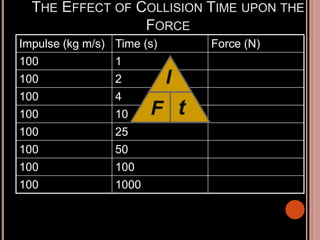
THE EFFECT OF COLLISION TIME UPON THE
FORCE
Impulse (kg m/s) Time (s) Force (N)
100 1 100
100 2 50
100 4 25
100 10 10
100 25 4
100 50 2
100 100 1
100 1000 0.1
F
I
t
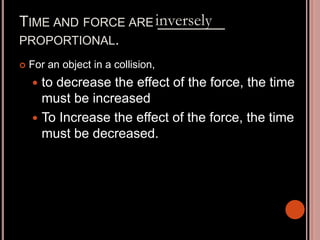
TIME AND FORCE ARE ________
PROPORTIONAL.
 For an object in a collision,
 to decrease the effect of the force, the time
must be increased
 To Increase the effect of the force, the time
must be decreased.
inversely
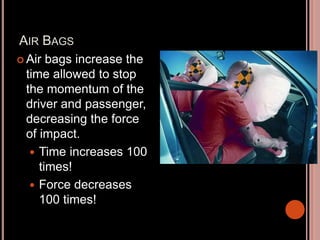
AIR BAGS
 Air bags increase the
time allowed to stop
the momentum of the
driver and passenger,
decreasing the force
of impact.
 Time increases 100
times!
 Force decreases
100 times!
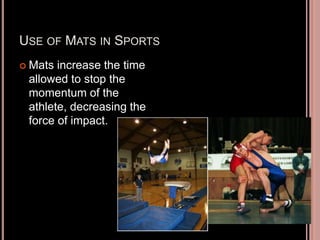
USE OF MATS IN SPORTS
 Mats increase the time
allowed to stop the
momentum of the
athlete, decreasing the
force of impact.
“RIDING THE PUNCH”
 When a boxer recognizes
that he will be hit in the head
by his opponent, the boxer
often relaxes his neck and
allows his head to move
backwards upon impact.
 “Riding the punch” increases
the time the force is applied,
decreasing the force of
impact.
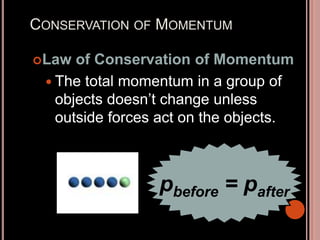
CONSERVATION OF MOMENTUM
Law of Conservation of Momentum
 The total momentum in a group of
objects doesn’t change unless
outside forces act on the objects.
pbefore = pafter
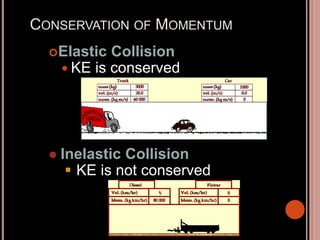
CONSERVATION OF MOMENTUM
Elastic Collision
 KE is conserved
 Inelastic Collision
 KE is not conserved
CONSERVATION OF MOMENTUM
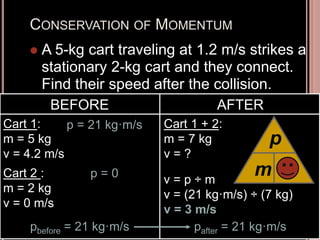
 A 5-kg cart traveling at 1.2 m/s strikes a
stationary 2-kg cart and they connect.
Find their speed after the collision.
BEFORE
Cart 1:
m = 5 kg
v = 4.2 m/s
Cart 2 :
m = 2 kg
v = 0 m/s
AFTER
Cart 1 + 2:
m = 7 kg
v = ?
p = 21 kg·m/s
p = 0
pbefore = 21 kg·m/s pafter = 21 kg·m/s
m
p
v
v = p ÷ m
v = (21 kg·m/s) ÷ (7 kg)
v = 3 m/s
CONSERVATION OF MOMENTUM
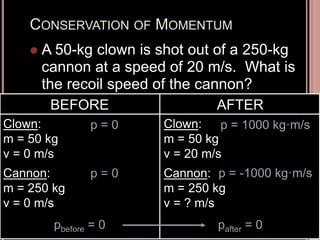
 A 50-kg clown is shot out of a 250-kg
cannon at a speed of 20 m/s. What is
the recoil speed of the cannon?
BEFORE
Clown:
m = 50 kg
v = 0 m/s
Cannon:
m = 250 kg
v = 0 m/s
AFTER
Clown:
m = 50 kg
v = 20 m/s
Cannon:
m = 250 kg
v = ? m/s
p = 0
p = 0
pbefore = 0
p = 1000 kg·m/s
pafter = 0
p = -1000 kg·m/s
CONSERVATION OF MOMENTUM
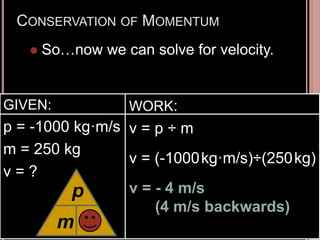
 So…now we can solve for velocity.
GIVEN:
p = -1000 kg·m/s
m = 250 kg
v = ?
WORK:
v = p ÷ m
v = (-1000kg·m/s)÷(250kg)
v = - 4 m/s
(4 m/s backwards)
m
p
v

force_-_weebly (1).pptx

  • 1.
  • 2.
    NEWTON’S FIRST LAW Anobject at rest will remain at rest and an object in motion will continue in motion at a constant velocity unless acted upon by a net force
  • 3.
    NEWTON’S FIRST LAW Newton’sFirst Law of Motion  “Law of Inertia” Inertia  tendency of an object to resist any change in its motion  increases as mass increases
  • 4.
    INERTIA  Inertia isthe tendency to resist change in motion  Change in motion is always caused by a force  An object will keep doing what it’s doing until a force acts on it
  • 5.
    MASS AND INERTIA Massive objects resist change in motion  Objects with more mass need larger forces to change their motion
  • 6.
    NEWTON’S 1ST LAW An object at rest (still) will stay at rest until a force acts on it.  An object in motion will stay in motion until a force acts on it.
  • 7.
    NEWTON’S 1ST LAW You aren’t wearing a seatbelt while driving (NOT a good idea). You run your car into a wall. Your car stops, but you remain in motion, so you fly through the windshield.  If you’re wearing your seatbelt, you slow down with the car. Airbags can reduce the force of the impact.
  • 8.
    FORCE, MASS, ANDACCELERATION Exerting a larger force on an object causes a greater change in velocity.  A greater change in velocity means there is greater acceleration.
  • 9.
    NEWTON’S SECOND LAW Newton’sSecond Law of Motion  The acceleration of an object is directly proportional to the net force acting on it and inversely proportional to its mass.  AKA-When mass goes up, acceleration goes down, and when force goes up, acceleration goes up F = ma
  • 10.
    FORCE, MASS, ANDACCELERATION If the same force is exerted on a more massive and a less massive object, the more massive object can’t accelerate as much. The more massive object will have a lower velocity.
  • 11.
    NEWTON’S SECOND LAW F= ma F: force (N) m: mass (kg) a: accel (m/s2) 1 N = 1 kg ·m/s2  a m F a F m
  • 12.
    GRAVITY Gravity  force ofattraction between any two objects in the universe  increases as... mass increases (one or both objects) distance decreases
  • 13.
    GRAVITY Who experiences moregravity - the astronaut or the politician? less distance more mass  Which exerts more gravity - the Earth or the moon?
  • 14.
    GRAVITY Weight  the forceof gravity on an object MASS always the same (kg) WEIGHT depends on gravity (N) W = mg W: weight (N) m: mass (kg) g: acceleration due to gravity (m/s2)
  • 15.
    GRAVITY Would you weighmore on Earth or Jupiter? greater gravity greater weight greater mass  Jupiter because...
  • 16.
    GRAVITY Accel. due togravity (g)  In the absence of air resistance, all falling objects have the same acceleration!  On Earth: g = 9.8 m/s2 m W g  elephant m W g  feather Animation from “Multimedia Physics Studios.”
  • 17.
    CALCULATIONS  What forcewould be required to accelerate a 40 kg mass by 4 m/s2? GIVEN: F = ? m = 40 kg a = 4 m/s2 WORK: F = ma F = (40 kg)(4 m/s2) F = 160 N m F a
  • 18.
    CALCULATIONS  A 4.0kg shotput is thrown with 30 N of force. What is its acceleration? GIVEN: m = 4.0 kg F = 30 N a = ? WORK: a = F ÷ m a = (30 N) ÷ (4.0 kg) a = 7.5 m/s2 m F a
  • 19.
    CALCULATIONS  Mrs. Ellisweighs 572 N. What is her mass? GIVEN: F(W) = 572 N m = ? a(g) = 9.8 m/s2 WORK: m = F ÷ a m = (572 N) ÷ (9.8 m/s2) m = 58.4 kg m F a
  • 20.
    CONCEPTEST Is the followingstatement true or false?  An astronaut has less mass on the moon since the moon exerts a weaker gravitational force.  False! Mass does not depend on gravity, weight does. The astronaut has less weight on the moon.
  • 21.
    FREE-FALL Free-Fall  when anobject is influenced only by the force of gravity Weightlessness  sensation produced when an object and its surroundings are in free-fall  object is not weightless! CUP DEMO
  • 22.
    FREE-FALL Weightlessness  surroundings arefalling at the same rate so they don’t exert a force on the object
  • 23.
    FREE-FALL NASA’s KC-135 -“The Vomit Comet” Go to NASA. Go to CNN.com. Go to Space Settlement Video Library. Space Shuttle Missions
  • 24.
    CONCEPTEST 1 TRUE orFALSE: An astronaut on the Space Shuttle feels weightless because there is no gravity in space. FALSE! There is gravity which is causing the Shuttle to free-fall towards the Earth. She feels weightless because she’s free-falling at the same rate.
  • 25.
    NEWTON’S THIRD LAW Newton’s Third Law of Motion  When one object exerts a force on a second object, the second object exerts an equal but opposite force on the first.
  • 26.
    NEWTON’S THIRD LAW One object exerts a force on the second object  The second exerts a force back that is equal in strength, but opposite in direction
  • 27.
    NEWTON’S THIRD LAW Problem: How can a horse pull a cart if the cart is pulling back on the horse with an equal but opposite force? NO!!!  Aren’t these “balanced forces” resulting in no acceleration?
  • 28.
    NEWTON’S THIRD LAW forces are equal and opposite but act on different objects  they are not “balanced forces”  the movement of the horse depends on the forces acting on the horse  Explanation:
  • 29.
    NEWTON’S THIRD LAW Action and Reaction forces do not cancel – they can act on different objects or spread in different directions
  • 30.
    NEWTON’S THIRD LAW Action-ReactionPairs  The hammer exerts a force on the nail to the right.  The nail exerts an equal but opposite force on the hammer to the left.
  • 31.
    NEWTON’S THIRD LAW Action-ReactionPairs  The rocket exerts a downward force on the exhaust gases.  The gases exert an equal but opposite upward force on the rocket. FG FR
  • 32.
    NEWTON’S THIRD LAW Action-ReactionPairs  Both objects accelerate.  The amount of acceleration depends on the mass of the object.  a F m  Small mass  more acceleration  Large mass  less acceleration
  • 33.
    MOMENTUM Momentum  quantity ofmotion p = mv p: momentum (kg ·m/s) m: mass (kg) v: velocity (m/s) m p v
  • 34.
    MOMENTUM:  inertia inmotion  when you’re moving, momentum keeps you moving  an object with lots of momentum is hard to stop
  • 35.
    MOMENTUM:  p =mv  p = momentum (in kg m/s)  m = mass (in kg)  v = velocity (in m/s)  momentum is a vector quantity, so a complete answer will include magnitude and direction m p v
  • 36.
    IS IT POSSIBLEFOR A MOTORCYCLE AND A LARGE TRUCK TO HAVE THE SAME MOMENTUM? m = 40,000 kg m = 400 kg
  • 37.
    MOMENTUM  Find themomentum of a bumper car if it has a total mass of 280 kg and a velocity of 3.2 m/s. GIVEN: p = ? m = 280 kg v = 3.2 m/s WORK: p = mv p = (280 kg)(3.2 m/s) p = 896 kg·m/s m p v
  • 38.
    MOMENTUM  The momentumof a second bumper car is 675 kg·m/s. What is its velocity if its total mass is 300 kg? GIVEN: p = 675 kg·m/s m = 300 kg v = ? WORK: v = p ÷ m v = (675 kg·m/s)÷(300 kg) v = 2.25 m/s m p v
  • 39.
    EXAMPLE: WHAT IS THEMOMENTUM OF A 150 KG DEFENSIVE TACKLE AT 5 M/S NORTH TOWARDS THE END ZONE?
  • 40.
    EXAMPLE: WHAT IS THEMOMENTUM OF A 325 POUND DEFENSIVE TACKLE AT 5 M/S NORTH TOWARDS THE END ZONE? m = 150 kg) v = 5 m/s north p = mv momentum p = (150 kg) (5 m/s) p = 750 kg m/s north
  • 41.
    TO CHANGE THEMOMENTUM OF AN OBJECT, YOU MUST CHANGE…  mass and/or velocity  usually velocity changes  change in velocity is acceleration  to make an object accelerate, a force is required  So a force causes a change in the momentum of an object.  Size of force and the time the force acts both affect change in momentum.
  • 42.
    THE IMPORTANCE OF“FOLLOWING THROUGH” IN SPORTS  The follow-through increases the time of collision and thus increases the change in momentum, making the ball have a higher velocity!
  • 43.
    IMPULSE:  what changesthe momentum  Depends on force and time of collision  Impulse = Ft  Impulse = change of momentum  units for impulse are same as units for momentum  Impulse = Δp OR  Ft = m(Δv) F I t m I Δv
  • 44.
    EXAMPLE: A HOCKEY PLAYERAPPLIES AN AVERAGE FORCE OF 80.0 N TO A 0.25 KG HOCKEY PUCK FOR A TIME OF 0.10 SECONDS. DETERMINE THE IMPULSE EXPERIENCED BY THE HOCKEY PUCK.
  • 45.
    EXAMPLE: A HOCKEY PLAYERAPPLIES AN AVERAGE FORCE OF 80.0 N TO A 0.25 KG HOCKEY PUCK FOR A TIME OF 0.10 SECONDS. DETERMINE THE IMPULSE EXPERIENCED BY THE HOCKEY PUCK. F = 80.0 N t = 0.10 s Impulse = Ft impulse Impulse = (80.0 N) (0.1 s) Impulse = 8 N s Impulse = 8 kg m/s kg m/s2 N F I t
  • 46.
    EXAMPLE #2  Whatis the change in momentum (impulse) of a 950 kg car that travels from 40 m/s to 31 m/s? GIVEN: I = ? m = 950 kg Δv = 40-31 m/s = 9 m/s WORK: I = m Δ v I = (950 kg)(9m/s) I = 8550 kg·m/s m I Δv
  • 47.
    EXAMPLE #3  Ifthe from the last problem had an impulse of 8550 kg*m/s, and it took 30 seconds to change speeds, then what force caused the change? GIVEN: I = 8550 kg* m/s F = ? N t= 30 s WORK: F= I÷ t F = (8550)÷ (30) F = 285 N F I t
  • 48.
    THE EFFECT OFCOLLISION TIME UPON THE FORCE Impulse (kg m/s) Time (s) Force (N) 100 1 100 100 2 50 100 4 25 100 10 10 100 25 4 100 50 2 100 100 1 100 1000 0.1 F I t
  • 49.
    TIME AND FORCEARE ________ PROPORTIONAL.  For an object in a collision,  to decrease the effect of the force, the time must be increased  To Increase the effect of the force, the time must be decreased. inversely
  • 50.
    AIR BAGS  Airbags increase the time allowed to stop the momentum of the driver and passenger, decreasing the force of impact.  Time increases 100 times!  Force decreases 100 times!
  • 51.
    USE OF MATSIN SPORTS  Mats increase the time allowed to stop the momentum of the athlete, decreasing the force of impact.
  • 52.
    “RIDING THE PUNCH” When a boxer recognizes that he will be hit in the head by his opponent, the boxer often relaxes his neck and allows his head to move backwards upon impact.  “Riding the punch” increases the time the force is applied, decreasing the force of impact.
  • 53.
    CONSERVATION OF MOMENTUM Lawof Conservation of Momentum  The total momentum in a group of objects doesn’t change unless outside forces act on the objects. pbefore = pafter
  • 54.
    CONSERVATION OF MOMENTUM ElasticCollision  KE is conserved  Inelastic Collision  KE is not conserved
  • 55.
    CONSERVATION OF MOMENTUM A 5-kg cart traveling at 1.2 m/s strikes a stationary 2-kg cart and they connect. Find their speed after the collision. BEFORE Cart 1: m = 5 kg v = 4.2 m/s Cart 2 : m = 2 kg v = 0 m/s AFTER Cart 1 + 2: m = 7 kg v = ? p = 21 kg·m/s p = 0 pbefore = 21 kg·m/s pafter = 21 kg·m/s m p v v = p ÷ m v = (21 kg·m/s) ÷ (7 kg) v = 3 m/s
  • 56.
    CONSERVATION OF MOMENTUM A 50-kg clown is shot out of a 250-kg cannon at a speed of 20 m/s. What is the recoil speed of the cannon? BEFORE Clown: m = 50 kg v = 0 m/s Cannon: m = 250 kg v = 0 m/s AFTER Clown: m = 50 kg v = 20 m/s Cannon: m = 250 kg v = ? m/s p = 0 p = 0 pbefore = 0 p = 1000 kg·m/s pafter = 0 p = -1000 kg·m/s
  • 57.
    CONSERVATION OF MOMENTUM So…now we can solve for velocity. GIVEN: p = -1000 kg·m/s m = 250 kg v = ? WORK: v = p ÷ m v = (-1000kg·m/s)÷(250kg) v = - 4 m/s (4 m/s backwards) m p v