PHYSICS: A
BASIC
SCIENCE
• Physics deals with the study of
matter and energy and their
interactions.
• It explains and describes the
physical happenings in the universe.
• It can also be defined as science of
measurement.
Branches of Physics
A. Classical Physics –
deterministic – it maintains that
things can be measured
precisely and known with
certainty.
Classical Physics
1. Mechanics – study of forces.
a. Kinematics – quantitative
description of motion.
b. Statics – study of forces at rest.
c. Dynamics – how motion is brought
about.
Classical Physics
2. Optics – study of light
a. Physical – nature properties
and propagation of light.
b. Physiological – vision
c. Geometrical – reflection and
refraction in mirrors and lenses.
Classical Physics
3. Acoustics – study of nature and
propagation of sound waves.
4. Thermodynamics – study of
temperature and energy, heat flow
and transformation of heat energy.
Classical Physics
3. Electromagnetism – properties and
relationship of electric current and
magnetism.
a. Electrostatics – electric charge at
rest.
b. Electrodynamics - moving charges
MEASUREMENT
• Measurement is a quantitative
description of a fundamental property.
• Used to describe quantities that can
be measured out of matter such as
length, mass, time, force, weight,
volume, temperature, luminous
intensity, etc.
Systems of Measurement
• 1. English System aka British
Engineering System
Used familiar objects and human
body parts as measuring devices.
Common household items such as cups,
gallons and baskets were used to
measure capacities.
Systems of Measurement
• 2. Metric System
From the Gr word metron – measure.
Most convenient and accurate because it uses
prefixes and standard unit of measurement.
International System of Measurement
(SI) – modernized version.
MULTIPLE AND
PREFIXES IN METRIC
SYSTEM
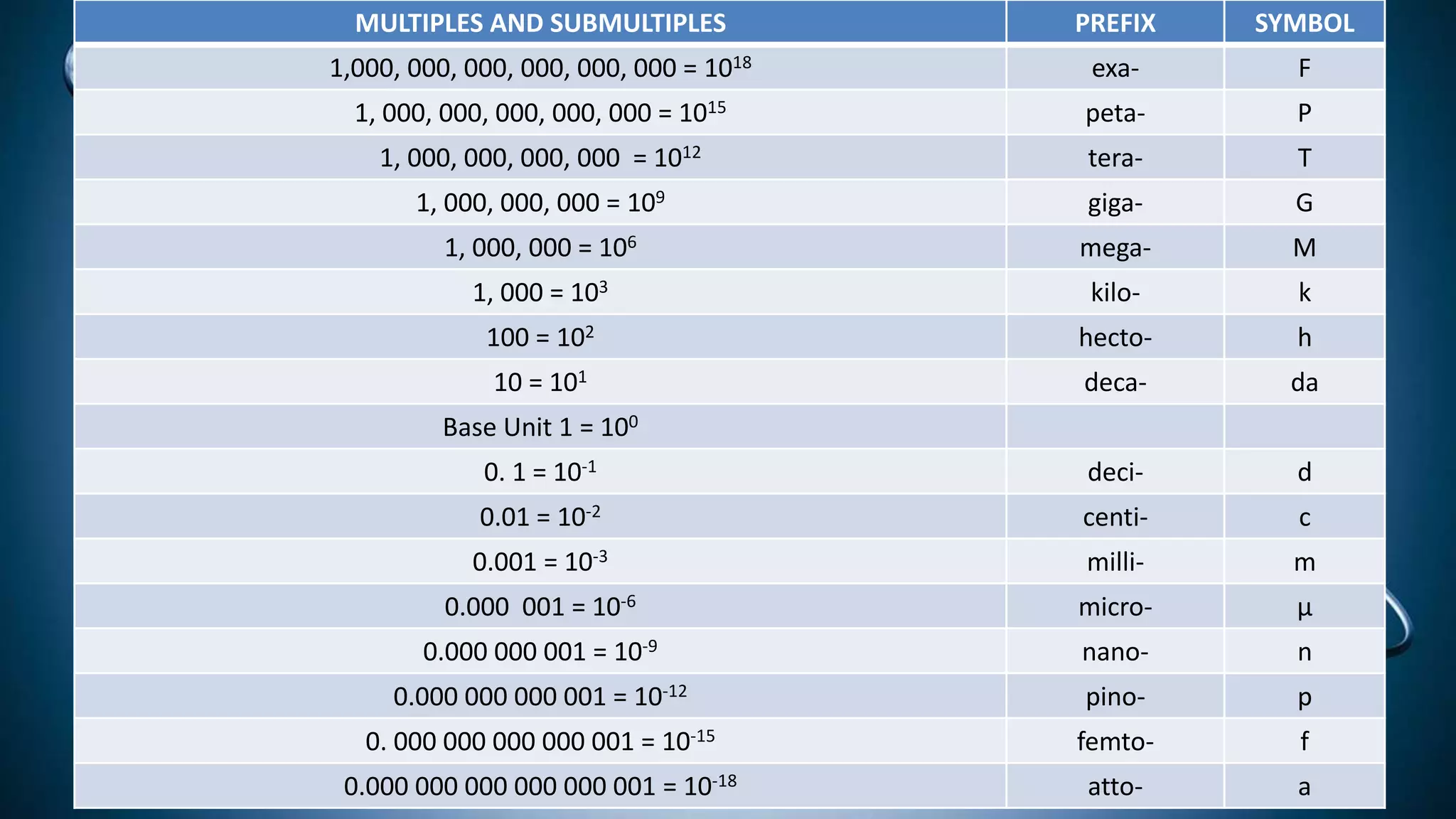
MULTIPLES AND SUBMULTIPLES PREFIX SYMBOL
1,000, 000, 000, 000, 000, 000 = 1018 exa- F
1, 000, 000, 000, 000, 000 = 1015 peta- P
1, 000, 000, 000, 000 = 1012 tera- T
1, 000, 000, 000 = 109 giga- G
1, 000, 000 = 106 mega- M
1, 000 = 103 kilo- k
100 = 102 hecto- h
10 = 101 deca- da
Base Unit 1 = 100
0. 1 = 10-1 deci- d
0.01 = 10-2 centi- c
0.001 = 10-3 milli- m
0.000 001 = 10-6 micro- µ
0.000 000 001 = 10-9 nano- n
0.000 000 000 001 = 10-12 pino- p
0. 000 000 000 000 001 = 10-15 femto- f
0.000 000 000 000 000 001 = 10-18 atto- a
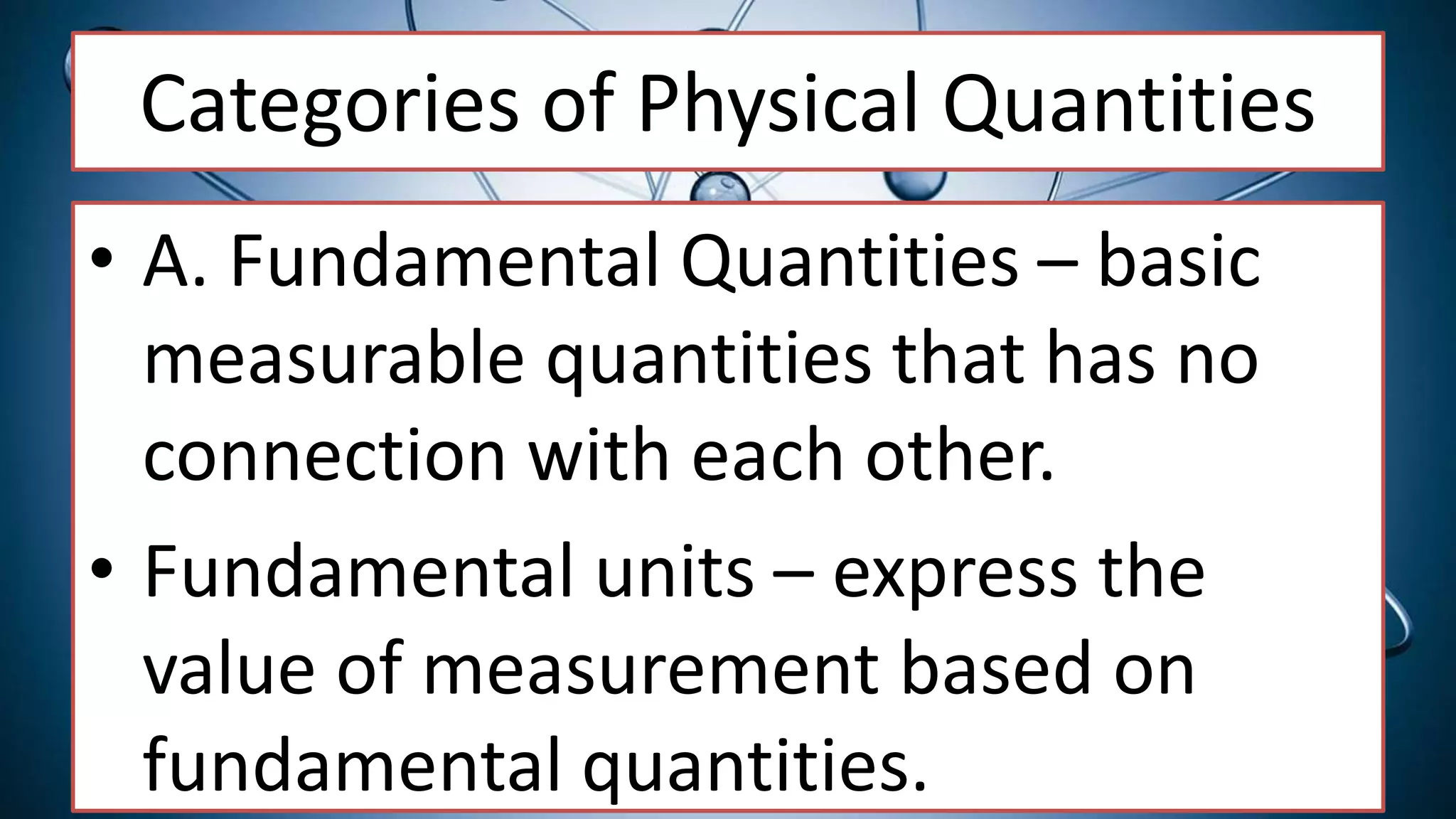
Categories of Physical Quantities
• A. Fundamental Quantities – basic
measurable quantities that has no
connection with each other.
• Fundamental units – express the
value of measurement based on
fundamental quantities.
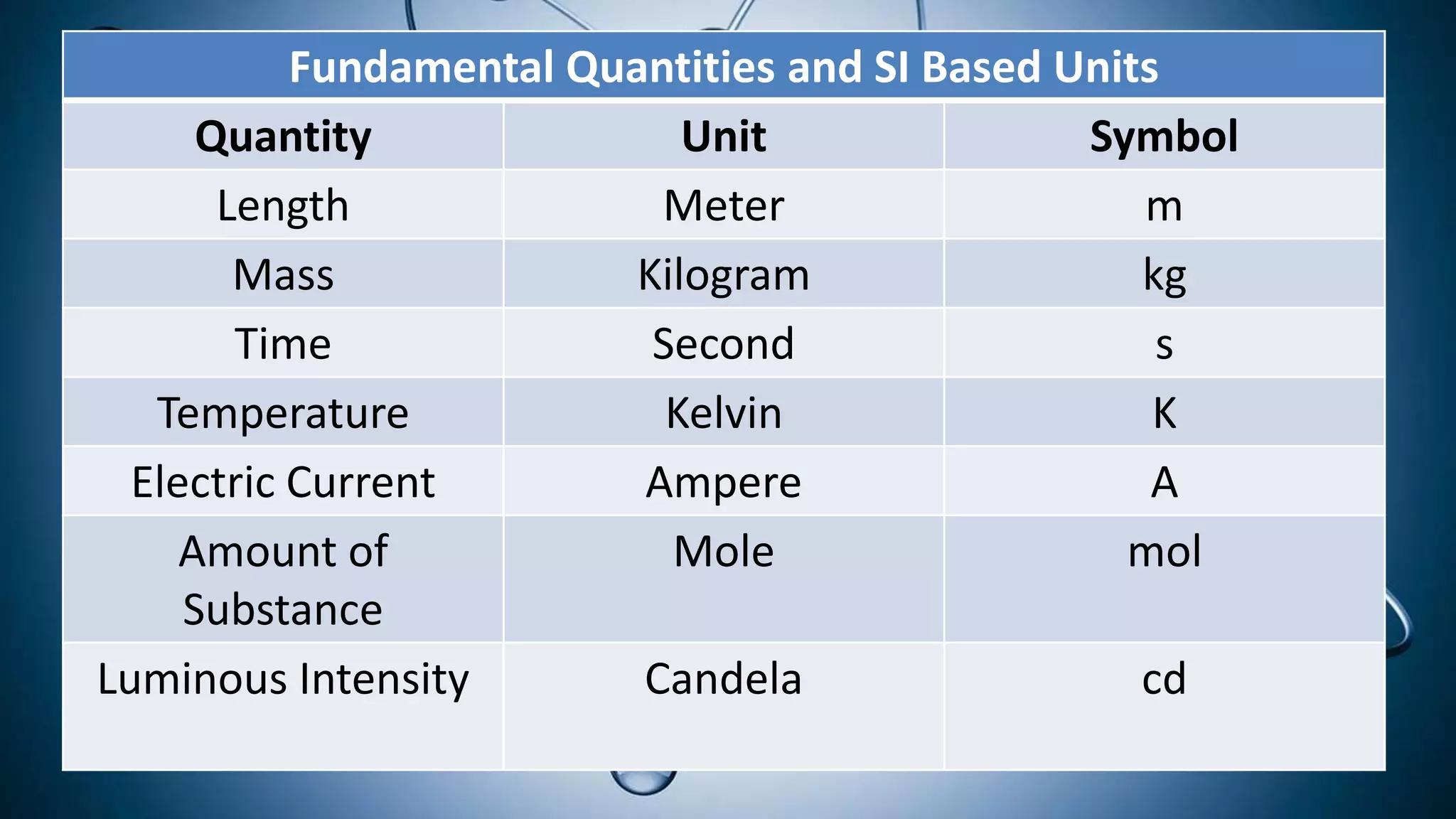
Fundamental Quantities and SI Based Units
Quantity Unit Symbol
Length Meter m
Mass Kilogram kg
Time Second s
Temperature Kelvin K
Electric Current Ampere A
Amount of
Substance
Mole mol
Luminous Intensity Candela cd
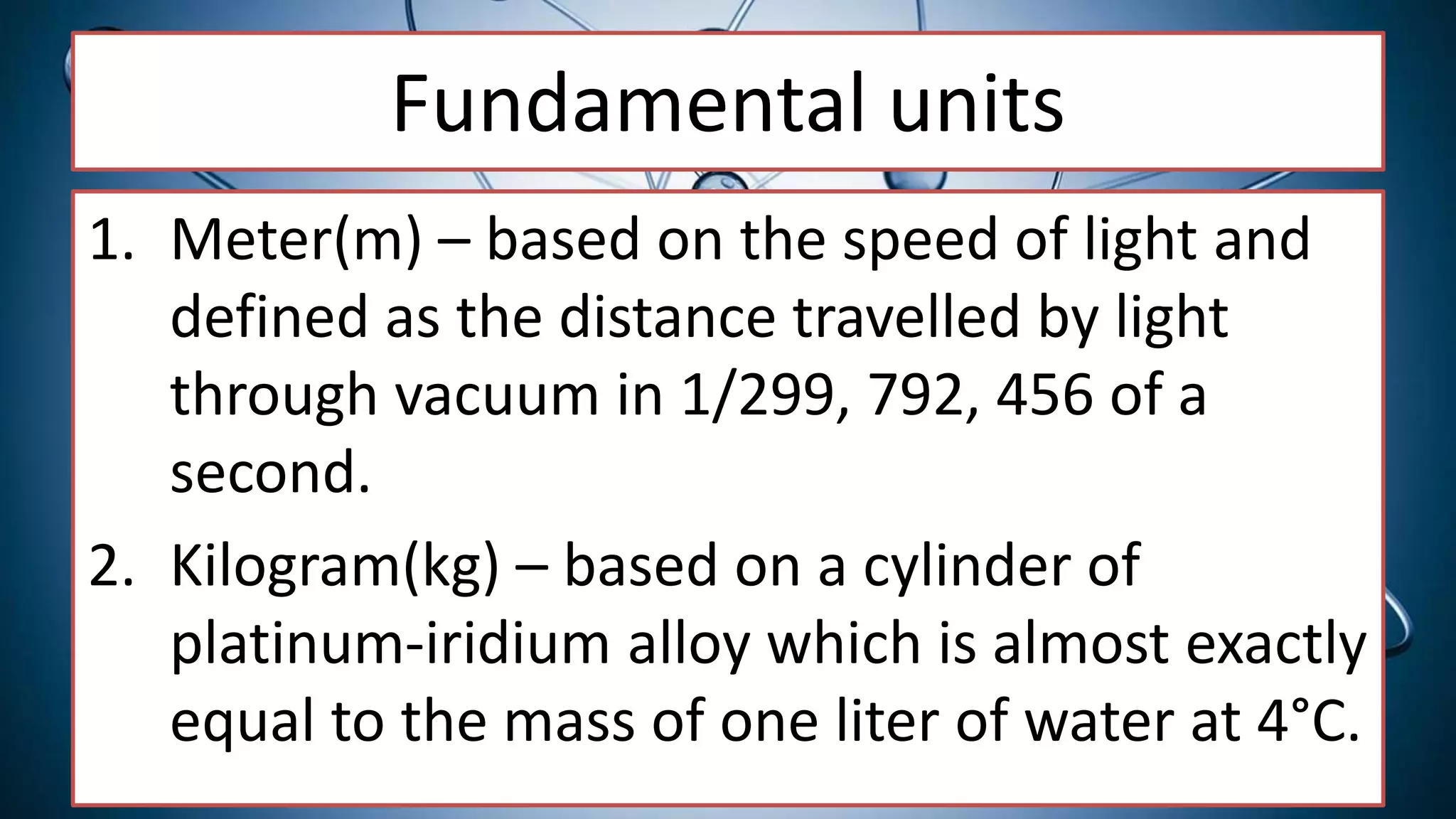
Fundamental units
1. Meter(m) – based on the speed of light and
defined as the distance travelled by light
through vacuum in 1/299, 792, 456 of a
second.
2. Kilogram(kg) – based on a cylinder of
platinum-iridium alloy which is almost exactly
equal to the mass of one liter of water at 4°C.
Fundamental units
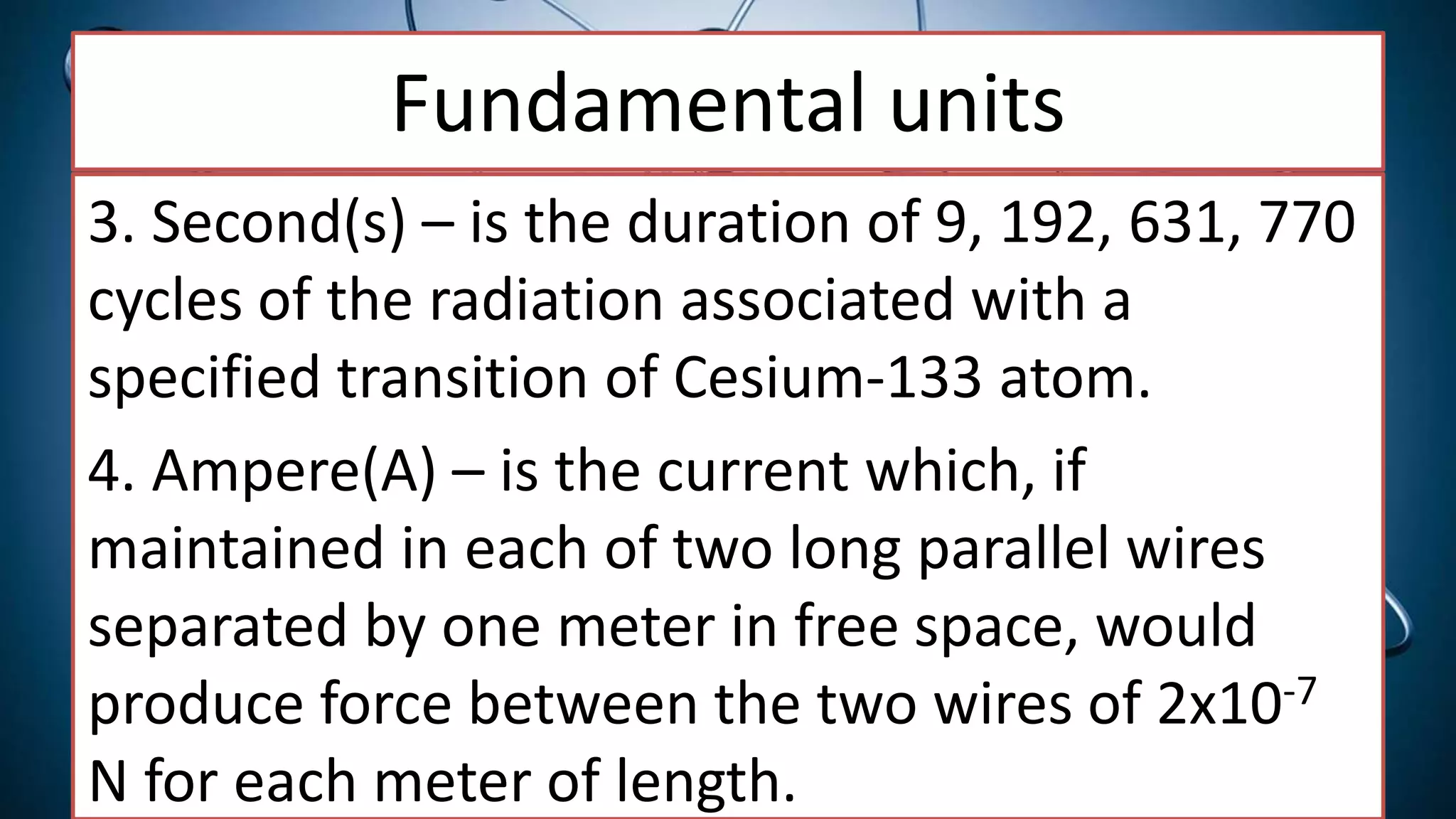
3. Second(s) – is the duration of 9, 192, 631, 770
cycles of the radiation associated with a
specified transition of Cesium-133 atom.
4. Ampere(A) – is the current which, if
maintained in each of two long parallel wires
separated by one meter in free space, would
produce force between the two wires of 2x10⁻⁷
N for each meter of length.
Fundamental units
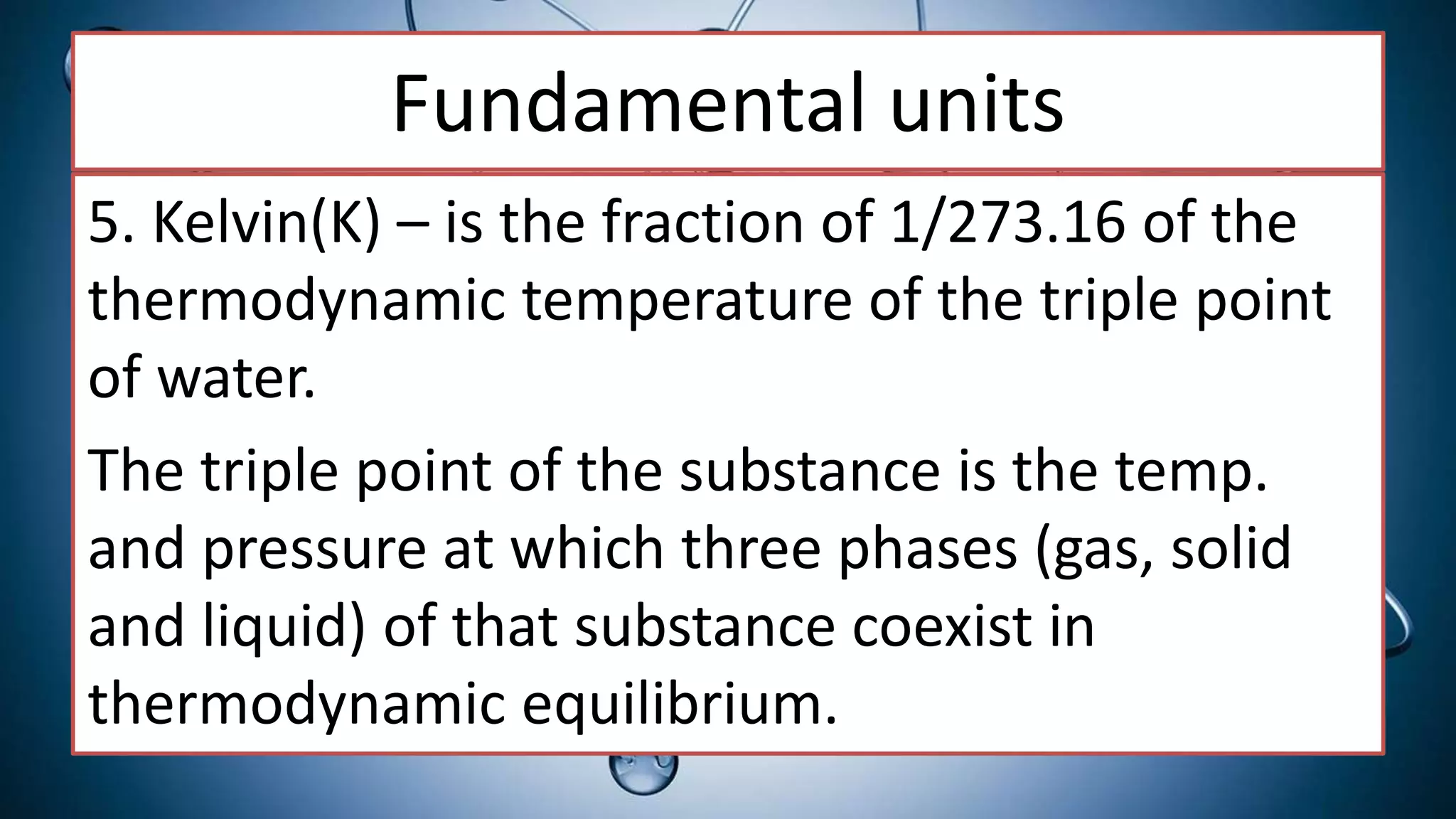
5. Kelvin(K) – is the fraction of 1/273.16 of the
thermodynamic temperature of the triple point
of water.
The triple point of the substance is the temp.
and pressure at which three phases (gas, solid
and liquid) of that substance coexist in
thermodynamic equilibrium.
Fundamental units
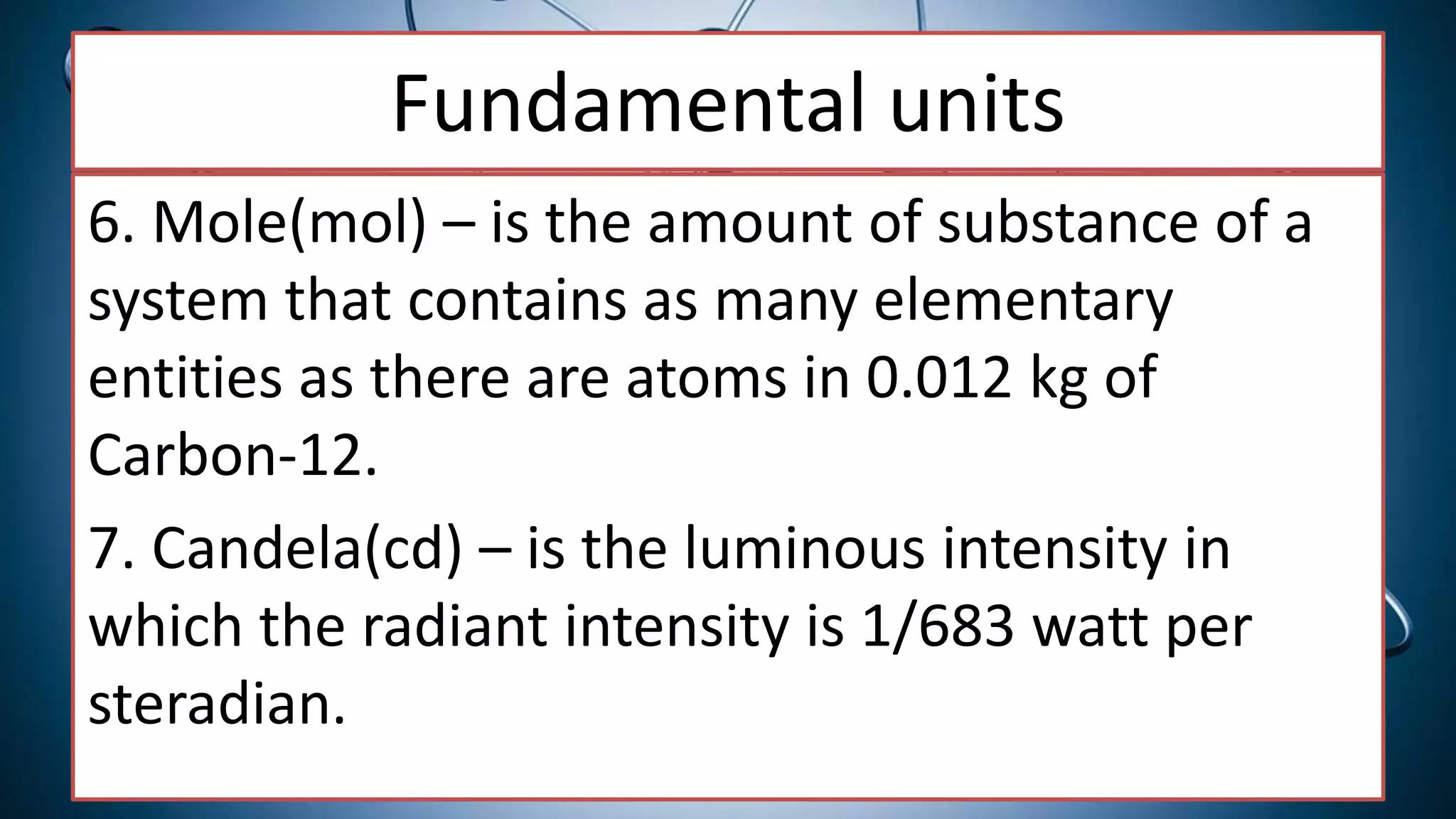
6. Mole(mol) – is the amount of substance of a
system that contains as many elementary
entities as there are atoms in 0.012 kg of
Carbon-12.
7. Candela(cd) – is the luminous intensity in
which the radiant intensity is 1/683 watt per
steradian.
Categories of Physical Quantities
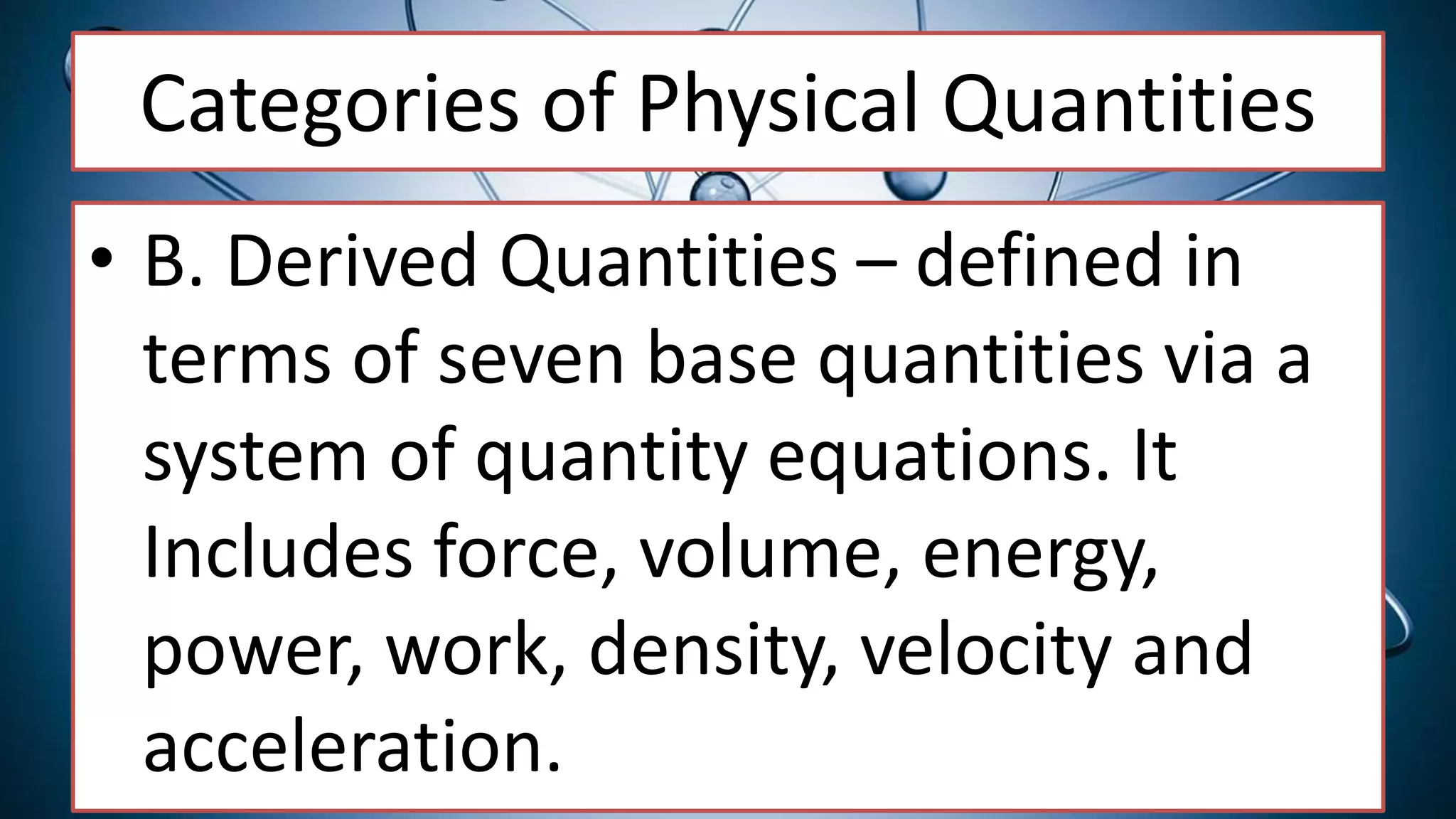
• B. Derived Quantities – defined in
terms of seven base quantities via a
system of quantity equations. It
Includes force, volume, energy,
power, work, density, velocity and
acceleration.
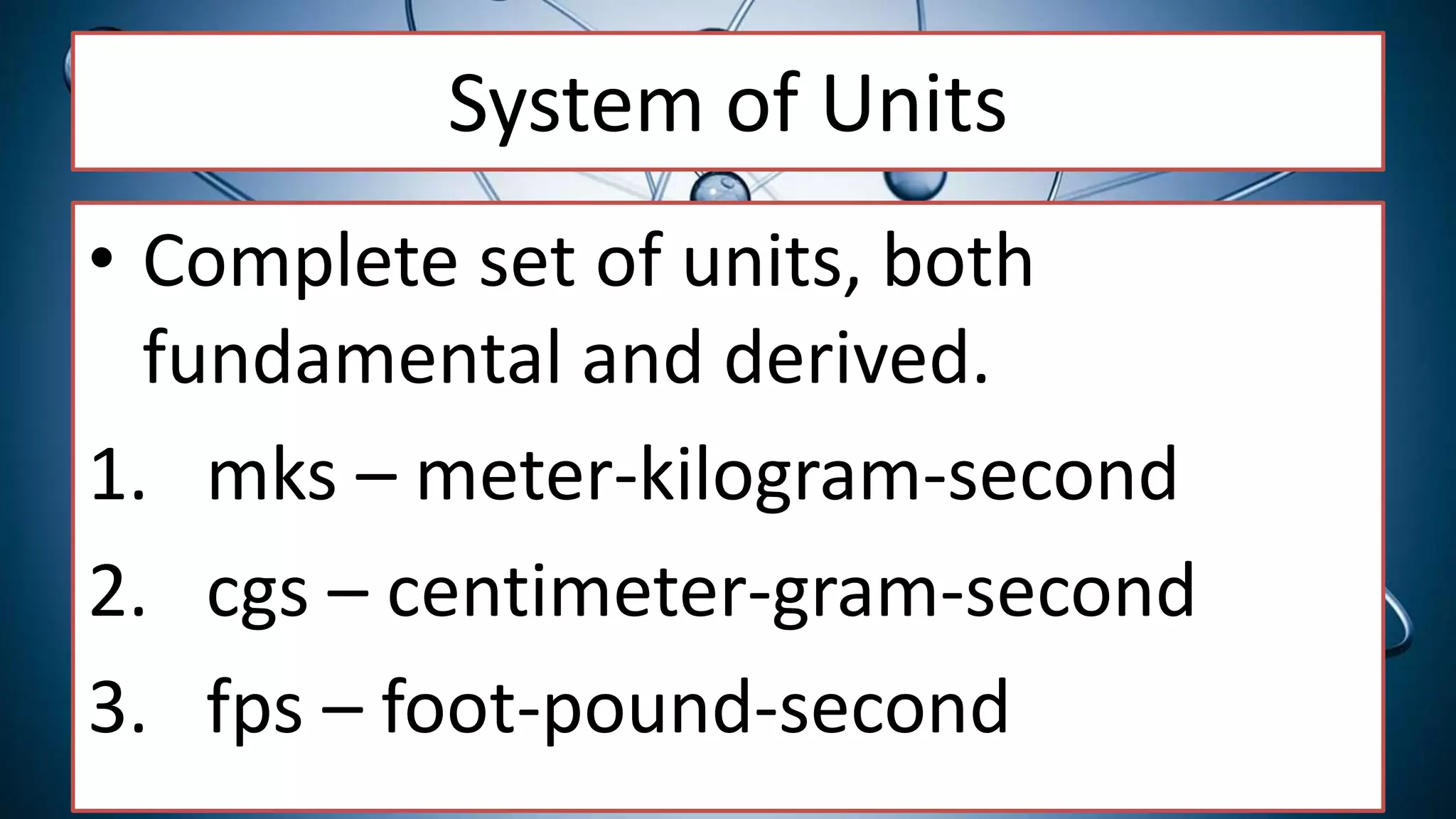
System of Units
• Complete set of units, both
fundamental and derived.
1. mks – meter-kilogram-second
2. cgs – centimeter-gram-second
3. fps – foot-pound-second
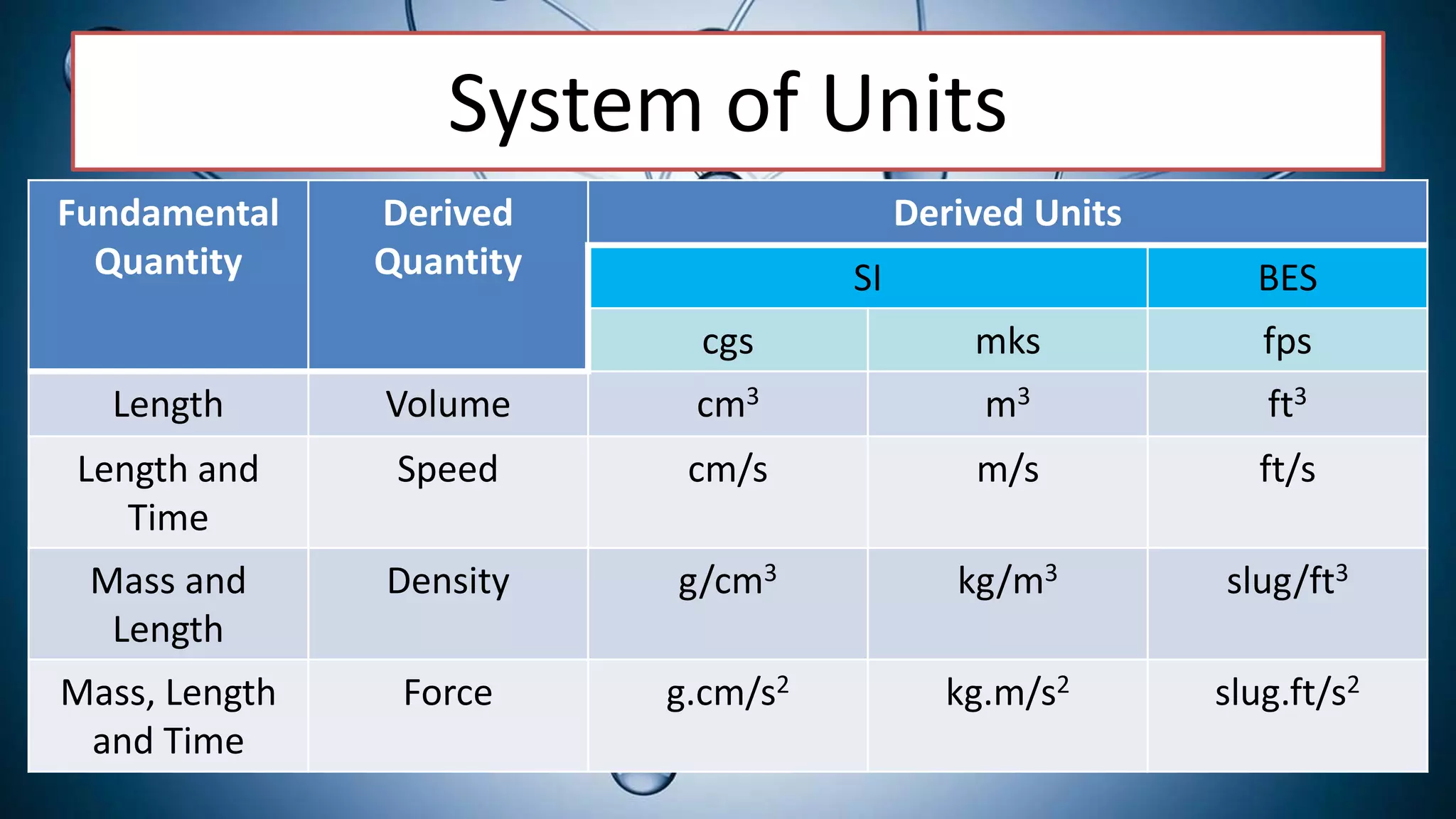
System of Units
Fundamental
Quantity
Derived
Quantity
Derived Units
SI BES
cgs mks fps
Length Volume cm3 m3 ft3
Length and
Time
Speed cm/s m/s ft/s
Mass and
Length
Density g/cm3 kg/m3 slug/ft3
Mass, Length
and Time
Force g.cm/s2 kg.m/s2 slug.ft/s2

Physics - Introduction, Branches and Basic Ideas

  • 1.
  • 2.
    • Physics dealswith the study of matter and energy and their interactions. • It explains and describes the physical happenings in the universe. • It can also be defined as science of measurement.
  • 3.
    Branches of Physics A.Classical Physics – deterministic – it maintains that things can be measured precisely and known with certainty.
  • 4.
    Classical Physics 1. Mechanics– study of forces. a. Kinematics – quantitative description of motion. b. Statics – study of forces at rest. c. Dynamics – how motion is brought about.
  • 5.
    Classical Physics 2. Optics– study of light a. Physical – nature properties and propagation of light. b. Physiological – vision c. Geometrical – reflection and refraction in mirrors and lenses.
  • 6.
    Classical Physics 3. Acoustics– study of nature and propagation of sound waves. 4. Thermodynamics – study of temperature and energy, heat flow and transformation of heat energy.
  • 7.
    Classical Physics 3. Electromagnetism– properties and relationship of electric current and magnetism. a. Electrostatics – electric charge at rest. b. Electrodynamics - moving charges
  • 8.
  • 9.
    • Measurement isa quantitative description of a fundamental property. • Used to describe quantities that can be measured out of matter such as length, mass, time, force, weight, volume, temperature, luminous intensity, etc.
  • 10.
    Systems of Measurement •1. English System aka British Engineering System Used familiar objects and human body parts as measuring devices. Common household items such as cups, gallons and baskets were used to measure capacities.
  • 11.
    Systems of Measurement •2. Metric System From the Gr word metron – measure. Most convenient and accurate because it uses prefixes and standard unit of measurement. International System of Measurement (SI) – modernized version.
  • 12.
  • 13.
    MULTIPLES AND SUBMULTIPLESPREFIX SYMBOL 1,000, 000, 000, 000, 000, 000 = 1018 exa- F 1, 000, 000, 000, 000, 000 = 1015 peta- P 1, 000, 000, 000, 000 = 1012 tera- T 1, 000, 000, 000 = 109 giga- G 1, 000, 000 = 106 mega- M 1, 000 = 103 kilo- k 100 = 102 hecto- h 10 = 101 deca- da Base Unit 1 = 100 0. 1 = 10-1 deci- d 0.01 = 10-2 centi- c 0.001 = 10-3 milli- m 0.000 001 = 10-6 micro- µ 0.000 000 001 = 10-9 nano- n 0.000 000 000 001 = 10-12 pino- p 0. 000 000 000 000 001 = 10-15 femto- f 0.000 000 000 000 000 001 = 10-18 atto- a
  • 14.
    Categories of PhysicalQuantities • A. Fundamental Quantities – basic measurable quantities that has no connection with each other. • Fundamental units – express the value of measurement based on fundamental quantities.
  • 15.
    Fundamental Quantities andSI Based Units Quantity Unit Symbol Length Meter m Mass Kilogram kg Time Second s Temperature Kelvin K Electric Current Ampere A Amount of Substance Mole mol Luminous Intensity Candela cd
  • 16.
    Fundamental units 1. Meter(m)– based on the speed of light and defined as the distance travelled by light through vacuum in 1/299, 792, 456 of a second. 2. Kilogram(kg) – based on a cylinder of platinum-iridium alloy which is almost exactly equal to the mass of one liter of water at 4°C.
  • 17.
    Fundamental units 3. Second(s)– is the duration of 9, 192, 631, 770 cycles of the radiation associated with a specified transition of Cesium-133 atom. 4. Ampere(A) – is the current which, if maintained in each of two long parallel wires separated by one meter in free space, would produce force between the two wires of 2x10⁻⁷ N for each meter of length.
  • 18.
    Fundamental units 5. Kelvin(K)– is the fraction of 1/273.16 of the thermodynamic temperature of the triple point of water. The triple point of the substance is the temp. and pressure at which three phases (gas, solid and liquid) of that substance coexist in thermodynamic equilibrium.
  • 19.
    Fundamental units 6. Mole(mol)– is the amount of substance of a system that contains as many elementary entities as there are atoms in 0.012 kg of Carbon-12. 7. Candela(cd) – is the luminous intensity in which the radiant intensity is 1/683 watt per steradian.
  • 20.
    Categories of PhysicalQuantities • B. Derived Quantities – defined in terms of seven base quantities via a system of quantity equations. It Includes force, volume, energy, power, work, density, velocity and acceleration.
  • 21.
    System of Units •Complete set of units, both fundamental and derived. 1. mks – meter-kilogram-second 2. cgs – centimeter-gram-second 3. fps – foot-pound-second
  • 22.
    System of Units Fundamental Quantity Derived Quantity DerivedUnits SI BES cgs mks fps Length Volume cm3 m3 ft3 Length and Time Speed cm/s m/s ft/s Mass and Length Density g/cm3 kg/m3 slug/ft3 Mass, Length and Time Force g.cm/s2 kg.m/s2 slug.ft/s2