0


       Chapter 5

Light and Telescopes
Astronomical Telescopes
                                                           0


                                       • Primary objective: to
                                         gather large amounts
                                         of light
                                       => large telescopes!
                                     • Other forms of
                                       radiation (other than
                                       visible light) can also
                                       be observed, but
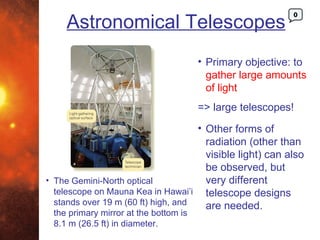
• The Gemini-North optical             very different
  telescope on Mauna Kea in Hawai’i telescope designs
  stands over 19 m (60 ft) high, and   are needed.
 the primary mirror at the bottom is
 8.1 m (26.5 ft) in diameter.
Radiation: Information
                                                   0


          from Space
    The Electromagnetic Spectrum

• In astronomy, we cannot perform experiments
  with our objects (stars, galaxies, …).


• The only way to investigate them is by
  analyzing the light (and other radiation) they
  emit.
Light as a Wave (I)                  0


•   Light waves are characterized by a
     wavelength λ and a frequency f.

•    f and λ are related through

                f = c/λ
             c = 300,000 km/s
               = 3 ×10⁸ m/s
Wavelengths and Colors                     0


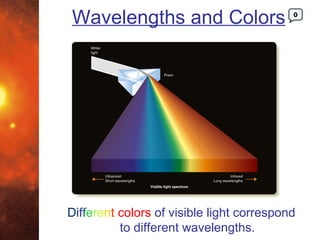
Different colors of visible light correspond
          to different wavelengths.
0

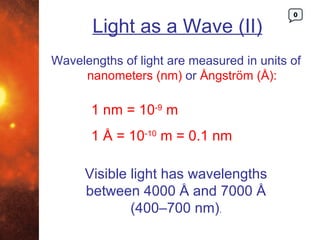
       Light as a Wave (II)
Wavelengths of light are measured in units of
     nanometers (nm) or Ångström (Å):

       1 nm = 10-9 m
       1 Å = 10-10 m = 0.1 nm

      Visible light has wavelengths
      between 4000 Å and 7000 Å
              (400–700 nm).
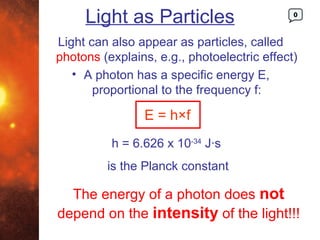
Light as Particles                      0


Light can also appear as particles, called
photons (explains, e.g., photoelectric effect)
   • A photon has a specific energy E,
       proportional to the frequency f:

                E = h×f
          h = 6.626 x 10⁻³⁴ J·s
         is the Planck constant

  The energy of a photon does not
depend on the intensity of the light!!!
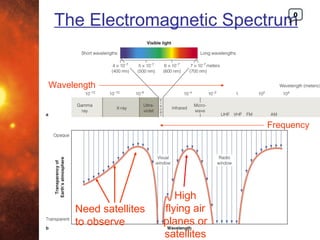
The Electromagnetic Spectrum            0


Wavelength


                                    Frequency


                          High
     Need satellites   flying air
     to observe        planes or
                       satellites
0
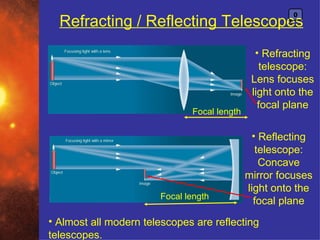
  Refracting / Reflecting Telescopes
                                               • Refracting
                                                telescope:
                                              Lens focuses
                                              light onto the
                                                focal plane
                              Focal length

                                              • Reflecting
                                               telescope:
                                                Concave
                                             mirror focuses
                                             light onto the
                       Focal length
                                               focal plane
• Almost all modern telescopes are reflecting
telescopes.
0

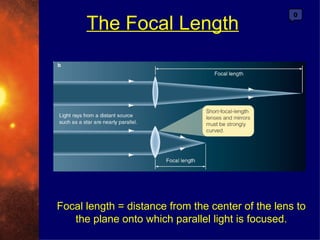
      The Focal Length


Focal length = distance from the center of the lens to
   the plane onto which parallel light is focused.
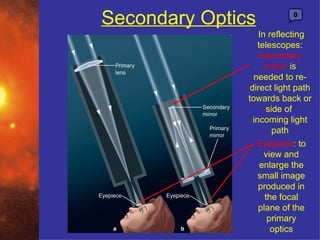
Secondary Optics           0


                   In reflecting
                   telescopes:
                   Secondary
                     mirror is
                 needed to re-
                direct light path
               towards back or
                     side of
                 incoming light
                       path
                  Eyepiece: to
                     view and
                    enlarge the
                   small image
                   produced in
                     the focal
                   plane of the
                      primary
                       optics
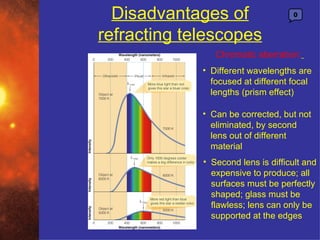
Disadvantages of                  0


refracting telescopes
                Chromatic aberration:
             • Different wavelengths are
               focused at different focal
               lengths (prism effect)

             • Can be corrected, but not
               eliminated, by second
               lens out of different
               material
             • Second lens is difficult and
               expensive to produce; all
               surfaces must be perfectly
               shaped; glass must be
               flawless; lens can only be
               supported at the edges
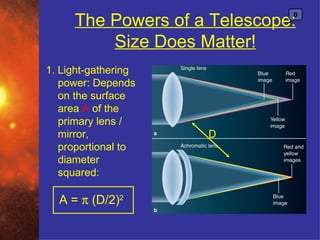
The Powers of a Telescope:
                              0


         Size Does Matter!
1. Light-gathering
   power: Depends
   on the surface
   area A of the
   primary lens /
   mirror,           D
   proportional to
   diameter
   squared:

  A = π (D/2)2
The Powers of a Telescope (II)              0


2. Resolving power: Wave
   nature of light => the
   telescope aperture
   produces fringe rings that
   set a limit to the resolution
   of the telescope
   Resolving power = minimum
   angular distance αmin between two
   objects that can be separated


αmin = 1.22 (λ/D)                      αmin
For optical wavelengths, this gives

αmin = 11.6 arcsec / D[cm]
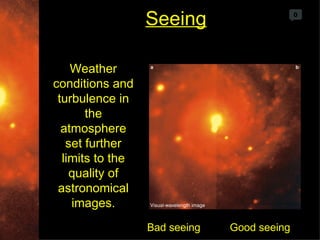
Seeing                     0


    Weather
conditions and
 turbulence in
       the
  atmosphere
   set further
  limits to the
    quality of
 astronomical
    images.
                  Bad seeing   Good seeing
0
 The Powers of a Telescope (III)
3. Magnifying Power: The ability of the
  telescope to make the image appear bigger.

     • The magnification depends on the ratio of focal
       lengths of the primary mirror/lens (Fo) and the
                       eyepiece (Fe):
                  M = Fo/Fe


 •   A larger magnification does not improve the
           resolving power of the telescope!
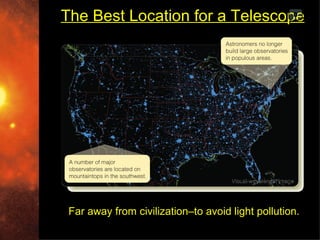
The Best Location for a Telescope                  0


 Far away from civilization–to avoid light pollution.
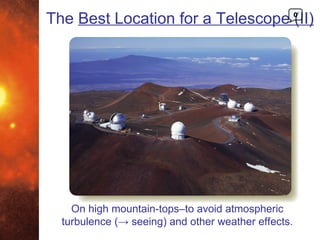
The Best Location for a Telescope (II)               0


    On high mountain-tops–to avoid atmospheric
  turbulence (→ seeing) and other weather effects.
Infrared Telescopes
                                           0


• Most infrared radiation is absorbed in
 the lower atmosphere.

• However, from high mountain tops or
  high-flying air planes, some infrared
  radiation can still be observed.
Infrared Telescopes
                                       0


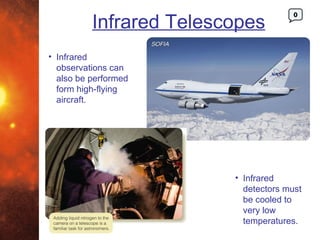
• Infrared
  observations can
  also be performed
  form high-flying
  aircraft.


                         • Infrared
                           detectors must
                           be cooled to
                           very low
                           temperatures.
0

Traditional Telescopes (I)


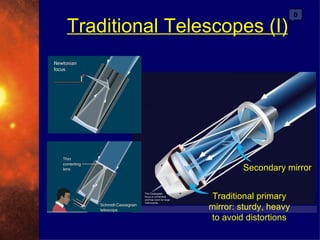
                        Secondary mirror


                 Traditional primary
                mirror: sturdy, heavy
                to avoid distortions
0


Traditional
Telescopes


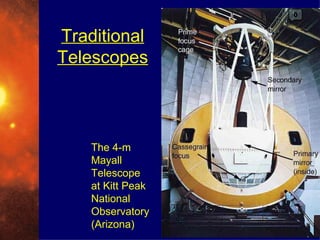
    The 4-m
    Mayall
    Telescope
    at Kitt Peak
    National
    Observatory
    (Arizona)
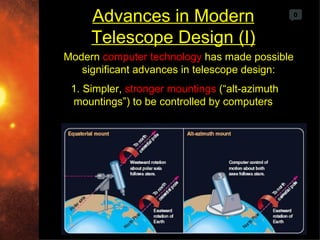
Advances in Modern                         0


     Telescope Design (I)
Modern computer technology has made possible
   significant advances in telescope design:
 1. Simpler, stronger mountings (“alt-azimuth
 mountings”) to be controlled by computers
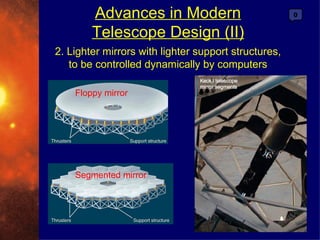
Advances in Modern                            0


        Telescope Design (II)
2. Lighter mirrors with lighter support structures,
   to be controlled dynamically by computers

    Floppy mirror


    Segmented mirror
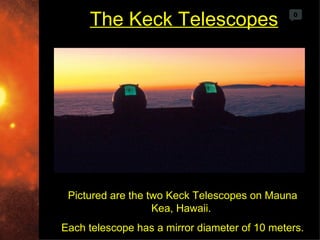
The Keck Telescopes                       0


 Pictured are the two Keck Telescopes on Mauna
                   Kea, Hawaii.
Each telescope has a mirror diameter of 10 meters.
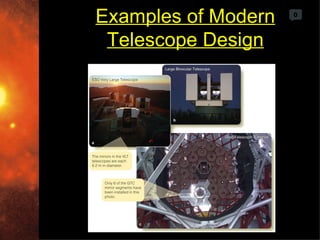
Examples of Modern   0


 Telescope Design
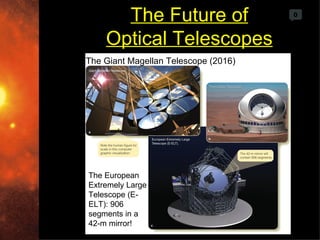
The Future of                   0


    Optical Telescopes
The Giant Magellan Telescope (2016)


The European
Extremely Large
Telescope (E-
ELT): 906
segments in a
42-m mirror!
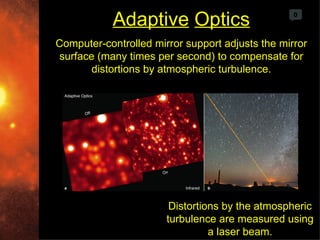
Adaptive Optics                       0


Computer-controlled mirror support adjusts the mirror
surface (many times per second) to compensate for
       distortions by atmospheric turbulence.


                        Distortions by the atmospheric
                       turbulence are measured using
                                 a laser beam.
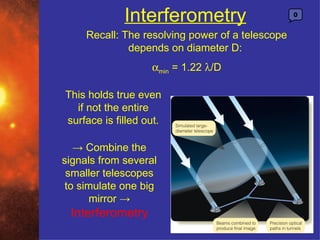
Interferometry                       0


     Recall: The resolving power of a telescope
              depends on diameter D:
                   αmin = 1.22 λ/D

This holds true even
  if not the entire
surface is filled out.

   → Combine the
signals from several
 smaller telescopes
 to simulate one big
      mirror →
 Interferometry
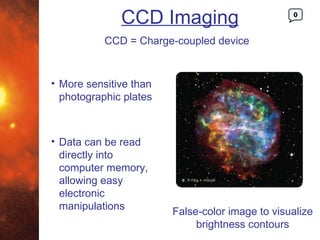
CCD Imaging                        0


           CCD = Charge-coupled device


• More sensitive than
  photographic plates


• Data can be read
  directly into
  computer memory,
  allowing easy
  electronic
  manipulations
                        False-color image to visualize
                             brightness contours
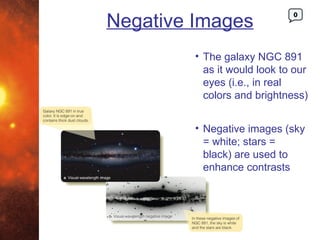
Negative Images
                              0


         • The galaxy NGC 891
           as it would look to our
           eyes (i.e., in real
           colors and brightness)


         • Negative images (sky
           = white; stars =
           black) are used to
           enhance contrasts
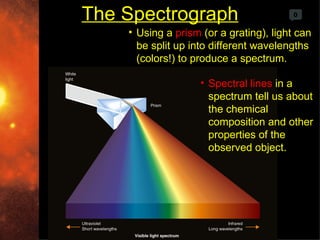
The Spectrograph                         0


    • Using a prism (or a grating), light can
      be split up into different wavelengths
      (colors!) to produce a spectrum.

                    • Spectral lines in a
                      spectrum tell us about
                      the chemical
                      composition and other
                      properties of the
                      observed object.
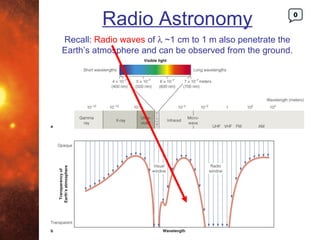
Radio Astronomy                                   0


Recall: Radio waves of λ ~1 cm to 1 m also penetrate the
Earth’s atmosphere and can be observed from the ground.
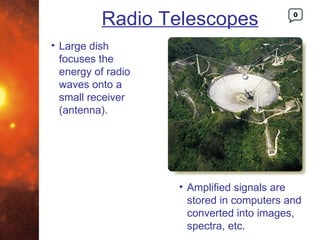
Radio Telescopes                 0


• Large dish
  focuses the
  energy of radio
  waves onto a
  small receiver
  (antenna).


                    • Amplified signals are
                      stored in computers and
                      converted into images,
                      spectra, etc.
Radio Maps                               0


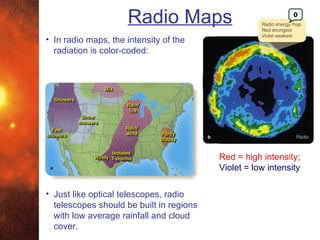
• In radio maps, the intensity of the
  radiation is color-coded:


                                          Red = high intensity;
                                          Violet = low intensity

• Just like optical telescopes, radio
  telescopes should be built in regions
  with low average rainfall and cloud
  cover.
Radio Interferometry                          0


• Just as for optical
  telescopes, the
  resolving power
  of a radio
  telescope is αmin
  = 1.22 λ/D.

• For radio
  telescopes, this is
  a big problem:
  radio waves are
  much longer than
  visible light.
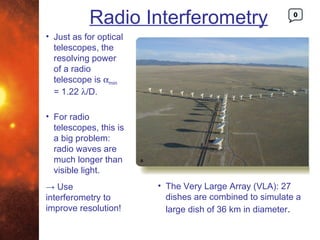
→ Use                   • The Very Large Array (VLA): 27
interferometry to         dishes are combined to simulate a
improve resolution!       large dish of 36 km in diameter.
Science of Radio Astronomy
                                               0


  Radio astronomy reveals several features,
  not visible at other wavelengths:

  • Neutral hydrogen clouds (which don’t
    emit any visible light), containing ~90%
    of all the atoms in the Universe

  • Molecules (often located in dense
    clouds, where visible light is
    completely absorbed)

  • Radio waves penetrate gas and
    dust clouds, so we can observe
    regions from which visible light is
    heavily absorbed
Observatories in Space (I)                0


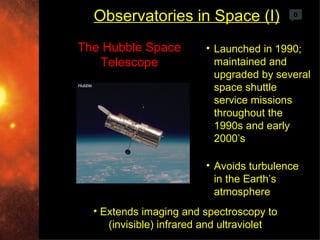
The Hubble Space         • Launched in 1990;
   Telescope               maintained and
                           upgraded by several
                           space shuttle
                           service missions
                           throughout the
                           1990s and early
                           2000’s

                         • Avoids turbulence
                           in the Earth’s
                           atmosphere
  • Extends imaging and spectroscopy to
     (invisible) infrared and ultraviolet
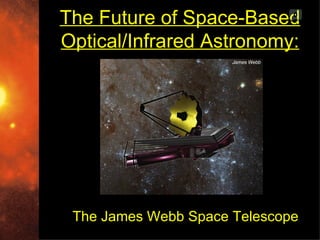
The Future of Space-Based     0


Optical/Infrared Astronomy:


 The James Webb Space Telescope
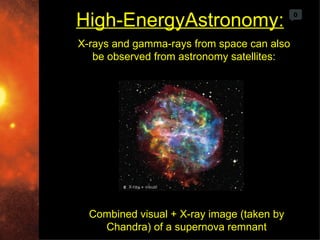
High-EnergyAstronomy:                       0


X-rays and gamma-rays from space can also
   be observed from astronomy satellites:


  Combined visual + X-ray image (taken by
    Chandra) of a supernova remnant

Light and Telescopes

  • 1.
    0 Chapter 5 Light and Telescopes
  • 2.
    Astronomical Telescopes 0 • Primary objective: to gather large amounts of light => large telescopes! • Other forms of radiation (other than visible light) can also be observed, but • The Gemini-North optical very different telescope on Mauna Kea in Hawai’i telescope designs stands over 19 m (60 ft) high, and are needed. the primary mirror at the bottom is 8.1 m (26.5 ft) in diameter.
  • 3.
    Radiation: Information 0 from Space The Electromagnetic Spectrum • In astronomy, we cannot perform experiments with our objects (stars, galaxies, …). • The only way to investigate them is by analyzing the light (and other radiation) they emit.
  • 4.
    Light as aWave (I) 0 • Light waves are characterized by a wavelength λ and a frequency f. • f and λ are related through f = c/λ c = 300,000 km/s = 3 ×10⁸ m/s
  • 5.
    Wavelengths and Colors 0 Different colors of visible light correspond to different wavelengths.
  • 6.
    0 Light as a Wave (II) Wavelengths of light are measured in units of nanometers (nm) or Ångström (Å): 1 nm = 10-9 m 1 Å = 10-10 m = 0.1 nm Visible light has wavelengths between 4000 Å and 7000 Å (400–700 nm).
  • 7.
    Light as Particles 0 Light can also appear as particles, called photons (explains, e.g., photoelectric effect) • A photon has a specific energy E, proportional to the frequency f: E = h×f h = 6.626 x 10⁻³⁴ J·s is the Planck constant The energy of a photon does not depend on the intensity of the light!!!
  • 8.
    The Electromagnetic Spectrum 0 Wavelength Frequency High Need satellites flying air to observe planes or satellites
  • 9.
    0 Refracting/ Reflecting Telescopes • Refracting telescope: Lens focuses light onto the focal plane Focal length • Reflecting telescope: Concave mirror focuses light onto the Focal length focal plane • Almost all modern telescopes are reflecting telescopes.
  • 10.
    0 The Focal Length Focal length = distance from the center of the lens to the plane onto which parallel light is focused.
  • 11.
    Secondary Optics 0 In reflecting telescopes: Secondary mirror is needed to re- direct light path towards back or side of incoming light path Eyepiece: to view and enlarge the small image produced in the focal plane of the primary optics
  • 12.
    Disadvantages of 0 refracting telescopes Chromatic aberration: • Different wavelengths are focused at different focal lengths (prism effect) • Can be corrected, but not eliminated, by second lens out of different material • Second lens is difficult and expensive to produce; all surfaces must be perfectly shaped; glass must be flawless; lens can only be supported at the edges
  • 13.
    The Powers ofa Telescope: 0 Size Does Matter! 1. Light-gathering power: Depends on the surface area A of the primary lens / mirror, D proportional to diameter squared: A = π (D/2)2
  • 14.
    The Powers ofa Telescope (II) 0 2. Resolving power: Wave nature of light => the telescope aperture produces fringe rings that set a limit to the resolution of the telescope Resolving power = minimum angular distance αmin between two objects that can be separated αmin = 1.22 (λ/D) αmin For optical wavelengths, this gives αmin = 11.6 arcsec / D[cm]
  • 15.
    Seeing 0 Weather conditions and turbulence in the atmosphere set further limits to the quality of astronomical images. Bad seeing Good seeing
  • 16.
    0 The Powersof a Telescope (III) 3. Magnifying Power: The ability of the telescope to make the image appear bigger. • The magnification depends on the ratio of focal lengths of the primary mirror/lens (Fo) and the eyepiece (Fe): M = Fo/Fe • A larger magnification does not improve the resolving power of the telescope!
  • 17.
    The Best Locationfor a Telescope 0 Far away from civilization–to avoid light pollution.
  • 18.
    The Best Locationfor a Telescope (II) 0 On high mountain-tops–to avoid atmospheric turbulence (→ seeing) and other weather effects.
  • 19.
    Infrared Telescopes 0 • Most infrared radiation is absorbed in the lower atmosphere. • However, from high mountain tops or high-flying air planes, some infrared radiation can still be observed.
  • 20.
    Infrared Telescopes 0 • Infrared observations can also be performed form high-flying aircraft. • Infrared detectors must be cooled to very low temperatures.
  • 21.
    0 Traditional Telescopes (I) Secondary mirror Traditional primary mirror: sturdy, heavy to avoid distortions
  • 22.
    0 Traditional Telescopes The 4-m Mayall Telescope at Kitt Peak National Observatory (Arizona)
  • 23.
    Advances in Modern 0 Telescope Design (I) Modern computer technology has made possible significant advances in telescope design: 1. Simpler, stronger mountings (“alt-azimuth mountings”) to be controlled by computers
  • 24.
    Advances in Modern 0 Telescope Design (II) 2. Lighter mirrors with lighter support structures, to be controlled dynamically by computers Floppy mirror Segmented mirror
  • 25.
    The Keck Telescopes 0 Pictured are the two Keck Telescopes on Mauna Kea, Hawaii. Each telescope has a mirror diameter of 10 meters.
  • 26.
    Examples of Modern 0 Telescope Design
  • 27.
    The Future of 0 Optical Telescopes The Giant Magellan Telescope (2016) The European Extremely Large Telescope (E- ELT): 906 segments in a 42-m mirror!
  • 28.
    Adaptive Optics 0 Computer-controlled mirror support adjusts the mirror surface (many times per second) to compensate for distortions by atmospheric turbulence. Distortions by the atmospheric turbulence are measured using a laser beam.
  • 29.
    Interferometry 0 Recall: The resolving power of a telescope depends on diameter D: αmin = 1.22 λ/D This holds true even if not the entire surface is filled out. → Combine the signals from several smaller telescopes to simulate one big mirror → Interferometry
  • 30.
    CCD Imaging 0 CCD = Charge-coupled device • More sensitive than photographic plates • Data can be read directly into computer memory, allowing easy electronic manipulations False-color image to visualize brightness contours
  • 31.
    Negative Images 0 • The galaxy NGC 891 as it would look to our eyes (i.e., in real colors and brightness) • Negative images (sky = white; stars = black) are used to enhance contrasts
  • 32.
    The Spectrograph 0 • Using a prism (or a grating), light can be split up into different wavelengths (colors!) to produce a spectrum. • Spectral lines in a spectrum tell us about the chemical composition and other properties of the observed object.
  • 33.
    Radio Astronomy 0 Recall: Radio waves of λ ~1 cm to 1 m also penetrate the Earth’s atmosphere and can be observed from the ground.
  • 34.
    Radio Telescopes 0 • Large dish focuses the energy of radio waves onto a small receiver (antenna). • Amplified signals are stored in computers and converted into images, spectra, etc.
  • 35.
    Radio Maps 0 • In radio maps, the intensity of the radiation is color-coded: Red = high intensity; Violet = low intensity • Just like optical telescopes, radio telescopes should be built in regions with low average rainfall and cloud cover.
  • 36.
    Radio Interferometry 0 • Just as for optical telescopes, the resolving power of a radio telescope is αmin = 1.22 λ/D. • For radio telescopes, this is a big problem: radio waves are much longer than visible light. → Use • The Very Large Array (VLA): 27 interferometry to dishes are combined to simulate a improve resolution! large dish of 36 km in diameter.
  • 37.
    Science of RadioAstronomy 0 Radio astronomy reveals several features, not visible at other wavelengths: • Neutral hydrogen clouds (which don’t emit any visible light), containing ~90% of all the atoms in the Universe • Molecules (often located in dense clouds, where visible light is completely absorbed) • Radio waves penetrate gas and dust clouds, so we can observe regions from which visible light is heavily absorbed
  • 38.
    Observatories in Space(I) 0 The Hubble Space • Launched in 1990; Telescope maintained and upgraded by several space shuttle service missions throughout the 1990s and early 2000’s • Avoids turbulence in the Earth’s atmosphere • Extends imaging and spectroscopy to (invisible) infrared and ultraviolet
  • 39.
    The Future ofSpace-Based 0 Optical/Infrared Astronomy: The James Webb Space Telescope
  • 40.
    High-EnergyAstronomy: 0 X-rays and gamma-rays from space can also be observed from astronomy satellites: Combined visual + X-ray image (taken by Chandra) of a supernova remnant