Chapter :01
PHYSICAL
QUANTITIES
AND
MEASUREMENT
BEFORE STARTING THIS
VEDIO LET ME TELL YOU
THAT:
Several hundred years ago, Galileo and Newton
both discovered important laws about gravity. In
this century, probably the most famous scientist
was Albert Einstein; his "Theory of Relativity"
talks about all the strange things that happen
when you're moving almost as fast as light, and a
lot of other cool stuff and their was only one
subject known as natural philosphy
Introduction to Physics
 The branch of science concerned with the
nature and properties of matter and energy.
 There are nine major branches of physics
 Science: the intellectual and practical
activity encompassing the systematic study
of the structure and behavior of the
physical and natural world through
observation and experiment. The word
is derived from the Latin word scienta.
 .
 .
BRANCHES
OF
PHYSICS
Mechanics
 Mechanics: It is the study of motion of
objects , its causes and effects.
 An example of mechanics is the
distance it takes for a car going 30mph
to stop.
Heat
 Heat: It deals with the nature of heat, modes
of transfer of heat and effects of heat. There
are three ways of transfer of heat(
CONVECTION, CONDUCTION,
RADIATION)
 The biggest example of heat energy in our
solar system is the sun itself. ..
Light
 Light(OPTICS): It is the study of
physical aspects of light,its properties,
working and use of optical instruments.
 There are many example we see in our
routine life carrying light
Sound
 A vibrating object will produce sound waves
in the air. For example, when the head of a
drum is hit with a mallet, the drumhead
vibrates and produces sound waves. The
vibrating drumhead produces sound waves
because it moves alternately outward and
inward, pushing against, then moving away
from, the air next to it.
Electricity and magnetism
 Electricity and magnetism the study of
the charges at rest and in motion, their
effects and their relationship with
magnetism.
Example of electricity and magnetism at
work is in an atom, since an electron is a
charge which moves about the nucleus, in
effect it forms a current loop, and hence a
magnetic field may be associated with an
individual atom.
Atomic Physics
 Atomic physics: It’s the study of
the structure and the
properties of atomsDalton's atomic theory proposed that all
matter was composed of atoms, indivisible
and indestructible building blocks. While
all atoms of an element were identical,
different elements had atoms of differing
size and mass
Plasma Physics
 Plasma physics: It’s the study of
production, properties of the ionic state
of matter-the fourth state of matter.
Plasma, in physics, an electrically conducting
medium in which there are roughly equal numbers
of positively and negatively charged particles,
produced when the atoms in a gas become
ionized. It is sometimes referred to as the fourth
state of matter, distinct from the solid, liquid, and
gaseous states
Nuclear Physics
 Nuclear physics is the study of the protons
and neutrons at the centre of an atom and
the interactions that hold them together in a
space just a few femtometres (10-15
meters) across
Example nuclear reactions include
radioactive decay, fission, the break-up
of a nucleus, and fusion, the merging of
nuclei.
Geophysics
 Geophysics: It is the study of internal
structure of the Earth.
Major areas of
modern geophysical research include
seismology, volcano logy and geothermal
studies, tectonics, geomagnetism, geodesy,
hydrology, oceanography, atmospheric
sciences, planetary science, and mineral
physics. Geophysics has many practical
applications.
PHYSICAL QUANTITIES
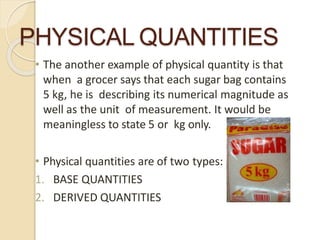
• The another example of physical quantity is that
when a grocer says that each sugar bag contains
5 kg, he is describing its numerical magnitude as
well as the unit of measurement. It would be
meaningless to state 5 or kg only.
• Physical quantities are of two types:
1. BASE QUANTITIES
2. DERIVED QUANTITIES
PHYSICAL QUANTITIES
• A physical quantity is quantity which can
be measured.
For Example: length, mass, time, temperature,
electric current, light intensity, volume and many
others.
• A physical quantity is always measured of
natural non-living objects.
• Physical quantities have numerical magnitude
and unit.
For Example: If the length of a student is 104cm,
then 104 is its numerical magnitude and cm is the
unit of measurement.
UNITS
• SI Units- International System of Units
•What is unit?
Once a standard is set for quantity then it
can be expressed in terms of that standard
quantity. This standard quantity is called a
unit.
• The eleventh General Conference on Weight
and Measures held in Paris in 1960 adopted a
world-wide system of measurements called
International System of Units. The International
System of Units is referred as SI.
PREFIXES
• Prefixes are the words or letters which we add
to the beginning of a word to make a new
word.
• For example, the word ‘’unhappy” consists
of the prefix “un” (which means not)
combined with the stem word “unhappy”
means “not happy”.
• SI units have advantage that their multiples
and sub- multiples can be expressed in terms
of prefixes.
BASE
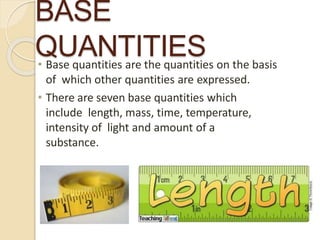
QUANTITIES• Base quantities are the quantities on the basis
of which other quantities are expressed.
• There are seven base quantities which
include length, mass, time, temperature,
intensity of light and amount of a
substance.
DERIVED
QUANTITIES
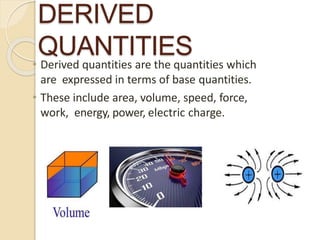
• Derived quantities are the quantities which
are expressed in terms of base quantities.
• These include area, volume, speed, force,
work, energy, power, electric charge.
BASE UNITS AND DERIVED
UNITS
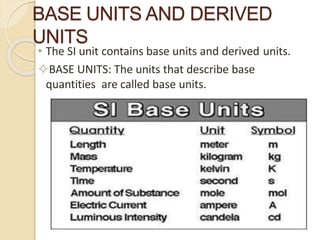
• The SI unit contains base units and derived units.
BASE UNITS: The units that describe base
quantities are called base units.
BASE UNITS AND DERIVED
UNITS
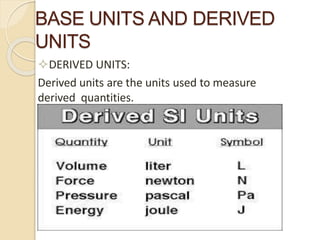
DERIVED UNITS:
Derived units are the units used to measure
derived quantities.
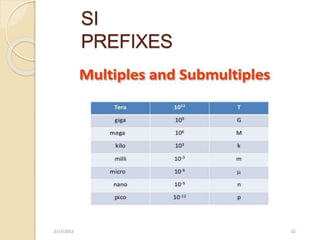
TABLE OF
PREFIXES
PREFIXES
•Note that the kilogram is the only SI unit with
a prefix as part of its name and symbol.
Because multiple prefixes may not be used, in
the case of the kilogram the prefix names
are used with the unit name "gram" and the
prefix symbols are used with the unit symbol
"g." With this exception, any SI prefix may be
used with any SI unit, including the degree
Celsius and its symbol °C.
SI
PREFIXES
MULTIPLES AND SUB-MULTIPLES OF LENGHT
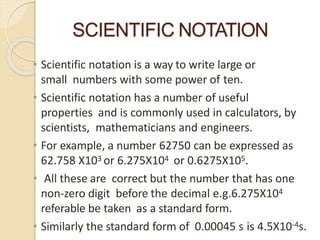
SCIENTIFIC NOTATION
• Scientific notation is a way to write large or
small numbers with some power of ten.
• Scientific notation has a number of useful
properties and is commonly used in calculators, by
scientists, mathematicians and engineers.
• For example, a number 62750 can be expressed as
62.758 X10³ or 6.275X10⁴ or 0.6275X10⁵.
• All these are correct but the number that has one
non-zero digit before the decimal e.g.6.275X104
referable be taken as a standard form.
• Similarly the standard form of 0.00045 s is 4.5X10⁻⁴s.
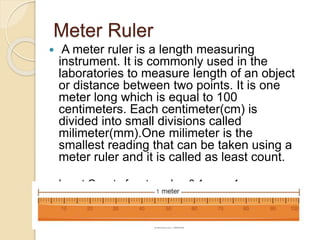
Meter Ruler
 A meter ruler is a length measuring
instrument. It is commonly used in the
laboratories to measure length of an object
or distance between two points. It is one
meter long which is equal to 100
centimeters. Each centimeter(cm) is
divided into small divisions called
milimeter(mm).One milimeter is the
smallest reading that can be taken using a
meter ruler and it is called as least count.
 Least Count of meter ruler=0.1cm or 1mm
HOPE YOU LIKE MY VEDIO
THANKS FOR WATCHING
PREPARED BY: RABIA
MEHMOOD
Do all these work to be ready for
next slides

Physical quantities

  • 2.
  • 3.
    BEFORE STARTING THIS VEDIOLET ME TELL YOU THAT: Several hundred years ago, Galileo and Newton both discovered important laws about gravity. In this century, probably the most famous scientist was Albert Einstein; his "Theory of Relativity" talks about all the strange things that happen when you're moving almost as fast as light, and a lot of other cool stuff and their was only one subject known as natural philosphy
  • 5.
    Introduction to Physics The branch of science concerned with the nature and properties of matter and energy.  There are nine major branches of physics  Science: the intellectual and practical activity encompassing the systematic study of the structure and behavior of the physical and natural world through observation and experiment. The word is derived from the Latin word scienta.  .  .
  • 6.
  • 7.
    Mechanics  Mechanics: Itis the study of motion of objects , its causes and effects.  An example of mechanics is the distance it takes for a car going 30mph to stop.
  • 8.
    Heat  Heat: Itdeals with the nature of heat, modes of transfer of heat and effects of heat. There are three ways of transfer of heat( CONVECTION, CONDUCTION, RADIATION)  The biggest example of heat energy in our solar system is the sun itself. ..
  • 9.
    Light  Light(OPTICS): Itis the study of physical aspects of light,its properties, working and use of optical instruments.  There are many example we see in our routine life carrying light
  • 10.
    Sound  A vibratingobject will produce sound waves in the air. For example, when the head of a drum is hit with a mallet, the drumhead vibrates and produces sound waves. The vibrating drumhead produces sound waves because it moves alternately outward and inward, pushing against, then moving away from, the air next to it.
  • 11.
    Electricity and magnetism Electricity and magnetism the study of the charges at rest and in motion, their effects and their relationship with magnetism. Example of electricity and magnetism at work is in an atom, since an electron is a charge which moves about the nucleus, in effect it forms a current loop, and hence a magnetic field may be associated with an individual atom.
  • 12.
    Atomic Physics  Atomicphysics: It’s the study of the structure and the properties of atomsDalton's atomic theory proposed that all matter was composed of atoms, indivisible and indestructible building blocks. While all atoms of an element were identical, different elements had atoms of differing size and mass
  • 13.
    Plasma Physics  Plasmaphysics: It’s the study of production, properties of the ionic state of matter-the fourth state of matter. Plasma, in physics, an electrically conducting medium in which there are roughly equal numbers of positively and negatively charged particles, produced when the atoms in a gas become ionized. It is sometimes referred to as the fourth state of matter, distinct from the solid, liquid, and gaseous states
  • 14.
    Nuclear Physics  Nuclearphysics is the study of the protons and neutrons at the centre of an atom and the interactions that hold them together in a space just a few femtometres (10-15 meters) across Example nuclear reactions include radioactive decay, fission, the break-up of a nucleus, and fusion, the merging of nuclei.
  • 15.
    Geophysics  Geophysics: Itis the study of internal structure of the Earth. Major areas of modern geophysical research include seismology, volcano logy and geothermal studies, tectonics, geomagnetism, geodesy, hydrology, oceanography, atmospheric sciences, planetary science, and mineral physics. Geophysics has many practical applications.
  • 16.
    PHYSICAL QUANTITIES • Theanother example of physical quantity is that when a grocer says that each sugar bag contains 5 kg, he is describing its numerical magnitude as well as the unit of measurement. It would be meaningless to state 5 or kg only. • Physical quantities are of two types: 1. BASE QUANTITIES 2. DERIVED QUANTITIES
  • 17.
    PHYSICAL QUANTITIES • Aphysical quantity is quantity which can be measured. For Example: length, mass, time, temperature, electric current, light intensity, volume and many others. • A physical quantity is always measured of natural non-living objects. • Physical quantities have numerical magnitude and unit. For Example: If the length of a student is 104cm, then 104 is its numerical magnitude and cm is the unit of measurement.
  • 18.
    UNITS • SI Units-International System of Units •What is unit? Once a standard is set for quantity then it can be expressed in terms of that standard quantity. This standard quantity is called a unit. • The eleventh General Conference on Weight and Measures held in Paris in 1960 adopted a world-wide system of measurements called International System of Units. The International System of Units is referred as SI.
  • 19.
    PREFIXES • Prefixes arethe words or letters which we add to the beginning of a word to make a new word. • For example, the word ‘’unhappy” consists of the prefix “un” (which means not) combined with the stem word “unhappy” means “not happy”. • SI units have advantage that their multiples and sub- multiples can be expressed in terms of prefixes.
  • 20.
    BASE QUANTITIES• Base quantitiesare the quantities on the basis of which other quantities are expressed. • There are seven base quantities which include length, mass, time, temperature, intensity of light and amount of a substance.
  • 21.
    DERIVED QUANTITIES • Derived quantitiesare the quantities which are expressed in terms of base quantities. • These include area, volume, speed, force, work, energy, power, electric charge.
  • 22.
    BASE UNITS ANDDERIVED UNITS • The SI unit contains base units and derived units. BASE UNITS: The units that describe base quantities are called base units.
  • 23.
    BASE UNITS ANDDERIVED UNITS DERIVED UNITS: Derived units are the units used to measure derived quantities.
  • 24.
  • 25.
    PREFIXES •Note that thekilogram is the only SI unit with a prefix as part of its name and symbol. Because multiple prefixes may not be used, in the case of the kilogram the prefix names are used with the unit name "gram" and the prefix symbols are used with the unit symbol "g." With this exception, any SI prefix may be used with any SI unit, including the degree Celsius and its symbol °C.
  • 26.
  • 27.
    SCIENTIFIC NOTATION • Scientificnotation is a way to write large or small numbers with some power of ten. • Scientific notation has a number of useful properties and is commonly used in calculators, by scientists, mathematicians and engineers. • For example, a number 62750 can be expressed as 62.758 X10³ or 6.275X10⁴ or 0.6275X10⁵. • All these are correct but the number that has one non-zero digit before the decimal e.g.6.275X104 referable be taken as a standard form. • Similarly the standard form of 0.00045 s is 4.5X10⁻⁴s.
  • 28.
    Meter Ruler  Ameter ruler is a length measuring instrument. It is commonly used in the laboratories to measure length of an object or distance between two points. It is one meter long which is equal to 100 centimeters. Each centimeter(cm) is divided into small divisions called milimeter(mm).One milimeter is the smallest reading that can be taken using a meter ruler and it is called as least count.  Least Count of meter ruler=0.1cm or 1mm
  • 29.
    HOPE YOU LIKEMY VEDIO THANKS FOR WATCHING PREPARED BY: RABIA MEHMOOD
  • 30.
    Do all thesework to be ready for next slides