ONE-SCHOOL.NET
                       Physics Equation List :Form 5
                                             Wave
Oscillation


                  1
              f =                         f = frequency
                                          T = Period
                                                                  (Hz or s-1)
                                                                  (s)
                  T
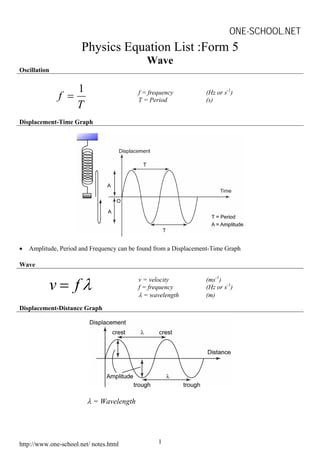
Displacement-Time Graph


•   Amplitude, Period and Frequency can be found from a Displacement-Time Graph

Wave


           v= fλ                          v = velocity
                                          f = frequency
                                          λ = wavelength
                                                                  (ms-1)
                                                                  (Hz or s-1)
                                                                  (m)

Displacement-Distance Graph


                         λ = Wavelength


http://www.one-school.net/ notes.html            1
ONE-SCHOOL.NET
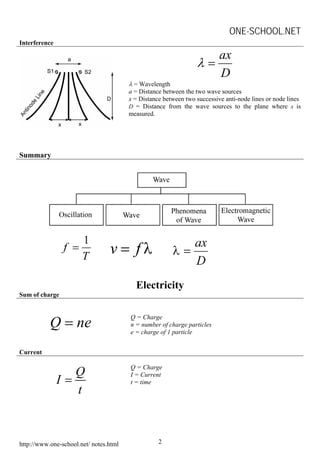
Interference

                                                                    ax
                                                                 λ=
                                                                    D
                                        λ = Wavelength
                                        a = Distance between the two wave sources
                                        x = Distance between two successive anti-node lines or node lines
                                        D = Distance from the wave sources to the plane where x is
                                        measured.


Summary


                                          Electricity
Sum of charge


           Q = ne
                                        Q = Charge
                                        n = number of charge particles
                                        e = charge of 1 particle


Current

                                        Q = Charge
                  Q
               I=
                                        I = Current
                                        t = time
                  t


http://www.one-school.net/ notes.html              2
ONE-SCHOOL.NET
Potential Difference

                W                         V = potential difference,                  (V or JC-1)
             V=                           W = energy
                                          Q = charge
                                                                                     (J)
                                                                                     (C)
                Q
Ohm’s Law and Resistance


           V = IR
                                          V = potential difference,                  (V or JC-1)
                                          I = Current                                (A or Cs-1)
                                          R = Resistance                             (Ω)

Resistance


                                                                                  1   1  1
                    R = R1 + R2                                            R=(      +   + ) −1
                                                                                  R1 R2 R3


Current
                   Series Circuit                                              Parallel Circuit


The current flow into a resistor = the current flow
inside the resistor = the current flows out from the
resistor                                             The current flow into a parallel circuit is equal to the
                     IA = IB = IC                    sum of the current in each branches of the circuit.

                                                                                   I = I1 + I2
                                                            Example


                                                            If the resistance of the 2 resistors is the same, current
                                                            will be divided equally to both of the resistor.
In a series circuit, the current at any points of the
circuit is the same.


http://www.one-school.net/ notes.html                   3
ONE-SCHOOL.NET
Potential and Potential Difference
Series Circuit                                                  Parallel Circuit


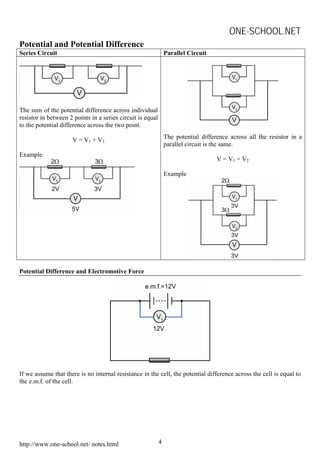
The sum of the potential difference across individual
resistor in between 2 points in a series circuit is equal
to the potential difference across the two point.

                     V = V1 + V2                                The potential difference across all the resistor in a
                                                                parallel circuit is the same.
Example
                                                                                    V = V1 = V2

                                                                Example


Potential Difference and Electromotive Force


If we assume that there is no internal resistance in the cell, the potential difference across the cell is equal to
the e.m.f. of the cell.


http://www.one-school.net/ notes.html                       4
ONE-SCHOOL.NET
Electromotive Force and Internal Resistance


             E = I (R + r)                                  or                 E = V + Ir
                    E = Electromotive Force                      (V)
                    r = internal resistance                      (Ω )
                    V = potential difference,                    (V or JC-1)
                    I = Current                                  (A or Cs-1)
                    R = Resistance                               (Ω)
2 methods to find the internal resistance and electromotive force
  a. Open Circuit – Close Circuit method
     Open Circuit                                       Close Circuit


    In open circuit ( when the switch is off), the In close circuit ( when the switch is on), the
    voltmeter shows the reading of the e.m.f.           voltmeter shows the reading of the potential
                                                        difference across the cell.
    •       With the presence of internal resistance, the potential difference across the cell is always
        less than the e.m.f..

 b. Linear Graph method
                                                     From the equation,

                                                                           E = V + Ir
                                                                     Therefore
                                                                           V = -rI + E

                                                     Gradient od the grapf, m
                                                     = -internal resistance


                                                     Y intercept of the graph, c
                                                     = electromotive force

Electrical Energy


       E = QV                    E = Electrical Energy
                                 Q = charge
                                                                                (J)
                                                                                (C)
                                 V = potential difference                       (V or JC-1)


http://www.one-school.net/ notes.html                  5
ONE-SCHOOL.NET
Electrical Power


         W                                                                            V2
      P=                       P = IV                 P=I R     2
                                                                                   P=
         t                                                                            R
                   P = Power                                    (W or Js-1)
                   W = Work done/Energy change                  (J)
                   t = Time                                     (s)
                   I = Current                                  (A)
                   V = Potential difference                     (V)
                   R = Resistance                               (Ω)

Efficiency


                                                     output power
                Electrical efficiency =                           × 100%
                                                     input power

                                    Electromagnetism
Root mean Square Value


                                                           Vp
                                                 Vrms =
                                                            2
                                                 Vrms = root mean square voltage     (V)
                                                 Vp = peak voltage                   (V)

                                                           Ip
                                                 I rms =
                                                            2
                                                 Irms = root mean square current     (A)
                                                 Ip = peak current                   (A)


http://www.one-school.net/ notes.html            6
ONE-SCHOOL.NET
Transformer

Input And Output Of A Transformer

                                        Vp = input (primary) potential difference           (V)
           Vs  N
              = s                       Vs = output (secondary) potential difference
                                        Np = number of turns in primary coil
                                                                                            (V)
           Vp N p                       Ns = number of turns in secondary coil


Power In A Transformer

Ideal Transformer                          Vp = input (primary) potential difference           (V)
      V p × I p = Vs × I s                 Vs = output (secondary) potential difference
                                           Ip = input (primary) current
                                                                                               (V)
                                                                                               (A)
                                           Is = output (secondary) current                     (A)
Non-ideal transformer
                    Vs I s
Efficiency =               × 100%
                    Vp I p

Power Transmission

2Steps to find the energy/power loss in the cable
a. Find the current in the cable by the equation P=IV
                                                       2
b. Find the Power lost in the cable by the equation P=I R.

                                            Electronic
Energy change of electron in an electron gun

     Kinetic energy electrical potential
                   =
     gain            energy

               1 2                                                                                   (ms-1)
                 mv = eV                         v = speed of electron
                                                 V = potential difference across the electron gun    (V)
               2                                 e = charge of 1 electron                            (C)
                   2eV                           m = mass of 1 electron                              (kg)
               v=
                    m


http://www.one-school.net/ notes.html                7
ONE-SCHOOL.NET
Cathode Ray Oscilloscope


                                        Vertical scale = Y-gain control

                                        Horizontal scale = Time base

                                        Period = Time for 1 complete Oscillation

                                                             1
                                        Frequency,     f =
                                                             T


Transistor - Potential Divider

                                               Potential difference across resistor R1
                                                      R1
                                               =           ×V
                                                   R1 + R2

                                               Potential difference across resistor R2
                                                     R2
                                               =           ×V
                                                   R1 + R2


http://www.one-school.net/ notes.html              8
ONE-SCHOOL.NET
                                          Radioactivity
Alpha decay

                                                 A− 4
                                         Z X ⎯⎯→ Z − 2Y + 2 He
                                         A                4

Beta decay

                                         A          A
                                         Z X ⎯⎯→ Z +1     Y+      0
                                                                 −1   e
                                              1
                                              0   n→1 p + −1 e
                                                    1      0

Gamma emission


                                                                 +γ
                                         A       A
                                         Z X ⎯⎯→ Z X

                                        A = nucleon number
                                        Z = proton number

Half-life

           1                  N = Amount of radioisotope particles after nth half life.
      N = ( )n N0             N0 = Initial amount of radioisotope particles.
           2                  n = number of half life


Nuclear Energy - Einstein Formula


      E = mc 2
                              m = mass change                (kg)
                              c = speed of light             (m s-1 )
                              E = energy changed             (J)


http://www.one-school.net/ notes.html                 9

Physics formula list 2

  • 1.
    ONE-SCHOOL.NET Physics Equation List :Form 5 Wave Oscillation 1 f = f = frequency T = Period (Hz or s-1) (s) T Displacement-Time Graph • Amplitude, Period and Frequency can be found from a Displacement-Time Graph Wave v= fλ v = velocity f = frequency λ = wavelength (ms-1) (Hz or s-1) (m) Displacement-Distance Graph λ = Wavelength http://www.one-school.net/ notes.html 1
  • 2.
    ONE-SCHOOL.NET Interference ax λ= D λ = Wavelength a = Distance between the two wave sources x = Distance between two successive anti-node lines or node lines D = Distance from the wave sources to the plane where x is measured. Summary Electricity Sum of charge Q = ne Q = Charge n = number of charge particles e = charge of 1 particle Current Q = Charge Q I= I = Current t = time t http://www.one-school.net/ notes.html 2
  • 3.
    ONE-SCHOOL.NET Potential Difference W V = potential difference, (V or JC-1) V= W = energy Q = charge (J) (C) Q Ohm’s Law and Resistance V = IR V = potential difference, (V or JC-1) I = Current (A or Cs-1) R = Resistance (Ω) Resistance 1 1 1 R = R1 + R2 R=( + + ) −1 R1 R2 R3 Current Series Circuit Parallel Circuit The current flow into a resistor = the current flow inside the resistor = the current flows out from the resistor The current flow into a parallel circuit is equal to the IA = IB = IC sum of the current in each branches of the circuit. I = I1 + I2 Example If the resistance of the 2 resistors is the same, current will be divided equally to both of the resistor. In a series circuit, the current at any points of the circuit is the same. http://www.one-school.net/ notes.html 3
  • 4.
    ONE-SCHOOL.NET Potential and PotentialDifference Series Circuit Parallel Circuit The sum of the potential difference across individual resistor in between 2 points in a series circuit is equal to the potential difference across the two point. V = V1 + V2 The potential difference across all the resistor in a parallel circuit is the same. Example V = V1 = V2 Example Potential Difference and Electromotive Force If we assume that there is no internal resistance in the cell, the potential difference across the cell is equal to the e.m.f. of the cell. http://www.one-school.net/ notes.html 4
  • 5.
    ONE-SCHOOL.NET Electromotive Force andInternal Resistance E = I (R + r) or E = V + Ir E = Electromotive Force (V) r = internal resistance (Ω ) V = potential difference, (V or JC-1) I = Current (A or Cs-1) R = Resistance (Ω) 2 methods to find the internal resistance and electromotive force a. Open Circuit – Close Circuit method Open Circuit Close Circuit In open circuit ( when the switch is off), the In close circuit ( when the switch is on), the voltmeter shows the reading of the e.m.f. voltmeter shows the reading of the potential difference across the cell. • With the presence of internal resistance, the potential difference across the cell is always less than the e.m.f.. b. Linear Graph method From the equation, E = V + Ir Therefore V = -rI + E Gradient od the grapf, m = -internal resistance Y intercept of the graph, c = electromotive force Electrical Energy E = QV E = Electrical Energy Q = charge (J) (C) V = potential difference (V or JC-1) http://www.one-school.net/ notes.html 5
  • 6.
    ONE-SCHOOL.NET Electrical Power W V2 P= P = IV P=I R 2 P= t R P = Power (W or Js-1) W = Work done/Energy change (J) t = Time (s) I = Current (A) V = Potential difference (V) R = Resistance (Ω) Efficiency output power Electrical efficiency = × 100% input power Electromagnetism Root mean Square Value Vp Vrms = 2 Vrms = root mean square voltage (V) Vp = peak voltage (V) Ip I rms = 2 Irms = root mean square current (A) Ip = peak current (A) http://www.one-school.net/ notes.html 6
  • 7.
    ONE-SCHOOL.NET Transformer Input And OutputOf A Transformer Vp = input (primary) potential difference (V) Vs N = s Vs = output (secondary) potential difference Np = number of turns in primary coil (V) Vp N p Ns = number of turns in secondary coil Power In A Transformer Ideal Transformer Vp = input (primary) potential difference (V) V p × I p = Vs × I s Vs = output (secondary) potential difference Ip = input (primary) current (V) (A) Is = output (secondary) current (A) Non-ideal transformer Vs I s Efficiency = × 100% Vp I p Power Transmission 2Steps to find the energy/power loss in the cable a. Find the current in the cable by the equation P=IV 2 b. Find the Power lost in the cable by the equation P=I R. Electronic Energy change of electron in an electron gun Kinetic energy electrical potential = gain energy 1 2 (ms-1) mv = eV v = speed of electron V = potential difference across the electron gun (V) 2 e = charge of 1 electron (C) 2eV m = mass of 1 electron (kg) v= m http://www.one-school.net/ notes.html 7
  • 8.
    ONE-SCHOOL.NET Cathode Ray Oscilloscope Vertical scale = Y-gain control Horizontal scale = Time base Period = Time for 1 complete Oscillation 1 Frequency, f = T Transistor - Potential Divider Potential difference across resistor R1 R1 = ×V R1 + R2 Potential difference across resistor R2 R2 = ×V R1 + R2 http://www.one-school.net/ notes.html 8
  • 9.
    ONE-SCHOOL.NET Radioactivity Alpha decay A− 4 Z X ⎯⎯→ Z − 2Y + 2 He A 4 Beta decay A A Z X ⎯⎯→ Z +1 Y+ 0 −1 e 1 0 n→1 p + −1 e 1 0 Gamma emission +γ A A Z X ⎯⎯→ Z X A = nucleon number Z = proton number Half-life 1 N = Amount of radioisotope particles after nth half life. N = ( )n N0 N0 = Initial amount of radioisotope particles. 2 n = number of half life Nuclear Energy - Einstein Formula E = mc 2 m = mass change (kg) c = speed of light (m s-1 ) E = energy changed (J) http://www.one-school.net/ notes.html 9